Wickes: Building for the future

In my last article, I screened for companies with a low Price-to-Sales ratio. The theory is that if such a company can generate even minor improvements in their net margins, this can positively impact profits and drive a re-rating of the stock. My screen contained 48 potential value picks. This week I look at one of them in detail: Wickes (LON:WIX)
Summary
- Wickes is a well-run business that reported good trading in its recent Q4 Trading Statement, although in an industry currently facing cost headwinds for 2023.
- Its strategy of implementing a seamless digital and physical offering, and greater in-store services, means that it is growing its market share. Particularly amongst tradespeople, for whom the range of products available and rapid click and collect are very desirable.
- It trades at a discount to listed peers such as Kingfisher (LON:KGF) and its former parent company Travis Perkins (LON:TPK) . A forward P/E of 9 on depressed earnings makes it look good value.
- In this case, the Stockopedia algorithm’s warnings of financial distress look to be misplaced. £166m of cash at the Half-Year and no non-lease debt means they are well positioned to trade through any short-term challenges.
Profile
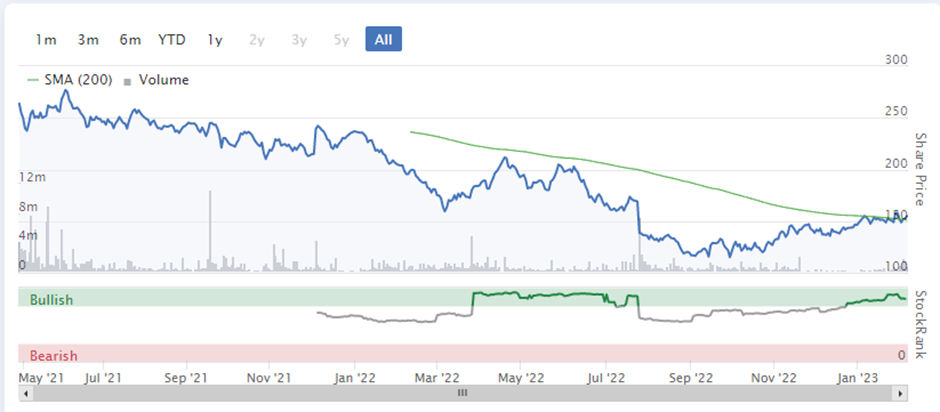
Wickes is a Main Market-listed home improvement business with an approximately £400m market cap. Many investors will have visited their stores at some point. The company is a relatively recent float, having been demerged from the much larger building merchant, Travis Perkins (LON:TPK) , in April 2021. It has not been all plain sailing for the spun-off business; the shares debuted at 263p and are only around 155p today.
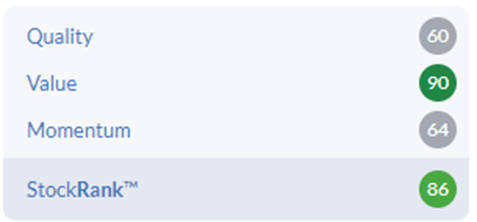
The company has a Stockrank of 86. But, as you’d expect from a profitable low Price-to-Sales company, the Value Rank stands out at 90:
The company appears to be highly geared:
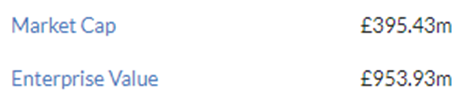
However, looking at the latest accounts, all of the debt is lease liabilities that are counted as such under IFRS16. Excluding lease liabilities, net cash in the first half was £166.5m. Investors will need to make their own minds up about this one. However, from my point of view, net lease liabilities are usually more important than the gross value for making investment decisions. These currently stand around £135m, so not insignificant, but perhaps not the millstone they first appear.
Business Model
Wickes is primarily a retailer through its chain of large format stores. They also offer installation of kitchens and bathrooms purchased from their showrooms, which they call the “do it for me” (DIFM) part of the business. Increasingly they have been focussing on selling to tradespeople, who can apply for a “Trade Pro” account which gives them a 10% discount on all store prices. The number of registered accounts has been growing rapidly and should be closer to 800k at the moment (the graph below is from their H1 results):

One of Wickes’ biggest selling points is the strength of its click-and-collect business. Management reports that many tradespeople value being able to order the materials they need for a job the day before and then drive their van to the store to have it loaded for them in the morning. Wickes stock painting supplies as well as more structural products such as CLS timber and cement. This makes them a one-stop shop for tradespeople who would otherwise need to go to multiple stores.
Although the company provide like-for-like growth rates for the DIY, TradePro and DIFM sales, they don’t give the segmental breakdown of sales or operating profits into these buckets, making the exact performance of each difficult to analyse. This is a gap I would like to see management address in the future.
Competitive Landscape
According to Statista, revenue in the UK DIY & Hardware Store market is forecast to be US$34.44bn in 2023. This means that Wickes represents around 5% of the market and leaves room to take market share. Although the overall growth rate of this market is pretty pedestrian, more importantly, 2023 is forecast to see a significant rebound from the weak performance in 2022.

This may need to be taken with a pinch of salt since the UK housing market is forecast to be weak in 2023, and house moves are a significant driver of DIY spending. On the other side, cost of living concerns are moderating somewhat in early 2023, but interest rates remain high, meaning that more consumer income may be directed to home improvement instead of moving house. The other big growth area has been insulation, which is in response to higher energy prices. Wickes recently launched a digital Sustainable House Guide, with advice on energy reduction for all rooms in the house with a click-to-purchase option for essential products.
The main competitors for Wickes are DIY stores such as B&Q, (owned by Kingfisher (LON:KGF) ), or trade/retail counters such as ScrewFix (also owned by Kingfisher) and Toolstation (owned by Travis Perkins (LON:TPK)). For the business of tradespeople, they compete with the larger building merchants. For DIFM Kitchens, Howden Joinery (LON:HWDN) is a listed competitor.
Strategy
Wickes’s strategy is to grow all three areas of their business - Trade, DIFM and DIY – mainly through increased market share. Although they may add new stores, store growth will likely be muted. So instead, they aim to achieve this growth by “Delivering exceptional customer experience through engaged colleagues, a winning culture and growing responsibly.” On the ground, this looks like an investment into existing stores, continued development of a seamless digital and physical offering and greater in-store services.
Competitive Advantage
The company has a reasonable but not outstanding Quality Rank:

This figure is affected by the gearing and Z-Score, which I discuss further below. In addition, longer-term return on capital figures reflects a period before listing and may be impacted by the capital structure at the time. The recent Return on Equity figures are much more reasonable:

These figures suggest that the company has a fair but not outstanding competitive advantage. This likely comes from its strong brand awareness amongst consumers. In addition, it has a strong reputation for producing own-brand products, such as paints, that are as good as branded products but more cost-effective. So while it may not stock as an extensive range of branded paints as B&Q, its offer is strong and, more importantly, higher margin.
In addition, the company has invested in technology that makes purchasing products as convenient as possible. As anyone who has stood for 10 mins waiting for the single click-and-collect desk to be free in their local B&Q knows, fast click-and-collect service is of value to customers. The downside of an online-first strategy is that it is easier for consumers to compare prices before buying. Overall, a branding and technology-led advantage represents a relatively durable moat, although one that exists in a pretty competitive industry.
Financials
Growth and Profitability
Given the demerger, longer-term financial numbers are not available. However, those that are, show impressive growth, with net profit growing 58% compound since 2019:

This is a short time period, including pre-IPO figures, so investors need to be wary about extrapolating this figure. Indeed, Net Profit is forecast to drop in the future. [The 2023E estimates above are actually Calendar Year 2022. The algos are confused by the weekly reporting that led to a Jan 1st year end last year.]
The main cause of the drop in profitability is a weaker economic outlook, particularly around UK housing and the impact of inflation. For product inflation, the company passes this through to the consumer at the same cash margins. However, other inflationary pressures will impact the. The following slide shows how the company is effectively dealing with these:

Balance Sheet
Usually, a current ratio of 1.15 would represent a weak balance sheet. However, this is well within the normal range for retailers, who tend to get paid far before they pay suppliers.

The amount of net cash on the balance sheet means that I have little concern over the short-term financial stability of the business. But, again, the gearing figures are muddied by the presence of significant lease liabilities:

The Altman z-score suggests that we should be cautious about the Bankruptcy risk:

But when I drill down into the details, the same concerns over working capital and lease debt are the cause:

Investors should be wary of retailers with negative working capital and large onerous lease liabilities. A severe downturn in trading can cause significant cash outflows that put the business in jeopardy. Wickes is a long way from this and has substantial financial flexibility.
Cashflow
At the half-year, cash flow was excellent. This allowed them to grow net cash from £123.4m to £166.5m during the period despite funding £22.1m of dividends and £18.2m of one-off costs.

The company has guided that the working capital flows will reverse in H2. However, despite this headwind, significant cash will remain. In addition, spending on IT separation is expected to be essentially complete by mid-2023, so this will then start to benefit the current year.
Dividends/Buybacks
The company’s policy is to pay out 40% of adjusted profit after tax as dividends. They say that this payout ratio may be higher in the short term so they can maintain the dividend. They can easily fund this from earnings and cash on hand.

Brokers are forecasting the dividend to fall on lower earnings in 2022/23:

However, management appears to be willing to relax their target payout ratio in the short term, and this may prove unduly pessimistic. Even if the brokers are correct, this represents a very reasonable 5.3% yield. Longer-term, they intend to return any surplus capital via buybacks or special dividends, which is nice to see.
Ownership Structure
As a recent spin-off, the shareholder structure is a balanced institutional one:

The downside is that directors don’t have a lot of skin in the game. CEO David Wood has been chiefly a buyer of the stock. However, he still only holds a fraction of one per cent of the company, and other directors have not been as forthcoming:

Valuation
With a value rank of 91, the company is cheaply rated on a number of metrics, not just the low Price-to-Sales that initially highlighted the company:

However, this is not an asset play with a Price-to-Tangible-Book of 2.77, because the company operates primarily from leased premises. Compared to Kingfisher (LON:KGF) and their former parent company Travis Perkins (LON:TPK), Wickes has a cheaper P/E and a higher dividend yield:

Kingfisher wins the comparison table overall, but this is due to a share price that has fallen less recently. While this may appeal to momentum investors, as a value investor buying today, Wickes looks the best value going forward.
Sadly, as a relatively large company, Wickes broker notes are not available to mere mortals. The analyst consensus was rising until July last year when the impact of inflation started to be reflected in the figures, and the trend turned down:

Cautious investors may wish to wait until the consensus trend improves before considering a position. The risk of this, however, is that the change of sentiment may already be reflected in the share price at that point.
Risks
The most significant risk is that a trading volume drop makes their store leases onerous. Given that they have relatively long lease terms, their ability to close stores to mitigate this effect would be limited. At the last balance sheet date, the total lease liabilities exceeded right-of-use assets by about £135m, indicating that a number of stores may not be profitable in the short term. However, the cash impact of any onerous leases is borne over the lifetime of the lease rather than a one-off hit that may appear on the balance sheet. And a recovery in trading may see the value of these assets written back.
The other risk is that as a relatively small company compared to larger listed peers, they could be squeezed if competitors decide to compete aggressively on price in the short term or significantly expand their marketing spend. However, the flip side is that they should have more opportunities to win market share if their strategy is successful.
Recent Trading
Wickes recently reported their Q4 revenue results at the end of January:

Here are those 1-yr growth rates graphically:

These show clear momentum in Q4. 11.5% revenue growth looks strong, given the economic background, although the trading statement reveals that 9% of that growth is pricing, not volume. They also say:
Since 2019, the business has increased Core LFL sales by 33.0% and consistently increased market share, demonstrating the strength of the business model and the success of our growth levers.
Profit is in line with expectations, which they handily say what they give as PBT of £72-76m. However, there are headwinds in 2023 in terms of energy and staff costs:
In addition to supporting customers through the cost of living crisis by remaining market leading on price, we are also helping our colleagues, as previously announced, by bringing forward the annual pay awards (including the increase in the National Minimum Wage) from April to January, at a cost of £3.5m.
With the recent decline in wholesale prices, we currently expect our energy costs in FY2023 to be around £10m higher than FY2022. This includes a modest premium for switching to fully renewable energy.
The announcement of pay awards being brought forward is probably behind the small downgrade in brokers’ forecasts for 2023. Given the difficulty in recruiting and retaining high-quality staff at the moment, this may be viewed as a sign of their long-term focus and a positive as well as a negative.
Sentiment
The Momentum Rank is good but not exceptional:

This reflects that the price has bounced off recent lows and is up 11% more than the general market over six months.

However, the shares have still underperformed significantly over the last year, so this is not a share that will appeal to momentum investors.
Conclusion
Although Wickes is a good business, it operates in competitive markets and is not immune to the impact of inflation on energy and wages. This means that in the short term, profits are likely to remain depressed. However, the company is cheaply rated, even on these depressed forecasts, versus both competitors and the broader market. In the long term, their seamless digital and physical retail strategy will appeal to customers and likely lead the company to gain market share. There are signs that they are already doing this with tradespeople, who increasingly value their click-and-collect proposition. With a large cash balance and no non-lease debt, the company should be able to trade through any market weakness and perform well when stronger market conditions return. As such, the shares may appeal to a patient value investor.
[Disclosure: Mark owns shares in Wickes (LON:WIX) ]
Disclaimer
This is not financial advice. Our content is intended to be used and must be used for information and education purposes only. Please read our disclaimer and terms and conditions to understand our obligations.
7 comments
hi Mark
Thanks for your detailed review.
On the face of it this is yet another disappointing 2021 IPO floated in good times. I can see the attractions you outline but lease liabilities are extremely high with minimal NTAV so the risk / reward may not be quite so appealling. Also the lack of skin in the game by Directors does question whether they are sufficiently aligned with investors.
I understood that Travis Perkins decided to dispose of Wickes in order to concentrate on trade customers. However, one of Wickes main competitors you quote (Howdens) only deal with trade customers, so that reason seems rather contradictory given that all three are in the same market. Maybe there was another reason?
Snazzy
Thanks for this analysis.
I think the upside comes from:
1. The scope to take market share in trade and ‘do it for me’, which is v high incremental ROE. Wickes can be more aggressive given it is no longer part of TPK and initiatives here can be accelerated. In this context I am disappointed management continue to open new branches, it is a diversion and the effort would be better deployed on improving the existing national estate. Home Depot has opened virtually no new branches in the past decade and the share price has been amazing.
2. The capital structure is ridiculously strong, they simply do not need this level of net cash and once the outlook becomes more clear, special dividends and buybacks must be considered.
3. There is scope to improve management, they are too cautious, a little institutional and are poorly incentivised through equity.
Thanks for this, it does look cheap versus peers. Do you think that there are any stale holders left form the Travis demerger as a number of the names look unusual for a UK small cap? The warning in July was a disaster for a new plc management team, it will take them some time to recover. The results in March absolutely must beat expectations, that is the major near term risk. I didn't realise that they were so good at click and collect for trade - that is really interesting, when I ask DIYers about Wickes they dont seem to know what the competitive advantage /USP is. I hold and should maybe average down.
Good analysis, thanks.
I bought a full allocation for my income portfolio 4 weeks ago. So far its' been a perfect income investment, there's no reason to doubt the dividends and the shares have gone neither up nor down which removes the temptation to sell!
One of the things you said was 'Although the company provide like-for-like growth rates for the DIY, TradePro and DIFM sales, they don’t give the segmental breakdown of sales or operating profits into these buckets' As a shareholder I'm comfortable with that because I think it's information which might possibly be more useful to competitors than shareholders.
Thanks Mark. I found this very interesting and educational. I will probably sit this one out, but if the share price falls enough then who knows. As you say, it seems a good well run company with an attractive offering to the trade.
Mark, thank you for this comprehensive analysis of the company which I found extremely useful.
Thank you Mark, good analysis. I've used them as a layman and been pleased with their pricing choice and willingness of staff to help. We hold and look to add in the future.