Wynnstay: Genesis of a re-rating?

Wynnstay is a Super Stock I've owned in the past, but I currently have no position in it. The interim results in June were billed as "clear evidence that Project Genesis [their transformation programme] is delivering". However, the market seems unconvinced, with recent share price falls taking the stock more than 20% below its 52-week high. A trading statement normally arrives in early December, and writing a Stock Pitch is a good way to test whether the market is missing a self-help story or correctly pricing a low-margin business in a difficult sector. I'm intrigued to take a closer look.
Disclosure: At the time of publication, the author does not hold a position in Wynnstay.
The Pitch
Wynnstay (LON:WYN) is an AIM-listed supplier of agricultural inputs and services, headquartered in Llansantffraid, Powys. It was incorporated in 1992 and has been listed since May 2004, though the business traces its roots back more than a century. It sells feed, fertiliser, seed and farm supplies to livestock and arable farmers through 11 manufacturing sites and 51 stores.
The management team is relatively new. South African Alk Brand became CEO on 1 October 2024 and almost immediately launched Project Genesis, a restructuring programme. CFO Rob Thomas joined in 2023 from EFS Global, having previously run the finances of NWF Agriculture's feeds division. Steven Esom, a former Managing Director of Waitrose & Partners, took over as Chairman at the March 2026 AGM.
The Algorithms rate the company a Super Stock with an overall StockRank of 95, made up of:
- Value Rank 92: The shares trade at 0.57x book value, 8.4x free cash flow and 0.13x sales, with a forecast yield of over 5%. On consensus forecasts, the P/E is 10.8x for FY26 and 9.6x for FY27.
- Quality Rank 86: This may flatter the company's current state. Trailing ROCE is 2.8%, ROE is 2.2%, and the operating margin is 0.72%. The rank is instead supported by a Piotroski F-Score of 7/9, financial strength, and low earnings manipulation risk.
- Momentum Rank 63: This is above average but falling, so it may be a warning sign; the shares sit 5.3% below their 50-day and 8.0% below their 200-day moving averages.
The business has three segments:
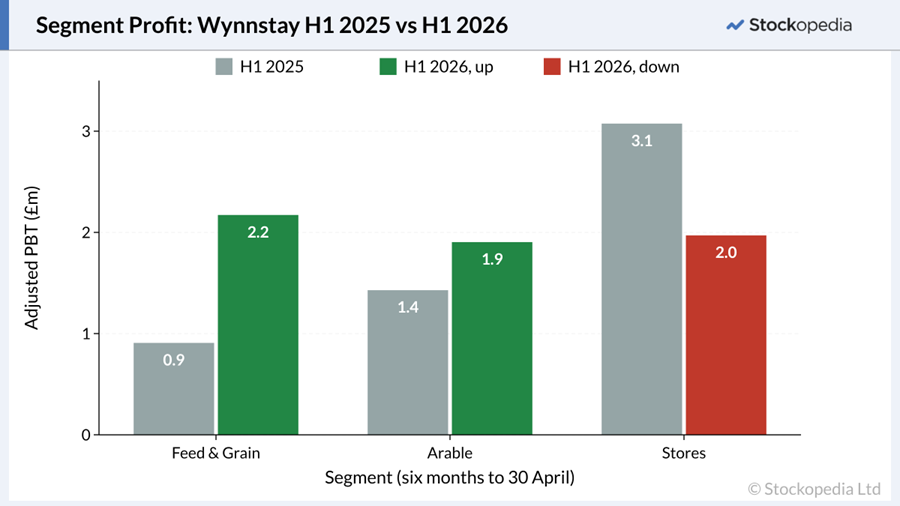
- Feed & Grain: This makes compound and blended feeds for dairy, beef, sheep and poultry farms, and trades grain and feed raw materials through its GrainLink platform. In H1 this year, it generated revenue of £145.5m and adjusted PBT of £2.2m, up from £0.9m in 2025H1.
- Arable: Its Glasson Fertilisers brand is the UK's second-largest fertiliser blender, and it runs one of the UK's leading seed processing facilities. H1 Revenue was £88.4m and adjusted PBT was £1.9m, up slightly from the H1 2025 figure of £1.4m.
- Stores: In H1, these had revenue of £70.2m and adjusted PBT of £2.0m (H1 2025: £3.1m). Historically, this is the group's most profitable division: it earned £5.7m of the group's £9.2m adjusted PBT in FY25, with a return on net assets of 11.7%.
The market capitalisation is £77.5m, against net assets of £134.9m at 30 April. That is a lot of farm infrastructure and working capital to buy for 57p in the pound.
The Big Picture
It is easy to think that Wynnstay is the same low-margin, cyclical farm merchant as it has been for much of its existence. After all, revenue growth forecasts are relatively lacklustre. However, there are some reasons for optimism:
- Profits are rising faster than revenue. H1 adjusted PBT rose 11.7% to £6.0m on revenue that was flat at £304.1m, and was 59% higher than H1 2024's £3.8m. That is what a cost-out efficiency programme is supposed to look like.
- A deep discount to assets: Net assets of £134.9m work out at 584p per share, and stripping out £15.5m of goodwill and £4.5m of other intangibles still leaves around 496p. At 335p, the shares trade at 0.57x book and 0.67x tangible book.
- A long dividend record: The interim dividend rose 3.5% to 5.9p, which the CFO described as the 23rd successive year of increases since listing. The FY26 consensus of 18.1p gives a 5.4% yield, covered 1.7x by forecast EPS of 31.0p.
- A clean balance sheet at the worst point of the year: Net cash (excluding leases) was £10.9m at 30 April, the seasonal low in the working capital cycle, up from £10.3m a year earlier. At the October 2025 year-end, it was £25.7m, after the term loan had been fully repaid.
- Undemanding forecasts: Consensus FY26 PBT is £10.0m, and management repeated £10m for FY26 and £11m for FY27 in the Q&A. With £6.0m banked in H1, the second half needs about £4.0m against £3.8m in H2 FY25. H2 is normally the weaker half, because spring fertiliser and winter feed sales fall in H1. The board says H2 has started in line with expectations, and the CFO says the fertiliser order book is "square", with everything purchased already sold. An end-of-year trading update is expected in early December and will confirm whether everything is on track.
- Returns heading the right way: Return on net assets (RONA), the group's preferred returns measure, rose from 5.6% in FY24 to 7.0% in FY25, improving in every division. It rose another 60bp in 26H1, versus the prior H1, towards the mid-term target of 10%. New investment has to clear a 15% hurdle rate, which management aims to use to pull the group average up over time.
Going Deeper
Project Genesis was the clean-up. The next phase, Strategy Genesis, is a five-year plan to sell more volume through a lower cost base, with medium-term targets set for FY29. Several near-term developments will show whether that pivot is working:
- New capacity built or funded: The plan targets around 160,000 tonnes of extra capacity across feed milling, fertiliser blending and seed processing. The 65,000-tonne Avonmouth fertiliser plant opened in April 2025, and the CFO says it has now run for 12 months ahead of its business case. In August, Wynnstay announced a new plant in Montrose that will double its Scottish blending capacity, due to be fully operational in early 2027 ahead of the spring season. Investment in additional blending and packing capacity at Condover, Shropshire, follows next year.
- Capacity from improvements: Shore Capital's September site visit found Llansantffraid capacity at c.230k tonnes, and Carmarthen at c.170k tonnes after c.£0.5m of investment added c.22k tonnes, or c.15%. Shore also describes the historical maintenance strategy as equipment "repeatedly repaired rather than replaced", which suggests the old management left some easy wins on the table.
- A shift towards egg feed: Management wants poultry and egg feed to reach c.40% of feed volumes, up from c.30%. This is backed by a long-term agreement with a pullet rearer (pullets are young hens raised to become layers), and that pullet business has doubled. The CEO said the plan is to grow the pullet operation to 2 million birds. Egg producers feed to set schedules, which makes demand less weather-driven than dairy.
- Stores aimed beyond the farm gate: Farmers account for around 60% of Stores' revenue, and selected branches are being converted into broader "country stores". The Oswestry flagship turns over c.£4m, which Shore says has the potential to triple, and c.90% of click-and-collect orders come from non-account customers.
- Self-funded growth: The CFO says more than £8m of capital can be released over the next two to three years, through improvements in timing and the property portfolio. That is roughly a tenth of the market cap.
- Incentives set above consensus: The CEO's performance share award vests in full at 47p of EPS for FY27, with a 39p threshold. FY27 consensus EPS is 35.0p. Assuming the plan measures EPS on a similar basis to consensus, management doesn't get paid unless it beats current forecasts by at least 11%.
What drives the business:
Farm suppliers are usually assumed to rise and fall with farm incomes. Until FY22, Wynnstay reported two divisions: Agriculture (feed, fertiliser, seed and grain, now split into Feed & Grain and Arable) and Specialist Retail (now Stores). I looked at how Wynnstay's profits responded to changes in Defra's UK farm accounts during this period. This is what I learnt.
Agriculture was largely a fertiliser-price business: Its profit tracked farm spending on fertiliser more closely than anything else. When fertiliser prices rise, stock bought earlier sells for more, and when they fall, the reverse happens. That is why the division's profit swung so violently.
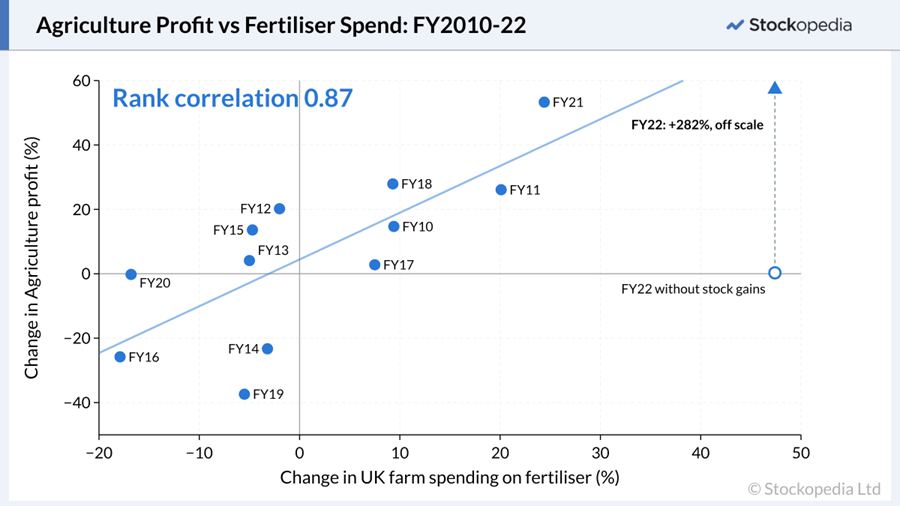
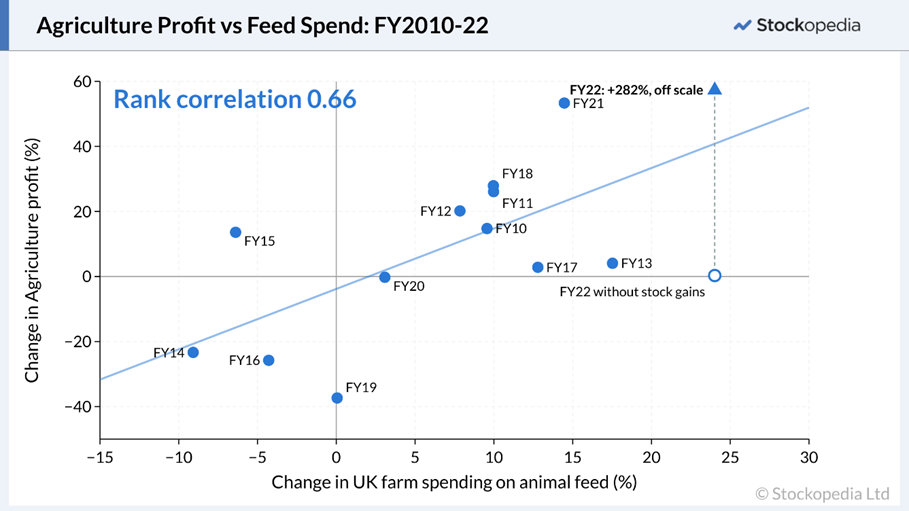
2022 benefited from a huge, fortuitously timed fertiliser price spike. Most of the link between farm input prices and Wynnstay's profit has come from holding stock bought at old prices when prices move. There is still a positive correlation to UK Farm feed spend, but the relationship isn't as strong:
Stores is a farmer-spending business, not a consumer one: Its profit followed the previous year's farm income, but had no meaningful link to CPI inflation. That fits a customer base in which farmers provide about 60% of revenue, spending after a good year rather than during it. Its profit fell in only 2 of the 13 years, and never by more than 10% in this period:
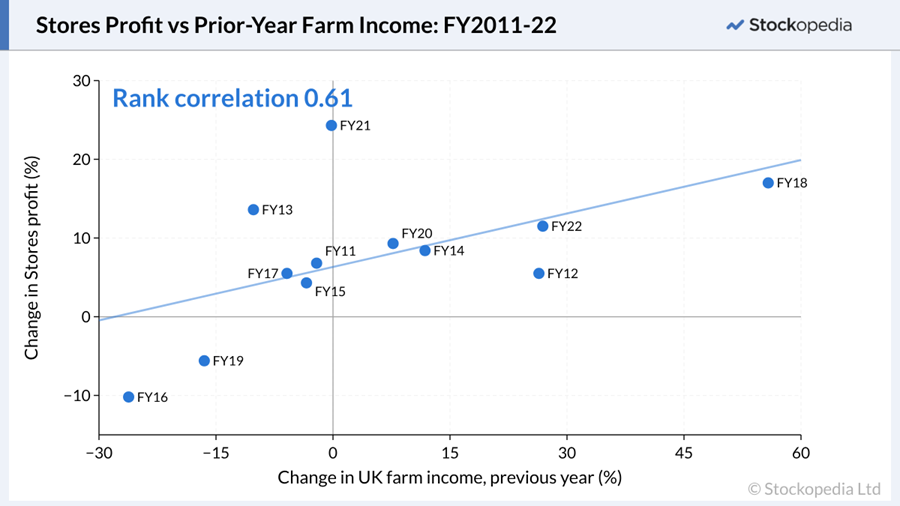
The new segments mostly fit, with one exception: Feed & Grain's adjusted PBT collapsed from £5.7m in FY23 to £0.7m in FY24, as farm feed spending fell 7% and the value of wheat output fell 28% after a very poor 2024 harvest. Arable broke the pattern, with profit rising from £0.8m to £1.4m while farm fertiliser spending fell 27%. Blending volumes rose about 8% as prices normalised, which is the likely explanation. However, Stores haven't followed the farm-income lag at all: profit rose 45% in FY24 after a 25% fall in 2023 farm income, then fell 36% in H1 FY26 after a record 2025. Three years prove little, but this points to company-specific causes, including the new transfer pricing.
The future for fertiliser: Management points to the FY23 market correction as the reason it now runs a tighter position. The CFO said: "If we've made the sale, we'll cover it immediately. We're trying to limit any long positions." The RNS describes "a broadly matched purchasing and sales position" with "limited exposure to speculative commodity movements". A matched book gives up the windfall to avoid an FY23-style loss. That also explains why the 2026 fertiliser price spike added so little to H1 FY26, when the 2021–22 spike transformed H1 FY22.
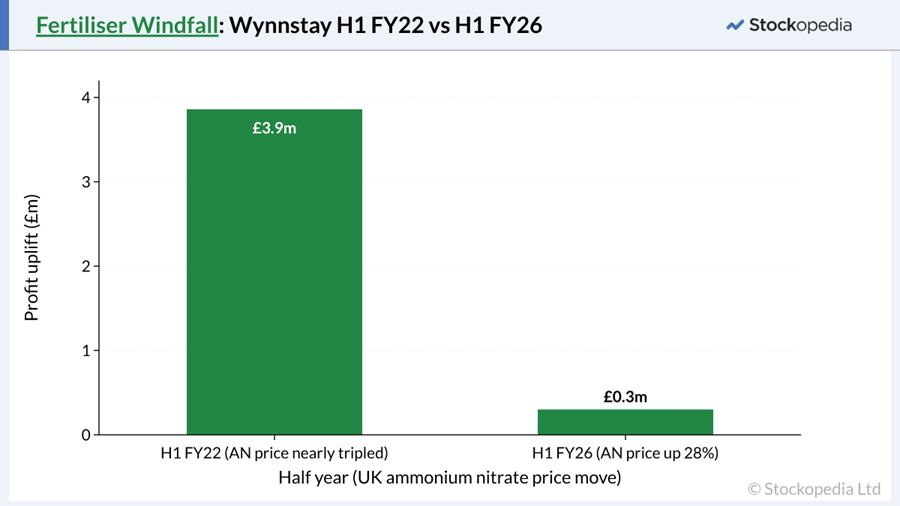
The fertiliser link that drove past profit swings should be much weaker from here, in both directions. That makes profit more a function of volumes and costs, which is where Genesis operates. However, the cash link remains: dearer fertiliser still ties up more working capital.
Project Genesis Impact: The same history makes it possible to test whether Project Genesis, launched in November 2024 at the start of FY25, shows up in the profits. Here is an estimate of actual profit versus what the historical relationships based on farm inputs predicted:
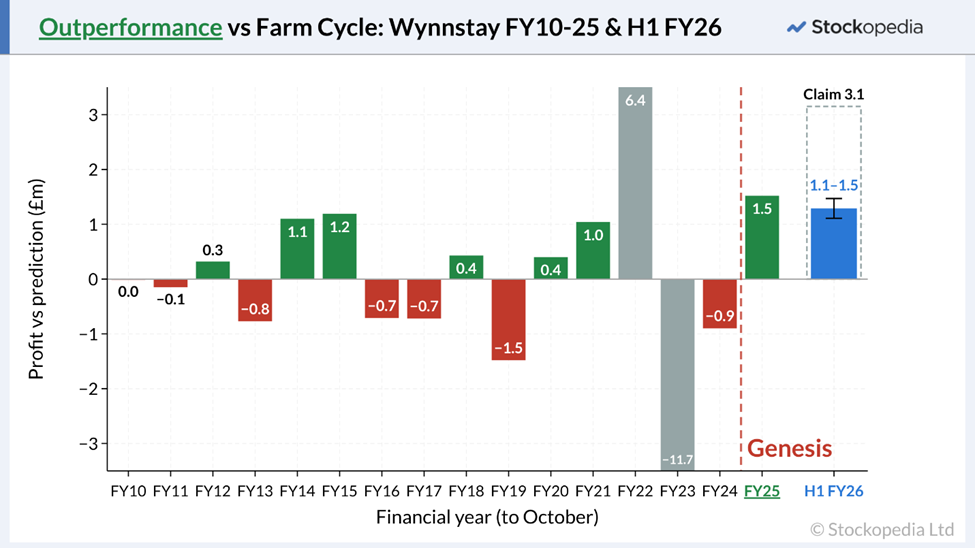
This suggests that FY25 beat the farm-cycle prediction by about £1.5m. Farm spending on feed and fertiliser barely moved in 2025 (+0.7%), so the model predicted adjusted PBT of about £7.7m. Wynnstay reported £9.2m. That 20-percentage-point gap is the largest in any normal year since FY10, suggesting Project Genesis is having an impact. However, the gain came from cost savings, not gross margin improvement, as Genesis closed loss-making mills, and Feed & Grain's H1 profit more than doubled on lower revenue. Part of that is the transfer-pricing change and so far, this appears to be a repair, improving margins towards long-term averages, not yet a transformation. Cost tests against 24H1 put the Genesis 26H1 impact at £1.1m–£1.5m, less than half of management's claim for the period, but still showing an improving trend.
Implication for FY26 & FY27 Numbers: Mapping the divisional drivers onto 2026 suggests the farm cycle helped the year just ended more than it will help the next:
- Arable: History says rising fertiliser prices lift profit, but Wynnstay's fully sold book capped the H1 gain at around £0.3m. High nitrogen prices are expected to continue into 2027, supporting revenue, but FY23 showed the damage when prices turned down.
- Feed & Grain: The summer drought left forage about 20% below average, which raises demand for bought-in feed through the winter. However, the September milk price of 38.45p a litre was 16% lower than a year earlier, and AHDB's milk-to-feed ratio fell into its "contraction zone" in August. The 2026 harvest is the bigger worry. Wheat yields came in about 12% below the five-year average, and poor harvests cut grain trading volumes in both FY24 and FY25.
- Stores: On the historical lag, 2025's record farm income (up 20.5% to £8.4bn) should have supported FY26 store sales, yet H1 profit fell 36%. If the lag reasserts itself, weaker 2026 farm incomes become a headwind for FY27. Cereal farm incomes in England were forecast to fall 66% in 2025/26, and milk prices are lower. Strong beef and lamb prices are the main offset.
What The Brokers Say
Shore Capital is Wynnstay's Nomad and broker, who describe the shares as "materially undervalued" and point to:
- a discount of more than 30% to the historic EV/EBITDA multiple of 6.5x
- a discount of more than 40% to NAV of 584p per share
- a yield above 5%
Shore's valuation method is more transparent than most. It argues that the shares should trade at NAV, around 600p, once returns on assets match the cost of capital, which it sees happening on a two-year view. Discounted back at 10%, that gives c.500p today, or c.550p including dividends. That implies 49% upside to 500p and 79% to 600p from 335p. Shore also links the 10% RONA target to roughly £13m of adjusted PBT by FY28, more than 40% above FY25, with the gain split evenly between growth and cost savings. That is a year earlier than the FY29 timescale management gave for its medium-term targets.
The company is also covered by paid-for research provider Edison. However, Edison appears to quote consensus estimates rather than doing its own independent modelling, which suggests there is only one set of broker figures in the market: Shore's.
The Bear Case
- Razor-thin margins: FY25 adjusted PBT of £9.2m came from £583.4m of revenue, a margin of 1.6%, and the trailing statutory operating margin is 0.72%. Gross margin was 13.8%, so small changes in farm-gate conditions have large effects on the bottom line.
- The best division is going backwards: Stores produced 62% of FY25 adjusted PBT, but its H1 profit fell 36% to £2.0m on revenue down 3.9%. The CFO blamed weaker demand for small-bag feed, wage and fuel inflation, and suppliers who "used the Middle East situation to put their prices up". However, a fall that large is out of character; in recent times, the division's profit has rarely fallen by more than 10% in a year.
- Part of the Feed & Grain jump is a reallocation: internal transfer pricing for manufactured feed moved to a "fully costed model" this year, shifting margin between segments. Feed & Grain's rise from £0.9m to £2.2m therefore overstates the group-level gain. Adjusted operating profit rose by only £0.5m across the group as a whole.
- Working capital is a structural exposure: Receivables were £104.5m at 30 April, up 14% year-on-year on flat revenue. That is more than the £77.5m market capitalisation, and much of it is owed by farmers whose incomes the company itself describes as under pressure.
- An unquantified legal risk: The Health and Safety Executive is still investigating the death of a colleague at Llansantffraid in January 2025. The directors say they can't estimate the likelihood or size of any financial impact, so no provision has been made.
- The adjusted numbers need watching: FY25 statutory PBT was £3.5m against £9.2m adjusted, after £5.9m of non-recurring costs. The cash bridge for the 12 months to April included another £2.5m of exceptional cash costs. Project Genesis may be having a positive impact on the business, but it is not without short-term costs.
The Bottom Line
Wynnstay has now delivered two consecutive periods of higher adjusted profit on flat or falling revenue, giving clear evidence that Genesis is working. Despite that, the shares trade at 10.8x FY26 forecast earnings, 0.57x book value, and a 5.4% yield. The market is pricing Project Genesis as a one-off tidy-up rather than a step change in what the business can earn long term.
The bear points are real. Margins are thin enough that a modest swing in gross margin or a weak harvest can wipe out a year's progress. Stores, usually the group's steadiest and best division, is going backwards for reasons that look company-specific rather than cyclical. Part of the Feed & Grain improvement is a transfer-pricing reallocation, and about £0.3m of the H1 gain came from the Middle East fertiliser spike. Most importantly, a business with trailing ROCE of 2.8% arguably deserves to trade below book.
The key question is whether new capacity at Avonmouth, Carmarthen, Montrose and Condover can lift RONA from around 7% towards 10% without giving margin back. The farm cycle is unlikely to do much of the work. The weak 2026 harvest and lower milk prices point to a tougher backdrop for Feed & Grain in FY27, and weaker 2026 farm incomes could weigh on Stores a year later. Most of the 13% profit growth consensus expects (£10.0m to £11.3m) therefore has to come from self-help. Assuming we get a December trading update, the first read on FY26 could come within weeks. Management has promised more detail on Stores and on releasing working capital at the full-year results. I'd want to see Stores profit stabilise, the receivables book come down, and year-end net cash hold up despite higher fertiliser prices before believing the 10% target.
However, the H2 bar is low, the balance sheet is clean, and directors bought a modest amount at 368p in June. Given the discount to tangible book value, Project Genesis could eventually have a sizable impact on profitability and reward the patient investor.
Disclaimer
This is not financial advice. Our content is intended to be used and must be used for information and education purposes only. Please read our disclaimer and terms and conditions to understand our obligations.

7 comments
Mark, thank you for this excellent analysis. We are long term patient holders who've held through £6 per share twice. We have more money invested in WYN than any other company and it's solid dividends have kept us in. I agree with all your well made bear points but will hold and look forward to the TU soon.
This is not really the place to leave the farmyard and mention something completely different. It's been obvious to me since I joined that the analysts here, and several subscribers I'll leave unnamed, could run my/our money much better than I can.
I suggest Stockopedia finds a way to become the Strictly Come Dancing of equities, analysts and Ed become the judges, they suggest a share each week for themselves and subscribers who vote yes or no. Subscribers fund it by whatever amount they want to put in to get it started. How that is done Stockopedia decides. If the subscriber figures are right, the initial pot could be £5 - £10 million, on deposit and steadily spent. I'm sure I'll be shot down on this but I mean well.
Mark, thank you so much for this really superb and comprehensive review. I have held shares since January 2021. I have met Alk Brand, CEO and Rob Thomas, CFO, several times and attended a few AGMs. I need more time to go through your numbers in detail, but one point jumps out straight away. WYN pride themselves on good working cap mgt; may I ask where you got Receivables at £104m as at 4/26? I cannot see that in the Interim report. Gross Trade and other receivables were £72.5M as at 10/25 y/e. Naturally, I would like this figure to be much lower. Note 20 of the 25 y/e accounts shows provisions on the debtor book on a current, more than 30,60 and 90-day basis. Best wishes, Andy
Thanks Andy, I am taking the figure here:
from here.
Let me know if you think I've picked up the wrong figure?
Hi Mark, Great speedy reply. You're right; I missed the detailed 6-month unaudited figures much lower down in the RNS. Of course, this is just a snapshot. My guess and hope is that this will have fallen significantly to the October y/e. I will want to look at this carefully, particularly if farmers are finding cash flow more difficult this year. Thanks again, Andy
Funnily enough, I now live in west wales where they have a large presence, whenever I visit Wynnstay seem to be a very well run store, I visit fairly often for chicken feed. I notice that they seem to not have much UK coverage, so room to grow?
Thanks for the analysis. An interesting read
Thank you for your hard work in writing this, Mark. I bought this a while back a tad below current levels on the basis of its stock rank, huge discount to NAV and above all new management and lack of correlation with anything else in my portfolio. My view looking at longer term charts is that you buy this with a 3 handle and sell it with a 6 handle - or slightly earlier to be conservative. Meanwhile the company’s net cash position and dividend means you are being paid to wait.
Thanks, it was very helpful for me to understand the company too. You highlight a good point I missed in the article; the financial performance of the company will be largely uncorrelated with many other UK equities, and that in itself makes it an interesting company to follow and perhaps one worth holding for that diversification.