Yellow Cake: Index selling fallout

Tl;Dr
Listed Uranium fund Yellow Cake is facing possible forced selling from index funds following deletion from the MSCI universe on Monday (30 November). This comes on top of an unusually large discount to NAV and listed peers, so investors may be getting a bargain.
[Disclosure: I have a long position in Yellow Cake (LON:YCA), and expect to add to it in the near term.]
Special Situations
I love situations where other investors are selling for reasons other than a change in intrinsic value. Back in the 1990s, Joel Greenblatt realised that when a company spins off a small subsidiary, investors tend to treat it as an unexpected bonus and sell the spin-off shares for whatever they can get. Waiting for this selling pressure to abate and buying spin-offs that looked cheap was an incredibly profitable strategy; he generated 50% compound annual returns for a decade by taking the other side of these moves.
Another source of price-insensitive buying or selling is index inclusions or deletions, where stocks are added to or removed from popular indices, forcing funds that follow them to buy or sell.
I have spotted a company about to be impacted by this sort of change. More precisely, it is a fund: Yellow Cake.
The opportunity
Yellow Cake (LON:YCA) is about as simple as a listed company gets. It owns 24.4 million pounds of uranium oxide, stored in Canada and France, plus a little cash. It has no debt, no mines and no hedges. Its value is the uranium price times the stockpile, converted into sterling.
Listed commodity funds such as this should trade at a discount to NAV. After all, the corporate structure adds a layer of costs. In many cases, those costs are unnecessary; why would you pay someone else to hold a financial asset, such as bitcoin? The problem is that many investors do, which is why funds such as bitcoin treasury companies exist.
This concern has likely prompted MSCI to decide it doesn't want index investors exposed to "non-operating companies", whose assets are mostly passive holdings rather than an operating business. Under this new rule, Yellow Cake was one of six companies named for deletion from MSCI indices on 11 November, alongside Strategy and Metaplanet. It leaves MSCI's indexes at the close on Monday 30 November, and funds that track those indexes have to sell, whatever the price.
Four things make Yellow Cake an interesting opportunity:
- The fund exists for a good reason. If I want exposure to Uranium prices, I don't want to take physical delivery of radioactive material and store it in my garden!
- It was already trading at a large discount to NAV.
- That discount has widened to 24.4% to Friday's close.
- There is a definite end to the index selling: Market Close on Monday.
The trade is to buy Yellow Cake into the forced selling in Monday's closing auction. Investors who want to take the uranium price out of it can short the larger listed Sprott Uranium fund against it. The gain comes from the gap returning to more normal levels.
The discount
Yellow Cake's NAV is the Uranium stockpile (24,374,996 lb) at the spot price plus $41.7m of cash, divided by 251.3 million shares and converted into sterling. Each $1/lb move in uranium shifts NAV by about 1.1%, and each one-cent move in GBP/USD by about 0.75%. Yellow Cake publishes its own estimate roughly monthly. Between those dates, I've asked Claude to rebuild it daily from the uranium price implied by Sprott's published holdings and the Bank of England's exchange rate. (The model correctly reproduces Yellow Cake's own figures as a sanity check.)
For much of the past year, Yellow Cake traded close to NAV. From late December to early March it was within a few points of it, and briefly at a premium, which let it sell new shares at £6.29 in February, close to NAV. The discount opened up in May, reached 15–20% by September, and hit a record 28.4% on 25 November. The one-year average is 10.5%.
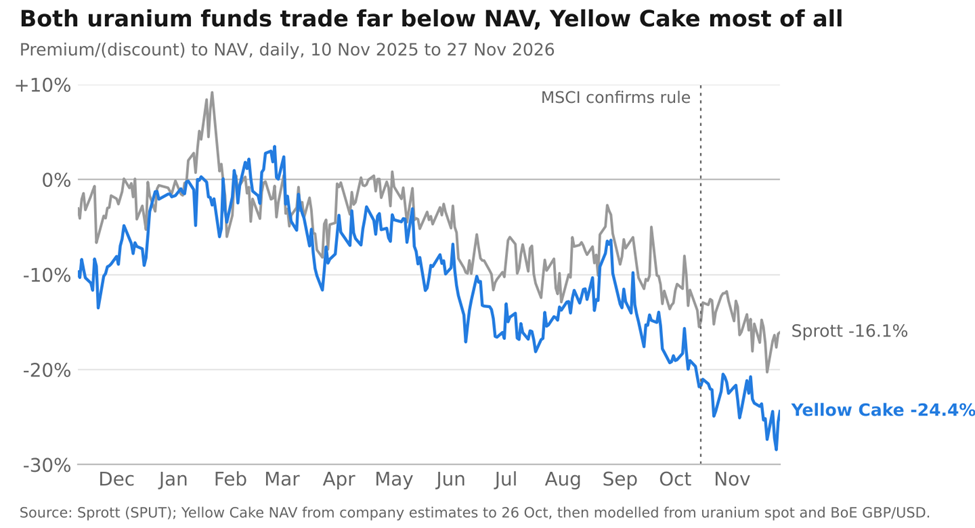
Most of that widening is not about Yellow Cake, but the market narrative around Uranium in general. Sprott's discount has moved in step with it, with a correlation of 0.91 on daily figures, and on 20 November reached 20.3%, its widest since it listed in 2021.
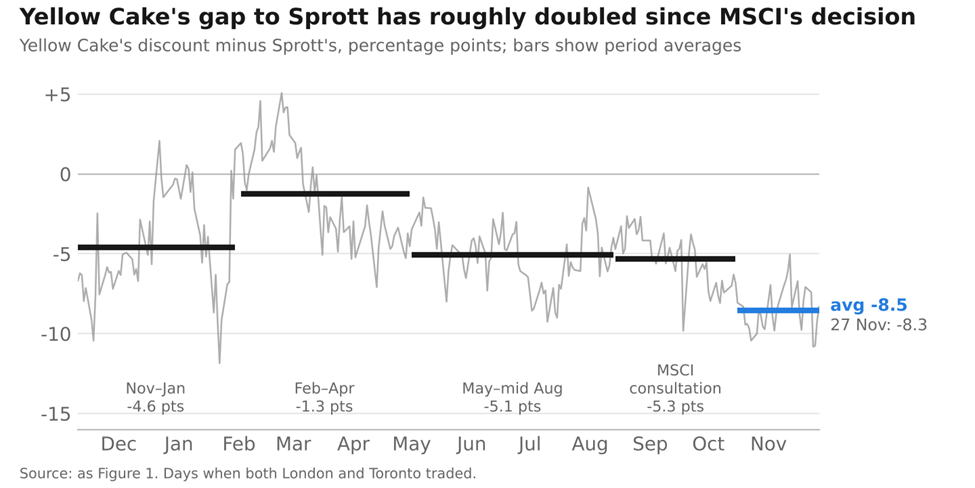
Yellow Cake is smaller, less liquid and priced in sterling on AIM, so it usually trades a little below Sprott: 4.0 percentage points on average in the year before MSCI's decision. That gap held at about 5 points even while MSCI was consulting on the rule in August and September. It jumped once MSCI confirmed the rule on 15 October and has averaged 8.5 points since. On Friday it was 8.3 points.
The Uranium problem
Not every investor has the tools or desire to short a similar instrument, such as Sprott, which means the Uranium exposure could be a risk for those looking to take advantage of this index deletion.
The shorts
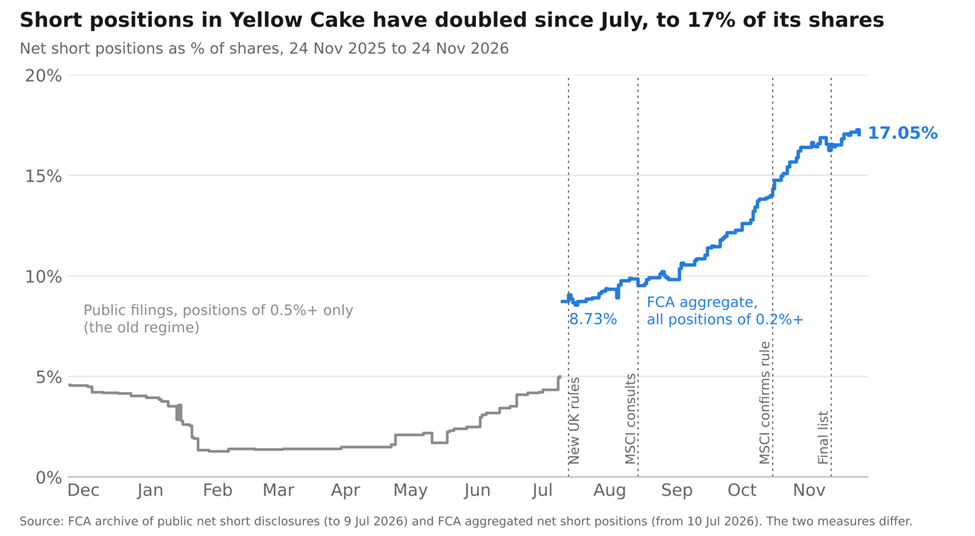
Based on the FCA-declared positions, 17% of the Yellow Cake equity is sold short. Although this has risen during the period when index deletion has been on the cards, it suggests that some see structural weakness in the company or Uranium markets:
The hedge fund narrative
I asked a hedge fund friend why he thought funds were short Yellow Cake, and he suggested that there was a short-term oversupply and energy producers were playing hardball on pricing given relatively fixed production. However, I'm not sure this narrative wholly stacks up. The data suggests that utilities are paying record prices for long-term supply, and producers have cut production and say pricing power has returned to them. The futures market also backs this up. Uranium futures are in contango, which means the future price expectations exceed the cost of funding and storing the material:
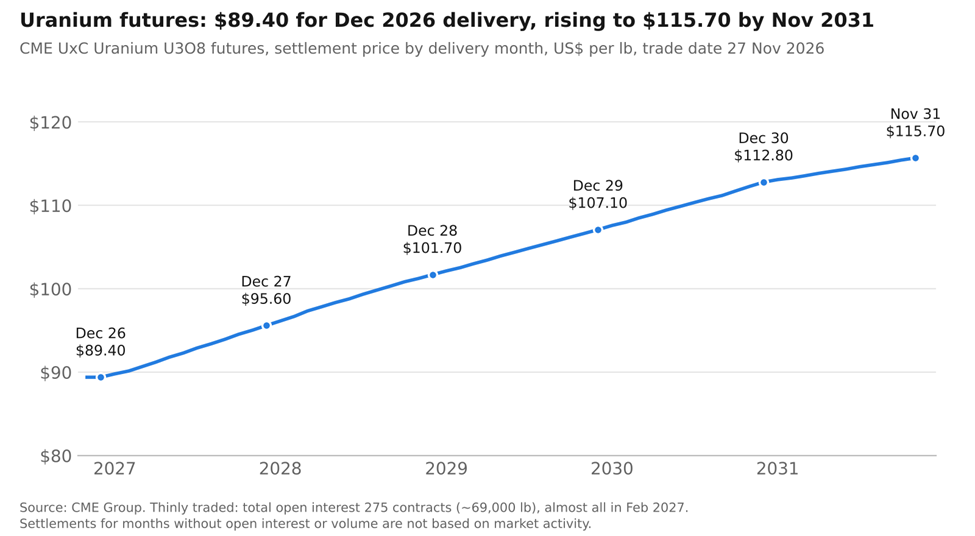
A curve like this, if it proves accurate, should support a longer-term investment in funds such as Yellow Cake.
We no longer know the names of the funds that are short, following a change in the FCA short reporting regime. However, prior to this change, many of the funds that were short tended to use trend-following strategies. I tend to be less concerned about taking the opposing view to these types of quant funds than discretionary managers, who may have found out something I haven't.
The Strategy
Timing
My analysis suggests the index deletion is weighing unusually heavily on an already depressed Yellow Cake price, and a bounce could be on the cards once the deletion event is out of the way. However, it doesn't tell me when I should position myself to take advantage of this.
One factor is the unusually high short interest. While some of this may be structural Uranium strategies, at least some will be hedge funds already positioning themselves ahead of the index deletion. This may dampen the drop on forced selling, as this may well be met with funds buying to close out their shorts.
Academic Evidence
Chang, Luo, Peng, Qian and Tan (2025) studied MSCI index changes in 56 markets from 2006 to 2023. On average, deleted stocks drift down from the announcement and bottom out at the close of the last trading day before the change takes effect: for Yellow Cake, this is the close on Monday, 30 November. Arbitrageurs borrow and sell deleted stocks ahead of the date and buy them back on the day, so short interest climbs before the event and falls sharply after it. Trading on that last day runs at more than ten times normal volume, nearly half of it in the final minute.
Academic evidence suggests the best single moment to buy is probably the closing auction today, when index funds have to sell at the closing price. However, the impact of the existing short positions on one side and momentum traders on the other could mean the best price occurs before or after the event. Scaling in rather than buying in one go may be the lowest risk strategy.
Liquidity
Yellow Cake has traded about 1.4 million shares a day over the past three months, roughly £7.4m, against a market value of about £1.28bn. Nobody publishes how much MSCI trackers own. The two iShares MSCI ETFs that hold it (MSCI EAFE and MSCI EAFE Small-Cap) have about 1.1% of the shares between them, and iShares about 1.7% in all. Adding institutional mandates, I'd guess 2–4% of the shares, or 5–10 million, have to be sold: four to seven days of normal volume, squeezed into one auction. However, for an individual investor, liquidity should not be an issue.
The risks
While this trade looks like it may be a profitable one over time, there are a few things that can go wrong:
- Uranium price: Spot has held between $89 and $93/lb for six weeks, but these funds would likely react negatively to any large fall in Uranium price, regardless of existing discount.
- Sterling move: A stronger pound lowers the sterling value of the Uranium. Each cent on GBP/USD is worth about 0.75% of NAV.
- Leverage: Any arbitrage strategy will use leverage, which adds to the risk that short-term moves go against the investor. Investors should only use strategies they understand well and are familiar with.
- The discount: It can widen further. Sprott's record 20.3% on 20 November had nothing to do with MSCI, and December brings tax-loss selling in the US and Canada, where most uranium investors are. The index selling may already be priced in, since arbitrageurs have had six weeks to get ahead of it.
- A missing narrative: I haven't found any structural reason why at least 17% of the Yellow Cake equity should be sold short beyond trend-following and the index deletion. However, I may have missed a reason why funds will be negative on the company or sector.
Conclusion:
The deletion of Yellow Cake from the MSCI universe looks likely to lead to forced selling, which, combined with an already unusually large discount, may create an opportunity for investors willing to take the other side of the trade. Given the existing short position, I'm not sure when the discount will bottom, but if it hasn't already, it is likely to be pretty close to Monday's closing auction, when funds need to exit.
[Disclosure: I have a long position in Yellow Cake (LON:YCA), and expect to add to it in the near term.]
Disclaimer
This is not financial advice. Our content is intended to be used and must be used for information and education purposes only. Please read our disclaimer and terms and conditions to understand our obligations.

4 comments
Lots of recent shares to find new holders?
On 29 September 2025, the Company issued approximately 23.0 million new ordinary shares to existing and new institutional investors at a price of GBP5.64 per share. Net proceeds from the placing were GBP125.9 million (USD169.1 million).
On 17 February 2026, the Company issued approximately 12.8 million new ordinary shares to existing and new institutional investors at a price of GBP6.29 per share. Net proceeds from the placing were GBP78.4 million (USD105.9 million).
Normally, new institutional holders would be fairly firm holders. And the NAV appears to have performed well since they issued those shares at par, just the widening discount has eroded those gains. So I'm not sure it's the new holders who have been selling.
As a holder of Yellow Cake (LON:YCA) I appreciate this analysis. Hope you're right about that bounce
Should be listed on the main market? Big market cap