Rare Earth Assays Support Significant Resource
THIS ANNOUNCEMENT CONTAINS INSIDE INFORMATION FOR THE PURPOSES OF ARTICLE 7 OF REGULATION 2014/596/EU WHICH IS PART OF DOMESTIC UK LAW PURSUANT TO THE MARKET ABUSE (AMENDMENT) (EU EXIT) REGULATIONS (SI 2019/310) ("UK MAR"). UPON THE PUBLICATION OF THIS ANNOUNCEMENT, THIS INSIDE INFORMATION (AS DEFINED IN UK MAR) IS NOW CONSIDERED TO BE IN THE PUBLIC DOMAIN.
NOT FOR RELEASE, PUBLICATION OR DISTRIBUTION, IN WHOLE OR IN PART, DIRECTLY OR INDIRECTLY IN OR INTO THE UNITED STATES, AUSTRALIA, CANADA, JAPAN, THE REPUBLIC OF SOUTH AFRICA OR ANY OTHER JURISDICTION WHERE TO DO SO WOULD CONSTITUTE A VIOLATION OF THE RELEVANT LAWS OF SUCH JURISDICTION.
24 June 2026
Cobra Resources plc
("Cobra" or the "Company")
Further Rare Earth Assays Support Significant Resource
Latest assays from the Head prospect point to a scalable system open to the north and south, while unique acid generation characteristics further enhance production economics
Cobra (LSE: COBR), a South Australian mineral exploration and development company, is pleased to announce further rare earth resource definition results at the Boland Prospect and initial drilling results from the Head Prospect.
A total of 74 drillholes (~3,200m) have been drilled at Boland and Head, designed to support an initial Mineral Resource Estimate ("MRE") for the project's unique, controlled aquifer-hosted ionic rare earth element ("REE") mineralisation which is amenable to low-cost in situ recovery ("ISR").
In addition to the REE assays, favourable results from initial analyses to support acid generation (Net Acid Production Potential ("NAPP")) estimates and permeability have been received. These will support the MRE inputs as key economic factors.
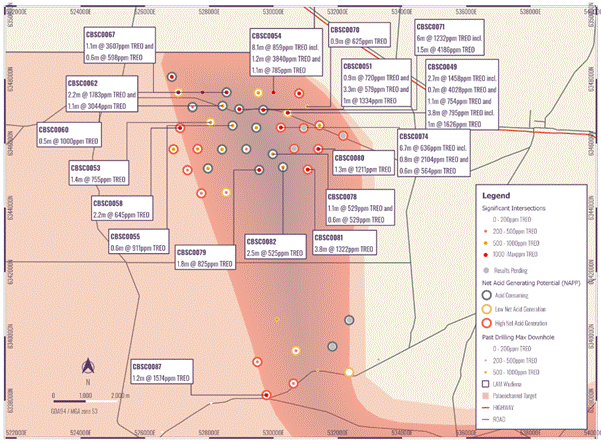
Approximately 80% of drilling results have been received to date, with the remaining results due in the coming weeks. Results add scale to the mineralisation footprint and demonstrate that mineralisation is concentrated within zones of the Boland and Head palaeosystems where NAPP calculations indicate acid generation, which significantly reduces extraction costs.
Highlights:
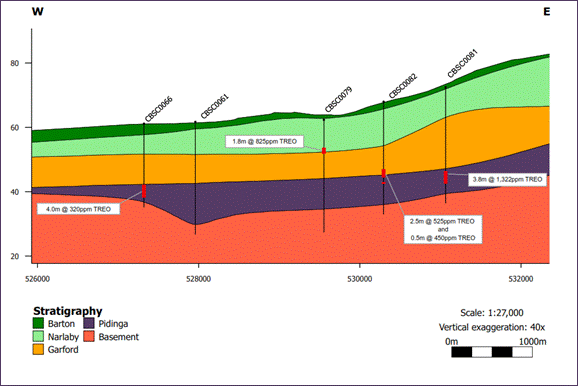
· A high-grade continuous ~5km flank has been defined at the Head prospect where mineralisation occurs within three lithologies amenable to ISR:
o Narlaby formation: a shallow, unconfined, narrow and highly permeable reduced sand.
o Garford formation: a smectite-rich clay with confined sandy interbeds.
o Pidinga formation: a confined aquifer of reduced, thick permeable sands with lignite interbeds.
· NAPP estimates demonstrate acid generation exceeds acid consumption within continuous high-grade zones.
· Partial results from particle size distribution analysis support productive calculated transmissivity estimates necessary for ISR production.
· Mineralisation remains open to the north and south.
· Significant intersections include:
o CBSC0071 intersected 5.95m at 1,232ppm Total Rare Earth Oxide ("TREO") (287ppm Nd+Pr and 23 ppm Dy+Tb) from 27.8m including 1.45m at 4,186ppm TREO (1,013ppm Nd+Pr and 70 ppm Dy+Tb) from 27.8m
o CBSC0074 intersected 6.65m at 636ppm TREO (127ppm Nd+Pr and 16 ppm Dy+Tb) from 26.6m
o CBSC0062 intersected 2.17m at 1,783ppm TREO (333ppm Nd+Pr and 67 ppm Dy+Tb) from 30.4m
o CBSC0081 intersected 3.8m at 1,322ppm TREO (267ppm Nd+Pr and 25 ppm Dy+Tb) from 26.1m
o CBSC0067 intersected 1.06m at 3,607ppm TREO (804ppm Nd+Pr and 84 ppm Dy+Tb) from 18.6m
o CBSC0087 intersected 1.15m at 1,574ppm TREO (360ppm Nd+Pr and 28 ppm Dy+Tb) from 18.8m
o CBSC0080 intersected 1.3m at 1,211ppm TREO (275ppm Nd+Pr and 25 ppm Dy+Tb) from 36.1m
o CBSC0079 intersected 1.8m at 825ppm TREO (166ppm Nd+Pr and 21 ppm Dy+Tb) from 8.7m
· Results from a further 12 drillholes from the Head Prospect remain outstanding.
· Further samples from mineralised Garford and Narlaby formations are being analysed for acid generation, metallurgy and particle sizing for incorporation into the MRE.
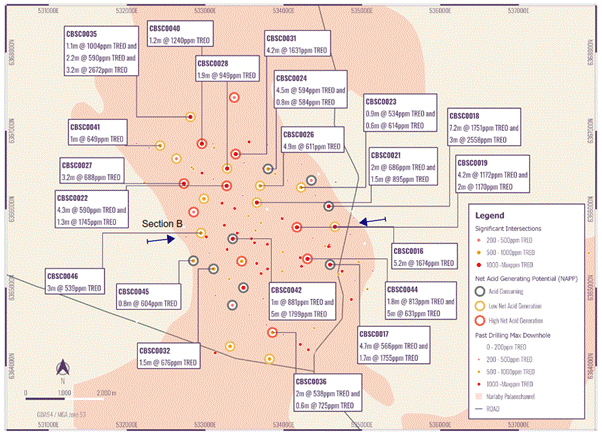
· Further Boland Highlights:
o CBSC0049 intersected 2.7m at 1,458ppm TREO (326ppm Nd+Pr and 30ppm) - (Tigu)
o CBSC0027 intersected 3.2m at 688ppm TREO (146ppm Nd+Pr and 16 ppm Dy+Tb) from 40.5m - (Tbp)
o CBSC0035 intersected 1.05m at 1004ppm TREO (228ppm Nd+Pr and 35 ppm Dy+Tb) from 32.6m and 2.2m at 590ppm TREO (145ppm Nd+Pr and 18 ppm Dy+Tb) from 42m - (Tbp)
o CBSC0044 intersected 5.62m at 459ppm TREO (99ppm Nd+Pr and 12 ppm Dy+Tb) from 21.7m including 1.82m at 813ppm TREO (178ppm Nd+Pr and 14 ppm Dy+Tb) from 21.7m
· Broad lower-grade zones within the Pidinga formation have been identified where the proportion of valuable heavy REEs is high; samples have high acid-generating capacity and high permeability. Such intervals include:
o CBSC0041 intersected 8.65m at 343ppm TREO (65ppm Nd+Pr and 10 ppm Dy+Tb) from 42.2m
o CBSC0025 intersected 4.45m at 449ppm TREO (97ppm Nd+Pr and 17 ppm Dy+Tb) from 42.6m
Rupert Verco, Managing Director of Cobra, commented:
"Results from the Head Prospect indicate the presence of a significant system that remains open to the north and south. The prospect contains all the right features to enable cost-efficient ISR - aquifer confinement, acid generation and highly permeable mineralisation. It highlights that the target geology within the Pidinga formation is likely to be regionally extensive across the 3,200km2 of palaeochannel systems contained within the Company's landholding.
The opportunity we are developing is truly unique. This is the first REE project of its kind in which a resource will incorporate modelling of key economic factors for permeability and acid generation. When coupled with the very low capital and operating costs of ISR, this changes the industry expectations of what is economically possible and positions Cobra competitively at the bottom of the cost curve.
Meanwhile, our diamond core drilling programme is progressing well at the Manna Hill copper project, and we look forward to announcing updates on this as well as further work towards a maiden rare earth MRE at Boland and Head."
To watch a video of Rupert Verco, Managing Director discussing results visit: https://investors.cobraplc.com/link/yV0gar.
Cobra's Approach to Resource Definition
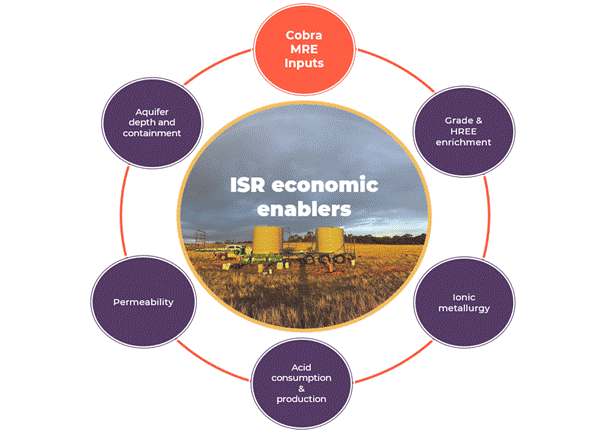
The Company is aiming to construct a resource that captures geological, metallurgical and physical parameters that enable high performance ISR. Achieving robust definition of all these parameters will best position the project to expedite its advancement and achieve the most desirable economics which result from a combination of: grade, heavy REE enrichment, permeability, recovery, and acid generation/consumption.
Figure 1: Schematic defining the key technical criteria being captured to support the Wudinna Rare Earth projects Mineral Resource Estimate
Drilling Results
High-grade mineralisation occurs on the margins of the main incised channel at Boland within a floodplain sedimentary sequence enriched in organics. Drilling has defined high grade zones on both the eastern and western margins of the palaeochannel system. Mineralisation intersected at the Head prospect has similar geological controls, with mineralisation occurring on the eastern margin of the Yaninee Channel palaeosystem. Key observations include:
· Broader low-grade zones have been intersected within the incised channel where very high (>80%) recoveries have been achieved with very low levels of sulphuric acid.
· Results received to date support continuous ISR-recoverable REE mineralisation across both the Boland and Head Prospects where continuity and scale are sufficient to support an MRE.
· Significant zones of mineralisation have been encountered within the Garford and Narlaby formations that are stratigraphically located above the Pidinga formation. Further test work is underway to define permeability and recovery so this mineralisation can be incorporated within the MRE.
Table 1: Significant Intersections from results received from Head and Boland Prospects
Head
CBSC0050
44.07
47.55
3.5
Pidinga
467
23
80
16
2.0
12
Head
incl
46
46.3
0.3
Pidinga
1,548
79
290
56
7.3
42
Head
CBSC0051
27.45
28.3
0.9
Narlaby
720
32
101
18
2.7
16
Head
CBSC0051
34
37.3
3.3
Garford
579
30
99
14
1.3
7
Head
CBSC0051
34
34.95
1.0
Garford
1,334
72
238
33
2.9
14
Head
CBSC0051
37.3
40.85
3.6
Garford
323
14
46
7
0.8
4
Head
CBSC0052
17
19.05
2.1
Pidinga
359
13
45
8
1.4
9
Head
CBSC0052
29.2
32
2.8
Garford
342
15
49
8
0.8
5
Head
CBSC0053
15.65
17
1.4
Pidinga
755
32
121
26
3.8
22
Head
CBSC0053
23
24.95
2.0
Narlaby
298
16
52
8
0.7
4
Head
CBSC0053
24.95
25.9
0.9
Garford
412
18
65
11
1.5
9
Head
CBSC0053
27.2
32
4.8
Pidinga
302
14
43
7
0.7
4
Head
CBSC0054
32.27
40.4
8.1
Pidinga
859
40
139
24
3.0
17
Head
incl
37.15
38.38
1.2
Garford
3,840
196
685
113
11.3
59
Head
CBSC0054
43.07
46.2
3.1
Garford
447
23
73
11
0.9
5
Head
CBSC0054
46.2
49.63
3.4
Garford
431
21
65
10
1.2
7
Head
CBSC0054
46.2
47.27
1.1
Pidinga
785
42
131
23
2.9
16
Head
CBSC0055
18.55
21.29
2.7
Pidinga
460
19
65
13
2.1
13
Head
CBSC0055
18.55
19.15
0.6
Garford
911
46
147
29
3.7
21
Head
CBSC0055
26
28.35
2.4
Garford
273
12
41
7
0.9
5
Head
CBSC0055
29
34.17
5.2
Garford
319
15
47
8
0.8
5
Head
CBSC0056
17.1
18.5
1.4
Pidinga
338
16
55
9
1.0
6
Head
CBSC0056
19.5
23
3.5
Garford
286
13
40
7
0.7
4
Head
CBSC0056
22.44
23
0.6
Pidinga
338
15
50
8
1.0
5
Head
CBSC0057
27.78
33.45
5.7
Pidinga
410
8
32
7
1.6
11
Head
CBSC0057
27.78
29.88
2.1
Garford
639
6
24
6
2.2
17
Head
CBSC0057
35
40.15
5.2
Garford
416
21
65
10
1.2
6
Head
CBSC0057
40.15
41
0.9
Garford
451
18
60
10
1.2
7
Head
CBSC0057
45.4
46.4
1.0
Pidinga
336
19
66
10
0.8
4
Head
CBSC0058
8
9.77
1.8
Narlaby
344
14
51
10
1.3
8
Head
incl
8.66
8.83
0.2
Narlaby
1,296
70
248
43
4.0
19
Head
CBSC0058
18
19.5
1.5
Narlaby
304
15
49
8
0.9
5
Head
CBSC0058
19.5
24.5
5.0
Pidinga
308
14
44
7
0.7
4
Head
CBSC0058
26
28.2
2.2
Pidinga
645
21
42
3
0.2
1
Head
CBSC0060
22.85
23.4
0.5
Narlaby
1,000
47
160
32
4.5
27
Head
CBSC0060
23.4
25.09
1.7
Garford
428
16
54
8
1.3
8
Head
CBSC0060
32.32
34.5
2.2
Pidinga
442
19
64
11
1.2
7
Head
CBSC0062
30.38
32.55
2.2
Narlaby
1,783
72
261
46
9.2
58
Head
CBSC0062
30.38
31.45
1.1
Garford
3,044
129
467
80
14.9
93
Head
CBSC0062
41.75
44
2.3
Pidinga
458
20
69
11
1.3
7
Head
CBSC0064
25.5
28.6
3.1
Pidinga
325
15
47
8
0.8
4
Head
CBSC0065
16.58
19.83
3.3
Garford
573
24
86
16
2.4
14
Head
CBSC0065
17.23
17.58
0.3
Garford
1,544
79
281
46
5.2
29
Head
CBSC0066
19
22.95
4.0
Pidinga
319
14
46
7
0.8
4
Head
CBSC0067
18.6
19.66
1.1
Pidinga
3,607
179
625
112
13.1
71
Head
CBSC0067
29
29.6
0.6
Garford
598
33
99
15
1.4
7
Head
CBSC0067
32
35.29
3.3
Garford
300
13
43
7
0.7
4
Head
CBSC0068
14.95
17
2.1
Garford
293
14
47
8
0.9
5
Head
CBSC0068
18.9
23
4.1
Pidinga
299
14
44
7
0.7
4
Head
CBSC0069
25.45
29
3.6
Garford
550
20
63
9
1.4
8
Head
CBSC0069
25.45
26.3
0.9
Garford
1,274
49
145
19
3.0
17
Head
CBSC0069
36.42
38.1
1.7
Pidinga
375
16
52
8
0.9
5
Head
CBSC0069
39.65
41
1.4
Garford
249
11
36
6
0.6
3
Head
CBSC0069
41
44
3.0
Pidinga
319
15
42
6
0.6
3
Head
CBSC0070
40.09
41
0.9
Garford
625
32
101
20
2.6
13
Head
CBSC0070
40.49
41
0.5
Garford
884
46
145
30
3.8
20
Head
CBSC0070
42.09
43.63
1.5
Pidinga
384
19
64
13
1.8
10
Head
CBSC0070
42.36
42.86
0.5
Pidinga
544
27
91
19
2.7
14
Head
CBSC0070
45.63
47
1.4
Pidinga
284
16
57
10
0.8
4
Head
CBSC0071
27.8
33.75
6.0
Garford
1,232
64
223
38
3.9
19
Head
inlc
27.8
29.25
1.5
Pidinga
4,186
226
787
134
12.3
57
Head
CBSC0071
35
37.6
2.6
Pidinga
365
17
58
9
1.2
6
Head
CBSC0071
38.3
40.5
2.2
Pidinga
321
15
47
8
0.8
4
Head
CBSC0072
42.45
43.25
0.8
Pidinga
384
18
65
14
1.7
10
Head
CBSC0074
26.6
33.25
6.7
Garford
636
28
98
18
2.3
14
Head
inlc
26.6
27.35
0.8
Garford
2,104
109
376
66
5.9
30
Head
CBSC0074
34.05
38
4.0
Garford
298
14
44
7
0.7
4
Head
CBSC0074
34.05
34.65
0.6
Garford
564
27
85
12
1.1
6
Head
CBSC0076
33.5
35
1.5
Pidinga
339
17
54
9
1.0
5
Head
CBSC0078
12.9
14
1.1
Narlaby
529
21
74
14
2.7
17
Head
CBSC0078
19.4
20
0.6
Pidinga
529
24
85
15
1.6
9
Head
CBSC0079
8.7
10.5
1.8
Garford
825
39
128
23
3.3
17
Head
CBSC0080
36.1
37.4
1.3
Pidinga
1,211
60
215
37
3.9
21
Head
CBSC0081
26.1
29.9
3.8
Pidinga
1,322
59
208
35
4.1
21
Head
CBSC0082
21
23.45
2.5
Pidinga
525
24
89
14
1.4
7
Head
CBSC0082
25
25.5
0.5
Pidinga
450
18
68
11
1.3
7
Head
CBSC0087
18.8
19.95
1.2
Pidinga
1,574
79
281
50
4.7
24
Head
CBSC0091
22.55
23.6
1.1
Pidinga
487
24
73
12
1.2
7
Boland
CBSC0022
13.7
18
4.3
Garford
590
27
93
18
2.1
11
Boland
CBSC0022
37.7
38.6
0.9
Pidinga
483
25
84
16
1.9
10
Boland
CBSC0022
52.7
54
1.3
Pidinga
1,745
104
357
44
2.6
11
Boland
CBSC0025
42.6
47.05
4.5
Garford
449
20
77
19
2.6
15
Boland
CBSC0027
27
29
2.0
Pidinga
471
22
76
14
1.6
9
Boland
CBSC0027
40.5
43.7
3.2
Saprolite
688
33
113
19
2.5
13
Boland
CBSC0029
18
23
5.0
Pidinga
482
22
76
15
1.7
9
Boland
CBSC0029
36.95
38
1.1
Pidinga
467
19
58
10
1.3
8
Boland
CBSC0030
19.9
21
1.1
Saprolite
141
5
19
4
0.6
3
Boland
CBSC0030
40.35
41
0.6
Garford
216
6
23
9
2.4
14
Boland
CBSC0032
26
29
3.0
Pidinga
452
19
66
13
1.5
8
Boland
CBSC0032
44.75
46.2
1.5
Garford
676
38
125
27
3.4
18
Boland
CBSC0034
27.5
29.45
2.0
Garford
633
32
105
20
2.1
11
Boland
CBSC0034
43.9
44.45
0.6
Pidinga
596
29
101
18
2.3
12
Boland
CBSC0034
45.9
47
1.1
Saprolite
1,117
66
205
34
3.6
19
Boland
CBSC0036
23.8
25.8
2.0
Saprolite
538
24
79
13
1.4
7
Boland
CBSC0036
34.9
35.5
0.6
Garford
725
39
132
28
3.7
21
Boland
CBSC0037
27.5
28.5
1.0
Pidinga
489
23
83
16
1.6
8
Boland
CBSC0038
35
36.1
1.1
Garford
410
10
41
13
3.4
27
Boland
CBSC0038
36.1
38
1.9
Pidinga
429
15
58
17
2.6
17
Boland
CBSC0039
29.4
33.5
4.1
Saprolite
426
19
64
11
1.2
8
Boland
CBSC0039
39.3
39.85
0.6
Pidinga
249
12
45
11
1.4
9
Boland
CBSC0040
21.4
26.1
4.7
Saprolite
415
20
66
13
1.4
9
Boland
CBSC0040
32.45
33.5
1.1
Pidinga
434
20
78
17
2.2
13
Boland
CBSC0040
44.3
44.5
0.2
Saprolite
390
8
26
5
0.6
3
Boland
CBSC0040
44.3
45.5
1.2
Garford
1,240
36
108
15
1.0
5
Boland
CBSC0041
29.6
32.6
3.0
Pidinga
449
21
72
14
1.7
9
Boland
CBSC0041
42.15
50.8
8.7
Pidinga
343
15
50
10
1.6
9
Boland
CBSC0041
55
56
1.0
Saprolite
649
55
166
26
1.8
9
Boland
CBSC0044
20.1
21.22
1.1
Garford
348
15
53
10
1.2
7
Boland
CBSC0044
21.68
27.3
5.6
Garford
459
23
76
15
1.8
10
Boland
CBSC0044
21.68
23.5
1.8
Garford
813
43
135
24
2.3
12
Boland
CBSC0044
31.6
36.6
5.0
Saprolite
631
36
104
13
1.1
6
Boland
CBSC0045
40.1
40.9
0.8
Saprolite
604
32
103
17
1.2
5
Boland
CBSC0046
26
29
3.0
Garford
539
23
79
16
1.8
10
Boland
CBSC0046
49.15
50
0.9
Saprolite
134
7
22
4
0.6
3
Boland
CBSC0047
24
27.85
3.9
Garford
629
30
102
19
2.1
11
Boland
CBSC0047
49.3
52.3
3.0
Saprolite
698
26
78
11
1.0
5
Boland
CBSC0049
33.3
36
2.7
Pidinga
1,458
71
254
43
4.8
25
Boland
incl
34.3
35
0.7
Pidinga
4,028
199
736
118
12.7
65
Boland
CBSC0049
37
38.05
1.1
Garford
754
29
105
20
3.5
21
Boland
CBSC0049
41
44.75
3.8
Garford
795
39
135
22
2.4
13
Boland
incl
42.7
43.7
1.0
Garford
1,626
82
295
48
5.5
30
Boland
CBSC0049
48
49
1.0
Garford
498
42
126
21
2.2
10
Net Acid Production Potential
A unique aspect to Cobra's palaeochannel hosted ionic mineralisation is the high levels of sulphide and low levels of carbonates. Testing has shown that Pyrite within this system can be readily oxidised to produce sulphuric acid - the primary reagent used in the mining of ionic REE systems.
Modelling acid generation and acid consumption synchronous with grade enables a sophisticated process to model resource cutoff-grades and mining parameters. The calculation utilised is:
Net Acid Production Potential ("NAPP") =
Maximum Potential Acidity ("AP")- Neutralising Capacity ("ANC")
· Calculations are made from the analysis of total Sulphur ("S"), Total Carbon ("C") and Total Organic Carbon ("TOC").
· Positive NAPP values indicate material with potential net acid-generating capacity, while negative values indicate material with estimated excess neutralising capacity.
· Calcite, shell grit and carbonates contribute to acid consumption.
· Samples at both Head and Boland demonstrate maximum AP of 60 kg/t (H2SO4).
· Sulphuric acid supply chain is a market that is critically impacted by current global events and a primary cost in REE extraction. Minimising acid needs through natural acid generation presents as a significant project advantage in minimising supply risk and production cost.
Figure 2: Plan of significant intersections plotted with NAPP estimates from the Head Prospect.
Figure 3: Head Prospect, Section A 634,550mN defining mineralisation intersections within three geological horizons: Narlaby, Garford and Pidinga formations.
Figure 4: Final results from the Boland prospect
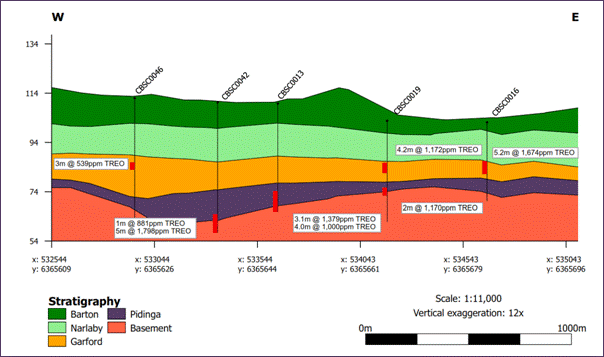
Figure 5: Section B, Boland Section highlighting mineralisation continuity within the Pidinga and Garford formations
Sizing Analysis
As a means of determining permeability, the Company has performed an extensive analysis of particle sizing distribution across numerous intersections. Permeability is a key enabler of ISR, and the obtained data will enable the Company to incorporate a permeability calculation within the MRE.
· Results from both Boland and Head support initial field studies that in turn support productive ISR permeabilities through mineralisation intersected within the Pidinga formation
· Sizing data is being compared against field hydrology results to enable broader modelling of mineralised formations and the productivity potential that could be achieved through ISR
· Additional samples have been taken from the Garford and Narlaby formations to calculate permeabilities
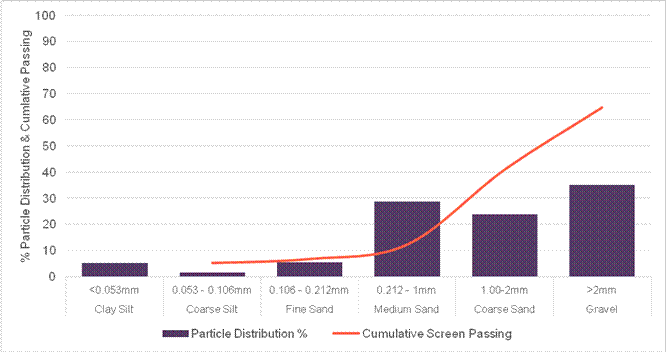
Figure 6 - Sizing distribution analysis from a high grade interval of 1,159ppm TREO from drillhole CBSC0027 from 42.7m to 43.7. Particle sizing distribution supports high permeability
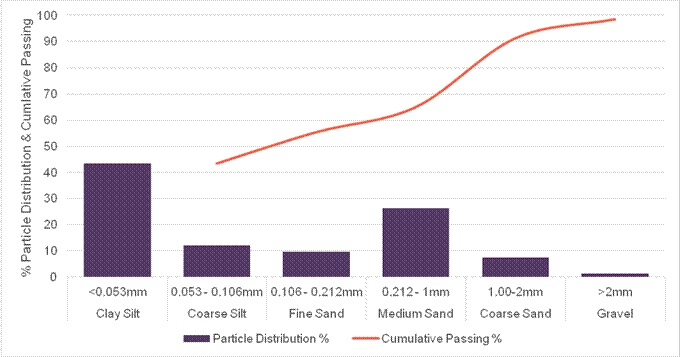
Figure 7 - Sizing distribution analysis from a low-grade interval of 439ppm TREO from drillhole CBSC0029 from 34.2m to 34.7m. Particle sizing distribution supports low to moderate permeability
Product Specification
In January, Cobra announced the results of its optimised Mixed Rare Earth Carbonate ("MREC") product comprising 58.83% TREO and composed of an exceptionally high ratio of valuable magnet and heavy REEs:
· Neodymium 27.5% of TREO
· Praseodymium 6.7% of TREO
· Dysprosium 3.8% of TREO
· Terbium 0.7% of TREO
· Heavy REEs 42.9% of TREO
· Radionuclide analysis from the Company's optimised MREC have been received. Results show low levels of all radionuclides except actinium, which exceed targeted limits. The Company and its advisors believe this can be effectively addressed and have commenced testing with ANSTO, including ISR pre-conditioning, pH control and actinium suppression.
· The Company is progressing commercial discussions with several parties to be beneficiaries of increased quantities of MREC produced from a field trial that is targeted for early 2027.
Unique Geological Setting
What makes the Wudinna REE project so unique is the Palaeochannel geology where ionic mineralisation occurs in geological formations with the following characteristics:
· They are confined by impermeable layers, enabling a confined ISR process, where lixiviant injection is bound to the mineralisation zone, maximising process control and significantly reducing environmental risk.
· Mineralisation contains high quantities of sand that provides permeability that bypass the necessity to mine ionic REE mineralisation by traditional methods where the properties of clay can materially impact the cost and productivity of heap leach or vat leach mining processes.
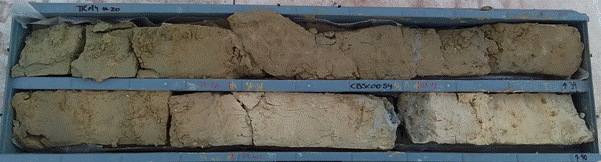
Defined below in Figures 8,9,10 are examples of the three formations that host ionic REE mineralisation with geological properties supportive of ISR.
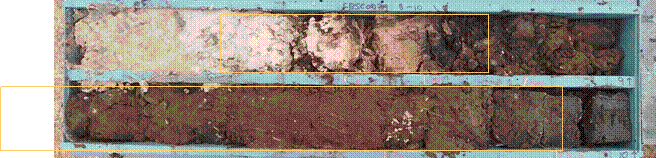
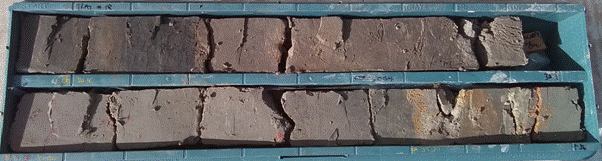
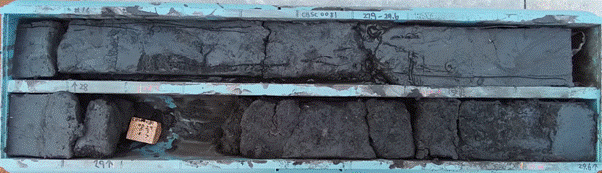
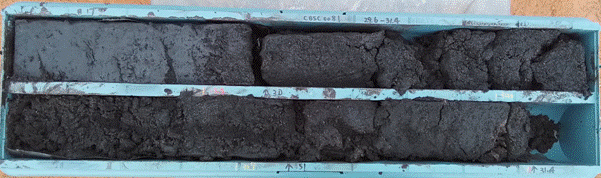
Figure 8: Photograph of core from CBSC0079 (8-10m) that intersected 1.8m at 825ppm TREO from 8.5m within the Narlaby formation. Yellow highlight represents mineralised intersection within the Narlaby formation.
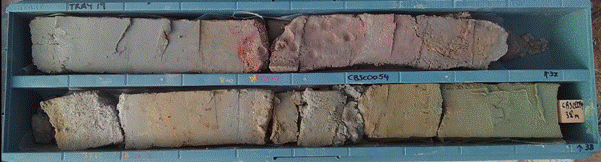
Figure 9: Photograph of core from CBSC0054 that intersected 8.1 at 859ppm from 32.27m within the Garford formation. Orange highlight represents a 1.75m permeable horizon from 37m grading 3,045ppm TREO.
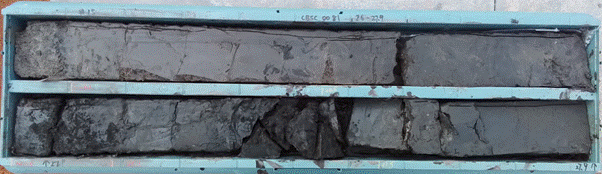
Figure 10: Photograph of core from CBSC0081 that intersected 3.8m at 1,322ppm TREO from 26.1m within the Pidinga formation.
Enquiries:
Cobra Resources plc
Rupert Verco (Australia)
Dan Maling (UK)
via Vigo Consulting
+44 (0)20 7390 0234
Hannam & Partners (Joint Broker)
Leif Powis
Andrew Chubb
+44 (0) 20 7907 8500
SI Capital Limited (Joint Broker)
Nick Emerson
Sam Lomanto
+44 (0)1483 413 500
Vigo Consulting (Financial Public Relations)
Ben Simons
Seb Weller
+44 (0)20 7390 0234
cobra@vigoconsulting.com
The person who arranged for the release of this announcement was Rupert Verco, Managing Director of the Company.
Information in this announcement relates to exploration results that have been reported in the following announcements:
· Exploration update: "Resource drilling completion", dated 5 May 2026
· Metallurgical update: "Boland Delivers Industry-Leading Heavy Rare Earth Product" dated 2 March 2026
· Metallurgical update: "Test work upgrades Boland liquor through 100% cerium removal resulting in a large increase in product value", dated 9th December 2025
· Exploration update: "Successful first pass suppression of cerium to maximise valuable dysprosium and terbium", dated 20 November 2025
· Exploration update: "Exceptional Results - Infield Permeability Study", dated 17 November 2025
· Exploration update: "Metallurgical Optimisation Upside", dated 20 October 2025
· Exploration update: "Exceptional Metallurgical Results from ISR Column", dated 14 October 2025
· Exploration update: "Met Study Supports Even Lower-Cost Recoveries", dated 11 September 2025
· Exploration update: "Low-Cost Recoveries from Optimised Testing", dated 11 August 2025
· Exploration update: "Rare Earth ISR System beyond Boland", dated 4 August 2025
· Exploration update: "Favourable Boland Metallurgical Results", dated 21 July 2025
· Exploration update: "Boland Project Update", dated 26 June 2025
· Wudinna Project Update: "Boland Aircore Drill Results", dated 25 February 2025
· Wudinna Project Update: "Further Positive Metallurgy Results from Boland Project", dated 16 December 2024
· Wudinna Project Update: "2nd Bench Scale ISR Study & £1.7M Placing", dated 26 November 2024
· Wudinna Project Update: "ISR Bench Scale Study Completion", dated 4 November 2024
· Wudinna Project Update: "ISR bench scale study delivers exceptional results", dated 1 October 2024
Competent Persons Statement
Information in this announcement has been compiled based on reports from Mitre Geophysics consultants and assessed by Mr Rupert Verco, a Fellow of the Australasian Institute of Mining and Metallurgy. Mr Verco is an employee of Cobra and has more than 17 years' industry experience which is relevant to the style of mineralisation, deposit type, and activity which he is undertaking to qualify as a Competent Person as defined in the 2012 Edition of the Australasian Code for Reporting Exploration Results, Mineral Resources and Ore Reserves of JORC. This includes 13 years of Mining, Resource Estimation and Exploration.
About Cobra
Cobra Resources is a South Australian critical minerals developer, advancing assets at all stages of the pre-production pathway.
In 2023, Cobra identified the Boland ionic rare earth discovery at its Wudinna Project in the Gawler Craton - Australia's only rare earth project suitable for in situ recovery (ISR) mining. ISR is a low-cost, low-disturbance extraction method that eliminates the need for excavation, positioning Boland to achieve bottom-quartile recovery costs.
In 2025, Cobra further expanded its portfolio by optioning the Manna Hill Copper Project in the Nackara Arc, South Australia. The project contains multiple underexplored prospects with strong potential to deliver large-scale copper discoveries.
In 2025, Cobra sold its Wudinna Gold Assets to Barton Gold (ASX: BDG) for up to A$15 million in cash and shares.
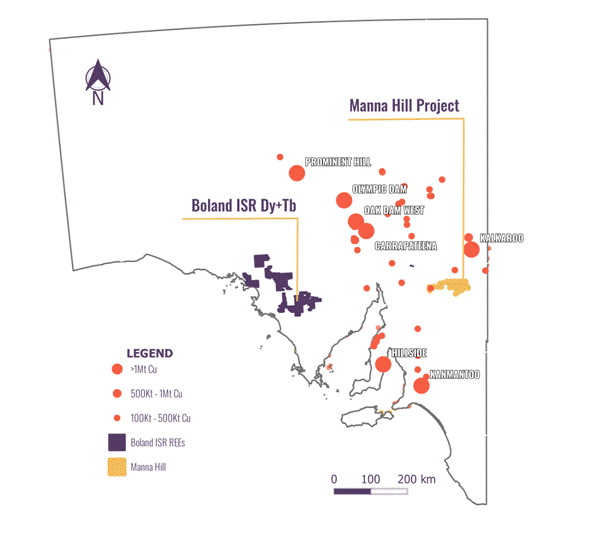
Regional map showing Cobra's tenements in South Australia
Follow us on social media:
LinkedIn: https://www.linkedin.com/company/cobraresourcesplc
X: https://twitter.com/Cobra_Resources
Engage with us by asking questions, watching video summaries and seeing what other shareholders have to say. Navigate to our Interactive Investor hub here: https://investors.cobraplc.com/
Subscribe to our news alert service: https://investors.cobraplc.com/auth/signup
Appendix 1: JORC Code, 2012 Edition - Table 1
Criteria
JORC Code explanation
Commentary
Sampling techniques
· Nature and quality of sampling (eg cut channels, random chips, or specific specialised industry standard measurement tools appropriate to the minerals under investigation, such as down hole gamma sondes, or handheld XRF instruments, etc). These examples should not be taken as limiting the broad meaning of sampling.
· Include reference to measures taken to ensure sample representivity and the appropriate calibration of any measurement tools or systems used.
· Aspects of the determination of mineralisation that are Material to the Public Report.
· In cases where 'industry standard' work has been done this would be relatively simple (eg 'reverse circulation drilling was used to obtain 1 m samples from which 3 kg was pulverised to produce a 30 g charge for fire assay'). In other cases more explanation may be required, such as where there is coarse gold that has inherent sampling problems. Unusual commodities or mineralisation types (eg submarine nodules) may warrant disclosure of detailed information.
Pre 2023
· Historic Rotary Mud drilling targeting paleochannel hosted uranium was completed. Some residue samples were retained in the Tonsley Core Library, downhole geophysical logging was the primary data collected for these holes.
· Select historic sample residues over Boland were analysed as reported in RNS 1834M (26 April 2024)
2023
Aircore
· A combination of 2m and 3m samples were collected in green bags via a rig mounted cyclone. A PVC spear was used to collect a 2-4kg sub sample from each green bag. Sampling commenced from the collar point with samples submitted for analysis from the top of saprolite.
· Samples were submitted to Bureau Veritas Laboratories, Adelaide and pulverized to produce a 4-acid digest sample.
2024-2026
SONIC
· Drill results are outlined in RNS 0297I (25 March 2024)
· Core was scanned by a SciAps X555 pXRF to determine sample intervals. Intervals through mineralized zones were taken at 10cm. Through waste, sample intervals were lengthened to 50cm. Core was halved by knife cutting. XRF scan locations were taken on an inner surface of the core to ensure readings were taken on fresh sample faces.
· Samples were submitted to Bureau Veritas Laboratories, Adelaide and pulverized to produce a 4 acid digest sample.
· Total Organic Carbon, Total Carbon and Total Sulphur were analysed from selected intervals to support net acid generation estimates
Aircore
· 1m sample intervals of 2-4 kg were taken via PVC spear from green bags at the rig. All samples collected were submitted to the lab for analysis. From 0-6 m in each hole samples were composited to 3m.
· Samples were submitted to Bureau Veritas Laboratories, Adelaide and pulverized to produce a 4 acid digest sample.
Drilling techniques
· Drill type (eg core, reverse circulation, open-hole hammer, rotary air blast, auger, Bangka, sonic, etc) and details (eg core diameter, triple or standard tube, depth of diamond tails, face-sampling bit or other type, whether core is oriented and if so, by what method, etc).
Pre 2023
· Drill methods include Rotary Mud and AC
2023
· Drilling completed by McLeod Drilling Pty Ltd using 75.7mm NQ air core drilling techniques from an ALMET aircore rig mounted on a Toyota Landcruiser 6x6 and a 200psi, 400cfm Sullair compressor.
2024-2026
· Sonic Core drilling completed Star Drilling using 4" core with a SDR12 drill rig. Holes were reamed to 6" or 8" to enable casing and screens to be installed
· Aircore Drilling completed by McLeod Drilling Pty Ltd using 75.7mm NQ air core drilling techniques from an ALMET aircore rig mounted on a Toyota Landcruiser 6x6 and a 200psi, 400cfm Sullair compressor.
Drill sample recovery
· Method of recording and assessing core and chip sample recoveries and results assessed.
· Measures taken to maximise sample recovery and ensure representative nature of the samples.
· Whether a relationship exists between sample recovery and grade and whether sample bias may have occurred due to preferential loss/gain of fine/coarse material.
· Aircore Sample recovery is for the style of drilling. All samples were recorded for sample type, quality and contamination potential and entered within a sample log.
· In general, sample recoveries range between 5-10kg for each 1 m interval being recovered from AC drilling.
· Mineralisation occurs within a confined aquifer where ground water does influence sample recovery
· Mineralisation within the targeted Pidinga Formation is bound to fine, organic rich material, the potential loss of mineralized material from coarser host sands is possible
· Any grade bias is expected to be grade loss
· The potential loss of fine material is being evaluated by sizing fraction analysis and follow-up sonic core drilling where aircore holes will be twinned.
Sonic Core
· Sample recovery is considered excellent.
Logging
· Whether core and chip samples have been geologically and geotechnically logged to a level of detail to support appropriate Mineral Resource estimation, mining studies and metallurgical studies.
· Whether logging is qualitative or quantitative in nature. Core (or costean, channel, etc) photography.
· The total length and percentage of the relevant intersections logged.
· All drill samples were logged by a qualified geologist at the time of drilling. Lithology, colour, weathering and moisture were documented. All core drilled has been lithologically logged.
· All drill metres have been geologically logged on sample intervals (1-3 m).
Sub-sampling techniques and sample preparation
· If core, whether cut or sawn and whether quarter, half or all core taken.
· If non-core, whether riffled, tube sampled, rotary split, etc and whether sampled wet or dry.
· For all sample types, the nature, quality and appropriateness of the sample preparation technique.
· Quality control procedures adopted for all sub-sampling stages to maximise representivity of samples.
· Measures taken to ensure that the sampling is representative of the in situ material collected, including for instance results for field duplicate/second-half sampling.
· Whether sample sizes are appropriate to the grain size of the material being sampled.
Pre 2023
· Historic Residue samples were generally 2m composites and were stored at the South Australian Drill Core Reference Library at Tonsley, a subsample of approximately 20g was removed for lab submission.
· Select samples of geological interest were selected for lab submission
· No QAQC samples were included in the submission of these samples. Sample results were intended to indicate mineralisation potential but would not be suitable for resource estimation
Post 2023
· A PVC spear was used to collect 2-4kg of sub-sample from each AC sample length controlled the sample volume submitted to the lab.
· Additional sub-sampling was performed through the preparation and processing of samples according to the Bureau Veritas internal protocols.
· Field duplicate AC samples were collected from the green bags using a PVC spear scoop at a 1 in 25 sample frequency.
· Sample sizes are considered appropriate for the material being sampled.
· Assessment of duplicate results indicated this sub - sample method provided appropriate repeatability for rare earths.
Sonic Drilling
· Field duplicate samples were taken nominally every 1 in 25 samples where the sampled interval was quartered.
· Blanks and Standards were submitted every 25 samples
· Half core samples were taken where lab geochemistry sample were taken.
· In holes where column leach test samples have been submitted, full core samples have been submitted over the test areas.
Quality of assay data and laboratory tests
· The nature, quality and appropriateness of the assaying and laboratory procedures used and whether the technique is considered partial or total.
· For geophysical tools, spectrometers, handheld XRF instruments, etc, the parameters used in determining the analysis including instrument make and model, reading times, calibrations factors applied and their derivation, etc.
· Nature of quality control procedures adopted (eg standards, blanks, duplicates, external laboratory checks) and whether acceptable levels of accuracy (ie lack of bias) and precision have been established.
· Samples were submitted to Bureau Veritas, Adelaide for preparation and analysis. Multi-element geochemistry were digested by four acid ICP-MS/ ICP-OES and analysed for Ag, Ce, Cu, Dy, Er, Eu, Gd, Ho, La, Lu, Mg, Na, Nd, P, Pr, Sc, Sm, Tb, Th, Tm, U, Y and Yb.
· Field rare earth standards were submitted at a frequency of 1 in 25 samples.
· Field duplicate samples were submitted at a frequency of 1 in 25 samples.
· Reported assays pass the companies implemented QAQC database reports
· Internal lab blanks, standards and repeats for rare earths indicated acceptable assay accuracy.
Sample Characterisation Test Work performed by the Australian Nuclear Science and Technology Organisation (ANSTO)
· Full core samples were submitted to Australian Nuclear Science and Technology Organisation (ANSTO), Sydney for preparation and analysis. The core was split in half along the vertical axis, and one half further split into 10 even fractions along the length of the half-core. Additional sub-sampling, homogenisation and drying steps were performed to generate ~260 g (dry equivalent) samples for head assay according to the laboratory internal protocols.
· Multi element geochemistry of solid samples were analysed at ANSTO (Sydney) by XRF for the major gangue elements Al, Ca, Fe, K, Mg, Mn, Na, Ni, P, Si, S, and Zn.
· Multi element geochemistry of solid samples were additionally analysed at ALS Geochemistry Laboratory (Brisbane) on behalf of ANSTO by lithium tetraborate digest ICP-MS and analysed for Ce, Dy, Er, Eu, Gd, Ho, La, Lu, Nd, Pr, Sm, Tb, Th, Tm, U, Y and Yb.
· Reported assays are to acceptable levels of accuracy and precision.
· Internal laboratory blanks, standards and repeats for rare earths indicated acceptable assay accuracy.
· Samples retained for metallurgical analysis were immediately vacuum packed, nitrogen purged and refrigerated.
· These samples were refrigerated throughout transport.
Metallurgical Leach Test Work performed by the Australian Nuclear Science and Technology Organisation (ANSTO)
· ANSTO laboratories prepared ~80g samples for diagnostic leaches, a 443g sample for a slurry leach and a 660g sample for a column leach and a 55kg sample for a bulk column leach. Sub-samples were prepared from full cores according to the laboratory internal protocols. Diagnostic and slurry leaching were carried out in baffled leach vessels equipped with an overhead stirrer and applying a 0.5 M (NH4)2SO4 lixiviant solution, adjusted to the select pH using H2SO4.
· 0.5-0.3 M H2SO4 was utilised to maintain the test pH for the duration of the test, if necessary. The acid addition was measured.
· Thief liquor samples were taken periodically.
· At the completion of each test, the final pH was measured, the slurry was vacuum filtered to separate the primary filtrate.
· The thief samples and primary filtrate were analysed as follows:
o ICP-MS for Ce, Dy, Er, Eu, Gd, Ho, La, Lu, Mn, Nd, Pb, Pr, Sc, Sm, Tb, Th, Tm, U, Y, Yb.
o ICP-OES for Al, Ca, Fe, K, Mg, Mn, Na, Si.
· The water wash was stored but not analysed.
· Column leaching was carried out by horizontal and vertical leach columns. The columns have been pressurised with nitrogen to between 4-6 bar and submerged in a temperature controlled bath.
· A 0.3 M (NH4)2SO4 lixiviant solution, adjusted to the select pH using H2SO4 was fed to the column at a controlled flowrate.
· PLS collected from the end of the column was weighed, the SH and pH measured and the free acid concentration determined by titration. Liquor samples were taken from the collected PLS and analysed as follows:
o ICP-MS for Ce, Dy, Er, Eu, Gd, Ho, La, Lu, Mn, Nd, Pb, Pr, Sc, Sm, Tb, Th, Tm, U, Y, Yb.
o ICP-OES for Al, Ca, Fe, K, Mg, Mn, Na, Si.
· The column leach test has been completed. Assays of the column have adjusted head grades of the initial bench scale study. Recoveries have been adjusted accordingly.
Verification of sampling and assaying
· The verification of significant intersections by either independent or alternative company personnel.
· The use of twinned holes.
· Documentation of primary data, data entry procedures, data verification, data storage (physical and electronic) protocols.
· Discuss any adjustment to assay data.
· Sampling data was recorded in field books, checked upon digitising and transferred to database.
· Geological logging was undertaken digitally via the MX Deposit logging interface and synchronised to the database at least daily during the drill programme.
· Compositing of assays was undertaken and reviewed by Cobra Resources staff.
· Original copies of laboratory assay data are retained digitally on the Cobra Resources server for future reference.
· Samples have been spatially verified through the use of Datamine and Leapfrog geological software for pre 2021 and post 2021 samples and assays.
· Twinned drillholes from pre 2021 and post 2021 drill programs showed acceptable spatial and grade repeatability.
· Physical copies of field sampling books are retained by Cobra Resources for future reference.
· Significant intersections have been prepared by Mr Michael McMaster and reviewed by Mr Rupert Verco
Location of data points
· Accuracy and quality of surveys used to locate drill holes (collar and down-hole surveys), trenches, mine workings and other locations used in Mineral Resource estimation.
· Specification of the grid system used.
· Quality and adequacy of topographic control.
2021-2023
· Collar locations were initially surveyed using a mobile phone utilising the Avenza Map app. Collar points recorded with a GPS horizontal accuracy within 5 m.
· RC Collar locations were picked up using a Leica CS20 base and Rover with an instrument precision of 0.05 cm accuracy.
· Locations are recorded in geodetic datum GDA 94 zone 53.
· No downhole surveying was undertaken on AC holes. All holes were set up vertically and are assumed vertical.
· RC holes have been down hole surveyed using a Reflex TN-14 true north seeking downhole survey tool or Reflex multishot
· Downhole surveys were assessed for quality prior to export of data. Poor quality surveys were downgraded in the database to be excluded from export.
· All surveys are corrected to MGA 94 Zone 53 within the MX Deposit database.
· Cased collars of sonic drilling shall be surveyed before a mineral resource estimate
2024 Aircore
· Collar locations were initially surveyed using A mobile phone GPS utilising the Avenza Map app. Collar points recorded with a horizontal accuracy within 5m.
· Locations are recorded in geodetic datum GDA 94 zone 53.
· No downhole surveying was undertaken on AC or Sonic holes. All holes were set up vertically and are assumed vertical.
· Higher accuracy GPS will be undertaken on soinc core drilling to support future resource estimates
2026 Sonic Core
· All holes were surveyed by Lyca GS20 equipment with Base corrections for 0.1cm precision by a licensed surveying contractor.
Data spacing and distribution
· Data spacing for reporting of Exploration Results.
· Whether the data spacing and distribution is sufficient to establish the degree of geological and grade continuity appropriate for the Mineral Resource and Ore Reserve estimation procedure(s) and classifications applied.
· Whether sample compositing has been applied.
· Drillhole spacing was designed on transects 200 to 500m apart.
· Additional scouting holes were drilled opportunistically on existing tracks at spacings 25-150 m from previous drillholes.
· Sonic core holes were drilled at ~20m spacings in a wellfield configuration based on assumed permeability potential of the intersected geology
· Drillhole spacing is not expected to introduce any sample bias.
· Assessment of the drillhole spacing for resource estimation will be made once a sufficient data set can provide statistical analysis
· .
Orientation of data in relation to geological structure
· Whether the orientation of sampling achieves unbiased sampling of possible structures and the extent to which this is known, considering the deposit type.
· If the relationship between the drilling orientation and the orientation of key mineralised structures is considered to have introduced a sampling bias, this should be assessed and reported if material.
· Aircore and Sonic drill holes are vertical.
Sample security
· The measures taken to ensure sample security.
· Transport of samples to Adelaide was undertaken by a competent independent contractor. Samples were packaged in zip tied polyweave bags in bundles of 5 samples at the drill rig and transported in larger bulka bags by batch while being transported.
· Refrigerated transport of samples to Sydney was undertaken by a competent independent contractor. Samples were double bagged, vacuum sealed, nitrogen purged and placed within PVC piping.
· There is no suspicion of tampering of samples.
Audits or reviews
· The results of any audits or reviews of sampling techniques and data.
· No laboratory audit or review has been undertaken.
· Genalysis Intertek and BV Laboratories Adelaide are NATA (National Association of Testing Authorities) accredited laboratory, recognition of their analytical competence.
Appendix 2: Section 2 reporting of exploration results
Criteria
JORC Code explanation
Commentary
Mineral tenement and land tenure status
· Type, reference name/number, location and ownership including agreements or material issues with third parties such as joint ventures, partnerships, overriding royalties, native title interests, historical sites, wilderness or national park and environmental settings.
· The security of the tenure held at the time of reporting along with any known impediments to obtaining a licence to operate in the area.
· Boland is located on EL7074, currently owned 100% by LAM Wudinna, a wholly owned subsidiary of Cobra Resource Plc
· In 2024, Cobra through its subsidiary Lady Alice Mines purchased the remaining ownership of the Wudinna Project tenements.
· The Head Prospect is located on EL6784, a tenement held by EL6784
· Alcrest Royalties Australia Pty Ltd retains a 1.5% NSR royalty over future mineral production from licenses EL7074, EL7075, EL7076, EL7077 and EL7078.
· A Native Title Agreement is in place with the Barngarla people.
· Aboriginal heritage surveys have been completed over EL7074, with no sites located in the immediate vicinity of aircore and sonic core drilling
· Exclusion zones are established around sensitive areas
Exploration done by other parties
· Acknowledgment and appraisal of exploration by other parties.
· On-ground exploration completed prior to Andromeda Metals' work was limited to 400 m spaced soil geochemistry completed by Newcrest Mining Limited over the Barns prospect.
· Other than the flying of regional airborne geophysics and coarse spaced ground gravity, there has been no recorded exploration in the vicinity of the Baggy Green deposit prior to Andromeda Metals' work.
· Paleochannel uranium exploration was undertaken by various parties in the 1980s and the 2010s around the Boland Prospect. Drilling was primarily rotary mud with downhole geophysical logging the primary interpretation method.
Geology
· Deposit type, geological setting and style of mineralisation.
· Target mineralisation is ionic rare earth mineralisation that occurs primarily within the Pidinga Formation within the Narlaby Palaeochannel, immediately above REE enriched Hiltaba Suite Granites
· Ionic REE mineralisation also occurs in and adjacent to the Garford formation clays and silty sands.
· Significant chemical (pH & eH) differences exist between underlying saprolite and overlying Palaeochannel sediments. REEs are absorbed to reduced organics found within the Pidinga Formation
· Benchtop metallurgy studies indicate ISR amenability of rare earths within the Pidinga Formation basal sands summarized in RNS 1285Q (16 December 2024)
· Ionic REE mineralisation is confirmed through metallurgical desorption testing where high recoveries are achieved at benign acidities (pH5-3) at ambient temperature.
· CSIRO has independently demonstrated high recoveries with sequential leach testing, delivering recoveries of 20-25% at pH7
· QEMSCAN and petrology analysis support REE ionic mineralisation, with little to no secondary phases identified.
· Ionic REE mineralisation occurs in reduced clay intervals that contact both saprolite and permeable sand units. Mineralisation contains variable sand quantities that yield permeability and promote in-situ recovery potential
· Evidence that REEs are ionically absorbed to sulphides
· Mineralisation is located within a confined aquifer
Drillhole Information
· A summary of all information material to the understanding of the exploration results including a tabulation of the following information for all Material drill holes:
o easting and northing of the drill hole collar
o elevation or RL (Reduced Level - elevation above sea level in metres) of the drill hole collar
o dip and azimuth of the hole
o down hole length and interception depth
o hole length.
· If the exclusion of this information is justified on the basis that the information is not Material and this exclusion does not detract from the understanding of the report, the Competent Person should clearly explain why this is the case.
· Drilling has been designed to support resource definition.
Data aggregation methods
· In reporting Exploration Results, weighting averaging techniques, maximum and/or minimum grade truncations (eg cutting of high grades) and cut-off grades are usually Material and should be stated.
· Where aggregate intercepts incorporate short lengths of high grade results and longer lengths of low grade results, the procedure used for such aggregation should be stated and some typical examples of such aggregations should be shown in detail.
· The assumptions used for any reporting of metal equivalent values should be clearly stated.
· Reported summary intersects are weighted averages based on length.
· No maximum/ minimum grade cuts have been applied.
· No metal equivalent values have been calculated.
· ISR recoverable zones have been composited to analyse for TOC, total sulphide and sizing distribution
· Rare earth element analyses were originally reported in elemental form and have been converted to relevant oxide concentrations in line with industry standards. Conversion factors tabulated below:
Element
Oxide
Factor
Cerium
CeO2
1.2284
Dysprosium
Dy2O3
1.1477
Erbium
Er2O3
1.1435
Europium
Eu2O3
1.1579
Gadolinium
Gd2O3
1.1526
Holmium
Ho2O3
1.1455
Lanthanum
La2O3
1.1728
Lutetium
Lu2O3
1.1371
Neodymium
Nd2O3
1.1664
Praseodymium
Pr6O11
1.2082
Scandium
Sc2O3
1.5338
Samarium
Sm2O3
1.1596
Terbium
Tb4O7
1.1762
Thulium
Tm2O3
1.1421
Yttrium
Y2O3
1.2699
Ytterbium
Yb2O3
1.1387
· The reporting of REE oxides is done so in accordance with industry reporting with the following calculations applied:
· TREO = La2O3 + CeO2 + Pr6O11 + Nd2O3 + Sm2O3 + Eu2O3 + Gd2O3 + Tb4O7 + Dy2O3 + Ho2O3 + Er2O3 + Tm2O3 + Yb2O3 + Lu2O3 + Y2O3
· LREO = La2O3 + CeO2 + Pr6O11 + Nd2O3
· HREO = Sm2O3 + Eu2O3 + Gd2O3 + Tb4O7 + Dy2O3 + Ho2O3 + Er2O3 + Tm2O3 + Yb2O3 + Lu2O3 + Y2O3
· MREO = Nd2O3 + Pr6O11 + Tb4O7 + Dy2O3
· NdPr = Nd2O3 + Pr6O11
· TREO-Ce = TREO - CeO2
· % Nd = Nd2O3/ TREO
· % Pr = Pr6O11/TREO
· % Dy = Dy2O3/TREO
· % HREO = HREO/TREO
· % LREO = LREO/TREO
· NAPP = Total S% × 30.6 - (Total Carbon - Total Organic Carbon) x 81.7
· XRF results are used as an indication of potential grade only. Due to detection limits only a combined content of Ce, La, Nd, Pr & Y has been used. XRF grades have not been converted to oxide.
Relationship between mineralisation widths and intercept lengths
· These relationships are particularly important in the reporting of Exploration Results.
· If the geometry of the mineralisation with respect to the drill hole angle is known, its nature should be reported.
· If it is not known and only the down hole lengths are reported, there should be a clear statement to this effect (eg 'down hole length, true width not known').
· Preliminary results support unbiased testing of mineralised structures.
· Most intercepts are vertical and reflect true width intercepts.
· Follow-up sonic drilling is planned to delineate portions of the reported intersections that are recoverable and unrecoverable via ISR
Diagrams
· Appropriate maps and sections (with scales) and tabulations of intercepts should be included for any significant discovery being reported These should include, but not be limited to a plan view of drill hole collar locations and appropriate sectional views.
· Relevant diagrams have been included in the announcement.
· Exploration results are not being reported for existing mineral resources.
· Drilling is aimed at defining new mineral resources.
Balanced reporting
· Where comprehensive reporting of all Exploration Results is not practicable, representative reporting of both low and high grades and/or widths should be practiced to avoid misleading reporting of Exploration Results.
· REE mineralization occurs in several phases, ionic phase mineralisation occurs within the Pidinga and Garford formations which are amenable to ISR recovery, REO values within both of these formations have been reported. Mineralisation occurring within the saprolite is considered secondary phase mineralisation.
Other substantive exploration data
· Other exploration data, if meaningful and material, should be reported including (but not limited to): geological observations; geophysical survey results; geochemical survey results; bulk samples - size and method of treatment; metallurgical test results; bulk density, groundwater, geotechnical and rock characteristics; potential deleterious or contaminating substances.
· Refer to previous announcements listed in RNS for reporting of REE results and metallurgical testing
Further work
· The nature and scale of planned further work (eg tests for lateral extensions or depth extensions or large-scale step-out drilling).
· Diagrams clearly highlighting the areas of possible extensions, including the main geological interpretations and future drilling areas, provided this information is not commercially sensitive.
· ISR study 1 was performed to achieve a 0.5M pH 3 whilst ISR study 2 was performed at a 0.3M pH 3
· Multiple Mixed Rare Earth Carbonates have been produced
· Hydrology, permeability and mineralogy studies are being performed on core samples.
· Hydrology and tracer recovery studies have been completed that support the permeabilities achieved in bench scale ISR testing.
Appendix 3: Drillhole coordinates
CBSC0016
534,655
6,365,778
101.8
May
CBSC0017
534,593
6,365,295
100.9
May
CBSC0018
534,576
6,366,039
101.3
May
CBSC0019
534,170
6,365,772
102.4
May
CBSC0020
534,354
6,366,369
107.5
May
CBSC0021
533,659
6,366,086
100.0
May
CBSC0022
533,274
6,366,299
101.7
June
CBSC0023
534,223
6,366,279
103.1
May
CBSC0024
533,801
6,366,515
101.6
May
CBSC0025
532,632
6,366,646
112.9
June
CBSC0026
533,700
6,366,300
101.5
May
CBSC0027
532,728
6,366,328
110.7
June
CBSC0028
533,279
6,366,520
104.4
May
CBSC0029
532,983
6,366,135
104.9
June
CBSC0030
532,851
6,365,965
106.3
May
CBSC0031
533,388
6,366,705
100.2
June
CBSC0032
533,106
6,365,240
111.2
June
CBSC0033
533,370
6,367,426
99.0
May
CBSC0034
533,487
6,365,001
111.4
June
CBSC0035
532,811
6,367,178
106.0
May
CBSC0036
533,858
6,364,429
109.7
June
CBSC0037
533,346
6,364,778
110.1
June
CBSC0038
533,317
6,364,253
113.2
June
CBSC0039
533,821
6,364,092
115.3
June
CBSC0040
532,957
6,366,837
106.9
June
CBSC0041
532,424
6,366,812
114.8
May
CBSC0042
533,351
6,365,625
110.2
June
CBSC0043
534,181
6,365,000
106.2
June
CBSC0044
534,305
6,365,368
107.1
June
CBSC0045
532,849
6,365,344
114.5
June
CBSC0046
532,945
6,365,698
111.6
June
CBSC0047
533,465
6,365,338
109.0
June
CBSC0048
527,476
6,347,125
70.7
June
CBSC0049
530,441
6,346,953
84.9
June
CBSC0050
530,798
6,347,555
89.1
June
CBSC0051
528,933
6,347,065
81.3
June
CBSC0052
527,479
6,347,130
70.8
June
CBSC0053
528,035
6,346,651
69.0
June
CBSC0054
529,998
6,347,585
89.6
June
CBSC0055
528,726
6,346,553
72.6
June
CBSC0056
526,886
6,345,819
60.8
June
CBSC0057
529,528
6,347,573
82.7
June
CBSC0058
527,092
6,346,478
63.4
June
CBSC0059
527,637
6,345,827
60.8
June
CBSC0060
528,414
6,347,167
75.2
June
CBSC0061
527,959
6,345,223
61.7
June
CBSC0062
528,538
6,347,588
84.2
June
CBSC0063
528,398
6,345,814
61.6
June
CBSC0064
528,528
6,344,475
65.4
June
CBSC0065
526,835
6,348,072
72.4
June
CBSC0066
527,321
6,345,169
61.1
June
CBSC0067
527,038
6,347,587
73.2
June
CBSC0068
527,753
6,344,449
60.7
June
CBSC0069
527,789
6,347,586
77.9
June
CBSC0070
531,053
6,347,143
85.6
June
CBSC0071
529,681
6,347,041
82.0
June
CBSC0072
531,432
6,346,561
88.4
Pending
CBSC0073
532,169
6,346,237
86.8
Pending
CBSC0074
530,228
6,346,494
77.9
June
Partial
CBSC0075
530,940
6,346,476
80.7
Pending
CBSC0076
529,463
6,346,489
75.6
June
CBSC0077
529,153
6,345,823
70.1
June
Partial
CBSC0078
529,976
6,345,667
66.3
June
CBSC0079
529,554
6,345,174
62.3
June
CBSC0080
531,392
6,345,825
82.2
June
CBSC0081
531,065
6,345,187
72.5
June
CBSC0082
530,295
6,345,261
68.0
June
CBSC0083
530,643
6,345,838
71.0
Pending
CBSC0084
532,350
6,338,882
67.3
Pending
CBSC0085
531,832
6,339,684
60.8
Pending
CBSC0086
532,357
6,340,503
72.8
Pending
CBSC0087
529,780
6,338,172
73.5
June
Partial
CBSC0088
530,621
6,338,533
60.8
June
CBSC0089
529,496
6,339,203
68.8
June
CBSC0090
530,697
6,339,550
65.4
June
CBSC0091
530,109
6,340,529
62.4
June
Partial
This information is provided by RNS, the news service of the London Stock Exchange. RNS is approved by the Financial Conduct Authority to act as a Primary Information Provider in the United Kingdom. Terms and conditions relating to the use and distribution of this information may apply. For further information, please contact rns@lseg.com or visit www.rns.com.
RNS may use your IP address to confirm compliance with the terms and conditions, to analyse how you engage with the information contained in this communication, and to share such analysis on an anonymised basis with others as part of our commercial services. For further information about how RNS and the London Stock Exchange use the personal data you provide us, please see our Privacy Policy.ENDUPDEZLBLQQLEBBV