
Cora Gold Limited - Sanankoro Resource Growth Drill Programme
Cora Gold Limited / EPIC: CORA.L / Market: AIM / Sector: Mining
8 June 2026
Cora Gold Limited ('Cora' or 'the Company')
Sanankoro Resource Growth Drill Programme:
Major Drill Campaign to Support Long-Term Growth Strategy
Cora Gold Limited, the West African focused gold company, is pleased to provide an update on its growth strategy at the Company's flagship Sanankoro Gold Project ('Sanankoro' or the 'Project') in southern Mali, as the Project advances towards construction and first gold production.
Following the successful financing activities in H1 2026, which ensure Sanankoro is fully funded to production, Cora is now focused on unlocking the broader long-term potential of the Project through an extensive resource growth and exploration programme, designed to expand the current JORC compliant mineral resource estimate ('MRE') of 1,044 koz at 1.04 g/t Au, extend Reserve mine life beyond the current 10.2 years outlined in the 2025 definitive feasibility study ('DFS') and support future production growth.
The 2026 drill programme will target both extensions to existing deposits and a number of highly prospective near-mine greenfield targets, offering the potential for rapid conversion into future mine plan feed.
Highlights
● 12,000+ metres of reverse circulation ('RC') and diamond drilling planned across four existing deposits and high priority greenfield targets. Drill metre allocation as follows:
o 40% at Zone B (current JORC compliant MRE of 9 Mt at 0.85 g/t Au for 250 koz)
o 30% at Selin (current JORC compliant MRE of 12 Mt at 1.11 g/t Au for 430 koz)
o 25% at Zone A and C (current JORC compliant MRE of 7.8 Mt at 1.11 g/t Au for 275 koz)
o 5% to greenfield targets
● Zone B expected to be a major focus due to extensive strike length (>2 km, excluding the additional 1.7 km Zone B North trend), broad mineralised widths, extensive artisanal mining activity, limited deeper drilling and significant potential to improve continuity within the existing resource model.
● Greenfield drilling will test several undrilled targets situated near existing and planned infrastructure, where successful drilling could support rapid resource growth and incorporation into future mine plans.
● Updated MRE planned following completion of the programme and receipt of all assay results.
● Exploration activities will continue across the wider Sanankoro permit package, which hosts five major gold-bearing structures and numerous emerging exploration targets.
Bert Monro, Chief Executive Officer of Cora, commented: "Our 2025 DFS demonstrated that Sanankoro is a robust, high-margin gold project with a 10-year mine life and compelling economics. As we move towards construction and production, the objective of this drill campaign is to expand beyond the initial mine plan to unlock the much larger long-term opportunity across the wider project area we believe is there to be drilled out.
"With full construction funding now secured, Cora is in the positive position of being able to advance mine development while simultaneously investing in resource growth and new discoveries. We believe the current resource base is just the starting point and, as evidenced in previous drill campaigns, Sanankoro will increase in size significantly with more drilling in the coming years with this being the first phase of that plan.
"This programme is designed not only to extend mine life, but also to create the foundation for a larger-scale operation over time through additional resources and higher production potential with continued exploration success."
MRE Growth Drilling Programme
The 2026 MRE growth drilling programme is expected to comprise more than 12,000m of drilling, predominantly RC drilling.
Initial drilling will focus on four of the five existing deposits at Sanankoro, with Zone B receiving the largest allocation of metres due to its significant growth potential due to the MRE model being predominantly constrained by a lack of drill coverage along strike and at depth.
The Company believes there is strong potential to increase both the scale and continuity of mineralisation at Zone B through additional drilling and while not the primary objective of the programme, sections of the drilling are also expected to convert additional mineral resources into the Indicated category, supporting future ore reserve growth.
Cora views this programme as the first phase of a broader long-term resource growth strategy across the Sanankoro project area. Success from the programme has the potential to support a materially extended mine life and increased production capacity beyond the levels currently contemplated in the 2025 DFS.
Zone B
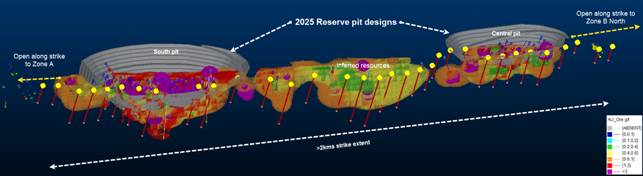
Figure 1. Zone B MRE model, coloured by gold grades (g/t) with planned drill holes layout and reserve pit designs for Zone B South and Central.
Zone B comprises three separate deposits: Zone B South, Zone B Central and Zone B North; all hosted along the same mineralised structural corridor associated with the Sanankoro Structure, located within the hanging wall of the Sanankoro Main Shear Zone ('SMSZ'). Collectively, the three deposits extend over approximately 3.7 km of strike length.
No drilling is currently planned at Zone B North as part of this programme (current JORC compliant MRE of 2.6 Mt at 0.93 g/t Au for 78 koz), with the initial focus directed towards expanding and improving the continuity of mineralisation at Zone B South and Central, where the Company believes there is strong potential for near-term resource growth.
The planned drilling programme at Zone B is designed to:
1. improve resource continuity at depth and reduce irregularities along the lower boundaries of the current MRE model;
2. extend shallow Inferred mineral resources down dip beyond the current base of the MRE pit shells;
3. test for additional mineralisation along strike at both the northern and southern extents of the deposit, where mineralisation remains open; and
4. assess continuity within the transitional and fresh rock domains, supporting the potential for future mine life extensions beyond the current oxide-dominated mine plan.
A representative drill section between Zone B South and Zone B Central highlights the scale and continuity potential of the mineralised system. The mineralised zone is approximately 80m wide and remains open down dip, with current drilling only partially constraining the deeper extent of the system. The section also demonstrates the significant oxide-hosted mineralisation located between the existing reserve pits, further supporting the potential for future resource growth and mine plan optimisation.
Figure 2. Zone B MRE section demonstrating the broad widths and planned drill hole to extend the MRE adding new resources. Stacked pit shells indicate the likely economic viability of extending the resources.
Selin
Selin is the largest individual mineral resource at Sanankoro, currently hosting a JORC compliant MRE of 430 koz (12 Mt at 1.1 g/t Au), and remains a key focus for future resource growth.
Importantly, Selin already contains significant mineralisation extending below the base of the current MRE pit shells generated using a gold price assumption of US$2,400/oz under the JORC Reasonable Prospects for Eventual Economic Extraction ('RPEEE') criteria. The Company believes there remains substantial scope to expand mineral resources both along strike and at depth.
The planned drilling programme at Selin will primarily focus on the southern portion of the deposit, where historical drilling remains relatively shallow and widely spaced, limiting the current interpretation of mineralisation continuity and overall scale potential.
In addition, drilling will target a separate western mineralised zone located outside the current reserve pits, but within the broader US$2,400/oz MRE RPEEE pit shell. Continued definition of this parallel zone has the potential to deliver additional near-pit mineral resources and further enhance the long-term development potential of the deposit.
The planned drilling at Selin is designed to:
1. improve continuity at depth within the current MRE model;
2. extend shallow Inferred mineral resources down dip beyond the current base of the MRE pit shells;
3. test for additional mineralisation at the southern extent of the deposit, with drilling optimally positioned across the main structure; and
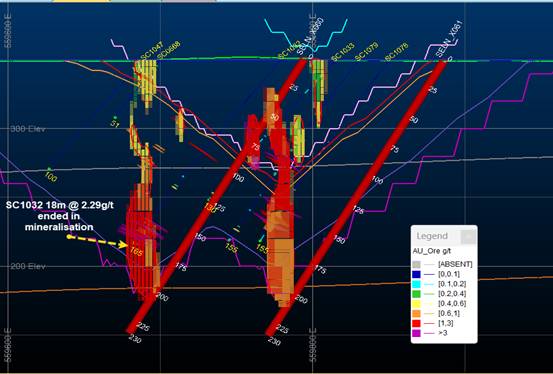
4. define the strike and depth extent of the western mineralised zone (see figure 4 below).
Historical drilling demonstrated the growth potential of the western zone. Drill hole SC1032 intersected 18 metres at 2.29 g/t Au and terminated in mineralisation at 146 metres depth, indicating the system remains open. The upcoming programme will target extensions to this mineralised zone both along strike and down dip.
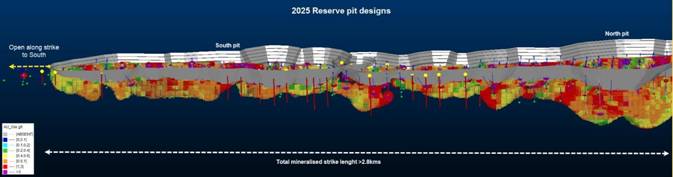
Figure 3. Selin MRE model, coloured by gold grades (g/t Au) with planned drill holes (red lines) and reserve pit designs (North and South pits).
Figure 4. Selin MRE section demonstrating the broad widths and planned drill hole to extend the MRE adding new resources. Stacked pit shells indicate the likely economic viability of extending the resources.
Zone A
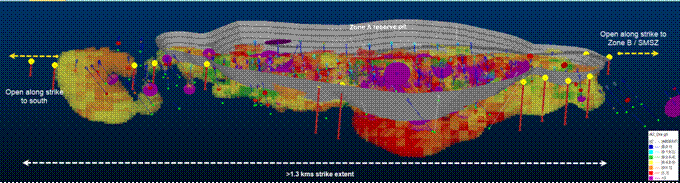
Zone A is the southernmost deposit located along the main Sanankoro structural corridor, a major mineralised trend that controls gold mineralisation over more than 5 km of strike length from Zone A through the Zone B deposits, connecting into the greenfield target of Dakounkoura. The deposit currently hosts a JORC compliant MRE of 210 koz (6 Mt at 1.1 g/t Au).
The planned drilling programme at Zone A is designed to improve the continuity and overall confidence of the existing MRE model, with a particular focus on the southern area of the deposit where mineralisation remains open and current drilling density is relatively limited. The Company believes this work has the potential to support future ore reserve growth through improved resource continuity and additional mineral resource expansion.
Figure 5. Zone A MRE coloured by gold grade (g/t), planned MRE growth drill holes and reserve pit design.
The planned drilling programme at Zone A will focus on:
1. extending higher-grade mineralisation down dip within the central portion of the deposit;
2. improving geological modelling and resource continuity at the southern end of the existing ore reserve pit design; and
3. testing for additional mineralisation along strike at both the northern and southern extents of the deposit, where mineralisation remains open.
A representative drill section at Zone A (see figure 6) highlights the strong continuity of mineralisation and demonstrates that the current MRE model remains constrained by limited deeper drilling. The existing MRE pit shell currently extends to the base of drilling in several areas, indicating potential for further resource growth at depth with additional deeper drilling as shown below.
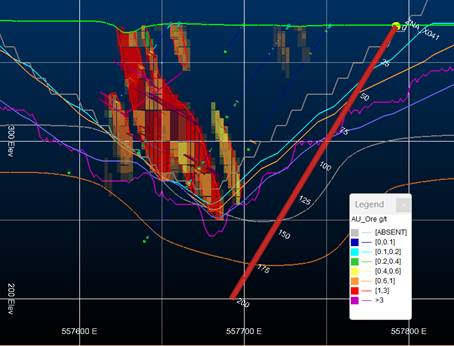
Figure 6. Zone A MRE coloured by gold grade (g/t) with planned drill hole to test for extents to high grade mineralisation.
Zone C
Zone C is currently the only defined deposit located along the footwall of the SMSZ, hosted within the Bokoro or footwall structure. The deposit currently hosts an entirely Inferred JORC compliant MRE of 65 koz (1.8 Mt at 1.1 g/t Au) due to the current drill spacing and therefore does not yet contain ore reserves.
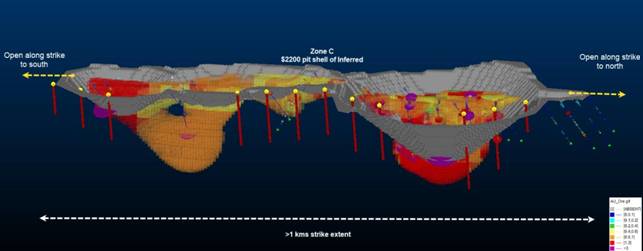
The planned drilling programme at Zone C will focus on the central portion of the deposit, where infill drilling at approximately 50 m spacing is designed to improve geological confidence, strengthen mineral resource continuity and support future resource classification upgrades.
Figure 7. Zone C MRE coloured by gold grade (g/t Au), planned MRE growth drill holes and management case US$2,200/oz pit shells of Inferred mineral resources (not ore reserves)
The planned drilling programme at Zone C will focus on:
1. infill drilling within the central portion of the deposit between the currently modelled northern and southern zones;
2. testing for additional mineralisation along strike at both ends of the deposit, where mineralisation remains open; and
3. extending the higher-grade mineralised zone down dip in the northern portion of the deposit.
The Company believes Zone C represents an important opportunity to both expand the existing mineral resource base and potentially convert portions of the deposit into future ore reserves through improved drill density and enhanced confidence in the continuity of mineralisation.
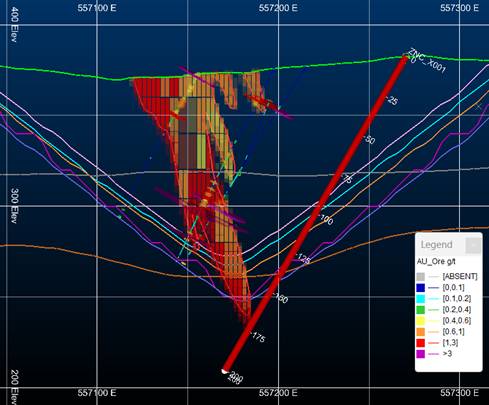
Figure 8. Zone C MRE section coloured by gold grade (g/t Au) with planned drill hole to test for extents to high grade mineralisation.
The drill section above highlights both the higher-grade nature of the deposit and the limited extent of deeper drilling completed to date. The current US$2,200/oz Inferred management case pit shell (light pink line) extends close to the base of the existing MRE model, while the broader US$2,400/oz MRE pit shell also bottoms out at the limit of current drilling.
This indicates that the current MRE remains constrained by a lack of deeper drilling and supports the potential for further resource growth at depth through additional drilling and not by economics.
Greenfields drilling
Approximately 5% of the drill programme budget has been allocated to testing three high-priority greenfield targets for their potential to host shallow, open-pitable oxide gold mineralisation.
The three targets selected for initial evaluation are TRA07, Dakounkoura and Zone B West, all of which are located close to existing defined deposits and planned project infrastructure and could provide a rapid pathway to future resource growth and mine plan expansion if drilling is successful.
Competent Person's statement
The technical information in this release that relates to Exploration Results was reviewed and approved by Mr Murray Paterson, in his capacity as a Competent Person, as required under the AIM Rules for Companies. Murray Paterson is the Head of Geology for the Company and is a member of good standing with the Australasian Institute of Mining and Metallurgy ('MAusIMM'). Mr Paterson has sufficient experience that is relevant to the style of mineralisation and type of deposit under consideration, and to the activity which he is undertaking, to qualify as a Competent Person as defined in the 2012 Edition of the 'Australasian Code for Reporting of Exploration Results, Mineral Resources and Ore Reserves'. Mr Paterson consents to the inclusion in this release of the Exploration Results in the form and context in which it appears.
Market Abuse Regulation ('MAR') Disclosure
Certain information contained in this announcement would have been deemed inside information for the purposes of Article 7 of Regulation (EU) No 596/2014, which is part of UK law by virtue of the European Union (Withdrawal) Act 2018, until the release of this announcement.
**ENDS**
For further information, please visit http://www.coragold.com or contact:
Bert Monro
Craig BanfieldCora Gold Limited
Derrick Lee
Pearl KellieCavendish Capital Markets Limited
(Nomad and Broker)+44 (0)20 7220 0500
Matt Hasson
Franck Nganou
H&P Advisory Limited
(Broker)
+44 (0)20 7907 8500
Susie Geliher
Charlotte PageSt Brides Partners
(Financial PR)
Notes
Cora is a West African gold developer with de-risked project areas within two known gold belts in Mali and Senegal. Led by a team with a proven track-record in making multi-million-ounce gold discoveries that have been developed into operating mines, Cora's primary focus is on developing the Sanankoro Gold Project in the Yanfolila Gold Belt in south Mali into an open pit oxide mine.
Cora has a Probable Reserve of 531 koz at 1.13 g/t Au (US$2,200/oz Au pit shell design). The 2025 Definitive Feasibility Study showed that the Project has strong economic fundamentals, including 98% IRR post tax, US$365 million NPV8 post tax and all-in sustaining costs of US$1,623/oz based on a gold price of US$3,500/oz.
In April 2026, the Company secured a binding US$120 million gold stream which, together with existing equity, fully funds the development of Sanankoro through to production. The agreement also provides flexibility, allowing up to 50% of the stream to be replaced with traditional senior debt within 240 days of approvals, enabling optimisation of the financing structure. With funding in place, the Company is advancing the finalisation of the permitting process with the Government of Mali to enable a swift transition into mine construction.
The Company continues to pursue additional value-enhancing opportunities across its broader portfolio, including the identification of large-scale gold mineralisation potential at the Madina Foulbé exploration permit, located within the Mako Gold Belt of the Kédougou-Kéniéba Inlier in eastern Senegal.
This information is provided by RNS, the news service of the London Stock Exchange. RNS is approved by the Financial Conduct Authority to act as a Primary Information Provider in the United Kingdom. Terms and conditions relating to the use and distribution of this information may apply. For further information, please contact rns@lseg.com or visit www.rns.com.
RNS may use your IP address to confirm compliance with the terms and conditions, to analyse how you engage with the information contained in this communication, and to share such analysis on an anonymised basis with others as part of our commercial services. For further information about how RNS and the London Stock Exchange use the personal data you provide us, please see our Privacy Policy.ENDUPDUPURWQUPQGQA

Recent news on Cora Gold
See all newsBrief: Cora Gold Says Eagle Eye Asset Holdings Indicated To Board Of Cora That It Intends To Restructure Its Affairs With Company
Cora Gold Limited - Sanankoro 2026 MRE Update Drilling: Selin Results
RCS - Cora Gold Limited - Investor Presentation via Investor Meet Company
Cora Gold Limited - FEED and Early Works Progress Update
Cora Gold Limited - Grant of Share Options