Foresight Envr - Annual Report for the Year Ended 31 March 2026
Coversheet
Thursday 18 June 2026
FORESIGHT ENVIRONMENTAL INFRASTRUCTURE LIMITED
("FGEN" or the "Company")
Annual Report and Accounts for the Year Ended 31 March 2026
FGEN, a leading listed investment company with a diversified portfolio of environmental infrastructure assets across the UK and mainland Europe, announces its Annual Report and Accounts for the financial year ended 31 March 2026 (the "Annual Report").
Clear strategy delivers resilient earnings; dividend target met and increased for 12th consecutive year:
· Positive NAV total return for the year of 6.2% and resilient NAV per share of 105.2p (FY25: 106.5p)
· FY26 dividend target of 7.96p met and increased to 8.04p for FY27, representing a current dividend yield of 9.8%
· Prudent balance sheet maintained with conservative gearing at 28.8% (FY25: 28.7%)
Consistent cash generation from a diversified environmental infrastructure portfolio:
· Highly differentiated portfolio of 39 underlying assets continues to contribute strong cash generation
· Several value-accretive follow-on investments made, with a combined IRR in the mid-teens
· Encouraging ramp-up progress made across the Company's growth assets
· Diversification across different markets and sectors actively managing exposure to prevailing market, regulatory and weather volatility
Increasingly well positioned for organic growth and stable, predictable income:
· Board remains focused on progressive dividend strategy, maintaining healthy cover of 1.25x for FY26, post project debt amortisation
· Growth in NAV targeted through continued operational excellence and selective capital recycling
Board changes announced today:
· Ed Warner will step down from the FGEN Board and Nomination Committee with effect from the conclusion of the AGM on 17 September 2026. Stephanie Coxon, currently Senior Independent Director and Chair of the Audit Committee, will succeed as Chair. Alan Bates will be appointed to the role of Senior Independent Director.
Ed Warner, Chair of FGEN, said: "Over the past year, we have made purposeful progress in executing the clear and disciplined strategy we outlined last year: emphasising proactive management of our existing assets, prioritising a core portfolio of environmental infrastructure, and continued delivery of both stable income and long-term capital growth. Our highly cash-generative and diversified portfolio of renewable generation, other energy infrastructure and sustainable resource management assets continues to demonstrate its resilience, delivering predictable returns while reducing exposure to individual market risks.
"Importantly, we are building a self-sustaining model that supports our progressive dividend and growth ambitions organically. While we remain mindful of broader market challenges, we are confident that our strategy, underpinned by strong structural tailwinds from the energy transition and increasing demand for resilient, sustainable infrastructure, positions FGEN to deliver attractive, risk-adjusted returns for shareholders over the medium to long term."
Summary of changes in NAV
NAV per share
NAV at 31 March 2025
106.5p
Dividends paid in the year
-7.9p
Power price forecasts (incl RO/FiT consultation outcome and CPS removal)
-2.0p
Inflation
+1.1p
Uplift from share buy-back programme
+0.7p
Other movements (including discount rate unwind less fund overheads)
+6.8p
NAV at 31 March 2026
105.2p
Key investment metrics
All amounts presented in £million (except as noted)
Year ended
31 March 2026
Year ended
31 March 2025
Net assets¹
655.5
678.7
Portfolio value²
759.1
765.7
Operating income and gains on fair value of investments
44.8
6.0
Net Asset Value per share³
105.2p
106.5p
Distributions, repayments and fees from portfolio³
78.6
90.4
Profit/(loss) before tax
37.2
(2.8)
Gross asset value³
920.1
951.3
Market capitalisation³
423.9
457.0
Share price
68.0p
71.7p
NAV total return for the year
6.2%
0.6%
Annualised NAV total return since IPO³
7.2%
7.3%
Total Shareholder Return since inception³
49.4%
41.0%
Annualised total shareholder return ³
3.4%
3.2%
1. Also referred to as "NAV".
2. Classified as investments at fair value through profit or loss in the statement of financial position.
3. Net Asset Value per share, distributions, repayments and fees from portfolio, total shareholder return, annualised total shareholder
return, market capitalisation, annualised NAV total return since IPO and Gross Asset Value are alternative performance measures ("APMs"). The APMs within the accounts are defined in the 2026 Annual Report.
Annual report
The Annual Report is available on the Company's website at: https://www.fgen.com/investors/reports-and-publications
A copy of the annual report has been submitted to the National Storage Mechanism and will shortly be available at https://data.fca.org.uk/#/nsm/nationalstoragemechanism.
Annual results presentation to equity analysts
Edward Mountney and Charlie Wright, Investment Managers to FGEN, will host a live presentation with Q&A for equity analysts at 10:00 a.m. (UK time) on Thursday 18 June 2026.
Analysts wishing to attend in-person or online, should contact FTI Consulting by email on fgen@fticonsulting.com where further details will be provided.
Retail Investor Webinar
On 22 June 2026, Edward Mountney and Charlie Wright will also host a live presentation on the Company's full year results via Investor Meet Company at 11:30 a.m. BST.
The presentation is open to all existing and potential shareholders. Questions can be submitted pre-event via your Investor Meet Company dashboard up until 9:00 am the day before the meeting or at any time during the live presentation.
Investors can sign up to Investor Meet Company for free, follow FGEN and gain access to the meeting via: https://www.investormeetcompany.com/foresight-environmental-infrastructure-limited/register-investor. Investors who already follow Foresight Environmental Infrastructure Limited on the Investor Meet Company platform will automatically be invited.
Contacts
For further information, please visit www.fgen.com or contact:
Foresight Group +44(0)20 3667 8100
Chris Tanner fgenir@foresightgroup.eu
Edward Mountney
Charlie Wright
Wilna de Villiers
Winterflood +44(0)20 3100 0000
Neil Langford
FTI Consulting +44 (0)7703 330 199
Ambrose Fullalove fgen@fticonsulting.com
Zac Lewis
Apex Fund and Corporate Services (Guernsey)Limited +44 (0)20 3530 3600
Michael Mabaso-Mlilo fgen@apexgroup.com
About FGEN
FGEN invests into environmental infrastructure to deliver stable returns, long term predictable income and opportunities for growth, whilst driving decarbonisation and sustainability.
Investing across renewable generation, other energy infrastructure and sustainable resource management, it targets projects and businesses with an emphasis on long term stable cash flows, secured revenues, inflation linkage and the delivery of essential services. FGEN's aim is to provide investors with a sustainable, progressive dividend per share, paid quarterly, alongside the potential for capital growth.
The target dividend for the year to 31 March 2027 is 8.04 pence per share¹.
FGEN is not formally subject to the EU Sustainable Finance Disclosure Regulation, but voluntarily discloses against the requirements of an Article 9 SFDR fund. It further discloses voluntarily against the UK's Sustainability Disclosure Requirements regime as a 'Sustainability Focus' fund. Beyond its alignment with evolving regulation, FGEN prides itself on its transparent and award-winning approach to ESG.
Further details can be found on FGEN's website www.fgen.com and LinkedIn page.
(1) These are targets only and not profit forecasts. There can be no assurance that these targets will be met or that the Company will make any distributions at all.
Foresight Environmental Infrastructure Limited
Annual Report 2026
About FGENForesight Environmental Infrastructure Limited ("FGEN" or the "Company") is an investment company, investing in a diversified portfolio of private infrastructure assets that deliver stable returns, long-term predictable income and opportunities for growth whilst supporting the drive towards decarbonisation and sustainable resource management.
The Company's portfolio includes 39 assets located across the UK and mainland Europe. FGEN is a Guernsey-registered company with a premium listing on the London Stock Exchange and is a proud constituent of the FTSE 250 index.
Our mission statement
At FGEN, we believe that investors shouldn't have to choose between earning attractive returns and delivering a real‑world positive environmental impact.
FGEN invests into private environmental infrastructure to deliver stable returns, long-term predictable income and opportunities for capital growth. Our strategy spans renewable energy generation, such as wind farms, solar parks and anaerobic digestion ("AD") plants, other energy infrastructure, such as energy storage, cleaner transportation and heat, and sustainable resource management initiatives across the waste and wastewater sectors. This diversified approach enables us to construct a balanced portfolio that is significantly de-risked from weather variability while supporting the provision of essential infrastructure services.
At the same time, we aim to deliver the core financial characteristics associated with traditional infrastructure investments: long-term, stable cash flows, secure and contracted revenues, and inflation-linked returns.
We pursue this diversified strategy to actively participate in the transition to a low-carbon and more resource-efficient economy, which we continue to view as one of the most compelling long-term investment opportunities. Our focus remains on established and resilient sectors underpinned by structural drivers, including decarbonisation, energy security and increasing societal demand for sustainability. Our flexible mandate also allows us to expand into adjacent areas of environmental infrastructure as technologies and markets mature, enabling us to capture a broader range of income and growth opportunities over time.
We invest across three key pillars of environmental infrastructure:
Renewable energy generation
The bedrock of FGEN's portfolio, which includes wind, solar, anaerobic digestion, biomass, energy-from-waste and hydro. With an established income generation profile, these assets provide diversification across different forms of resource and deliver attractive risk-adjusted returns.
71%
Share of portfolio value
Other energy infrastructure
Non-energy-generating assets that support the transition towards net zero, driven by increased demand for electrification and supported by legislation. This segment includes our battery storage units and low‑carbon transport.
11%
Share of portfolio value
Sustainable resource management
Sustainable resource management means applying sustainable practices to ensure that resources benefit both current and future generations. This includes areas such as waste and wastewater treatment, as well as sustainability enhanced agriculture and aquaculture activities.
18%
Share of portfolio value
Our track record
FGEN has a long-term track record of delivering stable, progressive dividends with sustainable dividend coverage, providing investors with an opportunity to invest in a high‑quality stock.
Weighted average discount rate and gearing
FGEN has one of the highest weighted average discount rates ("WADR") with one of the lowest gearing rates as compared to its peer group:
9.9%
Weighted average discount rate
28.8%
Gearing
Gearing is an alternative performance measure ("APM"). The APMs within the accounts are defined in the 2026 Annual Report.
Dividend progression
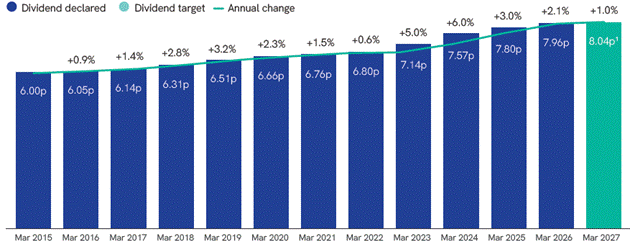
FGEN has consistently grown its dividend since IPO in 2014, reflecting a clear commitment to delivering long-term income for shareholders.
1. This is a target only; there can be no guarantee this target will be met.
Strong cash generation from investments
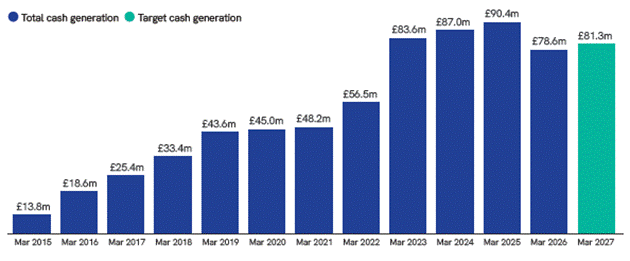
The portfolio's robust cash generation powers sustainable dividend growth and underscores the resilience of our investment strategy.
Performance highlights
Our results summary for the year ended 31 March 2026.
105.2p
NAV per share1
FY25: 106.5p
£655.5m
Net Asset Value ("NAV")
FY25: £678.7m
1,338 GWh4
Renewable energy generated
FY25: 1,272GWh
8.04p (+1%)
2027 dividend target3
FY26: 7.96p (+2.1%)
1.25x
Dividend cover1, 2
FY25: 1.32x
223,140 tCO2e5
GHG emissions avoided
FY25: 193,663 tCO2e
7.2%
Annualised NAV total return1
FY25: 7.3%
£759.1m
Portfolio value
FY25: £765.7m
653,464
Tonnes of waste diverted from landfill
FY25: 703,470 tonnes
28.8%
Gearing
FY25: 28.7%
39 assets
Diversified portfolio
FY25: 40 assets
£614,491
Contributed to community funds
FY25: £587,440
Resilient earnings and NAV:
• Positive NAV total return for the year of 6.2%
• 12th consecutive dividend increase since IPO
• FY27 dividend target represents a yield of 9.8%6
Portfolio diversification underpinning resilience:
• Strong cash generation from underlying assets
• Healthy dividend cover of 1.25x post project debt amortisation
• Diversification strategy actively reduces exposure to market, regulatory and weather volatility
Continued operational excellence:
• Several value-accretive portfolio follow-on investments with a combined IRR in the mid-teens
• Low gearing maintained at 28.8%
• Robust performance across the operational portfolio
• Continued ramp-up progress across the growth assets
1. Annualised NAV total return, Net Asset Value per share and dividend cover are alternative performance measures ("APMs"). The APMs within the Annual Report are defined in the 2026 Annual Report.
2. On a paid basis.
3. This is a target only; there can be no guarantee this target will be met.
4. When FGEN's ownership percentage is taken into account, generation was 1,019,140MWh.
5. When FGEN's ownership percentage is taken into account, avoided emissions were 187,395tCO2e.
6. Based on closing share price at the time of publication, 17 June 2026.
Chair's statement
"Our portfolio is designed to deliver stable and predictable income while creating the conditions for long-term capital growth in a self‑sustaining model without relying on equity fundraising."
Ed Warner
Chair
Overview
The past year has been one of purposeful progress for FGEN. Following the Board's thorough strategic review last year, we set a clear course for the Company, emphasising proactive management of our existing assets, an investment strategy that prioritises a core portfolio of environmental infrastructure, and continuation of our progressive dividend alongside delivery of capital growth. I enjoyed meeting shareholders at our recent Capital Markets Day, where our Investment Manager outlined how the portfolio is designed to deliver stable and predictable income while also creating the conditions for long-term capital growth and a self-sustaining model without relying on equity fundraising. This strategy is being executed with growing momentum, and I am pleased with the progress made across the portfolio during the period.
Performance summary
Against this strategic backdrop, FGEN's performance continues to demonstrate both the resilience and relevance of our approach and the industries we back. The highly cash-generative portfolio continued to deliver robust performance with dividends of 7.96 pence per share declared during the period with healthy dividend cover of 1.25x. This, alongside our low gearing level, places us very favourably among our peer group. The portfolio delivered a total NAV return of 6.2% over the year, with a modest decline in NAV per share from 106.5 pence to 105.2 pence more than offset by the dividend.
This strong performance continues to set us apart, particularly through its breadth and diversification. Our exposure across the three pillars of environmental infrastructure - renewable generation, other energy infrastructure and sustainable resource management - distinguishes the Company within a sector often concentrated in wind, solar and batteries. Our exposure to sectors such as anaerobic digestion and clean transport is delivering attractive risk-adjusted returns and diversification.
This diversity is deliberate. Our pillars are not simply thematic labels, but the foundation of a portfolio designed to reduce exposure to any single risk factor - whether power prices, weather resource, subsidy regimes, feedstock availability or end-market concentration. In today's increasingly complex and uncertain macroeconomic, geopolitical and regulatory environment, that flexibility is more valuable than ever.
Overall, our environmental infrastructure portfolio delivered a solid underlying operating performance, with renewable energy generation broadly in line with budgets.
A defining feature of the investment strategy is the inclusion of growth assets alongside the core income portfolio. FGEN's growth assets - CNG Fuels, the Glasshouse and Rjukan - together represent c.18% of the portfolio and each has passed significant operational milestones this year, demonstrating tangible progress in their ramp-up phase. CNG Fuels continues to scale its renewable biomethane platform; Rjukan is now producing and harvesting trout; and the Glasshouse is increasing commercial activity having successfully supplied eight of the 10 largest UK clinics.
These developments highlight strong execution and underpin the potential for future value creation. They also demonstrate how FGEN's investment trust structure allows for the provision of predictable, long-term capital to our portfolio, while also enabling shareholders to access liquidity through the buying and selling of shares in the market.
Governance and Board matters
Notwithstanding the above, conditions across the investment trust sector remain challenging, and the Board is not complacent about the persistent discount to NAV. FGEN completed a £30 million buyback programme in September 2025 and the fee structure changes introduced in October 2025, directly linking the Investment Manager's remuneration to progress on narrowing the discount, have strengthened alignment with shareholders. As stated at our recent Capital Markets Day, our shared objective is clear: to deliver an 8 to 10% NAV total return per annum, achieved organically and without reliance on equity fundraising.
Throughout the course of the year, the Board met with many shareholders to discuss the refocused strategy and plans to deliver returns in the years ahead. We trust that these ongoing engagements will give investors the confidence to support FGEN's continuation vote at the AGM in September 2026.
FGEN's AGM on 17 September 2026 will mark the end of my tenure as Chair of the Board, and I will step down at that time. I will hand over to Stephanie Coxon, currently Senior Independent Director and Chair of the Audit Committee, who will succeed me as Chair at that point. As part of this transition, Stephanie will step down from her role as Audit Committee Chair, and we have begun a search process to identify her replacement. Alan Bates will assume the role of Senior Independent Director while continuing as Chair of the Risk Committee.
Stephanie's deep knowledge of the Company and the sector will be invaluable, as well as providing continuity as FGEN continues to execute its long-term strategy. She is a highly experienced FTSE 250 non-executive Director, with over twenty years' experience spanning listed companies, investment companies, private equity, infrastructure and real estate. She also previously led PwC's investment trust capital markets team across the UK and Channel Islands for seven years, bringing deep sector expertise to the role.
It has been a privilege to serve FGEN and its shareholders since 2022. I have every confidence in the Board's ability to continue delivering a strategy in which we share deep conviction, and I look forward to following the Company's success as a shareholder in the years ahead.
Outlook
Looking ahead, the Board and the Investment Manager believe that the structural tailwinds underpinning FGEN's strategy remain strong and enduring. The energy transition continues to gather pace, anchored by economic, societal and political drivers and strongly reinforced by recent geopolitical events that highlight the importance of energy security, amplifying demand for energy systems that are both resilient and low carbon.
The scale of investment required in environmental infrastructure is substantial, representing one of the most significant opportunities of our time. Against this backdrop, FGEN's broad mandate provides investors with access to this long-term megatrend, while enabling the Company to capitalise on opportunities with flexibility and discipline as the UK and wider European markets transition to cleaner, more secure and more affordable energy systems.
On behalf of the Board, I would like to thank our shareholders for their continued support; our Investment Manager for their dedication to executing the strategy; and the management teams of our portfolio companies for the operational progress delivered during the year.
Ed Warner
Chair
17 June 2026
Our investment proposition
01. Highly diversified portfolio of environmental infrastructure assets
39 assets across 10 technology sectors
02. Delivering stable and predictable income with 12 years of uninterrupted dividend growth
7.96p dividend target met for FY26
03. Investment strategy supported by long-term megatrends
€660bn annual investment requirement into European energy transition1
04. Active portfolio management approach and deep origination capabilities
185+ infrastructure professionals across investment and asset management
05. Highly contracted income and low merchant exposure
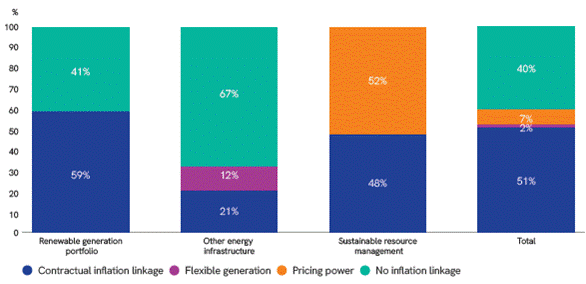
51% of revenues are inflation-linked
06. High-quality, well-resourced and aligned Investment Manager
450+ Real Assets under management
1. Source: https://energy.ec.europa.eu/topics/funding-and-financing/clean-energy-investment_en.
A resilient business model
Our objectives
Financial objectives
• Long-term predictable income growth for shareholders
• Diversification across sectors and geographies for a more robust, risk‑adjusted return
• Potential for capital growth
ESG objectives
• Promote the efficient use of resources
• Develop positive relationships with the communities in which FGEN operates
• Ensure effective and ethical governance across the portfolio
How we deliver on our objectives
01. Acquire
• Effective use of Foresight's network to originate investment opportunities
• Screened to meet FGEN's environmental infrastructure mandate
• Comprehensive due diligence processes to assess risks, valuation assumptions and ESG considerations
• Multi-level investment approvals
02. Develop, construct, maintain
• Active asset management through various stages of maturity
• Strong focus on risk identification and mitigation
• Seek partnerships with experienced partners to secure future pipeline opportunities
• Third‑party service providers monitor and manage day‑to‑day performance to meet ESG objectives
03. Enhance
• Improve operational and financial performance
• Identify value enhancement opportunities
• Ongoing cost management and efficiency improvement
• ESG KPIs are used to monitor progress and enhance performance
04. Hold/exit
• Cash yield supports dividend target
• Seek to deliver capital appreciation in the medium term through the disposal of growth assets once fully ramped up
Outcomes for shareholders
• 7.2% annualised NAV total return since IPO
• 7.96 pence dividend target for 2026 comfortably met
• 12th successive year of dividend growth
• 9.8% dividend yield1
Underpinned by
Risk management -read more about risk management in the 2026 Annual Report
Strong governance - read more about governance in the 2026 Annual Report
Financial management - read more about financial management in the 2026 Annual Report
1. Based on the closing share price at the time of publication, 17 June 2026.
Consistently delivering on our strategic priorities
"In June 2025, following a thorough and disciplined strategic review, the Board set a clear course for the Company. We committed to more proactive portfolio management and to a refocused investment strategy centred firmly on environmental infrastructure."
"This approach encompasses both stable, income‑generating assets and the delivery of capital growth through our growth assets. Alongside this, we reaffirmed our long‑standing commitment to a progressive dividend, fully covered by portfolio cash flows. The strategy is now being executed, and we believe it has strong and growing momentum.
Ed Warner
Chair
Strategic priorities
Continuation of the progressive dividend
Proactive management of existing portfolio
Delivering long-term
organic NAV growth
• Maintain the Company's progressive dividend policy, with 2027 dividend target increased by 1% to 8.04 pence per share1, supported by resilient cash generation from the diversified operational portfolio.
• Dividend cover expected to remain comfortable, underpinned by core environmental infrastructure revenues and disciplined portfolio management.
• Preserve the income-led proposition while pursuing growth from within the existing portfolio, without reliance on new equity issuance.
• Maintain high-performing operational assets through active management of availability, production, costs, contracts and risk.
• Continue value enhancement initiatives across the existing portfolio, supported by Foresight's operational, commercial and technical capabilities.
• Progress operational and revenue ramp-up across CNG Fuels, Rjukan and the Glasshouse to support medium-term value creation.
• Maintain prudent balance sheet discipline, with capital allocation decisions assessed against debt reduction, reinvestment and shareholder returns.
• Deliver organic NAV growth through operational performance, disciplined reinvestment and potential realisations from maturing growth assets.
• Use capital recycling to renew the portfolio, targeting core environmental infrastructure opportunities offering income, growth and attractive risk-adjusted returns.
• Maintain strategic flexibility over the timing and scale of disposals, based on value, buyer appetite and portfolio needs.
• Build a self-sustaining model capable of delivering income and NAV growth without reliance on equity fundraising.
1. This is a target only; there can be no guarantee this target will be met.
Our strategic priorities in action
Case study: The role of biomethane in the UK
Biomethane is playing an increasingly important role in the UK's transition to a low‑carbon energy system. As a direct substitute for fossil natural gas, it can be injected into the existing gas grid and used across heating, industry, transport and flexible power generation, without requiring significant new infrastructure. This compatibility makes it one of the most scalable and system‑ready decarbonisation solutions available today.
Sector
Renewable energy generation - anaerobic digestion
Current feedstock
Food waste, agricultural crops, agricultural residues, manure
Accreditation
RHI, FiT
Basis of FGEN valuation
Discounted cash flow ("DCF")
31 March 2026 valuation
£166m / 21% of FGEN's portfolio
Life extension NAV uplift
+£8.7m / +1.4p NAV
Industry analysis continues to reinforce biomethane's strategic relevance. Market studies continue to highlight its critical role in decarbonising "hard‑to‑electrify" sectors, including heavy transport, industrial heat and dispatchable generation. Independent research commissioned from a leading independent biomethane consultancy indicates that, even under conservative regulatory scenarios, future demand for biomethane remains resilient, driven by legislated decarbonisation targets and fuel mandates.
In particular, transport - both road and maritime - is expected to become a key source of long‑term demand, alongside continued use in buildings and industry. Importantly, this demand outlook is driven by compliance markets, rather than voluntary corporate purchasing, providing a more robust and predictable foundation for long-term valuation.
Beyond energy generation, anaerobic digestion ("AD") assets deliver additional environmental benefits, including waste management, recycling of organic materials and production of nutrient‑rich fertiliser. Increasingly, they are also being positioned as platforms for future revenue streams, such as biogenic CO₂ capture, further enhancing their importance within the UK's broader circular economy.
Extending the lives of assets beyond the RHI
During the year, the Investment Manager has continued to progress a portfolio‑wide initiative to extend the operational lives of its biomethane assets beyond the expiry of Renewable Heat Incentive ("RHI") and Feed‑in Tariff ("FiT") support. Historically, UK AD plants were often valued only to the end of these subsidy periods. Now, there is growing consensus that this is an overly conservative approach that does not reflect the intrinsic value of these assets as long‑term infrastructure.
Foresight's strategy is based on reassessing each asset's ability to operate economically after subsidy expiry, taking into account feedstock security, asset integrity and the evolving market for low‑carbon gas. This reflects a broader shift across the sector - from viewing AD as subsidised energy generation to being recognised as self-sustainable enduring infrastructure, capable of generating diversified revenue streams.
A combination of commercial modelling, independent market analysis and detailed technical due diligence underpins this approach. Across the portfolio, FGEN has undertaken engineering reviews to identify the capital investment required for long‑term operation, including major equipment refurbishment, replacement cycles and optimisation of plant performance. This ensures that life extension assumptions are supported by realistic and deliverable capital plans rather than passive run‑off scenarios.
Delivering long-term value
The outcome of this work has been a more resilient and forward‑looking valuation framework for the portfolio. By incorporating credible post‑subsidy cash flows supported by biomethane demand projections, phase one of the initiative has resulted in the recognition of approximately £8.7 million of incremental value across seven of the Company's 11 AD investments - equivalent to 1.4 pence per share on NAV - being the assets with the most compelling extension potential.
We believe that these assumptions remain prudent. Valuations are based on regulated market drivers and exclude higher voluntary green premiums that may emerge over time, ensuring that recognised value is grounded in observable policy frameworks.
Looking ahead, FGEN continues to explore additional opportunities to enhance asset value and extend lives across the remaining AD assets, including the integration of biogenic CO₂ capture and participation in emerging carbon markets. These initiatives have the potential to further diversify revenues and strengthen the role of biomethane as critical decarbonisation infrastructure.
A long-term infrastructure perspective
FGEN's work over the past year demonstrates the evolving investment case for biomethane. Rather than approaching subsidy expiry as an endpoint, the Company is actively positioning its assets for continued operation and value creation over the long term.
By combining disciplined technical planning with robust market analysis, FGEN has reinforced its strategy of owning and operating essential infrastructure that supports the UK's net-zero ambitions - while delivering sustainable, inflation‑linked returns for shareholders.
Our top 10 assets by portfolio value
1. Cramlington
Sector: Renewable energy generation - Biomass
Location: UK
% of portfolio: 9%
2. Rjukan
Sector: Sustainable resource management - Controlled environment
Location: Norway
% of portfolio: 7%
3. CNG Fuels
Sector: Other energy infrastructure - CNG
Location: UK
% of portfolio: 7%
4. Vulcan
Sector: Renewable energy generation - AD
Location: UK
% of portfolio: 6%
5. The Glasshouse
Sector: Sustainable resource management - Controlled environment
Location: UK
% of portfolio: 5%
6. Amber
Sector: Renewable energy generation - Solar
Location: UK
% of portfolio: 5%
7. Llynfi
Sector: Renewable energy generation - Wind
Location: UK
% of portfolio: 5%
8. ELWA
Sector: Sustainable resource management - Waste management
Location: UK
% of portfolio: 5%
9. Dungavel
Sector: Renewable energy generation - Wind
Location: UK
% of portfolio: 4%
10. Bio Collectors
Sector: Renewable energy generation - Waste AD
Location: UK
% of portfolio: 4%
Sector split1
Split by portfolio value
39 assets
Renewable energy generation
71%
Sustainable resource management
18%
Other energy infrastructure
11%
Split by geography
UK
90%
Rest of Europe
10%
Split by operational status
Operational
99%
Construction
<1%
Key performance indicators
NAV total return (annualised)
7.2%
2026
7.2%
2025
7.3%
2024
8.0%
2023
9.3%
2022
8.7%
Definition and rationale
Measure of financial performance of the Company since IPO on an annualised basis and after taking into account dividends paid to shareholders and net of management fees, operating expenses and finance costs.
Link to Fund objectives:
Long-term predictable income growth for shareholders
Potential for capital growth
KPI performance
• Annualised NAV total return since IPO of 7.2%. The portfolio continues to show good levels of resilience, with the dividend target being comfortably met for the year and underlying assets performing well.
Objectives for 2027
• Continue to apply a disciplined approach to capital allocation that includes selective follow-on investment into value-accretive portfolio opportunities.
Dividend
7.96p
2027 target
8.04p
2026
7.96p
2025
7.80p
2024
7.57p
2023
7.14p
1. This is a target only; there can be no guarantee this target will be met. Past performance is not indicative of future performance and is not guaranteed.
Definition and rationale
Aggregate dividends declared per share in respect of the financial year, with provision of income to shareholders being a key element of the Company's business plan.
Link to Fund objectives:
Long-term predictable income growth for shareholders
KPI performance
• 7.96 pence dividend declared for the year, in line with the stated target, and comfortably covered by cash received from the portfolio.
Objectives for 2027
• Target dividend for the next financial year of 8.04 pence, up 1% from 2026.
Dividend cover
1.25x
2027 guidance
1.20x - 1.30x
2026
1.25x
2025
1.32x
2024
1.30x
2023
1.51x
Definition and rationale
Operational cash flow divided by dividends paid to shareholders during the year, being a key measure of performance of underlying investments from year to year.
Link to Fund objectives:
Long-term predictable income growth for shareholders
KPI performance
• 1.25x dividend cover for the year, in line with expectations.
Objectives for 2027
• Continue to deliver income from underlying investments in order to maintain a well‑covered dividend for the financial year.
NAV per share
105.2p
2026
105.2p
2025
106.5p
2024
113.6p
2023
123.1p
2022
115.3p
Definition and rationale
Reflects the net assets of the portfolio divided by the closing number of shares in issuance at the reporting date, enabling investors to gauge whether shares are trading at a premium or a discount by comparing the Net Asset Value per share with the share price.
Link to Fund objectives:
Long-term predictable income growth for shareholders
Diversification across sectors and geographies for a more robust, risk‑adjusted return
Potential for capital growth
KPI performance
• NAV of £655.5 million, down from £678.7 million at 31 March 2025, following dividend, new investment, disposals and share buybacks.
• NAV per share of 105.2 pence, down 1.2% compared to 31 March 2025.
• 6.2% NAV total return for the 12 months ended 31 March 2026.
Objectives for 2027
• Continue to progress portfolio value‑enhancement initiatives and ramp up the growth assets to drive NAV growth.
Gearing
28.8%
2026
28.8%
2025
28.7%
2024
31.2%
2023
27.3%
2022
23.7%
Definition and rationale
An illustration of the Company's exposure to project and Fund‑level debt as a proportion of overall Gross Asset Value, allowing investors to ascertain financial risk in the Group's balance sheet.
Link to Fund objectives:
Long-term predictable income growth for shareholders
KPI performance
• Managing floating rate debt remains a key priority for the Company and low gearing has been maintained - supported by strong cash generation.
Objectives for 2027
• The Company will continue to carefully manage its debt facilities in a prudent manner and to balance opportunities to further reduce floating rate debt against other capital allocation priorities.
Cash yields
£78.6m
2026
£78.6m
2025
£90.4m
2024
£87.0m
2023
£83.6m
2022
£56.5m
Definition and rationale
A key measure of performance from the underlying portfolio.
Link to Fund objectives:
Long-term predictable income growth for shareholders
Diversification across sectors and geographies for a more robust, risk‑adjusted return
KPI performance
• Solid cash generation from investments, comfortably covering the dividend and funding repayment of floating rate debt.
• Cash yields lower than previous year due to high power price fixes rolling off but in line with opening annual budget.
Objectives for 2027
• To continue to distribute available cash from underlying projects in line with financial budgets set at the start of the year, in support of the Company's capital allocation objectives.
Past performance is not indicative of future performance and is not guaranteed.
Markets and opportunities
Overview
Environmental infrastructure remains one of the most significant investment opportunities of this era. The market continues to expand across renewable energy generation, other energy infrastructure and sustainable resource management, supported by the need to decarbonise power, heat, transport, industry and resource use. The period since March 2025 has reinforced both the scale of this opportunity and the importance of regulatory stability, as governments seek to accelerate decarbonisation while managing affordability, energy security and industrial competitiveness.
In the UK, the Clean Power 2030 Action Plan has provided a clearer pathway for the power sector, with significant further investment required in renewables, storage, flexibility and networks. The UK's decision to retain a national wholesale electricity market, under the Reformed National Pricing programme, has also removed a material uncertainty for investors, although further reforms to network charging, balancing, constraints management and locational signals remain important, as does the proposal for wholesale CfDs for existing low-carbon generators.
At the same time, the UK Government's decision to switch Renewables Obligation indexation from RPI to CPI from April 2026 highlights that regulation can create headwinds as well as tailwinds. While the more punitive freeze option was not pursued, the change has increased investor focus on regulatory risk and the durability of contracted and subsidy-backed revenues. FGEN's diversified mandate is therefore particularly relevant in the current environment, providing exposure across multiple technologies, revenue frameworks and end markets rather than relying solely on renewable power generation.
In Europe, the adoption of a legally binding 2040 climate target of a 90% net reduction in greenhouse gas emissions compared with 1990 levels provides an important long-term signal for investment across clean energy, industrial decarbonisation, carbon removals and resource efficiency. Alongside this, regulation such as the EU Packaging and Packaging Waste Regulation and continued support for biomethane under REPowerEU demonstrate the breadth of the opportunity beyond electricity generation alone.
FGEN's objective is to participate in this opportunity through three distinct but complementary pillars: renewable energy generation, other energy infrastructure and sustainable resource management. These are not simply thematic labels; they create a portfolio that is less exposed to any single risk factor, whether power prices, weather resource, subsidy regimes, feedstock availability or a particular customer market.
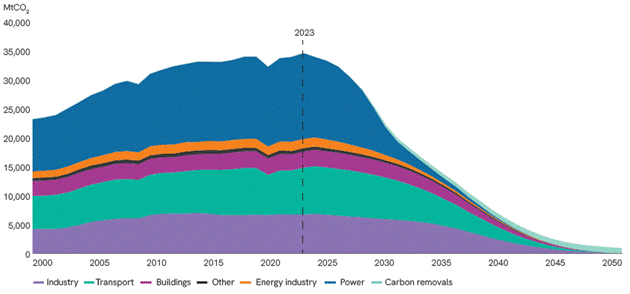
Projected carbon intensities
Source: BNEF 2024.
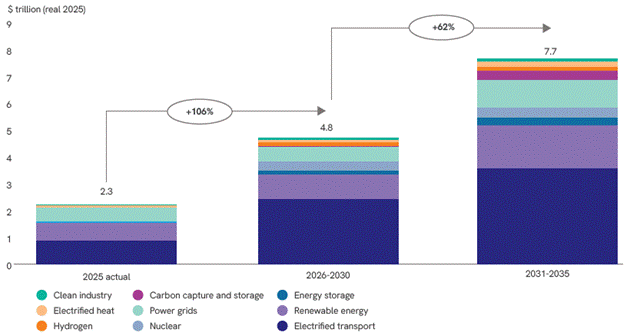
Global energy transition investment by sector
Source: BNEF 2026.
Renewable energy generation
Renewable energy generation remains the bedrock of FGEN's portfolio, diversified across wind, solar, anaerobic digestion, biomass, energy-from-waste and hydro, and generates revenues across a range of regulatory frameworks without an overweight reliance on any one sector or subsidy regime. These assets provide exposure to established infrastructure technologies with attractive income characteristics, including long-term cash flows, inflation linkage and stable production profiles.
Wind and solar remain central to UK and European decarbonisation plans. The UK's Clean Power 2030 pathway requires a significant acceleration in low-carbon generation, while European markets continue to support renewable deployment through auctions, national plans and broader climate commitments. However, this has also reemphasised that renewable deployment is increasingly constrained not by technology readiness, but by grid capacity, connection queues and the speed of network reinforcement.
Grid bottlenecks remain one of the most important barriers to the ongoing buildout of renewables. UK connections reform is intended to move away from a first-come, first-served queue towards a system that prioritises projects that are ready and strategically aligned, while National Grid's Great Grid Upgrade and related transmission investment programmes are critical for the major reinforcement required to move clean electricity from areas of high generation to centres of demand.
The UK policy environment for renewable generation has continued to evolve, notably proposals for a new voluntary Wholesale Contract for Difference for existing wind and solar assets, including legacy Renewables Obligation assets. While subject to consultation, the proposal could exchange the wholesale revenue component for a fixed strike price, potentially decoupling a material proportion of legacy wind and solar generation from wholesale price volatility and extending the visibility of inflation-linked or CfD-style cash flows for operational assets.
Alongside wind and solar, the role of biomethane is increasingly being recognised. Biomethane can directly displace fossil methane in existing gas infrastructure and can contribute to the decarbonisation of heat, transport, industry and agriculture. It also provides wider system benefits through the treatment of organic waste, production of digestate and potential integration with carbon capture to deliver greenhouse gas removals.
This is highly relevant to FGEN's anaerobic digestion portfolio. AD has been a successful part of the Company's evolution, bringing baseload generation and diversification away from intermittent weather-driven assets. As regulatory frameworks for biomethane production, green gas certificates, transport fuels and carbon removals develop further, the Company's existing AD expertise and asset base remain well positioned.
Asset classes
• Wind
• Solar
• Hydro
• Biomass
• Anaerobic digestion
• Geothermal
• Energy-from-waste
"The EU power sector is expected to generate 70% of its electricity from renewables by 2030, and nearly 90% by 2050. However, this profound transformation faces critical challenges, notably the need for substantial power sector capacity and infrastructure investment - cumulatively amounting to €5.6 trillion by 2050"
1. Source: IRENA.
Other energy infrastructure
The transition to net zero requires not only renewable generation, but also the infrastructure that enables clean energy systems to operate efficiently. Investment is required in storage, grid services, balancing, interconnectors, transmission and distribution networks, low-carbon transport and heat decarbonisation. This is the role of FGEN's other energy infrastructure pillar: assets that support the energy transition without necessarily generating power themselves.
The UK's decision not to proceed with zonal pricing has provided welcome clarity for investors, but the Reformed National Pricing programme will still involve meaningful change. Reforms are expected to focus on improving locational signals, reducing constraints, strengthening balancing arrangements and improving the efficiency of system operation. These measures will be important for renewable generators, storage assets and flexible demand, as the power system becomes more decentralised, intermittent and data intensive.
Battery storage remains an important enabling technology, although revenue models continue to evolve. As frequency response markets mature, trading, balancing and constraint management are becoming increasingly important drivers of value. FGEN's existing battery exposure provides diversification and potential upside from greater system flexibility needs, although further investment in the sector would be highly selective and dependent on revenue certainty and risk-adjusted returns. Pumped hydro, synchronous condensers and interconnectors are other examples of asset classes within wider grid infrastructure that can offer greater certainty of revenue via supporting government frameworks and are sectors within which Foresight is already active.
Low-carbon transport is another area where FGEN already has meaningful exposure through CNG Fuels, Europe's largest supplier of 100% renewable biomethane to transport, supplying major UK fleet operators and providing a commercially available solution for HGV operators today. This is particularly important because heavy goods transport remains difficult to electrify at scale, and biomethane offers a practical alternative that can materially reduce emissions while remaining cost competitive. It is a good example of why FGEN's mandate extends beyond renewable power, providing exposure to a different revenue stack and a different set of value drivers from a conventional renewables portfolio.
Heat decarbonisation remains a significant long-term opportunity. The UK and EU continue to support heat networks, district heating, waste heat utilisation and lower-carbon fuels, reflecting the scale of emissions associated with heat. FGEN's existing experience in bioenergy, private wire heat and power, and the Glasshouse's use of surplus heat and electricity from a co-located AD plant, provide practical examples of how energy infrastructure can support decarbonisation beyond the power market alone.
Asset classes
• Short and long-duration storage
• Cleaner transportation
• Interconnectors and transmission assets
• Decarbonisation of heat
"Simply investing in clean electricity generation is not enough. Parallel efforts to strengthen and modernise network infrastructure and system integration are essential."
1. Source: European Commission.
Sustainable resource management
Sustainable resource management means using resources with the future in mind. It includes waste and water management, recycling, circular economy infrastructure and other assets that support more efficient and sustainable use of resources. The sector continues to benefit from strong societal and regulatory tailwinds, particularly as governments seek to address water quality, pollution, waste reduction and resource security.
In the UK water sector, AMP8 represents a record investment period, with £104 billion of expenditure expected between 2025 and 2030. This is intended to support resilience, leakage reduction, storm overflow improvements, pollution reduction, environmental protection and long-term supply security. The scale of this programme creates opportunities across the water infrastructure value chain, including treatment, monitoring, last-mile delivery, digitalisation and localised solutions.
The waste sector is also supported by regulatory change. England's Simpler Recycling rules came into force for workplaces in 2025, requiring most businesses, charities and public sector organisations to separate dry recyclables, food waste and residual waste before collection. These reforms should support demand for food waste collection, recycling, waste processing and anaerobic digestion capacity.
At the EU level, the Packaging and Packaging Waste Regulation entered into force in 2025 as well and will generally apply from August 2026 onwards. The regulation is intended to reduce packaging waste, improve recyclability, increase recycled content and support reuse and refill models, all of which reinforce the direction of travel towards a more circular economy.
For FGEN, sustainable resource management is expected to remain focused on mature environmental infrastructure sectors, particularly waste and water, where assets can display long-term revenue visibility, essential service characteristics and regulatory support. The Company's existing waste and wastewater concessions provide stable diversification away from power markets, while its broader exposure to anaerobic digestion, energy-from-waste and controlled environment assets demonstrates how resource efficiency can align with both environmental impact and infrastructure returns.
The Glasshouse and Rjukan are examples of investments within the wider sustainable resource management theme, and whilst FGEN does not expect to make further standalone controlled environment investments, these assets remain important to the current portfolio's capital growth potential and demonstrate the breadth of environmental infrastructure opportunities that can arise where sustainability, physical assets, operational control and growing end-market demand intersect.
Asset classes
• Waste collection and processing
• Recycling
• Water management
• Sustainable resource production
"The traditional linear model of "take, make, use, dispose" is unsustainable and pushes us beyond planetary boundaries. In a circular economy, products and materials are kept in circulation for as long as possible, and waste and resource use are minimised"
1. Source: European Commission.
The Investment Manager
FGEN is managed by Foresight Group LLP ("Foresight" or "Foresight Group") as its external Alternative Investment Fund Manager ("AIFM") with discretionary investment management authority for the Company.
About Foresight Group
Founded in 1984, Foresight is a FTSE 250 listed investment manager with a focus on real assets and capital for growth. It manages a range of private and public funds, including products tailored for retail investors. The firm develops investment strategies aimed at supporting the energy transition, industrial decarbonisation, nature recovery and the growth of high-potential businesses. Its approach combines financial and operational expertise to enhance asset value and deliver competitive returns.
Foresight's platform
£14bn1
Assets under management
7
Countries across Europe, the UK and Australia
5GW
Renewable energy generation
Foresight Group divisions
Real Assets
79%2
of assets under management
Private Equity
14%2
of assets under management
453
Infrastructure assets
250+
Portfolio companies
Foresight's Real Assets division
1,000+3
Investment opportunities reviewed
185+
Infrastructure professionals
17
Year track record
1. AUM as at 31 March 2026 - relates to continuing operations following the announced agreed sale of Foresight Group's public markets division. All other figures as at 30 September 2025.
2. Totals of data presented in this document may vary slightly from the actual arithmetic totals of such data due to rounding adjustments, with all percentage movements calculated on underlying numbers.
3. For the year 1 April 2025 ― 31 March 2026.
The Real Assets division manages 453 infrastructure assets with a focus on renewable energy generation (including wind and solar power, bioenergy, hydropower and geothermal energy), energy storage and grid infrastructure, as well as sustainable resource management, social and transport infrastructure projects and sustainable forestry assets.
The Real Assets team includes over 185 investment, commercial and technical professionals operating from offices in the UK, Italy, Spain and Australia, and collectively speaking over 10 languages.
The Foresight Real Assets broader strategy is focused on the following:
• making good, consistent returns for investors;
• satisfying the strong demand for ESG and alternative long‑term investment strategies from its institutional and retail investor base;
• building on its ability to execute complex clean energy and other sustainability-led infrastructure investments in order to capitalise on the projected market growth arising from government and societal objectives to decarbonise economies; and
• tapping into the in-house team's multi-national/disciplinary expertise which provides full lifecycle support from investment to exit in order to generate sustainable long‑term asset operation and economic benefits.
A team of over 185 dedicated professionals, bringing a diverse and comprehensive skillset.
The Real Assets investment team
• The Real Assets investment team comprises 41 professionals with broad sector experience
• The team leverages established UK and international networks to access emerging market opportunities
• Equipped to deploy and manage capital across a wide range of infrastructure sectors and asset life stages
• Bringing extensive investment origination and execution capabilities to FGEN
• Over 1,000 investment opportunities have been reviewed in 2025/26 across all strategies
The Asset Management team
• The Asset Management team comprises 69 professionals, including engineers, commercial managers and accountants
• Equipped to manage assets across development, construction and operational stages
• The team uses integrated management systems to ensure effective oversight and co‑ordination of assets
• Focus on asset management and optimisation, particularly in identifying and delivering value enhancement opportunities
Other support functions
• A team of eight dedicated infrastructure investor relations ("IR") professionals managing reporting requirements for institutional investors and overseeing all aspects of communication and engagement with all relevant stakeholders
• A team of four experienced sustainability professionals integrating sustainable practices across investment, portfolio management and IR, utilising proprietary sustainability systems to support decision-making, portfolio oversight and reporting
• Other support functions include finance, marketing, administration and compliance
Foresight's experience and reputation gives a competitive edge in origination of deal flow.
Strong origination capabilities
• Size and breadth of team allows for significant deal origination volume
• A strong track record of execution enables us to unlock relative value
• Co-ordinated origination strategy ensures optimal pipeline selection
FGEN's dedicated investment management team with over 50 years of collective experience.
Edward Mountney
Investment Manager
Edward has been a part of FGEN since 2016 and joined the senior management team in 2022. Before this, he served as Head of Valuations at Foresight Group and John Laing Capital Management. With over 15 years of experience in infrastructure and renewables, Edward is a Member of the Institute of Chartered Accountants in England and Wales. He holds a BA (Hons) in Business and Management from Oxford Brookes University.
Charlie Wright
Investment Manager
Charlie has been at Foresight Group since 2017, recently joining the senior management team for FGEN. He has over 18 years of experience in infrastructure and renewables as an adviser, equity investor and project director, and has overseen a wide range of investments across Europe. He was previously at John Laing Group and KPMG. Charlie holds a BA in History from Exeter University and an ICAEW & CISI Diploma in Corporate Finance.
Chris Tanner
Investment Manager
Chris has been an Investment Manager1 to FGEN since IPO in 2014. He joined Foresight in 2019 as a Partner and has over 25 years of industry experience. Chris is a Member of the Institute of Chartered Accountants in England and Wales and has an MA in Politics, Philosophy and Economics from Oxford University. Chris also serves as Chair of the Finance Forum for The Association of Renewable Energy and Clean Technology ("REA").
1. Prior to January 2022, FGEN engaged Foresight in an investment advisory capacity rather than as the Investment Manager.
The Investment Manager's report
The year in review
Introduction
During the year, FGEN has continued to benefit from the breadth and capability of Foresight Group's infrastructure platform. The Investment Manager's experience across origination, deal structuring, asset management, construction oversight, valuation, sustainability and investor relations remains central to delivering FGEN's broad environmental infrastructure mandate. This breadth is particularly important because FGEN is not simply a collection of renewable power assets; it is a diversified environmental infrastructure company with exposure across energy generation, enabling infrastructure, waste, water and sustainable industries.
The year has been characterised by continued progress against the refocused strategy set out in June 2025. The operational portfolio has continued to deliver resilient cash flows and dividend support, while the growth assets have moved further from construction and early-stage operational risk towards ramp-up, optimisation and value realisation. This combination - income from the operational portfolio and capital growth potential from the growth assets - is central to the Company's investment proposition.
Market conditions for listed infrastructure and renewables companies have remained challenging, with discounts to NAV, elevated interest rates and regulatory uncertainty continuing to influence investor sentiment. In that environment, the Investment Manager has remained focused on what the Company can control: operational performance, value enhancement, engaging with prospective investors, disciplined capital allocation and the creation of a credible pathway to organic NAV growth without reliance on new equity issuance.
Progress against strategy
The June 2025 strategic update was an important moment because it gave a clear articulation of where the Board and Investment Manager believe the Company can create value in the current market, and it has made positive progress against its refocused strategy, with the Board remaining focused on serving shareholders through three things: proactive management of the existing portfolio; an investment strategy that prioritises a core portfolio of environmental infrastructure; and continuation of the progressive dividend alongside delivery of capital growth.
Issuing new equity remains unlikely in the current market environment, so growth has to be delivered from capital already available to the Company, i.e. cash generation from the operational portfolio, selective follow-on reinvestment and potential realisations from asset sales. The growth assets form a meaningful component of this strategy, providing the Company with a clear pathway to organic growth and enabling a differentiated market proposition. FGEN can continue to rely on its cash-generating core portfolio while allowing these growth assets to mature into potential realisation opportunities. This gives the Company strategic flexibility without requiring the sale of core yielding assets that support dividend cover.
FGEN's Capital Markets Day, held on 12 May 2026, provided the opportunity for the Board and Investment Manager to present this strategy in greater detail, as detailed further in the 2026 Annual Report.
A portfolio that evolves with the market opportunity
FGEN has always prioritised diversification from its outset, given the benefits of a lower concentration of risk and a wider set of opportunities. The portfolio has evolved deliberately since IPO and has used Foresight's unique investment track record in environmental infrastructure to strategically respond to where we see the best risk-adjusted opportunities in a gradually shifting landscape.
At launch, the clearest opportunity was core renewables, particularly UK wind and solar, supported by attractive subsidy frameworks. Those assets remain important and continue to provide a meaningful part of the Company's cash generation. As competition in wind and solar increased and returns compressed, the Company expanded into bioenergy, particularly anaerobic digestion. That has been a notably successful part of the portfolio, providing baseload generation, exposure to biomethane and diversification away from purely weather-driven generation.
The portfolio has since evolved into other energy infrastructure and sustainable resource management, including CNG Fuels, Rjukan and the Glasshouse. These assets respond to long-term social, economic and political tailwinds, including decarbonisation, energy security, cleaner transport, sustainable food production and resource efficiency.
This evolution is not a departure from infrastructure discipline. The Company continues to prioritise assets and businesses with infrastructure-like characteristics, including physical asset backing, essential service qualities, revenue visibility, operational control and the potential for attractive risk-adjusted returns. The ability to follow value across environmental infrastructure, while remaining disciplined on risk, is an important differentiator versus narrower renewable generation strategies and will continue to be over the coming years.
Performance summary
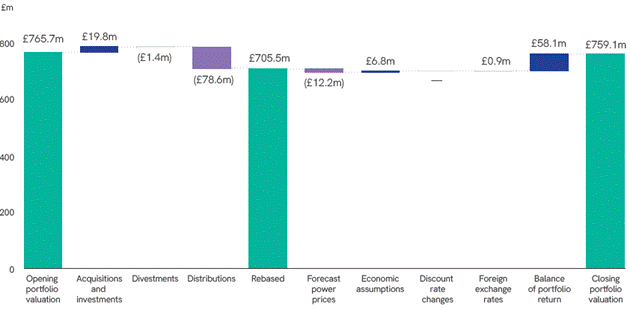
NAV per ordinary share at 31 March 2026 was 105.2 pence, compared with 106.5 pence at 31 March 2025. The Company's portfolio valuation was £759.1 million, compared with £765.7 million the prior year end. The portfolio remained highly cash generative, with cash receipts from investments of £78.6 million, supporting dividend cover of 1.25x for the year.
The Company declared dividends of 7.96 pence per share in respect of the year, in line with the target and continuing FGEN's progressive dividend track record. Gearing at year end was 28.8%, remaining at a prudent level, consistent with the Board's disciplined approach to balance sheet management.
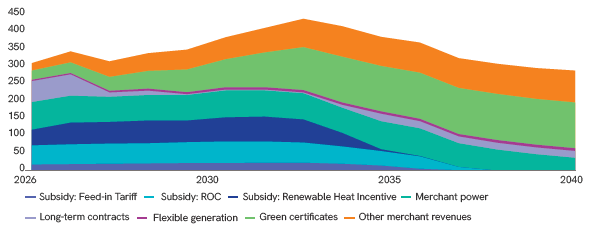
Operational performance across the portfolio was pleasing, with renewable and low-carbon energy generation of 1,338 GWh. The Company's diversified revenue mix - across power, gas, subsidies, certificates, long-term contracts and non-energy sources - continued to support resilience in a period of lower power prices, regulatory change and ongoing macroeconomic uncertainty.
The growth assets made further progress during the period. CNG Fuels continued to grow volumes and develop its market-leading biomethane refuelling platform; Rjukan moved further into operational ramp-up following first harvest; and the Glasshouse continued to expand sales and customer relationships. These assets remain important to the Company's medium-term NAV growth potential.
Investment activity
Investment activity during the period remained disciplined and focused on opportunities connected to the existing portfolio. The Company made follow-on investments into carbon capture across three of FGEN's anaerobic digestion assets, further investment into the pressure reduction system or "PRS 2" at Vulcan AD, and a debt investment into CNG Fuels. These investments were assessed against alternative uses of capital and are considered by the Investment Manager to be value-accretive opportunities within the existing portfolio, delivering a weighted average return in the mid-teens.
The follow-on investments into carbon capture across three AD assets reflect the growing recognition that biomethane assets can play a broader role in decarbonisation. In addition to being value-accretive investments in their own right via the sale of biogenic CO2 as a food-grade product for the UK market, they also act as a key enabler for the life extension of the assets where GHG intensity linked biomethane green premiums are expected to dominate.
Further investment into PRS 2 builds on the success of previous pressure reduction system value enhancement work, which increased gas injection capacity and supported additional revenue generation. This is an example of the Investment Manager's active asset management approach: identifying opportunities within the existing portfolio where targeted capital can unlock additional value.
The debt investment into CNG Fuels supports the continued growth of a platform that is already demonstrating strong operational momentum, and provides FGEN with both equity and debt stakes in the business to bolster its protected position.
Looking forward, future investment activity will continue to be selective and will be measured against other capital allocation options, including debt repayment, buybacks, dividends and liquidity preservation.
Outlook
The Investment Manager remains confident in the long-term opportunity for FGEN. Environmental infrastructure continues to be supported by powerful structural drivers, including decarbonisation, electrification, energy security, grid modernisation, sustainable resource management and climate resilience. These drivers are reinforced by policy frameworks such as the UK Clean Power 2030 agenda, the EU 2040 climate target, AMP8 in the UK water sector and circular economy regulation across the UK and EU.
Whilst there has been some notable political turbulence over the period, including heightened geopolitical tensions due to the ongoing events in Ukraine and the Middle East, we retain an optimistic outlook for the wider environmental infrastructure opportunity, with decarbonisation and the path to net zero underpinned by robust social and economic winds. Foresight's continued investment activity across its private funds provides the wider infrastructure team with ongoing exposure to a broad range of infrastructure sectors and investment stages, spanning development platforms, construction and operational assets. The core FGEN investment management team therefore remains closely aligned with new investment activity and market developments. This ensures the Company is ready to deploy this expertise as soon as capital is available and the investment is value accretive for shareholders.
The near-term focus remains on maintaining the high-performing operational portfolio, delivering value enhancement initiatives, progressing the growth assets through ramp-up and allocating capital with discipline. Over the medium term, the growth assets should provide capital for reinvestment, debt reduction or other value-accretive uses whether that be via disposals or surplus cash generation in excess of the dividend cover. As detailed in the 2026 Annual Report, the Capital Markets Day outlined how cash generation, selective disposals, reinvestment and balance sheet management can support a self‑sustaining model for FGEN. It also demonstrated how the portfolio is now positioned to deliver a progressive dividend, organic NAV growth, low gearing and disciplined capital recycling, without the need for new equity fundraising. The Investment Manager believes this combination positions the Company well to continue delivering attractive risk-adjusted returns while supporting the transition to a more sustainable economy.
Capital Markets Day and strategic outlook
Overview
FGEN hosted a Capital Markets Day in May 2026 to update investors on progress against its refocused strategy and to demonstrate how the portfolio is positioned for resilient income and organic growth. The day included presentations from FGEN's investment management team and from the management teams of the key growth assets, giving investors direct insight into operational progress, market positioning and future value creation potential. Below we summarise the key strategic highlights from the event, focusing on how FGEN's established operational portfolio, maturing growth assets and disciplined capital allocation framework combine to support the Company's long-term objectives.
FGEN strategy into the medium and long term
FGEN's central objective is to maintain a progressive dividend while delivering long-term organic NAV growth. In the current market environment, the strategy is focused on value creation from within the existing portfolio: cash generation from operational assets, selective follow-on reinvestment, potential asset realisations and disciplined capital recycling. In the short term, the priority is to maintain a high-performing operational portfolio, supported by active asset management, cost control, contract management and prudent balance sheet discipline. Over the medium term, FGEN expects to use opportunistic divestments and reinvestment to refresh the portfolio, with timing determined by asset maturity, market appetite and shareholder value. Longer term, the ambition is to sustain a differentiated environmental infrastructure platform capable of delivering income and NAV growth on a self-funded basis.
Operational portfolio with capital growth potential
FGEN's established operational portfolio, covering wind and solar, AD, biomass, energy storage concessions, waste from energy and hydro, remains the resilient income base of the Company. It provides the cash generation that supports dividend cover and underpins the progressive dividend, without depending on the growth assets to contribute near-term income. This operational base is diversified across technologies, revenue frameworks and end markets, reducing reliance on any single power price assumption, subsidy regime or operating exposure. Alongside this, the growth assets provide a distinct and complementary source of potential capital growth. These assets are now operational and progressing through ramp-up, moving from construction risk towards optimisation, cash generation and potential value realisation. The result is a balanced portfolio structure: operational assets support income today, while growth assets create embedded optionality for future NAV growth and strategic flexibility.
A route to organic NAV growth
The Capital Markets Day outlined a credible route to organic NAV growth through operational performance, asset-level maturation, selective realisations and reinvestment. The key conclusion was that FGEN can continue to create value from capital already within the Company, with CNG, the Glasshouse and Rjukan representing a distinct growth component that complements the established operating portfolio. These assets are not held primarily for current cash yield, as, once they reach operational maturity, they can generate NAV growth through cash generation or potential realisations. This makes the growth story additive rather than a substitute for income. Disposal proceeds or excess cash can be reinvested into new environmental infrastructure opportunities that balance income, growth and risk, extending the life of the fund through disciplined value recognition, capital recycling and sector rotation over time.
Strategic flexibility
FGEN's portfolio construction provides flexibility in how value is realised and redeployed. The Company does not need to sell all growth assets, nor does it need to hold them indefinitely. Decisions can be made according to asset maturity, valuation, buyer appetite and broader portfolio priorities, which may include reinvestment, debt reduction or returns to shareholders. This flexibility is enhanced because potential realisations are expected to come from assets held primarily for capital appreciation, rather than from the core income-generating portfolio. As a result, FGEN can refresh and reposition the portfolio over time without undermining dividend support.
Key conclusions
The strategic conclusion from the Capital Markets Day was clear: FGEN's operational portfolio provides resilient cash generation and dividend support; the growth assets provide capital growth potential and future realisation options; and disciplined capital allocation creates a pathway to organic NAV growth. This combination of income resilience, embedded growth potential and capital recycling capability differentiates FGEN as an environmental infrastructure company and supports its long-term ambition to deliver both progressive income and sustainable capital growth.
Our portfolio at a glance
Renewable energy generation
The bedrock of FGEN's portfolio is established income-generating assets focused on diversification across technologies to support the delivery of attractive risk-adjusted returns.
Renewable energy generation 71%
Wind
23%
Anaerobic digestion - crop
16%
Solar
11%
Biomass
9%
Anaerobic digestion - food waste
5%
Energy‑from‑waste
3%
FEIP
3%
Hydro
1%
Technologies1:
Baseload generators:
• Anaerobic digestion
• Biomass
• Energy-from-waste
Intermittent generators:
• Wind
• Solar
• Hydro
Investment attractions:
• Government-backed incentives across a range of mechanisms, including ROCs, RHI and FiTs
• Mature technologies with low operating risk and stable production profiles
• Explicit and implicit inflation linkage
• Diversification of resource risk across different weather patterns, forms of feedstock and power and gas pricing
• Delivering a complementary mix of intermittent and baseload power generation
Potential risks:
• Regulatory changes (REMA, Fixed Price Certificate ("FPC") consultation)
• Merchant electricity and gas prices
• Wind and solar resource
• Cost and supply of feedstock
• Operational issues
1. Excludes FEIP. See the Annual Report for a full list of FEIP assets.
Asset
Location
Ownership
Capacity
(MW)
Commercial operations date
Wind
Bilsthorpe
England
100%
10.2
Mar 2013
Burton Wold Extension
England
100%
14.4
Sep 2014
Carscreugh
Scotland
100%
15.3
Jun 2014
Castle Pill
Wales
100%
3.2
Oct 2009
Dungavel
Scotland
100%
26.0
Oct 2015
Ferndale
Wales
100%
6.4
Sep 2011
Hall Farm
England
100%
24.6
Apr 2013
Llynfi Afan
Wales
100%
24.0
Mar 2017
Moel Moelogan
Wales
100%
14.3
Jan 2003 & Sep 2008
New Albion
England
100%
14.4
Jan 2016
Wear Point
Wales
100%
8.2
Jun 2014
Anaerobic digestion: agricultural crop
Biogas Meden
England
49%
5.31
Mar 2016
Egmere Energy
England
49%
6.32
Nov 2014
Grange Farm
England
49%
6.32
Sep 2014
Icknield Farm
England
53%
7.41
Dec 2014
Merlin Renewables
England
49%
6.32
Dec 2013
Peacehill Farm
Scotland
49%
6.83
Dec 2015
Rainworth Energy
England
100%
2.24
Sep 2016
Vulcan Renewables
England
49%
12.62
Oct 2013
Warren Energy
England
49%
6.32
Dec 2015
Solar
Amber
England
100%
9.8
Jul 2012
Branden
England
100%
14.7
Jul 2013
CSGH
England
100%
33.5
Mar 2014 & Mar 2015
Monksham
England
100%
10.7
Mar 2014
Pylle Southern
England
100%
5.0
Dec 2015
Biomass
Cramlington biomass combined heat and power
England
100%
32.06
2018
Anaerobic digestion: food waste
Codford Biogas waste management
England
100%
3.84
2014
Bio Collectors waste management
England
100%
11.75
Dec 2013
Energy-from-waste
Energie Tecnologie Ambiente ("ETA")
Italy
45%7
16.8
2012
Foresight Energy Infrastructure Partners ("FEIP")
FEIP limited partner ("LP")9
Various
2.9%
n/a
n/a
Hydro
Northern Hydropower
England
100%
2.08
Oct 2011 & Oct 2017
Yorkshire Hydropower
England
100%
1.88
Oct 2015 & Nov 2016
Total
362.2
1. MWth (thermal) and an additional 0.4MWe CHP engine for on-site power provision.
2. MWth (thermal) and an additional 0.5MWe CHP engine for on-site power provision.
3. MWth (thermal) and an additional 0.25MWe CHP engine for on-site power provision.
4. Electrical exporting plant measured as MWe.
5. 10MWth and an additional 1.7MWe capacity through two CHP engines.
6. 26MWe (electrical) and 6MWth (thermal).
7. Not including FEIP's 45% ownership. the 2026 Annual Report for a full list of FEIP investments.
8. Includes a 1.2MW battery storage.
9. See the 2026 Annual Report for a full list of FEIP investments.
Other energy infrastructure
Non-energy-generating assets that support the transition towards net zero, driven by increased demand for electrification and government-backed legislation. This segment includes our battery storage units and low-carbon transport investment.
Other energy infrastructure 11%
Low-carbon transport
7%
Battery energy storage
4%
Technologies1:
• Battery Energy Storage Systems ("BESS")
• Low-carbon transport
Investment attractions:
• Strong cash yield expected from sites once established
• Merchant revenues from the storage assets with a degree of inverse correlation with renewable capture prices, alongside "sticky" revenues across CNG
• Diversification of revenue sources away from power generation
• Capital growth potential
Potential risks:
• Construction risk
• Merchant nature of trading revenue streams
• Evolving market and increased competition
• Shorter track record of operations than for other technologies
Asset
Location
Ownership
Capacity (MW)
Commercial operations date
Battery energy storage
West Gourdie battery storage
Scotland
100%
50.0
May 2023
Clayfords battery storage
Scotland
50%
50.0
Pre-construction
Sandridge battery storage
England
50%
50.0
Dec 2025
Low-carbon transport
CNG Fuels
England
Minority stake2
n/a
Various
1. Excludes FEIP. See the 2026 Annual Report for a full list of FEIP assets.
2. FGEN holds 25% of CNG Foresight Holdings Ltd, which owns 60% of the shares in CNG Fuels Ltd and which holds £150.15 million in 10% preferred return investments issued by CNG Fuels.
Sustainable resource management
Sustainable resource management means using resources with the future in mind. It involves applying sustainable practices to ensure that resources benefit both current and future generations. This includes areas such as waste and wastewater concessions, as well as controlled environments for agriculture and aquaculture.
Sustainable resource management 18%
Controlled environment
12%
Waste and wastewater concessions
6%
Technologies1:
• Controlled environment - agriculture and aquaculture
• Waste and water management
Investment attractions:
• Concession-based projects benefit from inflation-linked, long-term contracts with public sector counterparties
• Controlled environment investments in sustainable technologies with large revenue markets
• Potential for capital growth across Rjukan and the Glasshouse
• Diversification of revenue sources away from power generation
Potential risks:
• Merchant revenues and operational ramp-up at Rjukan and the Glasshouse
• Handback risk at end of ELWA and Tay concessions
Asset
Location
Ownership
Capacity (MW)
Commercial operations date
Controlled environment
The Glasshouse
England
10%
n/a
March 2025
Rjukan aquaculture system
Norway
25%
n/a
August 2025
Waste and wastewater concessions
ELWA waste management
England
80%2
n/a
2006
Tay wastewater treatment
Scotland
33%
n/a
Nov 2001
1. Excludes FEIP. See the 2026 Annual Report for a full list of FEIP assets.
2. 80% of ordinary share capital plus 100% of outstanding loan notes.
Investment portfolio and valuation
Investment portfolio
Diversification is a key factor for the Company, reducing dependency on a single market, technology type or set of climatic conditions, whilst giving exposure to a wide opportunity set, as illustrated in the analysis below as at 31 March 2026, according to share of portfolio value:
Sector split
Wind 23%
Anaerobic digestion - crop 16%
Solar 11%
Controlled environment 12%
Biomass 9%
Waste and wastewater concessions 6%
Low‑carbon transport 7%
Anaerobic digestion - food waste 5%
Energy storage 4%
Energy‑from‑waste 3%
FEIP 3%
Hydro 1%
Geography
UK 90%
Rest of Europe 10%
Remaining asset life
Up to 10 years 15%
11 to 20 years 38%
More than 20 years 47%
Weighted average remaining asset life of the portfolio is 18.5 years.
Operational status
Operational 99%
Construction <1%
Operator exposure
SGRE 15%
Future Biogas 12%
BWSC 9%
Brighter Green Engineering 7%
Hima Seafood AS 7%
Other 50%
Asset concentration
Cramlington (biomass) 9%
Rjukan (CE aq) 7%
CNG Fuels (low-carbon transport) 7%
Vulcan (AD) 6%
Glasshouse (CE ag) 5%
Top 6-10 22%
Other 44%
Valuation method
Discounted cash flow ("DCF") 99%
Cost 1%
Portfolio valuation
The Investment Manager is responsible for carrying out the fair market valuation of the Company's investments, which is then presented to the Directors for their approval and adoption. The valuation is carried out on a quarterly basis as at 30 June, 30 September, 31 December and 31 March each year.
The valuation is predominantly based on a discounted cash flow analysis of the future expected equity and loan note cash flows accruing to the Group from each operational portfolio investment. Where assets are under construction or not yet operational, they are valued at cost until such time as the risks associated with construction have substantially passed. For some technologies with more complex construction activities, this will be when the asset reaches the start of commercial operations, while for others this may be during late-stage construction.
The portfolio valuation uses key assumptions which are recommended by Foresight using its experience and judgement, having considered available comparable market transactions and financial market data in order to arrive at a fair market value. An independent verification exercise of the methodology and assumptions applied by Foresight is performed by a leading accountancy firm and an opinion is provided to the Directors. The Directors have satisfied themselves as to the methodology used and the assumptions adopted and have approved the valuation.
The Directors' valuation of the portfolio at 31 March 2026 was £759.1 million, compared to £765.7 million at 31 March 2025, as shown in the table below. The decrease of £6.6 million is the net impact of divestments; new acquisitions (including follow-on investments); cash received from investments; changes in macroeconomic, power price and discount rate assumptions; and underlying growth in the portfolio. A reconciliation of the factors contributing to the change in the portfolio and the movement in value of investments during the year is shown in the table below:
31 Mar 2026 £m
31 Mar 2025 £m
Valuation of the portfolio at opening balance
765.7
891.9
Acquisitions in the period (including follow-on investments)
19.8
30.7
Divestments
(1.4)
(89.1)
Cash distributions from the portfolio
(78.6)
(90.4)
Rebased opening valuation of the portfolio
705.5
743.1
Changes in forecast power prices
(12.2)
8.8
Changes in economic assumptions
6.8
1.7
Changes in discount rates
-
-
Changes in exchange rates
0.9
(0.9)
Balance of portfolio return
58.1
13.0
Valuation of the portfolio
759.1
765.7
Fair value of the intermediate holding companies
(102.4)
(87.5)
Investments at fair value through profit or loss
656.7
678.2
Allowing for investments of £19.8 million (including follow-on investments and payment of deferred consideration), divestments of £1.4 million and cash receipts from investments of £78.6 million, the rebased valuation is £705.5 million. The portfolio valuation at 31 March 2026 is £759.1 million (31 March 2025: £765.7 million), representing a 7.6% increase over the rebased valuation of £705.5 million during the year.
Valuation assumptions
Each movement between the rebased valuation and the 31 March 2026 valuation is considered below:
Forecast power prices
The project cash flows used in the portfolio valuation at 31 March 2026 reflect contractual fixed price arrangements under PPAs, where they exist, and short‑term forward market prices for the next two years where they do not.
After the initial two-year period, the project cash flows assume future electricity and gas prices in line with a blended curve informed by the central forecasts from three established market consultants, adjusted by the Investment Manager for project-specific arrangements and price cannibalisation.
For the Italian investment, project cash flows assume future electricity prices informed by long-term projections of two leading independent market consultants.
In addition to the usual update of electricity and gas price projections, this year's valuation movement also reflects two regulatory changes. Firstly, in line with the Company's announcement on 14 November 2025, updated assumptions reflecting the outcome of the UK Government's Renewable Obligation and Feed-in Tariffs consultation have been incorporated into the valuation. From 1 April 2026, both schemes will be indexed at the Consumer Price Index ("CPI"). The impact of these changes reduced NAV by £3.1 million, equivalent to 0.5 pence per share.
Secondly, on 16 April 2026, the UK Government announced that Carbon Price Support ("CPS") will be removed from April 2028 onwards. As CPS has historically increased the cost of fossil fuel‑based electricity generation, its removal is expected to reduce the marginal cost of gas‑fired generation - which typically sets UK wholesale power prices - resulting in lower long‑term power price forecasts and a corresponding £2.3 million reduction in NAV, equivalent to 0.4 pence per share. The Investment Manager has assessed this impact in consultation with independent market forecasters; however, the effect is partially mitigated by FGEN's diversified portfolio, which reduces exposure to any single revenue driver.
The overall change in forecasts for future electricity and gas prices compared to forecasts at 31 March 2025 has resulted in a reduction in the valuation of the portfolio of £12.2 million.
The graph below represents the blended weighted power curve used by the Company, reflecting the forecast of three leading market consultants, adjusted by the Investment Manager to reflect its judgement of capture discounts and a normalised view across the portfolio of expectations of future price cannibalisation resulting from increased penetration of low marginal cost, intermittent generators on the GB network. The solid line represents the weighted average realised price forecast - including short-term price fixes under PPAs - whereas the dotted line shows the equivalent merchant price for unhedged generation.
Illustrative blended power price curve
Guarantees of origin certificates
As the portfolio includes a number of renewable energy generation projects, it is able to generate revenue from the sale of Renewable Energy Certificates in addition to income from the sale of gas and electricity. A certificate is issued by Ofgem or the Green Gas Certification Scheme for each unit of renewable electricity or gas generated respectively, and can be sold as part of, or separately from, the offtake contracts in place for the wholesale electricity and/or gas. The certificates received for UK projects are Renewable Energy Guarantee of Origin ("REGO") and Renewable Gas Guarantee of Origin ("RGGO") for electricity and gas, respectively. Being traded on the open market, the price is variable and subject to typical demand and supply dynamics.
In addition to guarantees of origin certificates, the portfolio's investment into CNG Fuels also receives revenue from the sale of Renewable Transport Fuel Certificates ("RTFC") to obligated fuel suppliers to meet their regulatory emissions targets under the UK's Renewable Transport Fuel Obligation ("RTFO"). Certificates are created for each unit of renewable biomethane supplied as a transport biofuel. Certificate issuance depends on the fuel type and level of greenhouse gas savings, with bio-CNG earning 3.8 certificates for every kilogram sold.
As with forecast power prices, valuations reflect contractual fixed price arrangements where they exist, or the following assumptions informed by forecasts provided from a range of independent market consultants where they do not:
31 March 2026
31 March 2025
REGO (£/MWh)
2026-2028: £1.58
2029-2030: £1.34 2031+:£1.30
2025-2028: £5.00
2029+: £2.00
RGGO (£/MWh)
2026-2027: £9.30
2028+: £9.00
2025: £9.50
2026+: £9.00
RTFC (pence/certificate)
2026: 26.8p 2027+: 27p
22p
Following a period of lower pricing in REGO markets over the first half of the year, modelled assumptions have been reduced by the Investment Manager, whereas demand for RGGO certificates continues to remain strong, with pricing supporting a slight increase in near-term valuation assumptions.
RTFC pricing has increased steadily since the Company's investment into CNG, and whilst pricing has softened since the start of the recent conflict in the Middle East, revenues have remained robust due to the Company's forward hedging strategy.
The net result of changes is a decrease in valuation of £2.0 million, equivalent to 0.3 pence per share. The movement is included within the balance of portfolio return item within the valuation bridge.
Revenue analysis
The graph below shows the way in which the revenue mix of the portfolio changes over time for future financial years, given the assumptions made regarding future power prices set out above. As expected, the proportion of merchant revenues increases in later years as the subsidies that projects currently benefit from expire.
On a net present value ("NPV") basis (using the discount rate applicable to each project), the relative significance of each revenue category illustrated above is as follows:
Revenue NPV
5% Subsidy: Feed-in tariffs
16% Subsidy: ROC
15% Subsidy: Renewable heat incentive
25% Merchant power
7% Long-term contracts
2% Flexible generation
13% Green certificates
17% Other merchant revenues
Subsidy revenues, long-term contracts and revenues generated from gas dispensed under contract at CNG Fuels that sit within other merchant revenues in the pie chart, all retain contractual inflation linkage, leading to 51% of total revenues featuring contractual inflation linkage.
Renewable generation portfolio
FGEN's renewable energy generation portfolio includes a combination of intermittent generating wind and solar investments, alongside baseload generating anaerobic digestion, biomass, energy-from-waste ("EfW") and hydropower investments. Revenues in these projects typically consist of a combination of government-backed, inflation-linked subsidies, short-term price fixes contracted under a PPA/GPA, merchant revenue or other revenues such as those earned from private wire contracts.
The Company seeks to minimise the impact of power price volatility through its carefully constructed portfolio of diversified asset types, as well as by maintaining a programme of rolling price fixes for energy it generates, typically having the majority of projects on fixed price arrangements over the near term.
Refer to the power price hedging section in the operational review in the 2026 Annual Report for more detail about the price fixes in place across the portfolio at the year end.
Taking the proportion of merchant revenues hedged under fixed price short‑term PPAs, along with subsidy revenues and revenues from long-term contracts outside of the energy-generating assets, prices have been fixed for 61% of total revenues for the 2027 calendar year. Accordingly, merchant revenues remain a low proportion of revenues and reflect the broader diversification of FGEN's portfolio.
Other energy infrastructure
Mitigating the effects of climate change stimulates not only opportunities connected to energy generation, but also in supporting and enabling energy infrastructure where significant investment is needed to further decarbonise the economy. This is reflected in FGEN's diversified portfolio, which includes grid-scale batteries and low‑carbon refuelling alternatives for heavy goods vehicles.
Batteries
Following successful energisation of Sandridge battery storage this year, FGEN's portfolio now includes two operational and one ready-to-build ("RTB") c.50MW Battery Energy Storage Systems ("BESS").
Revenues from BESS assets can be generated through multiple channels, although third-party consultants continue to highlight the importance of prioritising the capture of trading margins over the more limited opportunities from grid service revenues. As a result, merchant revenues are expected to form the largest component of the revenue model for these assets.
While the sector does not currently benefit from long-term contractual inflation linkage, revenues are typically driven by a margin over costs, which is expected to be sustained regardless of inflationary pressures.
Low-carbon transport
In the case of FGEN's investment into CNG Fuels, an integrated business owning and operating CNG refuelling stations that also sources biomethane for those stations and generates Renewable Transport Fuel Certificates ("RTFCs") in the process, revenues are generated from CNG dispensed and trading activity in biomethane and RTFCs.
Per the terms of its fuel supply contracts, CNG Fuels reserves the right to revise pricing to reflect changes in the wholesale price of natural gas and fuel duty, and will annually adjust prices (upwards only) in line with CPI inflation. Trading revenues flow from the buying and selling of biomethane across European markets and the sale of RTFCs created by the use of biomethane as a transport fuel.
Sustainable resource management
Sustainable resource management means using resources with the future in mind. It involves applying sustainable practices to ensure that resources benefit both current and future generations. This includes areas such as waste and wastewater treatment, as well as controlled environment for agriculture and aquaculture.
Waste and wastewater treatment
This category currently consists of concessions structured under the Private Finance Initiative ("PFI")/Public Private Partnership ("PPP") procurement models where concession payments from the public sector client are highly predictable. Both concession projects, ELWA and Tay, will be going through a process of "handback" over the next few years.
Controlled environment
Controlled environment ("CE") projects typically face a greater level of market risk than environmental infrastructure projects with subsidy support or with long-term contracts. Therefore, the Company has only invested in projects that enjoy a privileged market position over competitors, for example due to physical location, technology or product differentiation.
In the case of FGEN's Glasshouse, the investment is a combination of senior secured shareholder loans that was used to construct the Glasshouse itself, with potential for further uplift from the Company's minority equity investment over time as the business's operations reach maturity. The Glasshouse is co-located with an existing FGEN anaerobic digestion facility, which itself receives an additional source of revenue via a private wire supplying low-carbon heat and power to the Glasshouse.
In the case of CE Rjukan, revenues will primarily be generated from the production and sale of trout. This will be sold to European and international salmonid markets through an agreement with an established Norwegian seafood distribution company with global reach.
Whilst these investments do not currently have long-term contractual inflation linkage, the projects retain pricing power and are expected to increase prices to maintain margins as the underlying cost base inflates.
For more information on both the Glasshouse and Rjukan, see the Capital Markets Day 2026 section on the FGEN website.
The degree of contractual inflation linkage of each category illustrated above is as follows:
The Company's diversification strategy ensures the portfolio benefits from a significant proportion of contracted revenues and revenues earned by non-energy-generating assets. Under current forecasts, dividend cover is expected to be healthily covered for the years ahead.
Useful economic lives
Useful economic lives of assets are based on the Investment Manager's estimates of the period over which the assets will generate revenue and are periodically reviewed for continued appropriateness. Historically, the assumption used for the useful life of investments is the lower of lease duration and 35 years for solar assets, 30 years for wind farms and 20 years for anaerobic digestion facilities - being the life of the RHI subsidy.
In light of growing evidence that AD facilities may be able to successfully operate for longer durations, the Investment Manager has worked with an independent external adviser to assess the potential future value of biomethane beyond the end of the RHI subsidy, informed by current and expected evolution of biomethane policy in the UK and Europe. The consultant has applied this assessment across the FGEN AD portfolio, including revenue stack analysis and cost requirements, taking into account the technical specifications of each facility.
As a result, the Company has recognised a 1.4 pence per share NAV uplift from extending the lives of the seven ADs with the most compelling extension potential, with work ongoing to further assess the remaining ADs in the portfolio.
Economic assumptions
The valuation reflects an update in inflation assumptions based on a combination of actual historic inflation and recent independent economic forecasts.
Valuation assumptions for operational assets are set out below:
Economic assumptions used in the portfolio valuation
Country
Assumption
31 March 2026
31 March 2025
UK
RPI inflation rate
2026: 4.0%
2027-2030: 3.0%
2031+: 2.25%
2025: 3.5%
2026-2030: 3.0%
2031+: 2.25%
CPI inflation rate
2026: 3.0%
2027-2030: 2.5%
2031+: 2.25%
2025: 2.75%
2026+: 2.25%
Deposit rate
2.0%
2.0%
Corporate tax rate
25%
25%
Italy
Inflation rate
2026: 2.5%
2027+: 2%
2.0%
Deposit rate
0%
0%
Corporate tax rate (IRES)
24%
24%
Regional tax rate (IRAP)
4.8%
4.8%
Norway
Inflation rate
2.0%
n/a
Deposit rate
1.2%
n/a
Corporate tax rate
22%
n/a
The euro/sterling exchange rate used to value euro-denominated investments was €1.15/£1, and the rate for Norwegian krone-denominated investments was NOK12.89/£1 at 31 March 2026 (€1.19/£1 and NOK13.55/£1 at 31 March 2025).
The total net increase in value resulting from changes to inflation rates, deposit rates and foreign exchange rates in the year is £7.7 million.
Discount rates
The discount rates used in the valuation exercise represent the Investment Manager's and the Board's assessment of the rate of return in the market for assets with similar characteristics and risk profile. The discount rates are reviewed on a regular basis and updated to reflect changes in the market and in the project risk characteristics.
Despite continued elevated UK gilt yields, market benchmarks continues to indicate support for the Company's valuation assumptions; therefore, no macro-driven changes have been made to discount rates during the period.
However, the Investment Manager also considers project-specific changes, and therefore, there have been some adjustments to the discount rates across the growth assets due to the operational ramp-up progress being made and parts of the AD portfolio due to the life extensions.
Taking the above into account and including an increase in the value of the growth assets in the portfolio since the start of the year, the overall weighted average discount rate ("WADR") of the portfolio has increased to 9.9% at 31 March 2026 (31 March 2025: 9.7%).
The WADR applied to each of the principal operational sectors within the portfolio is displayed in the following table, noting this represents a blend of levered and unlevered investments and therefore the relevant gearing of each sector is also shown.
Unlevered discount rate
Levered discount rate
Sector WADRs
Gearing
Wind
8.0%
8.8%
8.7%
37%
Solar
7.2%
8.0%
7.4%
19%
Anaerobic digestion - crop fed
9.1%
-
9.1%
-
Anaerobic digestion - food waste
9.9%
-
9.9%
-
Biomass
10.3%
-
10.3%
-
Energy-from-waste
10.0%
-
10.0%
-
Hydropower
-
8.0%
8.0%
43%
Waste and wastewater concessions
8.3%
8.8%
8.3%
13%
Battery storage
10.3%
-
10.3%
-
Weighted average
9.9%
16.1%
The table above does not separately disclose discount rates for certain sectors, including controlled environment and low-carbon transport, where the Investment Manager considers the underlying assumptions to be commercially sensitive. The WADR applied to these assets is 14.5% and the relevant assumptions are incorporated within the portfolio WADR of 9.9%.
Balance of portfolio return
This represents the balance of valuation movements in the year, excluding the factors noted above. The balance of the portfolio return mostly reflects the impact on the rebased portfolio value, all other measures remaining constant, of the effect of the discount rate unwinding and also some additional valuation adjustments from updates to individual project assumptions. The total represents an uplift of £58.1 million.
Of this, the key positive items are the uplift of £59.2 million from discount rate unwind, the uplift of £8.7 million from work undertaken to extend the lives of FGEN's AD portfolio as described above and a £7.3 million uplift from the signing of new gas injection contracts at the Company's Vulcan Renewables anaerobic digestion facility, following the successful implementation of operational enhancement initiatives underway to maximise the untapped potential of the gas injection capabilities of the site.
Offsetting these positive movements were a reduction in the value of green certificates discussed earlier and that led to a reduction in value of £4.5 million, as well as extended periods of downtime and additional capex requirements at the Company's biomass and food waste AD facility, resulting in £7.4 million and £5.0 million valuation reductions respectively.
Valuation sensitivities
The Net Asset Value ("NAV") of the Company is the sum of the discounted value of the future cash flows of the underlying asset financial models, construction and development spend, the cash balances of the Company and UK HoldCo, and the other assets and liabilities of the Group less Group debt.
The portfolio valuation is the largest component of the NAV and the key sensitivities are considered to be the discount rate applied in the valuation of future cash flows and the principal assumptions used in respect of future revenues and costs.
A broad range of assumptions is used in our valuation models. These assumptions are based on long‑term forecasts and are not affected by short‑term fluctuations in inputs, whether economic or technical. The Investment Manager exercises its judgement in assessing both the expected future cash flows from each investment based on the project's life and the financial models produced for each project company and the appropriate discount rate to apply.
The key assumptions are as follows:
Discount rate
The WADR of the portfolio at 31 March 2026 was 9.9% (31 March 2025: 9.7%). A variance of plus or minus 0.5% is considered to be a reasonable range of alternative assumptions for discount rates.
An increase in the discount rate of 0.5% would result in a downward movement in the portfolio valuation of £21.2 million (3.4 pence per share) compared to an uplift in value of £23.1 million (3.7 pence per share) if discount rates were reduced by the same amount.
Volumes
Base case forecasts for intermittent renewable energy projects assume a "P50" level of electricity output based on reports by technical consultants. The P50 output is the estimated annual amount of electricity generation (in MWh) that has a 50% probability of being exceeded - both in any single year and over the long term - and a 50% probability of being underachieved. Hence the P50 is the expected level of generation over the long term.
The P90 (90% probability of exceedance over a 10‑year period) and P10 (10% probability of exceedance over a 10‑year period) sensitivities reflect the future variability of wind, hydropower and solar irradiation and the uncertainty associated with the long‑term data source being representative of the long‑term mean.
Separate P10 and P90 sensitivities are determined for each asset, and historically, the results are presented on the basis that they are applied in full to all wind, hydro and solar assets. This implies individual project uncertainties are completely dependent on one another; however, a portfolio uncertainty benefit analysis performed by a third-party technical adviser identified a positive portfolio effect from investing in a diversified asset base.
That is to say that the lack of correlation between wind, hydro and solar variability means P10 and P90 sensitivity results should be considered independent. Therefore, whilst the overall P90 sensitivity decreases NAV by 4.7 pence, the impact from wind, solar and hydro separately is 3.4 pence per share, 1.2 pence per share and 0.1 pence per share respectively, as shown in the chart in the 2026 Annual Report.
Anaerobic digestion facilities do not suffer from similar deviations as their feedstock input volumes (and consequently biogas production) are controlled by the site operator.
Biomass and EfW forecasts are based on projections of future input volumes and are informed by both forecasts and independent studies where appropriate. Revenues in the PPP projects are not sensitive generally to changes in volumes due to the nature of their payment mechanisms.
Electricity and gas prices
Electricity and gas price assumptions are based on the following: for the first two years, cash flows for each project use forward electricity and gas prices based on market rates unless a contractual fixed price exists, in which case the model reflects the fixed price followed by the forward price for the remainder of the two‑year period. For the remainder of the project life, a long‑term blend of central case forecasts from three established market consultants and other relevant information is used and adjusted by the Investment Manager for project‑specific arrangements and price cannibalisation.
The sensitivity assumes a 10% increase or decrease in power prices relative to the base case for each year of the asset life after the first two‑year period. While power markets can experience movements in excess of +/-10% on a short‑term basis, as has been the case recently, the sensitivity is intended to provide insight into the effect on the NAV of persistently higher or lower power prices over the whole life of the portfolio, which incorporates regulatory impacts such as the cessation of Carbon Price Support. The Directors feel that +/-10% remains a realistic range of outcomes over this very long time horizon, notwithstanding that significant movements will occur from time to time.
An increase in electricity and gas prices of 10% would result in an uplift in the portfolio valuation of £36.2 million (5.8 pence per share) compared to a downward movement in value of £36.3 million (5.8 pence per share) if prices were reduced by the same amount.
Assuming all other factors remain constant, if electricity prices were to fall to £50/MWh, with a corresponding decline in gas prices, the Company would continue to maintain a resilient level of dividend cover over the next three financial years. Even in a more conservative scenario, where prices fall to £40/MWh, the portfolio is still expected to generate sufficient cash flows to cover the dividend, though with a reduced margin of headroom.
Uncontracted revenues on non-energy-generating portfolio
Non-energy-generating assets, such as batteries, low-carbon transport and controlled environment agriculture and aquaculture, are not materially affected by either scarcity of natural resource or power price markets. Therefore, the Investment Manager has presented an alternative sensitivity illustrating an assumed 10% increase or decrease on all uncontracted revenues for each year of the asset's life.
An increase in uncontracted revenues of 10% would result in an upward movement in the portfolio valuation of £26.4 million (4.2 pence per share) compared to a decrease in value of £25.0 million (4.0 pence per share) if those revenues were reduced by the same amount.
Feedstock prices
Feedstock accounts for over half of the operating costs of running an AD plant. As feedstocks used for AD are predominantly crops grown within existing farming rotation, they are exposed to the same growing risks as any agricultural product. The sensitivity assumes a 10% increase or decrease in feedstock prices relative to the base case for each year of the asset's life.
An increase in the feedstock prices of 10% would result in a downward movement in the portfolio valuation of £12.5 million (2.0 pence per share) compared to an uplift in value of £11.9 million (1.9 pence per share) if prices were reduced by the same amount.
No such sensitivity is applicable to FGEN's biomass investment, where fuel costs are tied under long-term contracts.
Inflation
Most projects in the portfolio receive a revenue stream which is either fully or partially inflation‑linked. The inflation assumptions are described in the macroeconomic section in the 2026 Annual Report. The sensitivity assumes a 0.5% increase or decrease in inflation relative to the base case for each year of the asset's life.
An increase in the inflation rates of 0.5% would result in an uplift in the portfolio valuation of £13.9 million (2.2 pence per share) compared to a decrease in value of £13.5 million (2.2 pence per share) if rates were reduced by the same amount.
Euro/sterling and NOK/sterling exchange rates
The proportion of the portfolio assets with cash flows denominated in foreign currency represents 10% of the portfolio value at 31 March 2026. If foreign currency strengthens by 5%, the value uplift will be £3.5 million (0.6 pence per share) compared to a £4.1 million (0.7 pence per share) decrease in value if FX weakens by the same amount.
Corporation tax
The UK corporation tax assumptions applied in the portfolio valuation are outlined in the notes to the accounts in the 2026 Annual Report. The sensitivity below assumes a 2% increase or decrease in the rate of UK corporation tax relative to the base case for each year of the asset's life.
An increase in the UK corporation tax rate of 2% would result in a downward movement in the portfolio valuation of £12.3 million (2.0 pence per share) compared to an uplift in value of £12.6 million (2.0 pence per share) if rates were reduced by the same amount.
Sensitivities - impact on NAV at 31 March 2026
The following chart shows the impact of the key sensitivities on NAV per share, with the £ labels indicating the impact of the sensitivities on portfolio value.
FEIP investment portfolio
Below is a list of investments in several European opportunities through the Company's limited partnership in Foresight Energy Infrastructure Partners ("FEIP").
Asset
Location
Capacity (MW)
Commercial operations date
FEIP: FGEN has committed €25 million to FEIP
Avalon solar and green hydrogen
Spain
137MWp
Operational/under construction
Carna pumped storage hydro and co‑located wind
Scotland
210MW
Under construction
Consortium solar
Greece
267MW
Under construction
ETA Manfredonia EfW
Italy
16.8MW
March 2016
Inca pumped storage hydro
Ireland
300MW
Under construction
Kölvallen wind
Sweden
277MW
May 2025
MaresConnect interconnector
Republic of Ireland
750MW
Under construction
Puskakorpi wind
Finland
88MW
Dec 2022
Quartz battery storage
England
106.5MW
Under construction
Skaftåsen Vindkraft AB wind
Sweden
231MW
June 2023
Torozos wind
Spain
93.5MW
Dec 2019
85 Degrees geothermal heat
Netherlands
53MW
Operational/under construction
Beleolico offshore wind
Italy
30MW
July 2022
Blue Jay battery storage
Scotland
99.3MW
Under construction
Operational review
Investment performance
The NAV per share at 31 March 2026 was 105.2 pence, down from 106.5 pence at 31 March 2025.
FGEN has announced an interim dividend of 1.99 pence per share for the quarter ended 31 March 2026, payable on 26 June 2026, in line with the full‑year target of 7.96 pence per share for the year ended 31 March 2026.
The Board has also set a dividend target of 8.04 pence per share for the year to 31 March 2027, the 12th consecutive dividend increase since IPO.
Financial performance
The portfolio delivered cash receipts from investments of £78.6 million for the year, compared with a budget of £80.9 million, representing a shortfall of 2.9% before the impact of expected recoveries. The Company expects to recover approximately £4.2 million through contractual compensation mechanisms, principally in relation to availability and performance protections. Including these expected recoveries, cash generation would have been 2.3% ahead of budget, demonstrating the continued resilience of the portfolio and the value of contractual downside protections across the asset base.
This cash generation supported dividend cover of 1.25x for the year, after amortisation of project-level debt facilities, comfortably within the Company's target range of 1.20x - 1.30x.
The chart below shows the budgeted proportion of cash distributions forecast to be received from underlying investments at the start of the financial year, versus the relative sector-level over or under-performance against this target during the period under review. See overleaf for the equivalent chart showing generation performance of the energy-generating assets versus budget.
Renewable energy generation delivered £66.7 million of cash receipts, 4.7% below budget, with weaker wind and solar performance partially offset by strong performance from anaerobic digestion and biomass assets. Other energy infrastructure generated £3.2 million, 25.1% ahead of budget, driven by the battery storage portfolio. Sustainable resource management assets generated £8.7 million, 4.1% ahead of budget, with wastewater treatment and controlled environment assets performing ahead of expectations. The overall result demonstrates the resilience of FGEN's diversified portfolio and the value of contractual protections, which continue to support predictable income generation and dividend coverage through varying resource and market conditions.
Across the portfolio companies, total revenue generated was £255.8 million and total EBITDA was £82.2 million. The Company operates a diversified portfolio of assets across multiple sectors which supports diversification of the operating risk profile - with both revenues and corresponding margins varying based on the underlying operations of each. For example, wind and solar assets generate electricity through the use of a free natural resource and therefore typically have a lower cost base than an anaerobic digestion facility, which requires a feedstock as part of its energy generation process. To compensate, these anaerobic digestion facilities will also typically have a higher revenue base - as can be seen by the average all-in energy price table below.
Financial performance: budget vs actual project distributions
The average all-in price received by the differing technology classes in the UK for their energy volumes generated in the 12 months ended 31 March 2026 is shown in the table below:
Average all‑in energy price
Year ended 31 Mar 2026
Year ended 31 Mar 2025
Wind
£141 per MWhe
£201per MWhe
AD electric
£261 per MWhe
£262 per MWhe
AD gas-to-grid
£149 per MWhth
£152 per MWhth
Biomass
£169 per MWhe
£184 per MWhe
Energy-from-waste
€126 per MWhe
€133 per MWhe
Solar
£235 per MWhe
£313 per MWhe
Hydro
£337 per MWhe
£295 per MWhe
Operational performance
Overall, the underlying operating performance of the environmental infrastructure portfolio was pleasing. The renewables segment of the portfolio produced 1,338 GWh (2025: 1,272 GWh) of green energy, which was 1.2% below the generation target. When expected compensation (insurance and warranty claims) is taken into consideration, the equivalent portfolio generation was 1,364 GWh, 1.8% above the target for the period.
Renewable energy generation
Power price hedging
FGEN's exposure to wholesale power prices is mitigated by the practice of having a substantial proportion of generation for both electricity and gas on fixed price arrangements for durations ranging from six months to two years. The extent of generation subject to fixes at 31 March 2026 is as follows:
Summer 2026
Winter 2026
Summer 2027
Winter 2027
Wind
82%
69%
15%
15%
Solar
100%
100%
35%
35%
Biomass
-
-
-
-
Energy-from-waste
100%
50%
-
-
AD - electric
100%
100%
-
-
AD - gas
88%
86%
53%
47%
Weighted average
80%
70%
17%
17%
While a large proportion of the summer and winter 2026 capacity was hedged during the period of high gas and power prices in March 2026, the Investment Manager continues to monitor 2027 pricing and beyond.
Since the year end, the Investment Manager has entered into value-accretive power price hedging at its Cramlington biomass facility, for 47% of capacity at £94/MWh for the period between 1 June 2026 and 31 March 2027. A proportion of the remaining capacity is expected to be hedged in the coming months, subject to favourable power price conditions.
Renewable energy: 1,338.4GWh generated, 1.8% above budget1
Baseload generators
Anaerobic digestion - crop
The AD portfolio is the largest producer of energy on a GWh basis generating 43% of the energy produced by the FGEN portfolio. Gas production (measured in GWh thermal) generated 581 GWh2, 11% ahead of its sector target (2025 variance was 0.1% favourable). Of this, the Vulcan PRS 1 value enhancement contributed 74 GWh of biomethane injection to the gas grid as it ramped up operations through the second half of the financial year.
Six of the nine plants outperformed their generation targets, notably strong performances coming from Icknield Gas and Vulcan Renewables, which performed 27.5% and 34.8% above their generation targets respectively, driven by high biogas yields, good availability and ramp-up of the PRS 1 value enhancement at Vulcan. Meden's negative variance (-8.7%) against its generation target was due to issues with the upgrader limiting gas-to-grid flow, while the prolonged ramp-up period following a digester degrit at Peacehill Gas resulted in it finishing the year 5.6% below its target. Rainworth's negative variance (-1.1%) against its generation target was due to a power failure and subsequent membrane replacement works that constrained gas production.
Despite a poor harvest in 2025, all AD plants had access to sufficient feedstock throughout the year due to the purchasing of spot maize earlier on in the year. Due to higher-than-usual rainfall in early 2026, digestate spreading was constrained, resulting in increased storage requirements and costs for some sites. More clamp extension and digestate storage projects are currently in progress to enhance the portfolio's resilience against climate change.
Wholesale gas and power prices gradually declined from April 2025, with a peak in June following the initial Middle East conflict. From late February 2026, gas and power prices spiked with increased volatility following the Middle East conflict and closure of the Strait of Hormuz.
The Investment Manager has taken the opportunity to hedge 85% of the gas generation capacity for summer and winter 2026, and 45% of gas capacity in summer and winter 2027, as seen in the table in the 2026 Annual Report.
1. 1.8% above budget including anticipated compensation. 1.2% below budget excluding compensation.
2. When FGEN's ownership percentage is taken into account, the generation by the AD portfolio was 296GWh, 10.7% above the sector target.
Anaerobic digestion - food waste
Following a series of life cycle maintenance works in the first half of the financial year, Riverside Bio and Codford Biogas successfully returned to steady state performance in the second half.
The portfolio generated 95 GWh over the reporting period, 8.8% below target but a 17% increase compared to 2025 (80 GWh), providing evidence of improved performance.
While Codford is currently operating at maximum capacity, the Investment Manager plans to implement a series of upgrades at Riverside Bio in the next financial year to further increase generation. With the recently implemented Simpler Recycling Legislation requiring commercial businesses and local authorities in England to segregate their food waste, these upgrades will allow more of this available feedstock to be processed.
Biomass
Cramlington generated 143 GWh during the reporting period, representing 11% of total portfolio generation. Performance was impacted by a six-week outage overrun in July 2025 and a series of recurring superheater bundle leaks, resulting in output finishing 25.2% below the annual target. Including compensation payments, the variance narrows to a 15.7% shortfall. Following remediation of the boiler issues, plant reliability and availability improved materially, with performance exceeding budget from March onwards.
The Investment Manager is in early-stage discussions with neighbouring facilities and the county council to supply additional private heat and power.
Energy-from-waste
As previously reported, Energie Tecnologie Ambiente ("ETA") was offline for the first half of the financial year following the turbine alternator short circuit incident in early April 2025. The insurance claim for the incident is ongoing.
The plant returned to service ahead of schedule in October 2025 and has exceeded generation targets since.
Intermittent generators
Wind
The wind portfolio generated 394 GWh during the reporting period, a 13% increase compared to the prior year (2025: 350 GWh). While generation was 5.8% below budget, this reflects a year of improving operational performance. Including estimated compensation payments, equivalent generation increased to 400 GWh, reducing the shortfall to 4.2% against budget. Gross availability across the portfolio reached 93.3%, a significant improvement on 2025 (90.4%), demonstrating continued progress in asset reliability and uptime.
The turbine blade upgrades were completed at MM2 during the year. These upgrades improve aerodynamic performance and are expected to increase annual energy production ("AEP"). A third-party validation report estimates an AEP uplift of 5.6% could be realised as a result of these improvements.
Solar
The solar portfolio generated 70 GWh, representing 5% of the total energy produced by the portfolio - and was 1.6% above budget, supported by positive levels of irradiation across the financial year.
A major inverter refurbishment and a module repowering at the Amber sites was carried out during the year, which is expected to improve performance significantly in the next financial year.
During the financial year, an active PPA hedging strategy continued to be pursued. As a result, 100% of the solar portfolio's capacity has fixed PPA prices for the period from April 2026 to March 2027.
Hydro
The hydro portfolio generated 2.4 GWh, which was 55% below target (2025: 4 GWh). This deficit was primarily due to an exceptionally dry summer and persistently low river levels from late spring through to early autumn 2025.
The hydro assets represent a very small part of FGEN's portfolio, accounting for less than 1% of total energy generation for the year.
Operational performance
Overall, the underlying operating performance of the environmental infrastructure portfolio was pleasing. The renewables segment of the portfolio produced 1,338 GWh (2025: 1,272 GWh) of green energy which was 1% below the generation target. When expected compensation (insurance and warranty claims) is taken into consideration, the equivalent portfolio generation was 1,364 GWh, 1% above the target for the period.
Renewable energy generation
Other energy infrastructure
CNG Fuels (in ramp-up phase)
The CNG refuelling business continues to demonstrate strong growth momentum, with a 19% (10.4 million kg) increase in fuel dispensed year-on-year, driven by ongoing fleet adoption as customers bring new vehicles into service and recently commissioned stations to ramp up utilisation. This reflects the strengthening structural demand for Bio‑CNG as a cost‑competitive and immediately deployable decarbonisation solution for heavy goods vehicles.
The network continues to expand in line with this demand. A new station at Livingston became operational during the year, while construction commenced at Magor, South Wales in October, and planning approval secured for a further site near Swindon (adjacent to the M4) in March 2026, where construction began in May 2026. As at 31 March 2026, CNG had 17 refuelling stations, including the site under construction, maintaining its position as the UK's leading Bio‑CNG refuelling network.
Customer demand remains robust, supported by long-term agreements with major fleet operators. During Q3, CNG Fuels signed an agreement with M&S to supply mobile refuelling solutions across up to four depot locations, further underpinning committed fuel volumes and providing a pathway for continued network utilisation growth. The management team is actively progressing similar arrangements with other key customers.
Increased utilisation across the network, combined with continued station rollout, positions the business well to deliver sustained volume growth and benefit from operating leverage as throughput increases.
Battery storage assets
The FGEN battery portfolio delivered a resilient operational performance during the period, despite increasingly challenging market conditions.
The 50MW Sandridge battery completed commissioning and has begun trading, with full takeover expected in mid-2026. Early performance has been in line with expectations as the asset transitions into steady-state operations.
West Gourdie continued to perform reliably, maintaining strong availability (97.11%) and capturing value across its optimisation strategy, with performance across ancillary services, wholesale markets and the Balancing Mechanism remaining solid relative to prevailing conditions.
Market conditions were more supportive in the early part of the period, with higher wholesale spreads and greater dispatch opportunities. However, performance softened through the summer and early autumn as spreads compressed and Balancing Mechanism activity reduced, limiting optimisation opportunities. While conditions improved over winter, with periods of higher volatility and stronger pricing, these were shorter-lived than in prior years. As a result, wholesale trading remained more opportunistic, and Balancing Mechanism revenues were lower due to fewer and less favourable dispatch events.
Ancillary service revenues remained relatively stable, although increased participation in dynamic services continued to place downward pressure on pricing.
These trends reflect a combination of lower commodity prices, comfortable system margins, evolving generation patterns and continued growth in GB battery capacity, increasing competition across core revenue streams. Increased renewable generation has also reshaped intraday price profiles, leading to more frequent low-price periods and fewer sustained price spikes, with volatility increasingly concentrated into shorter events.
Other battery storage assets (in construction phase)
The sale of the Lunanhead battery development was completed in August 2025, while further options are being explored for Clayfords.
Sustainable resource management
Waste and wastewater concessions
The ELWA waste project continues to deliver strong operational and financial performance in line with expectations. Operational targets were once again exceeded, with landfill diversion reaching 99.85%, significantly outperforming the 67% contractual target. Recycling rates also surpassed expectations at 27.7%, compared to the 22% target. Waste tonnages remained stable throughout the year and were consistent with forecast assumptions.
In March 2026, the Company successfully repaid the remaining senior debt in accordance with the scheduled timeline.
The Tay wastewater project delivered another year of stable operational performance, with no availability or performance deductions recorded during the period. The insurance claim relating to the previously reported dryer fire on 16 September 2025, remains ongoing, with all associated costs having been submitted to the insurer.
Controlled environment - Glasshouse (in ramp-up phase)
During the period, Glass Pharms, the operator of the Glasshouse, continued to ramp up operations, with revenue, gross profit and EBITDA all exceeding budget expectations. Production volumes have grown significantly, increasing by 250% year-on-year, while kilograms of flower sold were broadly in line with forecasts. The company continues to receive funding support from FGEN as it progresses towards consistent cash flow breakeven. In September 2025, it secured £2 million of additional working capital through a convertible loan note ("CLN"), of which £1.25 million has been drawn to date.
The company continues to ramp up sales and is now selling to eight of the 10 largest clinics in the UK - including a contract with one of the largest clinics to provide guaranteed minimum monthly volumes of flower in FY27. In parallel, it continues to strengthen relationships with existing clients while exploring new opportunities, including expansion into overseas markets.
Controlled environment - Rjukan aquaculture (in early ramp-up phase)
Rjukan, FGEN's land-based recirculating aquaculture system ("RAS") trout facility in Norway, made important operational progress during the year. Construction of the facility was substantially completed and commercial harvesting commenced in July 2025, marking the transition of the asset from construction into its operational ramp-up phase. The facility is designed to produce approximately 8,000 tonnes of trout per annum at full production, serving European and international salmonid markets.
Early operations have shown the facility's ability to deliver both good growth rates and harvest weights, and Hima Seafood has also reported positive progress in stabilising key RAS processes, including water quality management and the purging system, which is an important component of product quality. As can be the case with process infrastructure assets, particularly with live organisms working through a system with interlinking processes, the initial ramp-up has also shown that for production to reach full target volumes, certain aspects of the facility require upgrades, primarily oxygen delivery, fish transportation, feeding systems, and wastewater treatments.
Accordingly, the project company, working closely with its technology suppliers and operating team, is implementing the relevant remedial and optimisation actions, meaning a moderation in production volumes over the next couple of years and harvest volumes for the reporting period were also below budget. The company remains reliant on ongoing shareholder support for working capital during the ramp-up period, with funding being provided by shareholders on a pro rata basis.
While there is work to do to progress the facility to full capacity, the investment thesis remains unchanged. As Rjukan fully ramps up, FGEN is positive about the value prospects and retains strategic flexibility as to whether it exits or holds. In addition, the wider thesis remains as important as before - land-based aquaculture is a critical piece of infrastructure for producing sustainable seafood without many of the environmental impacts associated with conventional sea-based production. Similarly, Rjukan's unique characteristics means it benefits from access to high-quality Norwegian freshwater and renewable electricity.
Divestments
Disposal of Lunanhead
In August 2025, the Company announced the sale of its 50% equity stake in Lunanhead, a 50MW lithium-ion Battery Energy Storage System ("BESS") development project located in Perthshire, Scotland.
Lunanhead was jointly owned with Foresight Solar Fund and has been sold to a third-party buyer at a value consistent with the asset's carrying value as at 30 June 2025, which represents less than 0.2% of the Company's total portfolio value. As previously reported, the Investment Manager continues to explore options for Clayfords BESS, in which the Company also holds a 50% stake.
Follow-on investments
Overview
During the period, the Company committed to c.£20 million follow-on investment into the portfolio, with a weighted average return in the mid-teens, applying a disciplined approach where additional capital can enhance value, protect existing positions, support operational maturity or extend the long-term cash generation potential of existing assets. Follow-on investment activity has and will continue to be assessed against competing uses of capital, including debt repayment, buybacks and distributions, and is prioritised where it is expected to support NAV growth, improve cash generation or extend asset life, and is consistent with FGEN's stated strategy.
CNG
The Company approved £6.25 million follow-on funding to CNG Fuels through its participation in a senior debt facility to support the continued rollout of permanent Bio-CNG refuelling stations. FGEN's commitment represents its pro rata share of the facility, consistent with its existing ownership position, and is intended to fund new station construction, including the Magor site in South Wales, alongside future stations that meet agreed drawdown criteria and are approved through the CNG Fuels governance process. The investment rationale is underpinned by the continued growth of renewable biomethane as a commercially available decarbonisation solution for heavy goods vehicles, the strength of CNG Fuels' customer base and the benefits of supporting an integrated platform across biomethane sourcing, station ownership and RTFC generation.
Carbon capture
The Company approved c.£7 million investment into carbon capture projects at three of the anaerobic digestion plants jointly owned with Future Biogas. Such enhancements are an example of the strategic benefits that underpinned the sale of the majority shareholding in the portfolio to Future Biogas, providing greater alignment of incentives between the parties and leveraging Future Biogas' expertise in the sector. The projects involves the installation of Air Liquide CO₂ capture and liquefaction technology at three existing gas-to-grid anaerobic digestion plants - Grange, Egmere and Merlin - to convert otherwise vented biogenic CO₂ into a food-grade liquid product for the UK market. The investment rationale includes creating a new revenue stream from the sale of captured CO₂, and supporting the long-term life extension case for the AD assets as post-subsidy value increasingly depends on demonstrable sustainability credentials and low greenhouse gas intensity. The project is expected to generate attractive value enhancement returns while materially reducing the carbon intensity of the relevant AD assets and strengthening their future strategic relevance within the wider biomethane portfolio.
PRS 2
The Company approved further investment of c.£7 million into the Vulcan Pressure Reduction System Phase 2 project. PRS 2 is an expansion of the initial gas shipping and pressure reduction system at Vulcan Renewables, involving the installation of additional gas download stations to increase the site's ability to receive compressed upgraded biomethane from third-party AD plants and inject it into the gas grid. The project builds on the successful commissioning of PRS 1 and seeks to utilise Vulcan's advantaged RHI accreditation and available network entry capacity through gas supply arrangements with third-party biomethane producers. The investment is expected to deliver attractive value enhancement returns and more broadly, supports the Company's strategy of extracting additional value from core renewable energy assets, increasing biomethane volumes and enhancing long-term cash generation from the AD portfolio.
Other investments
FEIP
FGEN has committed to investing €25 million in Foresight Energy Infrastructure Partners ("FEIP"), a Luxembourg limited partnership investment vehicle. At 31 March 2026, FEIP has invested in 15 projects and is no longer seeking to make new investments.
The investment in FEIP allows FGEN to further diversify its geographic and technology exposure, while also gaining an allocation to construction‑stage assets which is expected to enhance returns.
Given construction-stage assets can only represent a small part of the Company's portfolio, the FEIP investment allows a greater level of diversification than would be possible with direct investments, providing for a more attractive risk-adjusted return profile. FGEN is excused from any FEIP investment that is not consistent with FGEN's investment policy. No management fees are payable on the amounts invested by FGEN. FEIP also owns a 45% stake in ETA, the Italian EfW plant, in which FGEN is also an investor. As at 31 March 2026, €23.2 million has been invested in FEIP.
Financing
On 22 April 2026, FGEN announced that it had signed a one-year extension to its existing £150 million revolving credit facility ("RCF") and has activated a £15 million accordion facility. The additional capacity provides greater headroom to ensure the Company can continue to fund existing commitments and the continued development of its diversified environmental infrastructure portfolio.
As at 31 March 2026, drawings under the RCF were £123.1 million (31 March 2025: £99.3 million).
The RCF provides an increased source of flexible funding outside equity raisings, with both sterling and euro drawdowns available on attractive terms. The facility will principally be used to make future acquisitions of environmental infrastructure investments to add to the current portfolio, as well as covering any working capital requirements.
The interest charged in respect of the renewed RCF continues to be linked to the Company's ESG performance, with FGEN incurring a 5 bps premium or discount to its margin based on performance against defined targets. Those targets include:
• environmental: increase coverage of independent biodiversity assessments and implement initiatives to enhance biodiversity net gain across the portfolio;
• social: increase volume of contributions to local communities; and
• governance: maintain a low number of work-related accidents, as defined under the Reporting of Injuries, Diseases and Dangerous Occurrences Regulations ("RIDDOR") by the Health and Safety Executive.
Performance against these targets will be measured annually, with the cost of the RCF being amended in the following financial year. Lenders to the facility include HSBC, ING, Nationwide Building Society (trading as Virgin Money) and Royal Bank of Scotland International. The margin can vary between 205 bps and 215 bps over SONIA (Sterling Overnight Index Average) for sterling drawings and Euribor (Euro Interbank Offered Rate) for euro drawings, depending on performance against the ESG targets.
In addition to the RCF, several of the projects have underlying project-level debt.
Project-level gearing at 31 March 2026 across the portfolio was 16.1% (31 March 2025: 18.1%). Taking into account the amount drawn down under the RCF of £123.1 million, the overall fund gearing at 31 March 2026 was 28.8% (31 March 2025: 28.7%).
As at 31 March 2026, the Group, which comprises the Company and the intermediate holding companies, had cash balances of £9.0 million (31 March 2025: £7.8 million).
Financing at 31 March 2026
£123.1m
28.8%
drawn on RCF
gearing1
1. Gearing is an alternative performance measure ("APM"). The APMs within the accounts are defined in the 2026 Annual Report.
Risks and risk management
Risks and risk management
FGEN has a comprehensive risk management framework overseen by the Risk Committee, comprising independent non-executive Directors.
Risk is the potential for events to occur that may result in damage, liability or loss. Such occurrences could adversely impact the Company's business model, reputation or financial standing. Alternatively, under a well-formed risk management framework, potential risks can be identified in advance and can either be mitigated or possibly even converted into opportunities.
The 2026 Annual Report detail the principal and emerging risks that the Directors consider are material and which potentially could impact the Company or occur in an environmental infrastructure project such as those invested in by the Company.
In assessing these risks for the purposes of this report, the Directors typically consider the next 12-18 months as being the critical window for risks to materialise. Environmental infrastructure assets are long-term assets and risks can crystallise throughout an asset's life. Nevertheless, this report is intended to give the reader an understanding of the current risk outlook for the Company and the risks that the Board and the Investment Manager feel have the most significance at the present time. This outlook is updated regularly in the publications that the Company puts into the market, so readers can get a sense of how the Board and the Investment Manager's view of risks changes over time.
Given that the Company delegates certain activities to the Investment Manager and Administrator, reliance is also placed on the controls of the Group's service providers.
In the normal course of business, each project will have developed a rigorous risk management framework, including a comprehensive risk register, that is reviewed and updated regularly and approved by its board. The purpose of FGEN's risk management policies and procedures is not to eliminate risk completely, as this is neither possible nor commercially viable. Rather, it is to reduce the consequence of occurrence and to ensure that FGEN is adequately prepared to deal with risks so as to minimise their effect should they materialise.
Risk identification and monitoring
Three Lines of Defence
First Line of Defence ("1LoD"): This consists of functions that manage the risk gateway into the portfolio. They are accountable for and responsible to perform or enable the identification, measurement, management and reporting of risks inherent to the investment activities. This includes the design, operation and ensuring performance and effectiveness of controls.
Second Line of Defence ("2LoD"): This consists of independent risk management and compliance functions which are responsible for establishing Foresight's risk management framework and associated control standards, as well as providing independent challenge over the activities, processes and controls carried out by the first line. Additionally, where agreed with the First Line of Defence and the relevant governance forum, 2LoD can perform and complement the responsibility of identification, measurement, management and reporting of risks, with 1LoD retaining the overall accountability for risk management related to their activities.
Third Line of Defence ("3LoD"): This provides independent risk assurance to the Board and senior management about the adequacy of the overall risk and control framework, and establishes a mechanism for assessing the effectiveness of the risk management and control activities of the first and second lines. FGEN has a separate Risk Committee, comprising five non-executive Directors, which is responsible for overseeing and advising the Board on the current and potential risk exposures of the Company, with particular focus on the Group's principal risks, being those with the greatest potential to influence shareholders' economic decisions, and the controls in place to mitigate those risks. The Board believes that the FGEN Risk Committee provides effective challenge to the risk and compliance frameworks set in place by the Investment Manager. The Board acknowledges that this is not equivalent to an independent internal audit function but that it provides a sufficient and proportionate approach. The Board feels they have a sufficient level of oversight of the internal controls in place.
In the case of new and emerging risks, assessment occurs outside of the quarterly cycle. These systems of internal control were in place for the year under review and continue to be in operation.
Provision 29
Provision 29 of the Corporate Governance Code introduces enhanced expectations for Boards to monitor and review the effectiveness of material controls across financial, operational, reporting and compliance areas, and to provide an explicit declaration of their effectiveness at the balance sheet date. This strengthened requirement is intended to enhance transparency, accountability and assurance for stakeholders. The declaration requirement will apply to the Company for the financial year ending 31 March 2027.
While formal mapping to Provision 29 is ongoing, the Board is taking a proactive approach to readiness. During the year, it has continued to oversee the Investment Manager's risk management and internal control framework, providing regular scrutiny of key controls and their effectiveness.
In anticipation of the new requirements, the Company has adopted a proportionate and structured approach to identifying the key control environment expected to fall within scope. This includes consideration of:
• controls supporting valuations, financial reporting and share issuance/buyback processes;
• controls governing investment decision-making, portfolio monitoring and due diligence;
• operational and resilience controls operated by the Investment Manager, including technology and data governance; and
• compliance controls relating to the Company's regulatory obligations.
Initial work has focused on understanding how key controls align to the Company's principal risks, leveraging the Investment Manager's existing risk management framework. This is helping to strengthen visibility of control ownership, support documentation of control design and enhance the basis for future monitoring of operational effectiveness.
Areas of particular focus during the year have included:
• financial reporting processes and valuation methodologies;
• technology, cybersecurity and data governance;
• oversight of outsourced and third-party service providers, including business continuity and disaster recovery arrangements; and
• fraud risk management and economic crime controls.
The Board will continue to develop its approach to Provision 29 over the coming year, including completing the formal mapping of material controls and enhancing its review processes in advance of the first required declaration.
Risk management framework
FGEN has a comprehensive risk management framework and risk register that assesses: a) the probability of each identified risk materialising; and b) the impact it may have on FGEN. Mitigations and, where applicable, controls have been developed with respect to each risk so as first to reduce the likelihood of such risk occurring and secondly to minimise the severity of its impact in the case that it does occur. The risk register is a "live" document that is reviewed and updated regularly by the Risk Committee as new risks emerge and existing risks change.
The principal risks faced by the Group are formally reviewed by the Risk Committee at each quarterly meeting, and the Committee reports to the Board in respect of changes to the general risk environment and material developments in already identified risks. Each of the underlying projects is overseen by an experienced portfolio manager who reports to their individual project board. The portfolio managers maintain strong relationships between counterparties, contractors, third‑party asset managers and other stakeholders. This ensures effective management of potential risks.
Board of Directors
Audit Committee
Risk Committee
Nomination Committee
ESG Committee
Oversight of service providers
Strategy
Controls
Monitoring
Risk appetite Risk assessment Risk identification
Documentation Mitigation Risk limits
Controls testing Stress testing/sensitivity Audit
Emerging risks
Emerging risks are characterised by a degree of uncertainty, and the Investment Manager and the Board consider new and emerging risks at the Risk Committee which takes place quarterly; the risk register is then updated to include these considerations if required. Furthermore, the Company is advised by various advisers within the listed infrastructure space and the Investment Manager, Foresight, considers emerging risks over a wider market arena.
Examples of emerging risks that have been considered by the Board and Investment Manager during the period include the following:
(i) Ongoing uncertainty over energy market reform in the UK. Whilst the government has confirmed that zonal pricing will not be introduced under REMA, material areas of reform remain outstanding, including the detailed delivery of a reformed national pricing model. In addition, the consultation on ROC Fixed Price Certificates could affect long-term revenue assumptions for ROC-accredited assets, depending on final design and implementation.
(ii) Heightened geopolitical tension arising from the US/Iran conflict and the associated macroeconomic consequences. Escalation in the Middle East has the potential to disrupt energy markets, shipping routes and global supply chains, with implications for oil and gas prices, inflation, interest rate expectations and investor sentiment. These factors could impact asset operating costs, valuation assumptions, financing conditions and the wider attractiveness of listed infrastructure.
(iii) The risk that policy ambition across the UK and European environmental infrastructure is not matched by deliverable regulatory frameworks, planning capacity, grid access and supply chain availability. Governments continue to signal strong support for clean energy, grid modernisation, storage, waste, water and broader environmental infrastructure; however, the pace of delivery remains vulnerable to planning delays, judicial review, grid connection bottlenecks, network charging uncertainty, skills shortages, equipment availability and competing political priorities around affordability and energy security. These factors could delay construction timetables, increase development and operating costs, constrain revenue opportunities and reduce investor confidence in certain technologies or geographies.
This risk map shows our assessment of each area of principal risk after mitigation.
Residual likelihood
Very high
1
High
3
7
2
Medium
4
5, 6, 10
Low
8, 9
Very low
Minimal
Minor
Moderate
Major
Severe
Residual impact
Key:
1. Fund performance and investor sentiment
2. Interest rates
3. Adverse movement in inflation
4. Changes in regulation and government support
5. Capital recycling and liquidity of investments
6. Ramp-up risk
7. Asset exposure to weather resource
8. Exposure to market power prices
9. Operational risk
10. Counterparty risk
FGEN's risk register covers six main areas of risk:
• Strategic, economic and political
• Operational, business, processes and resourcing
• Financial and taxation
• Compliance and legal
• Asset specific
• ESG
This year we are only detailing the most pertinent principal risks affecting the Company. We have identified 10 risks within two of the above-mentioned categories. These risks are summarised below, followed by a detailed discussion of the mitigating factors.
See more on climate-related risks in our Sustainability and ESG report in the 2026 Annual Report.
Risk
Potential impact
Mitigations
Controls
Strategic, economic and political
Risk type
1 Fund performance and investor sentiment
Change in year
New principal risk
Link to Fund objectives
Long-term predictable income growth for shareholders
Potential for capital growth
Residual risk
Medium
A new principal risk, replacing access to capital and covering a broader spectrum of risk. If the Company underperforms its peer group, fails to deliver expected NAV progression or investor sentiment towards the Company or sector deteriorates, demand for FGEN shares may weaken. This could widen the discount to NAV, constrain the Company's ability to raise capital and restrict ability to fund commitments or deliver portfolio growth. Under-performance could also increase scrutiny of the Company's strategy, dividend policy, management arrangements and capital allocation decisions.
The Board and Investment Manager seek to deliver resilient long-term returns through a diversified portfolio, active asset management, disciplined capital allocation and a clear investment strategy focused on core environmental infrastructure. Ongoing shareholder engagement, transparent reporting and regular market updates are intended to support investor confidence. Peer activity, sector discounts, corporate actions and investor feedback are monitored closely.
The Board reviews performance against strategic objectives, peer benchmarks, share rating, shareholder feedback and capital allocation priorities. The Investment Manager provides regular reporting on NAV performance, asset performance, market conditions and investor sentiment. The Board, broker and financial PR adviser support regular shareholder engagement and communications, including around key strategic matters and AGM resolutions.
Risk type
2 Interest rates
Change in year
No change
Link to Fund objectives
Long-term predictable income growth for shareholders
Potential for capital growth
Residual risk
HIgh
Higher or more persistent interest rates may affect the Company in several ways: by increasing discount rates used in asset valuations; reducing portfolio NAV; increasing the cost of floating-rate borrowings; and making alternative asset classes more attractive to investors, which may further affect demand for the Company's shares. Elevated rates may also contribute to wider sector discounts and reduce the availability or attractiveness of debt financing.
The Investment Manager monitors interest rate markets, gilt yields, debt market conditions and peer valuation benchmarks when recommending valuation assumptions. The Company uses fixed-rate debt or interest rate swaps where appropriate at project level, and detailed cash flow modelling is used to assess the impact of changes in interest costs and refinancing assumptions. Maintaining prudent gearing and proactive lender engagement reduces refinancing risk and supports financial flexibility.
Discount rates and financing assumptions are reviewed by the Foresight Valuation Committee and approved by the Board as part of the quarterly valuation process. Portfolio valuations are subject to Board approval, independent review by PwC. Financing structures for new investments or refinancings are reviewed through the Foresight Investment Committee and, where required, the FGEN Investment Committee and Board.
Risk type
3 Adverse movement in inflation
Change in year
No change
Link to Fund objectives
Long-term predictable income growth for shareholders
Diversification across sectors and geographies for a more robust, risk‑adjusted return
Potential for capital growth
Residual risk
Medium
The portfolio has direct and indirect exposure to inflation through subsidies, service contracts, costs, revenues and discount rate assumptions. If inflation is materially lower than valuation assumptions, revenues and portfolio valuations may be reduced. Conversely, higher inflation may increase operating, maintenance, construction or financing costs and may contribute to higher discount rates. Changes to inflation indexation mechanisms, such as shifts from RPI to CPI, may also reduce expected revenue growth.
A significant proportion of portfolio revenues benefit from contractual inflation linkage or pricing power, providing a degree of natural inflation protection. Inflation assumptions used in valuations are reviewed regularly against market forecasts and economic data. The Board retains discretion over the extent of dividend increases and considers inflation, cash generation, dividend cover and long-term sustainability when setting dividend targets.
Inflation assumptions are reviewed through the Foresight Valuation Committee and approved by the Board as part of the quarterly valuation process. Portfolio valuations are independently reviewed by PwC. The Board monitors dividend cover, cash flow forecasts and inflation sensitivities when considering distributions and capital allocation.
Risk type
4 Changes in regulation and government support
Change in year
No change
Link to Fund objectives
Long-term predictable income growth for shareholders
Diversification across sectors and geographies for a more robust, risk‑adjusted return
Potential for capital growth
Residual risk
Medium
Changes in law, regulation, subsidy regimes, market design or government policy may adversely affect the revenues, costs, compliance requirements or valuations of portfolio assets. This includes changes to renewable support mechanisms, network charging, energy market reform, inflation indexation, sustainability regulation, tax law and broader policy support for the energy transition. Regulatory change may be prospective or retrospective and may affect individual assets, sectors or the wider investment case for environmental infrastructure.
FGEN's diversified investment mandate reduces exposure to any single regulatory regime, technology or support mechanism. The Investment Manager monitors policy developments in the UK and relevant European markets, engages with trade associations and advisers, and participates in consultation processes where appropriate. External legal, technical, tax and regulatory advisers are used to assess material developments and potential valuation or cash flow impacts.
Regulatory and policy developments are reviewed by the Investment Manager and reported to the Board and Risk Committee. Investment Committee processes consider regulatory risks for new investments, while the Portfolio Oversight Committee monitors developments affecting existing assets. Valuation implications are reviewed through the Foresight Valuation Committee, Board valuation approval process and independent review by PwC.
Risk type
5 Capital recycling and liquidity of investments
Change in year
New principal risk
Link to Fund objectives
Long-term predictable income growth for shareholders
Diversification across sectors and geographies for a more robust, risk‑adjusted return
Potential for capital growth
Residual risk
Medium
A new principal risk with respect to the Company's capital recycling strategy, which may depend on asset disposals that are influenced by factors outside FGEN's control, such as market conditions, buyer demand and financing markets. Infrastructure assets are inherently illiquid, and investments may be difficult to sell at the desired time or price. Failure to execute planned disposals could restrict balance sheet flexibility, delay capital redeployment, limit debt reduction or buybacks and slow progress against strategic objectives.
The Investment Manager maintains regular portfolio reviews to identify potential disposal candidates, assess valuation benchmarks and evaluate market appetite. Disposal processes are timed and structured to maximise value, with the Board retaining discretion over whether proceeds are used for debt repayment, shareholder returns, funding commitments or reinvestment. FGEN's diversified portfolio and active asset management approach are intended to support realisable value and broaden the pool of potential buyers.
Potential disposals and capital recycling decisions are subject to Board oversight and, where applicable, Investment Committee approval. The Foresight Valuation Committee, Board valuation approval process and PwC valuation review provide oversight of carrying values. The Investment Manager monitors peer transactions, market pricing and investor appetite to inform disposal timing and expected proceeds.
Operational, business and resourcing
Risk type
6 Ramp-up risk
Change in year
No change
Link to Fund objectives
Long-term predictable income growth for shareholders
Diversification across sectors and geographies for a more robust, risk‑adjusted return Potential for capital growth
Residual risk
Medium
The growth assets, i.e. CNG, the Glasshouse and Rjukan, may not achieve operational, production or sales ramp-up in line with the investment case. Delays, technical issues, lower production volumes, customer demand shortfalls, pricing pressure, biological or infection risks, contractor performance issues or additional funding requirements could reduce cash generation, delay breakeven, impair valuations and affect the Company's liquidity and strategic plans, given the importance of successful ramp-up to medium-term value creation and potential exit outcomes.
The Investment Manager uses experienced contractors, operating partners and specialist advisers, and adopts conservative modelling assumptions for ramp-up timing, pricing and production where appropriate. Asset management teams monitor operational milestones, technical issues, funding requirements and commercial progress closely. The Board and Investment Manager retain flexibility to adjust strategy, funding and exit timing in response to asset-specific performance and market conditions.
Ramp-up performance is monitored through the Foresight Portfolio Oversight Committee, FGEN Risk Committee and regular Board reporting. Key activities at relevant assets require appropriate project director approvals. Funding requirements are incorporated into detailed cash flow forecasts and liquidity monitoring, while valuation impacts are reviewed through the Foresight Valuation Committee, Board valuation approval process and PwC review.
Risk type
7 Asset exposure to weather resource
Change in year
No change
Link to Fund objectives
Long-term predictable income growth for shareholders
Diversification across sectors and geographies for a more robust, risk‑adjusted return
Residual risk
High
The financial performance of wind, solar and hydro assets depends on the availability of natural resource, including wind speeds, irradiation and rainfall, which are outside the control of the Company. Resource levels below forecast may reduce generation, revenues, cash distributions and portfolio valuations. Climate change and changing weather patterns may also affect long-term resource assumptions, while extreme weather events may damage assets or interrupt operations.
The Company mitigates weather resource risk through diversification across technologies, geographies and weather systems, including exposure to both intermittent and baseload generation and non-energy infrastructure. Independent technical advisers are used when assessing resource assumptions for new investments and periodic performance reviews. The Investment Manager reviews actual generation against forecasts and adjusts assumptions where appropriate. Climate risk analysis and stress testing are used to assess physical risks to the portfolio.
Resource assumptions and asset performance are reviewed by the Foresight Valuation Committee and reflected in the quarterly valuation process. New investments are subject to Foresight Investment Committee review and, where outside delegated authority, FGEN Investment Committee approval. The Board signs off portfolio valuations, with independent PwC review providing additional challenge.
Risk type
8 Exposure to market power prices
Change in year
No change
Link to Fund objectives
Long-term predictable income growth for shareholders
Diversification across sectors and geographies for a more robust, risk‑adjusted return
Potential for capital growth
Residual risk
Very high
Revenues from the Company's renewable energy generation assets and certain other energy infrastructure investments are exposed to electricity and gas market prices. Actual prices achieved may differ materially from valuation assumptions, reducing cash generation, dividend cover and portfolio valuation. Longer-term power price forecasts may be affected by commodity prices, demand, renewables penetration, capture price discounts, negative pricing, curtailment, cannibalisation, carbon prices and changes in market design. Battery storage revenues are also market based and may be more complex and volatile than traditional generation revenues.
The Company mitigates short-term price volatility through fixed-price arrangements, PPAs and hedging where appropriate, and uses a blended curve from several independent market forecasters for long-term valuation assumptions. The Investment Manager cross-checks assumptions against public information from peers, market data and project-specific arrangements, including capture discounts and cannibalisation. The portfolio's diversified revenue base, including subsidies, long-term contracts and non-power revenues, reduces reliance on merchant power prices.
Power price assumptions are reviewed by the Foresight Valuation Committee and approved by the Board as part of the quarterly valuation process. The Board signs off the portfolio valuation, which is independently reviewed by PwC. The Company's power price hedging policy and price fixing activity are monitored by the Investment Manager and reported to the Board.
Risk type
9 Operational risk
Change in year
No change
Link to Fund objectives
Long-term predictable income growth for shareholders
Diversification across sectors and geographies for a more robust, risk‑adjusted return
Potential for capital growth
Residual risk
Medium
Operational issues at portfolio assets may reduce availability, output, revenues or asset valuations. These may include health and safety incidents, technical failures, component defects, contractor under-performance, grid outages or constraints, cyber incidents, environmental events, insurance issues, handback risks, distribution lock-ups or counterparty failures. Material issues at individual assets may require additional expenditure, impair asset valuations, restrict cash distributions to the Company or result in reputational damage.
The Investment Manager monitors asset performance on an ongoing basis, supported by sector specialists, project directors, operating partners, O&M contractors and external advisers. The portfolio is diversified across technologies, contractors, counterparties and geographies, reducing exposure to a single operational issue. Appropriate insurance is maintained, health and safety processes are monitored, cyber security arrangements are reviewed and contingency planning is undertaken for material incidents.
Operational performance is reviewed through the Foresight Portfolio Oversight Committee, FGEN Risk Committee and regular Board reporting. Health and safety audits, incident reporting, contractor monitoring, business continuity testing and cyber security reviews provide additional oversight. Valuation impacts from operational issues are reviewed by the Foresight Valuation Committee, approved by the Board and independently reviewed by PwC.
Risk type
10 Counterparty risk
Change in year
New principal risk
Link to Fund objectives
Long-term predictable income growth for shareholders
Diversification across sectors and geographies for a more robust, risk‑adjusted return
Potential for capital growth
Residual risk
Medium
A new principal risk regarding Company exposure to the risk that key contractual counterparties fail to perform, become financially distressed or are unable to meet their obligations. This may include operators, O&M contractors, offtakers, PPA providers, co-investors and asset-level management teams (for example at Rjukan, CNG and Cramlington). Counterparty failure or under-performance could reduce asset availability, delay ramp-up, restrict cash distributions, increase replacement or remediation costs, impair valuations and affect delivery of the Company's strategy.
The Investment Manager manages counterparty risk through financial, technical, legal and commercial due diligence at acquisition and investment stage. Where appropriate, the Company uses experienced advisers, contractual protections, performance obligations, warranties, guarantees and step-in or replacement rights. Material counterparties are monitored on an ongoing basis, drawing on Foresight's sector knowledge, project director oversight and asset management experience. Diversification across sectors, contractors, offtakers and counterparties reduces reliance on any single relationship.
Counterparty exposures are monitored by the Investment Manager and reported through the Foresight Portfolio Oversight Committee, FGEN Risk Committee and Board. New investments are reviewed by the Foresight Investment Committee and, where required, the FGEN Investment Committee, including assessment of key counterparty dependencies and contractual protections. Material counterparty issues and valuation impacts are reviewed through the Foresight Valuation Committee, with portfolio valuations subject to Board approval and PwC review.
Sustainability and ESG
ESG Committee Chair's foreword
"This year has seen a structural shift from sustainability screening to fully integrated decision intelligence."
This year has marked further progress in our environmental, social and governance ("ESG") journey, as we continue to embed sustainability into our strategy, operations and decision‑making. We remain committed to transparent, credible and decision‑useful disclosures, while evolving our approach in line with emerging best practice and a shifting external environment, including ongoing market uncertainty.
Reflecting this, we have restructured this year's report to bring key developments, updates and performance highlights to the forefront, with supporting process detail provided in the appendix. We have also deepened our alignment with the International Financial Reporting Standards ("IFRS") S1 and S2, integrating previously separate ESG and Taskforce on Climate-related Financial Disclosures ("TCFD") reporting into a more streamlined framework.
The primary development this year saw the enhancement of our approach to risk assessment and due diligence through a new framework aligned with evolving global standards. This includes further development of the Frontierra platform, supported by the UK Space Agency, to incorporate "value at risk" capabilities. This strengthens the integration of climate and nature‑related risks into portfolio valuation and investment decision‑making and represents a structural shift from sustainability screening to dynamic, fully integrated decision intelligence - embedding climate and nature considerations into investment strategy, risk management and long-term portfolio resilience.
We have also taken an important step towards science‑based net-zero targets, with our Investment Manager developing targets across the wider Group that will cascade to fund level and be integrated into our plans.
Nature and biodiversity remain a core focus. This year, our revolving credit facility biodiversity target evolved to focus on active interventions - the first of its kind for a Foresight‑managed fund. Supporting this, we have delivered initiatives including biodiversity planting, invasive species management, enhanced grazing regimes and installation of nesting boxes. We have also renewed our partnership with the Eden Project and continued to support biodiversity research, including acoustic monitoring across our sites.
At the asset level, we continue to advance decarbonisation initiatives, including progress on carbon capture at anaerobic digestion sites.
Looking ahead, our ambition remains clear: to build a resilient portfolio aligned with a net-zero future while contributing positively to the natural environment and local communities.
Jo Harrison
Chair, ESG Committee
17 June 2026
At a glance
FGEN's Strategic Ambition
"FGEN's portfolio of investments will be net zero by 2050 in line with the 1.5°C Paris Agreement objective, be resilient to the changing climate and contribute towards a more sustainable future."
The Strategic Ambition informs FGEN's transition plan, published in 2025.
Evolving the due diligence process
During the period, the Investment Manager transitioned pre‑investment due diligence to an updated sustainability and climate risk framework aligned with evolving global standards, including the Sustainability Accounting Standards Board ("SASB") and the EU Taxonomy. Sustainability assessments are embedded into investment processes and formally incorporated into Investment Committee materials, supported by enhanced counterparty and value chain due diligence using third‑party platforms.
The Frontierra platform, described further in the 2026 Annual Report, has also been integrated into pre‑investment due diligence and asset‑level risk registers, providing the Asset Management team with greater visibility of identified risks and potential mitigation requirements, while also supporting clearer planning of required works and enabling appropriate budget allocation. While this process is still at an early stage, we expect it to evolve and further strengthen our approach to climate resilience and adaptation over time. The platform was further enhanced during the year to quantify value at risk associated with climate and nature‑related risks, strengthening investment and portfolio management decision‑making.
Biodiversity interventions supported by RCF
FGEN is the first fund in the Foresight portfolio to include an active biodiversity intervention target within its sustainability‑linked revolving credit facility. Following the achievement of the initial biodiversity management plan target last year, the Company achieved its new target of biodiversity interventions being undertaken across 20% of wholly owned operational UK sites.
Renewed partnership with the Eden Project
Foresight renewed its partnership with the Eden Project following three years of collaboration, including development of the Nature Recovery Blueprint. The renewed partnership strengthens stakeholder engagement and includes plans to extend activity across additional regions.
Progressing emissions reduction
FGEN continues to progress its long‑term ambition to achieve net-zero GHG emissions by 2050. During the year:
• carbon capture technology was approved for implementation at three AD sites in Norfolk and Lincolnshire, converting captured CO2 into food‑grade product while significantly improving emissions intensity;
• FGEN's carbon forecasting model informed development of a Group‑wide forecasting approach, the outputs of which will be integrated into investment decision‑making; and
• the Investment Manager also identified division‑level emissions reduction targets, supporting development of fund‑level targets and progression towards Scope 1, 2 and 3 reduction objectives.
Awards
FGEN was shortlisted for the following awards in the period:
Edie Awards 2025 (Sustainability reporting and communications project of the year)
AIC Shareholder Communication Awards 2025 - Best ESG Communication
Investment Week - Sustainable Investment Awards 2025 - Best Sustainable Investment Fund
Sustainability metrics
Total emissions
128,308* tCO2e
FY25 166,748 tCO2e
FY24 143,607 tCO2e
Fully owned operational UK sites with a biodiversity management plan in place
84%*
FY25 84 %
FY24 69 %
In scope sites with biodiversity interventions in the period2
27%
FY25 n/a
FY24 n/a
RIDDOR reportable accidents2
7*
FY25 10
FY24 4
Contributed to community funds1, 2
£614,491*
FY25 £ 587,440
FY24 £ 655,076
Assets with cyber security policies in place
51%*
FY25 57 %
FY24 n/a
1. FGEN's Community Funding guidance, published in May 2024, outlined the priority themes for community funded projects for FY24 and FY25 and has been carried through to FY26. These themes are: biodiversity projects and sustainability-focused educational opportunities.
2. KPIs associated with FGEN's revolving credit facility ("RCF").
Renewable energy generated
1,338,420* MWh
FY25 1,272,038 MWh
FY24 1,357,805 MWh
Waste diverted from landfill
653,464* tonnes
FY25 703,470 tonnes
FY24 680,825 tonnes
Wastewater treated
35.84 * billion litres
FY25 34.66 billion litres
FY24 40.21 billion litres
Full-time equivalent jobs supported
508
FY25 426
FY24 467
* Metrics marked with an asterisk have been included in the assessment for limited assurance. Further detail on the process is set out on in the 2026 Annual Report.
FGEN's full sustainability-related reporting metrics can be found in the supporting information in the 2026 Annual Report.
ESG objectives
Promote the efficient use of resources
To invest in projects that manage the availability of natural resources, whether through utilisation of renewable resources, increasing resource or energy efficiency, or reusing or recovering waste.
Example criteria:
• Resource management
• Life on land/below water
• Climate change and resilience
Develop positive relationships with the communities in which FGEN operates
To encourage positive relationship‑building between portfolio assets and the communities in which they sit.
Example criteria:
• Health and wellbeing
• Local economic impact - job creation
• Local social impact
• Community engagement and benefit
Ensure effective and ethical governance across the portfolio
To manage portfolio assets in a way that promotes ethical and effective governance.
Example criteria:
• Anti-bribery and corruption
• Modern slavery
• Audit and tax practices
• Cyber security
• Health and safety practices
• Board composition
Case study - Llynfi Afan Renewable Energy Park community benefit milestone
Overview
Llynfi Afan Renewable Energy Park is a 24MW onshore wind farm in South Wales that is wholly owned by FGEN. The wind farm has been operational since 2017 and produces enough energy each year to power approximately 17,900 homes. Alongside its contribution to renewable energy generation, the project's community benefit fund has been focused on delivering long‑term value to local communities.
£1 million community investment milestone
This year marks a significant milestone for the project, with the community benefit fund surpassing £1 million in funding made available to local initiatives since it began operating. The fund provides ongoing financial support to communities in Neath Port Talbot and Bridgend throughout the life of the wind farm, helping ensure that the benefits of renewable energy are shared locally.
Delivering tangible local impact
The funding has supported a wide range of projects that enhance community wellbeing and resilience, including:
• redevelopment of children's playgrounds;
• installation of outdoor community gyms;
• development of school allotments;
• support for local sports clubs and facilities;
• maintenance of libraries and swimming pools;
• refurbishment of community spaces, including the Miners' Welfare Hall; and
• purchase of defibrillators for a number of villages.
Progress against targets
The ESG targets currently applied to the portfolio are set out in the table below. Performance against all targets is reviewed at least annually by the ESG Committee and by the FGEN Board. FGEN's full table of sustainability-related metrics are provided in the 2026 Annual Report. The Investment Manager continues to consider additional targets across the ESG metrics. The timescales against which targets are set are aligned with the risk management timescales set out in the 2026 Annual Report.
Category
Target
Target timescale
Progress in the period
Overall progress
Environmental: biodiversity
*NEW* Undertake biodiversity interventions on >=20% of fully owned, UK-based operating assets1, 2
FY26
Active biodiversity interventions were undertaken covering 27% of the portfolio. This included:
• avoidance of any intrusive works during breeding bird season;
• changes to grazing regimes to allow for better sward recovery;
• installation of nest boxes; and
• management of invasive species.
Complete
Social: community funding contributions
Provide £600,000 in community benefit through asset-level community benefit fund1
FY26
Over 50% of assets have a community fund in place, committing a total of £614,491 to community projects in the period
Complete
Governance: health and safety performance
>=87% of assets having conducted an annual health and safety audit in the period, while maintaining the number of reportable health and safety incidents at or below three1
FY26
Health and safety audits: 91% of assets were subject to health and safety audits in the period
Reportable health and safety incidents: 7 RIDDOR reportable accidents in the period
Partially achieved
Governance: cyber security
Produce and roll out cyber security policy across the portfolio by FY25
Short term
Initial drafts of the cyber security policies have been completed, with review by portfolio managers underway to identify required mitigation actions and associated budgets
Minor delay
Environmental: biodiversity
100% of fully owned, UK-based operating assets to have biodiversity management plans in place1, 2
Medium term
84% of fully owned operational UK sites have a biodiversity management plan in place, equal to FY25. The final sites are CNG locations where the opportunity to develop biodiversity management plans and install biodiversity interventions is very limited. Consideration will be given next year to editing this target to reflect further opportunities in the portfolio
Under review
Environmental: biodiversity
Implement biodiversity enhancement at FGEN's anaerobic digestion sites
Medium term
This target has been expanded to cover all FGEN sites with an active biodiversity management plan in place. See below for an update on activities undertaken
Superseded, see below
Environmental: biodiversity
*NEW* Implement biodiversity enhancement at sites with a biodiversity management plan in place1
Medium term
This target is linked to, and informs, FGEN's RCF target of achieving active biodiversity interventions each financial year. See above for more information. Biodiversity enhancements and works included:
• wildflower planting on AD sites;
• rotational grazing on solar sites;
• invasive species treatment on solar sites; and
• installation of ecological acoustic monitoring.
On track
Environmental: transition
Integrate transition plan reporting into Board papers
Short term
Progress reporting against the transition plan targets and workstreams was integrated into ESG Committee papers and updates are routinely reported to the Board
Complete
Environmental: GHG
Integrate carbon intensity benchmarking into annual target review process
Short term
Work was undertaken to identify the carbon intensity of the AD portfolio, and to calculate improvements to that intensity following the installation of carbon capture technology. Further work on benchmarking is ongoing and will be informed by the Investment Manager's planned carbon reduction targets
On track
Environmental: GHG
Embed forecast asset acquisitions into FGEN's carbon forecast model
Short term
Pipeline functionality has been embedded into the tool
On track
Environmental: GHG
Integrate carbon forecast model into investment proposals
Short term
FGEN's carbon forecast model has been used by the Investment Manager to inform the development of a Group-wide carbon forecast model which will include Fund-specific functionality. This model will be intended for use in forecasting the impact of investment decisions on Fund and Group-level GHG emissions
On track
Environmental: GHG
Review Scope 1 emissions sources and identify sector or portfolio-wide opportunities for improvement
Short term
The most carbon-intensive assets have been identified and particular focus is being paid to the AD portfolio due to fugitive emissions. A carbon capture initiative has been approved for implementation at three AD sites and is anticipated to result in an emissions intensity of >-100g CO2e/kWh
On track
Environmental: GHG
Develop short and medium-term targets for emissions reduction
Short term
The Investment Manager identified a series of carbon reduction targets for its activities, including targets for the Real Assets Division, which includes FGEN. These targets are being analysed and mapped across individual funds and will inform FGEN's target setting in the next year
On track
Environmental: GHG
Engage with relevant portfolio companies to implement Scope 1 reductions
Short term
An engagement letter has been sent to Future Biogas to identify FGEN's carbon reduction commitments
On track
Environmental: GHG
Achieve net-zero Scope 1, 2 and 3 emissions by 2050
Long term
A carbon capture initiative has been approved for implementation at three AD sites and is anticipated to result in an emissions intensity of >-100g CO2e/kWh
On track
1. These targets are associated with FGEN's revolving credit facility.
2. The scope of the biodiversity surveys undertaken is intended to be in addition to standard planning and pre‑construction surveys. As such, it is not suited to pre-operational sites. Additionally, the survey methodology is specific to UK sites, in that it applies the Defra biodiversity metric, therefore it is not appropriate for use on non-UK sites at present.
Climate-related risks and opportunities
FGEN's methodology and approach to identifying and managing climate-related risks and opportunities is set out in the 2026 Annual Report.
Portfolio-level climate-related risks
Portfolio-level climate-related risks are considered by the Investment Manager and mitigation options are discussed as part of FGEN's comprehensive risk management framework. The climate-related risks associated with the portfolio are illustrated below. A detailed account of the material climate-related risks that have been identified, as well as their impacts and mitigation, can be found the 2026 Annual Report.
Portfolio-level climate-related opportunities
In addition to risk, portfolio-level climate-related opportunities are considered and mapped by the Investment Manager. The climate-related opportunities identified for the portfolio are illustrated below. A detailed account of the material climate-related opportunities can be found in the 2026 Annual Report.
Disaggregating physical climate impacts
FGEN's portfolio is influenced by physical climate risks, as noted in the risk chart above (extreme weather events).
All assets were assessed for nine physical climate hazards, with individual hazard risks. These include coastal flooding, drought, fluvial flooding, pluvial flooding, landslide, temperature extremes, tropical cyclone, water stress and wildfire.
The assessment calculated relative average annual loss for each asset as a percentage of the asset value. The following thresholds for value impact were applied:
• 0-5% - Minimal
• 5-10% - Moderate
• >10% - High
All assets are subject to minimal loss of value as a result of physical climate impacts. Water stress and temperature extremes are the most significant physical risks to individual assets wtihin the portfolio, including FGEN's hydro and wastewater treatment assets; however, they still have a less than 5% impact on asset value. For these assets, the highest projected physical risks at 2050 are again temperature extremes and water stress. Information on the top physical risks to each of FGEN's investment sectors is set out in the table below.
Physical risks
Impact
Renewable energy generation
Other energy infrastructure
Sustainable resource management
Mitigation
Temperature extremes
Increased technology and equipment degradation
✓
✓
• Ongoing assessment of equipment degradation
• Assess and identify technical climate resilience measures, e.g. cooling for inverters
Exceedance of threshold for safe operating conditions
✓
✓
✓
• Ongoing assessment of technology-specific thresholds for safe operating temperatures
• Apply mitigation measures, e.g. retrofit cooling mechanisms
Wildfire
Damage to equipment
✓
• Implement appropriate prevention measures e.g. fire-resistant design, vegetation management
• Implement monitoring and early warning systems
• Investigate potential adaptation measures
Drought/water stress
Impact on performance due to lack of water, e.g. to generate steam for turbines or grow crops
✓
✓
Assessment of:
• Ability to hold additional water reserves
• Water recycling opportunities
• Ability to store additional feedstock
Implement monitoring to manage water usage and detect stress.
Fluvial and pluvial flooding
Reduced performance due to water damage
✓
✓
• Review flood risk management plans
• Evaluate the suitability and effectiveness of site-specific adaptation measures already in place, e.g. larger drainage channels on solar farms
Inconsistent water availability (flood and drought)
Volatile generation profile driven by excess rainfall and/or drought conditions
✓
• Evaluate alternative water sourcing options, including storage and closed loop cooling systems
• Integrate climate risk in forecasting and annual budgets
Scenario analysis results
NAV per share
Difference (p)
% Difference
Base case SSP 2 - 4.5
105.20
0
0
SSP 1 - 2.6
106.18
0.98
0.93
SSP 3 - 7.0
105.69
0.49
0.46
SSP 5 - 8.5
103.77
-1.43
-1.38
The Investment Manager uses the Climanomics platform to undertake scenario analysis. Further information on the methodology applied is set out in the 2026 Annual Report.
Based on the analysis produced by the Climanomics platform, the portfolio continues to show a good level of resilience across a wide variety of climate scenarios and associated impacts, with this year's analysis showing a slight widening of the range of projected impacts across all scenarios.
• Exposure to the modelled transition risks (including litigation, market shifts, reputational damage and technological disruption) remains negligible across all scenarios under the base case by 2050.
• Under the base case, SSP 2-4.5, the portfolio is assessed to maintain resilience when considering both more and less severe climate futures.
• Under the less severe SSP1-2.6 scenario, now considered increasingly unlikely, the model indicates a positive impact on NAV of 0.93% by 2055 relative to the central case. This represents an increase compared to the 2025 scenario analysis results.
• The SSP3-7.0 scenario follows a similar trajectory, with a net positive impact on NAV of 0.46% by 2055. This is a smaller increase compared to the uplift observed under the SSP1-2.6 scenario.
• Under the most severe scenario (SSP5-8.5), which is also currently viewed as unlikely based on prevailing estimates, the analysis indicates a negative impact on NAV of 1.38% by 2055 relative to the central case. This represents a deterioration compared to the -1.16% impact projected for 2054 in last year's analysis.
Improving asset-level resilience
As part of our ongoing efforts to embed climate adaptation measures across the portfolio, we are implementing initiatives to enhance overall resilience. This year the Investment Manager implemented drainage improvements at solar sites. At both Crug Mawr and Branden Victoria, drainage works have been completed to mitigate flood risk, including the installation of French drains to address seasonal flooding around combiner boxes, helping to reduce the likelihood of technical issues and minimise site downtime.
Environmental and health and safety incidents
Reportable environmental and health and safety incidents
The following RIDDOR reportable and environmental incidents were recorded for FGEN's portfolio in the period.
Asset class
Reportable health and safety incidents
Reportable environmental incidents
Renewable energy generation
• Two dangerous occurrences reported across two solar sites caused by electrical overload, resulting in fire damage to equipment. In both cases, the area was made safe and follow-up tests were carried out.
• Three lost time incidents reported by waste and bioenergy assets.
• A back injury resulted in an employee requiring significant time off work. Safety and operating procedures were reviewed and mitigation was put in place to prevent further injury.
• A broken hand caused by a faulty vehicle door. Safe operating procedures have been tightened and all vehicles are subject to more frequent inspection.
• A team leader fell, injuring their elbow. The incident was reviewed and no remedial actions were required.
• Four pollution incidents were reported to the Environment Agency by waste and bioenergy assets. These were caused by membrane damage and eventual failure, a split feedline and a planned degritting operation.
• 14 incidents that had potential to cause environmental pollution were reported to the Scottish Environmental Protection Agency and Scottish Water by the Fund's wastewater treatment plant. Of those, five led to pollution events - four caused by pump failure at station and one due to repair of a leaking fitting, requiring shutdown of a station. All events were within permit limits.
Other energy infrastructure
• One lost time incident as a driver fell from his vehicle, resulting in a back injury. Training and safety procedures were reviewed and reiterated.
Sustainable resource management
• A serious injury incident resulted in an employee suffering burns caused by an explosion while working on an oxygen line. Root cause analysis and other safety investigations have been undertaken and recommended improvement measures are being implemented.
GHG emissions performance
Metric
Description
Units
FY26
FY25
FY24
FY23 (baseline)
Weighted average carbon intensity ("WACI")1
Portfolio's exposure to carbon-intensive assets
tCO2e/£m revenue
163.82
146.06
231.6
339.9
Total carbon emissions2
Absolute greenhouse gas emissions associated with the portfolio
tCO2e
64,848.56*
84,754.90
79,637
91653
Carbon footprint
Portfolio carbon emissions, normalised by the market value of the portfolio
tCO2e/£m invested
98.94*
124.9
106
112.5
Carbon intensity
Portfolio carbon emissions per million pounds of revenue
tCO2e/£m revenue
253.32
216.9
280.7
349.9
Exposure to carbon‑related assets
Percentage of carbon-related assets in the portfolio
%
13
14
14.6
17
1. The Investment Manager is committed to working with third‑party MSA providers to continually improve data quality.
2. In accordance with TCFD methodology, these calculations are undertaken using Scope 1 and Scope 2 emissions only.
* Metrics marked with an asterisk have been included in the assessment for limited assurance. Further detail on the process is set out in the 2026 Annual Report.
Performance to date
Scoped emission figures can be found in the 2026 Annual Report. FGEN's GHG emissions decreased during the period compared with the previous year. This was affected by the following:
* a decrease in scope 1 emissions was largely a consequence of Energie Tecnologie Ambiente being offline for the first half of the financial year, as previously reported, resulting in a corresponding reduction in scope 1 emissions;
* an increase in scope 2 emissions was driven by improvements in reporting of emissions at Cramlington. Previous years have applied pro-rated estimates based on a small number of months of data availability. More accurate information is now available and has been wrapped in to the scope 2 calculations; and
* decrease in scope 3 emissions (see sustainability-related performance metrics on the 2026 Annual Report) is driven by revenue data.
GHG emissions avoided
A summary of the greenhouse gas benefits delivered by the portfolio is provided in the table below. FGEN invests into a broad range of environmental infrastructure technologies and the total GHG emissions avoided takes into account any assets that are net emitters. Further detail on the process is set out in the 2026 Annual Report.
GHG emissions avoided (tCO2e)
Asset portfolio by sector
FY26
FY25
FY24
Wind
121,530*
107,949
120,321
Solar (including rooftop)
18,973*
17,588
19,983
AD
84,186*
70,216
74,481
Hydro
473*
747
987
Biomass
-1,632*
-2,157
-2,167
Energy-from-waste
-389*
-680
-688
Total
223,140*
193,663
212,917
The calculation methodology follows the International Financial Institutions ("IFI") Approach to GHG Accounting for Renewable Energy Projects and uses the Harmonised IFI Default Grid Factors for calculation.
Sustainable Finance Disclosure Regulation
FGEN discloses under Article 9 of the SFDR, defined as "a fund that has sustainable investment as its objective". Pursuant to Article 11 of the SFDR, certain disclosures relating to the overall sustainability‑related impact of the Company are set out in the UN SDG performance table in the 2026 Annual Report. The remaining disclosures are summarised below:
Sustainable investment objective of the Company
The Company's objective contributes to the climate change mitigation objective and supports the transition to a low-carbon economy by investing in a diversified portfolio of environmental infrastructure, including infrastructure assets, projects and asset-backed businesses that utilise natural or waste resources or support more environmentally friendly approaches to economic activity whilst generating a sustainable financial return.
The Company's activities will contribute materially towards the emissions reduction objectives set out under the Paris Climate Agreement. By way of example, FGEN has invested into a portfolio of diversified renewable energy assets, clean fuel distribution assets and other assets that contribute to decarbonising both the national energy mix and other emissions-intensive activities.
SFDR disclosures
The following disclosures are available on the Company's website:
• Principal Adverse Impact reporting, set out in the Annex V disclosure document;
• Annex III Pre-Contractual Disclosure;
• Article V Periodic Disclosure; and
• RTS Website Disclosure.
Alignment with EU Taxonomy (internal assessment)
• FGEN commitment: minimum proportion of 80% of investments aligned with EU Taxonomy by value.
• Current alignment: 97%*.
• Greenhouses and other indoor food production systems, inclusive of aquaculture, have not yet had technical screening criteria ("TSC") developed. However, the proposed text for the remaining four environmental objectives of the EU Taxonomy clearly stipulates that both greenhouses and other indoor food production systems are to be prioritised for development in the next iteration. Using the TSC for other food production systems as a baseline, FGEN is confident that its assets in these sectors will satisfy the stipulated criteria as and when they are developed. As such, within this disclosure, the Company has chosen to account for these assets as being Taxonomy aligned.
Financial review
Analysis of financial results
The financial statements of the Company for the year ended 31 March 2026 are set out in the 2026 Annual Report.
The Company prepared the financial statements for the year ended 31 March 2026 in accordance with UK-adopted international accounting standards as applicable to companies reporting under those standards. In order to continue providing useful and relevant information to its investors, the financial statements also refer to the "Group", which comprises the Company, its wholly owned subsidiary Foresight Environmental Infrastructure (UK) Ltd ("UK HoldCo") and the indirectly held wholly owned subsidiary HWT Limited (which holds the investment interest in the Tay project).
Basis of accounting
The Company applies IFRS 10 and Investment Entities: Amendments to IFRS 10, IFRS 12 and IAS 28, which states that investment entities should measure all their subsidiaries that are themselves investment entities at fair value. The Company accounts for its interest in its wholly owned direct subsidiary Foresight Environmental Infrastructure (UK) Ltd as an investment at fair value through profit or loss.
The primary impact of this application, in comparison to consolidating subsidiaries, is that the cash balances, the working capital balances and borrowings in the intermediate holding companies are presented as part of the Company's fair value of investments.
The Company's intermediate holding companies provide services that relate to the Company's investment activities on behalf of the parent, which are incidental to the management of the portfolio. These companies are recognised in the financial statements at their fair value, which is equivalent to their net assets.
The Group holds investments in the 39 portfolio assets that make distributions comprising returns on investments (interest on loans and dividends on equity) together with repayments of investments (loan repayments and equity redemptions).
Key investment metrics
All amounts presented in £million (except as noted)
Year ended 31 Mar 2026
Year ended 31 Mar 2025
Net assets1
655.5
678.7
Portfolio value2
759.1
765.7
Operating income and gains on fair value of investments
44.8
6.0
Net Asset Value per share3
105.2p
106.5p
Distributions, repayments and fees from portfolio3
78.6
90.4
Profit/(loss) before tax
37.2
(2.8)
Gross Asset Value3
920.1
951.3
Market capitalisation3
423.9
457.0
Share price3
68.0p
71.7p
Total shareholder return3
49.4%
41.0%
Annualised total shareholder return3
3.4%
3.2%
1. Also referred to as "NAV".
2. Classified as investments at fair value through profit or loss in the statement of financial position.
3. Net Asset Value per share, distributions, repayments and fees from portfolio, Total shareholder return, annualised total shareholder return, market capitalisation and Gross Asset Value are alternative performance measures ("APMs"). The APMs within the accounts are defined in the 2026 Annual Report.
FGEN total return since IPO
Net assets
Net assets decreased from £678.7 million at 31 March 2025 to £655.5 million at 31 March 2026. The decrease was primarily due to the net effect of shareholder dividend payments and buybacks, alongside lower power price forecasts, adverse regulatory changes, partly offset by underlying portfolio returns and value enhancements.
The net assets of £655.5(2) million comprise £759.1 million portfolio value of environmental infrastructure investments and the Company's cash balances of £0.5 million, partially offset by £102.4 million of intermediate holding companies' net liabilities and other net liabilities of £1.8 million.
The intermediate holding companies' net liabilities of £102.4 million comprises a £123.1 million credit facility loan, partially offset by cash balances of £8.5 million and other net assets of £12.2 million.
Analysis of the Group's net assets at 31 March 2026
All amounts presented in £million (except as noted)
At 31 Mar 2026
At 31 Mar 2025
Portfolio value
759.1
765.7
Intermediate holding companies' cash
8.5
5.1
Intermediate holding companies' revolving credit facility
(123.1)
(99.3)
Intermediate holding companies' other assets
12.2
6.7
Fair value of the Company's investment in UK HoldCo
656.7
678.2
Company's cash
0.5
2.6
Company's other net liabilities (excluding cash)
(1.8)
(2.1)
Net Asset Value2
655.5
678.7
Number of shares
623,338,335
637,443,058
Net Asset Value per share
105.2p
106.5p
1. Net Asset Value per share is an alternative performance measure ("APM"). The APMs within the accounts are defined in the 2026 Annual Report.
2. Total may not cast due to rounding.
At 31 March 2026, the Group (the Company plus intermediate holding companies) had a total cash balance of £9.0 million (31 March 2025: £7.8 million). This included £0.5 million held on the Company's statement of financial position (31 March 2025: £2.6 million) and £8.5 million held by the intermediate holding companies (31 March 2025: £5.1 million). The latter is included in the Company's statement of financial position under "investments at fair value through profit or loss".
At 31 March 2026, UK HoldCo had drawn £123.1 million of its RCF (31 March 2025: £99.3 million), which is included in the Company's statement of financial position within "investments at fair value through profit or loss".
The movement in the portfolio value from 31 March 2025 to 31 March 2026 is summarised as follows:
All amounts presented in £million
Year ended 31 Mar 2026
Year ended 31 Mar 2025
Portfolio value at start of the year
765.7
891.9
Acquisitions/further investments (net of post‑acquisition price adjustments)
19.8
30.7
Disposals in investment assets
(1.4)
(89.1)
Distributions received from investments
(78.6)
(90.4)
Growth in value of portfolio
53.6
22.6
Portfolio value
759.1
765.7
Further details on the portfolio valuation and an analysis of movements during the year are provided in the investment portfolio and valuation section in the 2026 Annual Report.
Income
The Company's profit before tax for the year ended 31 March 2026 was £37.2 million, generating earnings of 5.9 pence per share (year ended 31 March 2025: loss of 0.4 pence per share). The year-on-year movement was primarily driven by a shift from negative valuation movements in the prior year to higher positive gains in the year ended 31 March 2026, underpinned by increased underlying portfolio returns.
All amounts presented in £million (except as noted)
Year ended 31 Mar 2026
Year ended 31 Mar 2025
Interest received on UK HoldCo loan notes
29.8
31.1
Dividend received from UK HoldCo
36.4
32.3
Net loss on investments at fair value
(21.4)
(57.4)
Operating income and gains on fair value of investments
44.8
6.0
Operating expenses
(7.6)
(8.8)
Profit/(loss) before tax
37.2
(2.8)
Earnings/(losses) per share
5.9p
-0.4p
In the year to 31 March 2026, the operating income on fair value of investments was £44.8 million, including the receipt of £29.8 million of interest on the UK HoldCo loan notes, £36.4 million of dividends also received from UK HoldCo and net losses on investments at fair value of £21.4 million.
The operating expenses included in the income statement for the year were £7.6 million, in line with expectations. These comprise £5.8 million Investment Manager fees and £1.8 million operating expenses. The details on how the Investment Manager fees are charged are set out in note 15 to the financial statements.
Ongoing charges
The ongoing charges ratio1 is an indicator of the costs incurred in the day-to-day management of the Fund. FGEN uses the AIC-recommended methodology for calculating this ratio, which is an annual figure.
The ongoing charges percentage for the year to 31 March 2026 was 1.11% (year ended 31 March 2025: 1.24%).
1. The ongoing charges ratio is an alternative performance measure ("APM"). The APMs within the accounts are defined in the 2026 Annual Report.
The ongoing charges have been calculated, in accordance with AIC guidance, as annualised ongoing charges (i.e. excluding acquisition costs and other non-recurring items) divided by the average published undiluted Net Asset Value in the period. The ongoing charges percentage has been calculated on the consolidated basis and therefore takes into consideration the expenses of UK HoldCo as well as the Company. Adjusting for the impact of the drawn down amount under the RCF, the ongoing charges ratio would have been 0.93% (31 March 2025: 1.06%). For the financial year ending 31 March 2027, the expected ongoing charges ratio is 1.05%, factoring in the full benefit of the Investment Management fee reduction and assuming no change in NAV. Foresight believes this to be competitive for the market in which FGEN operates and the stage of development and size of the Fund, demonstrating that management of the Fund is efficient with minimal expenses incurred in its ordinary operation.
Cash flow
The Company had a total cash balance at 31 March 2026 of £0.5 million (31 March 2025: £2.6 million).
The breakdown of the movements in cash during the year is shown below.
Cash flows of the Company for the year (£million):
Year ended 31 Mar 2026
Year ended 31 Mar 2025
Cash balance at 1 April
2.6
0.3
Loan repayment from subsidiary
-
18.0
Interest on loan notes received from UK HoldCo
29.8
31.1
Dividends received from UK HoldCo
36.4
32.3
Directors' fees and expenses
(0.3)
(0.3)
Investment Manager fees
(6.0)
(7.8)
Administrative expenses
(1.6)
(1.3)
Dividends paid in cash to shareholders
(49.6)
(50.5)
Purchase of Treasury shares
(10.8)
(19.2)
Company cash balance at 31 March
0.5
2.6
The Group had a total cash balance at 31 March 2026 of £9.0 million (31 March 2025: £7.8 million) and borrowings under the revolving credit facility of £123.1 million (31 March 2025: £99.3 million).
The breakdown of the movements in cash during the year is shown below.
Cash flows of the Group for the year (£million):
Year ended 31 Mar 2026
Year ended 31 Mar 2025
Cash distributions from environmental infrastructure investments
78.6
90.4
Administrative expenses
(2.1)
(1.7)
Directors' fees and expenses
(0.3)
(0.3)
Investment Manager fees
(6.0)
(7.8)
Financing costs
(6.6)
(10.5)
Bank Interest Income
0.2
0.1
Electricity Generator Levy
(2.0)
(3.3)
Cash flow from operations1
61.8
66.9
Acquisition of investment assets and further investments
(19.8)
(30.7)
Disposal of asset
1.4
88.6
Acquisition costs (including stamp duty)
(0.1)
(1.6)
Short-term projects debtors
(3.5)
(2.6)
Purchase of treasury shares
(10.8)
(19.2)
Debt arrangement fee cost
(0.1)
(2.3)
Drawdown/(repayment) under the revolving credit facility
21.9
(58.9)
Dividends paid in cash to shareholders
(49.6)
(50.5)
Cash movement in the period
1.2
(10.3)
Opening cash balance
7.8
18.1
Group cash balance at 31 March
9.0
7.8
During the year, the Group received cash distributions of £78.6 million from its environmental infrastructure investments.
Cash received from investments in the year covers the operating and administrative expenses and financing costs, as well as the dividends declared to shareholders in respect of the year ended 31 March 2026. Cash flow from operations of the Group of £61.8 million covers dividends paid in the year to 31 March 2026 of £49.6 million by 1.25x.
The Group anticipates that future revenues from its environmental infrastructure investments will continue to be in line with expectations and therefore will continue to cover fully future costs as well as planned dividends payable to its shareholders2.
Dividends
During the year, the Company paid a final dividend of 1.95 pence per share in June 2025 (£12.3 million) in respect of the quarter to 31 March 2025.
Interim dividends of 1.99 pence per share were paid in September 2025 (£12.4 million) in respect of the quarter to 30 June 2025, of 1.99 pence per share in December 2025 (£12.4 million) in respect of the quarter to 30 September 2025, and of 1.99 pence per share in March 2026 (£12.4 million) in respect of the quarter to 31 December 2025. On 27 May 2026, the Company declared a final dividend of 1.99 pence per share in respect of the quarter ended 31 March 2026 (£12.4 million), which is payable on 26 June 2026.
The target dividend for the year to 31 March 2027 is 8.04 pence per share, a 1.0% increase from the dividend of 7.96 pence per share declared in respect of the year to 31 March 20262.
1. Cash flow from operations is an alternative performance measure ("APM"). The APMs within the accounts are defined in the 2026 Annual Report.
2. These are targets only and not profit forecasts. There can be no assurance that these targets will be met.
Independent auditor's report
to the members of Foresight Environmental Infrastructure Limited
Our opinion is unmodified
We have audited the financial statements of Foresight Environmental Infrastructure Limited (the "Company"), which comprise the statement of financial position as at 31 March 2026, the income statement, statement of changes in equity and cash flow statement for the year then ended, and notes, comprising material accounting policies and other explanatory information.
In our opinion, the accompanying financial statements:
• give a true and fair view of the financial position of the Company as at 31 March 2026, and of the Company's financial performance and cash flows for the year then ended;
• are prepared in accordance with UK-adopted international accounting standards; and
• comply with the Companies (Guernsey) Law, 2008.
Basis for opinion
We conducted our audit in accordance with International Standards on Auditing (UK) ("ISAs (UK)") and applicable law. Our responsibilities are described below. We have fulfilled our ethical responsibilities under, and are independent of the Company in accordance with, UK ethical requirements including the FRC Ethical Standard as required by the Crown Dependencies' Audit Rules and Guidance. We believe that the audit evidence we have obtained is a sufficient and appropriate basis for our opinion.
Key audit matters: our assessment of the risks of material misstatement
Key audit matters are those matters that, in our professional judgment, were of most significance in the audit of the financial statements and include the most significant assessed risks of material misstatement (whether or not due to fraud) identified by us, including those which had the greatest effect on: the overall audit strategy; the allocation of resources in the audit; and directing the efforts of the engagement team. These matters were addressed in the context of our audit of the financial statements as a whole, and in forming our opinion thereon, and we do not provide a separate opinion on these matters. In arriving at our audit opinion above, the key audit matter was as follows (unchanged from 2025):
The risk
Our response
Investments at fair value through profit and loss
£656,728,000 (2025: £678,157,000);
Refer to Audit Committee report, note 2(f) accounting policy and note 9 disclosures
Basis:
The Company's investment in its immediate subsidiary (the "UK HoldCo") is carried at fair value through profit or loss and represents a significant proportion of the Company's net assets. The UK HoldCo in turn owns investments in intermediate holding companies and environmental infrastructure projects.
The fair value of the investment in the UK HoldCo, which is reflective of its net asset value, predominantly comprises of the fair value of underlying environmental infrastructure projects.
The fair value of the underlying environmental infrastructure projects has been primarily determined using the income approach discounting the future cash flows to be received from the underlying projects (the "Valuations"), for which there is no active market. The Valuations incorporate certain assumptions including generation output assumptions, discount rates, power price forecasts, inflation rates and other macroeconomic assumptions.
Management engages an independent valuation specialist to review the Valuations and form an opinion on the appropriateness of the Valuations.
Risk:
The Valuations represent both a risk of fraud and error associated with estimating the timing and amounts of long term forecasted cash flows alongside the selection, and application, of appropriate assumptions. Changes to long term forecasted cash flows and/or the selection and application of different assumptions may result in a materially different valuation of investments held at fair value through profit or loss.
We therefore have determined that the Valuations have a high degree of estimation uncertainty giving rise to a potential range of reasonable outcomes greater than our materiality for the financial statements as a whole.
Our audit procedures included:
Internal Controls:
We have obtained an understanding of the valuation process and tested the design and implementation of the valuation process control.
We performed the procedures below rather than seeking to rely on the control as the nature of the balance is such that we would expect to obtain audit evidence primarily through the detailed procedures described.
Management's independent valuation specialist valuation report:
• we assessed the objectivity, capabilities and competence of management's independent valuation specialist;
• we assessed the scope of management's independent valuation specialist review of the Valuations and read their valuation report and the investment valuation memoranda produced by the Investment Manager; and
• we held discussions with management's independent valuation specialist to understand the nature of the procedures performed by them in arriving at their opinion on the appropriateness of the Valuations.
Challenging managements' assumptions and inputs including use of KPMG valuation specialists
With the support of KPMG valuation specialists we challenged the appropriateness of the Company's valuation methodology and key assumptions such as discount rates, power price forecasts, inflation rates, and other macro economic assumptions applied, by:
(i) assessing the appropriateness of the valuation methodology applied;
(ii) benchmarking the discount rates applied against independent market data and relevant peer group companies;
(iii) assessing the reasonableness of the power price forecasts used, by reference to power price curves supplied to management by external consultants and external data sources;
(iv) challenging inflation rates and other macro economic assumptions used, by reference to observable market data and market forecasts;
(v) agreeing significant additions of operational and non-operational environmental infrastructure projects to supporting documentation;
(vi) comparing, where appropriate, the valuation of the underlying environmental infrastructure projects to any indicative non-binding offers received by management; and
(vii) using our KPMG valuation specialists' experience in valuing similar investments.
For a risk based sample of the cash flow valuation models:
• we tested their mathematical accuracy including, but not limited to, material formulae errors;
• we challenged the generation output assumptions, by reference to due diligence reports prepared by third party engineers or historical performance, where available;
• we agreed other key inputs, such as contracted revenue to supporting documentation;
• we assessed the appropriateness of changes to operational assumptions and cashflows, with reference to third party support and historical experience where required; and
• in order to assess the reliability of management's forecasts, we assessed the historical accuracy of the cash flow forecasts against actual results and project disposals in the year.
Assessing disclosures:
We considered the appropriateness and adequacy of the disclosures made in the financial statements (see notes 2(f), 9 and 16) in relation to the use of estimates and judgements regarding the fair value of investments, the valuation estimation techniques inherent therein and fair value disclosures for compliance with UK-adopted international accounting policies.
Our application of materiality and an overview of the scope of our audit
Materiality for the financial statements as a whole was set at £13.0 million, determined with reference to a benchmark of net assets of £655.5 million, of which it represents approximately 2% (2025: 2%).
In line with our audit methodology, our procedures on individual account balances and disclosures were performed to a lower threshold, performance materiality, so as to reduce to an acceptable level the risk that individually immaterial misstatements in individual account balances add up to a material amount across the financial statements as a whole. Performance materiality for the Company was set at 75% (2025: 75%) of materiality for the financial statements as a whole, which equates to £9.75 million. We applied this percentage in our determination of performance materiality because we did not identify any factors indicating an elevated level of risk.
We reported to the Audit Committee any corrected or uncorrected identified misstatements exceeding £0.65 million, in addition to other identified misstatements that warranted reporting on qualitative grounds.
Our audit of the Company was undertaken to the materiality level specified above, which has informed our identification of significant risks of material misstatement and the associated audit procedures performed in those areas as detailed above.
Going concern
The directors have prepared the financial statements on the going concern basis as they do not intend to liquidate the Company or to cease its operations, and as they have concluded that the Company's financial position means that this is realistic. They have also concluded that there are no material uncertainties that could have cast significant doubt over its ability to continue as a going concern for at least a year from the date of approval of the financial statements (the "going concern period").
In our evaluation of the directors' conclusions, we considered the inherent risks to the Company's business model and analysed how those risks might affect the Company's financial resources or ability to continue operations over the going concern period. The risks that we considered most likely to affect the Company's financial resources or ability to continue operations over this period were:
• availability of capital to meet operating costs and other financial commitments;
• the outcome of the upcoming continuation vote.
We considered whether these risks could plausibly affect the liquidity in the going concern period by comparing severe, but plausible downside scenarios that could arise from these risks individually and collectively against the level of available financial resources indicated by the Company's financial forecasts.
We also considered the risk that the outcome of the continuation vote could affect the Company over the going concern period, by considering the outcome of previous votes held by the Company, inspecting summaries of discussions held with the broker, and considering key financial metrics including the discount of the Company's share price against its reported net asset value per share, in comparison to its peers over the last 12 months.
We considered whether the going concern disclosure in note 2(b) to the financial statements gives a full and accurate description of the directors' assessment of going concern.
Our conclusions based on this work:
• we consider that the directors' use of the going concern basis of accounting in the preparation of the financial statements is appropriate;
• we have not identified, and concur with the directors' assessment that there is not, a material uncertainty related to events or conditions that, individually or collectively, may cast significant doubt on the Company's ability to continue as a going concern for the going concern period; and
• we have nothing material to add or draw attention to in relation to the directors' statement in the notes to the financial statements on the use of the going concern basis of accounting with no material uncertainties that may cast significant doubt over the Company's use of that basis for the going concern period, and that statement is materially consistent with the financial statements and our audit knowledge.
However, as we cannot predict all future events or conditions and as subsequent events may result in outcomes that are inconsistent with judgements that were reasonable at the time they were made, the above conclusions are not a guarantee that the Company will continue in operation.
Fraud and breaches of laws and regulations - ability to detect
Identifying and responding to risks of material misstatement due to fraud
To identify risks of material misstatement due to fraud ("fraud risks") we assessed events or conditions that could indicate an incentive or pressure to commit fraud or provide an opportunity to commit fraud. Our risk assessment procedures included:
• enquiring of management as to the Company's policies and procedures to prevent and detect fraud as well as enquiring whether management have knowledge of any actual, suspected or alleged fraud;
• reading minutes of meetings of those charged with governance; and
• using analytical procedures to identify any unusual or unexpected relationships.
As required by auditing standards, and taking into account possible incentives or pressures to misstate performance and our overall knowledge of the control environment, we perform procedures to address the risk of management override of controls, in particular the risk that management may be in a position to make inappropriate accounting entries, and the risk of bias in accounting estimates such as valuation of unquoted investments. On this audit we do not believe there is a fraud risk related to revenue recognition because the Company's revenue streams are simple in nature with respect to accounting policy choice, and are easily verifiable to external data sources or agreements with little or no requirement for estimation from management. We did not identify any additional fraud risks.
We performed procedures including:
• identifying journal entries and other adjustments to test based on risk criteria and comparing any identified entries to supporting documentation;
• incorporating an element of unpredictability in our audit procedures; and
• assessing significant accounting estimates for bias.
Further detail in respect of valuation of unquoted investments is set out in the key audit matter section of this report.
Identifying and responding to risks of material misstatement due to non-compliance with laws and regulations
We identified areas of laws and regulations that could reasonably be expected to have a material effect on the financial statements from our sector experience and through discussion with management (as required by auditing standards), and from inspection of the Company's regulatory and legal correspondence, if any, and discussed with management the policies and procedures regarding compliance with laws and regulations. As the Company is regulated, our assessment of risks involved gaining an understanding of the control environment including the entity's procedures for complying with regulatory requirements.
The Company is subject to laws and regulations that directly affect the financial statements including financial reporting legislation and taxation legislation and we assessed the extent of compliance with these laws and regulations as part of our procedures on the related financial statement items.
The Company is subject to other laws and regulations where the consequences of non-compliance could have a material effect on amounts or disclosures in the financial statements, for instance through the imposition of fines or litigation or impacts on the Company's ability to operate. We identified financial services regulation as being the area most likely to have such an effect, recognising the regulated nature of the Company's activities and its legal form. Auditing standards limit the required audit procedures to identify non-compliance with these laws and regulations to enquiry of management and inspection of regulatory and legal correspondence, if any. Therefore if a breach of operational regulations is not disclosed to us or evident from relevant correspondence, an audit will not detect that breach.
Context of the ability of the audit to detect fraud or breaches of law or regulation
Owing to the inherent limitations of an audit, there is an unavoidable risk that we may not have detected some material misstatements in the financial statements, even though we have properly planned and performed our audit in accordance with auditing standards. For example, the further removed non-compliance with laws and regulations is from the events and transactions reflected in the financial statements, the less likely the inherently limited procedures required by auditing standards would identify it.
In addition, as with any audit, there remains a higher risk of non-detection of fraud, as this may involve collusion, forgery, intentional omissions, misrepresentations, or the override of internal controls. Our audit procedures are designed to detect material misstatement. We are not responsible for preventing non-compliance or fraud and cannot be expected to detect non-compliance with all laws and regulations.
Other information
The directors are responsible for the other information. The other information comprises the information included in the annual report but does not include the financial statements and our auditor's report thereon. Our opinion on the financial statements does not cover the other information and we do not express an audit opinion or any form of assurance conclusion thereon.
In connection with our audit of the financial statements, our responsibility is to read the other information and, in doing so, consider whether the other information is materially inconsistent with the financial statements or our knowledge obtained in the audit, or otherwise appears to be materially misstated. If, based on the work we have performed, we conclude that there is a material misstatement of this other information, we are required to report that fact. We have nothing to report in this regard.
Disclosures of emerging and principal risks and longer term viability
We are required to perform procedures to identify whether there is a material inconsistency between the directors' disclosures in respect of emerging and principal risks and the viability statement, and the financial statements and our audit knowledge. We have nothing material to add or draw attention to in relation to:
• the directors' confirmation within the long-term viability statement that they have carried out a robust assessment of the emerging and principal risks facing the Company, including those that would threaten its business model, future performance, solvency or liquidity;
• the emerging and principal risks disclosures describing these risks and explaining how they are being managed or mitigated; and
• the directors' explanation in the long-term viability statement as to how they have assessed the prospects of the Company, over what period they have done so and why they consider that period to be appropriate, and their statement as to whether they have a reasonable expectation that the Company will be able to continue in operation and meet its liabilities as they fall due over the period of their assessment, including any related disclosures drawing attention to any necessary qualifications or assumptions.
We are also required to review the long-term viability statement, set out under the Listing Rules. Based on the above procedures, we have concluded that the above disclosures are materially consistent with the financial statements and our audit knowledge.
Corporate governance disclosures
We are required to perform procedures to identify whether there is a material inconsistency between the directors' corporate governance disclosures and the financial statements and our audit knowledge.
Based on those procedures, we have concluded that each of the following is materially consistent with the financial statements and our audit knowledge:
• the directors' statement that they consider that the annual report and financial statements taken as a whole is fair, balanced and understandable, and provides the information necessary for shareholders to assess the Company's position and performance, business model and strategy;
• the section of the annual report describing the work of the Audit Committee, including the significant issues that the audit committee considered in relation to the financial statements, and how these issues were addressed; and
• the section of the annual report that describes the review of the effectiveness of the Company's risk management and internal control systems.
We are required to review the part of Corporate Governance Statement relating to the Company's compliance with the provisions of the UK Corporate Governance Code specified by the Listing Rules for our review. We have nothing to report in this respect.
We have nothing to report on other matters on which we are required to report by exception
We have nothing to report in respect of the following matters where the Companies (Guernsey) Law, 2008 requires us to report to you if, in our opinion:
• the Company has not kept proper accounting records; or
• the financial statements are not in agreement with the accounting records; or
• we have not received all the information and explanations, which to the best of our knowledge and belief are necessary for the purpose of our audit.
Respective responsibilities
Directors' responsibilities
As explained more fully in their statement set out in the 2026 Annual Report, the directors are responsible for: the preparation of the financial statements including being satisfied that they give a true and fair view; such internal control as they determine is necessary to enable the preparation of financial statements that are free from material misstatement, whether due to fraud or error; assessing the Company's ability to continue as a going concern, disclosing, as applicable, matters related to going concern; and using the going concern basis of accounting unless they either intend to liquidate the Company or to cease operations, or have no realistic alternative but to do so.
Auditor's responsibilities
Our objectives are to obtain reasonable assurance about whether the financial statements as a whole are free from material misstatement, whether due to fraud or error, and to issue our opinion in an auditor's report. Reasonable assurance is a high level of assurance, but does not guarantee that an audit conducted in accordance with ISAs (UK) will always detect a material misstatement when it exists. Misstatements can arise from fraud or error and are considered material if, individually or in aggregate, they could reasonably be expected to influence the economic decisions of users taken on the basis of the financial statements.
A fuller description of our responsibilities is provided on the FRC's website at www.frc.org.uk/auditorsresponsibilities.
The purpose of this report and restrictions on its use by persons other than the Company's members as a body
This report is made solely to the Company's members, as a body, in accordance with section 262 of the Companies (Guernsey) Law, 2008. Our audit work has been undertaken so that we might state to the Company's members those matters we are required to state to them in an auditor's report and for no other purpose. To the fullest extent permitted by law, we do not accept or assume responsibility to anyone other than the Company and the Company's members, as a body, for our audit work, for this report, or for the opinions we have formed.
Barry Ryan
For and on behalf of KPMG Audit Limited
Chartered Accountants and Recognised Auditors
Guernsey
17 June 2026
Income statement
for the year ended 31 March 2026
Notes
Year ended 31 Mar 2026 £'000s
Year ended 31 Mar 2025 £'000s
Operating income and gains on fair value of investments
4
44,752
5,958
Operating expenses
5
(7,589)
(8,793)
Operating profit/(loss)
37,163
(2,835)
Profit/(loss) before tax
37,163
(2,835)
Tax
6
-
-
Profit/(loss) for the year
37,163
(2,835)
Earnings/(losses) per share
Basic and diluted (pence)
8
5.9
(0.4)
The accompanying notes form an integral part of the financial statements.
All results are derived from continuing operations.
There is no other comprehensive income in either the current year or the preceding year, other than the profit for the year, and therefore no separate statement of comprehensive income has been presented.
Statement of financial position
as at 31 March 2026
Notes
31 Mar 2026 £'000s
31 Mar 2025 £'000s
Non-current assets
Investments at fair value through profit or loss
9
656,728
678,157
Total non-current assets
656,728
678,157
Current assets
Trade and other receivables
10
34
21
Cash and cash equivalents
492
2,617
Total current assets
526
2,638
Total assets
657,254
680,795
Current liabilities
Trade and other payables
11
(1,802)
(2,094)
Total current liabilities
(1,802)
(2,094)
Total liabilities
(1,802)
(2,094)
Net assets
655,452
678,701
Notes
31 Mar 2026 £'000s
31 Mar 2025 £'000s
Equity
Share capital account
13
664,401
664,401
Treasury shares
(30,001)
(19,156)
Retained earnings
14
21,052
33,456
Equity attributable to owners of the Company
655,452
678,701
Net assets per share (pence per share)
105.2
106.5
The accompanying notes form an integral part of the financial statements.
The financial statements were approved by the Board of Directors and authorised for issue on 17 June 2026.
They were signed on its behalf by:
Ed Warner Stephanie Coxon
Chair Director
Statement of changes in equity
for the year ended 31 March 2026
Year ended 31 Mar 2026
Notes
Share capital account £'000s
Treasury shares £'000s
Retained earnings £'000s
Total £'000s
Balance at 1 April 2025
664,401
(19,156)
33,456
678,701
Profit and total comprehensive income for the year
14
-
-
37,163
37,163
Purchase of treasury shares
-
(10,845)
-
(10,845)
Dividends paid
7
-
-
(49,567)
(49,567)
Balance at 31 March 2026
664,401
(30,001)
21,052
655,452
Year ended 31 Mar 2025
Notes
Share capital account £'000s
Treasury shares £'000s
Retained earnings £'000s
Total £'000s
Balance at 1 April 2024
664,401
-
86,813
751,214
Loss and total comprehensive income/(expense) for the year
-
-
(2,835)
(2,835)
Purchase of treasury shares
-
(19,156)
-
(19,156)
Dividends paid
-
-
(50,522)
(50,522)
Balance at 31 March 2025
664,401
(19,156)
33,456
678,701
The accompanying notes form an integral part of the financial statements.
Cash flow statement
for the year ended 31 March 2026
Notes
Year ended 31 Mar 2026 £'000s
Year ended 31 Mar 2025 £'000s
Profit/(loss) for the year
37,163
(2,835)
Adjustments for:
Interest received
4
(29,781)
(31,073)
Dividends received
4
(36,400)
(32,300)
Net loss on investments at fair value through profit or loss
4
21,429
57,415
Operating cash flows before movements in working capital
(7,589)
(8,793)
(Increase)/decrease in receivables
(13)
4
Decrease in payables
(292)
(560)
Net cash outflow used in operating activities
(7,894)
(9,349)
Investing activities
Loan repayment from subsidiary
-
18,000
Interest received
4
29,781
31,073
Dividends received
4
36,400
32,300
Net cash generated from investing activities
66,181
81,373
Notes
Year ended 31 Mar 2026 £'000s
Year ended 31 Mar 2025 £'000s
Financing activities
Purchase of treasury shares
13
(10,845)
(19,156)
Dividends paid
7
(49,567)
(50,522)
Net cash outflow used in financing activities
(60,412)
(69,678)
Net (decrease)/increase in cash and cash equivalents
(2,125)
2,346
Cash and cash equivalents at beginning of the year
2,617
271
Cash and cash equivalents at end of the year
492
2,617
The accompanying notes form an integral part of the financial statements.
Notes to the financial statements
for the year ended 31 March 2026
1. General information
Foresight Environmental Infrastructure Limited (the "Company" or "FGEN") is a closed-ended investment company domiciled and incorporated in Guernsey, Channel Islands, under Section 20 of the Companies (Guernsey) Law, 2008. The shares are publicly traded on the London Stock Exchange under a premium listing. The audited financial statements of the Company are for the year ended 31 March 2026 and have been prepared on the basis of the accounting policies set out below. The financial statements comprise only the results of the Company as its investment in Foresight Environmental Infrastructure (UK) Limited ("UK HoldCo") is measured at fair value as detailed in the material accounting policies below. The Company and its subsidiaries invest in environmental infrastructure that utilises natural or waste resources or supports more environmentally friendly approaches to economic activity.
2. Material accounting policies
(a) Basis of preparation
The financial statements, which give a true and fair view, were approved and authorised for issue by the Board of Directors on 17 June 2026. The set of financial statements included in this financial report has been prepared in accordance with UK-adopted international accounting standards as applicable to companies reporting under those standards and complies with the Companies (Guernsey) Law, 2008.
As a result of adopting the amendments to IFRS 10, IFRS 12 and IAS 28 first adopted in the Company's Annual Report to 31 March 2015, the Company is required to hold its subsidiaries that provide investment services at fair value, in accordance with IFRS 9 Financial Instruments Recognition and Measurement and IFRS 13 Fair Value Measurement. The Company accounts for its investment in its wholly owned direct subsidiary UK HoldCo at fair value. The Company, together with its wholly owned direct subsidiary UK HoldCo and the intermediate holding subsidiary HWT Limited, comprise the Group (the "Group") investing in environmental infrastructure assets.
The net assets of the intermediate holding companies (comprising UK HoldCo and HWT Limited), which at 31 March 2026 principally comprise working capital balances, the revolving credit facility ("RCF") and investments in projects, are required to be included at fair value in the carrying value of investments.
Consequently, the Company does not consolidate its subsidiaries or apply IFRS 3 Business Combinations when it obtains control of another entity as it is considered to be an investment entity under UK-adopted international accounting standards. Instead, the Company measures its investment in its subsidiary at fair value through profit or loss.
The financial statements incorporate the financial statements of the Company only.
UK HoldCo is itself an investment entity. Consequently, the Company need not have an exit strategy for its investment in UK HoldCo.
Each investment indirectly held has a finite life. For the PPP assets, the shareholder debt will mature towards the end of the concession, and at the end of the concession the investment will be dissolved. In the case of renewable energy assets, the life of the project is based on the expected asset life and the land lease term, after which the investment will also be dissolved. The exit strategy is that investments will normally be held to the end of the concession, unless the Company sees an opportunity in the market to dispose of investments. Foresight Group, the Company's Investment Manager, and the Company's Board regularly consider whether any disposals should be made.
The Directors continue to consider that the Company demonstrates the characteristics and meets the requirements to be considered as an investment entity.
The following relevant standards which have not been applied in these financial statements were in issue but not yet effective:
• Amendments to the Classification and Measurement of Financial Instruments - Amendments to IFRS 9 Financial Instruments and IFRS 7 Financial Instruments: Disclosures (applicable for annual periods beginning on or after 1 January 2026);
• Annual Improvements to IFRS Accounting Standards (applicable for annual periods beginning on or after 1 January 2026) - Amendments to:
• IFRS 1 First-time Adoption of International Financial Reporting Standards;
• IFRS 7 Financial Instruments: Disclosures, and its accompanying guidance on implementing IFRS 7;
• IFRS 9 Financial Instruments;
• IFRS 10 Consolidated Financial Statements; and
• IAS 7 Statement of Cash Flows;
• Contracts Referencing Nature-dependent Electricity - Amendments to IFRS 9 and IFRS 7;
• IFRS 18 Presentation and Disclosure in Financial Statements (applicable for annual periods beginning on or after 1 January 2027); and
IFRS 19 Subsidiaries without Public Accountability: Disclosures (applicable for annual periods beginning on or after 1 January 2027).
The Company is currently assessing the impact of IFRS 18 on its financial statements. Particular focus is being given to potential changes in the structure of the income statement, the statement of cash flows and the enhanced disclosure requirements related to management performance measures ("MPMs"). The assessment also includes a review of how information is grouped and presented within the financial statements.
The following relevant standards became effective during the year and did not have a material impact on the Company's reported results:
• Lack of Exchangeability - Amendments to IAS 21 The Effects of Changes in Foreign Exchange Rates (applicable for annual periods beginning on or after 1 January 2025).
(b) Going concern
The Directors, in their consideration of going concern, have reviewed comprehensive cash flow forecasts prepared by the Company's Investment Manager, Foresight Group, which are based on prudent market data and a reasonable worst case scenario and believe, that it is appropriate to prepare the financial statements of the Company on the going concern basis.
In arriving at their conclusion, the Directors assessed the risks of the volatility of energy prices, the potential impact of the principal risks (documented in the strategic report), the potential impact of the escalation in the Middle East and the upcoming continuation vote.
In addition to the risks outlined above, the Directors have also considered sustainability-related risks, including climate change (in line with the recommendations of the Task Force on Climate-related Financial Disclosures ("TCFD"), which is integrated throughout the Sustainability and ESG report found on in the 2026 Annual Report). The Investment Manager has reviewed the portfolio's exposure to these risks and has concluded that it is currently not material to the Fund, although it continues to monitor the market attentively.
The Board considers the going concern assessment period of 18 months to 30 September 2027 to be appropriate. A longer period than the typical requirement of 12 months has been adopted to factor in the full payment of the March 2027 dividend. On 22 April 2026, the Company announced that it had signed a one-year extension to the £150 million revolving credit facility ("RCF") and activated a £15 million accordion facility. All other terms of the RCF, as announced on 13 June 2024 remain unchanged. The Directors considered that the Company had adequate financial resources, and were mindful that the Group had unrestricted cash of £9.0 million (including £0.5 million in the Company) as at 31 March 2026 and a revolving credit and accordion facility) of £165 million, of which £123.1 million was drawn as at 31 March 2026. All key financial covenants under this facility are forecast to continue to be complied with for the duration of the going concern assessment period.
The RCF continues to provide ample headroom to cover outstanding portfolio commitments. The RCF provides the flexibility for the Fund to continue meeting existing funding commitments to portfolio assets. The RCF covenants have been tested on downside risk scenarios, with the assumption of 10% lower power price projections compared to the base case, reduced P90 generation levels, a proportion of the portfolio not yielding and a combination of these scenarios. In all scenarios, including the combined downside case, the Company remained compliant with its key covenants.
At the statement of financial position date, the Group reported a net current liabilities position. The Directors have reviewed the Group's forecasts and liquidity position and are satisfied that the Group will have sufficient resources to meet its obligations as they fall due for a period of at least 12 months from the date of approval of these financial statements.
As outlined in the updated Articles of Incorporation, if in respect of any full financial year of the Company commencing on or after 1 April 2025, the ordinary shares have traded on average at a discount in excess of 10% to the Net Asset Value per share, the Board shall put to the Members, at the next AGM of the Company, an ordinary resolution to consider whether the Company should continue in its present form. To pass the ordinary resolution, at least 50% of the voting members are required to vote in favour. Given the continued discount to NAV at which the Company's shares trade, the Board has considered the potential for a continuation vote in September 2027, which falls within the going concern assessment period.
Based on the above, the Directors are satisfied that the Company has sufficient resources to continue to operate for the foreseeable future, a period of not less than 12 months from the date of this report. Accordingly, they continue to adopt the going concern basis in preparation of these financial statements.
(c) Revenue recognition - Operating income and loss on fair value of investments
Operating income and loss on fair value of investments in the income statement represents gains or losses that arise from the movement in the fair value of the Company's investment in UK HoldCo, dividend income and interest received from UK HoldCo. Dividends from UK HoldCo are recognised when the Company's right to receive payment has been established. Interest income is accrued by reference to the loan principal outstanding, applicable interest rate and in accordance with the loan note agreement. Refer to note 9 for details.
(d) Taxation
Under the current system of taxation in Guernsey, the Company itself is exempt from paying taxes on income, profits or capital gains. Dividend income and interest income received by the Company may be subject to withholding tax imposed in the country of origin of such income. The underlying intermediate holding companies and project companies in which the Company invests provide for and pay taxation at the appropriate rates in the countries in which they operate. This is taken into account when assessing the fair value of the Company's investments.
(e) Cash and cash equivalents
Cash and cash equivalents comprise cash balances, deposits held on call with banks and other short-term highly liquid deposits with original maturities of three months or less. Bank overdrafts that are repayable on demand are included as a component of cash and cash equivalents for the purpose of the cash flow statements. Deposits held with original maturities of greater than three months are included in other financial assets.
(f) Financial instruments
Financial assets and financial liabilities are recognised on the Company's statement of financial position when the Company becomes a party to the contractual provisions of the instrument. Financial assets are derecognised when the contractual rights to the cash flows from the instrument expire or the asset is transferred and the transfer qualifies for derecognition in accordance with IFRS 9 Financial Instruments.
I) Financial assets
The Company classifies its financial assets as either investments at fair value through profit or loss or financial assets at amortised cost. The classification depends on the results of the "solely payments of principal and interest" and the business model test. The Company determines the business model at a level that reflects how groups of financial assets are managed together to achieve a particular business objective. This assessment includes judgement reflecting all relevant evidence, including how the performance of the assets is evaluated and their performance measured, the risks that affect the performance of the assets and how these are managed and how management are compensated. Monitoring is part of the Company's continuous assessment of whether the business model, for which the remaining financial assets are held, continues to be appropriate and, if it is not appropriate, whether there has been a change in business model and so a prospective change to the classification of those assets.
i) Investments at fair value through profit or loss
Investments at fair value through profit or loss are recognised upon initial recognition as financial assets at fair value through profit or loss in accordance with IFRS 10. In these financial statements, investments at fair value through profit or loss is the fair value of the Company's subsidiary, UK HoldCo, which comprises the fair value of UK HoldCo and HWT Limited and the environmental infrastructure investments.
The intermediate holding companies' net assets (UK HoldCo and HWT Limited) are mainly composed of cash, working capital balances and borrowings under the Company's wholly owned direct subsidiary's RCF, and are recognised at fair value, which is equivalent to their net assets. Although the working capital and the RCF outstanding balance are measured at amortised cost, their fair values do not materially differ from their amortised costs.
The Company's investment in UK HoldCo comprises both equity and loan notes. Both elements are exposed to the same primary risk, being performance risk. This performance risk is taken into consideration when determining the discount rate applied to the forecast cash flows.
In determining fair value, the Board considered observable market transactions and has measured fair value using assumptions that market participants would use when pricing the asset, including assumptions regarding risk. The loan notes and equity are considered to have the same risk characteristics. As such, the debt and equity form a single class of financial instrument for the purposes of disclosure. The Company measures its investment as a single class of financial asset at fair value in accordance with IFRS 13 Fair Value Measurement.
ii) Financial assets at amortised cost
Trade receivables, loans and other receivables that are non-derivative financial assets and that have fixed or determinable payments that are not quoted in an active market are classified as "loans and other receivables". Loans and other receivables are measured at amortised cost using the effective interest method, less any impairment. They are included in current assets, except where maturities are greater than 12 months after the reporting date, in which case they are classified as non-current assets. The Company's loans and receivables comprise "trade and other receivables" and "cash and cash equivalents" in the statement of financial position.
The loan notes issued by the Company's wholly owned subsidiary UK HoldCo are held at fair value, which is included in the balance of the investments at fair value through profit or loss in the statement of financial position.
II) Financial liabilities and equity
Debt and equity instruments are classified as either financial liabilities or as equity in accordance with the substance of the contractual arrangement.
i) Equity instruments
Ordinary shares are classified as equity. Costs directly attributable to the issue of new shares that would otherwise have been avoided are written off against the balance of the share capital account as permitted by Companies (Guernsey) Law, 2008.
ii) Financial liabilities
Financial liabilities are classified as other financial liabilities, comprising:
• loans and borrowings which are recognised initially at the fair value of the consideration received, less transaction costs. Subsequent to initial recognition, loans and borrowings are stated at amortised cost, with any difference between cost and redemption value being recognised in the income statement over the period of the borrowings on an effective interest basis; and
• other non-derivative financial instruments, including trade and other payables, which are measured at amortised cost using the effective interest method less any impairment losses.
In accordance with IFRS 9, financial guarantee contracts are recognised as a financial liability. The liability is measured at fair value and subsequently in accordance with the expected credit loss model under IFRS 9.
The fair value of financial guarantees is determined based on the present value of the difference in cash flows between contracted payments required under the debt instrument and the payments that would be required without the guarantee, or the estimated amount that would be payable to a third party for assuming the obligations.
III) Effective interest method
The effective interest rate is the rate that exactly discounts estimated future cash payments or receipts through the expected life of the financial instrument to the relevant asset's carrying amount.
IV) Fair value estimation for investments at fair value
The Company's investments at fair value are not traded in active markets.
Fair value is calculated by discounting at an appropriate discount rate future cash flows expected to be received by the Company's intermediate holdings, from investments in both equity (dividends and equity redemptions), shareholder and inter-company loans (interest and repayments). The discount rates used in the valuation exercise represent the Investment Manager's and the Board's assessment of the rate of return in the market for assets with similar characteristics and risk profile. The discount rates are reviewed on a regular basis and updated, where appropriate, to reflect changes in the market and in the project risk characteristics. The discount rates that have been applied to the financial assets at 31 March 2026 were in the range of 7.0% to 25.0% (31 March 2025: 7.0% to 25.0%). Refer to note 9 for details of the areas of estimation in the calculation of the fair value.
For subsidiaries which provide management/investment-related services, the fair value is estimated to be the net assets of the relevant companies, which principally comprise cash, loans and working capital balances.
(g) Segmental reporting
The Board is of the opinion that the Company is engaged in a single segment of business, being investment in environmental infrastructure to generate investment returns while preserving capital. The financial information used by the Board to allocate resources and manage the Company presents the business as a single segment comprising a homogeneous portfolio.
(h) Statement of compliance
Pursuant to the Protection of Investors (Bailiwick of Guernsey) Law, 2020, the Company is a registered closed-ended investment scheme. As a registered scheme, the Company is subject to certain ongoing obligations to the Guernsey Financial Services Commission, and is governed by the Companies (Guernsey) Law, 2008, as amended.
(i) Seasonality
Neither operating income nor profit are impacted significantly by seasonality. While meteorological conditions resulting in fluctuation in the levels of wind and sunlight can affect revenues of the Company's environmental infrastructure projects, due to the diversified mix of projects, these fluctuations do not materially affect the Company's operating income or profit.
3. Critical accounting judgements, estimates and assumptions
In the application of the Company's accounting policies, which are described in note 2, the Directors are required to make judgements, estimates and assumptions about the fair value of assets and liabilities that affect reported amounts. Actual results may differ from these estimates.
Key sources of estimation uncertainty
The estimates and underlying assumptions are reviewed on an ongoing basis. Revisions to accounting estimates are recognised in the period in which the estimate is revised if the revision affects only that period, or in the period of the revision and future periods if the revision affects both current and future periods.
Investments at fair value through profit or loss
The fair value of environmental infrastructure investments is calculated by discounting at an appropriate discount rate future cash flows expected to be received by the Company's intermediate holdings, from investments in both equity (dividends and equity redemptions), shareholder and inter-company loans (interest and repayments). Estimates such as the cash flows are believed to be reasonable under the circumstances, the results of which form the basis of making judgements about the fair value of assets not readily available from other sources. Actual results may differ from these estimates.
The project cash flows used in the portfolio valuation at 31 March 2026 reflect contractual fixed price arrangements under PPAs, where they exist, and short-term market forward prices for the next two years where they do not.
After the initial two-year period, the project cash flows assume future electricity and gas prices in line with a blended curve informed by the central forecasts from three established market consultants, adjusted by the Investment Manager for project-specific arrangements and price cannibalisation.
For the Italian investment, project cash flows assume future electricity prices informed by long-term projections of two leading independent market consultants.
The power price assumptions, including the discount to the near-term power price assumptions, are a key source of estimation and uncertainty. Information on the sensitivity of the portfolio to movement in power price is disclosed in note 16.
Discount rates used in the valuation represent the Investment Manager's and the Board's assessment of the rate of return in the market for assets with similar characteristics and risk profile. The discount rate is deemed to be one of the most significant unobservable inputs and any change could have a material impact on the fair value of investments. Underlying assumptions and discount rates are disclosed in note 9 and sensitivity analysis is disclosed in note 16.
Due to the current economic environment, the Investment Manager and the Board believe that the rate of inflation should also be considered a key source of estimation uncertainty. Information on the sensitivity of the portfolio valuation to movements in inflation rates is disclosed in note 16.
Critical accounting judgements
Equity and debt investment in UK HoldCo
In applying their judgement, the Directors have satisfied themselves that the equity and debt investments in UK HoldCo share the same investment characteristics and, as such, constitute a single asset class for IFRS 7 disclosure purposes. Please refer to the accounting policies in note 2 for further detail.
Investment entities
The Directors consider that the Company demonstrates the characteristics and meets the requirements to be considered as an investment entity. Please refer to the accounting policies in note 2 for further detail.
4. Operating income and loss on fair value of investments
Year ended 31 Mar 2026 £'000s
Year ended 31 Mar 2025 £'000s
Interest income
29,781
31,073
Dividend income
36,400
32,300
Net loss on investments at fair value through profit or loss
(21,429)
(57,415)
44,752
5,958
5. Operating expenses
Year ended 31 Mar 2026 £'000s
Year ended 31 Mar 2025 £'000s
Investment management fees
5,755
7,208
Directors' fees and expenses
314
327
Administration fee
110
124
Other expenses
1,410
1,134
7,589
8,793
The Company had no employees during the year (31 March 2025: nil). There was no Directors' remuneration for the year other than Directors' fees as detailed in note 15 (31 March 2025: £nil).
Included within other expenses is an amount of £204,000 to KPMG Audit Limited for the audit of the Company for the year ended 31 March 2026 (year ended 31 March 2025: £197,000).
The Company paid £49,600 during the year for non-audit services to KPMG Audit Limited, all in relation to the Half-year Report (year ended 31 March 2025: £48,904).
6. Tax
Income tax expense
The Company has obtained exempt status from income tax in Guernsey under the Income Tax (Exempt Bodies) (Guernsey) Ordinance, 1989. FGEN is charged an annual exemption fee of £1,600 (year ended March 2025: £1,600).
The income from its investments is therefore not subject to any further tax in Guernsey, although the investments provide for and pay taxation at the appropriate rates in the countries in which they operate. The underlying tax within the subsidiaries and environmental infrastructure assets, which are held as investments at fair value through profit or loss, is included in the estimate of the fair value of these investments.
7. Dividends
Year ended 31 Mar 2026 £'000s
Year ended 31 Mar 2025 £'000s
Amounts recognised as distributions to equity holders during the period (pence per share):
Final dividend for the year ended 31 March 2025 of 1.95 (31 March 2024: 1.89)
12,323
12,503
Interim dividend for the quarter ended 30 June 2025 of 1.99 (30 June 2024: 1.95)
12,436
12,858
Interim dividend for the quarter ended 30 September 2025 of 1.99 (30 September 2024: 1.95)
12,404
12,667
Interim dividend for the quarter ended 31 December 2025 of 1.99 (31 December 2024: 1.95)
12,404
12,494
49,567
50,522
A dividend for the quarter ended 31 March 2026 of 1.99 pence per share was approved by the Board on 26 May 2026 and is payable on 26 June 2026.
8. Earnings/(loss) per share
Earnings per share is calculated by dividing the profit attributable to equity shareholders of the Company by the time weighted average number of ordinary shares in issue during the year:
Year ended 31 Mar 2026 £'000s
Year ended 31 Mar 2025 £'000s
Earnings/(loss)
Earnings/(loss) for the purposes of basic and diluted earnings per share, being net profit attributable to owners of the Company
37,163
(2,835)
Number of shares
Time weighted average number of ordinary shares for the purposes of basic and diluted earnings per share
626,624,590
653,841,890
The denominator for the purposes of calculating both basic and diluted earnings per share is the same, as the Company has not issued any share options or other instruments that would cause dilution. Shares held in treasury are excluded from the calculation.
Year ended 31 Mar 2026 £'000s
Year ended 31 Mar 2025 £'000s
Basic and diluted earnings/(loss) per share (pence)
5.9
(0.4)
9. Investments at fair value through profit or loss
As set out in note 2, the Company accounts for its interest in its 100% owned subsidiary UK HoldCo as an investment at fair value through profit or loss. UK HoldCo in turn owns investments in intermediate holding companies and environmental infrastructure projects.
The table below shows the movement in the Company's investment in UK HoldCo as recorded on the Company's statement of financial position:
31 Mar 2026 £'000s
31 Mar 2025 £'000s
Fair value of environmental infrastructure investments
759,120
765,674
Fair value of intermediate holding companies
(102,392)
(87,517)
Total fair value of investments
656,728
678,157
Reconciliation of movement in fair value of portfolio of assets
The table below shows the movement in the fair value of the Company's portfolio of environmental infrastructure assets. These assets are held through other intermediate holding companies. The table also presents a reconciliation of the fair value of the asset portfolio to the Company's statement of financial position as at 31 March 2026, by incorporating the fair value of these intermediate holding companies.
Portfolio value £'000s
Cash, working capital and debt in intermediate holding companies £'000s
Total £'000s
Portfolio value £'000s
Cash, working capital and debt in intermediate holding companies £'000s
Total £'000s
Opening balance
765,674
(87,517)
678,157
891,927
(138,355)
753,572
Acquisitions
Portfolio of assets acquired/further investment
19,825
-
19,825
30,722
-
30,722
Disposal of assets
(1,376)
-
(1,376)
(89,137)
-
(89,137)
18,449
-
18,449
(58,415)
-
(58,415)
Growth in portfolio1
53,609
-
53,609
22,585
-
22,585
Cash yields from portfolio to intermediate holding companies
(78,612)
78,612
-
(90,423)
90,423
-
Yields from intermediate holding companies
Interest on loan notes1
-
(29,781)
(29,781)
-
(31,073)
(31,073)
Dividends from UK HoldCo to the Company1
-
(36,400)
(36,400)
-
(32,300)
(32,300)
-
(66,181)
(66,181)
-
(63,373)
(63,373)
Other movements
Investment in working capital in UK HoldCo
-
5,262
5,262
-
(19,512)
(19,512)
Administrative expenses borne by intermediate holding companies1,2
-
(8,857)
(8,857)
-
(16,626)
(16,626)
(Drawdown)/repayment of UK HoldCo revolving credit facility borrowings
-
(23,711)
(23,711)
-
59,926
59,926
Fair value of the Company's investment in UK HoldCo
759,120
(102,392)
656,728
765,674
(87,517)
678,157
1. The net loss on investments at fair value through profit or loss for the year ended 31 March 2026 is £21,429,000 (31 March 2025: net loss of £57,415,000). This, together with interest received on loan notes of £29,781,000 (31 March 2025: £31,073,000) and dividend income of £36,400,000 (31 March 2025: £32,300,000) comprises operating income and gains/(losses) on fair value of investments in the income statement.
2. Administrative expenses borne by intermediate holding companies includes the payment of the Electricity Generator Levy.
The balances in the table above represent the total net movement in the fair value of the Company's investment. The "cash, working capital and debt in intermediate holdings" balances reflect investment in, distributions from or movements in working capital and are not value generating.
Fair value of portfolio of assets
The Investment Manager has carried out fair market valuations of the investments as at 31 March 2026. The Directors have satisfied themselves as to the methodology used and the discount rates applied for the valuation. Investments are all investments in environmental infrastructure projects and are valued using a discounted cash flow methodology, being the most relevant and most commonly used method in the market to value similar assets to the Company's. The Company's holding of its investment in UK HoldCo represents its interest in both the equity and debt instruments. The equity and debt instruments are valued as a whole using a blended discount rate, and the value attributed to the equity instruments represents the fair value of future dividends and equity redemptions in addition to any value enhancements arising from the timing of loan principal and interest receipts from the debt instruments, while the value attributed to the debt instruments represents the principal outstanding and interest due on the loan at the valuation date.
The valuation techniques and methodologies have been applied consistently with the valuations performed since the launch of the Fund in March 2014.
Discount rates applied to the portfolio of assets range from 7.0% to 25.0% (31 March 2025: 7.0% to 25.0%). The weighted average discount rate of the portfolio at 31 March 2026 is 9.9% (31 March 2025: 9.7%).
The following economic assumptions have been used in the discounted cash flow valuations:
Country
Assumption
31 Mar 2026
31 Mar 2025
UK
RPI inflation rates
2026: 4.0% 2027-2030: 3.0% 2031+: 2.25%
2025: 3.5% 2026-2030: 3.0% 2031+: 2.25%
CPI inflation rates
2026: 3.0% 2027-2030: 2.5% 2031+: 2.25%
2025: 2.75% 2026+: 2.25%
Deposit interest rates
2%
2%
Corporation tax rates
25%
25%
Italy
Inflation rates
2026: 2.5% 2027+: 2%
2%
Deposit rates
0%
0%
Corporation tax rates (IRES)
24%
24%
Regional tax rate (IRAP)
4.8%
4.8%
Norway
Inflation rate
2%
n/a
Deposit rate
1.20%
n/a
Corporate tax rate
22%
n/a
Euro/sterling exchange rate
1.15
1.19
NOK/sterling exchange rate
12.89
13.55
Refer to note 16 for details of the sensitivity of the portfolio to movements in the discount rate and economic assumptions.
The assets in the intermediate holding companies substantially comprise working capital, cash balances and the outstanding RCF debt; therefore, the Directors consider the fair value to be equal to the amortised cost.
Details of environmental infrastructure project investments are as follows:
% holding at 31 Mar 2026
% holding at 31 Mar 2025
Project name
Equity
Shareholder loan
Equity
Shareholder loan
Amber
100%
100%
100%
100%
Bilsthorpe
100%
100%
100%
100%
Bio Collectors
100%
100%
100%
100%
Biogas Meden
49%
49%
49%
49%
Branden
100%
100%
100%
100%
Burton Wold Extension
100%
100%
100%
100%
Carscreugh
100%
100%
100%
100%
Castle Pill
100%
100%
100%
100%
Clayfords
50%
50%
50%
50%
CNG Foresight
25%
25%
25%
25%
Codford
100%
100%
100%
100%
Cramlington
100%
100%
100%
100%
CSGH
100%
100%
100%
100%
Dungavel
100%
100%
100%
100%
Egmere Energy
49%
49%
49%
49%
ELWA
80%
80%
80%
80%
ETA Manfredonia
45%
45%
45%
45%
Ferndale
100%
100%
100%
100%
Glasshouse
10%
100%
10%
100%
Grange Farm
49%
49%
49%
49%
Hall Farm
100%
100%
100%
100%
Icknield
53%
100%
53%
100%
Llynfi
100%
100%
100%
100%
Lunanhead
0%
0%
50%
50%
Merlin Renewables
49%
49%
49%
49%
Moel Moelogan
100%
100%
100%
100%
Monksham
100%
100%
100%
100%
New Albion Wind Farm
100%
100%
100%
100%
Northern Hydro
100%
n/a
100%
n/a
Peacehill
49%
100%
49%
100%
Pylle Southern
100%
100%
100%
100%
Rainworth
100%
100%
100%
100%
Rjukan
25%
33%
25%
33%
Sandridge
50%
50%
50%
50%
Tay
33%
33%
33%
33%
Thierbach
36%
25%
36%
25%
Lubmin
0%
0%
30%
5%
Vulcan
49%
49%
49%
49%
Warren
49%
49%
49%
49%
Wear Point
100%
100%
100%
100%
West Gourdie
100%
100%
100%
100%
Yorkshire Hydro
100%
n/a
100%
n/a
Additionally, the fair value of the portfolio of assets includes the Fund's investment into FEIP, details of which can be found in the 2026 Annual Report.
Details of investments made during the year
During the year, £1.3 million was injected into CNG Foresight Limited. As at 31 March 2026, CNG had 17 refuelling stations, including the site under construction.
The Group funded a capital call of €0.7 million to Foresight Energy Infrastructure Partners SCSp ("FEIP"), in line with its existing commitment to the fund.
The Group also invested £8.1 million into Rjukan Holdings Limited, £6.3 million into a sub-portfolio of AD assets, £1.3 million into the Glasshouse project, £0.7 million into Sandridge Battery Storage, £0.7 million into Bio Collectors waste management and £0.8 million to various other projects.
10. Trade and other receivables
31 Mar 2026 £'000s
31 Mar 2025 £'000s
Prepayments
27
19
Other debtors
7
2
Closing balance
34
21
11. Trade and other payables
31 Mar 2026 £'000s
31 Mar 2025 £'000s
Accruals
1,802
2,094
Closing balance
1,802
2,094
The accruals balance for the year ended 31 March 2026 includes an amount of £1,324,000 for the investment management fee for the quarter to 31 March 2026 payable to Foresight Group LLP.
12. Loans and borrowings
The Company had no outstanding loans or borrowings at 31 March 2026 (31 March 2025: £nil), as shown in the Company's statement of financial position.
As at 31 March 2026, the Company held loan notes of £330.9 million which were issued by UK HoldCo (31 March 2025: outstanding amount of £330.9 million). This balance is included within the Company's investment in subsidiaries, which is measured at fair value through profit or loss.
As at 31 March 2026, UK HoldCo had an outstanding balance of £123.1 million under a revolving credit facility (31 March 2025: £99.3 million). The loan bears interest of SONIA + 205 to 215 bps. This balance is included within the Company's investment in subsidiaries, which is measured at fair value through profit or loss.
There were no other outstanding loans and borrowings in either the Company, UK HoldCo or HWT at 31 March 2026.
13. Share capital account
31 Mar 2026 (audited)
31 Mar 2025 (audited)
Number of shares
£'000s
Number of shares
£'000s
Opening balance
637,443,058
645,245
661,531,229
664,401
Purchase of treasury shares
(14,104,723)
(10,845)
(24,088,171)
(19,156)
Closing balance
623,338,335
634,400
637,443,058
645,245
The number of voting shares at 31 March 2026 was 623,338,335 and 14,104,723 shares were kept in treasury as a result of the share buyback programme that started on 30 August 2024.
14. Retained earnings
31 Mar 2026 (unaudited) £'000s
31 Mar 2025 (unaudited) £'000s
Opening balance
33,456
86,813
Earnings/(loss) for the year
37,163
(2,835)
Dividends paid
(49,567)
(50,522)
Closing balance
21,052
33,456
15. Transactions with the Investment Manager and related parties
Transactions between the Company and its subsidiaries, which are related parties of the Company, are fair valued and are disclosed within note 9. Details of transactions between the Company and related parties are disclosed below. This note also details the terms of the Company's engagement with Foresight Group as Investment Manager.
Transactions with the Investment Manager
Foresight Group ("Foresight") is the Company's Investment Manager. Foresight's appointment as Investment Manager is governed by an Investment Management Agreement.
For the first half of the financial year Foresight was entitled to a base fee equal to:
(a) 0.95% per annum of the portfolio Net Asset Value of the Fund1 up to and including £500 million;
(b) 0.80% per annum of the portfolio Net Asset Value of the Fund on the balance above £500 million up to and including £1 billion; and
(c) 0.75% per annum of the portfolio Net Asset Value of the Fund in excess of £1 billion.
The Board approved a reduction in the management fee payable to Foresight Group LLP, by changing the calculation basis from Net Asset Value to the average of the Company's Net Asset Value and its market capitalisation.
With effect from 1 October 2025, Foresight became entitled to receive a fee, accruing and calculated quarterly in arrears as at each Valuation Day, on the average of the Company's Net Asset Value and its market capitalisation, at the following annual rates:
(a) up to and including £0.5 billion: 0.95%;
(b) between £0.5 billion - £1 billion: 0.8%; and
(c) over £1 billion: 0.75%.
The fee is capped at the maximum amount that would be payable if it was based on the Company's Net Asset Value only.
The total Investment Manager fee charged to the income statement for the year ended 31 March 2026 was £5,755,000 (31 March 2025: £7,208,000), of which £1,324,000 remained payable as at 31 March 2026 (31 March 2025: £1,530,000).
During the year, the Investment Manager, through its subsidiary Foresight Asset Management Limited, charged asset management fees of £571,047 to the underlying projects (31 March 2025: £479,368).
1. "Fund" means the Company and Foresight Environmental Infrastructure (UK) Limited together with their wholly owned subsidiaries or subsidiary undertakings (including companies or other entities wholly owned by them together, individually or in any combination, as appropriate) but excluding project entities.
Transactions with related parties
During the year, the Directors of the Company, who are considered to be key management, received fees of £306,250 (31 March 2025: £323,335) for their services. The Directors of the Company were also paid £4,406 of expenses (31 March 2025: £3,780).
The Directors held the following shares:
Total number of shares held 31 Mar 2026 (audited)
Total number of shares held 31 Mar 2025 (audited)
Ed Warner
75,000
75,000
Stephanie Coxon
65,000
45,000
Alan Bates
25,000
25,000
Jo Harrison
8,066
8,066
Nadia Sood
-
-
All of the above transactions were undertaken on an arm's length basis.
The Directors were paid dividends in the year of £12,520 (31 March 2025: £8,811).
16. Financial instruments
Financial instruments by category
The Company held the following financial instruments at 31 March 2026. There have been no transfers of financial instruments between levels of the fair value hierarchy. There are no non-recurring fair value measurements.
31 March 2026 (audited)
Cash and cash balances £'000s
Financial assets held at amortised cost £'000s
Financial assets at fair value through profit or loss £'000s
Financial liabilities at amortised cost £'000s
Total £'000s
Non-current assets
Investments at fair value through profit or loss (Level 3)
-
-
656,728
-
656,728
Current assets
Trade and other receivables
-
34
-
-
34
Cash and cash equivalents
492
-
-
-
492
Total financial assets
492
34
656,728
-
657,254
Current liabilities
Trade and other payables
-
-
-
(1,802)
(1,802)
Total financial liabilities
-
-
-
(1,802)
(1,802)
Net financial instruments
492
34
656,728
(1,802)
655,452
31 Mar 2025 (audited)
Cash and cash balances £'000s
Financial assets held at amortised cost £'000s
Financial assets at fair value through profit or loss £'000s
Financial liabilities at amortised cost £'000s
Total £'000s
Non-current assets
Investments at fair value through profit or loss (Level 3)
-
-
678,157
-
678,157
Current assets
Trade and other receivables
-
21
-
-
21
Cash and cash equivalents
2,617
-
-
-
2,617
Total financial assets
2,617
21
678,157
-
680,795
Current liabilities
Trade and other payables
-
-
-
(2,094)
(2,094)
Total financial liabilities
-
-
-
(2,094)
(2,094)
Net financial instruments
2,617
21
678,157
(2,094)
678,701
The Company's investments at fair value through profit or loss are classified at Level 3 within the IFRS fair value hierarchy.
The Level 3 fair value measurements derive from valuation techniques that include inputs to the asset or liability that are not based on observable market data (unobservable inputs).
In the tables above, financial instruments are held at carrying value as an approximation to fair value unless stated otherwise.
Reconciliation of Level 3 fair value measurement of financial assets and liabilities
An analysis of the movement between opening and closing balances of the investments at fair value through profit or loss is given in note 9.
The fair value of the investments at fair value through profit or loss includes the use of Level 3 inputs. Please refer to note 9 for details of the valuation methodology.
Sensitivity analysis of the portfolio
The sensitivity of the portfolio to movements in the discount rate is as follows:
31 March 2026
Discount rate
Minus 0.5%
Base 9.9%
Plus 0.5%
Change in portfolio valuation
Increases £23.1m
£759.1m
Decreases £21.2m
Change in NAV per share
Increases 3.7p
105.2p
Decreases 3.4p
31 March 2025
Discount rate
Minus 0.5%
Base 9.7%
Plus 0.5%
Change in portfolio valuation
Increases £18.0m
£765.7m
Decreases £17.2m
Change in NAV per share
Increases 2.8p
106.5p
Decreases 2.7p
The sensitivity of the portfolio to movements in long-term inflation rates is as follows:
31 March 2026
Inflation rates
Minus 0.5%
Base
Plus 0.5%
Change in portfolio valuation
Decreases £13.5m
£759.1m
Increases £13.9m
Change in NAV per share
Decreases 2.2p
105.2p
Increases 2.2p
31 March 2025
Inflation rates
Minus 0.5%
Base
Plus 0.5%
Change in portfolio valuation
Decreases £20.4m
£765.7m
Increases £20.6m
Change in NAV per share
Decreases 3.2p
106.5p
Increases 3.2p
The fair value of the investments is based on a "P50" level of electricity generation for the renewable energy assets, being the expected level of generation over the long term.
Wind, solar and hydro assets are subject to electricity generation risks.
The sensitivity of the portfolio to movements in energy yields based on an assumed "P90" level of electricity generation (i.e. a level of generation that is below the "P50", with a 90% probability of being exceeded) and an assumed "P10" level of electricity generation (i.e. a level of generation that is above the "P50", with a 10% probability of being achieved) is as follows:
31 March 2026
Energy yield: wind
P90 (10 year)
Base P50
P10 (10 year)
Change in portfolio valuation
Decreases £21.1m
£759.1m
Increases £21.0m
Change in NAV per share
Decreases 3.4p
105.2p
Increases 3.4p
Energy yield: solar
P90 (10 year)
Base P50
P10 (10 year)
Change in portfolio valuation
Decreases £7.2m
£759.1m
Increases £7.3m
Change in NAV per share
Decreases 1.2p
105.2p
Increases 1.2p
Energy yield: hydro
P90 (10 year)
Base P50
P10 (10 year)
Change in portfolio valuation
Decreases £0.9m
£759.1m
Increases £1.0m
Change in NAV per share
Decreases 0.1p
105.2p
Increases 0.2p
31 March 2025
Energy yield: wind
P90 (10 year)
Base P50
P10 (10 year)
Change in portfolio valuation
Decreases £21.8m
£765.7m
Increases £21.2m
Change in NAV per share
Decreases 3.4p
106.5p
Increases 3.3p
Energy yield: solar
P90 (10 year)
Base P50
P10 (10 year)
Change in portfolio valuation
Decreases £7.9m
£765.7m
Increases £8.1m
Change in NAV per share
Decreases 1.2p
106.5p
Increases 1.3p
Energy yield: hydro
P90 (10 year)
Base P50
P10 (10 year)
Change in portfolio valuation
Decreases £1.2m
£765.7m
Increases £1.3m
Change in NAV per share
Decreases 0.2p
106.5p
Increases 0.2p
Anaerobic digestion facilities do not suffer from similar deviations as their feedstock input volumes (and consequently biogas production) are controlled by the site operator.
Biomass and EfW forecasts are based on projections of future input volumes and are informed by both forecasts and independent studies where appropriate. Revenues in the PPP projects are not sensitive generally to changes in volumes due to the nature of their payment mechanisms.
Electricity and gas price assumptions are based on the following: for the first two years, cash flows for each project use forward electricity and gas prices based on market rates unless a contractual fixed price exists, in which case the model reflects the fixed price followed by the forward price for the remainder of the two‑year period. For the remainder of the project life, a long‑term blend of central case forecasts from three established market consultants and other relevant information is used, and adjusted by the Investment Manager for project‑specific arrangements and price cannibalisation.
The sensitivity assumes a 10% increase or decrease in power prices relative to the base case for each year of the asset life after the first two‑year period. While power markets can experience movements in excess of +/-10% on a short‑term basis, as has been the case recently, the sensitivity is intended to provide insight into the effect on the NAV of persistently higher or lower power prices over the whole life of the portfolio, which incorporates regulatory impacts such as the cessation of Carbon Price Support. The Directors feel that +/-10% remains a realistic range of outcomes over this very long time horizon, notwithstanding that significant movements will occur from time to time.
The sensitivity of the portfolio to movements in electricity and gas prices is as follows:
31 March 2026
Energy prices
Minus 10%
Base
Plus 10%
Change in portfolio valuation
Decreases £36.3m
£759.1m
Increases £36.2m
Change in NAV per share
Decreases 5.8p
105.2p
Increases 5.8p
31 March 2025
Energy prices
Minus 10%
Base
Plus 10%
Change in portfolio valuation
Decreases £35.3m
£765.7m
Increases £35.9m
Change in NAV per share
Decreases 5.5p
106.5p
Increases 5.6p
Assuming all other factors remain constant, if electricity prices were to fall to £50/MWh, with a corresponding decline in gas prices, the Company would continue to maintain a resilient level of dividend cover over the next three financial years. Even in a more conservative scenario, where prices fall to £40/MWh, the portfolio is still expected to generate sufficient cash flows to cover the dividend, though with a reduced margin of headroom.
The sensitivity of the portfolio to movements in AD feedstock prices is as follows:
31 March 2026
Feedstock prices
Minus 10%
Base
Plus 10%
Change in portfolio valuation
Increases £11.9m
£759.1m
Decreases £12.5m
Change in NAV per share
Increases 1.9p
105.2p
Decreases 2.0p
31 March 2025
Feedstock prices
Minus 10%
Base
Plus 10%
Change in portfolio valuation
Increases £6.8m
£765.7m
Decreases £6.5m
Change in NAV per share
Increases 1.1p
106.5p
Decreases 1.0p
No such sensitivity is applicable to FGEN's biomass investment, where fuel costs are tied under long-term contract.
The sensitivity of the portfolio to movements in corporation tax rate is as follows:
31 March 2026
Corporation tax
Minus 2%
Base 25%
Plus 2%
Change in portfolio valuation
Increases £12.6m
£759.1m
Decreases £12.3m
Change in NAV per share
Increases 2.0p
105.2p
Decreases 2.0p
31 March 2025
Corporation tax
Minus 2%
Base 25%
Plus 2%
Change in portfolio valuation
Increases £11.4m
£765.7m
Decreases £11.3m
Change in NAV per share
Increases 1.8p
106.5p
Decreases 1.8p
Euro/sterling and NOK/sterling exchange rates
The proportion of the portfolio assets with cash flows denominated in foreign currency represents 10% of the portfolio value at 31 March 2026. If foreign currency strengthens by 5%, the value uplift will be £3.5 million (0.6 pence per share) compared to a £4.1 million (0.7 pence per share) decrease in value if FX weakens by the same amount.
The Directors consider that the carrying value amounts of financial assets and financial liabilities recorded at amortised cost in the financial statements are approximately equal to their fair values.
Uncontracted revenues on non-energy-generating portfolio sensitivity
Non-energy-generating assets, such as batteries and controlled environment agriculture and aquaculture, are not materially affected by either scarcity of natural resource or power price markets. Therefore, the Investment Manager has presented an alternative sensitivity illustrating an assumed 10% increase or decrease on all uncontracted revenues for each year of the asset's life.
An increase in uncontracted revenues of 10% would result in an upward movement in the portfolio valuation of £26.4 million (4.2 pence per share) compared to a decrease in value of £25.0 million (4.0 pence per share) if those revenues were reduced by the same amount.
Capital risk management
Capital management
The Group, which comprises the Company and its non-consolidated subsidiaries, manages its capital to ensure that it will be able to continue as a going concern while maximising the return to shareholders through the optimisation of the debt and equity balances. The capital structure of the Group principally consists of the share capital account and retained earnings as detailed in notes 13 and 14, and debt as detailed in note 12. The Group aims to deliver its objective by investing available cash and using leverage whilst maintaining sufficient liquidity to meet ongoing expenses and dividend payments.
Gearing ratio
The Company's Investment Manager reviews the capital structure of the Company and the Group on a semi-annual basis. The Company and its subsidiaries intend to make prudent use of leverage for financing acquisitions of investments and working capital purposes. Under the Company's Articles, and in accordance with the Company's investment policy, the Company's outstanding borrowings, excluding the debts of underlying assets, will be limited to 30% of the Company's Net Asset Value ("NAV").
As at 31 March 2026, the Company had no outstanding debt. However, as set out in note 12, as at 31 March 2026, the Company's subsidiary UK HoldCo had an outstanding balance of £123.1 million under a revolving credit facility (31 March 2025: £99.3 million).
Financial risk management
The Group's activities expose it to a variety of financial risks: capital risk, liquidity risk, market risk (including interest rate risk, inflation risk and power price risk) and credit risk. The Group's overall risk management programme focuses on the unpredictability of financial markets and seeks to minimise potential adverse effects on the Group's financial performance.
For the Company and the intermediate holding companies, financial risks are managed by the Investment Manager, which operates within the Board-approved policies. For the environmental infrastructure investments, due to the nature of the investments, certain financial risks (typically interest rate and inflation risks) are hedged at the inception of a project. All risks continue to be managed by the Investment Manager. The various types of financial risk are managed as follows:
Financial risk management - Company only
The Company accounts for its investments in its subsidiaries at fair value. Accordingly, to the extent there are changes as a result of the risks set out below, these may impact the fair value of the Company's investments.
Capital risk
The Company has implemented an efficient financing structure that enables it to manage its capital effectively. The Company's capital structure comprises equity only (refer to the statement of changes in equity). As at 31 March 2026, the Company had no recourse debt, although as set out in note 17, the Company is a guarantor for the RCF of UK HoldCo.
Liquidity risk
The Directors monitor the Company's liquidity requirements to ensure there is sufficient cash to meet the Company's operating needs.
The Company's liquidity management policy involves projecting cash flows and forecasting the level of liquid assets necessary to meet these. Due to the nature of its investments, the timing of cash outflows is reasonably predictable and, therefore, is not a major risk to the Company.
The Company was in a net cash position and had no outstanding debt at the balance sheet date. At the balance sheet date, the Group had debt of £123.1 million, being the amount drawn on the RCF.
Market risk - foreign currency exchange rate risk
.Where investments are made in currencies other than pounds sterling, the Company will consider whether to hedge currency risk in accordance with the Company's currency and hedging policy as determined from time to time by the Directors. A portion of the Company's underlying investments may be denominated in currencies other than pounds sterling. However, any dividends or distributions in respect of the ordinary shares will be made in pounds sterling and the market prices and NAV of the ordinary shares will be reported in pounds sterling.
Currency hedging may be carried out to seek to provide some protection for the level of pounds sterling dividends and other distributions that the Company aims to pay on the ordinary shares, and in order to reduce the risk of currency fluctuations and the volatility of returns that may result from such currency exposure. Such currency hedging may include the use of foreign currency borrowings to finance foreign currency assets and forward foreign exchange contracts.
Financial risk management - Company and non-consolidated subsidiaries
The following risks impact the Company's subsidiaries and in turn may impact the fair value of investments held by the Company.
Market risk - interest rate risk
Interest rate risk arises in the Company's subsidiaries on the RCF borrowings and floating rate deposits. Borrowings issued at variable rates expose those entities to variability of interest payment cash flows. Interest rate hedging may be carried out to seek to provide protection against increasing costs of servicing debt drawn down by UK HoldCo as part of its RCF. This may involve the use of interest rate derivatives and similar derivative instruments.
Each infrastructure investment hedges their interest rate risk at the inception of a project. This will either be done by issuing fixed rate debt or variable rate debt which will be swapped into fixed rate by the use of interest rate swaps.
Market risk - inflation risk
Some of the Company's investments will have part of their revenue and some of their costs linked to a specific inflation index at inception of the project. In most cases this creates a natural hedge, meaning a derivative does not need to be entered into in order to mitigate inflation risk.
Market risk - power price risk
The wholesale market price of electricity and gas is volatile and is affected by a variety of factors, including market demand for electricity and gas, the generation mix of power plants, government support for various forms of power generation, as well as fluctuations in the market prices of commodities and foreign exchange. Whilst some of the Company's renewable energy projects benefit from fixed prices, others have revenue which is in part based on wholesale electricity and gas prices.
A decrease and/or prolonged deterioration in economic activity in the UK, for any reason, could result in a decrease in demand for electricity and gas in the market. Short-term and seasonal fluctuations in electricity and gas demand will also impact the price at which the investments can sell electricity and gas. The supply of electricity and gas also impacts wholesale electricity and gas prices. Supply of electricity and gas can be affected by new entrants to the wholesale power market, the generation mix of power plants in the UK, government support for various generation technologies, as well as the market price for fuel commodities.
Volume risk - electricity generation risk
Meteorological conditions poorer than forecast can result in generation of lower electricity volumes and lower revenues than anticipated.
Credit risk
Credit risk is the risk that a counterparty of the Company or its subsidiaries will default on its contractual obligations it entered into with the Company or its subsidiaries. Credit risk arises from cash and cash equivalents, derivative financial instruments and deposits with banks and financial institutions, as well as credit exposures to customers. The Company and its subsidiaries mitigate their risk on cash investments and derivative transactions by only transacting with major international financial institutions with high credit ratings assigned by international credit rating agencies.
The Company's infrastructure investments receive regular, long-term, partly or wholly index-linked revenue from government departments, local authorities or clients under the Renewables Obligation Certificates and Feed-in Tariff regimes. The Directors believe that the Group is not significantly exposed to the risk that the customers of its investments do not fulfil their regular payment obligations because of the Company's policy to invest in jurisdictions with satisfactory credit ratings.
Given the above factors, the Board does not consider it appropriate to present a detailed analysis of credit risk.
The Company's maximum exposure to credit risk is the £330.9 million owed by HoldCo, detailed in note 12.
Liquidity risk
Liquidity risk is the risk that the Group will not be able to meet its financial obligations as they fall due. The Group adopts a prudent approach to liquidity management by ensuring it maintains adequate reserves and banking facilities by continuously monitoring forecast and actual cash flows and matching the maturity profiles of financial assets and liabilities.
The Directors monitor the Company's liquidity requirements to ensure there is sufficient cash to meet the Company's operating needs.
The Company's liquidity management policy involves projecting cash flows and forecasting the level of liquid assets required to meet its obligations. Due to the nature of its investments, the timing of cash outflows is reasonably predictable and, therefore, is not a major risk to the Group.
Debt raised by asset investments from third parties is without recourse to the Group.
17. Guarantees and other commitments
As at 31 March 2026, the Company provided a guarantee over the Company's wholly owned subsidiary UK HoldCo's obligations under the £150 million RCF.
On 22 April 2026, FGEN announced that it had signed a one-year extension to its existing £150 million revolving credit facility ("RCF") and has activated a £15 million accordion facility. £15 million of the £30 million accordion facility remains uncommitted. Lenders to the facility include HSBC, ING, Nationwide Building Society (trading as Virgin Money) and Royal Bank of Scotland International.
As at 31 March 2026, the Group has the following future investment obligations over a 12-month horizon: £6.4 million to a sub-portfolio of AD assets, £4.9 million to CNG Fuels, £1.2 million to Vulcan Renewables PRS, £1.4 million to Sandridge battery storage, €1.8 million (equivalent to £1.5 million) to Foresight Energy Infrastructure Partners ("FEIP"), £0.8 million to the Glasshouse project, £0.2 million to Bio Collectors waste management and £0.1 million in other projects.
18. Subsidiaries and associates
The following subsidiaries and associates have not been consolidated in these financial statements as a result of applying the requirements of "Investment Entities: Applying the Consolidation Exception (Amendments to IFRS 10, IFRS 12 and IAS 27)":
Name
Category
Place of business
Registered office
Ownership interest
Voting rights
Foresight Environmental Infrastructure (UK) Limited
Intermediate holding
UK
A
100%
100%
HWT Limited
Intermediate holding
UK
B
100%
100%
Easton PV Limited
Project holding company
UK
A
100%
100%
Pylle Solar Limited
Project holding company
UK
A
100%
100%
Second Energy Limited
Operating subsidiary
UK
A
100%
100%
JLEAG Wind Holdings Limited
Project holding company
UK
A
100%
100%
JLEAG Wind Limited
Project holding company
UK
A
100%
100%
Amber Solar Parks (Holdings) Limited
Project holding company
UK
A
100%
100%
Amber Solar Parks Limited
Operating subsidiary
UK
A
100%
100%
Bilsthorpe Wind Farm Limited
Operating subsidiary
UK
A
100%
100%
Ferndale Wind Limited
Project holding company
UK
K
100%
100%
Castle Pill Wind Limited
Project holding company
UK
K
100%
100%
Wind Assets LLP
Operating subsidiary
UK
D
100%
100%
Hall Farm Wind Farm Ltd
Operating subsidiary
UK
D
100%
100%
Branden Solar Parks (Holdings) Limited
Project holding company
UK
A
100%
100%
Branden Solar Parks Limited
Operating subsidiary
UK
A
100%
100%
KS SPV 3 Limited
Operating subsidiary
UK
A
100%
100%
KS SPV 4 Limited
Operating subsidiary
UK
A
100%
100%
Carscreugh Renewable Energy Park Limited
Operating subsidiary
UK
D
100%
100%
Wear Point Wind Limited
Operating subsidiary
UK
D
100%
100%
Monksham Power Ltd
Project holding company
UK
A
100%
100%
Frome Solar Limited
Operating subsidiary
UK
A
100%
100%
BL Wind Limited
Operating subsidiary
UK
D
100%
100%
New Albion Wind Limited
Operating subsidiary
UK
D
100%
100%
Dreachmhor Wind Farm Limited
Operating subsidiary
UK
D
100%
100%
France Wind GP Germany GmbH1
Project holding company
DE
E
100%
100%
France Wind Germany GmbH & Co. KG1
Project holding company
DE
E
100%
100%
CSGH Solar Limited
Project holding company (dormant)
UK
A
100%
100%
CSGH Solar (1) Limited
Project holding company (dormant)
UK
A
100%
100%
sPower Holdco 1 (UK) Limited
Project holding company (dormant)
UK
C
100%
100%
sPower Finco 1 (UK) Ltd
Project holding company (dormant)
UK
C
100%
100%
Higher Tregarne Solar (UK) Limited
Operating subsidiary
UK
A
100%
100%
Crug Mawr Solar Farm Limited
Operating subsidiary
UK
A
100%
100%
Golden Hill Solar (UK) Limited
Project holding company (dormant)
UK
A
100%
100%
Golden Hill Solar Limited
Operating subsidiary
UK
A
100%
100%
Shoals Hook Solar (UK) Limited
Operating subsidiary
UK
A
100%
100%
CGT Investments Limited
Project holding company
UK
F
100%
100%
CWMNI GWYNT TEG CYF
Operating subsidiary
UK
F
100%
100%
Moelogan 2 (Holdings) Cyfyngedig
Project holding company
UK
F
100%
100%
Moelogan 2 C.C.C.
Operating subsidiary
UK
F
100%
100%
Llynfi Afan Renewable Energy Park Limited
Operating subsidiary
UK
D
100%
100%
Bio Collectors Holdings Limited
Project holding company
UK
I
100%
100%
Bio Collectors Limited
Operating subsidiary
UK
I
100%
100%
Riverside Bio Limited
Operating subsidiary
UK
I
100%
100%
Riverside AD Limited
Operating subsidiary
UK
I
100%
100%
Yorkshire Hydropower Holdings Limited
Project holding company
UK
D
100%
100%
Yorkshire Hydropower Limited
Operating subsidiary
UK
D
100%
100%
Northern Hydropower Holdings Limited
Project holding company
UK
D
100%
100%
Northern Hydropower Limited
Operating subsidiary
UK
D
100%
100%
Codford Biogas Limited
Operating subsidiary
UK
L
100%
100%
Rainworth Energy Limited
Operating subsidiary
UK
J
100%
100%
FS West Gourdie Limited
Operating subsidiary
UK
A
100%
100%
Spruce Bioenergy Limited
Project holding company
UK
A
100%
100%
Cramlington Renewable Energy Developments Limited
Operating subsidiary
UK
K
100%
100%
Fryingdown Solar Park Limited
Non-trading entity
UK
A
100%
100%
Five Oaks Solar Parks Limited
Non-trading entity
UK
U
100%
100%
ELWA Holdings Limited
Project holding company
UK
K
80%
80%
ELWA Limited2
Operating subsidiary
UK
K
80%
81%
Green Gas Oxon Limited
Project holding company
UK
H
52.6%
52.6%
Icknield Gas Limited
Operating subsidiary
UK
H
52.6%
52.6%
Foresight Biomass Holding Italy S.r.l.
Project holding company
IT
M
45%
45%
Energie Tecnologie Ambiente S.r.l.
Operating associate
IT
M
45%
45%
Foresight Rjukan Holding Limited
Project holding company
UK
A
43%
43%
Catchment Tay Holdings Limited
Project holding company
UK
N
33.3%
33.3%
Catchment Tay Limited
Operating associate
UK
N
33.3%
33.3%
Foresight Hydrogen HoldCo GmbH
Project holding company
DE
O
40.1%
40.1%
Hima Seafood Rjukan AS
Operating associate
NO
P
25%
25%
HH2E Werk Thierbach GmbH
Operating associate
DE
Q
23%
23%
HH2E AG
Project holding company
DE
Q
23%
23%
Foresight Battery Storage Holding Limited
Project holding company
UK
A
50%
50%
Sandridge Battery Storage Limited
Operating associate
UK
A
50%
50%
Clayfords Energy Storage Limited
Operating associate
UK
R
50%
50%
AD Holdco 1 Limited
Project holding company
UK
G
49%
49%
Egmere Energy Limited
Operating associate
UK
G
49%
49%
Warren Energy Limited
Operating associate
UK
G
49%
49%
Vulcan Renewables Limited
Operating associate
UK
G
49%
49%
Grange Farm Energy Limited
Operating associate
UK
G
49%
49%
Merlin Renewables Limited
Operating associate
UK
G
49%
49%
Biogas Meden Limited
Operating associate
UK
G
49%
49%
JLEAG AD Limited
Project holding company
UK
A
49%
49%
Peacehill Gas Limited
Operating associate
UK
S
49%
49%
CNG Foresight Holding Limited
Project holding company
UK
A
25%
25%
1. Underlying French wind assets were disposed of in January 2022.
2. ELWA Holdings Limited holds 81% of the voting rights and a 100% share of the economic benefits in ELWA Limited.
Registered offices
(A) The Shard, 32 London Bridge Street, London SE1 9SG
(B) 50 Lothian Road, Festival Square, Edinburgh, Midlothian, Scotland, EH3 9WJ
(C) Long Barn, Manor Courtyard, Stratton-On-The-Fosse, Radstock, England, BA3 4QF
(D) C/O RES White Limited, Beaufort Court, Egg Farm Lane, Kings Langley, Hertfordshire, England, WD4 8LR
(E) Steinweg 3-5, Frankfurt Am Main, 60313, Germany
(F) Cae Sgubor Ffordd Pennant, Eglwysbach, Colwyn Bay, Conwy, Wales, LL28 5UN
(G) 10-12 Frederick Sanger Road, Guildford, Surrey, England, GU2 7YD
(H) Friars Ford, Manor Road, Goring, Reading, England, RG8 9EL
(I) 10 Osier Way, Mitcham, Surrey, England, CR4 4NF
(J) C/O Material Change, The Amphenol Building 46-50 Rutherford Drive, Park Farm Industrial Estate, Wellingborough, England, NN8 6AX
(K) 8 White Oak Square, London Road, Swanley, England, BR8 7AG
(L) 20 Central Avenue, St Andrews Business Park, Norwich, England, NR7 0HR
(M) Piazza Barberini 52, 00187, Rome, Italy
(N) C/O Infrastructure Managers Limited, 2nd Floor Drum Suite, Saltire Court, 20 Castle Terrace, Edinburgh, Scotland, EH1 2ENO)
(O) C/O Intertrust (Deutschland) GmbH Eschersheimer Landstraße 14, 60322 Frankfurt am Main
(P) Skriugata 26, 3660, Rjukan
(Q) Kaiser-Wilhelm-Straße 93, 20355 Hamburg
(R) Foresight Group LLP, Clarence House, 133 George Street, Edinburgh, Scotland, EH2 4JS
(S) Peacehill Farm, Wormit, Fife, Scotland, DD6 8PJ
(T) Ground Floor Heritage House, 2-14 Shortlands, London, England, W6 8DJ
(U) 2 Fitzroy Place, 8 Mortimer Street, London, England, W1T 3JJ
19. Events after balance sheet date
A dividend for the quarter ended 31 March 2026 of 1.99 pence per share, amounting to £12.4 million, was approved by the Board on 26 May 2026 for payment on 26 June 2026.
On 22 April 2026, FGEN announced that it had signed a one-year extension to the £150 million revolving credit facility ("RCF") and activated a £15 million accordion facility.
Alternative performance measures ("APMs")
APM
Purpose
Calculation
APM value
Reconciliation to IFRS
Total shareholder return (since IPO and annualised)
Measure of financial performance, indicating the amount an investor reaps from investing since IPO and expressed as a percentage (annualised or total since IPO of the Fund)
Since IPO: closing share price as at 31 March 2026 plus all dividends since IPO assumed reinvested, divided by the share price at IPO, expressed as a percentage
49.4%
(FY25: 41.0%)
Calculation for total shareholder return since IPO: closing share price as at 31 March 2026 as per key investments metrics in the 2026 Annual Report plus all dividends since IPO assumed reinvested, divided by the share price at IPO, expressed as a percentage
Annualised: closing share price as at 31 March 2026 plus all dividends since IPO assumed reinvested, divided by the share price at IPO, to the power of one over the number of years since IPO, expressed as a percentage
3.4% annualised
(FY25: 3.2%)
Calculation for annualised total shareholder return: closing share price as at 31 March 2026 as per key investment metrics in the 2026 Annual Report plus all dividends since IPO assumed reinvested, divided by the share price at IPO, to the power of one over the number of years since IPO, expressed as a percentage
Net Asset Value per share
Allows investors to gauge whether shares are trading at a premium or a discount by comparing the Net Asset Value per share with the share price
The net assets divided by the number of ordinary shares in issuance
105.2 pence
(FY25: 106.5 pence)
The calculation divides the net assets as per the statement of financial position in the 2026 Annual Report by the closing number of ordinary shares in issue as per note 13 in the 2026 Annual Report
Market capitalisation
Provides an indication of the size of the Company
Closing share price as at 31 March 2026 multiplied by the closing number of ordinary shares in issuance
£423.9 million
(FY25: £457.0 million)
The calculation uses the closing share price as at 31 March 2026 as per the key investment metric table and the closing number of ordinary shares as per note 13 of the financial statements in the 2026 Annual Report
Gross Asset Value ("GAV")
A measure of the value of the Company's total assets
Gross Asset Value on investment basis including debt held at SPV level
The sum of total assets of the Company as shown on the statement of financial position and the total debt of the Group and underlying investments
£920.1 million
(FY25: £951.3 million)
This is the total debt (RCF drawn: £123.1 million plus project-level debt: £141.6 million) plus the Net Asset Value as per the statement of financial position in the 2026 Annual Report
Gearing
Ascertain financial risk in the Group's balance sheet
Total debt of the Group and underlying investments as a percentage of GAV
28.8%
(FY25: 28.7%)
The calculation uses the total debt (RCF drawn: £123.1 million plus project-level debt: £141.6 million) and shows this as a percentage of the GAV
Distributions, repayments and fees from portfolio
A measure of performance from the underlying portfolio
Total cash received from investments in the period
£78.6 million
(FY25: £90.4 million)
As per "Cash flows of the Group for the year", also titled "Cash distributions from environmental infrastructure investments" in the 2026 Annual Report
Cash flow from operations of the Group
Gauges operating revenues and expenses of the Group
As per the "Cash flows of the Group for the year" table in the 2026 Annual Report, the calculation takes the cash distributions from environmental infrastructure investments and subtracts the following: administrative expenses, Directors' fees and expenses, Investment Manager fees, financing costs (net of interest income)
£61.8 million
(FY25: £66.9 million)
Detailed breakdown in the 2026 Annual Report in the "Cash flows of the Group for the year"
Cash dividend cover
Investors can gauge the ability of the Group to generate cash surplus after payment of dividend
Cash flow from operations of the Group divided by dividend paid within the reporting period
1.25x
(FY25: 1.32x)
The calculation uses the cash flows from operations as per "Cash flows of the Group for the year" in the 2026 Annual Report and the dividends paid in cash to shareholders as per the cash flow statement in the 2026 Annual Report
Ongoing charges ratio
A measure of the annual reduction in shareholder returns due to operational expenses, based on historical data
The ongoing charges have been calculated, in accordance with AIC guidance, as annualised ongoing charges (i.e. excluding acquisition costs and other non-recurring items) divided by the average published undiluted Net Asset Value in the period. Total annualised ongoing charges include Investment Manager fees, legal and professional fees, administration fees and Directors' fees
1.11%
(FY25: 1.24%)
Annualised ongoing charges for the period ended 31 March 2026 have been calculated as £7.3 million. The ongoing charges ratio divides this by the published average Net Asset Value over the last four quarters to the calculation date (including 31 March 2026)
Annualised NAV total return since IPO
Measure of financial performance (annualised), which indicates the movement of the value of the Company since IPO
Closing NAV per ordinary share as at 31 March 2026 plus all dividends since IPO assumed reinvested, divided by the NAV at IPO, to the power of one, over the number of years since IPO
7.2%
(FY25: 7.3%)
Calculated using the closing NAV per ordinary share as per the statement of financial position in the 2026 Annual Report
Company summary
Company information
Foresight Environmental Infrastructure Limited is a Guernsey‑registered closed‑ended investment company (registered number 57682) with a premium listing on the London Stock Exchange and a constituent of the FTSE 250 index
Registered address
1 Royal Plaza, Royal Avenue, St Peter Port, Guernsey GY1 2HL
Ticker/SEDOL
FGEN/BJL5FH8
Company year end
31 March
Dividend payments
Quarterly in June, September, December and March
Investment Manager
Foresight Group LLP, No OC300878, registered in England and Wales and authorised and regulated by the Financial Conduct Authority
Company Secretary and Administrator
Apex Fund and Corporate Services (Guernsey) Limited, a company incorporated in Guernsey on 13 April 2005 (registered number 43046)
Market capitalisation
£423.9 million at 31 March 2026
Investment Manager fees1
The Investment Manager is entitled to receive a fee accruing and calculated quarterly in arrears as at each valuation day, on the average of the Company's Net Asset Value and its market capitalisation, at the following annual rates:
(a) up to and including £0.5 billion: 0.95%;
(b) between £0.5 billion - £1 billion: 0.8%; and
(c) over £1 billion: 0.75%.
The fee is capped at the maximum amount that would be payable if it was based on the Company's Net Asset Value only
Investment Manager term
Rolling one-year notice
ISA, PEP and SIPP status
The ordinary shares are eligible for inclusion in PEPs and ISAs (subject to applicable subscription limits) provided that they have been acquired in the market and they are permissible assets for SIPPs
AIFMD status
The Company is classed as an externally managed Alternative Investment Fund under the Alternative Investment Fund Managers Regulations 2013 and the AIFM Directive. The Investment Manager acts as the Company's AIFM
Non-mainstream pooled investment status
The Board conducts the Company's affairs, and intends to continue to conduct the Company's affairs, such that the Company would qualify for approval as an investment trust if it were resident in the United Kingdom. It is the Board's intention that the Company will continue to conduct its affairs in such a manner and that independent financial advisers should therefore be able to recommend its ordinary shares to ordinary retail investors in accordance with the FCA's rules relating to non‑mainstream pooled investment products
FATCA
The Company has registered for FATCA and has a GIIN number 2BN95W.99999.SL.831
Investment policy
The Company's investment policy is set out in the Annual Report 2026 and can also be found on the Company's website: fgen.com
Website
fgen.com
1. Investment Manager fees became effective on 1 October 2025. For information on the Investment Manager fees applicable to the period under review, see note 15 in the 2026 Annual Report .
Directors and advisers
Directors
Ed Warner (Chair)
Stephanie Coxon (Senior Independent Director)
Alan Bates
Jo Harrison
Nadia Sood
Administrator to the Company, Company Secretary and registered office
Apex Fund and Corporate Services (Guernsey) Limited
1 Royal Plaza
Royal Avenue
St Peter Port
Guernsey GY1 2HL
Channel Islands
Registrar
MUFG Corporate Markets (Guernsey) Limited
Mont Crevelt House
Bulwer Avenue
St Sampson
Guernsey GY2 4LH
Channel Islands
UK transfer agent
MUFG Corporate Markets
Central Square
29 Wellington Street
Leeds LS1 4DL
United Kingdom
Auditor
KPMG Audit Limited (formerly KPMG Channel Islands Limited)
Glategny Court
Glategny Esplanade
St Peter Port
Guernsey GY1 1WR
Channel Islands
Investment Manager
Foresight Group LLP
The Shard
32 London Bridge Street
London SE1 9SG
United Kingdom
Public relations
FTI Consulting
200 Aldersgate
Aldersgate Street
London EC1N 8SB
United Kingdom
Corporate broker
Winterflood Securities Limited
The Atrium Building
Cannon Bridge House
25 Dowgate Hill
London EC4R 2GA
United Kingdom
Corporate bankers
HSBC
PO Box 31
St Peter Port
Guernsey GY1 3AT
Channel Islands
Cautionary statement
The 2026 Annual Report, including about FGEN, our track record, performance highlights, Chair's statement, investment proposition, the business model, the strategic priorities, top 10 assets, the KPIs, markets and opportunities, the Investment Manager, the Investment Manager's report, the year in review, Capital Markets Day and strategic outlook, the portfolio at a glance, the portfolio and valuation, operational review, sustainability and ESG and the financial review (together, the review section) have been prepared solely to provide additional information to shareholders to assess FGEN's strategies and the potential for those strategies to succeed. These should not be relied on by any other party or for any other purpose.
The review section may include statements that are, or may be deemed to be, "forward‑looking statements". These forward‑looking statements can be identified by the use of forward‑looking terminology, including the terms "believes", "estimates", "anticipates", "forecasts", "projects", "expects", "intends", "may", "will" or "should" or, in each case, their negative or other variations or comparable terminology.
These forward‑looking statements include all matters that are not historical facts. They appear in a number of places throughout this report and include statements regarding the intentions, beliefs or current expectations of the Directors and the Investment Manager concerning, among other things, the investment objectives and investment policy, financing strategies, investment performance, results of operations, financial condition, liquidity, prospects, opportunities and distribution policy of the Company and the markets in which it invests.
These forward‑looking statements reflect current expectations regarding future events and performance and speak only as at the date of this report. By their nature, forward‑looking statements involve risks and uncertainties because they relate to events and depend on circumstances that may or may not occur in the future.
Forward‑looking statements are not guarantees of future performance or results and will not necessarily be accurate indications of whether or not or the times at or by which such performance or results will be achieved. The Company's actual investment performance, results of operations, financial condition, liquidity, prospects, opportunities, distribution policy and the development of its financing strategies may differ materially from the impression created by the forward‑looking statements contained in this report.
Subject to their legal and regulatory obligations, the Directors and the Investment Manager expressly disclaim any obligations to update or revise any forward‑looking statements contained herein to reflect any change in expectations with regard thereto or any change in events, conditions or circumstances on which any statement is based.
In addition, the review section may include target figures for future financial periods. Any such figures are targets only and are not forecasts.
This Annual Report has been prepared for the Group as a whole and therefore gives greater emphasis to those matters which are significant to Foresight Environmental Infrastructure Limited and its subsidiary undertakings when viewed as a whole.
This information is provided by RNS, the news service of the London Stock Exchange. RNS is approved by the Financial Conduct Authority to act as a Primary Information Provider in the United Kingdom. Terms and conditions relating to the use and distribution of this information may apply. For further information, please contact rns@lseg.com or visit www.rns.com.
RNS may use your IP address to confirm compliance with the terms and conditions, to analyse how you engage with the information contained in this communication, and to share such analysis on an anonymised basis with others as part of our commercial services. For further information about how RNS and the London Stock Exchange use the personal data you provide us, please see our Privacy Policy.ENDFR SFUSSAEMSELM