KCR Residential REIT - Final Results
RNS Number : 0355AKCR Residential REIT PLC22 October 202622 October 2026
KCR Residential REIT Plc
(“KCR” or the “Company”)
Final Results
KCR Residential REIT Plc is pleased to announce its annual results for the year ended 30 June 2026.
The Annual Report will shortly be available on the Company’s website, www.kcrreit.com and will be distributed to shareholders in the coming days.
The 2026 financial year has seen continued implementation of the strategy applied since 2020 to deliver further growth of the business in an environment that has remained challenging.
Operational highlights
- Revenue for the financial year increased by 15% (to £2.17 million up from £1.89 million in 2025) – strong performance gains in the core rental income of 19% were partially offset by lower levels of sales commissions. Performance gains predominantly driven by improved occupancy levels being achieved at Deanery Court together with incremental rental increases across the portfolio as a whole.
.
- Deanery Court achieved average occupancy of 83% for the year (up from 67% in 2025). Portfolio level occupancy has remained strong over the financial year with rental increases continuing to be achieved at renewals / re-lettings.
- Strong improvement in operating cashflow with net cash from operations of £416k (2025 deficiency £117k). This is the first positive operating cashflow result in the history of the Group. After allowing for financing charges, net cash used in operating activities was £383k (down from £800k in 2025). Whilst the business remains cash negative, substantial progress has been made in reducing the cash burn, notwithstanding the negative impact higher interest rates have had on financing costs.
- Active focus on cost management resulted in administrative expenses only increasing by 3% to £1.41 million (up from £1.36 million in 2025). Given the ongoing cost pressure across the business as a whole this is a particularly pleasing result. Costs continued to be tightly controlled and whilst the current underlying inflationary environment continues to present challenges, a number of measures to deliver cost savings have been implemented.
The ongoing focus on improving operational performance and control of costs continues to reduce the cash burn in the business. Improved underlying operational performance was sufficient to offset the impact of higher financing costs and still achieve this.
The impact of deteriorating market conditions in Central London residential real estate has however resulted in significant negative mark to market property valuation movements dominating this year’s statutory profit and loss. Strong improvement in the performance of the portfolio was therefore insufficient to offset the further continued easing in yields, primarily in the London properties.
Whilst this is disappointing, property values can and do fluctuate. The portfolio valuations are sensitive to movements in yields and the Group’s London properties are well located, performing well and a tightening of yields will see the negative mark to market movements in valuation unwound.
Market conditions for residential property in London are expected to continue to remain soft in the near term however we continue to have a positive view on the London market over the medium term.
Core focus to drive value over the next financial year is:
- optimising performance from existing assets by continuing to improve average nightly rates and average occupancy at the Deanery Court property together with continuing focus on repricing rents as tenancies expire;
- reducing operating costs associated with Deanery Court to further enhance the net contribution from this asset;
- continuing to progress planning outcomes within the portfolio;
- control of core running costs with targeted programme to achieve reductions in core costs where possible; and
- acquisitions to increase scale (subject to pricing / value drivers).
KCR continues to make progress towards becoming cashflow positive and creating a stable platform that can be successfully scaled up. We look forward to delivering further improved performance from the existing portfolio over the course of the 2027 financial year.
This announcement contains inside information for the purposes of the UK Market Abuse Regulation and the Directors of the Company are responsible for the release of this announcement.
Caution regarding forward looking statements
Certain statements in this announcement, are, or may be deemed to be, forward looking statements. Forward looking statements are identified by their use of terms and phrases such as ''believe'', ''could'', "should" ''envisage'', ''estimate'', ''intend'', ''may'', ''plan'', ''potentially'', "expect", ''will'' or the negative of those, variations or comparable expressions, including references to assumptions. These forward-looking statements are not based on historical facts but rather on the Directors' current expectations and assumptions regarding the Company's future growth, results of operations, performance, future capital and other expenditures (including the amount, nature and sources of funding thereof), competitive advantages, business prospects and opportunities. Such forward looking statements reflect the Directors' current beliefs and assumptions and are based on information currently available to the Directors.
Notes to Editors:
KCR's objective is to build a substantial residential property portfolio that generates secure income flow for shareholders. The Directors intend that the group will acquire, develop and manage residential property assets in a number of jurisdictions including the UK.
For further information please contact:
KCR Residential REIT plc
Russell Naylor, Executive Director
Tel: +44 (0)7749 963 033
Cairn Financial Advisers LLP (Nomad and Broker)
Emily Staples / Louise O’Driscoll
Tel: +44 (0)20 7213 0880
CHAIRMAN’S LETTER FOR THE YEAR ENDED 30 JUNE 2026
Dear Shareholder
This year we have continued to implement the strategy we have applied since 2020 to deliver further growth of the business in what can only be described as an increasingly challenging environment. Sustained higher interest rates, cost of living pressure, global volatility flowing from the conflict in the Middle East, underlying cost escalation and deteriorating market conditions for residential property have presented ongoing challenges. The introduction of the Renters Rights Act in May 2026 has also resulted in further disruption to residential market conditions with the outlook in the near term expected to remain soft.
Notwithstanding the challenging operating environment, the underlying business has performed strongly with the Group delivering another record underlying operating performance. Our focus on continuing to improve performance from the underlying portfolio saw core rental income grow by 19% (2025: 5%).
Costs continued to be tightly controlled resulting in cash from operations delivering an operating surplus for the first time in KCR’s history.
The impact of deteriorating market conditions in Central London residential real estate has however resulted in significant negative mark to market property valuation movements dominating this year’s statutory profit and loss. Strong improvement in the performance of the portfolio was therefore insufficient to offset the further continued easing in yields, primarily in the London properties.
The ongoing regulatory uncertainty in respect of “marriage values” within the Osprey long leasehold portfolio has also negatively impacted carrying values for this component of the portfolio as well.
Impairment to the carrying value of the reversionary rights within the Osprey portfolio contributed c. £820k of the £2.28 million impairment, with the balance being the impact of yield expansion.
Whilst this is disappointing, property values can and do fluctuate. The portfolio valuations are sensitive to movements in yields and we draw shareholders attention in particular to Note 12 which sets out the impact of yield movements on the portfolio valuation.
The Group’s London properties are well located, performing well and a tightening of yields will see the negative mark to market movements in valuation unwound. Market conditions for residential property in London are expected to continue to remain soft in the near term however we continue to have a positive view on the London market over the medium term.
Pleasingly, notwithstanding the impact of the increased finance charges following expiry of the Hodge Bank fixed rates, continued improvement in operating performance resulted in substantive further progress being made in reducing the cash burn within the business, and as is highlighted in the Chief Executive’s statement the first net surplus from operations, before interest, in the Group’s history was achieved.
Strategy and Operations
During the financial year, and as reported at the half year, we have been continuing to focus on optimising the performance of the existing assets whilst continuing to control costs to achieve a cash neutral position. Substantial progress has been made in this regard over the 2027 financial year to date and the strategy remains to:
• improve the rental revenue from the existing properties;
• progressively upgrade the overall portfolio quality;
• explore the development opportunity within the portfolio; and
• focus on controlling and reducing costs where possible.
Revenue growth for the 2026 financial year has continued to be driven by the work completed over the last couple of years to modernise and improve the standard of the property portfolio. Active focus on improving the underlying operating performance of the portfolio has continued to deliver results.
The level of rental growth over the next financial year is, however, expected to slow as a number of the properties in the portfolio are now considered to be operating at close to an optimal level. Outcomes from cost saving measures implemented over the course of the financial year are expected to continue to provide further expense reductions over the course of the 2027 financial year. Costs continue to be tightly controlled and the active focus on areas where further reductions can be achieved is ongoing.
Deanery Court has continued to perform well and was a key driver of revenue growth for the 2026 financial year. Continued focus on improving average nightly rates and occupancy is expected to deliver further growth over the next financial year, albeit at a lower level than this year.
Development opportunities within the existing portfolio continue to be explored, with costs associated with this being closely managed. Planning submission for two of the Ladbroke Grove properties have been made and whilst we are yet to receive an outcome, feedback from the local council has been positive. Once planning outcomes are known we will formulate our approach with this asset.
Capital
The Secure Trust facility was increased by £425,250 during the financial year to replenish funds spent during the 2025 financial year (“2025”) on acquiring and refurbishing flats at Heathside. The existing terms and conditions of the Secure Trust facility remain unchanged. Details of this facility are set out in note 18 to the financial statements.
Market Conditions and Outlook for the Group
Residential property market conditions are expected to remain soft over the 2027 financial year. Uncertainty over the length of the current conflict in the Middle East, higher inflation levels, sustained higher interest rates and the impact of the introduction of the Renters Rights Act in May 2026 are all negatively impacting the near- term market outlook.
The pace of rental growth is expected to slow over the next 12 months as affordability caps impact renters. This, combined with ongoing cost pressure is expected to make the objective of achieving a cash positive position more challenging.
Deterioration in residential market conditions flowing from the factors outlined above has resulted in continued expansion in yields. Whilst solid underlying operational performance was achieved for the portfolio, yield expansion exceeded performance gains resulting in negative mark to market movements in the portfolio valuation. Yield expansion is seen as cyclical however any tightening is expected to lag an improvement in property market conditions.
Following completion of the first phase of the capital works programme at Heathside, the balance of the external works was completed during the financial year. This works programme was funded via the sinking fund and ongoing special levies. No major works are planned for the current financial year. Our focus is on optimising performance from the existing Group assets whilst controlling costs. Selective acquisitions at Heathside will also be considered given their accretive nature and strong market demand.
Existing portfolio performance remains strong, with continued rental growth being delivered over the 2026 financial year, and into the first quarter of 2027. Increased focus on the Cristal Apartments walk in walk out model has increased tenancy churn with more void periods. This is however compensated for via the substantially higher rentals being achieved overall. Nominal rental arrears have been experienced with no write offs incurred over the 2026 financial year.
Since 2020, the first full year following a new board and this management team taking over, revenues from essentially the same property footprint have been improved from £1.036m to £2.167m and gross profits from £883k to £1,681k; a compound annual growth rate (CAGR%) of 13%, and 11% respectively. At the same time, administrative expenses have been reduced by 2% CAGR over the period, a time of material inflationary increases in labour, material, utility and regulatory costs. These are in themselves significant successes and demonstrate the benefits of the focused strategy, but with only very limited fresh capital to invest in additional properties in this period, the central overhead base, albeit very well-controlled, has remained disproportionate to the size of the business.
With the turn in the interest cycle over the period, the required refinancings have inevitably significantly impacted profitability and cash burn within the business.
Against this backdrop, the Group’s overall long-standing objective has of necessity been postponed but the aim remains to grow the size of its residential portfolio to deliver an increase in revenue and profitability against its central overhead base and achieve an ability to pay dividends.
To achieve this, KCR continues to look for acquisitions on a disciplined basis and whilst softer market conditions are presenting better opportunities, tightness in debt markets and the higher cost of debt have made it very challenging to support both the investment and the capital raising that would be required to complete a transaction.
On behalf of the Board and our shareholders, I would like to thank everyone at KCR for their hard work and dedication over the past year.
James Thornton
Chairman
21 October 2026
CHIEF EXECUTIVE’S LETTER FOR THE YEAR ENDED 30 JUNE 2026
Dear Shareholder
I have pleasure in reporting to you on the progress of the Group for the year to 30 June 2026.
Our efforts over the last few years to restructure the balance sheet and to modernise and improve the standard of the property portfolio, together with the introduction of the Cristal Apartments operating model, has resulted in the Group being well positioned to drive growth from its existing assets.
Operational highlights –
- Revenue for the financial year increased by 15% (to £2.17 million up from £1.89 million in 2025) – strong performance gains in the core rental income of 19% were partially offset by lower levels of sales commissions. Performance gains predominantly driven by improved occupancy levels being achieved at Deanery Court together with incremental rental increases across the portfolio as a whole.
.
- Deanery Court achieved average occupancy of 83% for the year (up from 67% in 2025). Portfolio level occupancy has remained strong over the financial year with rental increases continuing to be achieved at renewals / re-lettings.
- Strong improvement in operating cashflow with net cash from operations of £416k (2025 deficiency £117k). This is the first positive operating cashflow result in the history of the Group. After allowing for financing charges, net cash used in operating activities was £383k (down from £800k in 2025). Whilst the business remains cash negative, substantial progress has been made in reducing the cash burn, notwithstanding the negative impact higher interest rates have had on financing costs.
- Active focus on cost management resulted in administrative expenses only increasing by 3% to £1.41 million (up from £1.36 million in 2025). Given the ongoing cost pressure across the business as a whole this is a particularly pleasing result. Costs continued to be tightly controlled and whilst the current underlying inflationary environment continues to present challenges, a number of measures to deliver cost savings have been implemented.
The ongoing focus on improving operational performance and control of costs continues to reduce the cash burn in the business. Improved underlying operational performance was sufficient to offset the impact of higher financing costs and still achieve this.
Core focus to drive value over the next financial year is:
- optimising performance from existing assets by continuing to improve average nightly rates and average occupancy at the Deanery Court property together with continuing focus on repricing rents as tenancies expire;
- reducing operating costs associated with Deanery Court to further enhance the net contribution from this asset;
- continuing to progress planning outcomes within the portfolio;
- control of core running costs with targeted programme to achieve reductions in core costs where possible; and
- acquisitions to increase scale (subject to pricing / value drivers).
Progress continues to be made to create a stable platform that can be successfully scaled-up.
Property portfolio
Property transactions during the year
No acquisitions were made during the year.
Refurbishment works on two of the legacy flats at Heathside were completed during the second half and both have since been let.
The introduction of the Renters Rights Act in May 2026 has seen substantial changes to the residential letting market with increased regulation and a more complex operating environment for landlords. This has also contributed to market uncertainty and the weaker outlook for investment residential property.
All Assured Shorthold Tenancies converted to periodic tenancies in May 2026 (irrespective of the previously contracted term).
As was the case last year, acquisition opportunities were considered during the year, however, none were progressed. We continue to maintain a disciplined approach to acquisitions and will only pursue those that we believe will offer compelling value to shareholders. As outlined above, higher debt costs and tighter terms and conditions have made it challenging to support both the investment and capital raising that would be required to support any substantive acquisitions.
Existing portfolio
KCR continues to focus on improving performance from its existing portfolio. The investment over recent years in improving the quality of the portfolio has continued to deliver revenue growth and improved operational performance.
A number of measures to reduce operating costs have been implemented during the year with outcomes expected to be reflected over the course of the 2027 financial year. Substantive savings for energy and internet costs have been locked in and will reflect as existing contracts expire.
The conversion of Deanery Court to the Cristal Apartments operating model during the 2023 financial year has resulted in continuing improved performance from this asset which is well positioned to continue to deliver further improvements in underlying operational performance during the current financial year.
We have submitted our preferred planning outcome for the Ladbroke Grove properties and whilst we are still awaiting an outcome, favourable feedback from the local council has been received. Once planning outcomes are known we will formulate our strategy for this asset.
As outlined in prior annual reports, KCR has created two operating lines, clearly identifiable by brand, property quality and letting strategy.
- Cristal Apartments. Residential apartments, finished to a high modern specification, furnished and let on a Walk-In-Walk-Out (WIWO) basis (utilities subject to fair usage caps, internet, furniture, and TV licence included in the rental agreement) for a frictionless and flexible letting experience. Rental contracts either via standard periodic tenancies or casual contract.
- Osprey Retirement Living. 4* retirement living property rented on flexible letting packages customized to suit tenant needs. All rentals are now on a periodic tenancy basis. .
- Cristal Apartments (WIWO letting strategy)
The Coleherne Road and Deanery Court properties are both branded and operated under the Cristal Apartments brand. Both have delivered substantially improved performance following the repositioning of the rental product offered and conversion to the WIWO operating model.
The property at Coleherne Road, held within K&C (Coleherne) Limited, comprises ten studio and one-bedroom flats. Following completion of a whole-building refurbishment of the property to a significantly higher standard, this property has been successfully repositioned in the market. There has been strong market acceptance for this property on a WIWO basis and we believe the reduced operating costs associated with a minimum tenancy period of six months will deliver an improved net contribution from this asset.
The Ladbroke Grove portfolio (owned by KCR (Kite) Limited) consists of 16 studio, one and two-bedroom flats in three buildings which remain 100% occupied. Units are being lightly refurbished as tenants leave and are then re-let in the private market. A planning submission for our preferred outcome was submitted during the prior financial year. The outcome has yet to be determined however positive feedback from the local council has now been received. Once the planning submission outcome is known we will finalise the approach with this property (progressive holistic works programme or refurbishment on a flat-by-flat basis).
The Southampton block of 27 residential units at Deanery Court, Chapel Riverside (owned by KCR (Southampton) Limited) has been converted to the WIWO operating model and we believe this asset will continue to be a key contributor to further improved operating performance over the current financial year as we focus on continuing to optimise performance of this asset.
- Osprey Retirement Living (4* retirement apartments)
The Osprey portfolio (K&C (Osprey) Limited) consists of 153 flats and 13 houses let on long leases in six locations, together with an estate consisting of 30 freehold cottages in Marlborough, where Osprey delivers estate management and sales services.
Heathside at Golders Green remains the most substantive asset within the portfolio and the Company’s strategy remains to continue to acquire flats within this property. The eleven flats now owned within Heathside are delivering strong rental returns on cost and have assisted in supporting Group revenue growth. We continue to focus on unlocking value via completion of lease extensions on the shorter dated long leasehold flats.
Heathside represents 80% of the Osprey portfolio value, where 26 of the 37 residential units are held on a long leasehold basis. The strategy continues to be to selectively acquire (subject to pricing) long-leasehold units in the block, refurbish them to a high standard and let them in the open market on a periodic tenancy basis. This strategy has delivered strong rental returns for the Group. Since successfully taking back management of this property from the RTM Co in 2022, a substantive upgrade to all of the interior common parts and the exterior has been completed (balance of the exterior works programme completed during the financial year). The works programme has enhanced both the aesthetics and liveability of the property for the benefit of residents and this is considered positive for both future capital values and achievable rentals for the apartments owned within the freehold.
Financial
The current financial year reflects continued growth in revenue and further improved underlying operating performance.
Costs continue to be tightly controlled with a number of cost reduction measures implemented during the financial year expected to deliver further improvements over the 2027 financial year. We have implemented a bulk contract purchasing arrangement for electricity, gas and internet which is expected to deliver a substantial reduction in energy costs as the existing contracts expire and new contracts are entered into.
Administration expenses were actively managed, however underlying inflationary / cost pressure resulted in these increasing by 3% which in the current environment is considered a good outcome.
Revenue for the financial year increased by 15% to £2.17m (2025: £1.89m).
Gross profit as a percentage of revenue was flat at 78% (2025: 78%). In absolute terms overall gross profit increased by 15% to £1.68m (2025: £1.47m).
Operating profit before separately disclosed items reduced to a loss of £2,006k (2025: £1,267k profit). A negative revaluation movement of £2,280k unwound the gain of £1,162k in the prior year.
Operating loss increased to £2,113k (2025; £990k profit) after separately disclosed items. The deterioration reflects the impact of the non-cash negative impact of revaluation outcomes (reversing the prior year gain).
Total comprehensive loss for the 2026 year of £2,897k (2025: £328k profit) and loss per share was 6.95p (2025: 0.79p profit).
Net assets per share decreased to 23.41p (2025: 30.36p). This deterioration was driven primarily by the non-cash negative impact of valuation movements.
Net cash from operations, adjusted for separately disclosed items also strongly improved to £523k (compared to a surplus of £160k in 2025). Refurbishment costs included as separately disclosed are those costs considered discretionary and relate to the ongoing focus on repositioning the underlying portfolio.
This expenditure is expected to support ongoing rental growth in the current financial year and will assist in continuing to improve underlying operational performance.
At the year end the Group had total current assets of £725k (2025; £691k) including approximately £232k in cash and cash equivalents (2025: £174k). The Secure Trust funding was increased by £425k during October 2025. The existing terms and conditions of the Secure Trust facility remain unchanged. Details of this facility are set out in note 18 to the financial statements. Further details regarding the financial performance of the Group can be found in the Strategic Report on the following pages.
Prospects
KCR continues to make progress towards becoming cashflow positive. Whilst the increased finance costs has made achieving a cash neutral position more challenging, with continued improvement in underlying operational performance and the achievement of targeted cost savings, we consider this objective remains realistic. We look forward to delivering further improved performance from the existing portfolio over the current financial year.
I am pleased by the ongoing progress made this year in continuing to improve the Group’s gross profit and the positioning of the Group to continue on this trajectory over the course of the current financial year.
Residential property market conditions are expected to continue to fluctuate over time, however there remains a structural undersupply across the United Kingdom which is viewed as positive for both future rental levels and capital values. The positive improvement in operational performance of the portfolio over the last few years has been offset by increased financing costs and ongoing expansion in yields over the same period. Tightening in yields over the cycle is expected to underpin potential for future positive valuation movements.
Russell Naylor
Executive Director21 October 2026
GROUP STRATEGIC REPORT FOR THE YEAR ENDED 30 JUNE 2026
The Directors present the strategic report of KCR Residential REIT plc ('KCR' or the 'Company') and its subsidiaries (together, the 'Group') for the year ended 30 June 2026.
PRINCIPAL ACTIVITY
The Group carries on the business of acquiring, developing and managing residential property predominantly for letting to third parties on long and short leases. At the year-end, the Group consisted of the Company, which is a public company limited by shares, and its wholly owned subsidiaries:
- K&C (Coleherne) Limited owns a freehold residential property in Chelsea, London containing ten studio and one-bedroom flats;
- K&C (Osprey) Limited owns eleven freehold apartments and the freehold of several retirement properties let on long leases to residents and provides management services in respect of these properties and to third-party landlords;
- KCR (Kite) Limited owns three freehold residential properties in Ladbroke Grove, London (16 flats);
- KCR (Southampton) Limited owns a long leasehold block of 27 two-bedroom apartments at Chapel Riverside, Southampton. The lease is a 999 year lease for which the Company pays a peppercorn rent; and
- K&C (Newbury) Limited owns no property and is now effectively dormant.
Throughout the year the Company remained a REIT (Real Estate Investment Trust) and has complied with REIT rules throughout the period and since the balance sheet date.
GROUP STRATEGY
The Directors intend to build a significant presence in the residential letting market, primarily through the acquisition of existing residential property. Consideration will also be given to the acquisition of land with planning permission that will be developed into residential property. Assets are predominantly acquired with the purpose of letting to third parties.
RESULTS
The Group reports a consolidated loss of £2,896,723 for the year to 30 June 2026 (2025: £327,641 profit).
REVIEW OF BUSINESS AND FINANCIAL PERFORMANCE
The Board has reviewed whether the Annual Report, taken as a whole, presents a fair, balanced and understandable summary of the Group's position and prospects, and believes that it provides the information necessary for shareholders to assess the Group's position, performance, and strategy.
In reporting financial information, KCR presents alternative performance measures, “APMs”, which are not defined or specified under the requirements of IFRS Accounting Standards. For example, portfolio occupancy and percentage of rent arrears. The Company believes that these APMs, which are not considered to be a substitute for or superior to IFRS measures, provide stakeholders with additional helpful information on the performance of the business. The Board reminds readers that these APMs are not GAAP measures, are not intended as a substitute for those measures, and that other companies may use different measures.
Revenue in this financial year increased by 15% to £2,166,854 (2025: £1,885,144). Core portfolio revenue (relating to rentals) was the primary contributor to revenue growth with the Deanery Court property being a key driver.
The Group recorded an operating loss before separately disclosed items of £2,006,024 (compared to an operating profit of £1,266,836 in 2025). Deterioration against the prior year was due to valuation impairments with a negative revaluation movement of £2,280,000 (compared to a positive revaluation movement of £1,162,000 in 2025). After allowing for separately disclosed items and finance costs, the loss before taxation was £2,896,723 (2025: £327,641 profit). The Group reports the operating result both before and after separately disclosed items as the costs associated with refinancing and refurbishment works are expected to vary significantly year-on-year.
Total assets at 30 June 2026 decreased to £24,992,114 (2025: £27,310,839). This decrease was mainly due to the negative impact of impairment in the valuation of the investment properties.
Net assets decreased to £9,754,044 (2025: £12,650,767) and net asset value per share decreased to 23.41p (2025: 30.36p).
KEY PERFORMANCE INDICATORS
The Directors and management team monitor key performance indicators relevant to each of the subsidiaries to improve Group performance. Management reports to the Board if data shows significant variances against expected outcomes and proposes mitigation action as necessary.
Examples of the KPIs used to monitor aspects of performance include:
- At property level:
- Vacancy rate in terms of number of units available and potential rental income
Target occupancy of at least 90% achieved for apartments let on a periodic tenancy basis (including those let on a walk in walk out basis); and
- Outstanding rents as a percentage of rental income
Target debtor balance of less than 10% of rental revenue achieved.
Deanery Court is being operated under the Cristal Apartments operating model on a non-AST basis, and as a result has the highest level of variability in terms of both occupancy and rent outstanding within the portfolio. This property achieved an average occupancy of 83% over the 2026 financial year, up from 67% in the prior year. We are focussing on continuing to improve both the achieved average per night revenue and average occupancy over the course of the current financial year.
- At Group level:
The ongoing focus continues to be on reducing costs, enhancing revenue and growing the business to achieve a cash break-even position (before separately disclosed capital expenditure), to provide a stable base from which to grow. Good progress in this respect continues to be made. In order to achieve this, the Group is focusing on optimising performance from the existing assets and incremental acquisitions where they make sense.
RISKS AND UNCERTAINTIES
The Board regularly reviews the risks to which the Group is exposed and ensures through its meetings and its regular reporting that these risks are minimised as far as possible.
The principal risks and uncertainties facing the Group at this stage in its development are:
- Financing and liquidity risk
The Company has an ongoing requirement to fund its activities through the equity markets and in the future to obtain finance for property acquisition and development. Although there is no certainty that such funds will be available when needed, the Company believes it would be able to access further funding for the Directors to continue to focus on selectively growing the Group’s asset base;
- Financial instruments
Details of risks associated with the Group's financial instruments are given in note 20 to the financial statements. The Directors seek to mitigate these risks in manners appropriate to the risk; and
- Valuations
The valuation of the investment property portfolio is inherently subjective as it is made on the basis of assumptions made by the valuers or the Directors, that may not prove to be accurate. The outcome of this judgment is significant to the Group in terms of its investment decisions and results. The Directors, who have long experience of property and valuation principles, seek to mitigate this risk by employing independent valuation experts to complete periodic valuations of the assets in the portfolio. Valuation assumptions are reviewed and considered by the Directors for reasonableness.
Directors’ duty to promote the success of the Company under Section 172 Companies Act 2006
Section 172 (1) of the Companies Act 2006 requires Directors to act in the way they consider, in good faith, would be most likely to promote the success of the Company for the benefit of shareholders as a whole, and in doing so having regard to a diverse group of stakeholders.
The Directors continue to have regard to the impact of decisions made on all stakeholders and are aware of their responsibilities to promote the success of the Company, in accordance with section 172 of the Companies Act 2006.
We aim to work responsibly with our stakeholders and outline below the key Board decisions made during the 2026 financial year:
Key Decision
Stakeholders
Action and Impact
Governance Policies
Regulators /
Shareholders
The Board periodically reviews governance policies for the Company and terms of reference for established committees to ensure they remain appropriate for the Group.
A robust governance framework is an integral part of how the Company operates and ensures compliance with its AIM (Alternative Investment Market) quotation and regulatory requirements, including compliance with REIT regulations.
The Company considers that the confidence provided to all stakeholders from a robust governance framework is an important component for ongoing stakeholder support of the Company.
Strategy Implementation
Tenants / Shareholders
The Company continued to take actions to implement the strategy outlined in last year’s Annual Report.
Primary focus was –
- Optimising revenue from Deanery Court.
- Progressing incremental refurbishment works to enhance the quality of the rental product provided.
- Progressing planning works to enhance value within the existing portfolio.
- Successful implementation of strategy is expected to result in continued improved financial performance of the Company.
Improving the quality of the standard of rental accommodation provides tenants with an enhanced and hassle-free rental experience. For shareholders, the investment in improving the quality and standard of the rental product is a primary driver of improved financial performance for the Company.
FORWARD-LOOKING STATEMENTS
This Annual Report contains certain forward-looking statements which have been made by the Directors in good faith, based on the information available at the time of the approval of the Annual Report and financial statements. By their nature, such forward-looking statements involve risks and uncertainties because they relate to events and depend on circumstances that will or may occur in the future. Actual results may differ from those expressed in such statements.
OUTLOOK
Whilst the near-term focus remains on improving the operational performance of the existing assets and containing or reducing costs, the Group is continuing to investigate the purchase of residential property assets that are capable of supporting an increasing income yield. It may be necessary for the Group to raise more capital in order to achieve this objective.
ON BEHALF OF THE BOARD:
Russell Naylor
Executive Director21 October 2026
CORPORATE GOVERNANCE STATEMENT FOR THE YEAR ENDED 30 JUNE 2026
Compliance with the QCA code
During the year to 30 June 2026 KCR Residential REIT plc, while an AIM quoted company, was operating with four directors and four employees. In September 2018, it adopted the QCA Code 2018 as a basis for reporting. Following the update of the QCA Code in November 2023, the Company is now adopting the revised QCA Code as a basis for reporting. The Board reviews the Company’s Financial Position and Prospects Procedures at least annually and stays abreast of developments in regulations and recognised standards of corporate governance, implementing recommended practices where practicable in order to support the Company’s medium to long-term success. As an example, during the 2025 financial year, an additional Independent Non-Executive Director was appointed to the Board, bringing the total to two Independent Non-Executive directors, representing half of the Board, in accordance with the QCA Code.
Given the size of the Company and its tightly controlled operational and risk environment, the Company does not, in all areas, fully comply with the QCA Code principles. Whilst the Directors will continue to work towards compliance, it is considered unlikely that this will be achieved, while the Company remains at its current size, given the small scope of Company operations. The Company will endeavour to comply with the 2023 QCA Code as far as practical and will update the website on an annual basis with commentary on the 2023 QCA Code Principles, including explanations where the Company is departing from the application of a principle.
The Directors believe that the Company’s approach to governance, taking into account its size, ensures continued effective operation of the board, its committees and their oversight.
Principle 1: Establish a purpose, strategy and business model which promotes long-term value for shareholders
The Company’s strategy is shaped by the Board of Directors and is set out in these Annual Reports and on the ‘About Us’ section of the Company’s website.
The Company's objective is to build a substantial property portfolio predominantly in the residential sector, that generates both secure income flow from rents and increases net asset value for shareholders. The Company acquires or develops blocks of studio, one, two and three-bed apartments that are close to transport links, shopping and leisure facilities, predominantly in London, its surrounds and the South-East.
The Company looks to acquire properties at below market value to improve yield on cost and enhance net asset value. It aims to achieve this through acquisition strategies including:
- using the REIT's inherent tax advantages; acquiring properties in corporate structures with embedded capital appreciation and deferred tax liabilities which are reduced to zero as the corporate becomes part of the REIT group;
- identifying and acquiring poorly presented properties in our preferred locations that can be repositioned by completing a capital works programme to materially improve the standard of rental product offered; and
- acquiring permitted land, funding the development process and retaining the developer's profit.
Over the medium to long term, the Company expects rental and property values to increase in line with inflation. These increases, coupled with new acquisitions, are designed to enable the Company, once it has reached sufficient scale, to pay dividends from cash flow generated by rents and to deliver net asset value increases through positive property revaluations. Active asset management of the properties may also deliver value increases. The Company, as a REIT, is required to distribute 90 per cent of its rental profits.
It is the Company’s paramount intention to conduct its activities in a professional and responsible manner for the benefit of its shareholders, its employees, and the communities in which it operates.
Further detail on purpose, strategy and business model (including any key challenges and how these will be addressed) is set out in the Strategic Report.
Principle 2: Promote a corporate culture that is based on ethical values and behaviours
The Board strives to promote a corporate culture based on sound ethical values and behaviours. Given the small number of employees and limited scope of Company activities, the Executive Director is primarily responsible for ensuring Group activities are consistent with the culture promoted by the Board.
The Board leads by ensuring that decisions taken at a Board level are consistent with sound ethical values and behaviour and supports the ability of the Group to successfully achieve its corporate objectives.
The Company has adopted a code for Directors' and employees' dealings in securities, which is appropriate for a company whose securities are traded on AIM. The code is also in accordance with the requirements of the Market Abuse Regulation that came into effect in 2016.
The Board is also aware that the tone and culture it sets will greatly impact all aspects of the Company and the way that employees behave. A significant part of the Company's activities is centred upon an open dialogue with shareholders, employees and other stakeholders.
Sound ethical values and behaviours will support the reputation of the Company as a trusted and reputable supplier of rental accommodation and as a manager and operator of retirement accommodation, which is essential in achieving its corporate objectives.
The Board encourages open communication within the Company from staff at all levels. Given the small number of employees and the current size of the Company, the Directors observe culture in their ad hoc interactions with staff and where staff behaviour is inconsistent with the desired corporate culture, support line management implementation of performance management.
Principle 3: Seek to understand and meet shareholder needs and expectations
The Company remains committed to engaging with its shareholders to ensure its strategy and performance are clearly understood. Engagement is also designed in order that the Company develops a good understanding of the needs and expectations of its shareholder base. Feedback from investors is obtained through direct interaction between the Executive Director and shareholders following the Company's full and half year results and certain other ad hoc meetings between executive management and shareholders that take place during the year. The Company’s Annual General Meeting in particular offers shareholders the opportunity to meet with the Board and ask any questions they might have.
The Company seeks to communicate with its shareholders on a proactive, timely and transparent basis at all times. Announcements through RNS (Regulatory News Service) are as comprehensive as possible. As part of the Company's repositioning, the speed of reporting of the interim and full year results to shareholders has substantially improved.
It is apparent from shareholder interaction that shareholders have several concerns, including:
- How do the Directors propose to expand operations without dilution to existing shareholdings?
Since property companies are capital-intensive, the Company will need to raise equity over time to fund the acquisition of new properties. Torchlight Fund LP exercising its option rights as accepted and approved by shareholders was dilutive to existing shareholders. Going forward, the Board will aim to maximise the issuance price of any additional equity offerings such that issuances are accretive or, if that is not possible, they will aim to offer all shareholders the opportunity to participate in the offering on a pre-emptive basis.
- When will the Company become profitable?
Historically the Company has advised that the Company may become profitable and cash flow positive once it has approximately £50m of investments generating satisfactory rental income. In view of the improved underlying operational performance and cost reductions, it is now considered likely that the Company may become profitable with less than £50m of income generating investments. Executive management is focused on achieving this objective as soon as possible. This is naturally dependent on the availability of suitable transactions and the ability to complete the acquisitions either via raising additional equity capital or debt.
Shareholder liaison is managed though Russell Naylor - russell.naylor@kcrreit.com.
Given the limited scope of the Company’s activity and small number of shareholders the Board does not include granular disclosure on shareholder engagement in the Annual Report.
The Company has a relationship agreement in place with its controlling shareholder.
The Company does not provide quantitative and qualitative reporting on environmental and social matters given the limited scope of the Company’s activity.
Principle 4: Take into account wider stakeholder interests, including social and environmental responsibilities, and their implications for long-term success
The Company currently operates in the UK. Given the relatively simple business model and strategy, the Company is able to easily identify its main stakeholders in the UK as being investors, tenants, and suppliers of services (accountant, nominated adviser, broker, lawyers), employees, directors, third-party property managers, banks and other debt providers and property agents introducing investment opportunities. It is important to the Board that they fully understand their key stakeholders’ needs, interests and expectations. This is achieved through providing various platforms for investor interaction, such as the AGM (Annual General Meeting) where shareholders can provide feedback. The Board interacts regularly with its key external advisers – accountants, lawyers and its nominated advisor consulting on regulatory and shareholder matters. It is also open to receiving feedback from other stakeholders throughout the year.
The Company is keen to provide its workforce with a safe environment where they can raise concerns in confidence. As such the Company has a whistleblowing policy which can be followed in the event of any concern and which clearly sets out the processes which will be followed and actions which may be taken if a concern is raised.
The Company has an important social responsibility in its role as a landlord of residential housing. We commit to delivering a high standard of service to our tenants, which includes providing safe and high-quality residential units, at market prices, managed in a professional way.
Treating all our stakeholders well, and in particular our key customers - our tenants, is key to growing a sustainable business that will have long-term success.
Quantitative and qualitative reporting on environmental and social matters is not included in the Annual Report given the limited scope of the Company’s activity. For the same reason, the Board does not have (and does not intend to introduce) KPI’s relating to environmental or social issues.
The Company’s KPI’s are based on key measures relative to operating performance and the Board considers these to be appropriate for the size and scale of the business.
Stakeholder engagement is primarily managed through the Executive Director, Russell Naylor although individual board members are also available to discuss feedback or concerns of internal and external stakeholders. Any feedback provided is discussed at board meetings and changes to procedures made as appropriate.
Principle 5: Embed effective risk management, internal controls and assurance activities, considering both opportunities and threats, throughout the organisation
The Board is responsible for setting the risk framework within which the Company operates and ensuring that suitable risk-management controls and reporting structures are in place throughout the Group.
The Board seeks to minimise risk in the management of its operations by identifying and mitigating controllable risks and implementing strategies to minimise the impact of known risks beyond the direct control of management. The Company uses third-party advisers to address specific issues that arise during operations where they bring complementary expertise and experience.
The Board has a risk register which identifies and assesses current and potential future risks to the Company. Each risk is considered by the Board on a proportionate and material basis. Consideration of climate change risks are included in the risk assessment process.
The Board monitors financial controls through the setting and approval of annual budgets and the regular review of management reports.
Key risks and uncertainties are set out in the Group Strategic Report.
The Audit and Risk Committee has responsibility for maintaining the risk register and reviewing both the risks and the Company’s attitude to and appetite for risk and its future risk strategy.
The Audit and Risk Committee reports to and makes recommendations to the Board on risk on a periodic basis. It attends an annual audit review meeting with the Company’s auditors to discuss the auditors’ findings, including their review of risks/potential risks which could affect the Company.
The Board also completes a formal review and assessment of the risk framework on an annual basis.
The Board is of the view that its internal controls with regard to risk identification and assessment are sufficiently robust to manage the identified risks adequately.
The Audit and Risk Committee also considers auditor independence and makes recommendations to the Board, to be put to shareholders for approval at the Company’s AGM on the appointment, re-appointment or removal of the Company’s external auditor.
In considering auditor independence, the Audit and Risk Committee assesses factors that might impact audit objectivity and or give rise to conflicts of interest, such as –
- Financial Relationships – whether the auditor or the audit firm has any direct or indirect financial interest in the company; and
- Non-audit services – what services (if any) are provided by the same audit firm and what is the materiality of the value of any non-audit services provided and whether this could compromise auditor independence.
The auditor also confirms their independence as part of the audit opinion which is included in this Annual Report.
Principle 6: Establish and maintain the board as a well-functioning, balanced team led by the chair
The Board currently comprises four directors of which one is an executive and the other three are non-executives. The Board comprises a balance of independent and non-independent Directors with collective, specific and complementary skills that enable the Company to manage and direct its affairs in a professional manner, with embedded corporate governance procedures that are fit for purpose.
The Board is balanced with Independent Non-Executive directors comprising half of the Board. The Directors who are considered to be independent are Gordon Robinson, and James Thornton. Given half of the Board are independent and there is only one executive director, the Board does not consider it necessary to appoint a senior independent director.
In considering director independence, the Board assesses factors such as legal and regulatory standards, personal relationships and potential for conflict of interest, financial interests, business ties, tenure and participation in key governance roles.
None of the independent Directors receive any remuneration or performance incentives other than their directors fee.
James Thornton has a de-minimis shareholding in the company of an immaterial value which is not considered to impact his independence.
All Directors are required to disclose any conflicts at each board meeting.
Ultimate responsibility for the quality and effectiveness of the Board lies with the chair.
Composition of the Board and consideration of the mix of skill sets is considered periodically to ensure Board remains well functioning.
Full Board meetings are generally held on a quarterly basis and all necessary documentation is provided to the Board in advance, so that they can understand the issues under review and make well-considered decisions. During the year, between full Board meetings, the Board convenes whenever necessary to consider and, if appropriate, approve the execution and completion by executive management of key matters that fall within the Board's defined remit as set out below.
The Board key sub-committees for audit and remuneration are comprised of a majority of Independent Non-Executive Directors and chaired by Non-Executive Directors.
All of the Directors devote such time to the Company's affairs as is required.
The Company departs from 2023 QCA Code recommendations for all directors to be subject to re-election at the AGM. Size and scale of Company operations together with the existence of a controlling shareholder do not warrant all Directors being put up for re-election each year.
The Company adopts a rotation policy for Directors, and shareholders have the ability to provide feedback on this policy. The Board considers the existing rotation policy adequately allows for Board renewal should shareholders wish this to occur.
The Board contains the necessary mix of experience, skills, and capabilities to adequately inform and oversee the execution of the Company’s strategy for the benefit of the shareholders over the medium to long-term.
Principle 7: Maintain appropriate governance structures and ensure that individually and collectively the directors have the necessary up to date experience, skills and capabilities.
The Board maintains up-to-date skills, knowledge and experience to enable it to direct and manage the Company's operations, finances and its interface with investors, the public markets and its other stakeholders.
The Board takes great care to appoint managers and staff with the appropriate skills and experience, and is aware of the importance of encouraging diversity among its workforce.
The Board works as a team and regularly reviews its procedures and composition.
The relevant experience and skills of the current Directors are set out under About Us / The Board on the Company’s website. Each Director is involved in other organisations which keep their professional skills sharpened and up to date. The Company also receives updates from its nominated adviser on regulatory matters, from its legal advisers on legal matters and from its auditors on matters pertaining to accounting regulations.
The Board is committed to high standards of corporate governance that are aligned with and are supportive of the Company’s business purpose. No system of internal control can completely eliminate the risk of process or individual failures. To an extent, the corporate governance structures which the Company is able to operate are limited by the size of the executive management team and the small number of executive Directors, which is itself dictated by the current size of the Company's operations. Within this limitation necessitated by the current small size of the business, the Board is dedicated to having strong internal control systems in place to enable it to maintain the highest possible standards of governance and probity.
The Chairman, James Thornton:
• leads the Board and is primarily responsible for the effective working of the Board;
• in consultation with the Board, ensures good corporate governance and sets clear expectations with regards to Company culture, values and behaviour;
• sets the Board's agenda and ensures that all Directors are encouraged to participate fully in the activities and decision-making process of the Board; and
• takes responsibility for relationships with the Company's professional advisers and major shareholders.
The Executive Director, Russell Naylor:
• is primarily responsible for developing the Company's strategy in consultation with the Board, for its implementation and for the operational management of the business;
• is primarily responsible for new projects and expansion;
• runs the Company on a day-to-day basis;
• implements the decisions of the Board;
• monitors, reviews and manages key risks;
• is the Company's primary spokesperson, communicating with external audiences, such as investors, analysts and the media;
• is primarily responsible for the systems of financial controls in operation for the Company and each of its subsidiaries;
• is primarily responsible for all financial management and financial planning matters;
• monitors, reviews and manages key risks as they relate to financial impact; and
• implements the financial and internal control decisions of the Board.
The Remuneration Committee is comprised of a majority of independent, non-executive Directors and is chaired by Gordon Robinson, Independent Non-Executive Director, and comprises Richard Boon, Gordon Robinson and James Thornton. The Remuneration Committee meets on an ad hoc basis when required.
The Audit and Risk Committee is comprised of a majority of independent, non-executive directors and is chaired by James Thornton, Chairman and Independent Non-Executive Director, and comprises James Thornton, Gordon Robinson, and Richard Boon. Russell Naylor is invited to attend as appropriate. It meets generally quarterly each financial year to consider matters outlined in its Terms of Reference including (but not limited to) –
- Financial reporting
- Risk management systems and internal controls
- External auditors
- Whistleblowing
- Fraud
- Compliance
The external auditors attend the Audit and Risk Committee meeting to approve the annual accounts and the meeting considers and takes action on any matters raised or recommended by the auditors arising from their audit.
The chair of each of the Committees may invite executive management and Board members to attend any meeting.
Matters reserved for the Board include (but are not limited to):
• vision and strategy;
• review of budgets, asset plans and trading results;
• approving financial statements;
• financing strategy, including debt strategy;
• business planning relating to acquisitions, divestments and major refurbishments not already agreed in the strategy and asset plans;
• capital expenditure in excess of agreed budgets;
• corporate governance and compliance;
• risk management and internal controls;
• appointments and succession plans at senior management level; and
• Directors' remuneration.
Principle 8: Evaluate Board performance based on clear and relevant objectives, seeking continual improvement.
The Board of KCR comprises:
Name Role Appointed Status
Russell Naylor Chief Executive 06 August 2019 Non-independent
James Thornton Non-Executive Director 06 August 2019* Independent
Richard Boon Non-Executive Director 06 August 2019 Non-independent
Gordon Robinson Non-Executive Director 01 April 2025 Independent
* appointed Chairman 3 November 2020
In accordance with its obligations under the 2023 QCA Code, the Board reviews internally on an annual basis its collective performance, and the performance of its committees and Board members. In reviewing performance, the Board considers factors such as –
- How well the Board works together, the diversity of skills and experiences and areas that could be improved.
- Director attendance and participation in both board and committee meetings.
- Leadership provided by the Chair in managing meetings, encouraging open discussion and feedback from all directors.
- Composition of the committees and skill mix of the members to ensure committees are operating efficiently and complying with the charters established.
- Audit Committee contribution to input and review of financial statements, engagement with external auditor and timeliness of financial reporting.
The Company departs from the 2023 QCA Code Principle 8 as in view of the size of the Company and its Board, the Directors do not believe that it is practical to undertake an external or a wide-ranging evaluation of the performance of Board members.
The primary tasks of the Executive Director, Russell Naylor, have been and will continue to be to grow the Company's asset base and revenue through improving the performance of the existing assets and the delivery of additional assets to the portfolio. This has included developing capital and asset partnerships and finding ways to raise appropriately priced and structured debt finance to support transactions and equity capital in an uncertain equity market. He is a key point of contact for the capital markets.
In these tasks, Russell Naylor will be supported by the Non-Executive Directors advising on matters such as internal financial controls, financial management, capital planning and overseeing the preparation of financial reports to shareholders.
The primary task of the Chairman, James Thornton, is to ensure that the Board has performed its role correctly, that governance is adhered to, and that the Company works towards delivering value to shareholders in accordance with the Company's strategy. He is also a point of contact with many of the Company's shareholders and professional advisers.
Succession planning remains an important issue for the Board, and in particular the Chairman. There are no plans to replace any existing Directors or appoint any new Directors in the next 12 months.
Principle 9: Establish a remuneration policy which is supportive of long-term value creation and the company’s purpose, strategy and culture.
The Company departs from 2023 QCA Code Principle 9 insofar as the annual remuneration report is not put to shareholders for an advisory vote and it does not envisage adopting this principle in the foreseeable future. The Company does not consider that the size and scale of its operations and overall remuneration levels warrant adopting this principle.
The Remuneration Committee meets as required to consider remuneration.
Remuneration of the Executive Director (Russell Naylor) includes a pre-agreed deferred consideration payable if or when the Company achieves a cash positive operating position. The Board considers the deferred consideration component is an appropriate incentive at the Company’s current size and stage of development.
If or when the Company achieves a cash positive operating position the Remuneration Committee will review the remuneration of the Executive Director.
No performance-based share schemes are in existence or proposed to be introduced at this stage of the Company’s development.
Total remuneration costs have reduced substantially over the last 5 years as head count has reduced in line with the continuing Company focus on achieving a cash positive operating position.
Principle 10: Communicate how the Company is governed and is performing by maintaining a dialogue with shareholders and other key stakeholders
The Company’s website sets out the principal approach of the Company to governance. It contains all relevant documents and information for shareholders, including all RNS announcements, financial reports, shareholder circulars (including notices of meetings), and the Company's articles. Following a general meeting, the Company will disclose the outcome of all votes in an RNS announcement.
The Company’s report on its Audit and Risk Committee and on its Remuneration Committee can be found in the Company’s Annual Report and Accounts.
The Board believes that the Company’s Annual Report and Interim Report provide shareholders and key stakeholders with the information necessary for them to make an informed assessment of the Company’s financial position and prospects including any risks known to the Company. Additionally, shareholders are encouraged to participate at the AGM, to ensure that there is a high level of accountability and identification with the Group's strategy and goals.
Audit & Risk Committee Report
The Audit & Risk Committee is a Board committee delegated with responsibility to oversee and review financial and internal controls in accordance with its Terms of Reference. The Committee also makes recommendations to the Board on payment of dividends or otherwise. The Committee is also responsible for setting and agreeing audit fees and overseeing the process for auditor appointment.
The Audit & Risk Committee is chaired by Independent Non-Executive Chairman, James Thornton, with a quorum of a minimum of two Non-Executive Directors. There are three Non-Executive Director members; James Thornton, Gordon Robinson and Richard Boon.
During the 2026 financial year the Audit & Risk Committee met 6 times to review and recommend the interim and year-end financial statements and separately in 2025 and 2026 to review risk issues and regulatory and governance matters.
Remuneration Committee Report
The Remuneration Committee is a Board committee of Non-Executive Directors acting within its terms of reference to execute its responsibility for the review and approval of salary and bonuses of Board members and senior management personnel and related employment matters.
During 2026, the Remuneration Committee met to review and approve senior management salaries and bonus structure for staff.
It is the Company’s policy that the remuneration of Directors should be commensurate with the services provided by them to the Company and should take account of published data on reasonable market comparable groups, where available. Details of the Directors’ remuneration are set out in the Report of the Directors.
REPORT OF THE DIRECTORS FOR THE YEAR ENDED 30 JUNE 2026
The Directors present their report with the financial statements of the Company and the Group for the year ended 30 June 2026.
A review of the business, risks and uncertainties and future developments is included in the Chairman's Letter, the Chief Executive’s Letter, the Group Strategic Report, and in note 20 to the financial statements.
DIVIDENDS
The Directors do not recommend payment of a dividend for the year (2025: £nil).
POLITICAL DONATIONS
The Group made no political donations during the year (2025: £nil).
DIRECTORS
The following Directors served during the year to 30 June 2026 and up to the date of approval of this Annual Report:
Name
James Thornton
Russell Naylor
Richard Boon
Gordon Robinson
The beneficial interests of the Directors holding office at 30 June 2026 in the issued share capital of the Company were as follows:
Ordinary
Shares
At 30 June 2025
Issued in the
year
At 30 June 2026
Name
No.
No.
No.
James Thornton
22,222
--
22,222
The beneficial interests of the directors holding office at 21 October 2026 in the issued share capital of the Company were as follows:
At 30 June 2026
Issued in the period
At 21 October 2026
Name
No.
No.
No.
James Thornton
22,222
-
22,222
SUBSTANTIAL SHAREHOLDINGS
As at 21 October 2026, the Directors had been notified that the following shareholders owned a disclosable interest of three percent or more in the Ordinary Shares of the Company:
Name
Interest
%Torchlight Fund LP
55.44%
Greenwood rC Ltd
4.32%
Venaglass Ltd
3.80%
DIRECTORS’ REMUNERATION
The Directors received the following remuneration for their services during the year:
2026
2025
Name
Remuneration
£Remuneration
£Russell Naylor*
115,000
115,000
James Thornton
30,000
30,000
Richard Boon
30,000
30,000
Gordon Robinson
30,000
19,000
205,000
194,000
* The remuneration paid to Russell Naylor included fees of £48,000 charged by Naylor Partners, a business in which Russell Naylor is a director (2025 - £48,000).
INTERNAL CONTROLS AND RISK MANAGEMENT
The Directors are responsible for the Group's system of internal control. Although no system of internal control can provide absolute assurance against material misstatement or loss, the Group's system is designed to provide reasonable assurance that problems are identified on a timely basis and dealt with appropriately.
In carrying out their responsibilities, the Directors have put in place a framework of controls to ensure as far as possible that: (i) ongoing financial performance is monitored in a timely manner; (ii) where required, corrective action is taken; and (iii) risk is identified as early as practically possible. The Directors have reviewed the effectiveness of internal controls.
The Board, subject to delegated authority, reviews, among other things, capital investment, property sales and purchases, additional borrowing facilities, guarantees and insurance arrangements.
Details of financial risk management are included within the Risks and Uncertainties section of the Group Strategic Report.
BRIBERY RISK
The Group has adopted an anti-corruption policy and whistle-blowing policy under the Bribery Act 2010. Notwithstanding this, the Group may be held liable for offences under that Act committed by its employees or subcontractors, whether or not the Group or the Directors had knowledge of the commission of such offences.
OTHER MATTERS
- Environmental
The Group understands the importance of operating its business in a manner that minimises any risks to the environment. Its policies seek to ensure that it achieves this goal.
- Group employees
The Group considers its employees to be its most valuable assets and ensures that it deals with them fairly and constructively at all times.
- Social matters
The Group is aware that it has a responsibility to the communities in which it operates and seeks to respect them at all times.
- Respect for human rights
The Group always respects the human rights of its stakeholders.
- Contributions to pension schemes
No pension scheme benefits are being accrued by the Directors.
DIRECTORS' INDEMNITIES AND INSURANCE
The Company has made qualifying third-party indemnity provisions for the benefit of its Directors during the year and they remain in force at the date of approval of this Annual Report.
GOING CONCERN
The Directors have adopted the going concern basis in preparing the financial statements.
The Directors consider, as at the date of approving the financial statements, that there is reasonable expectation that the Group has adequate financial resources to continue to operate, and to meet its liabilities as they fall due for payment, for at least twelve months following the approval of the financial statements.
The Company has undertaken procedures to ensure that the Company has sufficient cash resources and bank facilities and sufficient covenant margin to manage its business under going concern principles.
See note 2 to the financial statements for further details.
POST BALANCE SHEET EVENTS
Post balance sheet events are detailed further in the Chief Executive’s letter and note 23 of the financial statements.
STATEMENT OF DIRECTORS' RESPONSIBILITIES
The Directors are responsible for preparing the Annual Report and the financial statements in accordance with applicable law and regulations.
Company law requires the Directors to prepare financial statements for each financial year. Under that law, the Directors have elected to prepare the financial statements in accordance with international accounting standards in conformity with the requirements of the Companies Act 2006. Under company law, the Directors must not approve the financial statements unless they are satisfied that they give a true and fair view of the state of affairs of the Company and the Group and of the profit or loss of the Company and the Group for that period. In preparing these financial statements, the Directors are required to:
- select suitable accounting policies and then apply them consistently;
- make judgments and accounting estimates that are reasonable and prudent;
- state whether applicable accounting standards have been followed subject to any material departures disclosed and explained in the financial statements; and
- assess the Group’s ability to continue as a going concern, disclosing, as applicable, matters related to going concern and use the going concern basis of accounting unless they either intend to liquidate the Group, cease operations or have no realistic alternative but to do so.
The Directors are responsible for keeping adequate accounting records that are sufficient to show and explain the Company's and the Group's transactions and disclose with reasonable accuracy at any time the financial position of the Company and the Group and enable them to ensure that the financial statements comply with the Companies Act 2006. They are also responsible for safeguarding the assets of the Company and the Group and hence for taking reasonable steps for the prevention and detection of fraud and other irregularities.
The Directors are responsible for the maintenance and integrity of the corporate and financial information included on the Company's website. Legislation in the United Kingdom governing the preparation and dissemination of financial statements may differ from legislation in other jurisdictions.
STATEMENT AS TO DISCLOSURE OF INFORMATION TO THE AUDITOR
So far as the Directors are aware, there is no relevant audit information (as defined by Section 418 of the Companies Act 2006) of which the Group's auditor is unaware, and each Director has taken all the steps that he ought to have taken as a Director in order to make himself aware of any relevant audit information and to establish that the Group's auditor is aware of that information.
AUDITOR
In accordance with section 489 of the Companies Act 2006, a resolution to reappoint Grant Thornton Limited as auditor will be proposed at the forthcoming annual general meeting.
ON BEHALF OF THE BOARD
Russell Naylor
Executive Director
21 October 2026
REPORT OF THE INDEPENDENT AUDITOR TO THE MEMBERS OF KCR RESIDENTIAL REIT PLC
Opinion
We have audited the financial statements of KCR Residential REIT Plc (the ‘Parent Company’) and its subsidiaries (the ‘Group’) for the year ended 30 June 2026 which comprise the Consolidated Statement of Comprehensive Income, the Consolidated and Company Statements of Financial Position, the Consolidated and Company Statements of Changes in Equity, the Consolidated and Company Statements of Cash Flows and notes to the financial statements, including material accounting policy information. The financial reporting framework that has been applied in their preparation is applicable law and UK Adopted International Accounting Standards (“UK Adopted IASs”).
In our opinion, the financial statements:
- give a true and fair view of the state of the Group’s and of the Parent Company’s affairs as at 30 June 2026 and of the Group’s loss for the year then ended;
- are in accordance with UK Adopted IASs; and
- have been prepared in accordance with the Companies Act 2006.
Basis for opinion
We conducted our audit in accordance with International Standards on Auditing (UK) (IASs (UK)) and applicable law. Our responsibilities under those standards are further described in the ‘Auditor’s responsibilities for the audit of the financial statements’ section of our report. We are independent of the Group and the Parent Company in accordance with the ethical requirements that are relevant to our audit of the financial statements in Guernsey/Jersey, including the FRC’s Ethical Standard as applied to listed entities/ public interest entities, and we have fulfilled our other ethical responsibilities in accordance with these requirements. We believe that the audit evidence we have obtained is sufficient and appropriate to provide a basis for our opinion.
Conclusions relating to going concern
We are responsible for concluding on the appropriateness of the directors’ use of the going concern basis of accounting and, based on the audit evidence obtained, whether a material uncertainty exists related to events or conditions that may cast significant doubt on the Group’s and the Parent company’s ability to continue as a going concern. If we conclude that a material uncertainty exists, we are required to draw attention in our report to the related disclosures in the financial statements or, if such disclosures are inadequate, to modify the auditor’s opinion. Our conclusions are based on the audit evidence obtained up to the date of our report. However, future events or conditions may cause the Group or the Parent company to cease to continue as a going concern.
Our evaluation of the directors’ assessment of the Group and the Parent Company’s ability to continue to adopt the going concern basis of accounting included:
- Obtaining the 18-month going concern assessment as at yearend performed by management, including the assumptions and sensitivities prepared by management;
- Challenging the appropriateness of management's forecasts by:
- checking the mathematical accuracy of the cash flow forecast;
- assessing the key assumptions used in the going concern assessment based on our knowledge of the Group and the current economic climate; and
- assessing whether management has taken into account the risks and uncertainties noted in the annual report.
- We determined whether there is a material uncertainty which casts significant doubt over the ability of the Group and the Parent Company to continue as a going concern; and
- We assessed the disclosures in the financial statements relating to going concern, to ensure they were in compliance with IAS 1.
In our evaluation of the directors’ conclusions, we considered the inherent risks associated with the Group’s and the parent company’s business model, we assessed and challenged the reasonableness of estimates made by the directors and the related disclosures and analysed how those risks might affect the Group’s and the Parent Company’s financial resources or ability to continue operations over the going concern period.
Based on the work we have performed, we have not identified any material uncertainties relating to events or conditions that, individually or collectively, may cast significant doubt on the Group’s and the Parent company’s ability to continue as a going concern for a period of at least twelve months from when the financial statements are authorised for issue.
In auditing the financial statements, we have concluded that the directors’ use of the going concern basis of accounting in the preparation of the financial statements is appropriate.
Our approach to the audit
Overview of our audit approach
Overall materiality:
Group: £243,000, which represents 2% of the Group’s net assets.
Parent Company: £134,000, which represents 2% of the Parent Company’s net assets.
Key audit matters were identified as:
Valuation of Investment Properties (same as previous year)
Our audit approach was a risk-based substantive audit focused on the investment activities of the Group.
Key audit matters
Key audit matters are those matters that, in our professional judgement, were of most significance in our audit of the financial statements of the current period and include the most significant assessed risks of material misstatement (whether or not due to fraud) that we identified. These matters included those that had the greatest effect on: the overall audit strategy; the allocation of resources in the audit; and directing the efforts of the engagement team. These matters were addressed in the context of our audit of the financial statements as a whole, and in forming our opinion thereon, and we do not provide a separate opinion on these matters.
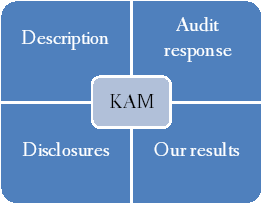
In the graph below, we have presented the key audit matters, significant risks and other risks relevant to the audit.

Key audit matter
Significant risk
Other risk
Key Audit Matter - Group
How our scope addressed the matter- Group
Valuation of Investment Properties
(2026: £24.2m and 2025: £26.5m)
The Group holds investment properties which comprise properties owned by the Group held for rental income and capital appreciation.
Investment properties are measured at fair value with reference to full and desktop valuation reports being prepared by the management experts and directors’ valuation specifically for the Osprey portfolio.
The valuations incorporated a number of assumptions under both the market and investment approaches. These included comparisons with similar properties for which market pricing information was publicly available, estimates of future rental income, and other relevant market-based factors used in determining the properties' fair values.
The valuation of investment properties involved significant management judgement and estimation uncertainty. Given the materiality of the balance and the sensitivity of the valuation to key assumptions, this area required significant audit attention and was therefore considered one of the most significant matters in our audit.
In responding to the key audit matter, we performed the following audit procedures:
- Updated our understanding of the processes, policies and methodologies, including the use of industry specific measures, and policies for valuing investment properties held and performed test of design and implementation of relevant controls;
- Obtained a copy of the valuation reports prepared by the management experts and directors’ valuations and confirmed that these reports are reviewed and approved by management through the review of board minutes;
- Assessed the independence, competence and objectivity of the management experts;
- We performed testing of the valuations performed by the management experts/directors, which included the following:
- Assessed and corroborated market related judgements and valuation inputs (i.e., market rent, market value, gross yield and rate per square foot) by reference to comparable transactions, and independent databases/indices;
- Held discussions and inquiries with both the directors and management experts to understand the underlying inputs and assumptions underpinning their valuation methodologies; and
- Tested the mathematical accuracy of key calculations used in the reports.
- Determined whether the methodologies used to value the investment properties were consistent with methods usually used by market participants for similar types of properties; and
- Assessed the adequacy of the financial statement disclosures in relation to the use of estimates and judgements regarding the fair value of the investment properties.
Our results
Our testing did not identify material misstatements in relation to the valuation of investment properties.
Our application of materiality
We apply the concept of materiality both in planning and performing the audit, and in evaluating the effect of identified misstatements on the audit and of uncorrected misstatements, if any, on the financial statements and in forming the opinion in the auditor’s report.
Materiality was determined as follows:
Materiality measure
Group
Parent Company
Materiality for financial statements as a whole
We define materiality as the magnitude of misstatement in the financial statements that, individually or in the aggregate, could reasonably be expected to influence the economic decisions of the users of these financial statements. We use materiality in determining the nature, timing and extent of our audit work.
Materiality threshold
£243,000 which represents 2% of net assets at 31 March 2026
£134,000 which represents 2% of net assets at 31 March 2026.
Significant judgements made by auditor in determining the materiality
In determining materiality, we made the following significant judgements:
- Net assets, as a benchmark, is considered the most appropriate because the investors would usually assess the performance of the Group and the Company by looking at the net asset value.
Due to the Company being listed and considering that investors or potential investors would be sensitive to changes in the net asset value, it was deemed that 2% would be the most appropriate percentage.
Significant revision(s) of materiality threshold
There was no significant revision of our materiality threshold as the audit progressed.
Performance materiality used to drive the extent of our testing
We set performance materiality at an amount less than materiality for the financial statements as a whole to reduce to an appropriately low level the probability that the aggregate of uncorrected and undetected misstatements exceeds materiality for the financial statements as a whole.
Performance materiality threshold
£182,000 which is 75% of financial statement materiality.
£100,500 which is 75% of financial statement materiality.
Significant judgements made by auditor in determining the performance materiality
In determining materiality, we made the following significant judgements:
- Our risk assessment, including our assessment of the Group and Parent Company’s overall control environment.
Significant revision(s) of performance materiality threshold
There was no significant revision of our performance materiality threshold as the audit progressed.
Communication of misstatements to the audit committee
We determine a threshold for reporting unadjusted differences to the audit committee.
Threshold for communication
£12,100 and misstatements below that threshold that, in our view, warrant reporting on qualitative grounds.
£6,700 and misstatements below that threshold that, in our view, warrant reporting on qualitative grounds.
The graph below illustrates how performance materiality interacts with our overall materiality and the tolerance for potential uncorrected misstatements.
Overall materiality – Group
Overall materiality – Parent Company
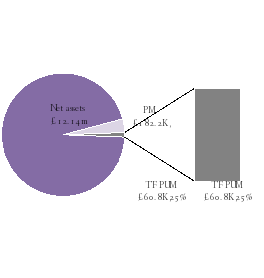
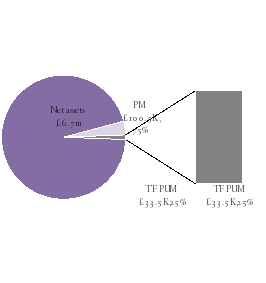
FSM: Financial statements materiality, PM: Performance materiality, TFPUM: Tolerance for potential uncorrected misstatements
An overview of the scope of our audit
- We performed a risk-based audit that requires an understanding of the Group’s and the Parent Company’s business and in particular matters related to:
Understanding the Group, its components, and their environments, including Group-wide controls
- We obtained an understanding of the Group and its environment, including Group-wide controls, and assessed the risks of material misstatement at the Group level;
Identifying significant components
- We evaluated the identified components to assess their significance and determined the planned audit response based on a measure of materiality. The measure of materiality used was based upon net assets or total assets as appropriate.
Type of work to be performed on financial information of parent and other components (including how it addressed the key audit matters)
- We undertook substantive testing on significant transactions, balances and disclosures, the extent of which was based on various factors such as our overall assessment of the control environment, the effectiveness of controls over individual systems and the management of specific risks; and
- For subjective estimates made by management on the valuation of the investment properties, we performed independent searches to confirm the appropriateness of the valuation methodology used in consideration of the comparable properties, market assumptions and other inputs used.
Other information
The directors are responsible for the other information. The other information comprises the information included in the annual report set out on pages 2 to 26 of the full financial report, other than the financial statements and our auditor’s report thereon. Our opinion on the financial statements does not cover the other information and, except to the extent otherwise explicitly stated in our report, we do not express any form of assurance conclusion thereon. In connection with our audit of the financial statements, our responsibility is to read the other information and, in doing so, consider whether the other information is materially inconsistent with the financial statements or our knowledge obtained in the audit or otherwise appears to be materially misstated. If we identify such material inconsistencies or apparent material misstatements, we are required to determine whether there is a material misstatement of the financial statements or a material misstatement of the other information. If, based on the work we have performed, we conclude that there is a material misstatement of this other information, we are required to report that fact.
We have nothing to report in this regard.
Opinions on other matters prescribed by the Companies Act 2006
In our opinion, based on the work undertaken in the course of the audit:
- the information given in the strategic report and the directors’ report for the financial year for which the financial statements are prepared is consistent with the financial statements; and
- the strategic report and the directors’ report have been prepared in accordance with the applicable legal requirements.
Matters on which we are required to report by under the Companies Act 2006
In light of the knowledge and understanding of the Parent Company and the Group and its environment obtained in the course of the audit, we have not identified material misstatements in the strategic report or the directors’ report.
Matters on which we are required to report by exception
We have nothing to report in respect of the following matters in relation to which The Companies Act 2006 requires us to report to you if, in our opinion:
- proper accounting records have not been kept; or
- the financial statements are not in agreement with the accounting records; or
- we have not obtained all the information and explanations, which to the best of our knowledge and belief, are necessary for the purposes of our audit.
Responsibilities of directors for the financial statements
As explained more fully in the directors’ responsibilities statement, the directors are responsible for the preparation of the financial statements which give a true and fair view in accordance with UK Adopted IASs, and for such internal control as the directors determine is necessary to enable the preparation of financial statements that are free from material misstatement, whether due to fraud or error.
In preparing the financial statements, the directors are responsible for assessing the Group’s and the Parent Company’s ability to continue as a going concern, disclosing, as applicable, matters related to going concern and using the going concern basis of accounting unless the directors either intend to liquidate the Group or the Parent Company or to cease operations, or have no realistic alternative but to do so.
Auditor’s responsibilities for the audit of the financial statements
Our objectives are to obtain reasonable assurance about whether the financial statements as a whole are free from material misstatement, whether due to fraud or error, and to issue an auditor’s report that includes our opinion.
Reasonable assurance is a high level of assurance but is not a guarantee that an audit conducted in accordance with ISAs (UK) will always detect a material misstatement when it exists. Misstatements can arise from fraud or error and are considered material if, individually or in the aggregate, they could reasonably be expected to influence the economic decisions of users taken on the basis of these financial statements.
A further description of our responsibilities for the audit of the financial statements is located on the Financial Reporting Council’s website at: www.frc.org.uk/auditorsresponsibilities. This description forms part of our auditor’s report.
Explanation as to what extent the audit was considered capable of detecting irregularities, including fraud
Irregularities, including fraud, are instances of non-compliance with laws and regulations. We design procedures in line with our responsibilities, outlined above, to detect material misstatements in respect of irregularities, including fraud. Owing to the inherent limitations of an audit, there is an unavoidable risk that material misstatements in the financial statements may not be detected, even though the audit is properly planned and performed in accordance with the ISAs (UK).
In identifying and assessing risks of material misstatement in respect of irregularities, including fraud and non-compliance with laws and regulations, our procedures included the following:
- We obtained an understanding of the legal and regulatory frameworks applicable to the Group and the Parent Company in which it operates. We determined that the following laws and regulations were most significant: the Companies Act 2006, and the Real Estate Investment Trust (REIT) status part 12 of the Corporation Tax Act 2010.
- We understood how the Group and the Parent Company are complying with those legal and regulatory frameworks by making inquiries to management including those responsible for compliance procedures. We corroborated our inquiries through our review of board meetings, review of compliance reports, review of correspondence with the regulator and review of key regulatory requirements. We identified areas of the above laws and regulations that could reasonably be expected to have a material effect on the financial statements from our sector experience and through discussion with management.
- We assessed the susceptibility of the Group and the Parent Company’s financial statements to material misstatement, including how fraud might occur, by evaluating management's incentives and opportunities for manipulation of the financial statements. This included the evaluation of the risk of management override of controls. We determined that the principal risks were in relation to valuation of investment properties and revenue transactions.
- In assessing the potential risks of material misstatement, we obtained an understanding of:
- the entity’s operation, including the nature of its revenue sources and of its objectives and strategies to understand the classes of transactions, account balances, expected financial statement disclosures and business risks that may result in risks of material misstatement.
- the applicable statutory provisions
- the entity's control environment.
Our audit procedures involved:
- identifying and assessing the design and implementation of controls management has in place to prevent and detect fraud.
- understanding how those charged with governance considered and addressed the potential for override of controls or other inappropriate influence over the financial reporting process; and
- identifying and testing journal entries, in particular any journal entries in respect of valuation of investment properties and revenue recognition.
- We communicated relevant laws and regulations and potential fraud risks to all engagement team members, and remained alert to any indications of fraud or non-compliance with laws and regulations throughout the audit;
- The Engagement Leader assessed the appropriateness of the collective competence and capabilities of the engagement team including consideration of the engagement teams:
- Understanding of, and practical experience with audit engagements of a similar nature and complexity through appropriate training and participation.
- Knowledge of industry in which the client operates; and
- Understanding of the legal and regulatory requirements specific to the entity including the provisions of the Companies Act 2006 and the Real Estate Investment Trust (REIT) status part 12 of the Corporation Tax Act 2010.
These audit procedures were designed to provide reasonable assurance that the consolidated financial statements were free from fraud or error. The risk of not detecting a material misstatement due to fraud is higher than the risk of not detecting one resulting from error and detecting irregularities that result from fraud is inherently more difficult than detecting those that result from error, as fraud may involve collusion, deliberate concealment, forgery or intentional misrepresentations. Also, the further removed non-compliance with laws and regulations from events and transactions reflected in the consolidated financial statements, the less likely we would become aware of it.
Use of our report
This report is made solely to the Parent Company’s members, as a body, in accordance with Chapter 3 of Part 16 of the Companies Act 2006. Our audit work has been undertaken so that we might state to the Parent Company’s members those matters we are required to state to them in an auditor’s report and for no other purpose. To the fullest extent permitted by law, we do not accept or assume responsibility to anyone other than the Parent Company and the Parent Company’s members as a body, for our audit work, for this report, or for the opinions we have formed.
Jeremy Ellis
Senior Statutory Auditor
for and on behalf of Grant Thornton Limited
Statutory Auditor, Chartered Accountants
St Peter Port, Guernsey
21 October 2026
CONSOLIDATED STATEMENT OF COMPREHENSIVE INCOME
FOR THE YEAR ENDED 30 JUNE 2026
30 June
2026
30 June
2025
Notes
£
£
CONTINUING OPERATIONS
Revenue
3
2,166,854
1,885,144
Cost of sales
(485,494)
(419,046)
GROSS PROFIT
1,681,360
1,466,098
Administrative expenses
(1,407,374)
(1,361,262)
Fair value through profit and loss - revaluation of investment properties
12
(2,280,010)
1,162,000
OPERATING (LOSS)/PROFIT BEFORE SEPARATELY DISCLOSED ITEMS
(2,006,024)
1,266,836
Separately disclosed items
Costs associated with refinancing
6
-
(73,694)
Costs associated with refurbishment of investment properties
6
(106,979)
(203,129)
OPERATING (LOSS)/PROFIT
(2,113,003)
990,013
Finance costs
5
(798,798)
(683,567)
Finance income
5
15,078
21,195
(LOSS)/PROFIT BEFORE TAXATION
6
(2,896,723)
327,641
Taxation
7
-
-
(LOSS)/PROFIT FOR THE YEAR
(2,896,723)
327,641
TOTAL COMPREHENSIVE (LOSS)/PROFIT FOR THE YEAR
(2,896,723)
327,641
(Loss)/profit attributable to owners of the parent
(2,896,723)
327,641
(Loss)/profit per share expressed in pence per share
8
Basic
(6.95)
0.79
Diluted
(6.95)
0.79
CONSOLIDATED STATEMENT OF FINANCIAL POSITION
30 June
2026
30 June
2025
Notes
£
£
ASSETS
NON-CURRENT ASSETS
Property, plant and equipment
11
18,774
91,303
Investment properties
12
24,248,290
26,528,300
24,267,064
26,619,603
CURRENT ASSETS
Trade and other receivables
14
493,386
516,924
Cash and cash equivalents
15
231,664
174,312
725,050
691,236
TOTAL ASSETS
24,992,114
27,310,839
EQUITY
SHAREHOLDERS' EQUITY
Share capital
16
4,166,963
4,166,963
Share premium
14,941,898
14,941,898
Capital redemption reserve
344,424
344,424
Accumulated deficit
(9,699,241)
(6,802,518)
TOTAL EQUITY
9,754,044
12,650,767
LIABILITIES
NON-CURRENT LIABILITIES
Interest bearing loans and borrowings
18
14,561,215
14,135,965
CURRENT LIABILITIES
Trade and other payables
17
676,855
524,107
676,855
524,107
TOTAL LIABILITIES
15,238,070
14,660,072
TOTAL EQUITY AND LIABILITIES
24,992,114
27,310,839
Net asset value per share (pence)
8
23.41
30.36
The financial statements were approved and authorised for issue by the Board of Directors on 21 October 2026 and were signed on its behalf by:
Russell Naylor
Executive Director
COMPANY STATEMENT OF FINANCIAL POSITION
30 June
2026
30 June
2025
Notes
£
£
ASSETS
NON-CURRENT ASSETS
Property, plant and equipment
11
-
-
Investments
13
10,706,081
10,706,081
10,706,081
10,706,081
CURRENT ASSETS
Trade and other receivables
14
2,756,088
3,492,563
Cash and cash equivalents
15
155,226
35,221
2,911,314
3,527,784
TOTAL ASSETS
13,617,395
14,233,865
EQUITY
SHAREHOLDERS’ EQUITY
Share capital
16
4,166,963
4,166,963
Share premium
14,941,898
14,941,898
Capital redemption reserve
344,424
344,424
Accumulated deficit
(12,881,030)
(12,291,358)
TOTAL EQUITY
6,572,255
7,161,927
LIABILITIES
CURRENT LIABILITIES
Trade and other payables
17
7,045,140
7,071,938
7,045,140
7,071,938
TOTAL LIABILITIES
7,045,140
7,071,938
TOTAL EQUITY AND LIABILITIES
13,617,395
14,233,865
As permitted by Section 408 of the Companies Act 2006, the income statement of the Company is not presented as part of these financial statements. The Company’s loss for the financial year was £589,672 (2025 - £558,279).
The financial statements were approved and authorised for issue by the Board of Directors on 21 October 2026 and were signed on its behalf by:
Russell Naylor
Executive Director
CONSOLIDATED STATEMENT OF CHANGES IN EQUITY
FOR THE YEAR ENDED 30 JUNE 2026
Share capital
Share
premium
Capital redemption reserve
Accumulated deficit
Total equity
£
£
£
£
£
Balance at 1 July 2024
4,166,963
14,941,898
344,424
(7,130,159)
12,323,126
Changes in equity
Total comprehensive profit
-
-
-
327,641
327,641
Balance at 30 June 2025
4,166,963
14,941,898
344,424
(6,802,518)
12,650,767
Changes in equity
Total comprehensive loss
-
-
-
(2,896,723)
(2,896,723)
Balance at 30 June 2026
4,166,963
14,941,898
344,424
(9,699,241)
9,754,044
COMPANY STATEMENT OF CHANGES IN EQUITY
FOR THE YEAR ENDED 30 JUNE 2026
Share capital
Share
premium
Capital redemption reserve
Accumulated deficit
Total equity
£
£
£
£
£
Balance at 1 July 2024
4,166,963
14,941,898
344,424
(11,733,079)
7,720,206
Changes in equity
Total comprehensive loss
-
-
-
(558,279)
(558,279)
Balance at 30 June 2025
4,166,963
14,941,898
344,424
(12,291,358)
7,161,927
Changes in equity
Total comprehensive loss
-
-
-
(589,672)
(589,672)
Balance at 30 June 2026
4,166,963
14,941,898
344,424
(12,881,030)
6,572,255
CONSOLIDATED STATEMENT OF CASH FLOWS
FOR THE YEAR ENDED 30 JUNE 2026
2026
2025
Note
£
£
Cash flows from operating activities
Cash generated from/(used in) operations
1
415,822
(116,552)
Interest paid
(798,798)
(683,567)
Net cash used in operating activities
(382,976)
(800,119)
Cash flows from investing activities
Purchase of investment properties
-
(210,000)
Interest received
15,078
21,195
Net cash generated from/(used) in investing activities
15,078
(188,805)
Cash flows from financing activities
Loan repayments in year
-
(7,618,359)
Proceeds from new loans in year
425,250
7,850,000
Net cash generated from financing activities
425,250
231,641
Increase/(decrease) in cash and cash equivalents
57,352
(757,283)
Cash and cash equivalents at beginning of year
174,312
931,595
Cash and cash equivalents at end of year
231,664
174,312
COMPANY STATEMENT OF CASH FLOWS
FOR THE YEAR ENDED 30 JUNE 2026
2026
2025
Note
£
£
Cash flows from operating activities
Cash used in operations
1
(575,311)
(553,333)
Interest paid
-
-
Net cash used in operating activities
(575,311)
(553,333)
Cash flows from investing activities
Interest received
1,258
3,610
Net cash generated from investing activities
1,258
3,610
Cash flows from financing activities
Decrease in loans to group companies
735,780
-
Repayments of loans from group companies
(41,722)
(229,465)
Net cash generated from/(used in) financing activities
694,058
(229,465)
Increase/(decrease) in cash and cash equivalents
120,005
(779,188)
Cash and cash equivalents at beginning of year
35,221
814,409
Cash and cash equivalents at end of year
155,226
35,221
NOTES TO THE STATEMENTS OF CASH FLOWS FOR THE YEAR ENDED 30 JUNE 2026
- RECONCILIATION OF LOSS BEFORE TAXATION TO CASH USED IN OPERATIONS
Group
2026
2025
£
£
(Loss)/profit before taxation
(2,896,723)
327,641
Depreciation charges
72,529
76,373
Revaluation of investment properties
2,280,010
(1,162,000)
Finance costs
798,798
683,567
Finance income
(15,078)
(21,195)
239,536
(95,614)
Decrease/(increase) in trade and other receivables
23,538
(61,378)
Increase in trade and other payables
152,748
40,440
Cash generated from/(used in) operations
415,822
(116,552)
Company
2026
2025
£
£
Loss before taxation
(589,672)
(558,279)
Finance income
(1,258)
(3,610)
(590,930)
(561,889)
Decrease in trade and other receivables
695
140
Increase in trade and other payables
14,924
8,416
Cash used in operations
(575,311)
(553,333)
NOTES TO THE CONSOLIDATED FINANCIAL STATEMENTS FOR THE YEAR ENDED 30 JUNE 2026
- PRESENTATION OF FINANCIAL STATEMENTS
General information
KCR Residential REIT plc is a public company limited by shares incorporated in the United Kingdom and registered in England and Wales. The address of the registered office and company registration number is given in the Company Information on page 1 of the financial statements. The nature of the Group’s principal activities are given in the Group Strategic Report on page 9 of the consolidated financial statements.
Statement of compliance
The consolidated financial statements, and parent company financial statements, have been prepared in accordance with UK-adopted International Accounting Standards (“UK-adopted ISAs”).
Functional and presentation currency
These consolidated financial statements are presented in Pounds Sterling ('£'), which is considered by the Directors to be the functional currency of the Group and rounded to the nearest £.
Changes in accounting policies
Adoption of new and revised standards
The following accounting pronouncements and standards became effective from 1 January 2025 and have been adopted but did not have a significant impact on the Company’s financial results or position:
- Lack of exchangeability – Amendments to IAS 21 The Effects of Changes in Foreign Exchange Rates
New standards in issue but not yet effective
As at 30 June 2026, the Group has not applied the following new and revised standards that have been issued but are not effective:
- Amendments to the Classification and Measurement of Financial Instruments – Amendments to IFRS 9 Financial Instruments and IFRS 7 Financial Instruments: Disclosures (effective 1 January 2026)
- Annual Improvements to IFRS Accounting Standards – Amendments to IFRS 1, IFRS 7, IFRS 9, IFRS 10 and IAS7 (effective 1 January 2026)
- Contracts Referencing Nature-dependent Electricity – Amendments to IFRS 9 and IFRS 7 (effective 1 January 2026)
- IFRS 18 Presentation and Disclosure in Financial Statements (effective 1 January 2027)
The directors do not anticipate that the adoption of the above amendments will have a significant impact on the financial statements of the Company in future periods, with the exception of IFRS 18 Presentation and Disclosure in Financial Statements. The Directors are currently assessing the impact that IFRS 18 will have on the financial statements of the Group in future periods.
- ACCOUNTING POLICIES
Basis of preparation
The consolidated financial statements have been prepared on the historical cost basis other than as set out in the following policies.
Going concern
The financial statements have been prepared on a going concern basis. This requires the Directors to consider, as at the date of approving the financial statements, that there is reasonable expectation that the Group has adequate financial resources to continue to operate, and to meet its liabilities as they fall due for payment, for at least twelve months following the approval of the financial statements.
The Group has undertaken procedures to ensure that the Group has sufficient cash resources and bank facilities and with sufficient covenant margin to manage the business under going concern principles. These procedures included the following:
- reviewing and establishing that cash balances and bank facilities are sufficient to cover at least twelve months of operations;
- review of financial covenant ratios and the Group’s ability to meet the covenants for a period of at least twelve months of operation; and
- reviewing cash flow forecast scenarios. Any decision on property acquisitions and developments in the next twelve months will be taken following review of revised cash flow forecasts.
Having reviewed the Company’s current position and cash flow projections, including the confirmation that the Company’s subsidiaries, which are also creditors as at the year-end will provide such financial support as is required for a period of at least 12 months from the date of signing of these financial statements, the Directors have a reasonable expectation that the Company has adequate resources to continue in operational existence for the foreseeable future. Accordingly, they continue to adopt the going concern basis in preparing these financial statements.
The Company has also provided an undertaking to its subsidiaries that no intra-group amounts owed to the Company will be called for repayment for a period of at least 12 months from the date of approval of these financial statements unless the subsidiary is in a position to make payments without adversely affecting their ability to continue to trade and settle any future obligations.
Basis of consolidation
Where the Company has control over an investee, it is classified as a subsidiary. The Company controls an investee if all three of the following elements are present: power over the investee, exposure to variable returns from the investee, and the ability of the investor to use its power to affect those variable returns. Control is reassessed whenever facts and circumstances indicate that there may be a change in any of these elements of control.
The consolidated financial statements incorporate the results of business combinations using the acquisition method. In the statement of financial position, the acquiree's identifiable assets, liabilities and contingent liabilities are initially recognised at their fair values at the acquisition date. The results of acquired operations are included in the consolidated statement of comprehensive income from the date on which control is obtained. They are deconsolidated from the date on which control ceases.
The subsidiaries included in the consolidated financial statements, from the effective date of acquisition, are K&C (Newbury) Limited, K&C (Coleherne) Limited, K&C (Osprey) Limited, KCR (Kite) Limited and KCR (Southampton) Limited.
The consolidated financial statements present the results of the Company and its subsidiaries ("the Group") as if they formed a single entity. Intercompany transactions and balances between group companies are therefore eliminated in full.
Transaction costs, other than those of a capital nature and those associated with the issue of debt or equity securities that the Group incurs in connection with a business combination are expensed as incurred.
Investments
Investments in subsidiaries are held at cost less provision for impairment.
Revenue recognition
Revenue of the Group for the year was derived mainly from its principal activity, being the letting to third parties of, and management of, property assets owned by the Group. This income includes rental income, management fees and sales commissions.
Revenue from contracts with customers is recognised when control of the services are transferred to the customer at an amount that reflects the consideration to which the Group expects to be entitled in exchange for those services net of discounts, VAT and other sales-related taxes. The Group concludes that it is the principal in its revenue arrangements, because it typically controls the services before transferring them to the customer. Contracts with customers do not contain a financing component or any element of variable consideration.
In accordance with IFRS 16, rental income from operating leases is recognised periodically in line with the time for which the property is rented. Rental income received in advance is recognised in deferred income.
Management fees derived from the management of property assets owned by third parties are recognised as the services are provided.
Revenue from sales commissions is recognised at the point in time when control of the asset is transferred from the vendor to the buyer.
Revenue derived from management fees and sales commissions are recognised in accordance with the 5 step approach in IFRS 15.
Separately disclosed items
Separately disclosed items are those that are deemed to be exceptional by size or nature in relation to the activities of the Group. Further information can be found in note 6 of the financial statements.
Finance costs
Finance costs comprise interest expense on borrowings.
Borrowing costs that are not directly attributable to the acquisition, construction or production of a qualifying asset are recognised in profit or loss as incurred.
Property, plant and equipment
Property, plant and equipment are stated at cost less accumulated depreciation.
Property, plant and equipment (continued)
Depreciation is provided at the following annual rates in order to write off each asset over its estimated useful life.
Fixtures and fittings
-
5% and 25% on cost
Computer equipment
-
25% on cost
Investment properties
Investment properties comprise properties owned by the Group which are held for capital appreciation, rental income or both. Investment properties are initially measured at transaction price, including expenditure that is directly attributable to the acquisition of the asset. Investment properties are revalued on acquisition by independent external valuers and then by the directors or independent valuers annually thereafter. Acquisitions and disposals are recognised on completion. Any gain or loss arising from a change in fair value is recognised in profit or loss.
Further details of the investment property valuation methodology are contained in note 12 of the financial statements.
Subsequent expenditure is capitalised only when it is probable that the future economic benefits associated with the expenditure will flow to the Group. Ongoing repairs and maintenance are expensed as incurred.
Cash and cash equivalents
Cash and cash equivalents comprise cash balances and balances held with banking institutions.
Financial assets
Recognition and derecognition
Financial assets are recognised initially on the date that the Group becomes a party to the contractual provisions of the instrument.
The Group derecognises a financial asset when the contractual rights to the cash flows from the asset expire, or it transfers the rights to receive the contractual cash flows in a transaction in which substantially all the risks and rewards of ownership of the financial assets are transferred.
Financial assets and liabilities are offset and the net amount presented in the statement of financial position only when the Group has a legal right to offset the amounts and intends either to settle on a net basis or to realise the asset and settle the liability simultaneously.
Classification and initial recognition of financial assets
Except for trade receivables that do not contain a significant financing component, which are measured at the transaction price in accordance with IFRS 15, all financial assets are initially measured at fair value, adjusted for any attributable transaction costs.
Financial assets are classified into the following categories:
- Amortised cost
- Fair value through profit or loss (FVTPL)
- Fair value through other comprehensive income (FVOCI)
Financial assets (continued)
The classification is determined by both:
- The entity’s business model for managing the asset
- The contractual cash flow characteristics of the financial asset
All income and expenses relating to financial assets that are recognised in profit or loss are presented within finance costs, finance income or other financial items, except for impairment of trade receivables which is presented within administrative expenses.
Subsequent measurement of financial assets
Financial assets are measured at amortised cost if the assets meet the following conditions (and are not designated as FVTPL):
- they are held within a business model whose objective is to hold the financial assets and collect its contractual cash flows; and
- the contractual terms of the financial assets give rise to cash flows that are solely payments of principal and interest on the principal amount outstanding.
After initial recognition, these are measured at amortised cost using the effective interest method. Discounting is omitted where its effect is immaterial. The Group’s cash and cash equivalents, trade and most other receivables fall into this category.
Financial assets which are designated as FVTPL are measured at fair value with gains or losses recognised in profit or loss. The fair values of financial assets in this category are determined with reference to active market transactions or using a valuation technique where no active market exists.
The Group do not have any financial assets which are designated as FVOCI.
Impairment of financial assets
IFRS 9’s impairment requirements use forward looking information to recognise expected credit losses – the ‘expected credit loss (ECL) method’. Recognition of credit losses is no longer dependent on first identifying a credit loss event, but considers a broader range of information in assessing credit risk and credit losses including past events, current conditions, reasonable and supportable forecasts that affect the expected collectability of the future cash flows of the instrument.
In applying this forward looking approach, a distinction is made between:
- Financial instruments that have not deteriorated significantly in credit quality since initial recognition or that have low credit risk (‘stage 1’) and
- Financial instruments that have deteriorated significantly in credit quality since initial recognition and whose credit risk is not low (‘stage 2’).
Stage 3 would cover financial assets that have objective evidence of impairment at the reporting date.
12 month expected credit losses are recognised for the first category while lifetime expected credit losses are recognised for the second category. Measurement of the expected credit losses is determined by a probability-weighted estimate of credit losses over the expected life of the financial asset.
Financial assets (continued)
The Group makes use of a simplified approach in accounting for trade and other debtors and records the loss allowance as lifetime expected credit losses. These are the expected shortfalls in contractual cash flows, considering the potential for default at any point during the life of the financial instrument. In calculating, the Group uses its historical experience, external indicators and forward-looking information to calculate the expected credit losses.
Financial liabilities
Financial liabilities are recognised initially on the date that the Group becomes a party to the contractual provisions of the instrument.
The Group derecognises a financial liability when its contractual obligations are discharged, cancelled or expire.
Financial liabilities are recognised initially at fair value adjusted for directly attributable transaction costs. Subsequent to initial recognition, these financial liabilities are measured at amortised cost using the effective interest method.
‘Other financial liabilities’ comprise trade and other payables and other short-term monetary liabilities.
Bank and other borrowings are initially recognised at the fair value of the amount advanced net of any transaction costs directly attributable to the issue of the instrument. Such interest-bearing liabilities are subsequently measured at amortised cost using the effective interest method. Interest expense in this context includes initial transaction costs and premium payable on redemption, as well as any interest or coupon payable while the liability is outstanding.
Financial liabilities and equity instruments are classified according to the substance of the contractual arrangements entered into. An equity instrument is any contract that evidences a residual interest in the assets of the Group after deducting all of its liabilities.
Discounting is not applied if the impact is not material.
Share capital
Ordinary Shares are classified as equity. Costs directly attributable to the issue of Ordinary Shares are recognised as a deduction from equity.
Leasing
The Group applies IFRS 16 Leases.
The Group has an operating lease concerning office premises. IFRS 16 provides an exemption for short term operating leases and leases of low value. The Company has taken advantage of the exemptions rather than establishing a right to use asset.
The costs of leases of low value items and those with a short term at inception are recognised as incurred.
The Group has no finance leases.
Taxation
Tax expense comprises current and deferred tax. Current and deferred tax is recognised in profit or loss except to the extent that it relates to a business combination, or items recognised directly in equity or in other comprehensive income. As a REIT, the Group is generally not liable to corporation tax.
Deferred tax would be recognised in respect of temporary differences between the carrying amounts of assets and liabilities for financial reporting purposes and the amounts used for taxation purposes. Deferred tax is not recognised for:
- temporary differences on the initial recognition of assets or liabilities in a transaction that is not a business combination and that affects neither the accounting nor taxable profit or loss;
- temporary differences related to investments in subsidiaries and jointly controlled entities to the extent that it is probable that they will not reverse in the foreseeable future; and
- taxable temporary differences arising on the initial recognition of goodwill.
Deferred tax is measured at the tax rates that are expected to be applied to temporary differences when they reverse, using tax rates enacted or substantively enacted at the reporting date.
Deferred tax assets and liabilities are offset if there is a legally enforceable right to offset current tax liabilities and assets, and they relate to taxes levied by the same tax authority on the same taxable entity, or on different tax entities, but they intend to settle current tax liabilities and assets on a net basis or their tax assets and liabilities will be realised simultaneously.
A deferred tax asset is recognised for unused tax losses, tax credits and deductible temporary differences to the extent that it is probable that future taxable profits will be available against which they can be utilised. Deferred tax assets are reviewed at each reporting date and are reduced to the extent that it is no longer probable that the related tax benefit will be realised.
Provisions
A provision is recognised if, as a result of a past event, the Group has a present legal or constructive obligation that can be estimated reliably, and it is probable that an outflow of economic benefits will be required to settle the obligation. Provisions are determined by discounting the expected future cash flows at a pre-tax rate that reflects current market assessments of the time value of money and the risks specific to the liability. The unwinding of the discount is recognised as finance cost.
Critical accounting estimates and judgments
The preparation of the consolidated financial statements in conformity with UK adopted IASs requires management to make judgments, estimates and assumptions that affect the application of accounting policies and the reported amount of assets, liabilities, income, and expenses. Actual results may differ from these estimates.
Estimates and underlying assumptions are reviewed on an ongoing basis. Revisions to accounting estimates are recognised in the period in which the estimates are revised and in any future years affected.
Information about critical estimates and assumptions that have the most significant effect on the amounts recognised in the consolidated financial statements and/or have a significant risk of resulting in a material adjustment within the next financial year is as follows:
Critical accounting estimates and judgments (continued)
- Determination of fair values
The Group's accounting policies and disclosures require the determination of fair value for both financial and non-financial assets and liabilities. Fair values have been determined for measurement and/or disclosure purposes based on the following methods.
When applicable, further information about the assumptions made in determining fair values is disclosed in the notes specific to that asset or liability.
Investment properties
The Group's investment properties are valued on the basis of market value. The fair value of investment properties is based either on independent professional valuations in accordance with the Royal Institution of Chartered Surveyors’ Appraisal and Valuation Standards or by the directors based on market prices for comparable properties and current market conditions. The Group's investment properties were valued at 30 June 2026 at £24,248,290. See note 12 for further details.
The Directors are of the opinion that the estimates and assumptions that they have used in the valuation of investment properties are appropriate. Further details of the valuation methodology are contained in note 12 of the financial statements.
- REVENUE
The Group is involved in UK property ownership, management and letting and is considered to operate in a single geographical and business segment.
The total revenue of the Group for the year was derived from its principal activities, being the letting to third parties of, and management of, property assets owned by the Group, and, in certain cases, the management of property assets owned by third parties.
The Group’s investment property consists of residential housing for the private rented sector and therefore has multiple tenants and as a result does not have any significant customers.
2026
2025
£
£
Revenue analysed by class of business
Rental income
1,963,388
1,646,669
Management fees
124,591
120,868
Sales commission
36,865
77,140
Ground rents
11,450
12,725
Leasehold extension income
25,000
19,662
Other income
5,560
8,080
2,166,854
1,885,144
- EMPLOYEES AND DIRECTORS
Group
2026
2025
£
£
Wages and salaries
329,285
314,610
Social security costs
28,638
21,452
Pension costs
5,789
4,663
363,712
340,725
The average monthly number of employees during the year was as follows:
2026
2025
Directors and management
5
5
Administration
3
3
8
8
2026
£
2025
£
Directors' remuneration (as per Report of the Directors)
205,000
194,000
Remuneration of the highest-paid director
115,000
115,000
The Group Directors are considered to be key management personnel.
Company
2026
2025
£
£
Wages and salaries
245,000
234,469
Social security costs
18,299
13,923
263,299
248,392
The average monthly number of employees during the year was as follows
Directors and management
5
5
- FINANCE COSTS AND INCOME
2026
2025
£
£
Finance costs
Loan interest
798,798
683,567
Finance income
Interest
15,078
21,195
- LOSS BEFORE TAXATION
The loss before taxation is stated after charging:
2026
2025
£
£
Other short term operating leases
13,140
13,140
Depreciation - owned assets
72,529
76,373
Auditors' remuneration for the Group
75,300
72,000
Separately disclosed items
The Group undertook substantial refurbishment work to investment properties owned by K&C (Osprey) Limited. The costs incurred in the 2026 financial year amounted to £100,169 (2025 - £184,244). Also during the year, KCR (Kite) Limited continued the process of applying for planning permission in respect of intended works to take place, the costs involved with the planning process amounted to £6,810 (2025 - £18,885).
Also, during the prior year, the Group obtained new financing from Al Rayan Bank, in order to repay the loans held with Hodge Bank. The costs of refinancing the loans, borrowed by K&C (Coleherne) Limited and KCR (Kite) Limited totalled £nil (2025: £73,694).
It is considered that the size and nature of these costs are such that they should be disclosed on the face of the Consolidated Statement of Comprehensive Income.
- TAXATION
Analysis of tax
2026
2025
Current tax
£
£
UK corporation tax
-
-
Deferred tax
-
-
Total tax
-
-
Factors affecting the tax expense
The tax assessed for the year is different to the standard rate of corporation tax in the UK. The difference is explained below:
2026
2025
£
£
(Loss)/profit on ordinary activities before taxation
(2,896,723)
327,641
(Loss)/profit on ordinary activities multiplied by the standard rate of corporation tax in the UK of 25% (2025: 25%)
(724,181)
81,910
Effects of
Investment property revaluation not taxable
570,003
(290,500)
Income and expenses not taxable
154,178
208,590
Tax credit
-
-
The Group has remained under the REIT regime throughout the year and since the statement of financial position date.
- (LOSS)/PROFIT PER SHARE AND NET ASSET VALUE
Basic loss per share is calculated by dividing the loss attributable to ordinary shareholders by the weighted average number of Ordinary Shares outstanding during the year.
Fully diluted earnings per share is calculated using the weighted average number of shares adjusted to assume the conversion of all dilutive potential Ordinary Shares.
2026
Loss
Weighted average number of shares
Per share amount
£
No
Pence
Loss attributable to ordinary shareholders
(2,896,723)
41,669,631
(6.95)
2025
Profit
Weighted average number of shares
Per share amount
£
No
Pence
Profit attributable to ordinary shareholders
327,641
41,669,631
0.79
Diluted loss per share
2026
Loss
Weighted average number of shares
Per share amount
£
No
Pence
Loss attributable to ordinary shareholders
(2,896,723)
41,669,631
(6.95)
2025
Profit
Weighted average number of shares
Per share amount
£
No
Pence
Profit attributable to ordinary shareholders
327,641
41,669,631
0.79
The weighted average number of shares used to calculate the diluted (loss)/profit per share includes share options in issue during the financial year. No share options were in issue during the 2025 or 2026 financial year.
The net asset value is calculated by dividing the equity attributable to ordinary shareholders by the number of Ordinary Shares in issue at the statement of financial position date.
2026
Equity
Number of shares
Per share amount
£
No
Pence
Net asset value
9,754,044
41,669,631
23.41
2025
Equity
Number of shares
Per share amount
£
No
Pence
Net asset value
12,650,767
41,669,631
30.36
- OPERATING LEASES RECEIVABLE
Following the introduction of the Renters Rights Act in May 2026 all tenancies are now periodic, and tenants can cancel with two months notice. There are no fixed term contractual amounts.
30 June
2026
30 June
2025
£
£
Within one year
130,136
638,770
Between one and five years
-
130,680
More than five years
-
5,352
Total
130,136
774,802
Lease revenue is generated from properties owned by K&C (Coleherne) Limited, K&C (Osprey) Limited and KCR (Kite) Limited that are let on short-term tenancy agreements.
- LEASING AGREEMENTS
Minimum lease payments, under non-cancellable operating leases, fall due as follows:
30 June
2026
30 June
2025
£
£
Within one year
9,600
13,140
Between one and five years
-
3,285
Total
9,600
16,425
KCR (Southampton) Limited owns a long leasehold block of apartments at Chapel Riverside, Southampton. The lease is a 999 year lease for which the Company pays a peppercorn rent.
- PROPERTY, PLANT AND EQUIPMENT
GROUP
Fixtures, fittings & computer equipment
£
COST
At 1 July 2024
403,236
Additions
-
At 30 June 2025 and 30 June 2026
403,236
DEPRECIATION
At 1 July 2024
235,560
Charge for year
76,373
At 30 June 2025
311,933
Charge for year
72,529
At 30 June 2026
384,462
NET BOOK VALUE
At 30 June 2026
18,774
At 30 June 2025
91,303
COMPANY
Fixtures, fittings & computer equipment
£
COST
At 1 July 2024, 30 June 2025 and 30 June 2026
7,516
DEPRECIATION
At 1 July 2023
7,516
Charge for year
-
At 30 June 2025 and 30 June 2026
7,516
NET BOOK VALUE
At 30 June 2026
-
At 30 June 2025
-
- INVESTMENT PROPERTIES
GROUP
Total
£COST OR VALUATION
At 1 July 2024
25,156,300
Additions
210,000
Revaluations
1,162,000
At 30 June 2025
26,528,300
Revaluations
(2,280,010)
At 30 June 2026
24,248,290
At 30 June 2025
26,528,300
The investment properties at Coleherne Road and Ladbroke Grove were valued by independent external valuers in August 2026. The properties were subject to desktop valuations. The property at Deanery Court was valued by independent external valuers in June 2026 with valuation date being 30 June 2026. The property was subject to a full valuation. The external valuations were carried out in accordance with the Royal Institution of Chartered Surveyors’ Valuation – Global Standards (Red Book).
The majority of the Osprey investment properties were valued by the Directors at 30 June 2026 with reference to independent external valuations performed in June, July and August 2026. As a result of the uncertainty on the potential changes to marriage values and the impact this has on the reversionary rights within the Osprey portfolio, the Directors have adopted the cautious valuation approach of the independent valuers in respect of these landlord’s freehold rights. Properties at Heathside were subject to a desk valuation in July 2026. The external valuations were carried out in accordance with the Royal Institution of Chartered Surveyors’ Valuation – Global Standards (Red Book).
A number of low value properties (approximately 6% of the total investment property value) within the Osprey portfolio were valued by the Directors with reference to independent valuations completed in August 2023 and the market commentary contained within the independent external valuations performed in June, July and August 2026.
The Directors determined that there were no material factors that would give rise to there being a material variance between the latest external valuations and the fair value as at 30 June 2026. The valuation of the investment properties was £24,248,290, which was included in the financial statements.
Fair value, for all properties with the exception of Deanery Court, is based on current prices in an active market for similar properties in the same location and condition. The current price is the estimated amount for which a property could be exchanged between a willing buyer and willing seller in an arm’s length transaction after proper marketing wherein the parties had each acted knowledgeably, prudently and without compulsion. Valuations are based on a market approach which provides an indicative value by comparing the property with other similar properties for which price information is available. Comparisons have been adjusted to reflect differences in age, size, condition, location and any other relevant factors.
The valuation of Deanery Court was determined using the income approach (investment method), whereby estimated market rental income is capitalised using a market-derived yield. In the prior year, the property was valued using the market approach based on comparable property transactions.
The change reflects the valuation methodology adopted by the external valuer in the current year.
The fair value for investment properties has been categorised as Level 3 inputs under IFRS 13. The valuer visited all material properties where full valuations were carried out in the current and previous year and these valuations were based on both internal and external site visits.
The valuation technique used in measuring the fair value, as well as the significant inputs and significant unobservable inputs are summarised in the table below:
Fair Value Hierarchy
Valuation Technique
Significant Inputs Used
Significant Unobservable Inputs
Level 3
Income capitalisation and or capital value on a per square foot basis
Adopted gross yield
5.00% to 7.84%
Adopted rate per square foot
£265 - £1,087
The fair value would increase if market rents were higher and/or the rates per square foot were higher and/or capitalisation rates were lower. If the gross yield of the investment properties decreased by 1% but rental income remained consistent, then the fair value of the properties would increase by approximately £4,336,093.
The fair values would decrease if market rents were lower and/or the rates per square foot were lower and/or capitalisation rates were higher. If the gross yield of the investment properties increased by 1% but rental income remained consistent, then the fair value of the properties would decrease by approximately £3,184,584.
If properties had been included on a historical cost basis, the cost of the properties at 30 June 2026 would have been £23,061,113 (2025: £23,061,113).
The revenue earned by the Group from its investment properties and all direct operating expenses incurred on its investment properties are recorded in the Consolidated Statement of Comprehensive Income.
The total rental income in relation to investment properties for the Group equated to £1,963,388 (2025: £1,646,669). The total rental expenses in relation to investment properties for the Group equated to £485,494 (2025: £419,046).
Included within Investment Properties are leasehold properties valued at £6,000,000 and freehold properties valued at £18,248,290 (2025: £5,965,000 and £20,563,300 respectively).
- INVESTMENTS
Company
Shares in group undertakings
£COST
At 1 July 2024 and 30 June 2025
10,706,081
Impairment
-
At 30 June 2026
10,706,081
As at 30 June 2026, the Company's investments comprise the following:
Subsidiaries
Holding (%)
K&C (Coleherne) Limited
Registered office: UK
Nature of business: Property letting
Class of shares: Ordinary
100.00
K&C (Osprey) Limited
Registered office: UK
Nature of business: Property letting
Class of shares: Ordinary
100.00
KCR (Kite) Limited
Registered office: UK
Nature of business: Property letting
Class of shares: Ordinary
100.00
KCR (Southampton) Limited
Registered office: UK
Nature of business: Property letting
Class of shares: Ordinary
100.00
K&C (Newbury) Limited
Registered office: UK
Nature of business: Dormant
Class of shares: Ordinary
100.00
All of the above companies are registered at Gladstone House, 77-79 High Street, Egham, Surrey, TW20 9HY.
The Directors review the investments at the end of each financial year for any signs of impairment. No indicators of impairment were identified at 30 June 2026.
- TRADE AND OTHER RECEIVABLES
Group
Company
2026
2025
2026
2025
£
£
£
£
Trade debtors
6,930
31,854
-
-
Amounts owed by group undertakings
-
-
2,745,470
3,481,250
Other debtors
152,691
201,661
-
-
Accrued income
-
88,961
-
-
Prepayments
333,765
194,448
10,618
11,313
493,386
516,924
2,756,088
3,492,563
The Group and Company's exposure to credit risk is disclosed in note 20.
There is no material difference between the fair value of trade and other receivables and their book value.
All receivables are due within 12 months of 30 June 2026. None of those receivables has been subject to a significant increase in credit risk since initial recognition and, consequently, no expected credit losses have been recognised.
- CASH AND CASH EQUIVALENTS
Group
Company
2026
2025
2026
2025
£
£
£
£
Cash in hand
446
42
-
-
Bank accounts
231,218
174,270
155,226
35,221
231,664
174,312
155,226
35,221
- SHARE CAPITAL
Allotted, issued and fully paid
Number
Class
Nominal value
30 June
2026
30 June
2025
£
£
41,669,631
Ordinary
£0.10
4,166,963
4,166,963
4,166,963
4,166,963
2026
Number
2026
£
2025 Number
2025
£
Ordinary shares of £0.10 each
At 1 July
41,669,631
4,166,963
41,669,631
4,166,963
Shares issued
-
-
-
-
At 30 June
41,669,631
4,166,963
41,669,631
4,166,963
- TRADE AND OTHER PAYABLES
Group
Company
2026
2025
2026
2025
Current
£
£
£
£
Trade creditors
167,312
149,679
26,764
39,972
Amounts owed to group undertakings
-
-
6,752,813
6,794,535
Other taxes and social security
10,771
18,234
5,054
5,031
Other creditors
5,342
6,763
-
-
Accruals and deferred income
493,430
349,431
260,509
232,400
676,855
524,107
7,045,140
7,071,938
The Group and Company exposure to liquidity risk related to trade and other payables is disclosed in note 20.
There is no material difference between the fair value of trade and other payables and their book value.
Amounts owed to group undertakings are repayable on demand.
Trade creditors, Amounts owed to group undertakings, Other taxes and social security and Other creditors are all due for repayment within 12 months.
- FINANCIAL LIABILITIES - BORROWINGS
Group
Company
2026
2025
2026
2025
£
£
£
£
Non-current
Bank loans
11,280,000
10,854,750
-
-
Other loans
3,281,215
3,281,215
-
-
14,561,215
14,135,965
-
-
Terms and debt repayment schedule (including interest)
2026
1 year or less
More than 1-2 years
More than 2-5 years
More than 5 years
Totals
Group
£
£
£
£
£
Bank loans
689,785
689,785
12,927,495
-
14,307,065
Other loans
116,483
116,483
3,320,043
-
3,553,009
806,268
806,268
16,247,538
-
17,860,074
2025
1 year or less
More than 1-2 years
More than 2-5 years
More than 5 years
Totals
Group
£
£
£
£
£
Bank loans
663,642
663,642
12,581,076
-
13,908,360
Other loans
116,483
116,483
3,436,526
-
3,669,492
780,125
780,125
16,017,602
-
17,577,852
Details of the principal loans are as follows:
- In the 2024 financial year K&C (Osprey) Limited entered into a new 5 year fixed rate facility of £3,004,750 with Secure Trust Bank Plc. The borrowing was used to refinance the existing facility and provide additional capital to support activities. In the 2026 financial year, the company increased the loan by £425,250. The facility is repayable by 60 monthly interest-only instalments and a final instalment of £3,430,000. The fixed rate of interest on the loan is 6.15%. The loan is secured by a charge and debenture over all the property and assets of the Company, including the property known as Heathside, 562 Finchley Road. The loan matures in June 2029.
- On 4 December 2018, KCR (Southampton) Limited took out a loan of £3,184,250, with Lendco Limited. The term of the loan was 10 years. The monthly instalments were interest payments and did not include any capital repayments. Interest was charged at 3.19% for the first 24 months. Interest for the remainder of the term was charged at 4.79% above LIBOR. The loan was refinanced in October 2021 at an amount of £3,281,215. Following the refinancing, the term of the loan was 7 years. The monthly instalments remain interest payments and do not include any capital repayments. Interest is charged at 3.55%. The loan is secured by a first legal mortgage and a first fixed charge over the land at Block B, Chapel Riverside, Endle Street, Southampton. The balance outstanding at 30 June 2026 was £3,281,215.
- On 10 February 2020, K&C (Coleherne) Limited took out a loan of £2,743,359 with Hodge Bank. The term of the loan was 25 years. The monthly instalments were interest payments and did not include any capital repayments. Interest was charged at 3.5 per cent. for the first 60 months. After this period the interest rate charged was a standard variable rate. The loan was secured by a freehold charge over 25 Coleherne Road. During the 2025 financial year, the loan was repaid in full upon refinancing with Al Rayan (see point e below).
- On 10 February 2020, KCR (Kite) Limited took out a loan of £5,124,810 with Hodge Bank. The term of the loan was 25 years. The monthly instalments were interest payments and did not include any capital repayments. Interest was charged at 3.5 per cent. for the first 60 months. After this period the interest rate charged was a standard variable rate. In August 2021, the Company made a repayment of £249,810, following the sale of 9 Lomond Court. During the 2025 financial year, the loan was repaid in full upon refinancing with Al Rayan (see point e below).
- On 16 April 2025, K&C (Coleherne) Limited and KCR (Kite) Limited entered a Commodity Murabaha Agreement with Al Rayan Bank plc. The companies drew down £7,850,000 from this facility which was used to settle the loans with Hodge Bank. The balance of £7,850,000 is repayable by 16 April 2031. The loan is secured by debenture over all assets and property of the company, and a cross guarantee with K&C (Coleherne) Limited and KCR (Kite) Limited.
Details of the covenants for loans taken out by K&C (Osprey) Limited, K&C (Coleherne) Limited and KCR (Kite) Limited are disclosed in note 20 of these financial statements.
Reconciliation of net movement in financial instruments
Group
Net cash at 1 July 2025
Cash flow
Loans received in year
Repayments in year
Other non-cash movement
Net cash
at 30 June 2026
£
£
£
£
£
Cash at bank and in hand
174,312
57,352
-
-
-
231,664
Borrowings
(14,135,965)
-
(425,250)
-
-
(14,561,215)
Total financial liabilities
(13,961,653)
57,352
(425,250)
-
-
(14,329,551)
Net cash at 1 July 2024
Cash flow
Loans received in year
Repayments in year
Other
non-cash movement
Net cash
at 30 June 2025
£
£
£
£
£
Cash at bank and in hand
931,595
(757,283)
-
-
-
174,312
Borrowings
(13,904,324)
-
(7,850,000)
7,618,359
-
(14,135,965)
Total financial liabilities
(12,972,729)
(757,283)
(7,850,000)
7,618,359
-
(13,961,653)
Company
Net cash at 1 July 2025
Cash flow
Repayments in year
Other
non-cash movement
Net cash
at 30 June 2026
£
£
£
£
£
Cash at bank and in hand
35,221
120,005
-
-
155,226
Total cash at bank and in hand
35,221
120,005
-
-
155,226
Net cash at 1 July 2024
Cash flow
Repayments in year
Other
non-cash movement
Net cash
at 30 June 2025
£
£
£
£
£
Cash at bank and in hand
814,409
(779,188)
-
-
35,221
Total cash at bank and in hand
814,409
(779,188)
-
-
35,221
- FINANCIAL INSTRUMENTS
The Group’s financial assets, as defined under IFRS 9, and their estimated carrying amount are as follows:
Group
Company
2026
2025
2026
2025
£
£
£
£
Carrying amount of financial assets at amortised cost
Trade and other receivables
159,621
322,476
2,745,470
3,481,250
Cash at bank and in hand
231,664
174,312
155,226
35,221
The Group’s financial liabilities, as defined under IFRS 9, and their estimated carrying amount are as follows:
Group
Company
2026
2025
2026
2025
£
£
£
£
Carrying amount of financial liabilities at amortised cost
Trade and other payables
676,855
524,107
7,045,140
7,071,938
Borrowings
14,561,215
14,135,965
-
-
- FINANCIAL RISK MANAGEMENT
The Company's Directors have overall responsibility for the establishment and oversight of the Group's risk management framework.
The Company’s and Group's risk management policies are established to identify and analyse the risks faced by the Company and Group, to set appropriate risk limits and controls, and to monitor risks and adherence to limits. Risk management policies and systems are reviewed regularly to reflect the changes in market conditions and the Group's activities. The Company and Group, through its training and management standards and procedures, aims to develop a disciplined and constructive control environment in which all employees understand their roles and obligations.
The Company and Group has exposure to the following risks arising from financial instruments:
- credit risk
- liquidity risk
- market risk
Capital risk management
The Company and Group's objective when managing capital is to safeguard its accumulated capital in order to provide an adequate return to shareholders by maintaining a sufficient level of funds, in order to support continued operations, whilst taking into consideration REIT distribution rules.
The Company and Group considers its capital to comprise equity capital less accumulated losses.
The share premium reserve includes premiums received on the issue of share capital.
K&C (Osprey) Limited increased their Secure Trust loan by £425,250 in the 2026 financial year. The existing terms and conditions of the facility remain unchanged. The total loans with Secure Trust at 30 June 2026 totalled £3,430,000. The loan agreement contains the following covenants:
o interest cover in respect of any interest period shall not be less than 1.40:1; and
o the loan to value will not at any time exceed 60%.
K&C (Coleherne) Limited and KCR (Kite) Limited refinanced their loan portfolio in the 2025 financial year. As a result, the Group entered into a new Commodity Murabaha agreement with Al-Rayan Bank plc. The total borrowings with Al Rayan Bank plc at 30 June 2026 totalled £7,850,000. The agreement contains the following covenants:
o finance cover ratio shall not be less than 1.25:1; and
o the borrowings to value will not at any time exceed 70%.
There have been no breaches of covenants during the financial year or since the balance sheet date.
Credit risk
Credit risk is the risk of financial loss to the Group if a customer or counterparty to a financial instrument fails to meet its contractual obligations.
The Group has no significant concentration of credit risk, with exposure spread over a large number of counterparties and customers.
The carrying amount of financial assets represents the maximum credit exposure. The maximum exposure to credit risk is as reported in the statement of financial position.
The Group undertakes credit checks on prospective new tenants to assess and mitigate credit risk. The checks include verification of income levels and capacity to pay, as well as checks of rental references. Any arrears are actively managed. The Group mitigates credit risk with regard to cash and cash equivalents by using banks with a credit rating of B or above.
Liquidity risk
Liquidity risk is the risk that the Company and Group will encounter difficulty in meeting the obligations associated with its financial liabilities that are settled by delivering cash or another financial asset. The Company’s and Group's approach to managing liquidity is to ensure, as far as possible, that it will always have sufficient liquidity to meet its liabilities when due, under both normal and stressed conditions, without incurring unacceptable losses or risking damage to the Company’s and Group's reputation.
The contractual maturities of financial liabilities are disclosed in note 18.
Liquidity risk is not deemed to be significant as although there is no certainty that such funds will be available when needed, the Company believes it would be able to access further funding.
Market risk
Market risk is the risk that changes in market prices, such as interest rate and equity prices will affect the Group and the Company's income or the value of its holdings of financial instruments. The objective of market risk management is to manage and control market risk exposure within acceptable parameters, while optimising the return.
The Group is exposed to interest rate risk in respect of its borrowings. The Group mitigates this risk by, securing facilities at a fixed interest rate where considered appropriate to do so.
Sensitivity
Interest rate sensitivity:
At 30 June 2026, if interest rates had been 0.5 of a percentage point higher and all other variables were held constant, it is estimated that the Group's loss before tax would increase to £2,995,661 (2025: profit of £260,793). This is attributable to the Group’s exposure on its borrowings and is based on the change taking place at the beginning of the financial year and held constant throughout the reporting period.
- RELATED PARTY TRANSACTIONS
During the year, remuneration paid to Russell Naylor included fees of £48,000 charged by Naylor Partners, a business in which Russell Naylor is a director (2025 - £48,000). A provision of £12,000 (2025 - £12,000) for a catch-up payment incentive which will be due when the business achieves cash-flow break-even is also included in administrative expenses in the financial statements.
Further details of total Director remuneration is contained within the Report of the Directors. Christopher James is also considered as key management personnel. His remuneration in the period totalled £100,000 (2025: £100,000), which includes a provision of £12,000 (2025: £7,500) for a catch-up payment incentive which will be due when the business achieves cash-flow break-even. At the year end, the provision in relation to the catch up payment for R Naylor and C James totalled £142,849 and is included within accruals.
At the year end, KCR Residential REIT plc owed the following amounts to subsidiary undertakings:
K&C (Coleherne) Limited - £1,708,748 (2025: £1,658,670)
KCR (Kite) Limited - £5,044,065 (2025: £5,135,865)
At the year end, KCR Residential REIT plc was owed the following amounts from subsidiary undertakings:
K&C (Osprey) Limited - £335,392 (2025: £744,192)
KCR (Southampton) Limited - £2,410,078 (2025: £2,737,058)
- ULTIMATE CONTROLLING PARTY
The ultimate controlling party of KCR Residential REIT plc is Torchlight LP, in its capacity as general partner of Torchlight Fund LP, a Cayman Island limited partnership.
23) POST-BALANCE SHEET EVENTS
There have been no significant post balance sheet events.
This information is provided by RNS, the news service of the London Stock Exchange. RNS is approved by the Financial Conduct Authority to act as a Primary Information Provider in the United Kingdom. Terms and conditions relating to the use and distribution of this information may apply. For further information, please contact rns@lseg.com or visit www.rns.com.
RNS may use your IP address to confirm compliance with the terms and conditions, to analyse how you engage with the information contained in this communication, and to share such analysis on an anonymised basis with others as part of our commercial services. For further information about how RNS and the London Stock Exchange use the personal data you provide us, please see our Privacy Policy.ENDFR FEFSMEEMSEDS