
Most UK company news lands at 7am. The Daily Stock Market Report tells you which announcements matter, and what they mean for your portfolio, from the market open on.
The Daily Stock Market Report is Stockopedia's live briefing on UK company news, published every trading day. Experienced stock market analysts read the morning's announcements from the London Stock Exchange, AIM and Aquis, pick out the stories that matter, and tell you what they mean for the shares. Read it daily, and you’ll join a community of the UK's most experienced private investors debating what’s really happened in UK stocks that day.
What you get
- The morning’s news, sorted. On a busy day there can be thousands of announcements. We do the filtering, so our summaries can tell you what matters before the open in a few minutes.
- What the news really means. Each story is read by an analyst who knows the company and its history, with the experience to spot the one line in a statement that changes the picture.
- A view to test your own against. Most companies we review carry an Analyst View rating, from Red to Green. It's an experienced investor's judgement, and sits as a counterpoint to our quantitative StockRanks.
- Experienced investors to compare notes with. The comments under each report are where readers trade views on the day's news, often within minutes of it landing.
No tips and no hype. The report won't tell you what to buy or sell. It helps you understand what's behind the moves, think more clearly about the future of shares you own or follow, and sharpen your own read of the market.
Why the announcements alone aren't enough
You can read the announcements yourself. They're freely available.
But company announcements are written by companies, often for compliance. They can be dry and frequently padded with public relations language. And they rarely tell you what you most need to know: what an investor should really be thinking about now.
That's the gap the report fills. The analysts read each announcement as someone who already follows the company. They cut through to the points that matter to an investor. Then they give their assessment.
We also bring context that's hard for a private investor to put together alone. Our analysts have regular access to broker research papers, and they check each set of results against the estimates the market was working from. Add company briefings, regular conversations with management teams and years of following the same businesses, and they can tell you whether a company has really beaten what the market expected, or only matched it.
Your morning with the report
The report changes through the day, so what you find depends on when you arrive.
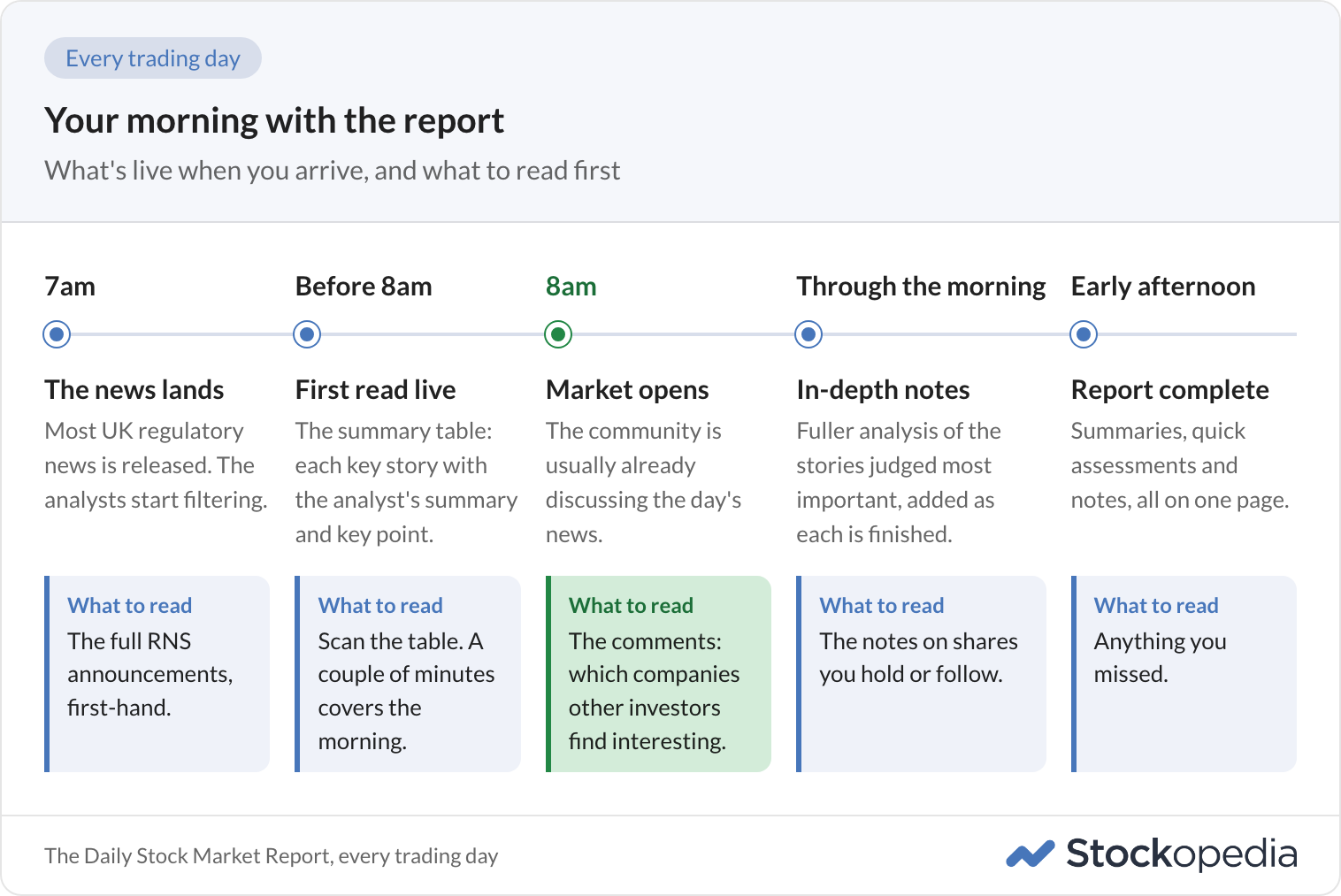
- 7am. Most UK regulatory news is released. The analysts start filtering, looking hardest at trading statements, results, contract awards, mergers and acquisitions, and key management changes. If you're up early, this is the time to read the full announcements for the shares you hold.
- Before 8am. The first read goes live as a summary table. Each row carries the analyst's own summary and the key point from that story, so you can scan the whole morning in a couple of minutes.
- 8am, the open. By the time the market opens, the community is usually already discussing the day's news in the comments.
- Through the morning. The analysts write in-depth notes on the stories they judge most important, and add each one as it's finished. Summaries and quick assessments keep arriving alongside them.
- Early afternoon. The report is normally complete.
What makes the cut
Most announcements won't change anything for an investor. The analysts' job is to find the ones that really do, so their time goes on the stories most likely to matter to your money.
The first test is materiality: does this news change the picture for the business?
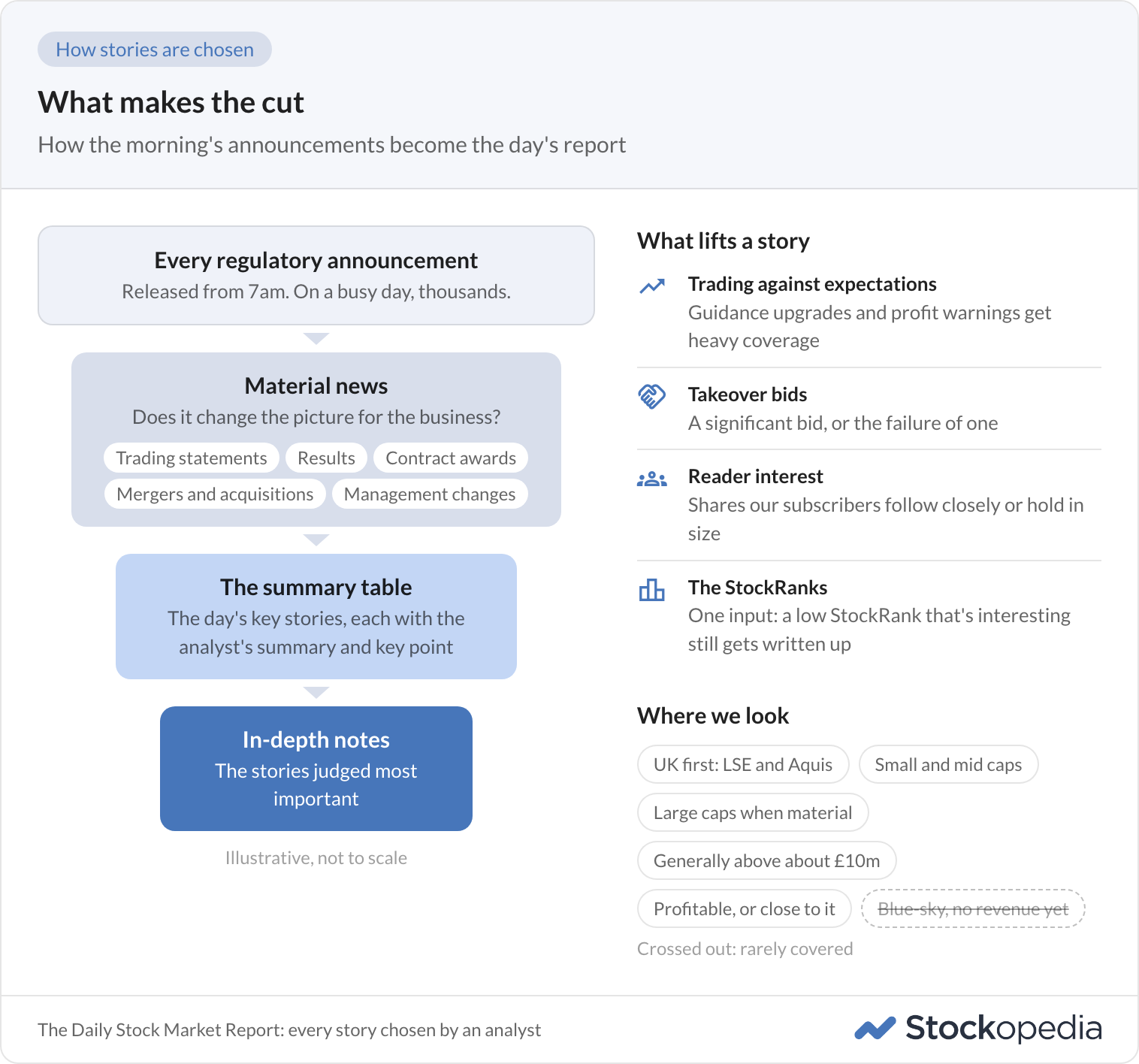
Results and trading updates usually pass. But some move a share price far more than others, and what usually decides it is how the company says it's trading against market expectations. Companies have a duty to explain how material their news is, and that line is often how they do it. That's why guidance upgrades, when a company tells the market to expect more, get heavy coverage. So do guidance downgrades, better known as profit warnings.
Beyond that, the analysts look for the likely big movers, such as a significant takeover bid or the failure of one, and for any story with the power to shift a business materially. They also cover a share when our subscribers are strongly interested in it, or hold it in size.
The StockRanks are an input too. They're Stockopedia's 0 to 100 scores for a share's quality, value and momentum, and our readers tend to be interested in high-StockRank shares. But a low-StockRank company that's genuinely interesting, for good reasons or bad, still gets written up.
Where we look, and why
The report focuses on small and mid-sized companies, and stretches up into the large caps when the news is material enough.
That's deliberate. The biggest companies are picked over by armies of professional analysts. Smaller ones get far less attention, and that's where the real mispricings tend to happen. It's also where factor-based investing, which picks shares on measurable traits such as value and momentum, has tended to find higher returns. For a private investor looking for an edge, that's the part of the market worth watching closely.
In practice, that means UK shares with a market capitalisation (the company's total value on the stock market) generally above about £10m. The analysts tend to write about trading businesses with genuine profits, or ones likely to come into profit in the foreseeable future. Blue-sky companies with no revenue yet, including most mining explorers and biotechs at that stage, are only irregularly covered.
The report is UK-first. An international name comes in when its news is big enough to spill over into this market: a very large US company reporting earnings, say, or a float big enough to move sentiment here. Over time, we intend to broaden coverage to other markets.
The Analyst View: a second opinion from an experienced investor
When a share you own is in the news, it helps to know what an experienced investor makes of it. That's what the Analyst View rating gives you.
Most companies we analyse in depth will receive one. It's a judgement made by the analyst covering the story, and it runs alongside the StockRanks: a human view next to an algorithmic one. When the two agree, that's worth knowing. When they disagree, it's worth finding out why.
There are five tiers, rather than three, as we reserve the extremes for notable situations. Only 15% of ratings are Green, 10% Red.
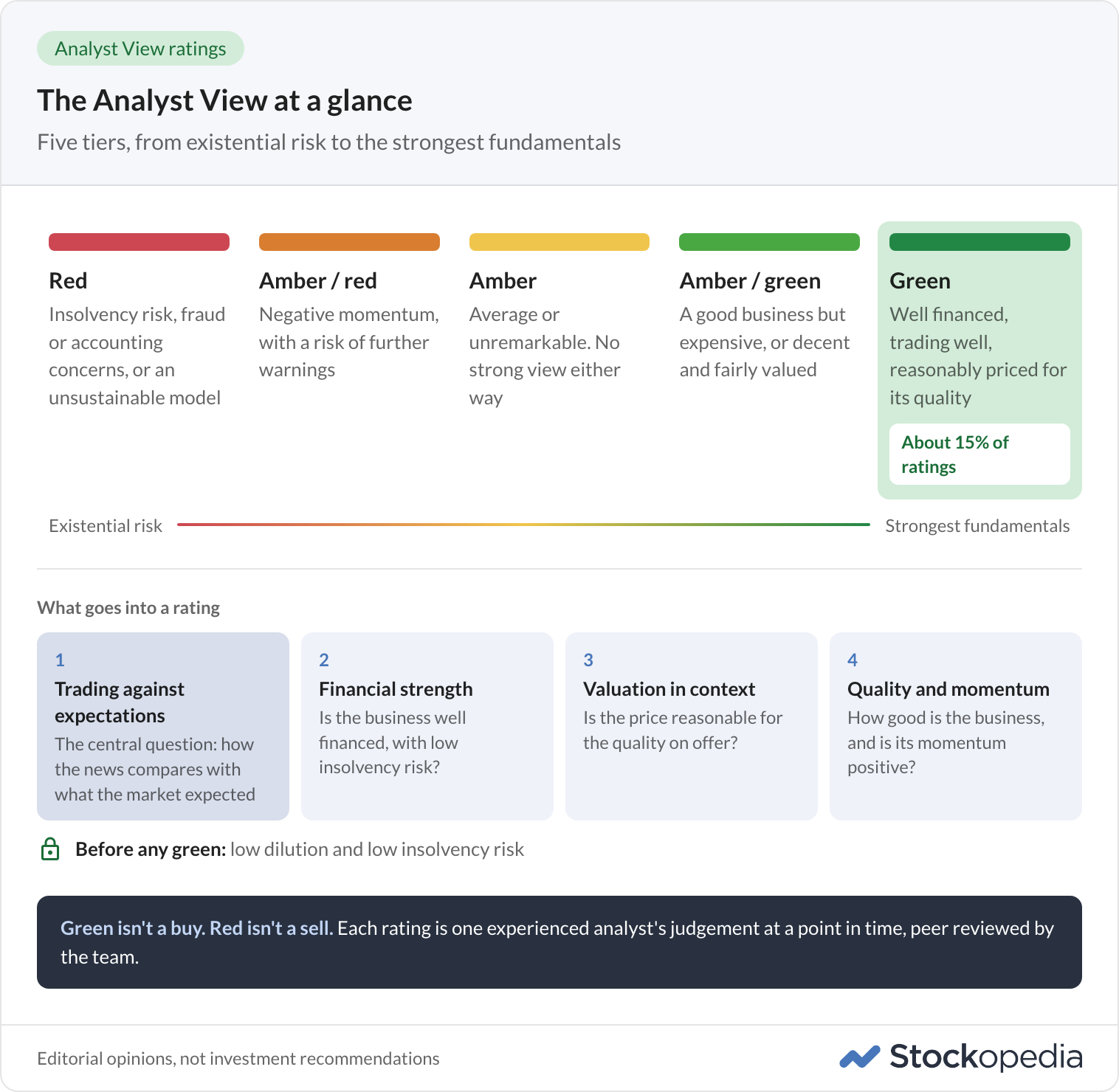
- Green. Well financed, trading well, positive momentum, a reasonable outlook, and reasonably priced for the quality on offer. Green is the hardest rating to earn: about 15% of ratings are green.
- Amber / green. Often a good business that is expensive, or a moderately good one that is reasonably valued. Close, but not there yet.
- Amber. Average or unremarkable. No strong view either way.
- Amber / red. Negative momentum, with a risk of further warnings or deterioration. Not terminal, but the trajectory is concerning.
- Red. Insolvency risk, fraud or accounting concerns, or an unsustainable business model. Valuation is largely irrelevant here. The issue is existential. About 10% of ratings are red.
The central question in any rating is how the company is trading against expectations. Then come financial strength, valuation in context, and quality and momentum. Low dilution (few new shares issued, which would shrink existing holders' stakes) and low insolvency risk are a prerequisite for a green.
The analysts peer review each other's ratings and discuss them as they make them, so they always know where each other stands. Not every company we cover gets one, and we don't rate the whole market: the ratings follow the news. The full rubric is on the Analyst View methodology page.
Green isn't a buy, and red isn't a sell. These are editorial opinions, not investment recommendations. A red is a warning about the business, not a call on the share price. Each rating is one experienced analyst's judgement of a company's fundamentals at a point in time: one input into your process, not a substitute for it.
Who writes it
Graham Neary, CFA, is the report's prime editor and orchestrates it with the team. He and Roland Head are the most regular authors, writing alongside Mark Simpson, James Fox and Ed Sheldon.
Between them, they range from former fund managers to private investors of many years' standing. They hold professional qualifications, have run institutional money and have written books on investing.
You'll always know who wrote what. Every note in the report carries the byline of a named person, and each writer has an author page setting out their background and coverage.
Our writers may hold shares in the companies they write about. Where they do, they disclose it on the page, and they don't deal in a share for two working days before or after publishing on it.
When we get something wrong, we amend the page and record that we've done so. Most often that follows a reader pointing it out in the comments, or writing to us at support@stockopedia.com. The full rules are on our Editorial standards, Disclosures and Corrections pages.
How to get the most from it
With ten minutes before the open, start with the summary table. Work out what's material to you, then read the comments, where some very sophisticated investors are talking about which companies are genuinely interesting. Between the two, you'll have the gist of the market before it opens. It's how I read it myself: the table first, then the comments.
Later in the morning, come back for the in-depth notes on the companies you hold or follow.
When a share you own is in the news, read the note, check the rating, then see what other readers are saying. Bear in mind that other holders are reading the same note, and some of them will act on it.
Charlie Munger used to say that good judgement comes from a "latticework of mental models", drawn from many places rather than one. The report is built to be one part of that lattice. Our analysts can spot strategic and forensic angles that algorithms alone would miss, and reading them will deepen your understanding of a company. But you act on your own judgement, not the analyst's.
What's useful also depends on your process. A deep value investor will have no use for a green on a high-flying growth stock. Someone who already holds that company will read the same note quite differently.
And if you spot something the analysts missed, say so in the comments. Whether you've been investing for decades or you're just starting out, every perspective helps complete the picture.
Tomorrow at 7am the next batch of announcements will land, and the first read will be live before the market opens.