Anthropic IPO - the business is real - is the price?

I use Claude, Anthropic's AI suite, every day. So does everyone at Stockopedia. We're overhauling our systems here at a pace I wouldn't have believed a few years ago. Friends in every field - across music technology, CGI, hedge funds and more - all tell me the same story. AI is transforming how we all work. This isn't a story read from a prospectus - it's something we're watching happen in real-time across all our desks.
So when Anthropic IPOs next week, I won't be an impartial observer. UK private investors can apply for shares at the offer price, and I’m considering doing so myself. But the question I keep coming back to is this: I'm convinced about the product, but what are the odds on the shares at a valuation of $1.4 trillion?
First, a scorecard on SpaceX's IPO
Back in June, I estimated SpaceX's StockRanks from its prospectus - in SpaceX - Momentum Trap or the first $100 trillion company? The StockRanks score every share from 0 to 100 on quality, value and momentum, where 50 is the market average. SpaceX came out at about 35 - a textbook Momentum Trap, a popular, expensive share running on price momentum rather than profitability.
Five months on, its live StockRank is 45, on a quality rank that’s improving. But the share price trajectory has been pretty carbon copy to my original expectations. SPCX jumped on its first day to $161, spiked to near $202, then almost halved down to $108 after its first results, and now sits around $140. Bought at the first close, you're down 13%.
Anthropic is a different business to SpaceX - yes they do compete on AI, but AI is all that Anthropic does. Anthropic also has a stunning growth profile. That's what makes this one harder.
The business is real
The revenue growth is unheard of. According to Anthropic's prospectus, its revenue was $4.6bn in the whole of 2025. In the first nine months of 2026 it was $33bn. By the end of October it’s annual revenue run-rate was projected at $81bn.
About 80% of the revenue is what Anthropic calls "pay-for-intelligence": customers paying for what they use, metered in tokens (think of a token as the same as a word). That’s mostly businesses integrating Claude models (like Sonnet, Opus and Fable) into their own products and running its agents. The rest comes from fixed monthly or annual plans. We use both at Stockopedia: a Claude Team subscription plan for everyone, plus using their API for extra usage or product use-cases we build on top.
Unlike SpaceX, Anthropic isn't pouring cash into rockets. They lease rather than build their computing power, so it spent less than $1bn on capital investment this year, while its operations brought in $6.6bn of cash. Its gross margin, what's left of each $1 of sales after direct costs, has gone from minus 95% in 2024 to about 85% this year.
Of course, that margin doesn’t include the cost of training new models, and each model takes an astronomic level of computing resource to train. In early 2025, Anthropic was spending $2.51 on compute for each $1 of revenue. But due to the revenue growth, by the middle of 2026 it was 48 cents per dollar.
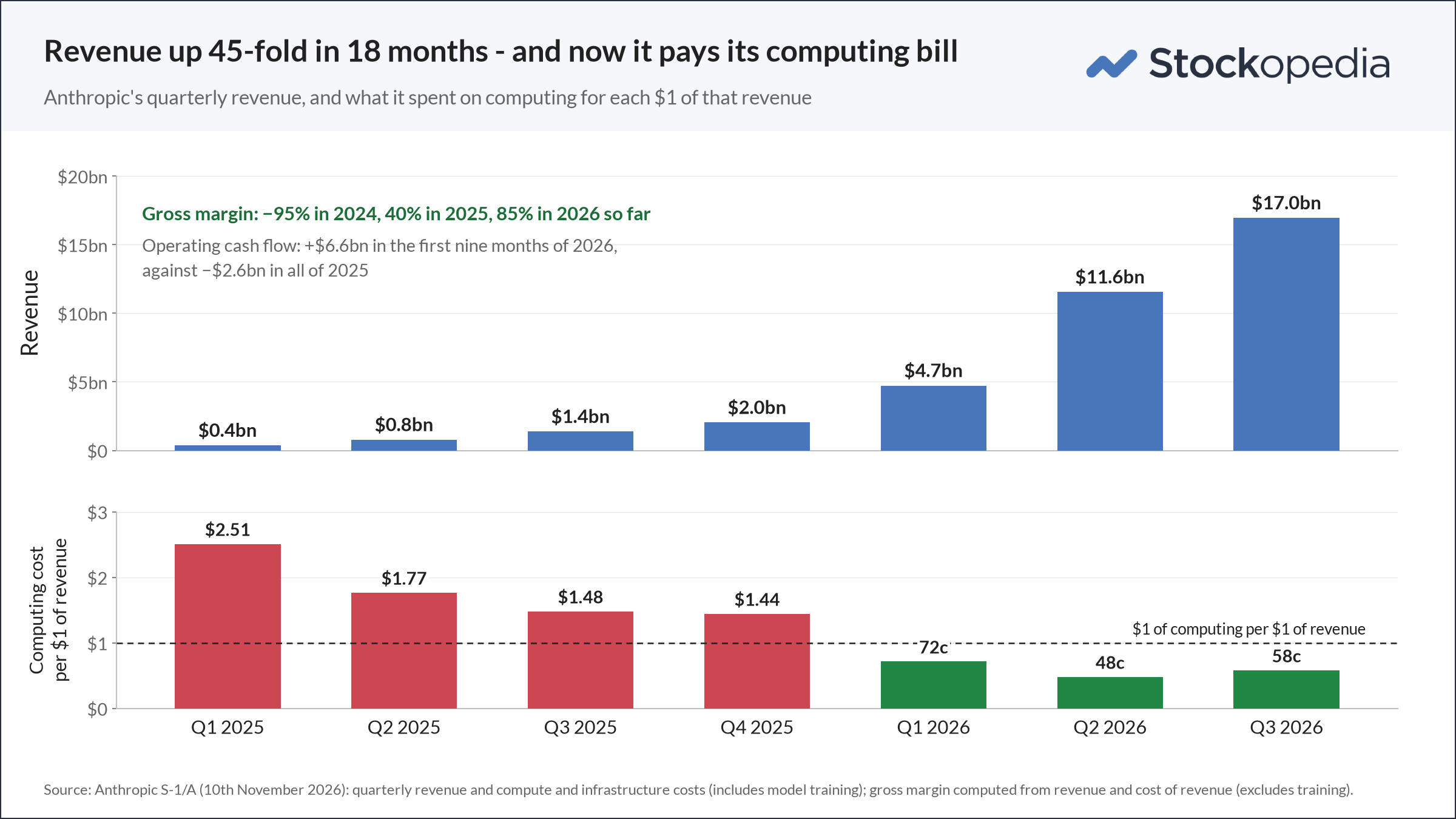
Is it profitable? Almost. Anthropic books the cost of training its models as an expense as it goes, rather than booking it as an investment, so the whole computing bill sits inside its profit figures. R&D expense was $19.2bn year to date, but even so, it made operating losses of only $1.3bn. Cashflow looks strong as mentioned above, partly by paying $3.3bn of staff pay in shares rather than cash. There’s a $36.5bn cash outflow under "investing" that looks alarming: but that's mostly money raised from investors and parked in T-bills, not spending. The thing to watch is what happens when leases start on its chips, as more of the computing bill will turn up as depreciation and lease repayments which may flatter operating cashflow.
What's already in the price?
Anthropic’s valuation has risen by 23x in 20 months in private financing rounds. But its revenue has grown even faster, so the price paid for each $1 of run-rate revenue has fallen, from 37 times in September 2025 to 17 times at the top of the IPO range. Unlike SpaceX's, this valuation has been chasing the revenue. Nonetheless on a trailing Price to Sales ratio basis - you are paying roughly 40x. SpaceX’s was 94x at IPO - make of that what you will!
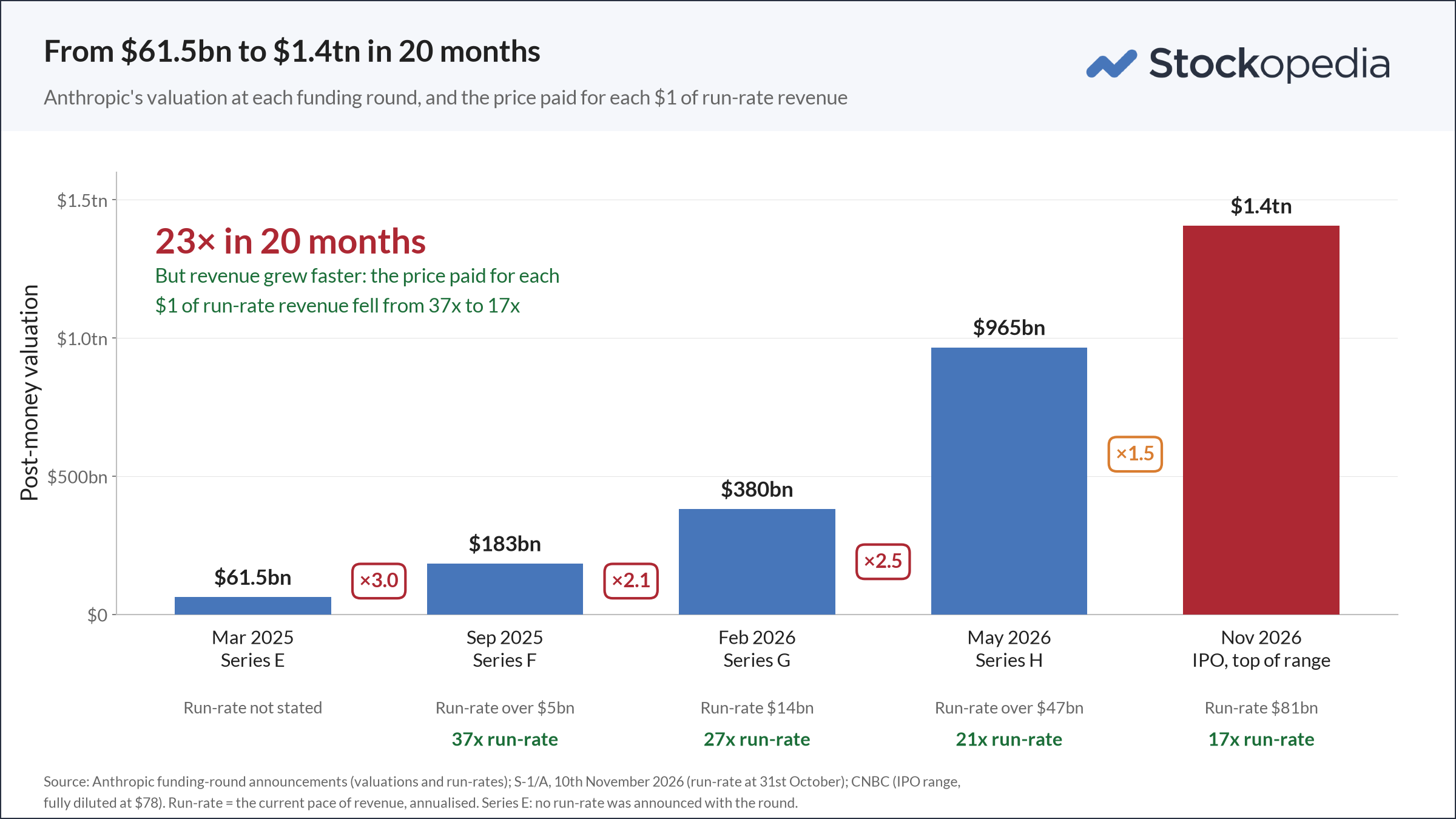
So what does a $1.4 trillion need to be justified? Let’s assume you want a 10% annualised return from owning the stock over the next decade. And let’s also assume it ends up valued like a mature tech giant at about a 7.5x Price to Sales ratio. Well it would need to grow revenue by about 20% a year for the ten years to do so. That's roughly what Amazon did from a similar size, when its sales went from $89bn in 2014 to $638bn in 2024. So it’s not unrealistic.
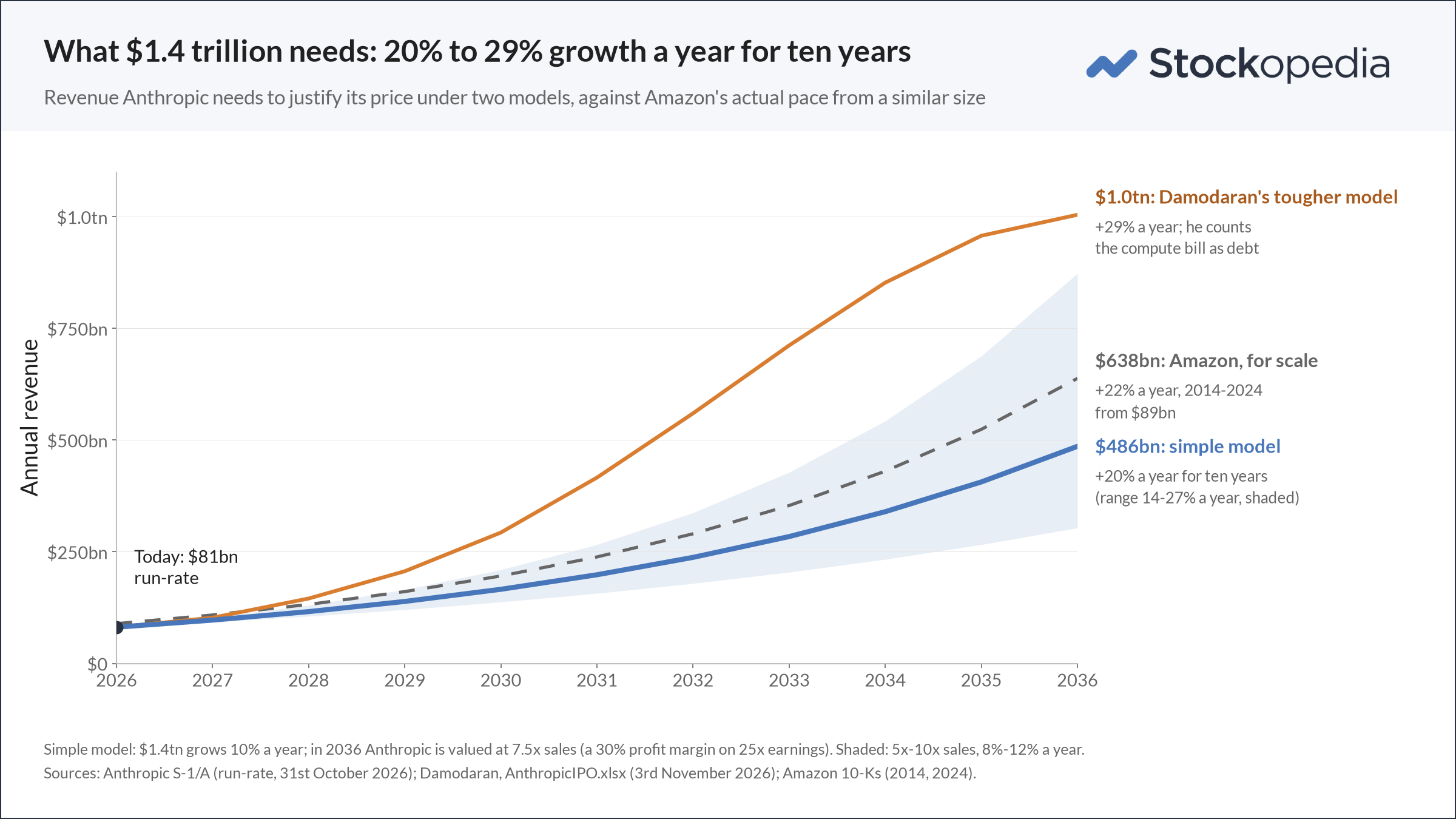
Aswath Damodaran, the world famous academic guru of valuation, has set a tougher bar. He treats the compute bill is a form of debt, so his model requires $1 trillion of revenue by 2036, which needs a 29% a year growth rate. His latest valuation, on 9th November, was $1.25tn, which is below the top of the IPO range. Having used Claude extensively over the last few years - and having switched everything away from OpenAI / ChatGPT over a year ago, and seeing the incredible pace of Claude product launches that are eating everything - my gut says these growth rates are achievable.
What the StockRanks would say
The StockRanks measure the odds you're being offered at today's price - they don’t give a valuation. We won't publish a live StockRank for ANT until there's enough data, so I’ve fed Anthropic’s prospectus figures at $78 a share - and modelled the private valuation record as a form of price history to calculate momentum.
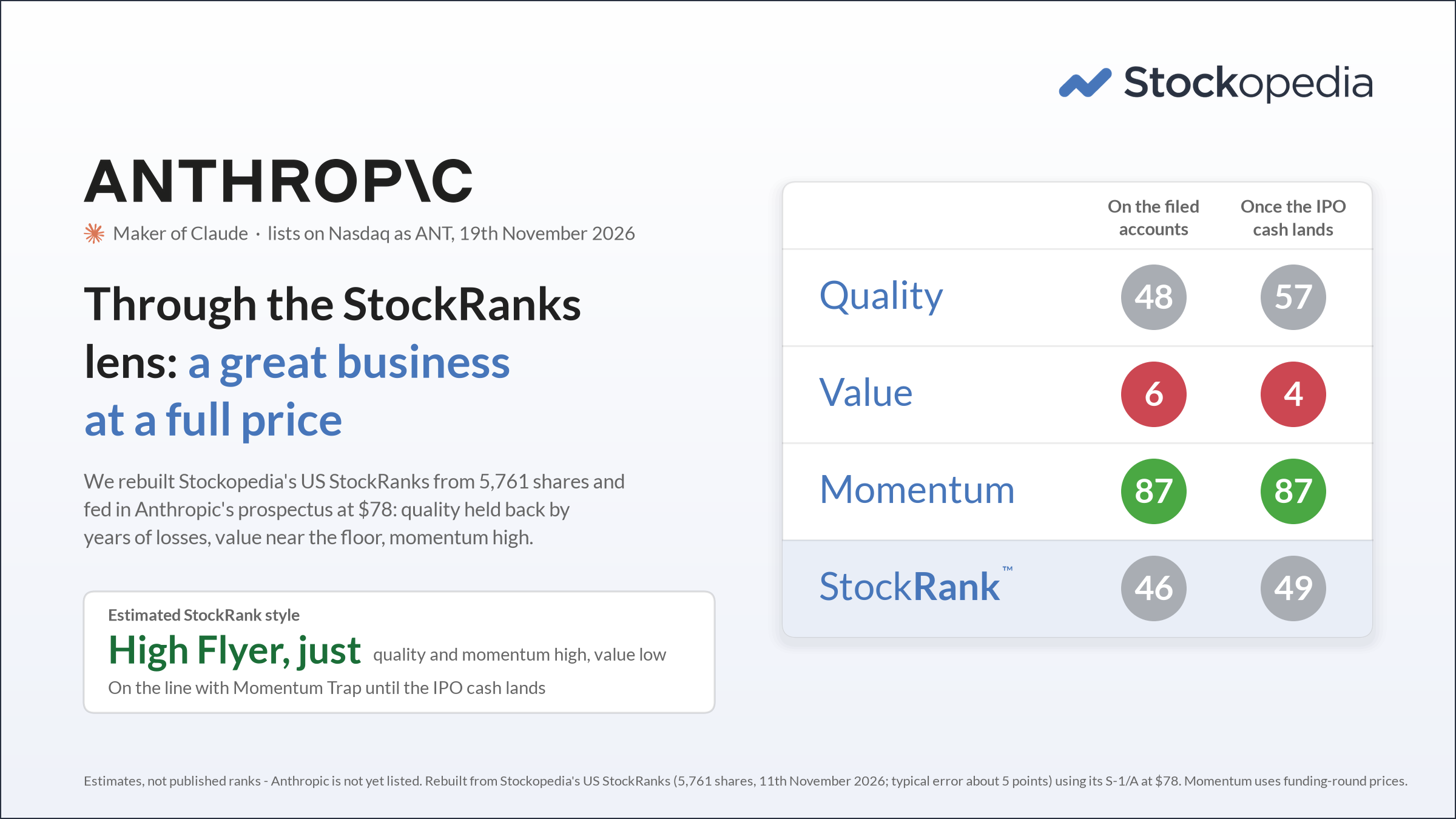
The StockRank comes out at 46 on the accounts Anthropic filed, and 49 once the IPO cash is on the balance sheet: about the market average. The value rank is near the floor, with no earnings and no dividend. The momentum rank is high. With no market price yet, it rests on the jump in the private share price between funding rounds, and there are no analysts' forecasts yet. (To be clear, as soon as we do calculate the Momentum Rank - it won’t be nearly as high as shown in this model - as we will compute based on post-IPO listed share prices only.)
Quality is the swing factor. Years of heavy losses drag down the long-run returns on capital, but the sales growth, gross profit and the improving fundamentals score well. On the accounts it filed, Anthropic sits on the line between a Momentum Trap and a High Flyer in our Styles Classification - balanced between a losing and winning style.
What could go wrong
The first big risk is the circular financing all across tech right now. This is when a supplier puts money into a customer, and the customer spends it back with the supplier. It inflates the numbers on all sides, until it reverses.
Anthropic is tangled up in this. Seven suppliers, led by Google and Nvidia at $10bn each, are buying $26bn of shares alongside the IPO. Across Broadcom, Google and Amazon, supplier money covers between a quarter and just over a third of what Anthropic has promised to spend with them. Starkly, Broadcom leases Anthropic its chips and will lend it up to $42bn "solely to finance quarterly rent obligations" on those same leases.
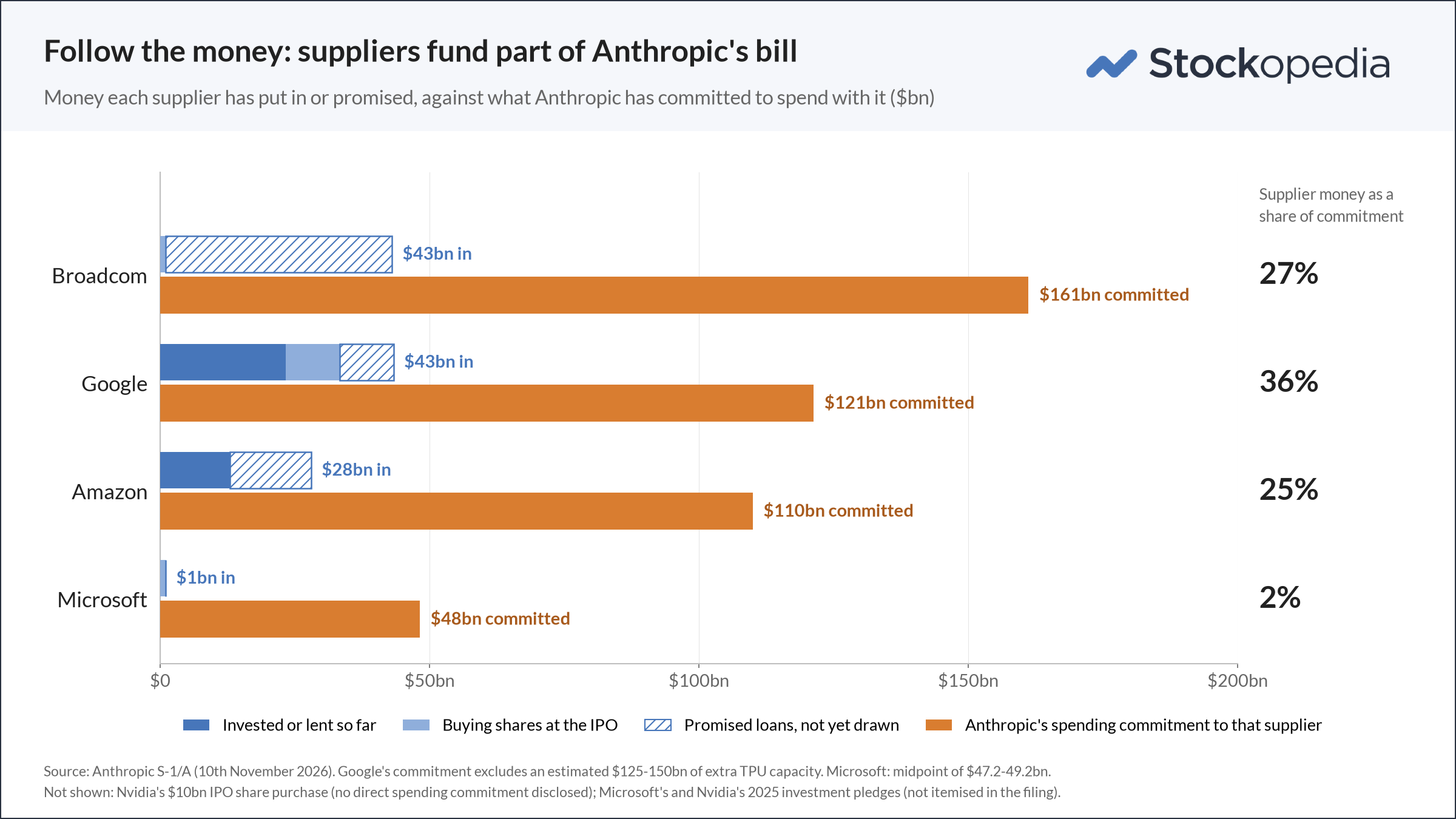
Michael Burry, of The Big Short fame, says that these cross-links look like security on the way up, but warns it leaves "the entire organism catastrophically vulnerable either on a pause or on the way down." We saw exactly this scenario play out in the dotcom telecoms bust in stocks like Lucent.
But perhaps the difference this time is who's borrowing. Back then telcos were lending to startups that were very fragile. Anthropic post-IPO will have more than $200bn of cash, and that’s real revenue from real businesses who also use the lender services (AWS, Google Cloud etc). But if the same hyperscale companies fund the build-out, sell the equipment and collect the sales, any hiccup spills everywhere.
Another risk is a trillion dollar compute bill in a falling market. Anthropic has signed $900bn of commitments, almost all for computing power and data centres: 11 times its current run-rate across long leases. But the price of AI is falling fast. Epoch AI estimates the cost of a given level of AI performance falls about 13-fold a year, and Anthropic's own price cuts took $600m off revenue between the second and third quarters. I’ve been astonished at how much more AI power we’ve been getting here at Stockopedia. There’s huge investment in compute capacity, and an oversupply of cheap compute could help every rival and every free open-source model, which could squeeze Anthropic.
And there’s a real risk that Anthropic’s pricing power will fall. This is where being a customer gives visibility. I wouldn't call what Anthropic has built lock-in - but its tools do fit together very well, and the more we use them, the more useful they get. Yes there are rivals. Grok (Musk’s AI) has bought Cursor (a very popular agentic coding platform), there’s OpenAI/ChatGPT (who I think do have a brand problem), and Gemini from Google and many other offerings. But Claude appears to be winning on brand, model strength and product offerings - and we would pay more.
But if cost became a real concern, switching the models that we use is something we would do. Most businesses do use models from different companies already. An API key can be switched by a configuration. And over 80% of Anthropic's third-quarter revenue came from models released in the previous six months - chasing the frontier to stay ahead is an expensive and exhausting game.
What to expect on the IPO
The pre-IPO setup appears hotter than SpaceX's. About 20% of the shares on offer are set aside for private investors, against a typical 5% to 10%. Only around 6% of the company’s shares in issue will trade which is a small float. And Anthropic could be fast tracked into the Nasdaq-100 within weeks, which would force index funds to buy it in size. If you own a US tracker fund, you may end up owning a slice of ANT whether you apply on the IPO or not.
The history is quite harsh at these valuations. Jay Ritter at the University of Florida has studied 4,110 US IPOs since 1980 with sales above $100m. Of those valued at more than 40 times sales, they typically jumped on IPO day but then lost 45% over the next three years. That cohort does though include lots of bubbly VC backed sub-scale software companies that have had a rough time, especially given AI has been disrupting them all.
But if you do buy shares on the IPO watch the “lock-ups”. Most existing shareholders can't sell for 180 days, until May 2027. But Anthropic employees can sell up to 10% of their locked shares from the first day, and the $26bn owned by suppliers isn't subject to lock up at all.
The bottom line
Anthropic is the most impressive business I’ve ever seen. If there was ever a company that floated at a valuation this high that I wouldn't bet against, it's this one.
But a great company and a good stock aren't the same thing. The price already needs a decade of growth like Amazon's just to give you just a 10% a year return, and a $900bn compute bill means one soft year in AI demand could be brutal. The StockRanks would only score it as average.
As Ben Graham has said - “in the short term, the market is a voting machine. In the long run, it's a weighing machine“. Over coming weeks, hype, the 6x over-subscribed IPO and post-float newsflow are likely to drive the shares. Like with SPCX - I expect a first-day share price jump unless the investment bankers get greedy and overprice it. Of course, with AI-related stocks recently selling off, and Nvidia shares wobbly on Jensen Huang’s resignation, who knows.
The UK offer: what you need to know
UK investors can apply to the Anthropic IPO through RetailBook, an FCA-authorised offer platform, via Hargreaves Lansdown, AJ Bell, interactive investor, Revolut, eToro and Interactive Brokers.
- You pay the same offer price as the institutions, converted from dollars.
- At interactive investor the minimum is £250, and you can apply through an ISA or SIPP. Other platforms' terms differ.
- Sterling applications at interactive investor close at 1pm on Wednesday 18th November, and the offer can close early.
- You'll need a W-8BEN, the US tax form for overseas investors, on file.
- Allocations aren't guaranteed. With demand like this, expect to be scaled back.
- It's a dollar share, so currency moves add to or subtract from your return.
Disclaimer
This is not financial advice. Our content is intended to be used and must be used for information and education purposes only. Please read our disclaimer and terms and conditions to understand our obligations.

4 comments
Great piece, well balanced as always. Would add to the list of risks the potential legal liabilities, which are varied and numerous, and apparently could run into 100s of billions. But the primary issue I have with these valuations is how little reward it appears to leave for public market investors. Talk of around 10% return per year being a target - this does not come close to justifying the risk for me. As with so many big IPOs very much feels like the private markets have had their fill and want to start offloading as the risk/reward becomes less favourable.
That's absolutely the case - the growth of private equity and venture capital over the last 30 years has meant leaner and leaner pickings for public market investors in early-stage growth companies. Now, growth companies are floated only when they run out of private money and when the incumbents want an exit and liquidity.
The way public markets are structured now and the way that savings vehicles are structured means that the vast majority of private individuals are invested in tracker funds and big funds that are often closet benchmark huggers anyway.
So these private businesses can just be offloaded into a set of forced buyers, and the private sellers can basically name their price.
It is, of course, a racket.
But financial markets have always been that.
That's not to say you can't make great returns in stock markets. You just have to take a more disciplined approach than following headlines and a narrative.
Thanks for the analysis. It is certainly a very full price. Not sure my guts can stomach the ride (or concerns)
Great piece Ed. Not for me, too much off balance sheet debt and use of SPVs ($900 billion in future obligations).