Applied Nutrition share price down 4% as investors prepare for a less explosive FY27

Analyst’s view:
I have been really impressed by this story over the past year and I still see plenty of positives. We don't cover too many founder-led businesses that own fast-growing consumer brands. Overall, my positive impression is very much intact. Production capacity for £300m of revenues - nearly double FY26's turnover - is now in the company's sights. But on balance, after today's in-line outlook statement, I think I'll take heed of the excellent arguments made by Roland back in August, and leave our moderately positive stance unchanged.
Down 4% at 304.2p (£760m) - Preliminary Results
Applied Nutrition has maintained current market expectations for FY July 2027 today, as it posts its results for FY July 2026.
We've been positive on this share in the past, although Roland moderated our stance in August (at 319p).
The share price has been drifting since then:
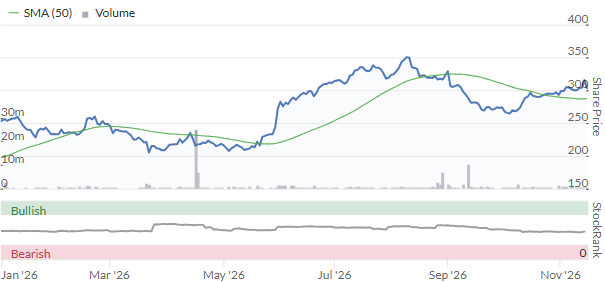
What struck me from Roland's August note was the market's dim reaction on that day to the company upgrading its earnings expectations.
We have a similar situation today with the share price falling slightly, despite the company saying that "very strong momentum within the business has continued into the first quarter of the new financial year", and maintaining its outlook.
Note the punchy valuation involved here (metrics as of last night):
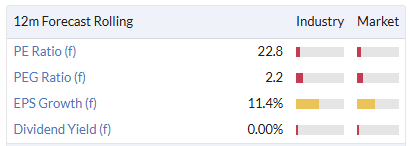
The market is sometimes very demanding where a growth valuation like this is involved, and an "in line" outlook is not always enough.
Let's quickly revise the FY26 result:
Revenue +50.9% to £161.6m
Adjusted EBITDA +40.1% to £43.3m
Adjusted PBT +39.1% to £42m
Statutory PBT (i.e. without any adjustments) comes in very close to the adjusted number at £40.6m, so this is a clean result.
Net cash was £15.9m at the financial year-end. The corresponding prior-year figure is not highlighted - it was higher at £18.5m.
The company notes that there was a large stock increase: inventories (finished goods and goods for resale) increased by £18m and there was also an increase of several million pounds in raw materials. All told, the inventories line in the balance sheet doubled. Working capital as a whole increased faster than revenue growth.
The company explains this by pointing to its £12m acquisition of Nutrablend, "both in terms of the value acquired and subsequent increases reflecting anticipated customer demand."
As a result, Applied Nutrition's cash flow performance for the year was disappointing. Free cash flow after-tax was £10.6m, lower than the prior year, and free cash flow conversion (free cash flow divided by adjusted profit after tax) was 33.5%.
Personally, I do not view this as a major red flag. We might call it an "amber flag" - something to note, and to keep an eye on in future reporting periods. My reasoning is that the company has just enjoyed a very significant growth spurt, and the working capital requirements that go with this can sometimes be very large. But if FY27 does not see such fast growth, then I would ideally like to see working capital unwind (or at least a more stable position) and a vastly better cash flow performance.
Estimates: speaking of FY27, thanks to Cavendish for republishing its estimates, which I believe are unchanged. FY27 should see revenue growth of 27% to £205m and adjusted PBT growth of 8% to £45.2m. Gross margin is expected to reduce slightly (from 44.1% to 43.5% and the PBT margin also takes a hit, from 26% to 22%.
CEO comment excerpt:
“FY26 was another year of strong growth for Applied Nutrition. We expanded our product range, strengthened existing key customer relationships and made our products available across more countries, channels and retailers than ever before...
Alongside this, we completed our first acquisition, expanding our presence and significant manufacturing capabilities in the United States. In the UK, we commenced construction of our production extension and new global distribution facility and head office. Together, these investments give us the infrastructure, capacity and platform to support the next phase of growth.
Thomas Ryder is the founder and remains the largest shareholder, owning over 32% of the business.
Graham's view
I have been really impressed by this story over the past year and I still see plenty of positives. We don't cover too many founder-led businesses that own fast-growing consumer brands. Overall, my positive impression is very much intact. Production capacity for £300m of revenues - nearly double FY26's turnover - is now in the company's sights.
The question for me today is whether to leave our moderately positive stance unchanged, or even take a more optimistic view.
On balance, after an in-line outlook statement, I think I'll take heed of the excellent arguments made by Roland back in August. Revenue growth and profit margins are set to decline slightly, and against that the valuation remains punchy for a market segment (sports nutrition) that can be vulnerable to commoditisation. The Cavendish EPS forecast for FY27 (13.5p) gives an earnings multiple of 22.5x at the latest share price.
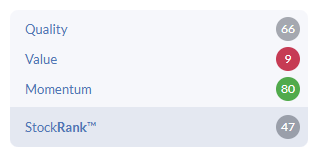
If the earnings multiple was back in the mid-teens, it would be easier to go fully positive here again. The StockReport shows a ValueRank of only 9:
Disclaimer
This is not financial advice. Our content is intended to be used and must be used for information and education purposes only. Please read our disclaimer and terms and conditions to understand our obligations.
Discussion on Applied Nutrition (0)
Comments here are also visible in the Daily Stock Market Report
No one has commented here yet! Why not be the first one?