Boon's Fund Recap – June to August 2023 - just about hangin' in there!

2023 YTD Performance +0.5% vs -0.4% benchmark
2022 Performance +12.0% vs -3.4%
2021 Performance +21.6% vs +14.6%
See all the previous BBB Monthly Recaps here.
Preamble from a UK Staycation
I started out with the ambition to publish commentary on the Boon Fund monthly; however, given increased time commitments, this latest update is covering 3 months – June till Aug. That is likely going to be the frequency going forwards, every 2-3 months.
I found some time to write in the last few days on a staycation road-trip around the UK – Peak District, Snowdonia, and Pembrokeshire. It was encouraging to see tourism alive and well. Restaurants were packed, beer gardens were full, and tourist sites thronged with visitors. However, hotel room rates signalled that not everything was fully booked out, and indeed the properties we visited, they were not at full capacity every night during this peak period.
As I paid £40 for two courses at gastropubs next to fields of cows, I worry about inflation, whether my capital will be eroded, and if I’m able to generate inflation-plus returns. At +0.5% gain YTD, I am definitely not. I am lucky that I am still of working age, and thus my income (hopefully) at least keeps up with inflation, even if the Boon Fund does not. Equity is always seen as an inflation hedge; surely as prices go up, companies make more money, profits rise commensurately, and therefore share prices soon too? But so far over 2022 and 2023, this hasn’t been the case, at least for UK equities.
Performance YTD
After spending most of the first half slightly behind the benchmark (FTSE All-Share), the Boon Fund is now in positive territory (+0.5%) when compared to the benchmark (-0.4%). However, this is scant consolation, as it is behind compared to easy access savings (3-5% annualised so far in 2023). It has also failed to keep up with inflation.
I have made the decision to take out a good chunk of my Stocks & Shares ISA money, and stick it into a 1-year fixed rate ISA savings instead, generating 5% instead. I look at my watchlist, and the current opportunities, and I don’t think I’ll be able to go fully invested in the next few months. So better to earn something on the cash balance, than nothing (as is the case with IG ISA’s).
So far YTD, there has been a Jekyll & Hyde performance to my two portfolios. The ISA has done decently well, up 5.8% for the year. Well ahead of the FTSE All-Share (-0.4%), as well as the AIM 100 (-11%) which is a more accurate benchmark given my ISA’s small cap focus.
My SIPP (-2.4%) has underperformed the FTSE-100 (-0.2%), its chosen benchmark. My SIPP typically holds mid and large caps.
This divergence of performance between my ISA and SIPP is nothing new, and continues the trend I saw in 2021 and 2022 years, as I will go into more detail below.
Performance since Inception of my ISA (top) and SIPP (bottom)
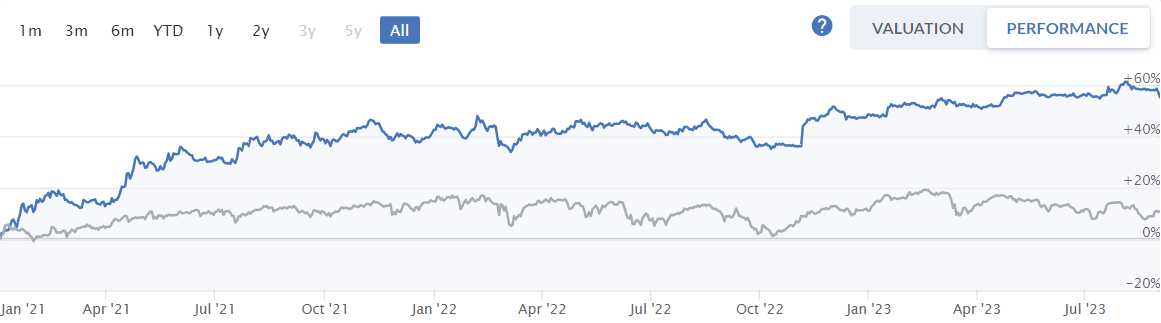
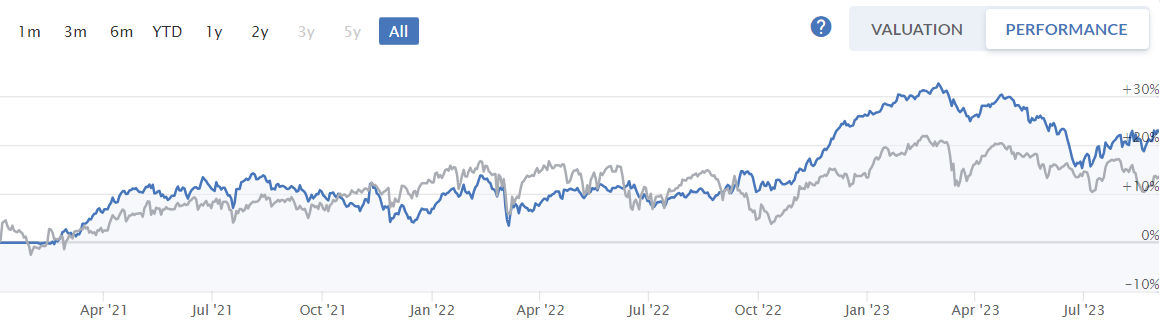
As you can see, my ISA has way outperformed my SIPP, rising +57% compared to +23% for my SIPP since inception. My ISA has mainly invested in small cap shares (<£100m market cap) compared to my SIPP where I put larger market caps.
Learnings from over a decade of share investing
What is to explain my ISA roaring performance success? I have to give a lot of credit to the Small Cap Value Report and the various authors over the years (Paul, Graham, etc). As well as the amazing comments from the Stockopedia community. Many of my ISA investments ideas were seeded in SCVR, whether in the main section or comments section.
I’d also like to credit a decade of “learning and testing”. I started investing around 2010, but in the first decade till 2020, I had only a small amount invested, treating it as play/hobby money. I made plenty of mistakes in that time; numerous shares went into administration or lost >90%. It was only around 2020 that I had the confidence of enough accumulated wisdom and experience to increase the amount of money in my ISA and SIPP.
The other major factor that has contributed to my success was changing my mindset from a casual hobby to a semi-professional hobby. I started tracking my portfolio returns rigorously and scientifically. I started proper watchlists and created “living” research docs for each share in my watchlist. I started rigorously crunching the financial numbers. I made sure to periodically refresh my analysis for shares in my portfolio and watchlists. I kept up to date with RNS releases. I kept tabs on company and economic news via subscriptions to the FT, Bloomberg, Telegraph, and The Times. In short, having a more professional approach to investing, albeit still only roughly 4-6 hours a week spent on it, has greatly contributed to my portfolio performance. I toy with the idea of quitting my day job and being able to invest more time; but at the moment, my capital isn’t big enough to justify the opportunity costs.
I often get asked why I only exclusively focus on UK shares, when the UK markets have been lagging massively behind others globally, like the US. I have three reasons for this:
- one is that I do not want to take FX risk. I have other investments in USD and other currencies already, so am diversified somewhat already in terms of FX.
- The second is that because I marry bottoms-up with macro trends, that would mean having to follow US economic news, which I do not have the time for.
- The third is that I believe the US market is vastly more efficient in pricing than the UK market, given many times more investors are participating. My style of investing is to find mispriced companies. This is best done in an inefficient, illiquid, and overlooked market.
Macro Musings
Inflation – I spent the past year and a half watching the markets convince themselves that inflation would spike and then return to the 2% target quickly. It seems like the markets have flipped and are now convinced that inflation will be here higher for longer. Which means, probably the opposite will happen, and we will see a big decline in inflation in the next 12 months. So I’m locking in most of my cash savings into 1-year or 2-year fixes at 5-6%. I also believe that companies that have pricing power, will flourish in the next 1-2 years, as input costs slow or decline, but pricing held strong to generate increased margins.
UK Housing – I think buy-to-let is going to get more attractive in the next 12 months. Plenty of buy-to-lets flooding the market from amateur landlords selling up as many existing rentals are barely profitable now, with increased mortgage costs and punitive government policies. Rents will keep rising, as brisk wage increases are feeding through now. The perennial shortage of housing stock is not going to get better, as new housing starts decline. The trick is finding cheap(ish) access to capital, as well as running big “institutional” portfolios of housing, rather than being a small-scale amateur landlord paying higher rate income tax. I’m fishing around all the housing REITs, as well as the BTR (Build-to-Rent) players in the market for opportunities. Tricky, as you want to find one that is not over-leveraged, have long term funding in place at low fixed interest rates, and have dry powder to invest in the next 1-2 years at good valuations. PRS Reit (LON:PRSR) , Legal & General (LON:LGEN) , and Empiric Student Property (LON:ESP) are names I’m tracking that I think might benefit from this opportunity.
Consumer Spending - while the latest stats on wage inflation are encouraging, I am not so sure that this will provide enough tailwinds for consumer spending in the UK. Before COVID, this was already a challenged sector, as the macro trend was spending less on buying physical stuff, more on experiences (eg holidays, activities) and having to save up for the biggie (house deposit). COVID provided a temporary boost for physical goods, but that has largely reversed now. The hospitality sector should benefit from more money in pockets; but the story here is that the UK is still too oversaturated with restaurants, pubs, bars, etc – too much competition, leading to barely any margin to be made. Maybe shares like XP Factory (LON:XPF) will be the bright winner over the next few years? But their format is easy to copy, there is little moat. Travel companies might be the resilient bet, despite its traditional cyclical tag. One of the reasons why I’m invested in On Beach group (LON:OTB) . My bet is that hospitality is where there will be some big winners in the next 1-3 years, but one has to pick very carefully, as many companies will go bust, but the few successful formats that survive will be able to roll-out quickly, cheaply, and profitably.
Travel – speaking of travel, my industry of expertise. Robust summer trading is in the bag, for most industry players. Early autumn (Sep, Oct) outlooks are still strong for most companies, but in my opinion Q4 is where the wheat will start to be separated from the chaff. Still bullish on travel sector, maybe a bit less than back in May though.
Performance Summary
The BBB ISA
YTD23 | FY22 | FY21 | |
| ISA Performance | +5.8% | +4.0% | +42.5% |
| FTSE All-Share Performance (Benchmark) | -0.4% | -3.4% | +14.6% |
| AIM 100 Performance (Secondary Benchmark) | -11% | -30% | +1.8% |
| % Portfolio in cash (average over the year) | 56% | 38% | 48% |
The BBB SIPP
| YTD23 | FY22 | FY21 | |
| SIPP Performance | -2.4% | +19.0% | +7.0% |
| FTSE 100 Performance (Benchmark) | -0.2% | +0.7% | +12.4% |
| % Portfolio in cash (average over the year) | 21% | 27% | 32% |
Detailed holdings in comments.
Trades done (June to August)
SELL ALL - LPA (LON:LPA) : I sold my stake in LPA, banking a 33% gain over about 8 months. I had initially gone in as I believed that their revenues was poised for huge growth, based on their mushrooming order book, as well as hidden value in their pension scheme that they were hinting at offloading for a profit. However, the former has still yet to materialise, and I’m beginning to wonder if their growing order book is a bit of a mirage. And the latter, they have gone completely radio silent on this, despite it now being a better environment for offloading pension schemes than ever before. So given that the shares had ramped up to 100p+, I decided to sell then; they have now dropped back down, and potentially I might look to re-enter. But still a bit suspicious of the jam-tomorrow promise of revenue growth.
BUY - Camellia (LON:CAM) : I’ve been tracking Camellia with curiosity over the years. They own agricultural operations globally, but also had an insurance division, as well as some cold storage and other weird businesses. Obviously run poorly, bad returns, declining profits, etc. But I do like their recent strategy, as they divest all their non-core businesses and focus on diversified agriculture globally. Still sceptical if management have what it takes to run the operations profitably. But they have a rock-solid balance sheet, with NTAV at my last calculation over 20,000p compared to the current SP of 5000-6000p. I also believe that global inflation in food commodities will keep rising briskly over the next few years; as the combination of population growth and climate change wreak havoc with food production globally. My only bone of contention is that Camellia needs a brand new management to shake up the strategy and accelerate the progress to sustainable, profitable growth. But this does not seem likely as the big shareholders seem content to just passively let this one ramble along. On balance, I think the discount to TNAV will close somewhat over the next 6-12 months as assets are turned into hard cold cash. And hopefully, agriculture operations start generating more profits, thereby causing a re-rating of the shares. Can see this one more than doubling, with very little downside risk.
BUY - Ashmore (LON:ASHM) : Cyclically, I think asset managers are current at their lows of the cycle, having been battered over the past year due to concerns on global growth and rising rates. Ashmore more so than others, as an Emerging Market specialist. Yet, my view is that EM is where economic growth in the next 3-5 years will come from. As DMs struggle under the burden of increased interest rates on credit and inflationary pressures, many EMs will benefit from increased commodity prices, as well as being less reliant on credit (and already having high interest rates). As DM equities go nowhere in the next year or two, I expect more investors will be tempted to chase returns in EMs. It is the classic DM to EM cycle of investment flows that I am targeting, and Ashmore for me at the current price is irresistible. In the meantime, I’m happy to collect a nice dividend.
BUY - PayPoint (LON:PAY) : Having realised a healthy gain on my Appreciate shares when they were bought out by Paypoint, I decided to invest after their share price drifted to what I saw as crazy value at 442p. This is a company that has a dominant position in corner shops across Britain; there is no other tech platform that can do the breadth of services it can, and offer shopkeepers more extra income. With a Network Effect moat like this, they can command high margins, and grow by just adding more and more third party services to their Paypoint platform. Hence the Appreciate purchase – they are now enabling all their 20,000+ corner shopkeepers to sell gift cards, as well as signing them up as sales agents for the Park Christmas Savings program. I see Paypoint easily delivering fat, growing profits in the years to come, easily. Always nice to own a monopoly.
SELL ALL - Chapel Down (OFEX:CDGP) : I’ve sold the last rump of my Chapel Down shares at 35p, meaning to re-enter as the SP drifted downwards. Alas, I missed the boat, and now it has shot up to 45p+, which I consider as an unsustainable share price. Will patiently wait for this to get back down to a bargain price to buy. Growth here is slow and long term, and will be punctured by periods of rough “weather” (metaphorically and literally), so there will be nice lull periods to pick up cheaply from stale bulls.
BUY - HSBC Hang Seng Tech UCITS ETF HKD (LON:HSTC) : I have been watching with interest the public flogging that Chinese tech companies have gone through. Now is the time the tide turns, I think. Investors have lost interest, leading to some ridiculous valuations. China’s growth is now cooling, so the government will have to soon take out the begging bowl instead of the whip to the tech companies, to ask them to drive growth. Because they can’t do it through the housing sector nor the financial sector, so what other big sectors can they ask to help drive that growth? Probably with lower regulations, tax benefits, etc.
SELL ALL - Metro Bank Holdings (LON:MTRO) : I decided to exit my Metro Bank stake, despite it not reaching my target sell price (150p+). I think there are now enough headwinds in the banking sector, so Metro is becoming a more risky bet. Net Interest Margin growth is now under pressure, despite continued BoE rate increases. Insolvencies and financial distress among SMEs are rising, and house prices are declining, two key lending areas for Metro. On a valuation basis they still trade a ridiculous discounts to sector peers. But these valuation gaps can stubbornly persist for years; and if a hurricane is coming, there is scant consolation if it was the prettiest boat in the harbour, if all boats are going to be battered.
Recently looked at companies
Zytronic (LON:ZYT) – buy target of 75p. Big question marks whether their technology is still competitive. They tout a big and growing order book and pipeline, yet its been the same story for a while. However, they have a strong balance sheet and a bargain price compared to the NTAV. But if their products aren’t any good, and they keep making losses, then that NTAV disappears quickly, like it did for Purple Bricks. Hence my low buy target price.
Serco (LON:SRP) - buy target of 135p. I’ve always liked this share, and think they have a strong competitive position. There are very few companies with the size and breadth of functions to bid for certain large and complex contracts. However, I’m not quite sure management have a clear enough growth strategy. So my buy price reflects that scepticism. But I like their long term contracts, which should weather any economic downturns, as well as strong FCF generation and low net debt. Poised to pick up contracts from smaller players getting into financial dificulties, in my opinion.
Inspired (LON:INSE) - this was highly rated a while back, as a play on ESG. It is pleasing to note in their latest update that management haven’t taken their attention away from the other three core divisions, and that all four divisions have been trading well. I like the niche they’re carved themselves, and their cross-sell strategy makes a lot of sense and seems to be working. Energy consulting and ESG consulting should be good growth drivers in the years ahead. The current SP is not pricing this opportunity at all; and so I see potential EPS growth as well as PE multiple expansion as credible opportunities for Inspired.
Checkit (LON:CKT) - What a pity, they had a huge cash pile, but they are burning it like crazy to reach SaaS recurring revenue scale. However, judging by the latest numbers, in my opinion it really doesn’t look like that cash runway will be sufficient. I wait to see more evidence before I will consider investing here.
H & T (LON:HAT) – I sold too early and missed their surge, but the share price has fallen back, even while trading has still progressed with good momentum. I like the counter-cyclical nature of their main pawnbroking business. They should do well as banks tighten unsecured credit and raise interest rates. But growth will be pedestrian; dependent on store openings, and new stores only seem to pay back in 2 years, which seems long to me. Especially when high street landlords are now desperate for tenants? So this will never get a racy PE multiple, so some discipline in entry price is needed for a steady, slow growth and good cashflows. 350p buy target for me.
Mountview Estates P.L.C. (LON:MTVW) - this real estate play has always been at a huge discount to NAV. Not the reported NAV, which is based on cost prices. Consistently, they have sold properties at 2x the balance sheet reported NAV. However, the ownership structure here is too concentrated, and the family involved have no interest in unlocking value in the short term. So really, it should be treated as an income play, like a normal REIT. In which case, for the illiquidity of the shares as well as the strong concentrated shareholder and iron grip on the company, I’d probably want a 8.5% dividend yield, which translates to a 9000p buy target for me. It has never gone that low, but who knows, if the wider housing sector sees a shakeout, and with the illiquidity here, I’ll patiently wait to see if this opportunity arises.
Disclaimer
This is not financial advice. Our content is intended to be used and must be used for information and education purposes only. Please read our disclaimer and terms and conditions to understand our obligations.
27 comments
Quick Update on Nov buys, and current performance. No full writeup until year end, when I'll do a full-year 2023 review.
Current performance of the Boon Fund is +5% YTD (as of 8th Dec), representing a very good Nov and Dec. Could have been better... if only I'd held on to Costain (LON:COST) and McBride (LON:MCB) instead of selling!
November activity:
New Buy of System1 (LON:SYS1) - this was a prior holding for me, and having kept this share on my watchlist, I recognised that it seems like their new strategy was working. This was proven right with their latest update - client growth and sales growth of data kept rising, at super high margins, while they kept a very tight control of fixed costs. This resulted in a huge increase in PBT. Shares have now risen strongly, but my view is that the product still has legs for further client growth. And all this is now strong operational leverage to profits.
Sold all of Costain (LON:COST) - I was spooked by rapidly cooling growth of the infrastructure and commercial construction activity and sentiment across the industry in Sep to Nov. Also their recent loss of some future contracts (HS2 etc) didn't help. Furthermore, the shares had already had a good run up, and balancing out the risks vs reward, I felt that there was little upside left for risks. I was wrong - it has continued to run up in price, despite the lack of positive or negative news. My view still holds; think it is more risk than reward now, but perhaps my view of fair price to sell was too low.
Thanks for the update Boon and looking forward to reading your end of year review. Just a quick point about Costain (LON:COST) - I thought that the Hs2 work which has been cancelled was not in the order book/estimates ?
It wasn't in their Order Book yet, you're right. But Costain (LON:COST) order book was already struggling to grow; was 2.7 at Jun22, 2.8bn at Dec22, and 2.5bn at Jun23. I've got a suspicion that they're struggling to fill it, and without HS2 now, I think the risk is that the next update we see closer to 2.0bn instead of 2.5bn, and the market starts to wonder if the future (yr2-4) of revenues are in jeopardy.
It seems certain that FY Dec23 revenues will come in predictably, but I think there's a bit of a risk to the FY Dec24 forecasts, and definitely the FY25 is starting to look shaky.
Ofc - if they keep growing their consulting arm, these order books don't really matter.
Quick update on two new buys:
New Buy of Mountview Estates P.L.C. (LON:MTVW) - this share has been on a radar to pick up at a cheap valuation. That is now, sub-10000p. They have a niche in property, buying up properties with complicated "lifetime" leases for a depressed price, and then when those leases expire (person dies), selling and capturing the reversion value to normal price. Properties are accounted for at-cost, and typically properties that they sell get 2x-2.5x the book value. However, the picture is mixed because they keep adding new properties to the portfolio.
I conservatively value at 1.7x the book value, which gives me closer to 17000p fair value, compared to the 10000p it currently trades at. Meanwhile, it generates enough cash to pay out dividends (ordinary+special) of c 7.5% yearly, which is still higher than what you get in a savings account.
Over a 12 month period, I think it has a strong chance to trade within a range and easily reach 12000p, so a very strong prospect of 20% capital gains + 7.5% dividend easily within the first 12 months. But I intend to hold longer, or until more of the intrinsic value is crystallised.
New Buy of Vanguard FTSE 250 UCITS ETF GBP Dis (LON:VMIG) - the FTSE250 is trading at too tantalising a valuation all round (P/E, P/B, Div, Breadth, EPS growth, etc) that I've taken an initial 5% portfolio weighting, and will drip-average to 10% over the next week. I've never gone passive in the UK with an ETF (only outside the UK), but right now none of the FTSE250 shares on my watchlist are buy-worthy or top-up-worthy, so FTSE250 index is the best way.
-----
I'm in the process of selling down one of my small-cap positions, but won't disclose as the liquidity is not very good and so selfishly, will sell out first and then update.
As I won't be posting another BBB Fund post for another few months (moving to a quarterly cadence), I thought I'd give some quick updates.
My YTD performance hasn't really moved since Aug22, at +0.2% YTD, which is frustrating. But still better than AIM100, and thereabouts to the FTSE All-Share.
In September, I had done the following trades:
Sold out of McBride (LON:MCB) - there was a decent update out, and the company is making useful progress. However, for me the net debt is still too high, and while they've been able to push through higher volumes and higher prices recently, can they continue this? They'll need to do so if they want to get more comfortable within the banking covenants (holiday expiring next Sep24). SP can double if they can thread the needle and do a "soft landing" over the next 12 months, but for me too much risk. I've banked my profits here.
Topped up Time Finance (LON:TIME) - good set of results, and clear momentum in their strategy. Happy to top up at the current prices, because I see this easily at 35-40p in six months time, a useful 40% gain.
Topped up Phoenix group (LON:PHNX) - picked up more shares before the results, which was steady and predictable progress. Never going to blow the lights out in terms of racy growth, but they throw off good amounts of cashflow. A juicy 10% yield, a Lord Lee recommendation for income portfolios, and hopefully soon they can get the M&A going again and acquire more distressed closed books for good valuations. Now one of my top holdings, c10% of my portfolio. Share price has drifted downwards (even accounting for ex-div), so it is now at a cheaper price than I bought in at!
Been meaning to thank you Boon for these thoughtful and insightful updates. So Thank You! Really useful to read in slow time and mull over.
Re: Zytronic (LON:ZYT) I still hold. Clearly selling was the smart move but my investment horizon's move like geological ages and even then I can't predict the future.
The price was starting to look very attractive with regard to NAV. Like you I was holding out for a slightly lower price before adding. Might have missed this opportunity - but there might be another one.
Is the product competitive?
Yes. That's a key question. Though there are two products to consider here. ZYT's touch product that then gets designed into an OEM product - such as an ATM, vending machine or Gaming table. It takes upto 2 years for ZYT's product to be designed into the OEM product and only then will ZYT find out if the order flow will be better or worse than expected. They only get 4-6 weeks order visibility once the OEM product is shipping. Short term order volatility has more to do with the competitiveness of the OEM product than of ZYT's?
The OEM product lifecycle can be very different between sectors - say ATM and gaming tables. ATM product design cycles apparently come around every 5-10years where as a gaming table product life can be much shorter - a year or two?
Margins on the ATM type business are typically lower - but order volatility will be lower, whereas game table margins will be much higher - if the product sells well. Which is totally unpredictable for ZYT?
Which I think may also be linked to where ZYT is currently competitive in the market. It did not have the right technology available to bid the last ATM design cycle. It does have attractive technology for gaming tables now, but that business has been even more volatile because of the events of the last 3 years.
Which probably means that ZYT are not particularly competitive at the lower margine, higher volume ATM type business. There are lower price suppliers - but with lower quality, reliability, performance products. Where physical abuse (from users and environment) performance and reliability are key factors - ZYT are likely very competitive. Basically higher end bespoke markets. Lower volume and much higher margin business. But much more volatile.
My concern is to look towards what ZYT are designing now for their future products and compare with where the industry is going particularly for financial, medical, industrial, vending and info/advertising. In the meantime maybe they will win big with a gaming customr. Maybe not. In the medium term to escape the volatility they need to widen their customer base and move up the food chain to a complete screen and controller system for longer product cycles. They know this and are working on it - but its easier said than done?
Hope this helps! Other views are very welcome?
I think there is a good probability that they will succeed in developing competitive higher end products for the next cycle. But there can't be any guarantee - too many variables? The current discount to NAV gives some defence against the downside with the upside currently in for free?
What I call a: heads you win, tails you don't lose (much)!
Its the kind of opportunity I am always searching for. I still have concerns and I already have a decent sized holding - and after being bashed violently over the last couple of years - keen to have as much downside protection as I can get before buying more,
cheers
Mark
Mark, I wish you all the best with this opportunity but I remain bewildered why you wouldn’t just buy a great company with a leading IP and come back in 10 years.
No need to answer as you’ve laid out some of your MO in the previous reply. Many ways to skin a cat and all that.
But as a serial business owner with decades of striving to be the best in my field, it beats me why investors wouldn’t take the short cut that the market and its liquidity provides to owning the very best in class.
Hello BnB - great points as usual.
but I remain bewildered why you wouldn’t just buy a great company with a leading IP and come back in 10 years.
Ah. That's easy. I do it........... for fun!
I hope that helps to ease your bewilderment? Maybe not :-)
As a serial business owner/part-owner/manager I've spent decades striving to be the best in my field. I now enjoy the process of striving to find similarly well run businesses with leading IP where I can invest. At the moment I don't want to leave them alone for 10 years, I enjoy being alongside them on that journey whether its success, failure or more usually something in between, If and when I stop enjoying it I will adjust my process. That's not hard to do.cheers
Mark
PS - With regard to Zytronic (LON:ZYT). What makes you think that I am not looking for a great company with leading IP? According to my research it is a well run and managed company, very well invested in its facilities and processes with leading IP in its market niche. It's clearly not 'great' right now. There is a large market opportunity - but that is no guarantee of success. Many will try but few will succeed. For me the jury is out at the moment and I am watching closely. I have yet to discover whether it is Digital Research or Microsoft......? But I am enjoying the journey.
Then the pleasure you get is similar to mine. I enjoy sharing the journey with my various blue chip company holdings - you can still do that even if there’s no intention to sell for 10 years. But I can see that winning “against the odds” would be more satisfying than just enjoying Microsoft’s 200% gain in the last 5 years.
However MSFT has delivered the satisfaction of making great returns out of a company that has been “too expensive” to buy since a decade ago! It’s a different balancing act, this time between price/value/moat instead of prosperity/irrelevance.
The best of success to you :-)
Thank you for this long comment! I found it really interesting to read your thoughts on Zytronic (LON:ZYT) .
Order pipeline definitely looks strong, and if management are right about "2 year from initial talks to production" we should start to see the post-COVID discussions start to drop into revenues soon.
Thanks foryour update.You alongside somebody's comments on one of the Paul & Graham's pieces brought Zytronic to my attention.I have no specialist knowledge in the sector, but given their NTAV and their recent streak of bad luck decided to give it a punt.
Also a deepvalue investor fund apparently (purely gossip - just from a comment on the Zytronic board there), who used to produce a newsletter on ADFVN, Henry Spain used the opportunity to build a 8% position.So will be interesting to see how it plays out.I'm hoping at least back up to the £1.50 range at least over time and can't believe that 20 years plus of IP isn't worth anything profitable or potentially profitable to anyone anymore.But better not to hope too much, but surely it's worth a possible shot.One distinct positive difference with say a Purplebricks is did they ever make a GAAP profit?I did buy some and recommend some years ago when they were the hot issue and expanding or planning to to the US, but never followed them since really.
I haven't yet jumped in myself to buying Zytronic (LON:ZYT) but think there is no rush; H2 update will be bad, no doubt about it. Given the long lead times to revenues hitting the P&L, if H2 was looking rosy we would have seen more positive outlook guiding from the company.
I've personally got a below 75p price target, and was actually waiting for a bout of market weakness to pick up sub-65p. But it looks like its moved in the other direction now to 85p; oh well.
The key question still in my mind, since I'm not an expert in this area, is whether their IP is still competitive and relevant?
Had a read through today's On Beach group (LON:OTB) trading update, and had mixed reactions. Initial thoughts, before I digest it more fully this weekend:
(I hold)
Really appreciate you spending the time to write these Boon. I thought the Costain (LON:COST) results were very positive - they would be cheap at over £1 per share. What are your thoughts on the Direct Line Insurance (LON:DLG) announcement today? (I hold both as well as PayPoint (LON:PAY) and Time Finance (LON:TIME))
I was a bit more lukewarm on Costain (LON:COST) results. It didn't clearly show a good increase in higher-margin consultancy activity, and their bread and butter construction business has seen a bit of weakness in forward order books, etc. Not catastrophic, but this means revenue growth in those areas in 2024, 2025 might be flat/low-digits. Which means growth will fully depend on the consultancy business from next year onwards.
But buying Costain is not about buying growth - it is about buying the mis-pricing currently on offer, as you mention, they are cheap. The pricing so far has been indicating a high chance of going bust or losing lots of revenue and profits. But they have proved otherwise - a business in health and delivering.
At this price, I don't see why a larger construction company doesn't acquire Costain for cheap. The net cash on the balance sheet, £130m, they're holding it because they need to prove to their lenders, clients that they have the funds to remediate any issues if they occur. If a large construction group acquires them for say 50% premium than the current SP, they'll pay c£250m for the business, but can pocket that £130m, and acquire Costain for only £120m net.
I am hoping that is what the largest shareholder, ASGC Construction, ends up doing.
(I hold)
On Direct Line Insurance (LON:DLG) haven't had a chance today to read through both announcements. But on the surface, looks like two of the main issues have been solved or making good progress - the risk of discounted equity fundraising from the low solvency ratio, as well as the recovery of their motor insurance division.
May also be a sitting duck now for an acquisition - less conglomerat-y and focused, so might attract a strategic suiter (say from Asia or USA who do the same thing) for geographic expansion? Or even a UK player to consolidate the market. Plenty of operational cost savings to be had from combining players in the market to build a stable of brands.
(I hold)
To everyone who has read and commented to thank me for writing this - my pleasure! I find myself unable to participate fully in most of the daily SCVR comment threads, so I'm hoping I get to do a brain dump of some thoughts once in a while through these Boon Fund posts.
Thanks Boon I love reading your updates and appreciate the time and thought that goes into each one.
I wouldn't beat yourself up to much 2023 has been grim following on from really grim 2022, using a broader brush approach its really just the big seven stocks in the US and ultra short dated bonds that have done much this year most other asset classes have struggled.
Andy
Indeed, it has been hard to pick stocks!
And if you look at the breadth metric, its consistently been below 50% in most indices. I'm hoping this means there are a bunch of really underpriced gems hiding in the wider sell-off, to pick up for good prices in the next few months.
Thank you. That was a really interesting post. I am a novice investor, having only got on board at the back end of 2021. As such, I try to learn as much as I can from other more experienced investors and I have picked up a lot of good pointers from you.
Thanks Boon. I really appreciate your summary and views.
I am looking forward to On Beach group (LON:OTB) TU later this month, but with some trepidation.
And I agree with your synopsis of PayPoint (LON:PAY) both of which I hold.
Interesting comments on Ashmore (LON:ASHM) and one I shall do some further work on.
I see that On Beach group (LON:OTB) have now announced a date for the upcoming trading update! Still quite bullish on them. Everything I know about the industry screams they will be coming out with a good update.
Ashmore (LON:ASHM) - I think the market might be waking up to this now. Results came out today. Disappointing of course in terms of results, lots of jam-tomorrow outlook.
However, it is telling that the share initially opened up like 4-5% down, but rapidly recovered to 3-5% up, and ended the day around 1-2% up. So there are also some other investors out there that have used today as a good buying opportunity.
(I hold both shares above)
OTB that's what I thought before the last update.
I think On Beach group (LON:OTB) made the 2023 faux-pas of aggressively loading up on fixed costs in service of future revenue growth, and not adequately guiding the market on what they were doing. Lots of headcount added, plus big discretionary brand marketing spending.
(I hold)
Thanks for the update. Very pragmatic.
JB
Hi Boon
I really enjoyed reading that.
Thank you for making the time to share your thoughts.
Abs
Appendix: current holdings
Small (0-5% of portfolio) , Medium (5-10% of portfolio), Large (10%+ of portfolio)
No Change
New
Camellia (LON:CAM)
New
M
M
No Change
No Change
No Change
S
S
No Change