Boon's Fund Recap - May 2022

See all the previous Monthly Recaps here.
May Performance -0.7% vs FTSE All-Share benchmark +0.4%
YTD Performance +2.3% vs FTSE All-Share benchmark -0.1%
(Part Time) Fund Manager’s Report
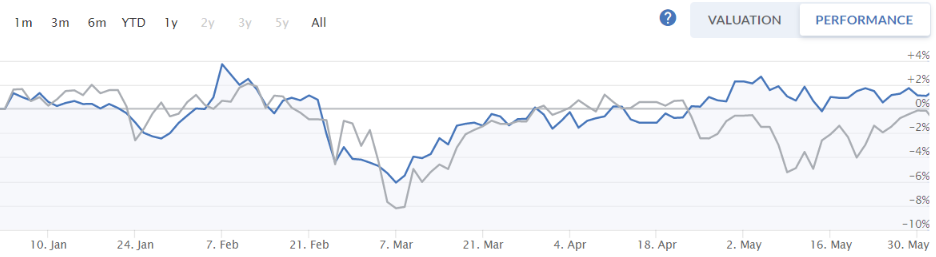
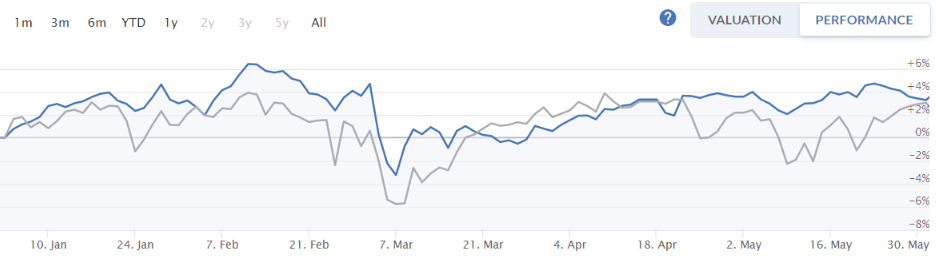
May was a frustrating month for me. The first half saw blistering outperformance, as much as a +5% outperformance vs benchmark MTD. The markets had lurched downwards, while both my ISA and SIPP held their values up well. However, by the end of the month, the markets had recovered most of their losses, while my holdings were barely unchanged. As a result, May ended down -0.7%, while the FTSE All-Share benchmark was up +0.4%. The AIM-100 was down -4.5% in May, where the majority of the shares in my portfolio are from.
YTD the AIM-100 is down -20%, while my ISA (all AIM shares) is up +1.1%.
Five months in, I am up +2.3% overall across my SIPP and ISA, a privileged position to be in. Charts below.
ISA YTD Performance (vs FTSE All-Share in grey)
Sipp YTD Performance (vs FTSE-100 in grey)
Earlier this month, it suddenly dawned on me that I might now have too many companies in my portfolio. Last year, I ran a concentrated portfolio, and my goal was to diversify. However, has the pendulum swung too far? I now have 15 companies (excluding my two ETFs). I know many other investors run a larger portfolio. But for me, as a part-timer with a demanding day job, is 15 too many? And I still have quite a bit of cash (28%) in both portfolios to deploy. Your thoughts in the comments below would be much appreciated.
May was a month dominated by the “missed opportunity” theme. Not in terms of buying, but in terms of selling. I had correctly identified that Spaceandpeople (LON:SAL) might have been a bit toppy at c15p during early May, and sold, but only half my holdings. It then went as low as 12.5p, and now at 13.5p.
Similar goes Zytronic (LON:ZYT) – I decided to sell at c170p right after results, but got distracted that day and didn’t execute, and the price has fallen ever since. I succumbed to the investor weakness of waiting for a bounce-back, and the shares at now at c155p.
I firmly believe that being decisive, but not rash, is probably a key skill for a successful investor. And in both cases, I had made the right initial calls, but should have been more decisive or bolder. A skill I need to improve on!
My most costly “rash” decision this year so far was my sale of THG (LON:THG) at the end of April at c110p. I invested in January with a strong conviction that a bid was coming. I got bored, and sold. Also I fretted about inflation, consumer discretionary income, and the cash burning nature of the company. All valid points. Until news of a rejected bid came, and the shares are now 145p. If I had held on to the shares, my YTD fund performance would be a robust +4.0% instead of a merely healthy +2.3%.
Anyways, I am grateful that my fund has preserved my capital, eeked out a small return, while also providing me with an ample cash pile for bargain hunting.
Many companies on my watchlist have triggered my buy prices (see further below for shares I’m closely watching), but I have yet to pull the trigger. Why? They are all low liquidity, small cap AIM shares that will suffer the most if there was a market capitulation. And I believe such capitulation is still to come; so far we have only seen the small foreshocks, not the main earthquake. I know I sound like a bear. And I am. But I am also still fairly long equity. However, I have become more disciplined in terms of conviction, re-assessing my holdings weekly, instead of the usual monthly. This is no time to be holding companies with a mild conviction, hoping for Mr Market to be nice to ride the market momentum.
Performance Summary
The BBB ISA
| May 22 | 2022 YTD | 2021 | |
| ISA Performance | -1.2% | +1.1% | +42.5% |
| FTSE All-Share Performance (Benchmark) | +0.4% | -0.1% | +14.6% |
| AIM 100 Performance (Secondary Benchmark) | -4.5% | -20% | +1.8% |
| % Portfolio in cash (average of end-month readings) | 31% | 38% | 48% |
The BBB SIPP
| May 22 | 2022 YTD | 2021 | |
| SIPP Performance | -0.3% | +3.3% | +7.0% |
| FTSE 100 Performance (Benchmark) | +0.8% | +3.0% | +12.4% |
| % Portfolio in cash (end-month readings) | 25% | 15% | 32% |
Detailed holdings at the bottom of the article.
Changes to the portfolio in May
PARTIAL SELL: Spaceandpeople (LON:SAL) – I decided to sell down, after GfK released some of the worse consumer confidence readings ever recorded. They will still do well in H1 (Jan-June), riding the post-pandemic re-opening wave. But the future outlook is uncertain. I expect shopping footfall to drop as consumers tighten their belts, and brand experiential marketing to be cut too as companies slash the low hanging OPEX fruit. On top of that, their other market, Germany, isn’t doing so well either in terms of inflation or consumer confidence.
I still think the shares are vastly undervalued, and in a normal trading environment they could be valued at 30p+. A pity I only managed to sell half my holding, due to low liquidity, before the share price moved lower due to my selling. Anyways, I wait for good news at their AGM this coming week, before deciding what to do with my remaining holding.
BUY: Yu (LON:YU.) – I have been tracking Yu Energy for a while now, through the frenzy and buzz of the energy crisis. They are the best play IMO at the moment; unaffected by the price cap as they are B2B, a challenger brand and poised to mop up what will be a huge switcher market coming up, as businesses on 1-year, 2-year fixed price contracts (pre energy price increase) come up for renewal. They are gutsy, having taken on the customer books of other failed suppliers.
The only question mark in my mind is whether management are good enough to hold it all together as they scale rapidly, or if the wheels will fall off the train. Hiring is being done at a frenzied pace at the moment, and they’ve done a recent small acquisition, all of which signals to me that management see the internal forward-looking metrics as healthy and full steam ahead.
Looking into June
I mentioned earlier that several companies on my watchlist have triggered buy alerts in May, but apart from Yu Energy, I have not added any to my portfolios. Partly because I am unsure whether I want to keep adding to my 15 existing holdings. And partly because I still believe the market capitulation has yet to arrive, and there will be an even better opportunity. Here, I share some of the companies that are on my immediate radar, where I think the prices are at a valuation that I would have bought, in different circumstances.
Photo-Me International (LON:PHTM) – travel is booming, that much we know. And after 2+ years of no travel for some, there’s a big demand for new passports. While photobooths might be in long term decline, they still make up a big part of Photo Me revenues. The current valuation is very undemanding, and the largest shareholder (and current Chairman) recently bought big at 75p, and will likely take the company private at some point in my opinion. On top of that, there are potential big growth drivers, as they have diversified into other “self service machines”, all of which are showing signs of good growth traction.
Quiz (LON:QUIZ) – I wouldn’t normally go for a small fashion retailer at the moment (look at what happened to Missguided) due to supply chain and inflation issues. But with Quiz, I think they will manage those challenges well, as their founder and current CEO is a seasoned veteran in clothing supply & manufacturing. Wardrobes will need updating this year for the big pent-up party season, I like their healthy gross margins, their low-risk revenue-based rent model, and last man standing play on the high street. Better to sell in physical stores, than to bear the brunt of high delivery return rates that sap profit margins, like Boohoo (LON:BOO) is experiencing. In no other industry is there a business model where 40% or more or orders (that end up being returned), are loss-making. Maybe in airlines, with their cheap economy seats. I wonder if this time next year, we will all realise that physical shops can structurally have better margins than online shops, given the right rent levels?
Chapel Down (OFEX:CDGP) – I’ve never bought on the NEX Exchange before – are there downsides, apart from the liquidity? What caught my eye here is the climate change story, that at some point soon (soon as in years/decades), the Kent area will have the perfect climate for vineyards, that is currently being enjoyed by the Champagne region in France. Obviously, looking at the share price graph, investors have gone stale on the story, waiting for it to happen. But like good wines, you have to wait for vineyard investments to mature and come good. Michael Spencer, the largest shareholder, recently increased his stake to just under 30%. And he knows his wine, as he is also invested in Bordeaux Index, an online wine trading platform. There is also strong asset backing in Chapel Down in the form of agricultural land, which comes in handy for inflation protection. The product is winning awards customer reviews are very favourable. The pound has weakened, making it easier to sell in the UK against imported Champagne and Prosecco, as well as exporting. And the risk of fundraising is now behind as it has turned profitable and no longer operational cash burning; any fundraising from now on should be for acquisitions and land purchases, not for BAU expenses. The downsides? Chapel Down will never deliver 20%, 30%+ revenue growth yearly, and so unlikely to get pulses racing and speculators piling in. Any share price appreciation will be steady, but that suits me fine.
ITV (LON:ITV) – this is an existing holding, but it recently triggered my alert for a no-brainer price to top-up. I am still mulling whether to do so, as I am at my max portfolio position size with ITV. The market seems to price it as though a full-blown recession is inevitable, at a 5x PE for this current year. Management have already confirmed Q1 was robust, and Q2 would be decent, so half the year is more or less in the bag already. There is the other argument that they should benefit in a recession; people stay in rather than go out for entertainment, thus viewership and therefore ad rates will go up. Plus, if streaming subscriptions are cut, people will naturally migrate to free, ad supported TV streaming apps like ITV Hub. They have net debt, yes, but they also have a crown jewel asset that could be sold in any distressed situation: their ITV Studio and their back catalog of content. On top of that, their TV monopoly is going to be strengthened soon, with the government mandating that all smart TVs and smart media devices will need to have the ITV app pre-installed, front and centre. This is like Microsoft pre-installing Internet Explorer, Apple pre-installing Safari on iPhones. Furthermore, there is a good chance ITV could end up owning Channel 4. Meanwhile, the BBC Is having its budget cut for the next few years due to the freeze in TV licence fee. Monopolies are good for profits, and ITV is looking strong. Provided we do not get a massive recession. But if you think we are headed for one, then no stock will be safe, only 100% cash or short equities is the way to go.
Here's hoping there are some good bargain hunting opportunities in June, but also that the values of my existing holdings do not crash! A wishful oxymoron?
Disclaimer
This is not financial advice. Our content is intended to be used and must be used for information and education purposes only. Please read our disclaimer and terms and conditions to understand our obligations.
11 comments
June portfolio update - will be a bit delayed as was meant to get it out today (Sun 3rd July) but unexpectedly got Wimbledon tickets. So my writeup will be finished next weekend. Also I'm going to do a half year special.
The short is that on relative terms, performance has been good, outperforming the FTSE All Share benchmark by c7% so far in 2022.
But one can't eat relative returns, and on an absolute basis I'm just barely in profit for the first half of 2022.
During June, so many buy price alerts were triggered for me. I'll be sharing some of them; many are getting to silly cheap valuation territory IMO.
Cross-posting my comment on a Daily SCVR report here, as I ended up writing quite a long bit and wanted to share it!
----------------
Read through the latest Barclaycard monthly consumer spend report for month of May.
Some interesting points. My comments are in italics:
Off the top of my head, this bodes well for Saga (LON:SAGA) in terms of Cruise, Travel Agency, and FX sales. Also for Quiz (LON:QUIZ) as they specialise in dresses, which will be in demand for summer travel given people need to update travel wardrobes. Bodes well for £SSP recovery at train stations and airports.
I would be avoiding the likes of DFS Furniture (LON:DFS) and Made.Com (LON:MADE) with the spend trends going quite negative now. And keeping an eye on hospitality without a strong loyal customer and/or affluent customer base with discretionary income. Revolution Bars (LON:RBG) and £HOST and Cake Box Holdings (LON:CBOX) and Restaurant (LON:RTN) come to mind. Although perhaps very value-focused like Fulham Shore (LON:FUL) might continue to do well as people trade down.
(I hold SAGA in The Boon Fund)
I think the the number of stocks also depends on the value of the portfolio - if I had a smallish portfolio (say 20k) then I'd probably only hold a few stocks. If I had something more substantial (say over 500k) then I'd want a lot more diversification and probably want at least 40 individual stocks.
Perversely, holding more stocks can be less time consuming - with a very concentratred portfolio you need to carry out very detailed analysis of each position. If each position makes up only 2% then you can afford to be slightly less thorough, although obviously returns will tend to be more in line with the index. Having said that I have a pretty high number of positions (around 50) yet consistently manage to beat all the main indices, so for me it's still worth running my own fund (as opposed to just giving it to a fund manager to look after).
I agree with your small vs big portfolio, and add one more qualifier. Whether it is small or big relative to your financial status.
A £20k portfolio if your net worth is in the millions, probably fine to run concentrated, as even if it loses 80% of its value, you'll still be OK financially.
But that same £20k if your net worth is only £30k, then you would want to diversify it, so to minimise the risk of a big loss.
My ISA and SIPP, combined in The Boon Fund, is a substantial (30-50%) part of my net worth. Therefore, my first priority with it is capital preservation; secondary is market beating returns.
Having just thought and written that, it dawned on me that perhaps 15 holdings in total is probably too little, for risking 30-50% of my net worth. On the other hand, a similar part of my net worth is equity in a single property. So hmm.
It’s all a question of information privileges. You can have a very high level of confidence in the value of your house relative to the market. You cannot say the same about your equity holdings where you are at a disadvantage relative to the BoD and then better resourced market participants. For years I was happy to have 90% and then later, but on a larger scale, 50% of my net worth tied up in a single business. The difference being a) I owned it and therefore had the most privileged information, and b) entrepreneurship is a trap whose growth (good) and working capital requirements (bad) eat up your assets and attention.
Would I now place my assets in only 15-30 companies? Maybe one day if I am a more experienced and confident investor. Until then a diversified global portfolio of 200 holdings gives me geographical, currency and thematic diversification - although it is quite directional on factor, ie growth - ouch!
"I firmly believe that being decisive, but not rash, is probably a key skill for a successful investor."
This is an important issue for an investor. The successful investor must have access to three things:
1. Adequate information
2. Good analysis of the information
3. Objective behaviour, vs. making decisions with feelings & emotions
A key point is that any decision (Buy/Sell/Hold) can only be assessed based on the information available at the time that the decision was made.
It would appear however that you are assessing your decisions ex post:
eg you are classifying your decision to Buy LON:THG as 'rash' because the stock fell after purchase.
eg your decision not to buy LON:PHTM is likely being classified as 'indecisive' because the stock subsequently rallied.
Hindsight is a wonderful thing. But focussing on (1-3) will likely lead to more successful outcomes.
I agree with your 1 to 3.
My point was being Decisive. I had come to a decision, on Photo-Me International (LON:PHTM) for example, which included 1-3. But as with all decisions in life, doubt creeps in, and one spends time running through in one's head, whether one has missed anything or analysed any part wrongly. It is that dithering; how do I have the courage to always just confidently push the red button right after I come to a conclusion to buy or sell?
"My point was being Decisive. I had come to a decision, on Photo-Me International (LON:PHTM) for example, which included 1-3. But as with all decisions in life, doubt creeps in, and one spends time running through in one's head, whether one has missed anything or analysed any part wrongly. It is that dithering; how do I have the courage to always just confidently push the red button right after I come to a conclusion to buy or sell?"
This is a key question.
The harsh reality is if you think of the three requirements for investment success we will, as investors, always be found lacking somewhere:
1. Adequate information - INVESTORS WILL ALWAYS BE LACKING SOME KEY INFORMATION
2. Good analysis of the information - ANALYSIS WILL NEVER BE PERFECT
3. Objective behaviour, vs. making decisions with feelings & emotions - WE ALL HAVE BIASES THAT WILL INFLUENCE BEHAVIOUR.
So it's good to start by realising that in the long run investors will only get it right maybe 6-7 times out of ten decisions (*).
You will make mistakes.
I will make mistakes.
Even Warren Buffet will make mistakes.
I think it's important to calculate an intrinsic value for every (prospective) holding, incorporating a confidence factor. This DCF calculator may be of use:
http://www.moneychimp.com/arti...
With an intrinsic value for each holding, upside can be used to inform stock weighting in the portfolio
From there maybe just buy an initial starter position (say 20% of target weight) and then just track newsflow - if the newsflow is positive & upside to intrinsic value is still attractive, then increase the holding towards target weight.
Hope this makes sense.
(*) This is true in many areas of life. Think about a football manager signing players. 100% success is unlikely, other than by chance. Think of Chelsea signing Romelu Lukaku. Or Watford signing Danny Rose. Or the majority of Man Utd's signings in the last few years.
Hello Boon - thank you for sharing this, it's much appreciated. An interesting portfolio and I look forward to future updates. And well done on your current performance.
As to whether 15 stocks is too many - or too little - I really could not say. Only you can know that. But its an interesting question - so here are some thoughts - please do with them what you will.
It intrigues me that you consider that it might be too many - because you don't have enough time to research them all fully.
There is normally a strong argument made for holding more stocks to diversify and reduce the impact of any one stock going 'Boo' - not to coin a phrase - and massively reducing performance.
That's always seemed counter-intuitive to me in that reducing the ability to research each investment fully should also reduce performance?. Of course that assumes that you don't subscribe to the Efficient Market Hypothesis and that you are comfortable with the increased volatility that a smaller number of stocks brings with it. It does seem to me that most of the hugely successful investors quoted in books also don't subscribe to the EMH and much of their success is down to a few right calls backed by significant concentration of their portfolio.
I've recently become a full(ish) time investor. An enforced change due to the impact of long covid. The silver lining is that I'm enjoying it enormously even though my performance is not as good as yours. Yet.
One clear consequence - for me - of more consistent research and analysis is that the number of stocks that I hold has reduced by 50% from around 40-50 to 20-25. And its still a struggle to fully research all of them - at least in the sense of constantly revisiting and updating my analysis and forecasts.
On the face of it I still have a way to go to get down to 15 stocks - and thats not easy right now with so many apparent bargains around me. But my portfolio is not equal weighted. Just 5 of my stocks comprise over 50% of my portfolio. It was closer to 60% until recently when pull-backs have made it less concentrated. Though for no reason other than sentiment upon lack of news so I fully expect the concentration to increase again. And why not - it seems to make sense to back my highest conviction investments with the most funding. Albeit not the most comfortable approach. In my case the absolute number of stocks that I hold is probably less important than the concentration of my holdings which is a lot more concentrated than the 20-25 stocks implies.
That's a long winded way of saying that perhaps you are asking the wrong question? Instead of asking whehter 15 shares is the right number perhaps it should be whethe your portfolio concentration reflects your assessment of risk versus reward - in my case the number of shares I hold tends to flow from that allocation. Sure I'd love to hold more - but then I'd have defund my best opportunities?
In my case the 5 shares are MS International (LON:MSI) Anglo Pacific (LON:APF) Macfarlane (LON:MACF) Vianet (LON:VNET) and interestingly the one that I hold in common with your portfolio Zytronic (LON:ZYT)
Zytronic (LON:ZYT) - you are quite right. If your conviction here is not strong then 170p would have been a good exit. My reasons for buying are longer term. Here are some fairly recent thoughts for what its worth. Like all of these shares I've spent a lot of time analysing and researching and in each case I think I see something that the market has yet to recognise. Doesn't mean that I am right. Or that the market will ever agree with me. My track record proves that. Some I get right. Others not. In the case of Zytronic which is effectively a turnaround suspended by the pandemic. - its a niche product development into a future market growth opportunitiy.
Did you listen to the recent management presentation on IMC? I listened because management ability is an important factor for me. Attending the AGM is not practical for me. To start with it was a little less than overwhelming, not to say a bit shaky. But to be fair it was the first time they have presented results (that I am aware of ) away from an AGM and the first time presenting to PI's. I normally pay less attention to the read through of the results slides than the Q&A and am inherently sceptical if the presentation appears too slick and the presenters too smooth as I want to get under the surface.
By the time of Q&A they were much more into their stride and the answers I found to be frank, open and illuminating - at least as far as they are allowed to be. At one point the CEO was beginning to bounce up and down in his seat, revealing both passion and excitment (I thought) over the growing opportunities, particularly for unattended retail (vending) and the EVC market in particular. Actually 3 of my top 5 shares have potential exposure in different ways to the EVC market opportunity.
Anyway, but I digress - you may have listened to the IMC presentation and come to another conclusion. I see Zytronic as a powerful combination of cash rich, asset owning, cash generating technology company with a growing portfolio of IP, patents and manufacturing knowhow in a market niche that has used the pandemic to refurbish its production facilities, lower its cost base, buyback shares and launch new products.
Unfortunately - or perhaps fortunately depending upon how you look at it - its not a share that PI's want to hold right now. For a number of reasons, tiny market cap, huge lack of liquidity, exit of institutional investors at tender offer, growth from a low base after the pandemic and lack of clarity over the ability of the company to capture the future market opportunity - it's a neglected and undervalued share in a bear market.
At the AGM update the H1 turnover was 25% with the order book 40% up and at the interims turnover was 24% ahead but management are habitually cautious on the full year turnoout as they only have around 1 or 2 months forward visibility on orders and much can depend upon their OEM customer orders how and when the orders flow though to Zytronic. That's an important point I think - as Zytronic is tiny and the market is niche - so unpredictability of order flow means that management have to keep their epectations conservative - even if they are bouncing up and down with excitement. As the actual current order flow, due to their customers own supply contraints and sales success - can make the order flow down to Zytronic volatile and easily mask the overall growth trajectory. In my view it increases the likelihood that they will exceed expectations. That's something I like - but it means the shareprice trajectory tends to lag the company growth. Not good if you are looking for a swift exit?
Because it's tiny and neglected and because the turnaround is starting from a low base in growing markets I think the immediate short term future for the share price is uncertain. Indeed with buyback ending recently I'm slightly surprised that the price has not already fallen. I do expect it to - and when it does I'll use it to buy more shares if I can.
In the 1 to 2 year timeframe I expect consistent growth in turnover and growing clarity on the size of the market opportunity in vending (EVC's) and across Industrial, Gaming and Finance to re-rate the share price considerably. In the meantime they still have spare cash to return to shareholders and growing dividends from cashflow. But then I could be wrong.
And of course none of this should be taken as a recommendation to buy Zytronic shares - perhaps you've come to a different conclusion in which case I'd certainly love to hear it,
Cheers
Mark
Mark, thank you for the very long comment! I thoroughly enjoyed reading it.
On Zytronic (LON:ZYT) thank you for flagging up the recent IMC presentation. It has been languishing on my to-do list to watch it. I subscribe to all the bull points that you mentioned on it; my rationale for selling was based on the somewhat high PE it is trading at the moment, and also the large revenue exposure to the gaming sector. Granted, gaming has boomed in the first few months of re-opening; but if consumer savings are depleted and lean times are ahead, gaming volumes will suffer, no? Or maybe not; there will always be the hardcore gamers, and maybe desperation will drive more to the slot machines to try their luck?
On diversification - maybe 15 is too few. I had a bit of a think about it some more. If I step back; my goal is to beat the market by at least 5-10% yearly, and minimise the risk of any big losses. That means I definitely do not want to run a concentrated portfolio. But of course, the bigger the portfolio, the more likely it is to revert to the "mean" index return.
What I think I'm looking for is to find a set of shares to invest in that will:
- minimise losses and avoid the big landmines, so that collectively they slightly outperform the index.
- if the average position side is 6.67% (eg 15 companies) and every year, I manage to find 2 winners out of the 15 companies (and by winner I mean deliver +50% returns)
- then the combination of the two is, approximately, 1% (basket of 13 shares beat the index slightly) + 3.36% (winner 1 delivers 50%) + 3.36% (winner 2 delivers 50%) = 7.67% return above the index
Of course, this is a very simplistic model in my head, but you can see that repeated over the years, if it works, will deliver that 5-10% outperformance. This, of course, assumes that I'm good enough to find two winners that deliver 50% yearly, consistently, by shortlisting only 15 companies to invest in!
Appendix: current holdings
Small (0-5% of portfolio) , Medium (5-10% of portfolio), Large (10%+ of portfolio)