Bovis Homes starting to show value. Trading on 1x Tangible Net Asset Value

Bovis Homes (BVS LN) Price 780p
TNAV ’16e 780p
Mkt Cap £1.1bn
Investment Case
My first thoughts are “how do I not lose money”, rather than looking at upside (which is reasonable in Bovis’s case).
Value emerging?
Bovis is trading at 1.0x 2016 P/TNAV (tangible net asset value) 0.9x FY17 P/TNAV, a discount to the sector and to its own non recession history. This TNAV has historically provided a floor to housebuilders in times of non recession. The historic valuation range is 1.0x to 1.4x (excluding recessions). The industry dynamics look reasonable from a supply / demand point of view although affordability remains stretched, especially in London (but Bovis has v limited exposure here) and demand does look to be sustained by Help to Buy, which accounts for c30-35% of industry volumes. A definite tail risk would be that the Govt withdrawsH2B. 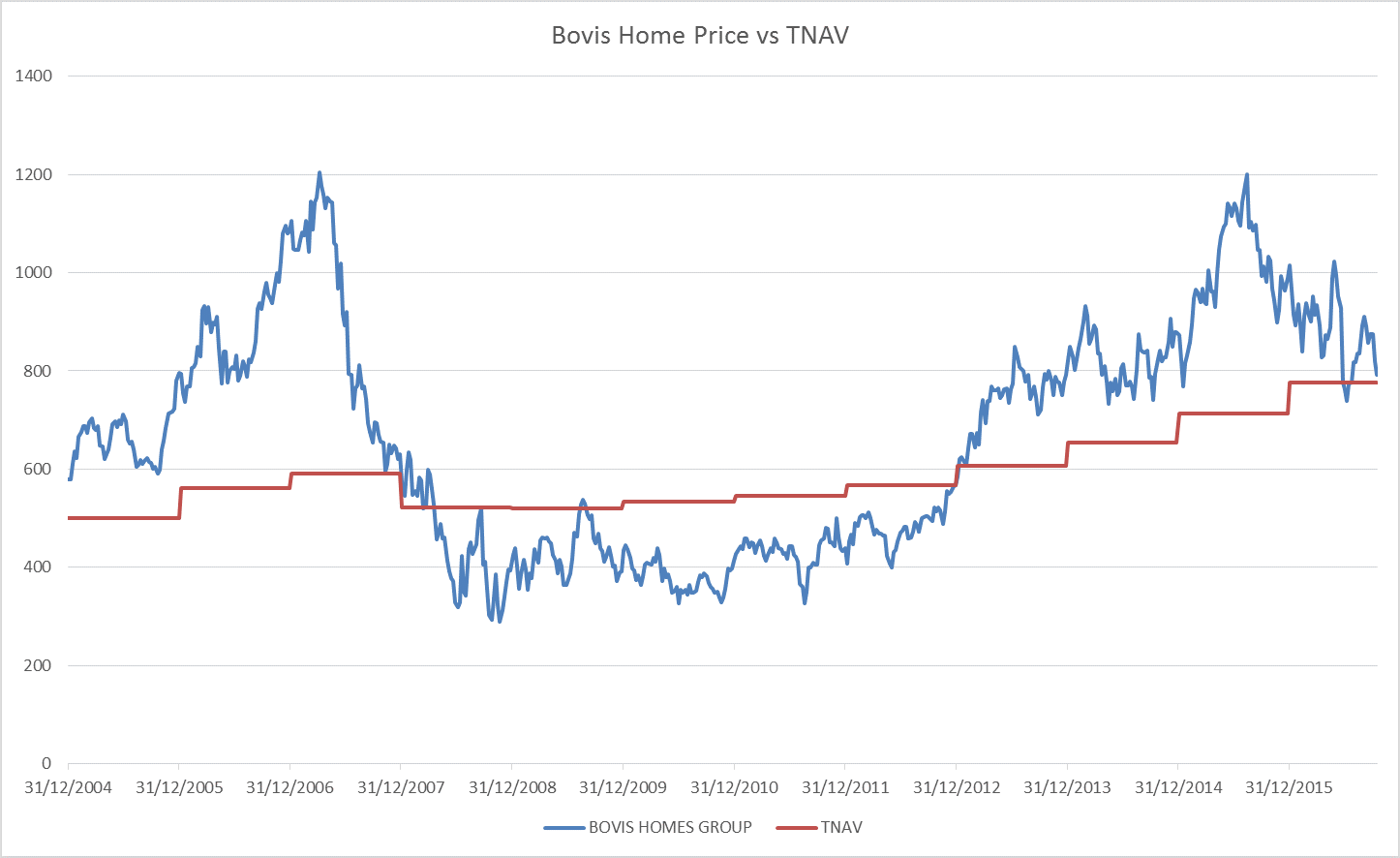
Bovis is a national housebuilder, which had 3934
completions in 2015 (2784 in South, 723 in the Midlands and 427 in the North). Of this 2901 were private legal completions,
social housing was 848 units and PRS 185 units.
Only 1 site out of 102 is within
the M25, so extremely limited Central London Exposure. Longer term the
business wants to get to 5-6000 completions pa from 150 sales outlets.
....But not the Best Housebuilder
This is certainly not the best UK housebuilder and has been dogged by operational issues such as build cost inflation.Bovis has lagged its peers in ROCE consistently since the financial crisis delivering 14% against the peer Group average of 20%. This is down to slowerasset turn. Bovis's margins are in line with number of its peers but the sell down rate is slower on a per site basis. The challenge for management is to increase ROCE. ROCE should start to improve this year and next as smaller faster asset turn sites acquired in the last couple of years feed into the mix. Should ROCE improve to 17-18% (but still below the peer group) I would expect the shares to rerate from 1x TNAV to a premium, to say 1.25x. As the TNAV would also be growing this rerating would see over 50% upside on the shares on a 3-4 year view.
Management - not admired
In my opinion FDs moving to CEO have a poor record (the excellent Rob Perrins at Berkeley Group aside) and David Ritchie is no different. He has been in position since July 2008 and the Group’s performance has lagged that of its peers. Were he to go and be replaced with an external CEO that would be taken positively. This is not captured in the current valuation which clearly just assumes the Group meanders onwards.
2017 The Year of the Stag(nation)
Many will point to declining business confidence and rising inflation feeding through negatively into consumer confidence in 2017. I dont disagree with this but I think we will see a period of sub trend economic growth rather than a full blown recession. I have modelled a 5% decline in volumes, a 2.5% fall in house prices (c5% in real terms) and build costs still rising gently in 2017. This would negatively impact operating margins from 17% down to 13 or 14% but importantly profits and Return on Capital Employed would remain positive. Tangible Net asset Value would still rise but at a slower rate than currently envisaged by analysts due to lower amounts of retained earnings.
|
|
PE |
ROCE |
DY |
P/TNAV |
|
2017 |
9x |
10% |
5.8% |
0.95x |
|
2018 |
10x |
9.5% |
5.8% |
0.90x |
This doesnt look like a disaster scenario to me.
Seasonality
In the short term, seasonality is usually a strong positive factor. If you had bought Bovis at the beginning of Q4 and held until the end of Q1, over the past 12 years the investment would have made an average price return of 15% (positive returns have been experienced 75% of the time). Conversely if you had held the shares from the end of Q1 to the end of Q3 in price terms you would have lost 6% on average (7 negative returns out of 12 periods).
So why is it interesting?
Primarily because the shares are right towards the bottom end of their valuation range. There is nothing to say that the shares cannot fall below TNAV, however maybe a third party like a private equity firm would look to buy the business and just run it off. I have seen analysis by Redburn Partners that shows a run off valuation of just the current business is c30% higher than the current share price. Admittedly they would have to pay a premium to do it, but then they could float a smaller business back on the market in 5 years time and I would hazard they would still make a decent return.Longer term a change in management and improvement in financial returns relative to its peer group would see a rerating.
Buying stakes in companies always feels better when there is lots of positive razzamatazz. But the key question is where do you make better returns? There isnt much good news in Bovis at the moment but I do feel there is a value proposition emerging. You couldnt give Glencore or HSBC away earlier this year. Yet BREXIT has happened and they are both at 12 month relative highs. OK so they were trading at more extreme discounts to book value but hopefully you get my point. "Buy when others are fearful"
This is not a recommendation to BUY but my own opinion. However I have put my money where my mouth is.
Disclaimer
This is not financial advice. Our content is intended to be used and must be used for information and education purposes only. Please read our disclaimer and terms and conditions to understand our obligations.
11 comments
Ken
Hi, I think my mistake here so far has been to ignore the technicals, which as you say aren't great. Maybe I should have canvassed more opinion on what level to buy at from a technical point of view.
My time frame is usually 3 years plus, so I don't consider myself a trader per se, but I do try and buy what I consider are mispriced companies. What I do try and do is buy after a period of underperformance when I think most momentum players have been flushed out and value is emerging. I may be wrong short term, but I hope to be right long term. So I don't care so much about a further 10% downside if I can see 60% upside on a 3yr view.
Thanks all understood
BVS is very sound in my book and I did hold it but got stopped out during the Brexit period and that is where I am now still stopped out by lack of momentum. Just saying ---obviously a long hold may be necessary it just depends upon what ugly face emerges from the murk to frighten us all, Bought Silver today!!!
PJ007
I dont think we will see the same level of write downs this time because
1. Completions: UK housing completions were 200k in 2007, falling to 120k in 2010, they have risen recently but only to around 170k vs household formation of over 220k units pa. So market is not oversupplied, and has less overall supply vs 2007.
2. Regulation of mortgage provision: greater regulation of mortgage provision with higher deposits needed, crackdowns on Buy to let and a greater proportion of repayment mortgages have taken some of the throth out of the market. Therefore I see less impact on demand. Also securitisations essentially stopped from 2008 following the demise of Bear Sterns then Lehmans. This stopped the mortgage market in its tracks almost overnight. There is no sign of this presently.
3. Demand - Mortgage rates are at historical lows with interest payments v low as a proportion of income, so interest affordability is v high and will remain so for years to come.
Doesnt mean it cant happen though !
I must have said something wrong with my last post but I will preserver. VegPatch your first rule is " how do I not lose money" I have fretted on this for a few hours, do I say some thing, do I not? But I guess we do this post stuff to get other peoples views -- so with the first rule in mind plus my mention of being stopped out through lack of momentum, did you consider the following or would you disregard it. The trend ( momentum) has been downwards since August 2015 and still is, the channel at the moment would be low of £7 high of less than £9, obviously reducing unless the trend is reversed. OK if you bought at the what appeared to be the bottom of the channel and got lucky you could sell and make a possible 15/20% over a few weeks, not bad if you are a trader. But as an Investor would you go against the trend, I think not. What's your thoughts?
Hi VegPatch - you make a very good case for Bovis. In fact I was looking to beef up my SIPP portfolio with a solid dependable stock with a good dividend yield & growth potential, and Bovis fits the bill. Bought some this morning.
I also did a screen search out of interest, for other other stocks trading well below NTAV in the same sector as Bovis and came up with U and I (LON:UAI) 59% MCap/ NTAV, and St. Modwen Properties (LON:SMP) 65%. This sector is not my forte. How do they compare with Bovis?
PJ077 - look at all the debt in the companies you mentioned. That would magnify any fall in the gross assets down to the net assets eg SBRY = net debt £1bn, interest cover 5x
Nominally Bovis has net cash but thats because it brings in the cash at year end. Average Interest of £5m though tells us that Bovis does have debt on average during the year. If we assume that £5m = 5% interest charge = roughly £100m of debt. That compares to gross assets of £1.6bn and net assets of c£1bn. so it isnt that leveraged.
I take your point but i feel that NAV has historically been supportive because assets are held at the lower of cost and net realisable value. So this understates the true NAV.
Out of all the companies you have mentioned BVS would get my vote!
It isnt inconceivable that BVS goes to a 20% discount to TNAV, I bought it post BREXIT there and sold when it went back to a premium. Hopefully it wont, but it would be "fill a bucket time" rather than "fill a thimble time".
Fair point on leverage VegPatch, Balance Sheet gearing was one of the two factors that hammered the housebuilders in the last recession.The other was land writedowns.
So I can't quite agree with your contention that "NAV has historically been supportive because assets are held at the lower of cost and net realisable value. So this understates the true NAV"
If house price inflations expectations reverse in 2017/18, land values on the Balance Sheet will be questioned. Who can forget Persimmon's £600m land writedown from 8 years ago?!
https://www.theguardian.com/business/2008/oct/28/persimmon-construction
For UK listed companies (market cap £100m+) there are currently 74 with a Price/Tangible Book ratio of <1.
This list includes such blue chip names as J Sainsbury (LON:SBRY) British Land (LON:BLND) Millennium & Copthorne Hotels (LON:MLC) Drax (LON:DRX) & Mitchells & Butlers (LON:MAB) .For Bovis, the shares post referendum fell well below the tangible asset value.. to 630p.. which coincidentally is the NCAV (current assets less all liabilities).
If Bovis can remain profitable (and avoid asset writedowns) 630p may well provide support into 2017.
Just bought a block of these yesterday. Needless to say I agree with you analysis. Basically undervalued compared to the rest of the market and other housebuilders.
Section 24