Can Stop Losses Improve the NAPS Portfolio?

Many subscribers have been attracted to the NAPS portfolio approach. The headline ~15.5% annualised returns over 11 years, plus a couple of percent in net yield on top, is quite magnetic. But let’s be under no illusions - a fully invested share portfolio with exposure to small and mid-cap shares is guaranteed to deliver some savage drawdowns. And the recent market volatility in precious metals and info stocks has given many of us a small teaser for what could happen in harder times.
In the pandemic crash of March 2020, the NAPS bottomed at a 46% drawdown. That decline wiped out nearly five years of accumulated gains. I know many investors who threw in the towel entirely during that period and I’m not surprised - it was awful. You have to ask yourself the hard question: Can you sustain a savage drawdown? And if not, how can you minimise it?
So one question I get asked more than any other is: could stop losses help reduce the drawdowns in the NAPS? A couple of weeks ago, in our extensive 100 minute NAPS Portfolio Webinar, I tried to answer this question.
The simulation
I simulated the NAPS portfolio with a 20% stop-loss applied to each position. The rule was simple: if any holding fell 20% from its purchase price, it was sold and the proceeds held in cash until the next annual rebalance date in January.
That cash-until-rebalance rule is an important limitation to understand upfront. In the real world, you might try to reinvest sooner. But it gives us a clean baseline to isolate the pure effect of stop losses on the base NAPS approach.
The drawdowns do shrink dramatically
The headline result was striking.
That 46% pandemic drawdown in the unconstrained, fully invested NAPS? With a 20% stop-loss, it shrank to roughly 27%. Still painful, but a fundamentally different experience. That's the difference between a bad period you can ride out and a crisis that makes you throw in the towel.
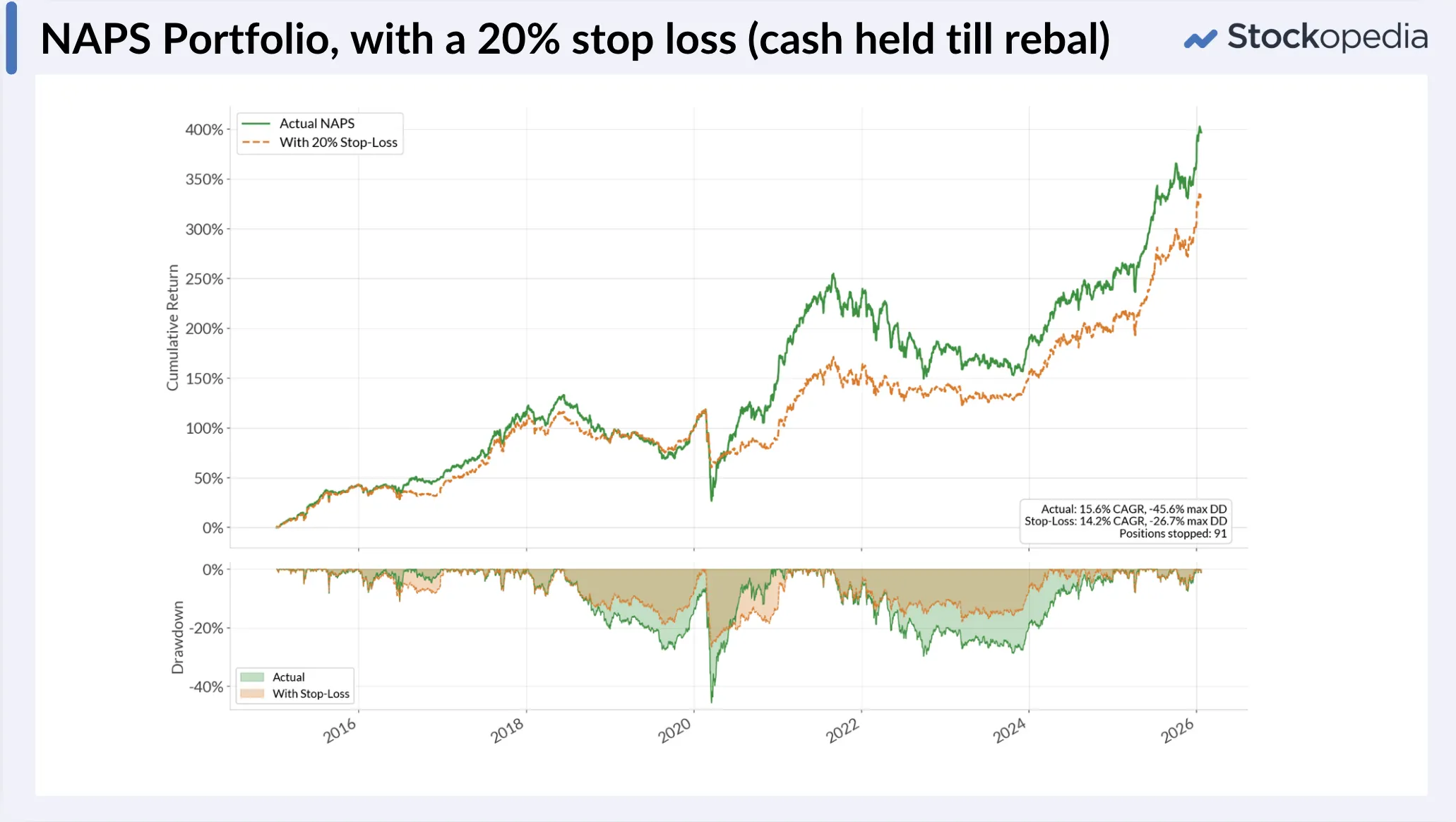
This matters far more than most people realise. It's one of the most important mental models in investing, and I wrote about it at length in A Practical Guide to Keeping Losses Small: the larger the loss, the ever larger the recovery required. A 26% drawdown needs a 35% gain to recover. Manageable. But a 46% drawdown needs an 85% gain. That's the brutal power-law maths of losses, and it's the reason Warren Buffett's first rule of investing is don't lose money.
So if a stop-loss halves your worst drawdown, shouldn’t we all use them?
Not quite.
Returns are lower
You can see from the chart above, which has the fully invested NAPS in green vs. the 20% stop-loss NAPS in amber, that the stop-loss approach did not generate such strong returns. But I tested stop-loss levels at many more levels - 10%, 15%, 20%, 25%, and 30% - all with cash held until the next rebalance. The pattern was consistent across every level:
- No stop-loss approach delivered the highest annualised return
- Tighter stops (10-15%) produced the shallowest drawdowns but the weakest returns
- Wider stops (25-30%) preserved more upside but offered less drawdown protection
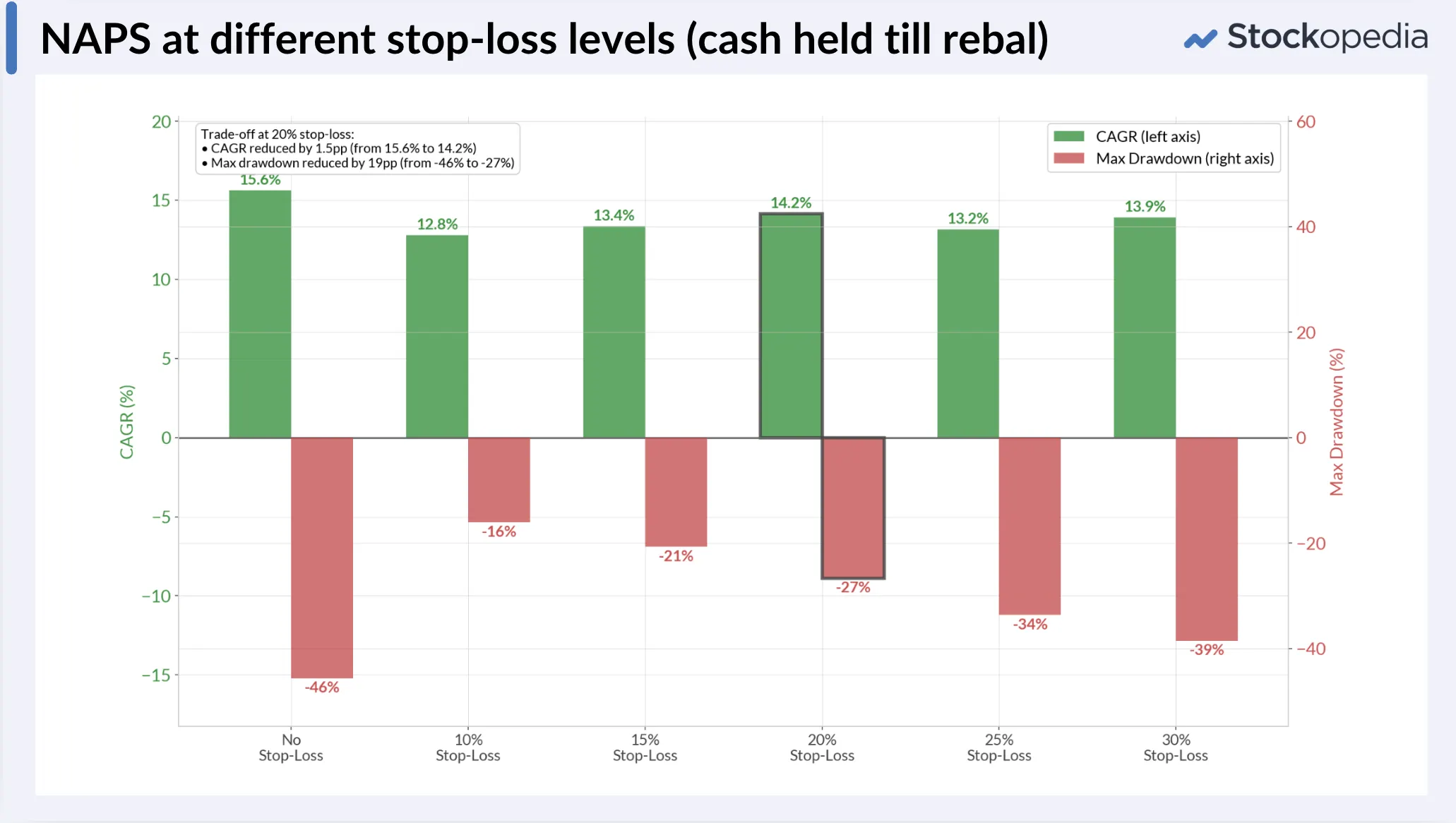
It's a clean, consistent trade-off. You're exchanging some return for a smoother ride. And the reason is straightforward: when positions are stopped out, the proceeds sit in cash earning nothing until the next January rebalance. If you're stopped out in March, that's ten months on the sidelines. In 2020, that meant missing one of the greatest recoveries in stock market history while more than half the portfolio sat idle.
The obvious solution is a re-entry rule - some signal that tells you when to get back in. I've written about using the market's moving average, watching for when high-ranked shares start breaking upwards again. But honestly, crafting robust re-entry rules is genuinely hard. It's easy to describe in principle and can be very difficult to implement in practice without generating false signals, whipsaws, and additional complexity that undermines the whole "no admin" philosophy.
Another thing worth noting: the simulation doesn't include transaction costs, which in the real world would widen the gap further. For the kinds of small and mid-cap shares that populate the NAPS, a buy-sell round trip could cost 1.9% in spreads, stamp duty and commissions. Every stop-loss event followed by a re-entry is paying that toll. If you're stopped out of several positions in a bad year, those costs add up.
And another thing worth noting: the simulation assumes you can actually sell at the time your stop loss is triggered. In a market crash, there is a huge dry up of liquidity, and there would be no guarantee you could exit positions at the stop loss level when everyone else is trying to sell.
What the NAPS already does for you
Here's something I think gets overlooked in this debate. The annual rebalance already includes a form of loss-cutting mechanism.
Every January, the NAPS forces you to sell almost all the positions and start fresh with the highest-ranked stocks. Most losers get cut, unless still a qualifying candidate. No emotional attachment. No analysis paralysis. The system takes the hard decisions, on a schedule.
And the data on what happens to the biggest NAPS losers reinforces why this matters. We tracked the 15 worst-performing positions across the portfolio's history - shares that fell 40%, 50%, even 72% during their holding year.
What happened after the annual rebalance forced the sale?
Nine out of 15 fell further. Only six recovered.
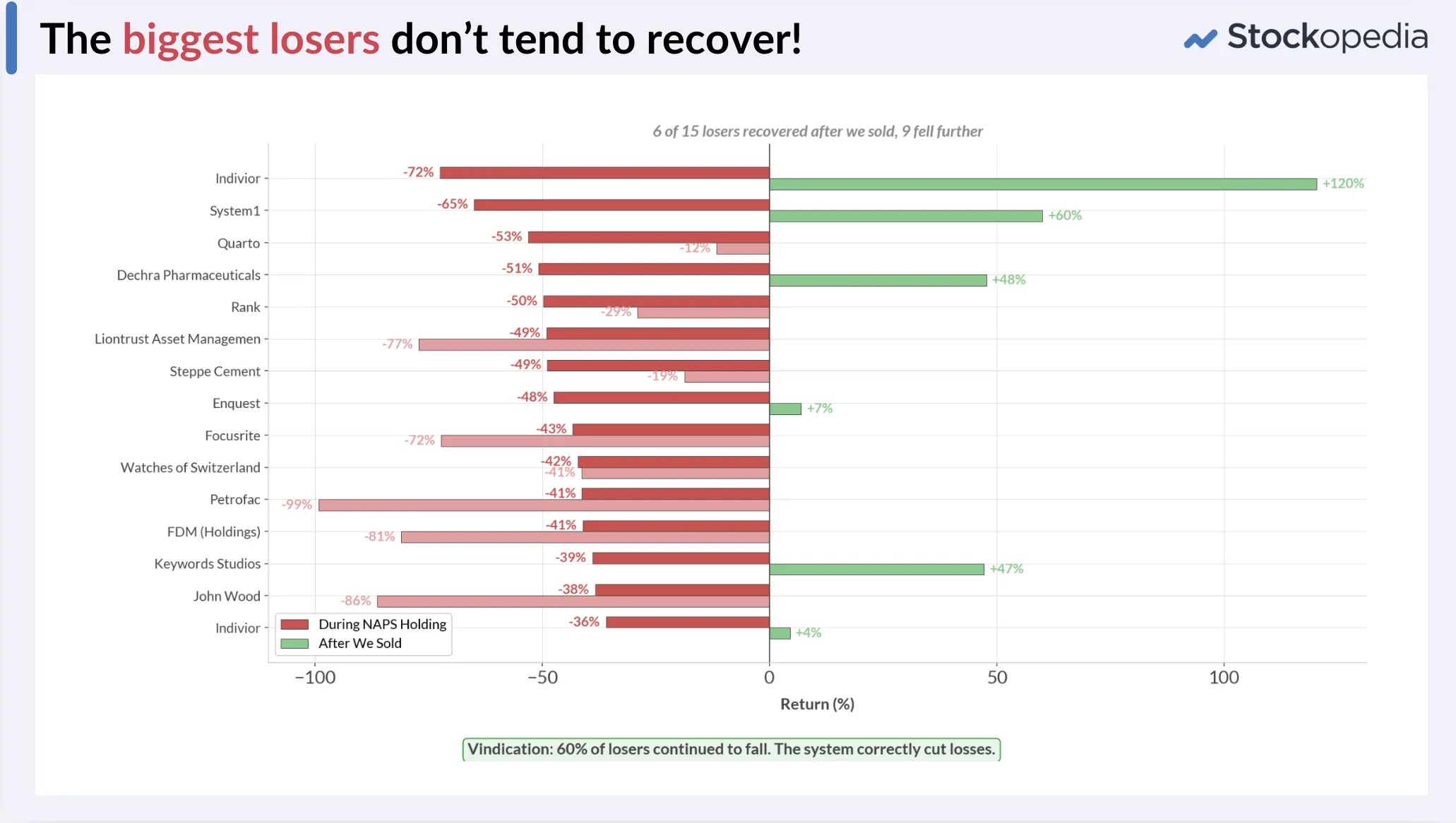
So the annual rebalance, as boring and mechanical as it sounds, is doing part of the job that a stop-loss should do: systematically removing you from positions where the odds have turned against you. It just operates on a calendar rather than a price trigger.
The real question
Of course this isn't really about stop losses. It's about what kind of drawdown can you tolerate. If you can genuinely stomach a 40%+ drawdown - not in theory, but in practice, when your portfolio is deep red and the headlines are apocalyptic - then an unconstrained fully invested portfolio can deliver the best long-term returns.
But if a drawdown of that magnitude would make you abandon the strategy entirely, then a 20-25% stop-loss could be the thing that keeps you invested through the worst of it. Lower returns are far better than no returns because you panicked and sold everything at the bottom.
The best strategy is the one you can follow. Stop losses don't improve returns - third party academic studies are pretty unambiguous on that. But they can dramatically improve your ability to stay in the game during the moments that test you most. And that really can matter more.
As I've always said: if you keep your losses small, the gains take care of themselves. Whether you do that with a stop loss, an annual rebalance, or some combination of both - just make sure you do it. The one thing the evidence is clear on is that doing nothing with your losers is the most expensive habit in investing.
How do you manage your losers? Please share your thoughts for the community in the comments section below.
Disclaimer
This is not financial advice. Our content is intended to be used and must be used for information and education purposes only. Please read our disclaimer and terms and conditions to understand our obligations.
60 comments
Cross-linking to a thread in one of the DSMRs with questions from GloucesterBob and I about Stop Losses and falling Stock Ranks.
https://www.stockopedia.com/co...
For spread to be an impact there are three variables:
1) How often you trade?
2) What type of stocks do you buy?
3) What type of broker do you use?
1 & 2 are well known with respect to NAPS but 3 is down to each investors choice of broker.
Only you can really answer #3
Also what are you comparing against?
You could be a very long term buy and hold investor and only buy 5 stocks a year (limited impact of spreads) or you could be a very active momentum investor (high impact of spreads)
I doubt that helps very much but there is no one answer.
Best of luck
Phil
I use 3 different brokers, l have not found any difference in the spread, between any of them.
The question was about rebalancing every quarter.
Dividends may cover the spread, if you only buy and sell once a year.
Peterthegreat stated ... "An article discussing the impact of spreads on the returns of the NAPS would indeed be welcome"
There might be not be a difference between the three brokers you use but I can assure there is a significant difference between Trading212, AJ Bell & Interactive Brokers.
Out of these three brokers, who provides the smallest spread Phil?
Here's the context ... You might be asking ... "What have fx fees and access to international markets got to do with NAPS?"
It could be you're just starting on yout investing journey or you could be ready to deploy more funds or try a new strategy. It could be that costs to implement a UK NAPS in several different brokers is marginal (unless you have a very small account and you should definitely pick something like Trading212 or Freetrade).
But with all things goings well you might be realise that the QVM approach that NAPS is based upon when applied to Europe outperforms UK by 30% since 2013.
It could be that knowing that makes you curious to start investing in Europe but having the wrong broker (which I would argue I have had for quite some time) will prove expensive. It is possible to move brokers but it is a bit of PITA.
I only chose the three brokers discussed as I know them and they have different models.
Trading212: no transaction fees, widest spreads, fx fees
AJ Bell: fixed transaction fee, wider spreads, fx fees
IB: %age based trasnaction fee but has a floor of £1 if I recall, tightest spreads, super cheap fx fees
IB offers the best spreads and lowest fx fees, better international coverage but it's horses for courses.
If you have a modest sum to invest a pure percentage based costs are better (so for Trading212 that is folded into the wider spread). If you have a larger portfolio, want more international access then one of the other two styles might suit better.
I would save a small fortune (particularly in fx fees) by moving my portfolios from AJ Bell to IB
And of course there are other brokers out there. I'm just trying to help people understand that transaction fee is not the only consideration.
I discuss it in a recent video ...
Hi Phil.
Many thanks for taking the time to answer my query and for providing the link to your YouTube video which I just watched. Very well explained.....Top man!!
Hi Ed, thank you for a super article. Would be interesting to know the effect on performance of a NAPS portfolio running from March to March (instead of Jan-Jan), and therefore being obliged to sell & rebuy smack bang in the middle of the Covid crash of 2020 & then the Trump tariff spat 5 years later. Putting aside liquidity issues & psychological aspects of doing this, were there a sufficient number of high ranking stocks from each of the sectors that qualified for purchase in order to replace those sold? Wondering if the "momentum" factor would have dropped to such an extent so as to adversely affect the overall rank and thus preclude purchase.
I use a stock picking and annual rebalance strategy very similar to the NAPS however I do use stop losses on stocks based upon several factors ie. in relation to how the overall market is performing and whether the stock rank has fallen below 70 or the stock price has fallen below an moving average or lost over 20%. It's not any hard and fast rules based but more looking at the fundamentals, reading threads and getting a feel for things after investing for quite a number of years. I don't reinvest into a new stock but generally reinvest the money into the portfolio stocks which are performing well. Do I get it right all of the time? Absolutely not. Some sold stocks do recover but my success rate is over 60% and am happy with the returns.
At the end of the day one has to adopt a strategy or system which makes you feel comfortable and allows you to sleep soundly at night! Well done to Ed for focussing on a very difficult problem.
.....thinks .. didn't I read somewhere that the NAPS portfolio had a rule to sell when the SR falls below 70 ... or is it outside the definition of a stoploss or am I just plain senile ..
The 90/70 rule - is another rule of thumb, but it's not one that's used in the NAPS. I've often said one can either use a time-based sell rule or a threshold-based sell rule. The main NAPS rule set just uses time with the one-year cadence - but obviously there are more dynamic approaches, and many people adapt rules for their own purposes.
I came up with the 90/70 rule as it was based on an interesting paper called "Combining Factors." You can probably find it by searching on SSRN. But I know there are those who use much tighter rank cut-offs. Phil Hoffer himself actually uses an 80% hard stop limit on the quality rank, which has been quite effective for him.
"Phil Hoffer himself actually uses an 80% hard stop limit on the quality rank, which has been quite effective for him."
That's not strictly what I do ... rather if a stock drops below a 80 grade on the quality rank I will tighten my notional stop loss, moving it from the bottom of the Ichimoku Kumo to the faster Ichimoku Kijun Sen. You have to do a lot to drag me out of a stock that's trending.
Serabi Gold (LON:SRB) was down 18% from NAPs inception, last Friday, now up 1.6%. It is still top in its sector. Auto stop losses you can easily get taken out in thin trading such as market opening. I don't use auto stop losses anymore.
Also you may have a 20% stop loss but that is not guaranteed, if there is a bad profit warning or event such as Brexit vote, shares could fall far more before your broker sells, or they may not sell at all.
I don't like stop losses and I don't use them now. When I have used them in the past, the sale has usually happened at a price much lower than the stop loss, due to poor liquidity in a fall.
I'm comfortable with big falls. I invested heavily into the Covid tank. I take the view that this approach will work until the whole capitalist market fails, at which time paper money will be meaningless!
So I prefer to have partial control of my losses rather than set arbitrary limits which are often breached anyway.
My losers are in a "coffee can" - once a discussion on here. Boohoo (LON:DEBS) HEIQ (LON:HEIQ^K24) Harbour Energy (LON:HBR) Inspiration Healthcare (LON:IHC) Thungela Resources (LON:TGA) tinyBuild (LON:TBLD)
I think the answer from a newby in this Game is if have tax gains then dumping these 'losers' can offset the 40%. Thungela would be a hold it's dirty coal but the jurisdiction is uninvestable in my view - so sad. Like Venezuela these countries are great nations but destroyed by criminals. Lets hope Mr T opens up the taps and money flows to the people and its risk takers Chevron (NYQ:CVX) etc
Using Edward's Stop Loss Levels in "A Practical Guide to Keeping Losses Small" as a checklist has been most useful.
As a pensioner I must avoid large losses.
I'm new to Stocko so haven't done a NAPS yet. But I always trade / invest with a mental SL linked to around 10% -15% linked to a major MA or breaching a major support area. Might allow a bit of tolerance if its a high conviction investment or an ETF. I probably overdo the protect my capital at all costs mentality!
Great article Ben,
I would be very interested in knowing what the impact would be of running a naps quarterly, but still with a 12 month holding period. So with 25% of total funds invested each time.
I thought it might smooth out returns, but also concentrate investment on reoccuring winners.
It would also make it easier to delay investment if there was a downtrading signal triggered.
David
Sorry, Edward not Ben!
DavidMcCabe:
An obvious improvement is to invest money in 2 shares each month. After a year there are 24 shares, the oldest 2 are then sold and 2 new ones are bought.
The advantage is that this is dollar cost averaging which saves you from buying at the top. It also means that you can potentially pick the top 2 each month rather than the top 20. Picking up all the bargains over the whole year not just one month.
Loving this analysis, thanks Ed. I have twisted and turned on this question a dozen times, and end up sticking with a very small set of rules:
1. I sell on intraday falls of 20% or more, based on the profit warning analysis that the Stockopedia team published
2. I sell at the periodic review point for the portfolio, when securities that fail the screening criteria get sold (as per your article above).
The only additional rule that I apply is to rebalance the portfolio at any time that a security exceeds 10% of total portfolio value for a continuous period of 1 month. This is a kind of pre-emptive stop loss, since its effect is to reduce the impact of an individual drawdown event on the portfolio as a whole.
Despite looking at many articles on the pros and cons of other strategies, I've never been able to find one where the price of the stop loss (in terms of reduced future returns) seemed to be worth paying over any reasonable timeframe. So, it seems like a thing to do for peace of mind, not to enhance your returns. Which is, of course, a perfectly legitimate policy!
Today my holding in Kainos hit the 20% downturn. I have reviewed all your data and the numbers are good. I contacted their IR and have had a prompt reply from Brendan Mooney himself! He assures me that all their numbers remain intact, so I hold. Review at 20% fall and decide from there. Maybe the AI fear is over rated here. Time will tell.
The discussion around stop losses only makes sense in the context of the strategy of the buyer. If had bough Kainos (LON:KNOS) as a momentum play I would have exited on Jan 19th '26 when the price action broke the Kumo.
If this is a NAPS purchase (remember NAPS stands for No Admin Portfolio System) then maintaing a stop loss regime turns it into SAPS (Some Admin Portfolio System) or QALOAPS (Quite A Lot Of Admin Portfolio System)
NAPS is meant to be a passive approach and the pay off is you might not get the ideal exit.
"the pay off is you might not get the ideal exit." BUT you hopefully get a market beating return for the bundle/portfolio held for the duration.
Yes of course and you get to live your life rather than being glued to your computer
If I had the time and energy I'd love to backtest against the pure NAPS (and include fees, spread, etc...)
There are a lot of slides on fees/spreads et in the Webinar - I will probably publish an article on this next week too.
An article discussing the impact of spreads on the returns of the NAPS would indeed be welcome. The actual spread may be difficult to determine until you actually deal and, in some cases, may vary significantly for a given stock over time (but no record of this as far as I know). The unknown impact of this expense on returns is why I have not used NAPS so far, so very interested to hear discussions about this.
Ed mentions divis received compensate for any downside from spreads on the whole
Keep It Simple - overthinking and You are your worst enemy. Have Rules.
The hardest part is keeping a watch and then implementing your Rules. Bit like New Year resolutions :)
I am wondering if re-balancing is done semi or quarterly could better minimize the drawn down and retain most of return from the NAPS portfolio instead of annual re-balancing and stop-losses?
Ed addressed that in the webinar - if done quarterly costs would kill your returns
Haven't watched the webinar yet, but surely it depends on how much your broker charges. AJ Bell only charge £3.5 a sell/purchase. On £1000, that only 0.35 per cent, the more you invest the smaller it gets. You may get charged an additional 0.5% is Rachel Thieves wants her wedge, but its less than 1% of the cost.
IG group (LON:IGG) don't charge anything. But there is the spread, which on small caps, can be around 3-5%, so if buying and selling those, it will hit your profits. Also stamp duty.
Don't the larger spreads usually apply to AIM stocks which compensates for the missing stamp duty!
Not really, stamp duty is only 0.5% and is only on purchase. Spreads on small caps can be over 5%, l would exclude those but NAPS does not currently.
plus the bid-ask spread, which for smaller companies can dominate.
True, but the spread becomes irrelevant when the price is dropping like a stone. LOL
Another very interesting article, Ed. You wrote: "Of course this isn't really about stop losses. It's about what kind of drawdown can you tolerate."
It also depends on what your personal financial situation is. If you are retired and gradually drawing down your pension pot to fund your living expenses, you are very exposed to what's called 'sequence of return risk'. For example, if there is a large drawdown in the value of your pension pot soon after you retire, that can significantly increase the risk of you later running out of money in your pension pot before you pass away. So retirees may be well advised to use much smaller stop losses than people who are still earning, even if they can psychologically tolerate large drawdowns.
First, I do not lodge stop losses with my broker - I maintain a spread sheet which includes a trailing stop loss for each of my holdings. Sell decisions are made on a case by case basis. For instance, I did not sell Serabi Gold (LON:SRB) when it fell through my 25% stop loss level recently.
Imagine a situation in which a particular sector has been performing well then goes into a downturn - gold or AI shares for example. One or two NAPS shares may well trigger my stop loss threshold in this scenario. Another sector may have begun to perform well since the start of the year. Perhaps a good tactic would be every time I decide to sell a share to rerun the NAPS screening process across all sectors. The likely result would be to replace a share in a declining sector with one in a sector that is beginning to perform well.
I use a system that perhaps by mistake includes what Ed has discussed. A review after 4 months.
If a share is down 10% then my investment thesis is faulty. Perhaps there is something i missed or perhaps the share is just out of fashion. In which case sell and try with another share.
This is particularly relevant because i have a strong bias towards momentum type shares. If they were going up strongly before i bought but are now falling then they are not really momentum shares are they?
I note that Robbie Burns and Phil Hoffer have a very ruthless stop loss system in place.
P.S. This only works where the bid - offer spread is modest.
P.P.S. Where all shares are falling, i.e. a market sell off, hopefully you recognise that and put the money in cash.
I've started using a S/L when buying a share where the S/L sits at the Low minus biggest drop in one day over the course of a year. Similar with a target, high for the day plus biggest day gain over the last year. Once target is reached, recalculate new S/L and target at the point. Only done so as it seems logical, e.g. probability of getting the biggest 1 day fall in a share in 52 is small. The only stock ive moved the S/L on at the mo is Avingtrans (LON:AVG. Serabi Gold (LON:SRB) and Atalaya Mining Copper SA (LON:ATYM) actually bounced off the S/L and kept me in the stock fortunately. Interested in people's thoughts
Transense Technologies (LON:TRT) is something I bought into as taster 13 months ago, I didn't set a top loss as the punt was small and one year later the price had gone from my purchase price of 102 pence to a price 12 months later at 137 pence -who needs a stop loss? I did as a week ago the price crashed to 66 pence and is now at 65 pence. A trailing stop loss of 25% for a speculative microcap would have got me out at 102 pence, another lesson learned. Having said that I will leave it where it is, volatility may yet save the day. Of course such a share will never be found in a NAPS portfolio.
I'm not saying it's perfect but separate max volatility to the upside and max volatility to the downside makes sense to me. If the volatility on one day was high then the stop will be wider as a result until the target is reached, at which point you recalculate both. I think it's a good safety net especially when you first buy a share.
Hi Ed,
Great article as always. I have tried every system every technique under the sun and as you said the best system is the one you can follow and believe in it.
It also depends on when you start. It is easier to follow a system after a few years of market beating returns than, say , starting late 2007.
Have you considered to invest any uninvested cash in CSH2 after a stop loss is triggered? At the moment yielding circa 4.5% it should increase returns.
Excuse me but what is CSH2?
Money Market etf. You essentially get the same rate as what banks lend to eachother. Pretty good if you've cash left and your provider doesn't give you good interest on your money
CSH2 is the ticker for an Amundi money market fund. You can buy and sell instantly and you get about the same return that you'd get sticking your money in a building society.
I agree with you Greedo. We all have different personalities and different attitudes to risk. I fall into the QALOAPS category and had a totally misguided perception of what I understood as a NAPS portfolio! My learning continues. In light of yesterdays update and looking at the data I took a step in RWS as part of my own approach.
Another very obvious route to reducing portfolio volatility is to include bonds in the mix. Conventional balanced portfolios do this. I buy a blend of conventional and 'linked gilts, corporate bonds and US treasury's. However, buying the right bonds takes some skill (I have no claim here) and will reduce volatility so long as the historic negative correlation between bonds and equities persists.
The key question in portfolio construction (before you get into questions about the quality and duration of the bonds you buy) is what proportion should you hold? Here you need to find a table giving you the expected volatilities v the mix of bonds and equities.
This strategy removes the need to worry about the timing of selling equities, as you remain invested throughout, but you have to periodically rebalance.
Some investors are having thoughts about using gold as a bond proxy, but the jury is out on that one. You can always hold cash of course
I would love to hear what the results would have been if the stop losses had been hit and then the next best candidate was bought with the cash (maybe the 1st of the following month)
At some point we'll investigate re-entries. I'm also interested in seeing what would happen if you reinvest in a positively performing stock in the portfolio each time a stop loss is hit.
Nice thought provoking article, as always sprinkled with academic titbits. It certainly would be interesting to model reinvestment in the better performing positions but the permutations of how and when to intervene seem endless. Each tweak applied moving further away from the NAPS principle. As intended, the NAPS certainly does showcase the power of the stock ranks but it also provides time limited novice investors with a proven framework to make money from the markets. That said, I recently gave up work and resolved to focus on minimising losses and to never again allow holdings to wither and die in a forlorn hope of recovery.
This feels like a timely moment to revisit my experiment with stop-losses. One of my NAPS holdings, MONY (LON:MONY) , has now reached a 25% drawdown since purchase in April 2025. I know some folks set stop-loss limits around this level.
But investing is rarely that tidy. A glance at my NAPS screen shows that I already hold the highest-ranked Technology share, Computacenter (LON:CCC) . MONY is the second highest-ranked name in the sector, so, selling it today would mean replacing it with a lower-ranked Technology share, Halma (LON:HLMA) , which feels like an odd outcome for an action I'm hoping to improve portfolio quality. For now, I’ve chosen to hold MONY until its anniversary date and reassess then.
That decision sits within a broader experiment I began in January 2025: selling shares when their StockRank falls below 70, or if there is a profit warning. Over the past year, that rule has been triggered four times. (Technically, it has happened five times, but I took no action when SSE (LON:SSE) fell below the 70 StockRank level, because there were no higher-ranking alternatives).
Before looking at the results, a quick note on structure. I built my NAPS portfolio by deploying capital in three tranches over nine months. As a result, holdings reach their “anniversary” at different points, rather than the whole portfolio being refreshed on a single day.
Here’s a summary of the four stop-loss sales and how they compare with simply holding to the anniversary date:
On the face of it, this looks damning for my stop-loss rule. In three out of four cases, selling early produced a worse outcome than simply holding until the planned rebalance. If I had sold and sat in cash until rebalancing, the conclusion would be fairly clear: the stop-loss did more harm than good.
But that isn’t what I did.
The Replacement Effect
In each case, I immediately reinvested the proceeds into the highest-ranked eligible share that I didn’t already own. This turns out to be the crucial detail.
Its replacement, Johnson Matthey (LON:JMAT) , rose 55% by the time IGR would have reached its anniversary date. I eventually held JMAT for a full year and sold it for an overall 65% gain.
Its replacement, AstraZeneca (LON:AZN) , rose 20% by EKF’s original anniversary date—and 37% by the time I sold it a year later.
Its replacement was Smith & Nephew (LON:SN.), which also drifted 1% lower by the time of HIK's anniversary date. SN itself was later stopped out for a 7% loss and replaced with GSK (LON:GSK) , which has since risen 19% to date.
In Conclusion
Taken in isolation, my stop-loss sales look poorly timed. Prices often stabilised or rebounded after I exited, and selling purely on a StockRank threshold would have reduced returns if it meant sitting in cash.
However, the picture changes once replacements are included. In most cases, capital was redeployed into stronger shares that more than compensated for the early exit. The benefit didn’t come from avoiding losses, but from upgrading portfolio quality sooner than scheduled.
I look forward to a future article on this topic, Ed, as I'm sure your computer boffins looking over the Stockopedia data tables would make a better job of this than me. But for now, at least anecdotally speaking, I'm happy to continue Surfing the StockRanks in this manner. My rolling NAPS portfolio is now up almost 55% over the last year and for that I must thank you Ed, and this amazing product your team has built. Thank you!
Hi 1MCF, congrats on a great result over the year. For clarity around the structure you mention, you deployed capital over nine months (so I’m guessing every 3 months), was this to the original NAP selections (or replacement if dropped) or did you re-run the NAPs each time, choosing the top 20? Thanks.
Hi Paul, yes, I re-ran the NAPS screen every three months, choosing the highest ranked shares but skipping over the sector slots I'd already filled.
Hi whatscottysays
I have been running a small real NAPS portfolio since May 2025. I review it monthly and sell any share that has dropped by more than 20% from the purchase price or fallen below SR 75. I then replace it with the highest SR in that economic group that I don't already own.
I looked at the churn in December and found it had led to 6 transactions over 7 months. While looking at the 6 replacement shares these had gained 8% more, including costs, than if I had stuck with the original picks.
I will do another review when it matures in May.
I also looked at using a moving stop loss as a trigger to review the portfolio. I have set up a notification to receive an alert if the price falls by more than 20% from the highest value reached. Unsurprisingly I received a number of alerts during the market volatility last week. Serabi Gold (LON:SRB) was one of the shares that was triggered despite remaining the highest SR for Basic Materials. I am not tempted to sell in these circumstances.
The method I currently employ so far has given a better return but does require a brief review on a monthly basis. So not a pure NAPS and more a VLAPS.
I did a tiny bit of research on last years NAPS and that would haven't taken you out of the big winners if I remember right? Or was that just the biggest drawdowns from each high?
Is there a way to set up a trailing stop loss on Stockopedia? I can't work out how to do this - if it is indeed possible at all.
Hi Mark
If you click on the bell in the top right hand corner and then on stop loss alerts. It allows you to set a stop loss for a fall of a given percentage below the highest price since a specific date.
Hope that helps