Charlemagne Capital - follow up analysis. Attractive risk reward

I submitted some analysis on Charlemagne Capital last year
http://www.stockopedia.com/content/charlemagne-cap...
It turns out my timing was a bit early with further falls in EM driven by weak economic growth, weakening currencies and weak commodity prices.
Fast forward to today: what has changed, and what do we know now that we didnt know then ?
1. Assets under Management (AUM) have been weak driven by outflows and price declines (ie equity indexes falling). AUM fell 16% in 2015, driven 1/3 by outflows and 2/3 by market declines.Importantly relative performance remains good and the firm should therefore see inflows if EM equities start to see inflows.
2. The business is breakeven at the moment.
3. Management have committed to use the strong balance sheet to maintain the dividend, which is been paid out out of reserves. The dividend is 10c or a yield of 7.9%.
Are there any attractions to investing in CCAP ?
Yes, the share price is now 8.9p, or a market cap of £26m.
There net assets of $22m post teh final dividend being paid which consists of cash on the balance sheet of $17m plus investments in own funds of $7m.
Net of tangible assets the enterprise value is £26- £15.5 = £10.5m
AUM is $1.9bn, so the company is trading on less than 1% of EV/AUM. Deals are regularly done at 3% of AUM and above.
which brings me on to the next point
The company is breakeven, but the Q1 AUM statement showed AUM had risen 6% vs Q4, and this was the second consecutive rise in AUM. Net inflows accounted for 1% of this rise, with market movements the majority. The recent weakenig of the USD is giving emerging markets some breathing space and their equity markets have risen as a result.
But to me the status quo is not sustainable. The dividend is being paid out of capital which isnt great but this company wont go bust. However there are 60 people working for Charlemagne, yet it only has assets of $1.9bn. The cost income is way too high. The best result for shareholders would be to see Charlemagne be sold.
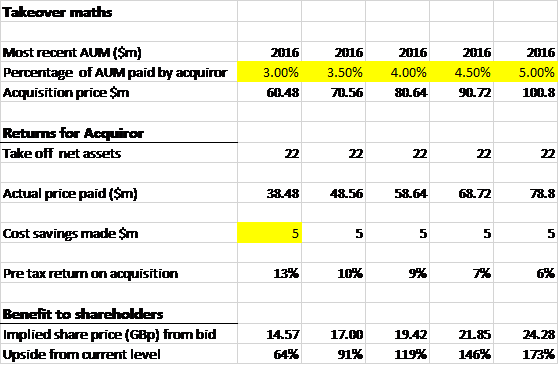
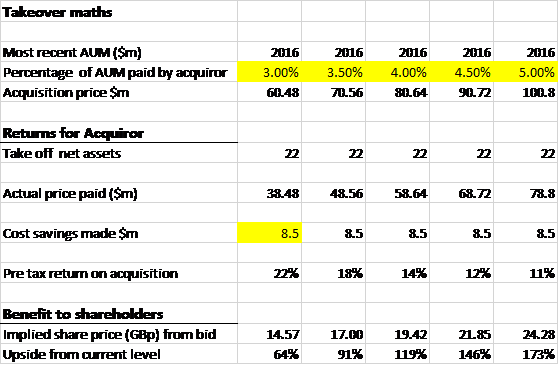
Given Charlemagne's sub-scale nature I think you could add those funds into another organisation. The most obvious buyer is another fund managemnt organisation with existing emerging market expertise such as Aberdeen or Ashmore. The buyer could probably reduce the staff by half as you wouldnt need all the PMs, sales people and marketing people. In 2015 personnel costs were: salaries $10.5m, performance related bonuses $5m and social security contributions $1.6m = a total of $17m. Assume you could cut that by only 1/3 = $5m straight to the bottom line. That is before reducing costs from HQ etc. Therefore a buyer who was prepared to pay say 3% of AUM, equating to 14.6p / share or 64% higher than the current level, would make a 13% pretax return on acquisition (RoAq). If the buyer could save 50% of the personnel costs, or $8.5m, they would make a 22.5% RoAq. Or if you assumed the minimum the buyer wanted was a 15% RoAq, they could afford to pay over 100% premium to the current shareprice. (For the purposes of the analysis i have assumed the buyer collects the $22m of net assets on the balance sheet which are primarily cash and and investments in own funds).
Here are two tables
1. Assuming $5m of cost savings
2. Assuming $8.5m of savings
so this falls into the very interesting camp for me. Its certainly a value situation with no apparent catalyst. I do own shares and will be asking difficult questions of management of how they propose to create value for shareholders in the absence of a sustained Emerging Market rally. The risk reward looks appealing to me.
VegPatch
Disclaimer
This is not financial advice. Our content is intended to be used and must be used for information and education purposes only. Please read our disclaimer and terms and conditions to understand our obligations.
No comments yet
No one has commented here yet! Why not be the first one?