Compounding Quality: The patient investor’s guide to stock market success

A few weeks ago, my 14-year-old brother who has just started studying for his GCSE maths exams asked me to help with with a question on compound interest. As a passionate advocate for the importance of teaching investment concepts in schools, I was delighted. Compounding is one of the most valuable lessons a novice investor can learn and (for those with a quality-first mindset) is a sure fire way of instilling enthusiasm for the power of the markets.
Compounding is often taught in the context of personal finance: investor A spends the profits from his investments every year while investor B reinvests them, after 20 years investor B has 50% more money in his portfolio. That sort of thing.
But how about in the context of business reinvestment? The principles of compounding are the same: earnings are reinvested to generate additional earnings over time. But how do businesses do that? And why are some so much better at it than others?
The answer lies in a company’s ability to squeeze profits from its operations. Highly profitable businesses have a greater capacity to reinvest in expanding their business. As the chart below shows, that reinvestment initially leads to a gradual increase in profits, but over time this accelerates.
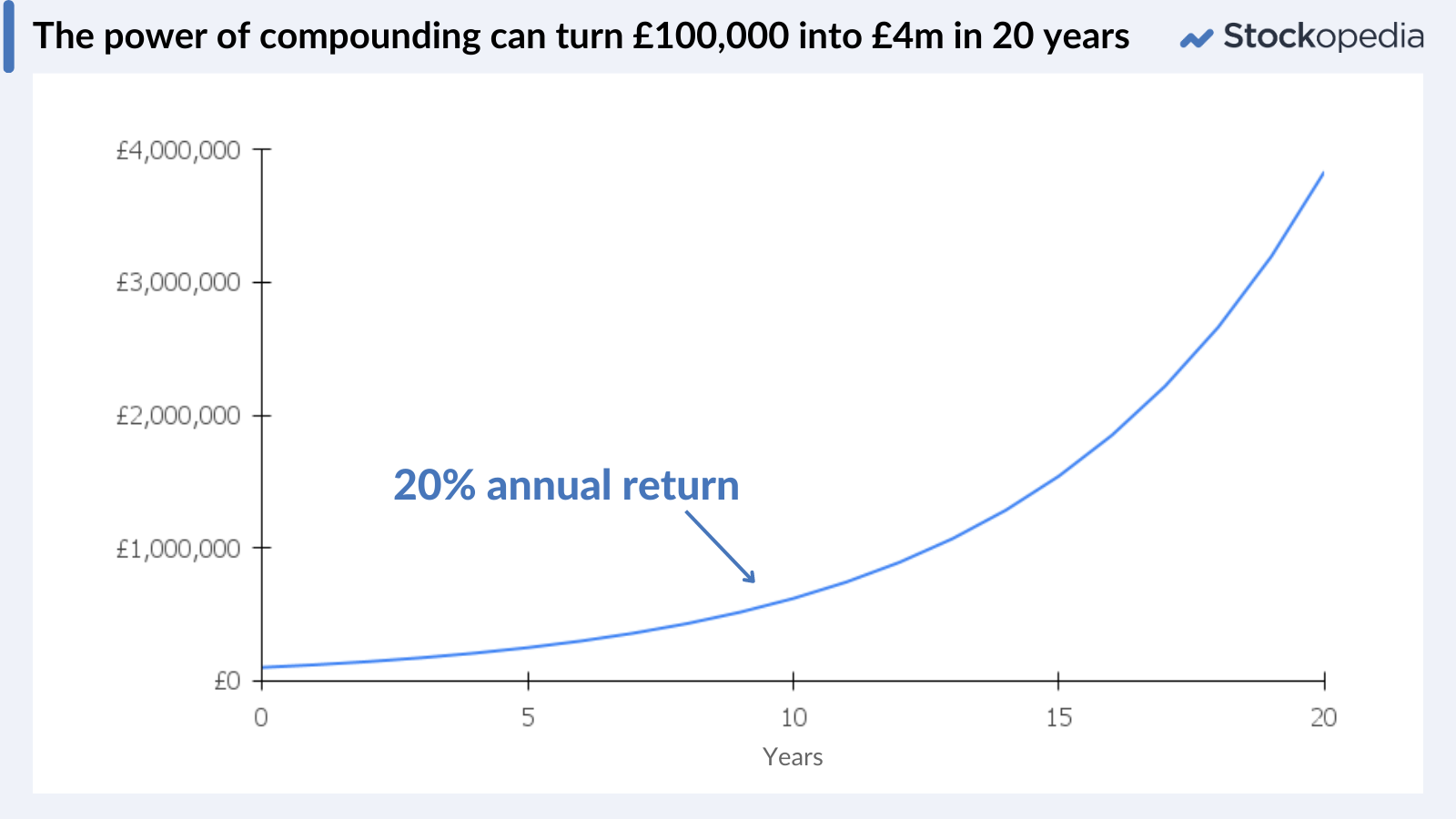
When it comes to compounding, it is important to remember that lines can bend.
All of this matters because the first investment strategy we have chosen to focus in our series is Quality Compounding, which works because the reliable and enduring profitability of some businesses means they can reinvest to stimulate accelerating profitable growth.
It’s an investment strategy employed by some of the world’s most revered investors. Warren Buffett, for example, who’s “favourite holding period is forever” and Terry Smith who seeks to buy great companies, not overpay and then “do nothing.”

But employing this strategy is not easy. To build a robust quality portfolio not only requires a good understanding of the concept of compounding, but also depends on patience, diligence and discipline. This article aims to:
- Help you assess whether your mindset and timeframe are suited to the “compounding quality” investment style
- Demonstrate why quality compounders are the ideal stocks for patient, diligent investors
- Show you how to identify compounding quality companies
- Demonstrate ways to implement this strategy
- Illustrate the pitfalls that investors seeking quality compounders should be wary of
Is “compounding quality” the right investment style for you?
‘Buy nice, or buy twice’, is the old adage that people like to use to justify extravagant purchases. It’s a useful framework when Patagonia has a nice jumper on sale, or when it comes to explaining the necessity of a 16-gear, Boardman road bike with disc-brakes. After all, that jumper and that bike are going to last a lifetime.
When it comes to investing, ‘buy nice’ is a similarly attractive proposition. Most investors like the idea of buying high quality shares which can generate reliable returns over a lifetime.
But can investments ever be ‘nice’ enough to last a lifetime? In other words, can the ‘buy-and-hold-forever’ strategy advocated by the likes of Warren Buffett in the US and Terry Smith in the UK actually work for private investors?
Yes, but not for everyone. Before embarking on this strategy, investors should ensure that they have the correct mindset, time frame and knowledge to make the right choices.
The approach is attractive to:
- Patient investors with a long-term time horizon. If you’re going to need to take your money out of the market or if you’re likely to get impatient by slow growth, quality compounding might not be the right style for you.
- Disciplined investors who aren’t likely to get scared by market fluctuations, or distracted by high-profile disrupters. Quality compounders tend to be impressive leaders in their field, not new upstarts.
- Diligent investors who find companies, their business models, marketplace and management, fascinating and will put the time into researching stocks before adding them to their portfolio.
Why patient investors are suited to quality compounders
True quality compounding businesses generate greater returns for investors who are willing and able to hold on for the long run. This is because the profits generated from operations are reinvested into the business to stimulate further profits in future years. The more years that the profit and reinvestment cycle can turn for, the higher the returns for shareholders. Patience is therefore key.
To illustrate how quality compounding works for patient investors, we’ve taken a look at the track record of French luxury goods business, LVMH Moet Hennessy Louis Vuitton.

LVMH was founded in 1980 when current chief executive Bernard Arnault merged designer clothes label Louis Vuitton and the champagne and whiskey company Moet Hennessy to create a behemoth in luxury brands. The company has grown largely through acquisition to bring 75 world-renowned luxury goods under its umbrella. These brands range from the 650 year old vineyard Domaine des Lambrays to Stella McCartney’s new environmentally friendly skincare range. They are recognisable worldwide and across generations, meaning they have a strong and enduring customer base which makes it very hard for competitors to take market share.
In the last 10 years, the strength of the brands has allowed LVMH to generate consistently growing revenues with an operating margin that has averaged 20%. Those profits have been easily converted into cash and subsequently reinvested into the business. The reinvestment has produced further profits which have been reinvested at a higher rate of return.
Investors have benefited from this virtuous circle as the share price has risen at an increasing rate to reflect the higher value business. Of course, a business like LVMH operates in huge global markets, which has been key to the sustainability of its growth. Niche compounders may not benefit from this luxury.
How to identify quality compounding stocks
Quality businesses are one thing: decent sales growth, wide margins, reliable profits, strong balance sheet - you know the drill. But what about compounding quality? These companies have a little bit of something extra, something that allows them to thrive regardless of the wider market conditions.
Guru investors, experts and fund managers have all tried to articulate exactly what it is that makes a true quality compounder investment. In Lawrence Cunningham’s book on the subject (Quality Investing: Owning the best companies for the long term), the author writes:
“The best companies often appear to be characterised by an ineffable something, much like that of people who seem graced by a lucky gene.”
That ‘ineffable something’ certainly seemed to apply when Warren Buffett added the US chocolate maker See’s Candies to his portfolio in 1972. His reasoning for buying the stock? The quality of the product and its its fiercely loyal customer base which he felt he could not replicate. That’s a sensible rationale, but not a universal criteria for stock selection.

The truth is that identifying the common characteristics that quality compounders share is not easy and the descriptions used by successful quality investors are often a little bit wooly. In our view, the best description of compounding quality companies are those that:
- Generate reliable profits over a prolonged period that can be reinvested at a high rate of return
- Tend to be market leaders with a sustainable competitive advantage (known as an economic moat) with high barriers to entry
Identifying these qualities isn’t easy, but in the sections below we will run through some of the quantitative and qualitative metrics that you can use to identify potential quality compounders.
Five financial metrics to identify quality compounders
First of all, let’s take a look at the financial metrics you need to know to identify compounding quality stock winners.
-
Return on Capital Employed (ROCE) greater than 20% - ROCE measures the additional operating profit generated per £ invested in the business. The higher the number, the greater the company’s ability to generate profits from its investment. Return on Invested Capital (ROIC) and Return on Equity (ROE) are other useful ratios to assess the ongoing efficiency of a company’s profitability. Investors hunting for true quality compounders should look for companies with a ROCE or ROIC significantly higher than the cost of financing. It’s essential to monitor the trend in ROCE over time - has the company been able to reinvest profits and sustain its high profitability?
-
Consistently strong profit margins - Operating, Pre-Tax and Net Profit Margins demonstrate how much money a company can generate from its sales. Margins that are sustained over a long period of time through both strong and weak sections of the market cycle help to identify quality compounding companies. Be careful to compare company margins to peers in the same sector as some industries lend themselves to higher margins than others. As the graphic below illustrates, companies that sell more stuff (high asset turnover businesses like retailers) can have lower margins, but may still sustain high returns on capital.

-
Operating cash conversion greater than 100% - A company’s ability to convert profits into cash flows is crucial to its ability to reinvest for further growth. Investors should be looking for companies that can convert more than 100% of net profits into cash consistently.
-
Consistent revenue growth - Quality compounders don’t have to generate growth that sets the world on fire, but they do generate consistent, reliable, above inflationary sales growth. When this revenue growth comes alongside high margins and strong cash conversion, profits can be reinvested at a higher rate of return to spur further sales growth in subsequent years. Search for companies with a positive compound annual revenue growth rate over five years.
-
Net gearing of less than 50% - Gearing is a measure of a company’s indebtedness compared to its equity. It’s a good measure of balance sheet health and indicates whether a company is over-reliant on borrowings. A healthy business will have net gearing of less than 50%, while those with net gearing of over 100% are best avoided.
Going deeper: Four qualitative characteristics for when the numbers aren’t enough
These financial metrics are a good starting point. But for stock pickers looking for buy-and-hold forever stocks, these metrics aren’t enough. Investors should seek to understand the history, business model and management style before having the confidence that they are true quality compounders.
The list below provides some ideas of qualities to look out for in these stocks:
-
Competitive advantage - In order to be able to sustain growth over a long period of time, companies must have a substantial competitive advantage over their peers. That may be a strong brand (think Nike and Adidas in the athletic apparel industry), an impressive network effect (such as Alphabet’s owner Google), a protected technological advantage (pharmaceutical companies) or an enormous, loyal customer base (Mastercard and Visa). These qualities are known as an economic moat, which protects the company from competition.

-
Management efficacy - Management decision making (especially when it comes to the allocation of capital for profitable growth) can give investors a decent idea about a stock’s quality. Experienced leaders whose incentives align with company performance are a good sign. But it is also important to remember Warren Buffett’s words of wisdom on the subject - good management alone is not enough to rescue a terrible business.
When a management with a reputation for brilliance tackles a business with a reputation for poor fundamental economics, it is the reputation of the business that remains intact.
-
Sector analysis - What sector is the company in and how does it compare to its peers? These are the types of questions that investors hunting for quality compounders should be asking. To be able to generate reliable profits year after year throughout different stages of the market cycle, these businesses should be leaders in their respective fields with a dominant market share.
-
The Lindy Effect - Some companies own products or services which are so ubiquitous that their usage becomes habitual. Over time these habits can become strong enough to create what is known as the Lindy Effect, which states that the longer a company, product or brand has survived, the more likely it is to survive in the future. It is however worth noting that not all businesses are immune from technological disruption - remember Kodak and Blockbuster?
How to implement the quality compounding style
For some investors, especially novices, the need for in-depth stock-by-stock analysis can be a barrier to this style of investing. And it’s true that real quality compounders are rare - careful research is required and even then, it is unlikely you will have identified a stock to buy-and-hold forever.
But if you have the right mindset and the capacity to put the time in, the hunt for true quality can be great fun. The sections below offer three different ideas to implement this strategy.
Level 1: The idle investor’s guide to building a compounding quality portfolio
For investors without much time to do careful research, Stockopedia has built a Ranking Tool to help you identify the highest quality companies in different markets. To use this tool simply set up a screen which filters for companies with a Quality Rank greater than 80 or use the screen that we’ve already made for you. Once your screen has generated a list, build your portfolio by selecting the highest ranking stock from each of the 10 sectors (this is to ensure diversity).
Your portfolio may need to be assessed and rebalanced annually to make sure it still includes the high quality companies. If you are an idle investor you may not have done the work to ensure you own sustainably high quality businesses.
The chart below shows the outperformance of the highest ranked Quality stocks compared to the FTSE All Share:

Quick hints for the idle investor:
- Think about restricting your screen to only stocks with a market cap over £50m - micro-caps can be risky
- There might be sectors you want to avoid - that’s fine, but make sure you have diversified across at least five of the stock market sectors when you build your portfolio
- If you’re feeling more adventurous consider building your own screen to identify stocks for your long list. Our library of screens can help give you some ideas.
Level 2: The stock-pickers guide to building a compounding quality portfolio
Use a screen to build a long list of companies which hit the financial criteria of a quality compounder - the market is home to many stocks, so screening is a good way of narrowing down your starting point.
Stockopedia has a list of screens built by quality investing gurus which can help you build your initial list of stocks. Alternatively you can build your own screen using the ratios shared by quality companies listed above.
Once you have your long list of potential companies, start your research. Look at annual reports and interim statements to check the company is growing and reinvesting its profits in a sensible way - flag any potential queries. Browse the company’s website to understand the business model and search for reviews of the company’s products or services - do the customers seem happy? Try to talk to management or if that’s not possible, look for interviews that they have given to journalists or other investors - ask for clarification on any red flags.
Stocks that you’re happy with can be added to your portfolio. Remember that for a quality investor, and if you have truly selected enduringly profitable companies, valuation is a lesser concern. Or, as Warren Buffett once said: “It is better to buy a great company at a fair price than a fair company at a great price.”
Quick hints for the stock picker:
- Use screens to narrow down the field for stock selection
- Don’t get too attached to the stocks in your portfolio if the fundamentals deteriorate - attachment bias can be the downfall of the quality investor
- Remember that not many great stocks stay great forever - continue to monitor the stocks in your portfolio to make sure the investment case holds true
Level 3: Buy-and-hold forever like Buffett
For experienced investors managing large portfolios, the temptation might be there to try to emulate some of the great fund managers and buy stocks to hold forever or at least for a few decades. Before attempting this strategy it’s important to remember that investors like Buffett are highly experienced and often have big teams of researchers. Of course, the private investor can “piggy back” these research brains by monitoring the new holdings of well known “quality compounding” fund managers. Investors that followed Buffett’s lead by buying Apple in Q1 2016 have returned more than 7x their investment.
Quick hints for the buy-and-hold forever investor:
- Question management about any uncertainties you might have with the stock
- Reinvest the dividends you earn from the company - this will add to the compounding
- Research the wider market to assess for competition
Quality Compounding: A style for any market?
Investors who buy companies to hold forever should be comfortable hanging on through all stages of a market cycle. Selling during a period of turbulence (either through panic or a desire to free up capital to deploy into better value stocks) can be costly.
The good news is that quality stocks do tend to hold up relatively well during periods of market uncertainty. Throughout history, periods of turbulence have been met with resilience by the highest quality stocks in the market.
Five pitfalls for the patient investor to sidestep
But beware the pitfalls of quality investing:
-
The value dilemma
As Terry Smith says, it’s important not to overpay for great businesses. But what is overpaying? Some great businesses deserve higher valuations than their peers because they can generate reliable returns for their investors. Others never fall to valuations which could be designated as ‘cheap’ compared to their peers. If a company is a true quality compounder, valuation shouldn’t matter that much because the virtuous circle of higher profits will keep churning out returns for disciplined investors.
This leads onto pitfall number two…
-
The timing dilemma
Investors who are waiting for a more attractive valuation in a quality company, might be waiting a long time. Take our example from above, LVMH. In the last five years, the stock has rarely traded under 30 times forecast earnings (a high valuation even for a high quality company), but in that time its share price has risen 200%. Anyone waiting for a more attractive entry point has missed out on some major gains.
If you’re the kind of investor who gets hung up on valuation, you might be more suited to the contrarian quality style of investing, which seeks to buy quality companies during periods of decline.
-
Failing to notice when a stock’s fortunes change
Inherent behaviours and psychology impact all investors regardless of what style they prefer, but one can be especially pervasive for quality compounders: attachment to the stocks in your portfolio. The idea with a quality compounding portfolio is to buy and hold a stock forever and some investors can find it very difficult to identify when something has changed in the investment case which means that stock is no longer one to hold-forever.
-
High profitability can revert to the mean
Quality stocks are also impacted by what’s known as “mean reversion”. In competitive markets, high profitability catches the eye of competitors, and invites competitive investment. This makes it tough for great companies to stay great forever as profit margins come under attack. In the UK, one of the great compounders as a private company was Hargreaves Lansdown, but since listing its return on capital has continuously declined as competition has nibbled away at its market position. The challenge for investors is that when profitability is found to be unsustainable, the valuation of the stock is likely to suffer.

-
The mature stage of quality companies - when quality stocks mature, perhaps due to reaching the limits of their market size, it is likely that they will no longer have good internal uses for their free cashflow. This period may see the valuation suffer as investors no longer prize the growth potential. Well managed businesses in this stage will return their free cashflow to investors as dividends. Of course, if you have bought well, the annual dividend income could be multiples of your initial investment, which you can reinvest into other new compounding stocks.
As with all styles, the key to success is commitment. In theory, the strategy works, so if you’re able to put the time in to put it into practice properly, you should see success. But if you’re struggling to commit to one style, it’s ok to take a more flexible approach - some strategies are more suited to certain points in the market cycle and perhaps you’ll find that your psychology is more suited to switching. In the following weeks we’ll be running through all of the strategies in our compass to help you make the most informed decisions.
Recommended Reading
- Investing for Growth - Terry Smith
- The Life, Lessons and Rules for Success - Warren Buffett
- How to Pick Quality Shares - Phil Oakley
- Quality Investing: Owing the best companies for the long term - Lawrence Cunningham
- Measuring the Moat - Michael Mauboussin
More in this series
The Strategy Map - Your Guide to Stock Market Strategy
Coming up…
- How to screen for quality compounding stocks
- Deep Value: The brave investors guide to stock market success
- How to screen for deep value stocks
Disclaimer
This is not financial advice. Our content is intended to be used and must be used for information and education purposes only. Please read our disclaimer and terms and conditions to understand our obligations.
34 comments
Hi all,
We're excited that Megan has agreed to run a webinar on quality investing. It's next Tuesday at 6 p.m. UK time. Find out more and sign up here.
As ever, we'll send the replay direct to anyone who registers, regardless of whether you join us live.
Looking forward to seeing as many of you as possible next Tuesday!
Thank you for this fantastic article this is good timing as I have just read John Huber's blog (https://basehitinvesting.subst...) on "Sources of Enduring Business Success", having a long term horizon and compounding.
He also references Nick Sleep (whose letters I am currently working my way through https://igyfoundation.org.uk/w...) he paraphrases:
"is how the average holding time period for many of the stocks he owned was around 50 days, whereas he planned to hold these stocks for more than 250 weeks (5 years). I think his key observation is important: The marginal buyer who is holding a stock for 2 months is not placing much emphasis on that company’s competitive advantage because that advantage won’t matter much at all over the next few months;"
Finally from Warren Buffett's BPL letter from 1963:
"....Francis I of France paid 4,000 ecus in 1540 for Leonardo da Vinci’s Mona Lisa. On the off chance that a few of you have not kept track of the fluctuations of the ecu, 4,000 converted out to about $20,000. If Francis had kept his feet on the ground and he (and his trustees) had been able to find a 6% after-tax investment, the estate now would be worth something over $1,000,000,000,000,000.00. That’s $1 quadrillion or over 3,000 times the present national debt, all from 6%. I trust this will end all discussion in our household about any purchase or paintings qualifying as an investment."
"In an amusing story, Buffett figures the $24 paid to the Indians for the island of Manhattan was worth about $12.5 billion in 1965, working out to about a 6.12% compounded gain. But he was making a point: To the novice, perhaps this sounds like a decent deal. However, the Indians have only had to achieve a 6½% return (The tribal mutual fund representative would have promised them this.) to obtain the last laugh on Minuit. At 6½%, $24 becomes $42,105,772,800 ($42 billion) in 338 years, and if they just managed to squeeze out an extra half point to get to 7%, the present value becomes $205 billion."
As quoted from Warren Buffett's ground rules which I am finding very interesting.
Regards
Michael
Great article Megan i have been exploring similar ideas too. I write about them at https://sanj2f3.substack.com/p...
You guys will be interested in an interview with Anthony Deden on the topic
He takes a little while to get into it, but it's an interesting watch.
Another semi-interesting one:
09:20 If you had invested equal amounts in the original S&P500, as founded in 1957, then you would have actually outperformed the S&P500 itself.
13:50 Lexington Corporate Leaders Trust, started 1935 in the US. It was founded before the investment act of 1940, so they weren't allowed to make any changes since that date. Amazingly, the fund has outperformed the S&P500 over the last 15 years (snapshot taken 11 months ago), and even on a 5-, 3- and 1-year basis.
One way that I've been looking at lately ...
On the front page of Stocko, you can see the indices for FTSE100, 250, and AIM. Click on one of them, and sort by descending quality. Look for ROCE above 13% (avg 5 yr) and at least 5% CAGR divs. The good news is that it's all on the page. Then check ones that pass. Look for
Also check the preceding 5 years before that (using the "Print" button). If all checks out, then it looks pretty good.
Here's some examples that I own:
Megan, welcome back, I thought you had left.
Ashtead (LON:AHT) is worth mentioning, this is the sort stock we are talking about, up over 300x in the last 20 years, is there a better performing stock? It does not qualify at the moment.
The Top Quality screen, has gone up 140% but the Top QM screen is up 289%, since inception. Adding momentum does increase performance. I tend to look at the top QM and VM shares on a regular basis. Last 15 months they have not performed that well, below the market.
One additional observation I would make is that some companies have excellent quality metrics, yet they are not necessarily good compounding opportunities. For example, fund managers are generally of low capital intensity/high ROCE, but they may not have great re-investment of profit opportunities. This often leads to profits being distributed. In my view this is why numerous UK fund management businesses have high dividend yields accompanying high ROCE. They are still potentially attractive investments, but not necessarily compounders.
I was going to make this same point. It’s a very important one IMO. You can’t simply equate a high ROCE to indicate a company is a compounder. It could just be the company needs very little capital to operate. That’s certainly the case with Bioventix (LON:BVXP) which is not a compounder in my book - any company that pays out cash in special dividends on occasion is definitely not a compounder.
All the best, Si
Megan
Thank you for a great article. It is always good to remind oneself of certain investing principles, as inevitably on a day to day basis it is too easy to deviate. Personally I feel that compounding and quality are some of the most important factors to be reminded.
One additional observation I would make is that some companies have excellent quality metrics, yet they are not necessarily good compounding opportunities. For example, fund managers are generally of low capital intensity/high ROCE, but they may not have great re-investment of profit opportunities. This often leads to profits being distributed. In my view this is why numerous UK fund management businesses have high dividend yields accompanying high ROCE. They are still potentially attractive investments, but not necessarily compounders.
I think that one thing that can help here is to look at dividend cover. High dividend covers suggests that the company has lots of re-investment opportunities, whilst low one suggests that their opportunities are limited.
A good example of the latter is WD40. Apparently it's a very small company. I think that competitors have tried to enter the market, but withdrawn not long thereafter, as there is just no growth to be had. WD40 has a great ROCE, but limited re-investment opportunities. I think the same is for See's Candy, too.
Hi BnB
I have a portfolio that is potentially full of compounders (see screenshot below) although interestingly/worryingly none of them have been mentioned in this thread so far. One of the things a low growth or recessionary environment will uncover is which companies are sufficiently resilient to keep compounding growth regardless and in an inflationary environment which companies have genuine pricing power.
I recognise some decent companies there. Games Workshop (LON:GAW) and Bloomsbury Publishing (LON:BMY) are both excellent and certainly have a moat. Fonix Mobile (LON:FNX) has a strong niche product. However, the only one I own is FDM (Holdings) (LON:FDM) . I don't see the strongest moat there, but their brand is respected, execution has been exemplary, and the tailwinds that have been blowing for decades ought to continue for decades more - unless AI renders all programmers redundant!
An excellent article. Clear, jargon-free, and wise.
Perhaps one day there should be an article on ROCE, ROIC, ROE, and this respective merits of each.
And how each affects market cap, ie overall valuation. - would be good.
Thank you for an excellent article
I'm a big proponent of the methodology. The point the article omits to make is that the UK is not the best place to find such businesses in sufficient numbers* to build a diversified portfolio. So I suggest the approach is for international investors only.
* There are a few mid to large caps:
Diploma
Halma
Spirax Sarco
Experian (historically cheap this morning until bargain hunters took up the offer)
Auto Trader - but is growth sustainable in the face of disrupters?
Rightmove - same question applies
RELX - great business but will AI boost the business model, or disrupt it?
Moving down the scale, I would suggest:
Alpha Group International
YouGov - interesting CMD today
Judges Scientific
Interested to see suggestions from others.
Hi BnB,
I completely agree about the lack of British stocks which fit the bill, you have picked a lot of the ones that are on my somewhat limited list.
Sage is another potential example in the large-cap space - although it has had its problems and isn't as impressive as its larger US peer Intuit.
On the smaller side of things Bioventix is a fabulous company, with a somewhat limited potential. Games Workshop as well, but also limited by scale.
Interesting point about Relx (which I am a massive fan of) and AI
Interesting point about Relx (which I am a massive fan of) and AI
Good article Megan. I suspect that, l ike a lot of subscribers here, I'm attracted to the concept of quality compounding, but my execution is less than optimal ...
On the AI thing everyone is focusing on the threat, but it's a two-way street. The AI models need data to train them and the organisations that own the data will likely be winners. Relx (LON:REL) are a probable beneficiary - Pearson (LON:PSON) and London Stock Exchange (LON:LSEG) also, although in all cases that has to be caveated with the concern that managements need to be sufficiently capable to address the issues and I'm not convinced that's true with all of the aforementioned.
As BnB points out, the UK is not liberally supplied with quality compounders, but that's at least partly because our companies tend to get sold before they get big. I suspect that the UK isn't a big enough market to sustain companies through the growth stage, but it's probably also something to do with the woeful capital allocation policies of UK institutions. Katie Potts of Herald Investment Trust (LON:HRI) is excellent on these kinds of issues.
However, to add a few companies that haven't been mentioned so far - Renishaw (LON:RSW), Admiral (LON:ADM), Croda International (LON:CRDA) and possibly CVS (LON:CVSG). In the latter case, at least, that may be as much to do with the secular trend to humanise pets, but even Terry Smith thinks it's a good sector to look at, and who am I to argue?
Generally, though, the problem isn't identifying quality companies, it's buying them at the right price. Rob Arnott did some research that shows we're very good at identifying quality companies but habitually overpay, such that we end up underperforming the market. But, of course, the last eighteen months have been one extended buying opportunity - as Shelby Cullom Davis said:
"You make most of your money in a bear market, you just don’t realise it at the time"
timarr
We're very good at identifying quality companies but habitually overpay, such that we end up underperforming the market
Does it matter over a timeframe of decades whether we buy at a FCF of 2.75x instead of 3.25x if the latter simply isn’t on offer in the year we invest? A year’s good numbers and the gap is made up. And underperforming the market isn’t a problem to me if you still overperform on a risk-adjusted basis, which is what these quality compounders offer - uninterrupted operating performance improvements and a good night’s sleep.
Does it matter over a timeframe of decades whether we buy at a FCF of 2.75x instead of 3.25x if the latter simply isn’t on offer in the year we invest?
It does rather depends on how long you plan to live ... :-)
timarr
How about Burberry (LON:BRBY), Next (LON:NXT), Cerillion (LON:CER) and AstraZeneca (LON:AZN)?
How about Burberry (LON:BRBY), Next (LON:NXT) and Cerillion (LON:CER) ?
I own Cerillion and welcome your suggestion with the proviso that it is still of small scale - more room to run perhaps, but also somewhat "niche". Its moat is also its greatest challenge - disrupting the incumbent software providers.
The other two - I'm not keen. Next is an excellent company but is nowadays in the business of returning capital to shareholders, being somewhere between a growth and a value play. Burberry just isn't very high quality relative to LVMH. Hermes or Ferrari. Look at the anaemic revenue growth. So how is it a leader in its market? Buy the three European winners - on a pullback- and sleep easily
A share that I have had good success from is Compass (LON:CPG) . Even during the great financial crisis it carried on increasing in value, though obviously it declined during the pandemic since people were not working in offices and I sold then repurchased.
How about Burberry (LON:BRBY), Next (LON:NXT), Cerillion (LON:CER) and AstraZeneca (LON:AZN)?
I see you've added AstraZeneca belatedly. I hold this one as well and should perhaps have put it on my list earlier, but I'm not a big fan of investing in pharma development directly, owing to its black box nature and binary exposures. I had to be persuaded by my bank and it's turned out well to date.
How about Burberry (LON:BRBY)?
I rest my case!
I don't understand.
Worth looking at the price action after this week's report (also worth reading to identify the frailties) and compare to LVMH, Richemont, Hermes et al share moves after their recent TUs.
Worth looking at the price action after this week's report (also worth reading to identify the frailties) and compare to LVMH, Richemont, Hermes et al share moves after their recent TUs.
I’m sorry but one minute you’re talking about compounding over decades and the next it’s just relative share price movements over a week. Which is it to be? The latter is irrelevant IMHO.
I’m sorry but one minute you’re talking about compounding over decades and the next it’s just relative share price movements over a week. Which is it to be? The latter is irrelevant IMHO.
I disagree. It’s about the update that prompted the movements. Apologies if I didn’t make that sufficiently clear. The disappointing TU from Burberry (LON:BRBY) is a sign of its lower quality relative to the European big guns. The associated price movements are simply a graphical illustration of its capacity to disappoint. How is that not relevant to my assertion, made prior to the TU, that it is not of the same calibre? Bear in mind that most luxury retailers, bar Kering, another serial disappointer, have been delivering positive surprises this quarter - and not because they were previously under-followed or unadmired.
If you disagree, feel free to make the case for Burberry’s right to be mentioned in the same breath.
As an investor in Fundsmith and a fan of Terry Smith, I have been trying this approach over the last couple of years with Diageo (LON:DGE) , Sage (LON:SGE) , Halma (LON:HLMA) , Oxford Instruments (LON:OXIG) , Spirax-Sarco Engineering (LON:SPX) , Diploma (LON:DPLM) , Judges Scientific (LON:JDG) . (BnB, we have most of the same companies, I have also looked to the US for some other large caps as well as L'Oreal.) These all seem to be excellent companies and I think as good a place as any while inflation continues unchecked.
The part I hadn't fully thought through is these companies have some similar characteristics to good quality bonds (Terry Smith also makes this point about Fundsmith) therefore as interest rates have risen, the discount rates applied to their future cashflows has risen, which has led to some share price under-performance. But I'm there for the medium term.
I am a huge fan of Next (LON:NXT) 's management and approach and think they have managed the switch from shop to digital way better than any other retailer. Their move into providing the website programs and logistics behind 3rd party digital brands (but also taking a stake in them) is tomorrow's property company, so that where I hope there is growth as well as overseas digital sales built up slowly and profitably. But really I'm backing the CEO, not the sector
I also hold some Fundsmith, have been disappointed with the performance recently, PayPal Holdings (NSQ:PYPL) which was one of his largest, if not largest holding, went badly wrong, he has sold out now. Never rated PayPal Holdings (NSQ:PYPL), having used them occasionally, their website is awful, I think Visa (NYQ:V) and MasterCard (NYQ:MA), would have been better choices.
Yes Diageo (LON:DGED) I think is worthy of being included in our top quality companies. I regret selling them.
martinck1 I am also a big fan and holder of fundsmith. I believe he totally sold out of SAGE in early 21, however Nick Train is a holder (as am I) although he has said he is on a 'wait and see if they can do this' period with them. Sage do seem to be performing recently, growing their ARR and particularly their cloud business. So fingers crossed with them.
I own a lot of the shares discussed here, but additionally I like Computacenter (LON:CCC) which I think qualifies as quality.
Decent ROCE, CROCI, free cashflow generation and growth, high inside ownership, low Capex requirements, low valuation (using Fcf yield). Its also a key player in a growing market, so overall a thumbs up from me.
I would add Games Workshop (LON:GAW) Bioventix (LON:BVXP)
What an absolutely fabulous article Megan and right up my (quality) street. This should be archived in the education section for long-term reference and so that it doesn’t get lost in the ether.
@Brilliant Leader - what a lovely comment - and I agree - great work Megan.
Just so you know, we are working on an education portal - to host article series, videos and more. It should go into development soon. We are well aware of the issue that befalls us at the mo, that this kind of content should live on perpetually. The solution should be good!