Contrarian Mondi (LON:MNDI) looks good and cheap

Summary
Earlier this week, Megan introduced the idea of contrarian investing – buying quality stocks at value prices. This approach is a major theme in my own investing, so this week I want to take a closer look at a company that I think could be a classic contrarian pick at the moment.
After reporting record profits last year, FTSE 100 packaging group Mondi (LON:MNDI) is currently facing a cocktail of cyclical and company-specific headwinds. The shares are now trading at levels last seen in the 2020 crash – and prior to that, not since 2016.
The short-term headwinds are undeniable. But Mondi remains highly profitable and has a solid balance sheet. I think the shares look too cheap for a business of this quality and are likely to provide attractive medium-term returns from current levels.
Bull points:
Leading market share in Europe markets
Above-average profitability
Strong cash generation
Modest valuation with potential for re-rating
Bear points:
Mondi’s largest markets are fairly mature
Cyclical exposure; softening demand
Risk of further earnings downgrades
Profile
About the stock
Mondi operates in the Basic Materials sector and is part of the Containers & Packaging industry group.
The group’s shares have recently traded at 1,290p on the LSE Main Market. Mondi is a member of the FTSE 100 and has 485m shares in issue, giving a market cap of £6.2bn.
The StockRanks currently show a classic contrarian profile (high quality and value, weak momentum) for Mondi:

The company’s share price performance reflects this score. The stock has fallen by around 20% over the last year, but is now showing signs of levelling out:

About the opportunity
Mondi is classified as Contrarian stock, highlighting its high quality and value scores and low momentum ranking. The company’s balanced rating highlights its relative lack of share price volatility over the last three years.

Mondi’s profits rose to record highs last year, thanks to a combination of strong demand and price rises that outpaced inflation. However, packaging is a sector that is exposed to the economic cycle. The company has warned of softer demand and customer destocking this year.
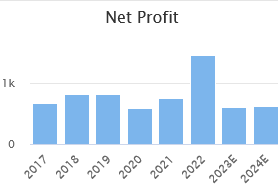
Profits are expected to fall sharply as pricing normalises and demand eases. Mondi is also still recovering from the loss of its Russian operations, which previously generated 20% of group profits.
It’s easy to see why the shares have fallen. But I think the current valuation is failing to recognise the group’s above-average profitability and attractive scale.
On a medium-term view, I think this could be a classic contrarian opportunity to buy shares in a good business, at a modest valuation.
When the economic cycle turns positive again, I expect Mondi’s performance to improve too. In the meantime, the stock offers a useful 4.6% dividend yield that looks quite safe to me.
Business & Model
What is the company’s history and what does it do?
Mondi produces a wide range of packaging for consumer and industrial markets, predominantly made from paper and cardboard.
The group was part of mining giant Anglo American (LON:AAL) until 2007, when it was demerged into a standalone business.
Mondi’s history can be traced back to 1967, when Mondi South Africa was founded. Expansion began with the acquisition of two Austrian packaging firms, and the business has continued to rely on a mix of acquisitive and organic growth.
Today, the group operates globally, but production and revenue are heavily weighted to Europe. The majority of South African operations have been demerged:
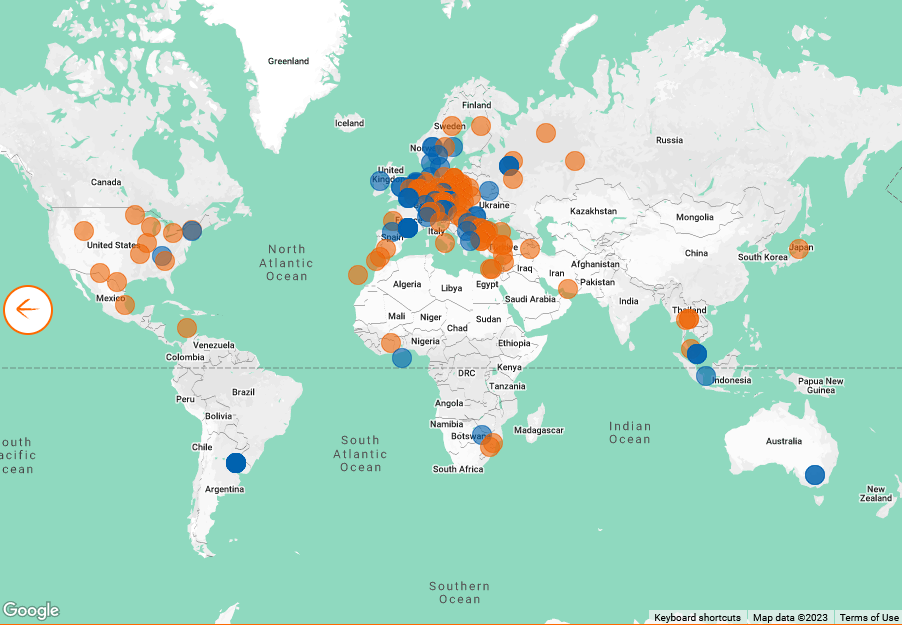
Source: Mondi website (blue = office, orange = production)
Key business segments and revenue breakdown
The business is divided into three main operating segments:
Corrugated packaging (34% of revenue): producing cardboard boxes, or containerboard, in the trade jargon. Markets include ecommerce, consumer goods and heavy industrial products.
Mondi is the market-leading virgin containerboard producer in Europe (non-recycled) and the number one producer of all containerboard and corrugated solutions in emerging Europe (Eastern Europe plus Turkey).
Flexible packaging (48% of revenue): Mondi is the leading producer of paper bags in Europe and the number one producer of kraft paper globally. This is the strengthened paper that’s used for packaging in consumer, construction, and industrial markets.
This division also produces plastic-based flexible packaging for use where paper is still unsuitable.
Uncoated fine paper (18% of revenue): printer paper and similar products for home, office and professional use. Most of this paper is produced in South Africa and sold in Europe, where Mondi is the number two supplier by market share.
Although this business is smaller than the group’s other two divisions, it was also the group’s most profitable division last year.
Geographic breakdown: the majority of Mondi’s revenue is generated by customers in Europe (% based on 2022 results):
Western Europe: 40%
Emerging Europe: 28%
Americas: 13%
Africa: 11%
Australasia: 8%
Russian operations: Mondi has operated in Russia for many years. Prior to the invasion of Ukraine, the group’s Russian operations generated about 20% of EBITDA each year.
Following the invasion, Mondi opted to divest its operations and marked them as discontinued. The company has since agreed a €1.2bn deal to sell its main Syktyvkar facilities in Russia.
Management plans to return disposal proceeds to shareholders when they’re received, but the deal hasn’t been fully approved yet and it’s not clear to me how easy it will be to repatriate cash, given the impact of banking sanctions.
What is the business model? How does it make money?
Mondi is a vertically-integrated business. Rather than buying in wood and pulp from external suppliers, the company owns some of its own forests and all of its own mills and production facilities.
External revenue is generated by producing and selling finished packaging products and materials such as containerboard and pulp to end users and third-party converters.
Markets & Competition
What is the state and size of the company’s market?
Demand for paper, cardboard and flexible plastics accounted for nearly 60% of global packaging demand in 2019. Mondi’s focus on these segments means the group operates in a very large market – effectively unlimited, I would suggest.
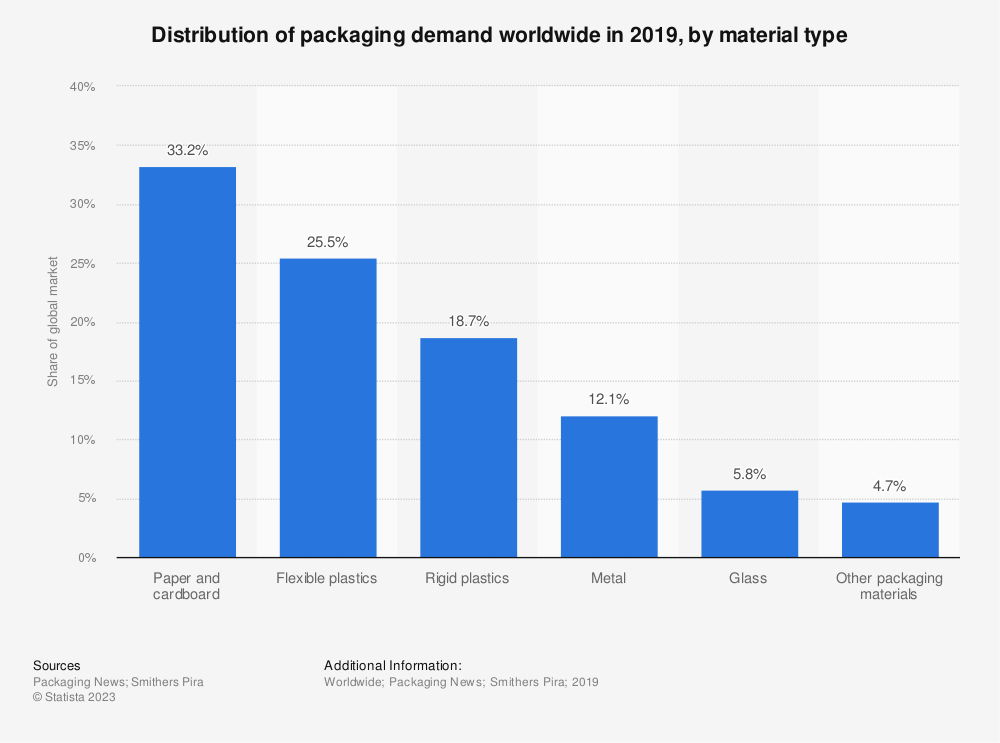
Source: Statista
Although the company is a FTSE 100 member and a sizable business, its overall market share is small. I’ve estimated some numbers, based on Mondi’s 2022 production figures and global data available on Statista:
Mondi’s share of its core European markets is very much higher than this, of course. But the group’s presence in the US is limited and it does not operate in China, which is by far the world’s largest packaging market.
Who are the company’s key competitors?
In terms of UK-listed companies, Mondi’s main competitors are DS Smith (LON:SMDS) and Smurfit Kappa (LON:SKG). The US and European stock markets are also home to a host of similar-sized listed rivals.
In addition, there are many smaller and privately-owned businesses operating in the packaging sector.
What is the company’s strategy?
Mondi focuses on building or buying cost-advantaged and sustainable assets that can be vertically integrated into its operations.
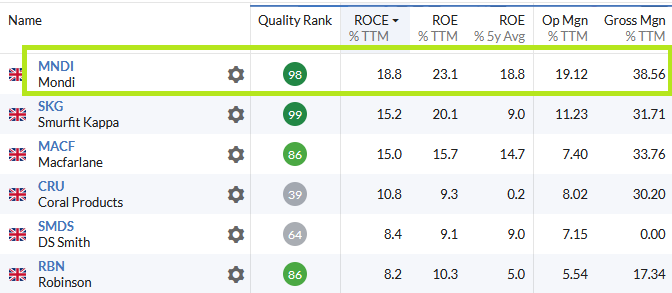
This strategy has helped the group become the most profitable listed packaging business on the UK market:
How does it derive its competitive advantage?
Mondi’s strong profitability suggests it may have some competitive advantages. I think these are derived in a number of ways.
Intangible assets: Mondi has a well-established brand and a certain amount of intellectual property. Its large-scale manufacturing and forestry operations are well-located and benefit from existing regulatory approvals and sustainability certifications.
Switching costs: some of the company’s products may offer minor advantages over competitors’ products, but in general, suitable alternatives are readily available. Some of the firm’s output is commoditised, e.g. pulp.
However, switching costs may become more significant in cases where customers’ supply chains and manufacturing processes have been closely integrated with Mondi’s distribution network.
Similarly, Mondi’s scale and broad range of products mean that it can provide a full range of solutions for customers, making switching less attractive.
Network effects: Mondi’s large market share and dense network of sales and production facilities in Europe should mean that it can provide a consistent and responsive service throughout this region.
For customers with significant operations throughout Europe, this may make it an attractive choice than some competitors.
Cost advantages: Mondi’s operations are generally well-located, with cost-effective access to raw materials and competitive cost bases. The company also generates 80% of the fuel used in its mills internally, from biomass. This means it has limited exposure to natural gas prices.
However, the group operates within a competitive market and cannot escape its exposure to energy and raw material costs. Over time, I think cost advantages are likely to be capped by market forces and competition.
Greater scale: Mondi is one of the largest producers and suppliers of corrugated packaging and kraft paper in Europe. This gives it the ability to service large customer accounts reliably.
Is the competitive advantage durable?
Mondi’s superior profitability versus UK-listed rivals suggests to me that the group does have some durable competitive advantages. I think these are probably linked to its vertical integration and large scale in its core European operations.
However, the group operates in competitive markets where most products can be substituted, if needed. This isn’t Rightmove (LON:RMV) or Diageo (LON:DGE), for example.
I see Mondi’s competitive advantages as a secondary reason to invest in the shares, rather than as a primary part of the investment case.
Financials & Ownership
What is the record of growth & profitability?
Mondi delivered a steady run of profit growth in the years before the pandemic, paired with quite high returns on capital employed.
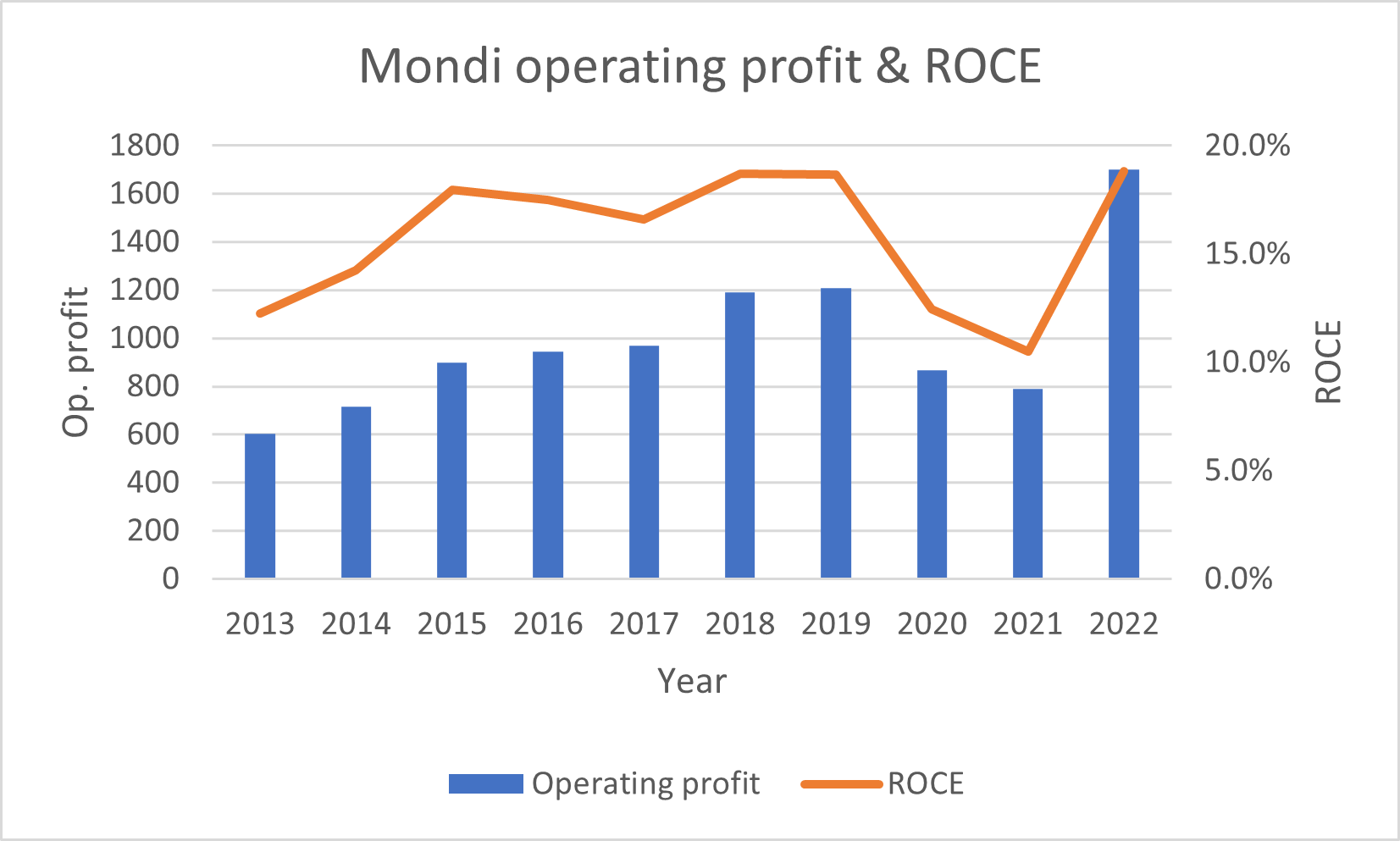
The company has a strong balance sheet and a good record of converting accounting earnings into free cash flow.
Shareholders have enjoyed a total returns well ahead of the FTSE All-Share index over the last 10 years:
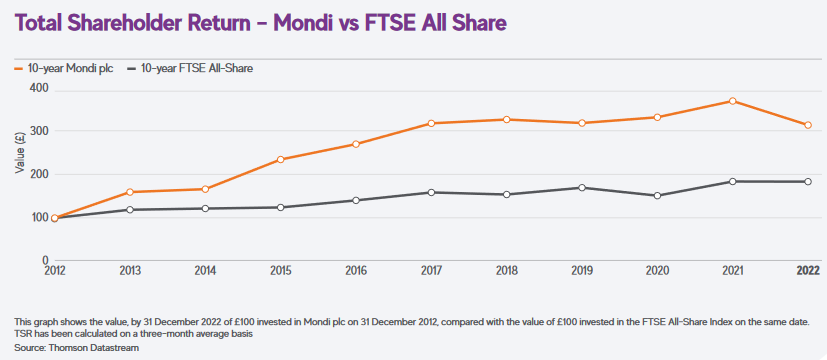
Source: Mondi 2022 annual report
I think Mondi’s above-average quality metrics and strong track record support the view that this could be a contrarian buying opportunity at the right price.
Is there evidence of historic share dilution?
Mondi has not issued any shares since its flotation in 2007.
What is the ownership structure of the company? Do management have stakes?
As is often the case with big cap stocks, there’s no significant management share ownership. The 2022 annual report showed CEO Andrew King with a shareholding worth c.£2.5m at current levels – significantly less than the £4.2m remuneration package he received in 2022.
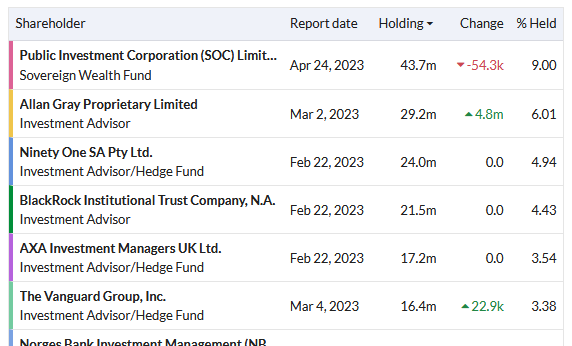
Mondi’s two largest shareholders are South African institutions, reflecting the group’s heritage and historic ownership.
Valuation
How does the relative valuation compare versus industry and sector?
A contrarian opportunity must score well for quality and value. Is that the case here?
The Containers & Packaging sub-sector of the UK market looks quite affordable in general at the moment:

Mondi’s valuation is broadly in line with this, with a trailing P/E of 7.6 and dividend yield of 4.8%.
If we compare the firm to its two main UK rivals, we can see that Mondi looks cheaper and better quality, on a trailing 12-month basis:
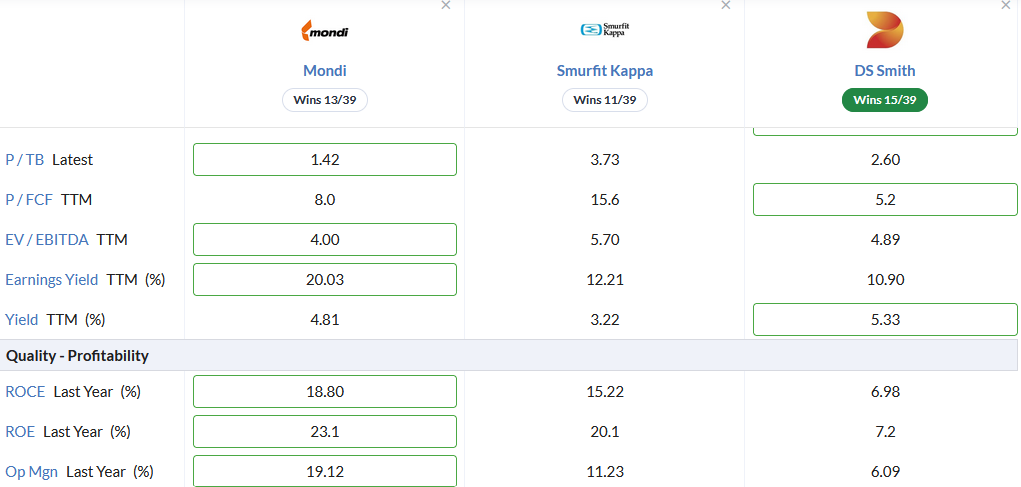
Looking ahead, the picture is more uncertain. Mondi’s earnings are expected to fall by around 35% this year – a bigger fall than the broader sector average. Overall, the stock’s relative valuation metrics look quite mixed:
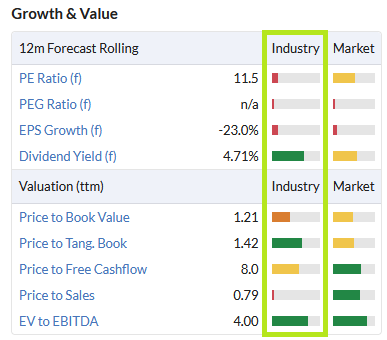
One other metric I think could be relevant in this case is the stock’s CAPE10y – a P/E ratio calculated using the current share price and 10-year average earnings.
For a cyclical business, a low CAPE10y can be a sign of an attractive valuation, as it suggests earnings may be at cyclical lows.
Mondi’s CAPE10y is significantly lower than those of its rivals DS Smith and Smurfit Kappa.
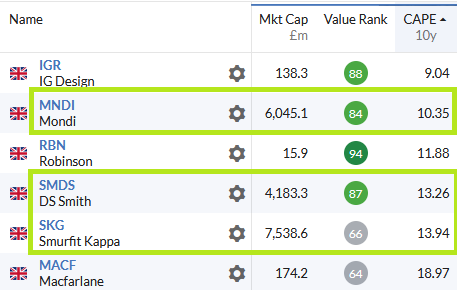
However, it’s possible the market is applying an additional discount to Mondi to reflect the loss of its Russian earnings, so the low CAPE10y may partially reflect this.
Trends & Catalysts
Are there any significant macro trends that the business is benefiting from?
As befits a contrarian stock, Mondi is not benefiting from macroeconomic trends at the moment. Quite the reverse – the risk of a broader economic slowdown is causing its customers to destock and putting pressure on pricing.
If we look further ahead, though, I think medium-term trends should be more supportive. Demand for ecommerce packaging seems likely to continue growing.
More broadly, companies will come under pressure to continue to increase their use of recyclable, fibre-based packaging that minimises waste. That should provide opportunities for large, well-invested producers like Mondi.
Are there any catalysts that could drive a rerating in the medium term?
A contrarian investment is often uncomfortable to start with. I think that’s likely to be true here. Looking ahead, I think the most likely catalysts for a re-rating will be economic factors.
Stronger economic growth in western Europe might lead to a stronger outlook for growth and margins. A reduction in interest rates could have a similar effect.
Risks, Threats & Hurdles
If economic conditions worsen or remain weak for longer than expected, Mondi’s volumes and pricing could come under renewed pressure. The business might end up needing to reverse some of last year’s price increases.
This situation could be made worse by management’s decision to continue investing through the downcycle. Mondi is currently working through a €1bn pipeline of expansionary projects, so there’s a risk that this investment might not generate hoped-for levels of return.
More broadly, it’s possible that the group’s focus on Western Europe may limit future growth opportunities. These countries have large and well-developed markets with mature economies and low rates of population growth.
Higher interest rates could also lead to a sustained period of lower valuations for slow-growing companies, as investors demand higher dividend yields.
Contrarian opportunities can sometimes turn out to be value traps – companies that are cheap for a reason. I don’t think that’s likely here, but I can’t rule it out completely.
Recent Trading & News
Recent trading summary
"Stable performance in the first quarter of 2023"
Underlying EBITDA from continuing operations of €351m was broadly flat compared to Q4, excluding non-cash gains related forestry valuations.
As expected, management warned of softer demand, with lower selling prices and destocking. Input costs have also fallen, although wood prices remained high and only started to reduce more recently.
CEO Andrew King says the company is continuing to invest in the business for future growth.
Outlook: demand remained subdued early in the second quarter, but the company did not make any changes to its previous guidance.
What do the brokers currently think and are they upgrading estimates?
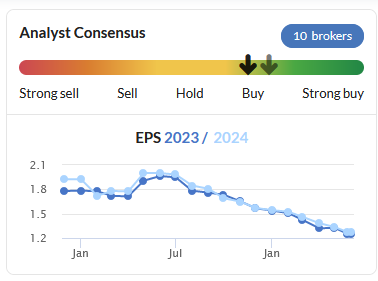
Broker forecasts have fallen steadily since the middle of 2022 and analysts do not expect a recovery in 2024. However, sentiment remains broadly positive, with a consensus rating of buy from 10 brokers covering the stock:
What would the person selling to us be thinking and who are they?
Mondi’s share price has fallen by 20% over the last year, but the company’s latest accounts do not suggest any significant financial risks to shareholder equity.
Based on current forecasts, the shares look reasonably valued to me.
Given this, I can see two possible reasons for investors to be selling Mondi shares at current levels:
Recession fears: some investors believe that western economies could suffer a much deeper or longer economic slowdown than forecasts suggest. That might lead to further earnings downgrades and share price falls.
Better opportunities elsewhere: Mondi may offer an opportunity, but some investors may believe that they can see better opportunities elsewhere. They might sell Mondi shares to free up cash.
Conclusion
Contrarian investing requires a measure of patience and stubbornness. By definition, you are going against the crowd. Your choice may seem to have limited growth potential or face tough external headwinds. It will certainly be unfashionable and probably dull.
All of these things might be said about Mondi.
On the other hand, this business has generated double-digit returns on capital employed for more than 10 years and has a strong balance sheet.
Historically, cash generation is strong and shareholders have been rewarded with steady dividend growth. The payout rose each year from 2009 through until 2020 and has now (almost) returned to pre-pandemic levels.
Mondi also has attractive scale, strong assets and good market share in its core markets.
I expect 2023 and perhaps 2024 to be difficult. But I believe the shares are attractively valued for investors who are prepared to wait for economic conditions to improve.
Disclaimer
This is not financial advice. Our content is intended to be used and must be used for information and education purposes only. Please read our disclaimer and terms and conditions to understand our obligations.
9 comments
Mondi has been in a long term downtrend since August 21 which has been reinforced by a steeper short term downtrend since February 23. On the chart I see no current sign of this ending soon, so I am going to wait for a better entry price. My trend analysis is currently suggesting a target buy price around £9.40.
Shares fall this morning after deal to sell Russian plant falls through.
I’ve invested in Mondi previously, for precisely the reasons outlined in the article, namely the better return profile. It was not a happy experience.
I now own Smurfit Kappa and have an equally high regard for Macfarlane, which has the best long term returns, enjoying a better boost from accretive M&A.
Worth noting that Mondi (LON:MNDI) are long paper - in other words they produce their own paper and thus exposed to the paper price. There are reports of over capacity in paper production which is expected to weigh on paper prices and could be a headwind for Mondi.
DS Smith (LON:SMDS) by contrast are net short paper, meaning they source more of their paper externally than they produce. They should therefore be less affected by falling paper prices. That said, DS Smith have the lowest margins in the sector so could be more vulnerable to a downturn.
Smurfit Kappa (LON:SKG) probably look the best name in this space.
Where do you find wholesale paper price ?.
Thanks Roland.
Recently purchased,not sure if i will be rewarded short term,gone into my isa & will remain there until value is recognised,appreciate your comprehensive analysis.
Thank you for this look at Mondi. I have held this share for some time now. I anticipate that it will bounce back in due course. In the meantime I shall continue to enjoy the dividend
I think the whole paper/card packaging sector is good value. My thinking may be simplistic but I just think it has long term tailwinds from both ongoing growth of online (notwithstanding the short term gyrations caused by covid bubble, high street bounceback and destocking), and replacement of plastics with card/paper.
I already hold Mondi and considering adding more in the sector while it's depressed.
Lovely article Roland, thank you.
If they are able, in due course, to repatriate the proceeds from the sale of the Russian business, this would leave them debt free / net cash, which IMO makes Mondi compelling, if not screaming value.
This is one of those situations where one can sit out the wait, and be reasonbly well paid whilst doing so.