Daily Stock Market Report (Fri 11 July 2025) - ACSO, PMI, SWC, WHR, SBAR, WSG

Good morning!
We have one major profit warning to look at today, from Accesso.
In personal news, I've started spread betting again, for the first time in several years.
The point of this will not be to get rich (!), but merely to open a range of small positions where I don't have the funds or the conviction yet to create full-size positions.
While I don't recommend spread betting, as it's highly risky and most people lose money doing it, I do have a suggestion for those who already engage in it: make sure you compare the standard daily funded bets vs. forwards on the same instrument.
The daily funded bets have an overnight financing charge which I think adds up to c. 7-8% annualised, depending on interest rates at the time and the provider you're using. On the other hand, forwards have a wider initial spread but no ongoing financing charges. For positions being held for several months or up to a year, I think they are far superior!
2pm: all finished there, have a good weekend everyone!
Companies Reporting
| Name (Mkt Cap) | RNS | Summary | Our view (Author) |
|---|---|---|---|
BP (LON:BP.) (£61.7bn) | Upstream production in Q2 now expected to be higher vs. prior quarter. | ||
Flutter Entertainment (LON:FLTR) (£37.6bn) | Flutter pays $1.755bn for 5% of Fanduel. Flutter now owns 100%. Extension of US partnership. | ||
| Smarter Web (OFEX:SWC) (£948m based on latest share count) | Bitcoin Purchase | Total bitcoin holdings increase to 1,275 (value £110m), and has £31m in cash. | RED (Graham) [no section below]
Net worth is £141m plus the value of a small web design agency, and yet the market cap is £948m. The way I see it, the only way this can avoid crashing back to earth is if a) the bitcoin price bails them out, or b) they raise vast amounts of cash and invest it very cleverly. So it is theoretically possible that they could bridge the gap between their current net worth and their vastly larger market cap. But I wouldn't bet on it. |
Warehouse Reit (LON:WHR) (£490m) | Warehouse Directors switch their recommendation from BBOX to Blackstone’s new 113.4p offer. | PINK (Graham) [no section below] | |
accesso Technology (LON:ACSO) (£191m) | SP down 26% Revenue expected at lower end of range. Major customer does not intend to renew an agreement, $6m of gross profit impact. 2026 outlook to be updated when conditions are clearer. | BLACK (RED) (Graham) This still has quite some distance to fall before I think it would be in deep value territory. As it has now published profit warnings for two summers in a row, I think a RED stance is appropriate. | |
Premier Miton (LON:PMI) (£117m) | SP down 6% Net outflows £173m (prior quarter: net outflows £221m). £10.5bn AuM. | AMBER/GREEN (Graham) These days, I tend to be AMBER/GREEN on fund manager stocks. They offer great value against historic metrics, but the relentless trend of outflows does concern me. Still, they are intriguing! PMI is classified by Stockopedia as a Super Stock. | |
Sundae Bar (LON:SBAR) (£42m) | Raised £95k recently, has allocated surplus proceeds to Bitcoin acquisition. | RED (Graham) [no section below] Everything with a bitcoin treasury policy gets a RED from me. This one is interesting because as far as I can tell, they only managed to raise £95k from their recent retail offer. And these funds are the initial basis of their bitcoin treasury policy - I'll be impressed if they even have enough funds left over to buy one bitcoin, after costs. Interim results to March 2025 showed zero revenues and very little cash. | |
Westminster (LON:WSG) (£12m) | Interest-free credit from a major shareholder. Conversion price on CLN moves from 3p to 2p. | RED (Graham) [no section below) This has been around for a very long time but never seems to do very much for its shareholders. Recent interim results were again loss-making and the company has been raising fresh equity to fill the gap. Today's news is another form of equity raise with the lender agreeing to get more shares in exchange for an interest-free loan. |
Graham's Section
accesso Technology (LON:ACSO)
Down 23% to 367p (£148m/$200m) - Trading and Commercial Update - Graham - RED
accesso Technology Group plc (AIM: ACSO), the premier technology solutions provider for leisure, entertainment, and cultural markets, today provides the following update on its ongoing commercial performance.
We haven’t looked at this one in about a year. The last time we covered it was another profit warning, last summer, when Paul said he was “unenthusiastically AMBER”.
That profit warning, caused by delays to new park openings, also saw an over 20% drop in the share price.
There have been more downs than ups for shareholders in recent years:
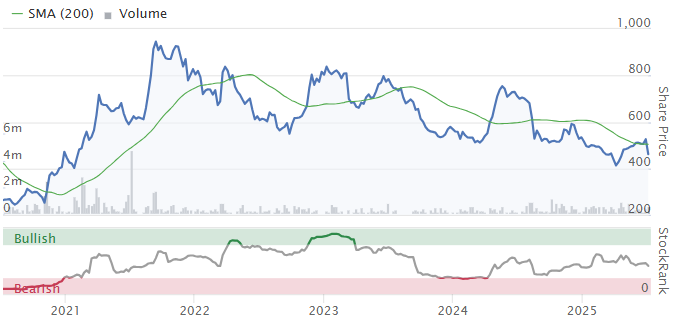
Here is today’s warning:
For the six months ended 30 June 2025, Group revenue reflected softer than expected attendance across our customer portfolio. Our own performance held up well, but customer dynamics at key venues limited volumes and therefore reduced the transaction pool from which we drive a large share of our revenue.
This exposure - to the number of people who attend venues using Accesso’s technology - doesn’t sound like something that Accesso has any control over.
They say that they “remain laser-focused on delivery” for the rest of the key summer period. But I don’t see how their own performance can help to boost attendance numbers in the short-term.
Full year revenue will be “at the lower end of our anticipated guidance range”, and unfortunately the company does not provide this range in the RNS.
Checking the most recent full-year results, published in April, the company said that revenue growth in 2025 “is unlikely to exceed the effective 5.3% reported in 2024”. It seems that consensus was for growth of about 2%.
EBITDA margin guidance of 15% is unchanged.
Loss of business: a major customer does not intend to renew one of their agreements with Accesso, resulting in a gross profit impact of $6m from 2026.
They say that the revenue lost is “meaningfully offset by significantly improved commercial terms in the remaining agreements with the customer” and that “this underlines the strength of our ongoing relationship and the customer's continued belief in our ticketing platform as a mission-critical revenue solution”.
This wording makes me uneasy, as it sounds like they are trying to spin a defeat as some sort of a positive. The loss of $6m of gross profit is pretty significant for a company of Accesso’s size. Total gross profit was $119m last year.
Sales pipeline and recent wins: they say “we have been encouraged by the strength of our sales pipeline and a notable improvement in our commercial win rate”, and “it is clear that our revised commercial strategy is proving successful”.
2026 outlook is cloudy:
The Group will update the market on guidance for 2026 once trading conditions become clearer, further progress is made on our current commercial momentum, and the contract discussions with the major customer are concluded.
When the company published its profit warning in August last year, it did not include 2025 guidance in the RNS. Same thing today, with no 2026 guidance.
But brokers have published 2026 forecasts that are visible on the StockReport: revenue $164m, net profit $18.6m. In light of the statement above, I think we should treat these forecasts as being out of date.
Graham’s view
I like the fact that the company recorded net cash of $28.7m at its last full-year results. But apart from that, I’m finding a whole bunch of negatives:
Major profit warnings both this year and last year, during the key summer periods.
High dependence on attendance numbers at its customers’ sites, a variable beyond the company’s control.
No concrete guidance figures given in the RNS and no research or forecasts made easily available.
No significant growth. Perhaps revenue is about to fall in 2025 vs. 2024. Then the loss of $6m of gross profit in 2026 will need to be offset by new business.
Some of the narrative in today’s RNS has been too heavily massaged for my liking.
Sometimes I go for AMBER/RED when there is a profit warning but where I feel that the stock still has many redeeming features.
In this case, the net cash (and arguably the £8m buyback) are redeeming features, but the list of negatives is too long.
I’m therefore going to go fully RED on this for the time being.
In valuation terms, the market cap is equivalent to $200m (enterprise value: $171m).
The company was forecast to generate c. $16m of adjusted net income this year, prior to today’s profit warning.
If we adjust that down to $12m for the sake of argument, that gives a cash-adjusted P/E multiple of 14x.
In my book, it therefore still has quite a distance to fall before it would be in deep value territory. So I think a RED stance is appropriate for now.
Premier Miton (LON:PMI)
Down 6% to 67.1p (£120m) - Q3 AuM Update - Graham - AMBER/GREEN
The market doesn’t love this AuM update.
Premier Miton had £10.2 billion as of March 2025 (see our coverage of their half year results in May).
This has now increased slightly to £10.5bn.
However once again, the increase is due to market movements, with the company again experiencing outflows:
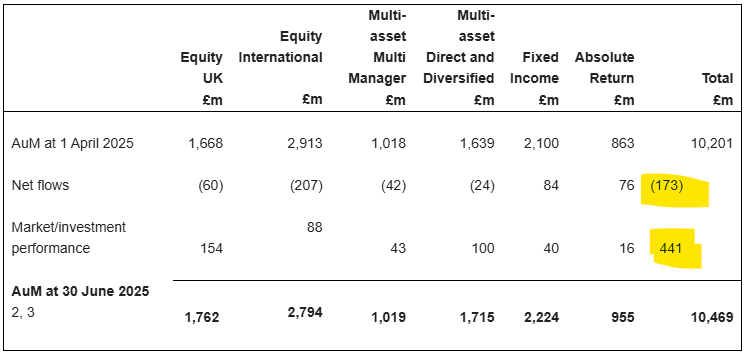
They point out that the outflows (£173m) were smaller than the prior quarter (£221m).
CEO comment:
"There were encouraging signs of progress during the Quarter despite reporting a net outflow overall. Demand for our absolute return and fixed income funds remained good, supported by consistent investment performance. Notably, net outflows from our UK equity funds reduced by over 50% compared to the average of the previous four quarters, reflecting improving investor sentiment and solid fund performance.
"While our European equity strategy recorded further net outflows of £132 million, this occurred alongside a strong period of performance, with the fund ranking second out of 130 in its sector over the Period. We believe that this positive performance will begin to translate into improved flow dynamics over the coming quarters.
Graham’s view
I note that at the Q2 update, they said their European Opportunities fund was experiencing outflows “driver by shorter term relative underperformance”.
Today they are pointing to a positive quarterly performance for their European strategy, but this is surely too short-term to be of any significance?
I’ve looked up their European Opportunities fund on Morningstar and I can see that it’s had a poor 2025 (7.5% return vs. benchmark 19.9%), and ranks very low against other funds for the year so far. But its long-term performance seems fine to me.
The scale of the outflows from their “International Equity” category is worth mentioning: 7% of starting AuM was withdrawn during the quarter.
Over the last six months, 11% of starting AuM has been withdrawn.
At least their other categories seem to be doing much better.
On balance, I’m inclined to leave our AMBER/GREEN unchanged here, as today’s update doesn’t seem to change all that much, even if it has disappointed some investors.
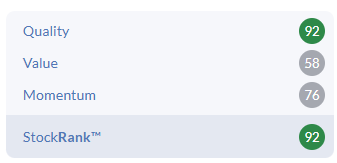
Like Polar Capital Holdings (LON:POLR) and Jupiter Fund Management (LON:JUP) (but not Liontrust Asset Management (LON:LIO)), this is categorised as a Super Stock. So it offers a bit of everything: quality, value and momentum - perhaps less momentum after today's move.
Disclaimer
This is not financial advice. Our content is intended to be used and must be used for information and education purposes only. Please read our disclaimer and terms and conditions to understand our obligations.

33 comments
PMI I heard, many many years ago, some pundit say that fund management companies are fragile and shouldn't be listed (I'm not saying that I necessarily agree with that statement).
I can't remember the name of the fund, but Gervais Williams of PMI was running a small-cap growth company. I think most of it was quite speculative AIM companies. It closed down recently?? Maybe someone can shed some light on it. (Oh, I think here it is: Miton UK Micro decided to wind up https://www.theaic.co.uk/aic/n...)
I vaguely recall that some UK funds were consolidating (not just at PMI) due to declining AUM. I'm not sure when this would all stop. We seem to get positive noises every now and again (for years, seemingly), but they seem to turn into false dawns.
Managing AIM focused funds is tough, and although the tax benefit is/was attractive, the tax tail often wagged the investment dog.
I've never really seen the appeal of spread betting verus simply holding physical shares. Seems far too risky and exposes you to sharp price movements. With shares your can just ignore these and wait for markets to recover. With higher rates there is also a cost, unless you're doing very short terms trading. I can see there might be tax advantages, but if all your shares are in an ISA/SIPP this is obviously irrelevant.
Of course spread betting allows you to use leverage, but I'm a firm believer that you should never really have more than a 100% exposure to markets - in other words if you're really bullish you can be zero cash and 100% invested, but certainly wouldn't borrow money to go beyond that.
Well said. I 100% agree, Bouden. Why take on the additional stress? I believe that Paul Scott has twice lost a fortune due to overleverage and he is no novice investor.
ACSO I seem to recall this was a major darling on Stocko at some point, with a lot of knowledgeable high-profile investors bullish on it.
The shares are down over 10 years, which is not so nice, and the EPS is the same in 2024 at it was in 2015.
I seem to recall saying a number of years ago that it looked like the company's return on capital was declining. It was perhaps too premature for me to judge at the time, but I pulled up the report from 14 Oct 2017 and the average ROCE has around 14.4%, quite a healthy number. The last few years has seen that in in mid single-digits. So my observation about the decline proved correct.
My takeaway from this is never invest in a share because it draws admiration from prominent investors. The could be wrong. Other such example include Boohoo and Asos. Both look like complete messes at this point in time.I have sat by, enviously, watching everyone coining it in. In the end, my reservations turned out to be well-founded.
Another takeaway is that small businesses are much riskier than their larger brethren.
Just my 2 cents.
I have sat by, enviously, watching everyone coining it in. In the end, my reservations turned out to be well-founded.
ref boohoo - it was a great company for many years - it ten bagged and delivered well for shareholders. retail has always been tough and there were many red flags with boohoo that people could (and should with benfit of hindsight watched) - facts are though that everyone that had done well on boohoo on the way up had plenty of opportunity to cash in their chips either partly or fully - its wrong to say those people didnt call it right on the way up. The doubters have most certainly won the argumet for now though as comapny changed from decent profity making machine to soemthing that doesnt make money - thats not rocket science to see that though.
itys easy to look back now and say it was obviously going to go wrong - well those that had an opinion and are lcuky enough to be right wopuld say that wouldnt they. Mike Ashley seems to do ok - so i am slightly surprised that boohoo hasnt done better than it has done - it that regard i certainly called it wrong.
itys easy to look back now and say it was obviously going to go wrong
I didn't know it was going to go wrong. For all I know everyone else was right and I was wrong. I guess it's a case that different people have different psychologies and are suited to different kinds of strategies.
I seem to be better suited to slow-but-steady ones, rather than the higher-octane strategies.
ref boohoo - it was originally a very conservative growth company when it was growing - it made profits was in control of working capital (unlike asos) and was expanding out of cashflow so ticked all the boxes that they were a mean mean fightingh machine with organic growth only - so was a super attractive investment at the time - foolishly i for one did not cash out enough at the top. obviously it morphed over time for good investment to bad - sensible people cashed in chips when warnings signs came along.
The lesson here is never fall in love with companies you are fanboys of - fevertree used to be my largest holding and i was a fanboy (nothing wrong with being fanboy when you are positive (it gets my goat up when people moan that comentators should be allowed to have a viewpoint) - but when times were getting tougher and share still decently valued i learned my lesson from bohoo and said - sell up and wait on the sidelines. I still think its a decent buisness but with little sign of profits bouncing back strongly enough to support valuation alone - and the complications of their tie up - that just leaves the excellent brand whioch might provide a windfall - i still think though that share will do well eventually.
i think the best investors are those that are brutal and head for the exit at the fisrt sign of trouble generally - i would make exceptions for obviously quality companies that would go through bad patches due to stuf beyond their control (eg J D Wetherspoon (LON:JDW) £GREG Jet2 (LON:JET2)) bad news doesnt always mean that company wont bounce back.
imho worst situations are were you get acquisitions alied with later bad news - MPAC (LON:MPAC) springs to mind - if you ramp up share count and debt and risk and dont deliver - disaster waits.
A bit of a generous assessment of Boohoo (LON:DEBS) in my view. In their best year ever they managed a 7.4% operating margin! Completely overhyped at that point on a p/e of 70x and now a basket case. Anyone who made money in this one was surely a bit lucky to do so?
Boohoo (LON:DEBS)
When they were first flagged up by Paul Scott at sub 30p they were on nothing like pe of 70 based on forward projections (they reliably delivered as promised often smashing it out of the park) and the growth in earnings was very real and quick and large.
here is the rise in pre tax profits from 2013 to 2019
3 mill in 2013
10.7 mill 2014
12.3 mill 2015
15.6 mill 2016
30.9 mill 2017
43.3 mill 2018
59.9 mill 2019
you may claim thats a crapola business model if you want but thats some decent compounded growth in profits before the wheels fell off with stuff that went wrong later.
reference operating margin its an online retailer - its margins are never going to be the same as next where people turn up and collect their kit. its bottom line profits that matter. Back in the day boohoo were much better at managing working capital than asos
are you denying that that trend in profit growth was not decent ? you can have you viewpoint that its not but it would seem a strange stance to take imho?
Not really the share price went from 25p to over 400p.
No sparkler. It wasn’t lucky. Boohoo (LON:DEBS) was a big success story for a while and when I sold it was an 8 bagger and a big success story for Paul Scott. It went badly wrong when I invested again and when like most of us who held all the way down we failed to spot the warning signs, including the competition from SHEIN.
With reference to the spreadbetting debate Robbie Burns is very good at this and his book is well worth reading on the subject.
I closed my account when I was up as I just felt I lacked the discipline and knowledge to succeed.
Been looking (for months) to purchase Yu (LON:YU.) as it is constantly popping in and out of my version of the NAPS for utilities. It is the most viewed share today and down 7% *on no news. Momentum is showing up, good time to buy, or am I missing something?
EDIT: Ignore the above. Looks like there was a rogue trade yesterday from 1594 to 1745 at 16:35. So the drop is actually a rise as its now 1610 ish.
If anyone has any thoughts on YU. I would appreciate them.
I think its just down vs the closing trade last night which was fictitiously 15% up last night. So effectively up around 8% over last two days
I also hold (LON:YU) . I like the net debt, the yield, its growth- ( Dividend, Turnover, P/L), in a space where there are good opportunities for decent firms ( many firms in this space are crap), my only worry is the some chunky sales by Directors ( no purchases since 2021). I will buy more if it breaks 1850... probably
I have looked at spreadbetting and dabbled in the past, but eventually abandoned it, other than for very occasional short positions (more often as a hedge than a directional bet).
I am aware of the tax advantages (both the CGT and the stamp duty angles).
However, the list of negatives is quite long:
1. With spreadbetting you not only have to get the direction right, you also have to get the timing right. With a conventional long position you can afford to sit tight and wait to be right, whereas with spreadbetting there are high costs to getting your timing wrong, whether that be interest or the spread on rolling your expiring fwd positions.
2. Comparing the spreads with the physical market is difficult unless you pay up for live pricing & Level 2 etc and know you can deal on the bid/offers you see. As a private investor who avoids voice-broking fees I generally only know what my dealing spread is on a deal AFTER I've traded because the platform often improves on the initial indication.
3. Now that interest rates are higher there is a significant opportunity cost to having a cash reserve sitting there to cover margin calls. Yes I know people like IG Index pay 4%+, but if you read the small print it is capped and you need to generate a certain number of trades etc.
4. Variation margin I can handle - it is the sudden changes in initial margin that mean I never quite relax when I have positions on at a spreadbetting platform. Global macro events can (and will) suddenly result in you needing to top up your initial margin balance at very short notice, or find your positions being closed out without you having any control - usually bang in the middle of your summer holidays. I like to run my portfolios such that a week or two travelling with no guaranteed internet access, or sudden diversions to care for ageing relatives don't pose a problem.
5. The business model is stacked against you. The platforms make money for a reason, and it isn't just because the majority of the punters are mugs, it is because the spreads & rates take a slice out of your returns in a manner that is very difficult to keep track of.
6. My last point is entirely illogical and emotional. Seeing a loss on a spreadbet "feels" different to a share you just bought trading below its initial purchase price. Spreadbetting makes me focus on the short term, whereas I am most successful when I focus on investing for the long term. I can't beat the high frequency boys, I have less visibility than the brokers and my costs are higher than the institutional investors. Over a longer investment horizon it is a much more level playing field, and the advantages swing my way.
Hi all, on point 4 regarding margin. I always found I was also topping up margin. Now I ensure there’s a large amount of cash in the account for margin and the bets are a tiny percentage of the cash held. I only use spreadex so have no idea what other platforms do but with spreadex there’s a percentage indicator. For example last bet I place was 5% of cash held. Hope that makes sense. The other issue is prices moving quickly for example Sabre Insurance (LON:SBRE) was moving forward in my portfolio enough to give confidence to place a bet. Big gap next morning despite a wide stop loss triggered the stop. Stock has advanced 10% since. The set up of the bet is very important and also checking the size of the price spread is not too big.
Sorry I one last thing I echo Monty Carlo you have to be able to sleep at nights and I am not convinced spread betting helps particularly betting on indices which are most popular but I most cases are 24hrs!!!!
I've never spreadbet, and I'm too chicken to. AFAIK there's no CGT on it (??). There's a good reason for this: HMRC know that most people lose money on it, so they draft up the rules accordingly.
Can't you choose the leverage of the spreadbet? So if you decide on no leverage, can you therefore risk no margin call, whilst getting tax benefits at the same time?
Good discussion on spread betting this morning. Echo your point 6 Monte Carlo. That was what did for me. I actually made quite a bit of dosh spread betting but most of my bets lost money. A few big winners kept me solvent.
Being prepared to cut quickly when a play moved against me was key, especially on daily rolling bets.
You can afford to be slightly more relaxed on a nine month contract but it’s never comfortable to see your play as n negative territory.
I have always been interested in the fact that 70% of spread bets lose money. Whereas the market goes up 51% of the time. Anyone have any insight into this?
The obvious point would be to avoid shares that have a large spreadbet following. They are presumably the latest 'hot' stocks that everyone wants, which are bid up beyond fair value.
Thanks Graham about spread betting, I use spread betting when I have a stock in my portfolio moving in the right direction so use betting to piggy back for want of a better phrase. It’s worth noting what you highlight about costs. Even when I think the bet is set up right I still get caught when market prices move very quickly. And watch you margin folks!!
Graham,
re Spreadbetting, thanks for sharing that, can we assume that this is because you are a bull on UK (presumably) markets or will the majority of your positions be shorts?
Helvellyn, thanks for the question. I'll be long-only and I'm planning to open a range of positions, creating a diversified portfolio. e.g. companies on my annual watchlist that I haven't got around to buying yet, and other companies I'm positive on! Using forwards I'll be able to open positions that are good for 6-9 months and can then be rolled over if I want to keep them open at that point.
That’s exactly how I used to spread bet Graham and it worked very well overall. I only stopped when the Regulations were tightened and worked against smaller investors like me. No longer could I buy small stakes in a number of shares and pay nothing up front.
Very interesting Ken! Sorry to hear that it didn't work out long term. That's what I'm doing - small stakes in a wide range of shares. All the best.
Adding a bit to my previous reply to Graham. Much of the time it worked very well. (i.e most of the stake bought in my shares account but a small stake also in spread account). That meant more cash in my shares account. I left the profit in cash with IG and let it add to the funds for new small stakes. Over the years it was profitable. The exceptions were the inevitable buys that went down and in a bad year generally. But that was no different to my shares portfolio……except because the spread bet stakes were always small the losses in the standard shares ISA account were bigger.
What did go wrong (and it meant I never used spread bets to short shares again) was when I shorted Subsea Resources years ago because I was very confident it was going bust. So I had a bigger stake than usual but with a stop loss just in case. I was stopped out at a loss almost immediately…..and within no time Subsea Resources went bust.
There are always warnings from people who haven’t spread bet about the big dangers. Many of those warnings are wise and many go wrong by spread betting far more than they can afford to lose, or by going for big bets on the Dow Jones and other indexes. Indexes are always a guess and so often they do the opposite of what we expected. So going for index bets is gambling. But my experience of doing it the same way as Graham intends was that overall it worked.
Finally anyone at risk of getting addicted to gambling should give all spread betting a miss.
Graham - the spread on those forwards contains both the dealing spread and the inherent financing charge - you don't get leverage for free (you just get it cheaper then the overnight DFB rate because they are charging you 6m-9m up front).
Once you add in a further risk margin to compensate for counterparty risk you may find things aren't as cheap as they look.
Are you able to calculate roughly what margin your counterparty is making on your trades?
It will be an interesting one to compare with the 20% ROCE that Stocko displays for IG group (LON:IGG) .
(For others reading, pls do not confuse spreadbetting with CFDs/futures where the costs are applied differently...even if both types of leveraged position are offered by the same provider)
Yes Monty Carlo, I understand that the point of the wider spread is to include the financing charge. At Hostelworld (HSW) for example, where I have a long position, the bid-ask on the March 2026 forward is currently 132.08-135.35. The bid-ask according to the LSE is 129.5-130. So I understand that I need the share price to move in my favour before I break even, and that the financing that it offers is not particularly cheap - although it's cheaper than daily funded bets! Overall I think that the tax advantages make it worthwhile for me. This is just a small side project, just a place to tinker with some small positions in shares that may get bumped up to my main portfolio at some point. Although HSW is already in my main portfolio - I wanted a little extra exposure!
So let's do some back of fag packet maths on that.....
For simplicity I'm going to ignore pricing in points and go back to exposure in terms of share count. I'm also going to ignore the whole delta adjusting stuff because spreadbet exposures vary as the price moves....
Difference in spread is (135.5 - 132.08) - (130-129.5) = 2.77p
What is the implicit finance cost in the forward? Lets just assume the shift in mids is close enough:
(135.35+132.08)/2 - (129.5+130)/2 = 3.965p
If we assume 20% initial margin then they are lending you 80% of the trade exposure for up to 9 months.
So if you trade 1000 shares worth then they are lending you 80% x 100 x £1.2975 = £1038
Their take is 1000 x (2.77p + 3.965p) is £67.35, which equates to 6.49% over 9 months. Annualise that and you are at 8.7%
Now...if you don't keep that position open to maturity they are lending you the money for less than 9 months and I'll bet the bid/offer you get to close out at doesn't fully compensate you for the remaining period of leverage your forego by closing out early, so up that 8.7% to something higher, probably double digits.
This is hugely simplistic (and not technically correct, plus I've ignored the comparative cost of trading the shares), but it illustrates how the spreadbetters make their money.....and how you have to make a very high return indeed to come out ahead!
Re: Spread betting Illiquid Positions For those of us less knowledgeable and talented than Graham, here's a reminder to think carefully before spread betting, and more so for illiquid positions. Graham has said he is staying long-only and keeping his positions small - he will always be aware of his total spread betting exposure. As Graham has said, most of us are better off not spread betting, no matter the tempting tax advantages, and use of leverage robs one of the luxury of time and patience as an unleveraged investor. Use of high leverage is, I'd suggest, asking for trouble - a financial time bomb and fast-track to wipe-out.
Graham, thank you and good luck, perhaps you will keep us updated on your positions and their progress.