Daily Stock Market Report (Mon 13th April 2026) - WISE, CHH, MWE, POLR, CLX, CNC, MRK, JNEO, ROAD

Good morning!
Markets are a little jittery this morning as President Trump says that the US is going to blockade all Iranian ports (starting at 6pm UK time). Negotiations between the US and Iran appear to have completely broken down.
Equity markets are set to open lower:
- The FTSE is opening down 60 points at 10,540
- The German DAX 40 is down 1.4%
- The S&P 500 is trading down 0.6% overnight
And energy prices are higher:
- Brent crude oil is up $5.50, approaching $99
- Gas Oil (diesel) is up 8% at $1,236
- UK Natural Gas is up 10% at 119p
All done for today! Spreadsheet accompanying this report: link.
Companies Reporting
| Name (Mkt Cap) | RNS | Summary | Our view (Author) |
|---|---|---|---|
GSK (LON:GSK) (£88bn | SR94) | Mocertatug rezetecan achieved confirmed objective response rates of 62% in platinum-resistant ovarian cancer (PROC) and 67% in recurrent or advanced endometrial cancer (EC) in BEHOLD-1 study. Promising efficacy and safety supports start of five phase III trials in 2026. | ||
National Grid (LON:NG.) (£67bn | SR67) | Performance in line with expectations and consistent with previous guidance. However, now expects a net impact of c.1p per share to underlying EPS related to customer refund charges in New England, related to a March judgement. | ||
Halma (LON:HLMA) (£15.8bn | SR70) | Acquired US firm Surgistar for $90m as a bolt-on to Healthcare subsidiary MicroSurgical Technology. Surgistar designs and manufactures ophthalmic surgical instruments. | ||
Wise (LON:WISE) (£12.1bn | SR44) | Q4 FY2026 Trading Update & Translation of IFRS financials into US GAAP | Cross-border volumes up 26% to £49.4bn, underlying income up 24% to £435.3m. Take rate reduced from 0.53% to 0.51%, percentage of instant transfers +10% to 75%. Expect FY26 underlying PBT margin to be towards the top of the 13-16% range. | GREEN = (Graham) I’m inclined to leave our GREEN stance unchanged here. At current growth rates, the investment thesis is fundamentally intact. I make some further comparisons with valuation at the privately-held Revolut, where I think that relative value arguments do favour Wise. |
Energean (LON:ENOG) (£1.60bn | SR53) | Energean Power FPSO is now fully operational and delivering gas to customers in line with contractual requirements. | ||
Sirius Real Estate (LON:SRE) (£1.58bn | SR75) | FY26: 18.4% YoY increase in rent roll, including +6.4% like-for-like. Expect to deliver FY results in line with expectations. | ||
Vistry (LON:VTY) (£1.08bn | SR80) | Adam Daniels has been appointed as CEO with immediate effect. He is currently the Executive Chair of one of Vistry’s two largest operating divisions. | ||
Polar Capital Holdings (LON:POLR) (£638m | SR94) | Q4 25 AUM +8% to £30.6bn at 31 March 26. Net inflows of £1.4bn, market gains of £0.8bn. Outlook: “entered 2026 with positive net inflow momentum […] but mindful of structural challenges facing the industry”. | GREEN = (Graham)
A fully positive stance on this continues to make sense in my mind, and the StockRanks agree in this case. It’s expensive relative to other fund managers, but there’s a good reason for that: inflows. That’s rare, and justifies a premium rating, in my view. This has long appeared to be a cut above most others in the industry. | |
Custodian Property Income Reit (LON:CREI) (£431m | SR71) | Update on the Strategic Acqiusition of £36m Grove Court Portfolio | Secured 5% increase in passing rent with the portfolio’s largest tenant, a motor dealership that accounts for 27% of Grove Court’s rent roll. GC Portfolio occupancy remains at c.97%. | |
Concurrent Technologies (LON:CNC) (£181m | SR51) | Board Changes & Final results for the year ended 31 December 2025 | SP -5% Revenue up 14%, pre-tax profit up 25% to £6.5m. Order intake increased “to a record £47m” driven by defence demand. FY26 outlook: “confident of delivering results for FY26 in line with market expectations”. Estimates: no change at Cavendish today. - FY26: revenue £52m, adj. EPS 7.8p. - FY27: revenue £60m, adj. EPS 9.3p. | AMBER ↓ (Graham) [no section below] The negative share price reaction at this provider of “embedded computing solutions” can be explained in various ways. Firstly, there’s the loss of the CFO, who retires from corporate life to pursue personal interests. Secondly, there’s the high valuation heading into these results (the forward adjusted P/E is still 25x now). Thirdly, there’s a massive tax charge. While PBT increased by 26% in 2025, after-tax profit increased by only 7.5%, as UK tax credits have suddenly disappeared. I know that R&D credits are less generous these days, but it would have been helpful to hear an explanation from the company itself - presumably this will be included in the annual report. I’m going to take our view down by one notch to neutral, as the shares appear fully valued to me. ValueRank is only 7. |
Roadside Real Estate (LON:ROAD) (£105m | SR24) | Acquiring a portfolio of 12 “premium-quality operational petrol station forecourts” and a convenience store clustered predominantly in Cumbria. Hoch had gross assets of £13.7m and generated a pre-tax profit of £1.8m in the year to 31 March 2025. Purchase will be funded with a new £25m HSBC bank facility and additional debt from Tarncourt (a related party to the CEO). Cavendish updated forecasts: - FY26E adj EPS: -2.0p (prev. -1.3p) - FY27E adj EPS: 0.41p (prev. 0.28p) | AMBER/RED = (Roland) The price being paid for these assets appears quite high at first glance. Assuming a 25% tax rate, Roadside appears to have paid 2x asset value and 21x last year’s net earnings for this collection of petrol stations. As I explain below, I can see some attractions in the company’s forecourt roll-up strategy, but I wonder if its lenders (including a related party) are better positioned to profit than its shareholders. On balance I think Roadside shares are looking expensive and somewhat speculative, so I’m going to leave my AMBER/RED view unchanged ahead of the company’s half-year results. | |
EKF Diagnostics Holdings (LON:EKF) (£104m | SR50) | Agreed to acquire Beep Insights Technology, “an IOS and Android software application that combines data from sports performance wearables connected via Bluetooth with real-time glucose and lactate tracking to give personalised metrics to improve sport's performance training.” | ||
Journeo (LON:JNEO) (£73m | SR50) | Agreement to supply bus stop infrastructure for a large local authority in the South of England, a longstanding existing customer. | AMBER/GREEN = (Roland) [no section below] £1.7m equates to around 3% of last year’s revenue, but the company doesn’t say whether this order will be delivered in the current financial year or split over more than one year. I have to admit that I see today’s RNS as another business-as-usual announcement from this somewhat prolific issuer of news. That’s not to detract from what sounds like a worthwhile and valuable contract win. My point is that it’s natural for businesses such as Journeo to regularly win new contracts. Constantly announcing them seems a little promotional to me. House broker Cavendish hasn’t commented today, suggesting that forecasts remain unchanged (as I would expect). Current forecasts suggest 6% earnings growth this year and place the shares on a forward P/E of 13. When combined with decent quality metrics and a strong balance sheet, I’m comfortable leaving our previous view unchanged. | |
Ondine Biomedical (LON:OBI) (£57m | SR4) | 2025 revenue rose by 29%, in-house capacity upgrades underway to support future growth. Completed patient enrolment in LANTERN Phase 3 US trial. | ||
MTI Wireless Edge (LON:MWE) £55m | SR98) | Received order from an existing customer to supply military antennas worth c.$2m to a local defence company. Expected to deliver in 2026/27. | AMBER/GREEN = (Roland) [no section below] Assuming equal delivery over 2026 and 2027, today’s order news will equate to c.$1m of revenue and perhaps $100k of operating profit in each year. This is less than 2% of last year’s full-year figures. There’s no change to broker forecasts from Shore Capital or Allenby today, so I’m left with the conclusion that today’s contract wins are most likely business as usual and already reflected in existing forecasts. While I think current forecasts are more likely to be upgraded than downgraded, that hasn’t happened yet. I was moderately positive following a similar update last week. I do not see any reason to change this view today, especially given the rising valuation here – I estimate the shares are now trading on c.16x FY26E earnings. | |
Marks Electrical (LON:MRK) (£50m | SR49) | FY March 2026 revenue £108.5m. Adj. EBITDA £2.65m and net cash £4.45m, both ahead of the range previously indicated. “The Group enters FY27 with positive trading momentum and a strengthened cash position.” Cavendish updated estimates: - FY26E adj EPS: 0.5p (prev. 0.1p) - FY27E adj EPS: 0.8p (prev. 0.4p) - FY28E adj EPS: 1.1p (prev. 1p) | AMBER ↑ (Graham) [no section below] We were AMBER/RED on this in November, but it has since upgraded guidance twice in quick succession. The upgrades are flowing from margin outperformance, not revenue, but there’s nothing wrong with that in a low-margin industry like electrical retailing. After two “ahead of expectations” updates, I’ll take our stance here back to neutral. Forecast profits are still not high enough to justify the current valuation, but the positive momentum and a better-than-expected net cash position are sufficient to make me neutral. | |
Calnex Solutions (LON:CLX) (£43m | SR51) | Trading slightly ahead of market expectations. Revenue +19%, and an improvement in profitability. Cash £9.3m. “The progress achieved in FY26 provides a strong foundation for continued profitable growth through FY27 and FY28.” Cavendish updated estimates: - FY26E adj EPS: 1.0p (prev. 0.63p) - FY27E adj EPS: 1.2p (new forecast) | AMBER ↑ (Roland) Today’s upgrade flags up a welcome improvement in profitability, with Cavendish lifting its FY26 EPS estimate by c.60% based on a <10% upgrade to revenue forecasts. However, I can’t ignore the valuation here, which places Calnex on FY26E P/E of 54 and already seems to price in a recovery. I’d also like to do further research to understand whether the superior levels of profitability seen in the past are likely to be achievable in the future. I’m upgrading to neutral to reflect positive progress and a mixed view on this business following a brief initial review. | |
Edx Medical (OFEX:EDX) (£40m | SR1) | “...the Company will continue to require capital to fulfil its potential… its access to capital from certain funds, its liquidity profile and visibility to investors will be improved by the AIM Admission.” | ||
Churchill China (LON:CHH) (£33m | SR83) | Revenue down 2.6%. PBT down 29% to £4.4m. Has forward purchased 64% of its gas requirements for 2027. “...it is only in a prolonged conflict with dramatically increased pricing, that this would materially impact the expected results.” | AMBER/GREEN ↑ (Roland - I hold) I am tentatively moving to a more positive view as today’s results are in line with expectations and show the company continuing to invest in long-term sustainability while staying focused on its core business model. The 7% dividend yield is comfortably supported by cash flow while the discount to book value improves the potential returns on offer for new buyers. The main medium-term risk, in my view, is that structurally high UK energy costs will continue to put pressure on profitability and make it progressively harder for Churchill to maintain its competitive advantages. | |
Arecor Therapeutics (LON:AREC) (£24m | SR10) | Lead product AT278, designed to transform Automated Insulin Delivery systems, has advanced across both product development and commercial partnering. 2025 continuing operations: revenue £1.7m (2024: £1.6m). Cash £6.1m. | ||
Cambridge Cognition Holdings (LON:COG) (£18m | SR20) | Orders up 73%, order book up 21%, but revenue down 10% (£9.4m) due to weak opening order book. Adj. EBITDA loss £0.5m. Cash £1.1m. Now expects 2026 revenue of £9.5m, up from £8.8m expected at year-end. Positioned “for growth in revenue, earnings and cash generation in 2026.” | ||
SysGroup (LON:SYS) (£11m | SR36) | FY March 2026: revenue +7.6%, adj. EBITDA £1.2m, ahead of market expectations. Net cash £2.7m. “Entered FY27 with positive momentum”. | ||
Mothercare (LON:MTC) (£8m | SR39) | Retail sales by franchise partners fell 22% to £180m. Adj. EBITDA £1.25m. Net borrowings £5.7m. Pension deficit £35m. |
Graham's Section
Wise (LON:WISE)
Up 6% to £10.26p (£10.5bn) - Q4 FY2026 Trading Update - Graham - GREEN =
Thank you to David Wordsworth in the comments for providing early comments on this one.
Let’s do a quick recap of this rapidly growing fintech’s progress.
Quarterly cross-border volume +26% year-on-year to £49.4bn
Quarterly active customers +22% year-on-year to 11.3m
Customer holdings +37% year-on-year to £29.4bn
In table format:
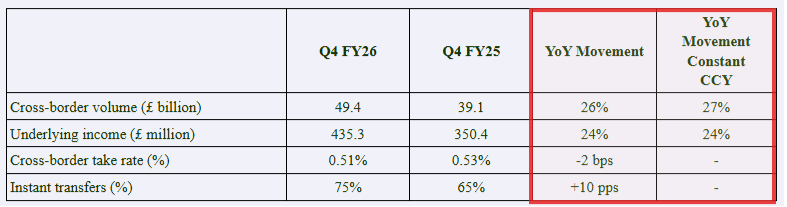
They continue to accept a lower “take rate” (fee on currency conversion), with this rate falling further to 51 basis points (0.51%).
When I looked at the Q3 update from Wise in January, I noted that the take rate had fallen year-on-year from 56 to 52 basis points. So the decline continues.
This reflects “a balanced approach to investing in price and the business to support long-term growth”.
I hate the phrase “investing in price” but it gets the message across. Growth is clearly the priority, and the company is still very profitable.
On the subject of profits:
Continue to expect FY26 underlying PBT margin to be towards the top of the 13-16% range (including costs related to the Dual Listing) as we remain focused on investing in long-term growth and becoming 'the' network for the world's money
US dual listing: FY26 results will be presented in USD and in accordance with US GAAP (generally accepted accounting principles). The LSE listing will be the company’s secondary listing, while the US listing will be primary.
What this says to me is that the company’s future investor communications will be directed primarily towards US-based investors.
CEO comment:
"We are making good progress on building the network for the world's money. Our infrastructure makes cross-border transactions cheaper and faster and, in January, we became one of the first payment institutions to be granted membership to Payments Canada, paving the way to direct access there.
More and more people are using Wise at home or abroad for their everyday spending, for paying bills, for savings and investments. That's why last month we formally launched our UK current account with a physical branch concept on Oxford Street in London."
Graham’s view
I updated our stance on this to GREEN in January (at 954p), and don’t regret doing that. For high-quality businesses, P/E multiples of 20+ don’t scare me away (but this earnings multiple is complicated - more on that shortly).
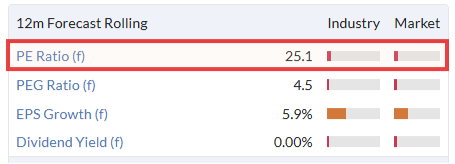
Why pay up for Wise? In one sentence: rapid growth, huge ambitions, and the potential for valuable network effects as a provider of currency market infrastructure used not just by individuals but by major institutions.
And it’s not just a story about hope for the future. The business is already highly profitable:
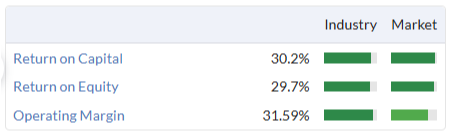
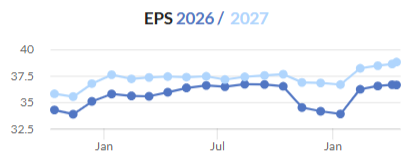
And earnings forecasts have held up pretty well over the past year, even rising:
Wise’s market cap today is equivalent to $14bn, still just a fraction of the $75bn valuation at which Revolut raised money late last year.
They are very different businesses, but at a high level:
Revolut 2025 revenue $6bn, PBT $2.3bn
Wise FY March 2026 revenue £1.74bn / $2.3bn, underlying PBT c. $370m at a 16% underlying margin.
Revolut is winning when it comes to size, growth and profitability. So in that sense its higher valuation makes a lot of sense. But let’s pin down some of the big-picture differences in valuation.
On price to trailing sales, Revolut is twice as expensive:
Price to trailing sales: Revolut 12.5x, Wise 6x
However, Wise appears to be more expensive when it comes to the trailing earnings multiple:
Price to trailing PBT: Revolut 33x, Wise 38x (on underlying PBT)
The Wise earnings multiple is complicated by the fact that its “underlying” earnings are much lower than actual earnings.
This goes back to the fact that Wise is an electronic money institution, not a UK bank, which restricts its ability to pay interest on client balances.
Long-term, Wise intends to pay out far more interest to clients than it currently does. Therefore, its “underlying” PBT ignores the interest earned by Wise that it would like to pay to customers, but is forced to keep for now by regulations.
It’s a very conservative way of looking at things, but I do think that underlying PBT is a useful measure.
Unfortunately, it does add a wrinkle to valuation: do we use the actual profits used by the company, or the (lower) profits that they would prefer to earn?
Those hypothetical lower profits would probably be accompanied by much faster growth, which would increase profits over time. So actually I think investors can use whichever earnings measure they prefer when it comes to valuation.
Overall, I’m inclined to leave our GREEN stance unchanged here. At current growth rates, the investment thesis is fundamentally intact.
As an aside, I note that the IPO price five years ago was £8, and the share price has really struggled to stay above this level. But revenues are up by 300% over this timeframe:
Polar Capital Holdings (LON:POLR)
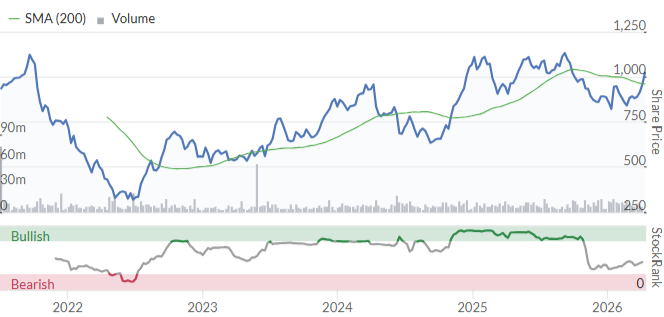
Up 7% at 679p (£682m) - AuM Update - Graham - GREEN =
At the last AuM update (in January), with small net inflows having been achieved (£149m), I upgraded our stance on this to GREEN.
The net inflows are much more meaningful this quarter, at £1.44bn, and combine nicely with positive market movements:
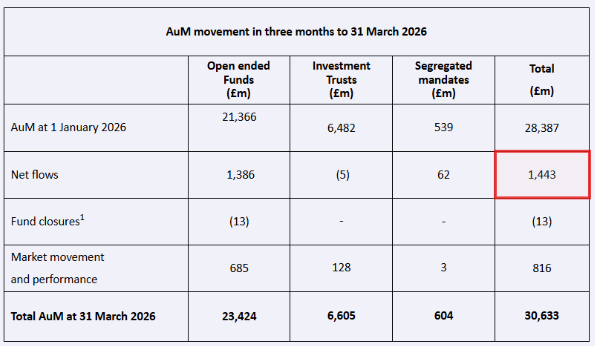
AUM grows 8% in the quarter - very nice. A great way to finish FY March 2026.
CEO comment:
"We have delivered a strong finish to the financial year, despite a backdrop of heightened geopolitical uncertainty and ongoing market volatility…
"For the full financial year, AuM increased by 43% to £30.6bn, from £21.4bn at the end of March 2025, reflecting a combination of net inflows, fund performance and market movements. We delivered a second consecutive year of positive net inflows, totalling £902m (excluding corporate actions and fund closures), demonstrating the strength of our specialist investment capabilities.
AuM increased by over £9bn over the year but the vast majority of this was from market movements not from inflows. The full-year table shows £8.8bn of growth from market movements.
Also, it’s worth highlighting that corporate actions such as tender offers and fund closures are outflows in the strictest sense of the word. Polar saw nearly £500m of AuM leave in this way, offsetting its £900m of positive net flows.
Still, this is a very positive performance given the context of the fund management industry, and it appears to have strengthened as the year progressed.
The strategies attracting the most interest during the quarter were Global Technology and Artificial Intelligence. If or when there’s a tech bust, we can expect Polar to suffer. But the company does have several other areas of specialism.
Outlook
"We have entered 2026 with positive net inflow momentum, although we remain mindful of the structural challenges facing the industry. Inflows were strongest in January and February, before moderating in March following the escalation of conflict in the Middle East. Encouragingly, positive momentum has continued into April to date.
Graham’s view
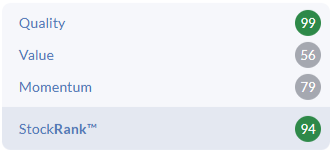
A fully positive stance on this continues to make sense in my mind, and the StockRanks agree in this case.
It’s a Super Stock:
And even with a weaker ValueRank, the value on offer doesn’t seem too bad:
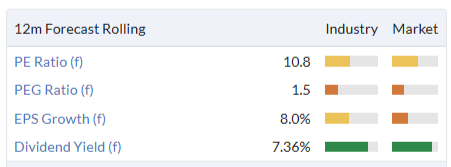
It’s expensive relative to other fund managers, but there’s a good reason for that: inflows. That’s rare, and justifies a premium rating, in my view. This has long appeared to be a cut above most others in the industry.
Roland's Section
Churchill China (LON:CHH)
Up 8.5% at 325p (£36m) - Final Results - Roland - AMBER/GREEN ↑
(At the time of writing, Roland has a long position in CHH.)
Churchill China plc (AIM: CHH), the manufacturer of innovative performance ceramic products serving hospitality markets worldwide, is pleased to announce its Final Results for the year ended 31 December 2025.
The twin headwinds of high UK energy costs and subdued demand have seen shares in Churchill China fall to 14-year lows in recent months:
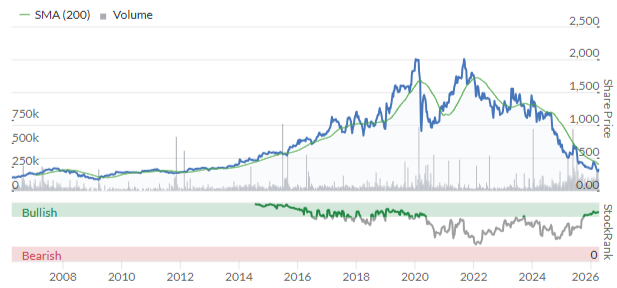
Today’s results have received a relatively positive reception, with the company reporting market share gains and reminding shareholders that it has hedged most of its gas requirements for 2026 and 2027.
The hedging had previously been disclosed so shouldn’t be a surprise, but after a difficult few years it is a relief to see that today’s results are largely in line with expectations, albeit down on 2024.
2025 results summary
Revenue down 2.6% to £76.3m
Pre-tax profit down 29.4% to £6.0m
Earnings per share down 31.4% to 39.7p
Dividend down 44.7% to 21.0p per share
Net cash up 6.9% to £10.8m
Trading in the UK weakened slightly during the second half, which the company attributed to political uncertainty ahead of November’s Budget. In Continental Europe, the company’s largest market, the second half was stronger than H1 leaving full-year performance unchanged.
Sales rose in the US, where Churchil reports minimal impact from tariffs, due to the higher tariffs applied to Asian exporters relative to the UK.
The main area of weakness was the Rest of the World – markets where Churchill is more reliant on new installations (rather than replacement purchases). For obvious reasons, new restaurant openings remain subdued in many markets:
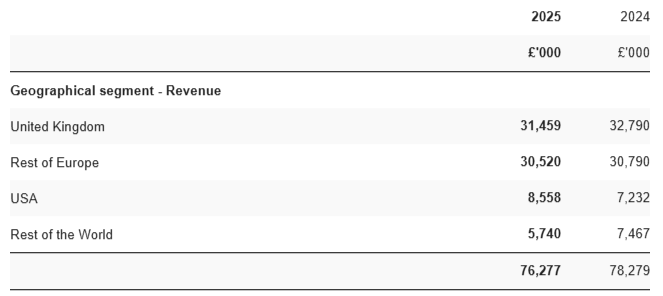
Profitability: Lower sales volumes combined with a planned reduction in inventories to reduce manufacturing volumes last year. Factories such as Churchill’s have relatively high fixed costs, so when production falls below optimum levels, the business can suffer from negative operating leverage.
We see this in today’s results, with profits falling by c.30% despite sales that were only 3% lower. As a result, the group’s operating margin fell by almost 3% to 7.4% (2024: 10.2%).
Investing for the future: Last year’s £2m reduction in inventories was enough to offset most of the £2.5m in capital expenditure for the year. As a result, the group’s year-end net cash position improved – not a bad result in the circumstances.
Despite the current cyclical slowdown, the group is continuing to invest heavily in new technology to cut energy usage and increase automation. This should leave the business well positioned for a return to sustainable growth in the future. Among the changes made this year were:
Completed commissioning of new plate making equipment “which is both more agile and energy efficient”.
Replaced “two more gas fired glazing pre heat units” with electrical units, delivering a 4% reduction in energy consumption (and carbon emissions) and improving yields.
Automated “a large proportion of our packing process leading to significant cost saving”.
Planning further equipment replacement and modernisation.
Lower inventories didn’t impact the company’s strong stock availability and “market leading reputation for service”. According to management, 98% of orders were delivered within 48 hours in 2025, with more than 70% of European orders fulfilled within 24 hours.
Leveraging its distribution network: to drive growth and take advantage of its strong distribution and sales network, the company says it’s “reviewing opportunities to distribute non-ceramic products in the same product areas”.
Management says this could be done through an acquisition or through exclusive distribution agreements with other suppliers, creating “an additional growth path”.
If it’s well executed, I think this could be a positive strategic move for the group. I’ll be interested to learn more in due course.
Valuation: too cheap?
Using today’s results, my sums give a return on capital employed of 8.1% and a return on equity of 7.2%. Both figures are likely to be below the level needed to cover the cost of capital for a small manufacturing business of this kind.
Although the shares look cheap on a P/E of around 8, it’s important to consider the risk that Churchill will not be able to rebuild margins sufficiently to generate attractive returns.
This risk is reflected in the stock’s deep discount to book value, but I think this could also represent an opportunity if profitability does recover over time.
My sums give a net asset value of 560p per share based on today’s result. This falls to 486p if I take a more conservative approach and strip out intangibles and the £7.7m pension surplus.
With the shares trading at 325p as I write, Churchill is trading at a discount of between 33% and 42% to its book value.
This can be an important consideration for investors in value situations, because buying at a discount to book value increases the return on cost of equity achieved on an investment:
Paying 325p for shares in a business with earnings of 40p per share implies a return on cost of equity of 12.3%;
This is substantially higher than the 7.2% return on equity that would be achieved if the shares traded at book value.
Outlook
Perhaps understandably, given the situation in the Middle East, Churchill has not included any concrete guidance for 2026 in today’s outlook statement. However, management did include a comment on energy costs, suggesting that a material impact remains unlikely at this stage, or at least is not imminent:
The outbreak of the Middle East conflict has created uncertainty in the energy markets and, as an energy intensive company, Churchill has exposure to increasing prices. The Group manages its risk exposure and is materially hedged for the year-ahead. In 2026 the Group has open exposure to circa 16% of its gas costs and has forward purchased 64% of its gas requirements for 2027. The Group has modelled the impact of rising costs under a number of scenarios and, whilst profitability would be impacted, it is anticipated that it is only in a prolonged conflict with dramatically increased pricing, that this would materially impact the expected results.
Unfortunately we don’t have access to broker notes for this business, so are left in the dark regarding earnings forecasts.
Prior to today, the consensus figures shown in Stockopedia were for a flat result in 2026, but I would guess these estimates may evolve as the year unfolds:
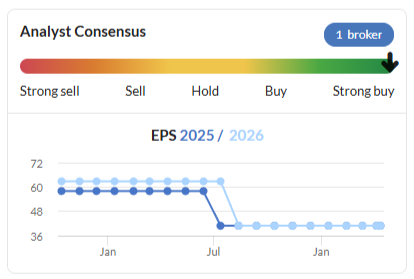
Roland’s view
Today’s results emphasise the company’s long-term culture and strategy on a number of occasions:
As a company with a long history, our values are well defined. Innovation, cooperation, uncompromising customer service, trust and honesty are the core values that drive our behaviours on a day-to-day basis.
In ESG, Churchill states that its strategy is “to be doing the right thing”:
As a high energy use company and one of the largest employers in the Stoke-on-Trent area we are aware of our responsibilities to the wider community and have made this a part of our DNA.
Investment in areas such as automation and electrification are seen as being a good fit with environmental strategic goals for the group, supporting future profitability and sustainability.
In my view, this strategy reflects the company’s long history as a family-controlled business and perhaps provides some clues as to why Churchill has outlasted so many other storied Stoke-on-Trent potteries.
As someone who hopes to be a long-term shareholder in Churchill, I’m encouraged by the company’s continued commitment to this approach.
Even so, I do remain concerned by the risks that structural high energy costs in the UK could mean that profitability remains persistently challenged at Churchill. With consumer spending remaining under pressure in the UK and elsewhere, I don’t see much hope of a near-term recovery in demand.
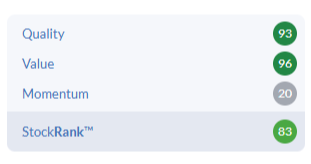
We’ve been neutral (AMBER) on Churchill China recently, but today’s results are in line with expectations and show the 7% dividend yield underpinned by cash generation and a strong balance sheet.
Given the discounted valuation on offer, I’m going to tentatively move our view up by one notch to AMBER/GREEN. I note this view is also reflected by the StockRanks, which see this pottery producer as a potential Contrarian stock – a winning style:
Calnex Solutions (LON:CLX)
Up 13% at 54p (£48m) - FY26 Trading Update - Roland - AMBER ↑
Today’s update from this network equipment test and measurement specialist is ahead of expectations, aided by expansion into the booming data centre market.
Diversification across the cloud computing & datacentres and government & defence markets continued to gain traction in FY26 and, against a backdrop of a stable telecoms market, supports confidence in continued growth in FY27 and FY28.
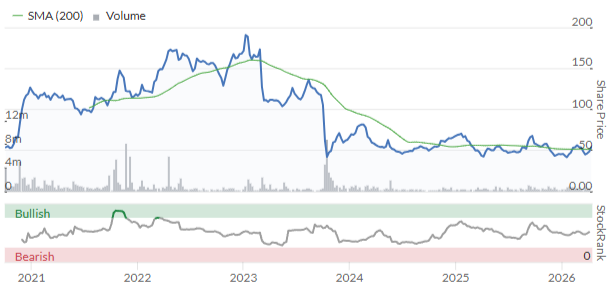
I’m interested to see if this could be an early sign of recovery for this business, whose profitability (and share price) were decimated by a telecoms sector slump after a promising IPO in 2020:
FY26 trading update (y/e 31 March)
Calnex has made good progress in FY26, trading slightly ahead of market expectations, delivering double-digit revenue growth and improved profitability, while continuing to invest in its long-term strategy.
Here are the main points from today’s year-end update:
Revenue expected to have risen by c.19% to £21.9m (+8% vs previous consensus of £20.4m);
Gross margins “have remained strong”, contributing to improved profitability;
Net cash of £9.3m at the year end;
“The Group expanded its global partner network, onboarded new North American partners and increased its focus on partner enablement to enhance sales coverage, particularly in higher growth markets.”.
Calnex highlights several key products that are attracting strong interest and/or sales in the hyperscaler market. These include a network emulation tool that’s currently in a “discovery phase” and Sentry, a product that has achieved “significant scales to a hyperscaler” in recent years.
Updated forecasts
With thanks to house broker Cavendish we have updated forecasts for FY26 today:
FY26E revenue: £21.9m (+9% vs £20.3m previously);
FY26E adj EPS: 1.0p (+59% vs 0.63p previously).
The much larger increase to profit versus revenue suggests strong operating leverage from increased revenue – nice to see.
However, it’s probably worth emphasising that achieving this figure would still leave Calnex on a trailing P/E of 54. A lot of recovery is already priced in here.
Outlook
Cavendish has also introduced forecasts for FY27 (the current year) and FY28 today. These appear to reflect management’s commentary that FY27 will be “a year of targeted investment” towards key product launches that will position the business for “accelerated growth in FY28”.
This suggests to me that we might expect slower earnings growth in FY27
Cavendish estimates:
FY27E adj EPS: 1.2p (+20% vs FY26E)
FY28E adj EPS: 1.9p (58% vs FY27E)
These forecasts leave Calnex trading on a FY26E P/E of 45, falling to a P/E of 28 in FY28.
Roland’s view
Today’s update is positive and the improved visibility on FY27 and FY28 is helpful for anyone considering Calnex as a potential recovery play or long-term growth story.
However, Cavendish’s forecasts suggest operating margins are expected to remain in single digits in both FY27 and FY28. I can’t help feeling that a fair amount of recovery is already priced into Calnex stock.
Stockopedia’s algorithms are also cautious and were applying Falling Star styling to the stock prior to today’s news:
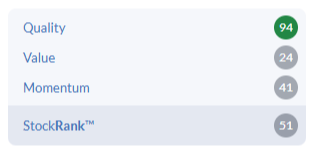
I can see both opportunity and risk here. I think it’s possible that Calnex will grow into a much larger and more profitable company, aided by data centre expansion and perhaps an eventual recovery in telecoms sector spending.
At the same time, I think it’s worth remembering that even today’s FY28 forecasts will still leave profits below the levels seen at the time of the company’s flotation in 2020 (and through 2023). Without further research, it’s not clear to me if this past profitability can be recaptured.
Mark was AMBER/RED on Calnex back in August last year, shortly after profit forecasts were cut.
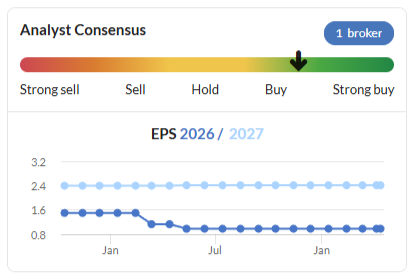
Based on today’s upgrade and refreshed outlook I think it’s reasonable for me to upgrade our view to AMBER (neutral) today. In my view, this is a fair reflection of the risk/reward balance I can see following this brief review.
Of course, more detailed research could strengthen either the bull or bear case on this founder-led business.
Roadside Real Estate (LON:ROAD)
Up 2% at 60p (£107m) - Acquisition of Hoch Group Limited - Roland - AMBER/RED =
Roadside (AIM:ROAD), the UK energy forecourt real estate business, is delighted to announce that it has entered into a conditional share purchase agreement (the "SPA") for the acquisition of the entire issued share capital of Hoch Group Limited, together with its subsidiaries ("Hoch") for a net purchase price of £28.6 million (the "Acquisition").
The price being paid for these assets appears quite high at first glance – assuming a 25% tax rate, Roadside appears to have paid 2x asset value and 21x last year’s net earnings for this collection of petrol stations.
I appreciate that well-invested, well-located forecourts are now quite attractive as retail/fast-food opportunities. I also recognise that Roadside may be able to improve margins on fuel and retail sales as part of a larger group. Even so, this still seems quite expensive to me.
This view is perhaps mirrored by updated Cavendish forecasts today that suggest the contribution margin from each of Roadside’s sites will fall following this acquisition.
I’d also note that substantially the whole acquisition appears to be debt funded.
Roadside has arranged a new £25m facility with HSBC that will be used to fund the majority of the deal and repay a £3.5m facility inherited with a previous acquisition.
Alongside this, the company will draw further debt from Tarncourt. This vehicle is a related party linked to Roadside CEO Charles Dickson and is also a shareholder in Roadside.
Cavendish expects net debt to be c.£28m post-completion of this acquisition. My conclusion from this deal structure is that while the acquisition may boost EBITDA, higher finance charges are likely to mean that shareholder profits do not improve.
Updated broker estimates: with thanks to Cavendish for publishing today, we have a more nuanced conclusion on the impact of this deal.
The company’s broker believes that earnings will be weaker than expected in FY26, but has upgraded its guidance from FY27 onwards:
FY26E adj EPS: -1.97p (previously -1.3p)
FY27E adj EPS: 0.41p (previously 0.28p)
Roland’s view
Roadside aims to use a roll-up strategy to build a portfolio of petrol station forecourt businesses. I can see the logic and opportunity in this and I suspect Tarncourt and HSBC may profit nicely from lending money to fund this strategy.
From the perspective of Roadside equity, I’m more cautious. While this might be a successful long-term play, I’m mindful that today’s updated Cavendish forecasts now price Roadside at 95x FY29E forecast earnings and 70x FY29E free cash flow.
Roadside shares don’t look cheap to me relative to the value of the group’s assets, either.
Several acquisitions have been completed since the last accounts were published (y/e 30 Sept 25), so calculating the current net asset value isn’t straightforward. However, the stock was trading at 3x NAV prior to today and I would guesstimate that this multiple will be maintained following the equity issuance and additional borrowing seen in recent months.
My overall impression is that this situation is starting to look both speculative and expensive. Stockopedia’s algorithms mirror this view, with Momentum Trap styling and a poor set of StockRanks:
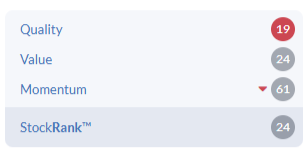
Roadside took nearly five months to publish its results for the year ended 30 September 2025, so I’m not sure when we can expect results for the half-year to 31 March 2026.
For anyone interested in analysing this situation in more detail, I would highlight that the FY25 accounts are now likely to be very stale and potentially not that helpful for further analysis.
The best way to gain some extra insight here today might be to try and build a pro forma income statement and balance sheet incorporating recent acquisitions, then to experiment with various parameters to create a range of medium-term valuation estimates.
I’m sceptical about the current valuation, growing debt burden and related party interests. However, I don’t entirely dislike the strategy. On balance I’m going to leave my view unchanged at AMBER/RED today.
Disclaimer
This is not financial advice. Our content is intended to be used and must be used for information and education purposes only. Please read our disclaimer and terms and conditions to understand our obligations.

30 comments
OK - as a user and just out of interest I have spent a few hours looking at Wise (LON:WISE) - I only transfer money from a uk high street bank to my own accounts overseas in the currency of destination. I have always been relatively happy with the rate you get ( therefore cost) and speed. As they offer traditional deposit services I wonder what that means for me? mainly is this risky for customers ? and what it means for Wise (LON:WISE) growth etc.
In terms of risk : Wise (LON:WISE) do NOT lend your money and hold it in segregated accounts at large banks. This is deemed safe although less safe than being protected by bank deposit regulation. Their moves to try and get banking licenses will probably make them safer but if you only transfer money your main risk is technology failure etc so relatively small. As a frequent user paying myself a living income overseas it seams relatively safe.
In terms of growth Wise (LON:WISE) would appear to want to be a multi currency bank without lending at present. With a bank license, depositors have better protection. Traditional banks compete poorly in multi currency models but businesses like Swissquote allow you to hold different balances say $ £ and € or CHF ....and pay them to various accounts in your own name. Banking services in different currencies have been poor and so Wise (LON:WISE) have a run at growing here, but they are not alone in the space, particularly in America and Europe.
The reason I am interested in all this outside of making sure my own money transfers are safe is that the more Wise (LON:WISE) migrates to banking - the less fintech it becomes and the more traditional banking competition. This does have implications for regulation and capital. Obviously their current ROE and Price to book are high. The more deposit business and services they include, I assume will reduce this but not necessarily. It's obviously important if you compare valuation to financial stocks rather than fintech growth. All their communication is growth : growth : growth, which would worry me a little as an investor. Personally I find the idea of growth close to 20% justifies a high PE > 20 a little unsophisticated. The platform clearly has value in its current form assuming nothing puts the customers off and they vote with their feet. ie The value is the customers being there.
As a long term winner in multi currency banking I can see a case but the current price to book would appear to capture all this to me - I don't see banking deposit services being as profitable in the future - so it feels prudent to expect ROE to fall ==>>> and reduce the price to book. Maybe I am just being very old fashioned but I am coming to the debate trying to build a case for a business I like (as a customer). Sadly I am struggling a little to see the big picture.
https://open.spotify.com/episo...
thank you
I would think that Wise (LON:WISE) will get a better rating when it lists in the US as the US market tends to put much greater value on technology businesses. Let's see./
Thoughts on Polar Capital Holdings (LON:POLR) would be appreciated if you have time team.
We did that, ThePhoenix! cheers.
Thanks for your Polar Capital Holdings (LON:POLR) review Graham. I thought I held some, but must have forgotten to press the buy button, or didn't get past the consideration stage, doh!
The contrast between Polar Capital Holdings (LON:POLR) and Impax Asset Management (LON:IPX) / Liontrust Asset Management (LON:LIO) is stark. Clearly POLR has funds that investors actually want to own (eg AI, tech) vs IPX/LIO having funds that investors don't (eg green/renewables/UK small caps) with the seemingly unstoppable decline in AUM for the latter.
Thanks as always Graham.
Wise (LON:WISE)
Morning everyone!
A solid, high-quality update from Wise this morning — not a blowout, but very clean across the key drivers.
Top-line:
• Cross-border volume +26% YoY (FY +25%)
• Active customers +22% YoY
• Underlying income +24% in Q4 (FY +18–19%)
• Customer balances +37% YoY
• Take rate down slightly to 51bps (as expected)
There are a couple of important points beneath the surface:
1) Growth remains durable at scale
Maintaining ~25% volume growth at this size is impressive. No signs of slowdown or saturation, and customer growth remains strong alongside it.
2) Take-rate compression is controlled
The 1–2bp decline is clearly deliberate. Pricing continues to be used to drive volume and share, with no evidence of margin stress.
3) Balance growth stands out
Customer holdings up 37% is arguably the most interesting line. This continues to support the shift from a pure transfer model toward a broader account-based relationship.
4) Business segment momentum
Business volumes growing ~35% YoY suggests continued strength in higher-value use cases, which could become more meaningful over time.
5) Margins intact
Management guiding to the top end of the 13–16% PBT range despite ongoing investment is reassuring.
---
Overall:
This looks like a high-quality in-line to slight beat. There’s no step-change narrative here, but the consistency is notable — Wise continues to execute well across volume, customers, and product adoption.
For me, the key takeaway is that the core drivers remain firmly in place, with no obvious deterioration anywhere in the model.
As ever, the question is less about any single quarter and more about how these trends compound over time — and on that front, this update feels quietly encouraging.
Additional note on today’s US GAAP translation update (following earlier comment):
Worth highlighting that the IFRS → US GAAP reconciliation released today looks more significant than it actually is.
Additional note on today’s US GAAP translation update (following earlier comment):
Worth highlighting that the IFRS → US GAAP reconciliation released today looks more significant than it actually is.
This is a reporting change, not a business change.
The key guidance remains intact:
- 15–20% long-term revenue growth (unchanged)
- Strong profitability (unchanged)
- Continued reinvestment into growth (unchanged)
What has changed is mainly presentation:
- “Underlying income” → standardised US GAAP “net revenue”
- GBP → USD reporting
- Removal of adjusted/“underlying” metrics ahead of US listing
---
The interesting bit is interest income mechanics:
Wise disclosed that:
- Only part of excess interest income is currently being paid to customers
- A meaningful portion (c.44% in H1) is temporarily retained due to regulatory/operational constraints
This means:
- Current margins are somewhat flattered vs long-term steady state
- Over time, more of this will be passed back to customers (their stated intent)
Why this actually matters?
Rather than maximising near-term profit, Wise is explicitly signalling:
“We will give excess economics back to customers to drive growth.”
In other words:
- Margin is a choice, not a constraint
- Pricing remains a strategic lever
- The flywheel (price → volume → scale → cost advantage) is still the core engine
My Takeaway:
- No change to the underlying thesis or trajectory
- Some near-term noise as the market adjusts to new reporting
- Quiet confirmation that long-term strategy remains firmly customer-first and volume-driven
If anything, this reinforces the idea that Wise is optimising for share and scale, not short-term margin optics.
As before — steady execution, no obvious thesis break.
Interested to hear others’ thoughts, particularly from those more familiar with US GAAP transitions.
'Morning David, perhaps it would be right for the PI to either hold or not hold Wise (LON:WISE) at this stage remembering the adage Buy Low, Sell High. I've done this twice with Wise but don't currently have any shares in it. There is no dividend and I'm not sure as to what currency it would be paid in when it does. Hope my pennyworth helps other Stocko members.
I was also wondering when dividends might become a part of the conversation, opening up their investability for certain investors. I am guessing the US listing may further delay this. I patiently hold.
Apologies for the slight delay in getting back to you both- the day job etc!
Interesting points raised here -particularly on “buy low, sell high” and dividends.
Just to offer my slightly different lens:
On “buy low, sell high” :
That works well for cyclical or mean-reverting businesses. I’m not sure it always applies as cleanly to structural compounders (which are my investment peccadillo).
In those cases, the “low” often only looks obvious in hindsight, and repeated trading can mean missing the longer compounding phase.
Wise has now grown revenues several-fold since IPO while the share price has broadly tracked sideways over long periods. That therefore raises the question that Graham inferred as to whether the market is still catching up to the business rather than the other way round.
On dividends :
Being completely candid, I don’t really see Wise as dividend payer. This is obviously hard to support , but I personally don’t really think that’s how Kristo has behaved. I fully acknowledge this is a personal opinion, and not supported by evidence.
Management have been quite clear that excess economics (particularly from interest income) are being reinvested or passed back to customers. Pricing is being used deliberately to drive volume and adoption.
That combination suggests a business still very much in share capture / network build-out mode rather than capital return mode.
In that context, not paying a dividend therefore supports the idea of rational capital allocation, rather than it being a drawback.
On valuation / timing :
Completely fair to question whether it’s “cheap” at any given point – but I think the more interesting question here is whether the underlying engine (customers, volumes, balances, platform adoption) continues to scale.
So far, those metrics still look strong.
I’m a very LT holder, so I don’t have strong views either way on short-term moves.
I do think it’s one of those cases where the framework you use (trading vs compounding) leads you to very different conclusions.
I’m always keen to hear different perspectives, and these are just mine!
Apologies for the stupid question but what's the long term vision for Wise (LON:WISE) ? as they offer more traditional banking products doesn't that push their ROE down and make the price to book look full already?
Not a stupid question at all – I think this gets to the heart of how I think about Wise.
In terms of the long-term vision, I don’t think Wise is really trying to become a “traditional bank” in the usual sense. Bluntly, I think it becomes a bank regionally when it views it advantageous to be one.
Therefore I feel the direction of travel looks more like a global multi-currency account layer for individuals and businesses, combined with underlying payment rails used by other institutions (via Wise Platform).
Therefore it’s less about balance-sheet-heavy lending and more about becoming infrastructure for moving and holding money across borders.
On the ROE point, I think this is where the framework matters.
If you look at Wise through a banking lens, then the concern is logical: more products could mean more capital, which might dilute returns and make price-to-book look full.
However, Wise doesn’t universally operate like a bank. It doesn’t take meaningful credit risk or rely on lending in the traditional sense- its economics come from flows, balances and fees rather than leverage.
Therefore the balance sheet behaves quite differently.
As the product set expands, you may see some marginal pressure on traditional metrics.
However this ‘user ecosystem’ may evolve to higher customer balances, greater engagement, and more use cases per engaged client. This increased revenue ultimately drives capital efficiency upward.
Personally, I find it more useful to think of Wise as a network that is adding functionality, rather than a ‘necessarily more complex’ bank.
My thoughts are If it wished to ‘become a bank’ it could’ve done so a long time ago, or purchased one that already used its rails.
If a network is therefore the right framing, I suspect traditional banking metrics like ROE or price-to-book may not fully capture what’s happening.
I’m very open to other interpretations though – it’s a genuinely interesting question……
Interesting thank you for the reply....moves by the company to accept deposit balances and add cards etc suggest they are indeed moving into other traditional banking services to increase transaction volumes. This is more competitive and obviously others may choose to compete on price where there appears to be plenty of room ie no shortage of capital that likes to enjoy high ROE. Whilst the network helps Wise (LON:WISE) run their business Im less convinced it matters much to customers.... who just want to execute timely at a fair price.
RE: Wise (LON:WISE)
... moves by the company to accept deposit balances and add cards etc suggest they are indeed moving into other traditional banking services to increase transaction volumes.
No, Wise are a payments company, not a bank and are likely to remain so. The difference may be opaque from the outside but it matters a lot. Banks are capital intensive, highly regulated and rely heavily on lending for income. Wise is utterly adverse to taking on credit risk or balance sheet lending or being directly regulated and is clear about this.
In fact card payments aren't a great way to make money - banks make a cut via interchange fees (their fraction of the fees paid from the merchant) - and I'm reasonably sure Wise wouldn't issue them if it didn't need to. The need arises from customer retention - they want to keep customers within the Wise walled garden rather than having them swap to (say) Revolut for card payments where they could be exposed to alternative FX options.
The interesting part about the relatively uninteresting update was the increased use of instant payments by their customers. Customers have three routes to move money via Wise: (1) they can use SWIFT, (2) they can use Wise's own account balances in different countries and (3) they can use instant payments where Wise has embedded them.
In general (1) is expensive - SWIFT is a backup where other options don't exist, and Wise won't use it unless there's no choice (so, perhaps a transfer to an "exotic" FX country). The most common route is (2) where (say) Wise hold significant balances in the source and destination countries and simply move money between their own accounts (think US->UK or EUR->JPN).
Increasingly however they are using instant payment systems - for example, they are embedded in UK Faster Payments and the EU's SEPA systems - which means they can move money end-to-end without using their own funds. This generally imposes a small charge but reduces the capital they need to hold to fund ttransfers of type (2). Their program of instant payment system integration is now well advanced - they had 9 the last time I looked.
Using instant payment instead of holding customer funds on account to fund transfers has a range of beneficial impacts - lower treasury costs, better customer satisfaction due to faster payments end-to-end, lower working capital, lower capital requirements and lower costs as they don't need to manage the costs of card payments in and out of Wise accounts.
All this is happening in slow time but the accruing impact is likely to be significant. The deeper Wise's integration goes, the more efficient they become and the harder they become to compete against on price. And none of this takes into account the growing business around Wise Platform - Morgan Stanley announced they're using it, which is the first breach in the dyke where a Tier 1 bank outsources cross-border payments to Wise.
Lots of good things here, but it's an uncertain world full of competitive threats. It's a great company but the future is not, and never will be, entirely certain.
timarr
OK apologies I thought I read a UK Bank License application had been made or under consideration - same in the US. Maybe I misread it.....but your point re cards is exactly my point too to be honest. I do understand what banking involves thanks, and the regulations only really apply to lending not deposit taking. I wouldn't underestimate Banks though depending how they feel about losing this X currency payment business.
RE: Wise (LON:WISE)
I wouldn't underestimate Banks though depending how they feel about losing this X currency payment business.
To be frank, they're bloody useless at it. It's a small part of their business, is increasingly highly regulated due to anti-money laundering and sanction screening processes and is very expensive as they all use SWIFT. Many counterparties have withdrawn due to the risks and the ones that keep on do so because it's very profitable, but I think the chances of even a Tier 1 bank seriously competing with Wise in the FX space are minimal.
For example - HSBC set up Zing to do this in 2024. They invested $150 million in it and then shut it down in 2025 due to lack of customers. A single bank, no matter how widely spread, can't achieve the network effects required.
The only realistic competitors are Visa or Mastercard or perhaps a digital currency provider, but so far no one's really come up with a compelling proposition.
timarr
Thanks again - bizarrely to me, it is actually easier for me to transfer money to Saxo Trading with Wise than direct from my bank - so as a customer I’m a convert.
Wise (LON:WISE)
I previously had similar concerns regarding banks and how they might react to the the potential loss of FX revenues.
So I decided to look at the Annual Report of Nationwide Building Society, who are large enough that most people in 1 country know them, but not as significant as the behemoths of the industry.
They charge what I consider to be ridiculously high FX fees in a world of Wise (LON:WISE)'s and Remitly Global (NSQ:RELY)'s. From memory there's a flat fee (£15 or £20 I think) plus a 2%-3% mark-up on the exchange rate.
What I quickly learnt was that they barely generate any revenue or profits from FX so I couldn't imagine they'd care too much about losing it. I suspect that this is the same for thousands of mid-tier financial institutions around the world.
Sadly that might also diminish the chance that these banks sign up to Wise Platform, but with the increasing popularity of neo-banks who knows if this might change.
And then when it comes to the big players, as timarr already pointed out, HSBC tried and failed to recreate Wise just a few years ago. I imagine that it's only a matter of time before someone else tries again. Or they just buy Wise.
A
“The difference may be opaque from the outside but it matters a lot.”
I think there’s a small but important distinction Timarr’s alluded to, as it’s easy to conflate what Wise offers with what it is regulated as.
On the UK side, there’s no evidence that Wise has applied for a banking licence.
Its FY2025 Annual Report and other disclosures confirm it operates as an FCA-authorised Electronic Money Institution (FRN 900507) under the Electronic Money Regulations 2011 and Payment Services Regulations 2017.
That’s how it has been able to launch the UK current account (announced March 2026-The Oxford St ‘pop up’).
The product looks very similar to a bank account (sort code, direct debits, debit card, multi-currency balances), but structurally it operates under a safeguarding model rather than deposit-taking.
As Wise itself states, customer funds are kept separate and “Wise doesn’t lend out your money”, with balances held in segregated accounts or invested in high-quality liquid assets (see FY2025 Annual Report, Note 15).
On the US side, there is a relevant regulatory development: Wise filed an application in June 2025 with the OCC for a non-depository national trust charter.
The application explicitly describes a payments and fiduciary model (multi-currency accounts, payment processing, custody of funds), and notably does not include lending or traditional deposit-taking.
The aim appears to be direct access to US payment infrastructure rather than becoming a full-service bank.
So while the product increasingly looks like a bank account from the outside, the underlying model remains quite different.
Wise is effectively trying to capture the flows, balances and customer relationship layer of banking, while avoiding the balance sheet, lending risk and capital requirements that come with a traditional banking licence.
That distinction is important when thinking about returns and scalability — it’s less “becoming a bank” and more “building a payments and money movement network with bank-like functionality”.
Ok interesting.... My thinking is more along the lines of what future ROE will be and whether it falls as Wise (LON:WISE) continues to evolve. So I am interested in what services they can add without being a bank or whether a license helps at some point. Obviously they need to connect to banking payments systems. If they are successful in cherry picking revenue that bolsters their ROE I presume this revenue gain is someone else's loss and the loser may not be too happy. Banking ROEs are quite low since less wholesale finance reduced leverage in lending.... and whilst Wise (LON:WISE) may have been successful taking multi currency business - they may find more resistance as the business evolves. Obviously as a customer I come from the stand point the currency transfer product is excellent and I think out loud whether this continues to be the business driver. It always surprised me that the regulated part of banking is actually lending not deposit taking. If I was thinking of deporting money at Wise (LON:WISE) which I am not, I would be very intrigued in the direction they evolve. I do note their communication at present is 100% aimed at non lending business.
RE: Wise (LON:WISE)
So I am interested in what services they can add without being a bank or whether a license helps at some point.
They're a cross-border payment business, everything else is a means to that end. Cross-border payments are generally painful because the underlying nature of FX transactions - if I send money from the UK to the US, for instance, no money leaves the UK and no money arrives in the US. You need counterparties on both sides, with an agreed messaging structure that includes certainty, you need liquidity on both sides and you need to meet the increasingly onerous regulations that can lead to eye watering fines or even executive prosecutions and jail time.
Wise currently has about 5% of the global market for retail cross-border transactions and about 1% of the SME market so there's plenty of market share to go for. Major currency corridors account for around 70% of transaction volume, so they don't need to go after more difficult to serve, less popular exchanges to continue to grow their volume.
Underlying this is the fact that most people don't transfer money very often and their default is to use their own bank - which may cost five times what Wise does but is a one off fee. That's why Wise Platform is so interesting, as it gives them access to this long tail of irregular users via these customers' first point of call, their own banks.
I don't see much changing for a while if they continue to grow as they are. At some point they will need to up marketing spend to keep customer onboarding up, but that seems to be some way off right now.
timarr
RE: Wise (LON:WISE)
This looks like a high-quality in-line to slight beat. There’s no step-change narrative here, but the consistency is notable — Wise continues to execute well across volume, customers, and product adoption.
Isn't AI wonderful?
The main negative here is that Wise is earning less for each pound transferred. Essentially income is growing slower than volume. Although the narrative implies this is Wise's choice, the fact that instant transfer volume is increasing is contraindicative - instant transfers are lower margin, more expensive to operate and are more common in low-margin corridors (e.g. USD-EUR, etc). That's where competition from the likes of Revolut is depressing spreads.
I'm still happy to hold long-term, but there's a trend here that's worth keeping an eye on.
timarr
Hi Timarr
That's an interesting point on Revolut driving down take rates.
I know you're the expert here, but I must admit to not being convinced by this yet.
Revolut published their 2025 Annual Report last week where I tried to pick up some clues on their incursion into the FX transfer world:
https://find-and-update.compan...
Some observations:
(Incidentally I'm not sure which banking hours - the country of origin or the country of holidaying. When I asked customer service about 10 years ago, they didn't know!)
From my relatively extensive experience of dealing with foreigners transferring money with Revolut, most of them don't care about any extra fees, which makes me think that Revolut isn't feeling/won't have any incentive to lower their take rates.
The obvious area for growth is the US, however, there's a lot of neo-bank competition there right now e.g. Chime Financial (NSQ:CHYM).
Wise Revenue splits for 2025 below for context (in £m):
For me this implies lower global liquidity pools held by Revolut and therefore the need to charge higher take rates even across popular routes (e.g. GBP - EUR)
Of course, I'm possibly being delusional/highly biased given my Wise holding and failure to invest in Revolut via Crowdcube many years ago.
Personally I feel digital currencies will be a greater driver of lower take rates in the future and I think it's good that Wise is focussing on customer and liquidity growth so that it can take advantage of this when the time comes.
For now though I remain a content Wise holder.
A
Hi abtan
RE: Wise (LON:WISE)
I was using Revolut as a random example - but you've got other competitors like Remitly, Airwallet, etc. On major currency corridors there's plenty of competition which will act to keep rates low (and yes, I know Wise's strategy is to squeeze these).
On the other hand, if Wise are - as the figures today show - are seeing increased use of instant transfers down these corridors that might explain decreased margins. Instant transfers could be cheaper than a Wise internal transfer overall, but could also cost more.
That said, increased instant transfers over major currency corridors will, long term, have the effect of decreasing the liquidity Wise needs to hold - which will eventually be a huge tailwind.
There's not enough detail today to be sure, but I always try and find the inverse position, it's all too easy to get afflicted by confirmation bias when looking at a major holding ... but as stated, I'm not selling.
timarr
Agreed, Timaar.
Part of the disconnect is that Wise is still often viewed as a kind of “cheap Revolut” — i.e. a product competing on FX pricing — rather than as a payments network.
If it were simply a cheaper front-end, you’d expect a crowded and fragmented market over time. Instead, the opposite seems to be happening.
As René Sellmann recently highlighted, a number of well-funded or well-backed competitors have struggled to gain traction or have been shut down entirely — including Santander’s PagoFX, HSBC’s Zing (as mentioned above), and Atlantic Money. Several private operators appear to have stalled (e.g. TransferGo, Xe, Oanda), while legacy incumbents like Western Union continue to lose relative share.
That doesn’t prove anything conclusively. It does suggest that what looks like a simple product on the surface may in fact be underpinned by something harder to replicate.
Thoughtful post, Timarr – and I think you’re highlighting a really important trend.
You’re absolutely right that income is growing slightly slower than volume and that take rates continue to edge down. That’s clearly visible in the numbers and definitely something worth keeping an eye on.
Where I’d gently offer a different perspective is on why that’s happening.
If this were purely competitive pressure (e.g. Revolut forcing spreads down), you’d expect margins to come under sustained pressure. But so far, Wise has continued to guide towards healthy profitability while volumes, customers and balances all scale strongly.
One explanation is that pricing is being used deliberately to drive adoption, while the underlying cost per transaction is falling over time – particularly as more volume moves onto their own rails and instant infrastructure. In that scenario, a lower take rate doesn’t necessarily imply a weaker business, just a different mix of price and scale.
On instant transfers specifically, I agree they are typically lower margin on the surface.
However, if they increase customer engagement, retention and overall usage (e.g. accounts becoming “everyday” rather than just for transfers), then they may still be economically attractive at the system level.
So I think the key question for me is less:
“Are margins being squeezed?”…and more:
“Is Wise choosing to trade margin for scale, and is that still value-accretive over time?”
I agree it’s a trend worth monitoring though – particularly the relationship between take rate, costs, and overall profitability as the business scales.