Daily Stock Market Report (Mon 16 June 2025) - AGR, PEEL, COST, ENT, ART, ONDO, TMG, CPH2, NESF, SSTY, TRD, SBTX

Good morning!
Despite ongoing political/military events, the FTSE is set to open unchanged this morning at about 8850.
12.15pm: it's a clean sweep, as we've covered all of the day's news! See you tomorrow.
Spreadsheet accompanying this report: link.
Companies Reporting
| Name (Mkt Cap) | RNS | Summary | Our view (Author) |
|---|---|---|---|
Entain (LON:ENT) (£4.8bn) | SP +9% to 824p | AMBER (Roland) [no section below] Forecasts I’ve seen prior to today have suggested that Entain is expected to generate EBITDA of c.$1,100m this year. This suggests today’s upgrade could be equivalent to a c.5% increase to full-year estimates. The positive operating leverage implied here (the extra revenue has largely dropped through to EBITDA) suggests to me that BetMGM could report further improvements in profitability if revenue continues to rise. However, Entain’s profitability as a group has been poor in recent years and the shares were already trading on nearly 17x forward earnings prior to today’s gain. Net debt is also a little high for my liking. The algorithms view this as a Momentum Trap. I would want to see evidence of improved profitability and deleveraging before taking a positive view. | |
Assura (LON:AGR) (£1.6bn) | Assura’s board are reviewing PHP’s offer document and they assure shareholders of their objectivity. | PINK (Roland) [no section below] Assura’s board recommended KKR/Stonepeak’s cash offer last week, but PHP issued full offer documents and a detailed discussion of its offer on Friday, pointing out that at that time, the PHP cash/shares offer was worth 53p, slightly more than the KKR/Stonepeak cash offer (52.1p). Assura’s board now seems keen to reassure shareholders that the PHP offer is getting a fair hearing. Regardless of which offer succeeds, competition for AGR’s assets has most likely pushed up the price shareholders will receive. I share Graham’s view that it would be nice to see this business continue as a UK-listed entity as part of PHP, but there’s no doubt that would also be the more complex deal to complete. | |
NextEnergy Solar Fund (LON:NESF) (£404m) | NAV -9.2% to 95.1pps (£547m). Dividend +1% to 8.43p, covered 1.1x. FY26 dividend target 8.43p. | AMBER (Roland) | |
Costain (LON:COST) (£351m) | FY25 trading in line with exps, on track for 4.5% op margin. Forward work position 4x annual revenue. | GREEN (Roland) | |
Peel Hunt (LON:PEEL) (£107m) | Revenue +6% to £91m, LBT of £3.5m. Net assets £89m, cash £20m. FY March 26 has started more positively than February and March 2025. | GREEN (Graham) Happy to stay GREEN on this due to balance sheet strength (reducing risk) and the prospects for some recovery in activity levels. I do wish it had the discipline to insist on a breakeven result, even in very difficult years such as this. | |
Triad (LON:TRD) (£56m) | Rev +50% (£21.4m). PBT £1.5m. Good visibility of future work. Substantial OPSS contract. | AMBER (Roland) [no section below] Graham took a neutral view on IT consultancy Triad in November. The firm’s share price is almost unchanged from that level today. Although revenue growth was strong last year and profitability improved, an operating margin of 7% doesn’t seem that high to me for a consultancy. I wonder if remuneration is generous; I note the three senior executive directors enjoyed c.15% pay rises last year and collected total fixed pay equivalent to nearly 50% of operating profit. Triad’s performance certainly improved last year. But the current share price leaves the stock on a P/E of 33. With no forecasts in the market and a minimal outlook disclosure today, I think it makes sense to remain neutral. | |
Skinbiotherapeutics (LON:SBTX) (£40m) | Agreement re: sale of food supplements, and £4.1m is raised at 17p to support it. For two years, Superdrug will have the exclusive right to sell STBX’s supplements (which alleviate the symptoms of inflammatory skin conditions), but STBX will retain the worldwide rights to sell them directly online, using their own website and Amazon. Major shareholders are providing £4.1m and retail shareholders will also have the chance to invest up to £600k. | AMBER (Graham) [no section below] We’ve not covered this one before and the long-term record shows that it’s effectively a start-up, with no meaningful revenues until last year. I’m fine with giving it the benefit of the doubt today and a neutral stance as it raises funds at the current share price, to support a deal with Superdrug. These shares are probably still very speculative, but the fundraise itself is an important vote of confidence, and a deal with Superdrug must add to the company’s credibility. | |
Artisanal Spirits (LON:ART) (£35m) | New franchise launched in Vietnam, another milestone in the Group’s strategic expansion in Asia. They already have a franchise in Korea and a subsidiary in Taiwan, alongside longer established China and Japan subsidiaries. | AMBER (Graham) [no section below] I last looked at this in December, noting that the company was unprofitable but claimed to have spirits on the balance sheet worth in reality over £100m (vs. their value of £26.5m on the balance sheet). FY24 results reiterated this claim. On balance I think a neutral stance continues to make sense. I might upgrade already if not for a net debt position of £27m. The company says that this has peaked and is underpinned by their whisky assets. Let’s see if they can now generate cash as they have claimed they will. | |
Ondo InsurTech (LON:ONDO) (£30m) | LeakBot device to be piloted to 5,000 homeowners’ insurance customers in Utah. | AMBER/RED (Graham) [no section below] While the company said (in April) that it had “no anticipated requirement for future funding”, I remain cautious given cash of probably less than £3m and losses pencilled in for the next two years. Today’s announcement provides further evidence that the company is gaining traction with its leak detection sensors in the United States - let’s see if it can make it to breakeven before additional equity is required. | |
Mission (LON:TMG) (£26m) | In line. Restructuring complete. Client retention strong. Searching for a successor to interim CEO. | AMBER/GREEN (Graham) [no section below] I last covered this collection of creative agencies in March, when we learned that net bank debt had reduced to £9.4m, with the potential for it to reduce further given an earn-out payment scheduled for June 2025 (although there is no mention of that in today’s update). With the company continuing to trade in line, I’m going to tentatively upgrade this to AMBER/GREEN. It has a StockRank of 98, including a ValueRank of 93 (P/E ratio only 5x). Recoveries are always somewhat fragile, and this is no different, but I think it could be worth another look. | |
Clean Power Hydrogen (LON:CPH2) (£22m) | Memo with an Irish energy developer, will now negotiate sale of initial five MFE220 units. | RED (Graham) [no section below] We haven’t covered this one before. It listed in early 2022, at the tail end of the IPO boom, with a placing at 45p. The shares are down by nearly 90% since then, with no revenues reported yet, although forecasts suggest that revenues will be generated in 2026. According to the most recent going concern statement, the company is likely to need more funding within 12 months. | |
Safestay (LON:SSTY) (£15m) | Awarded a business interruption insurance claim for £1.4m, to be received in the next 21 days. | AMBER (Graham) [no section below] We’ve been a little worried about this hostel owner and operator. See Roland’s most recent coverage in February - it has not yet reached sufficient scale or efficiency to post a profit, and net debt was last reported at close to £18m. I’m likely to downgrade it if its fortunes don’t improve soon. For now, this business interruption claim should provide some very helpful additional headroom. The insurance sector hasn’t covered itself in glory by taking such a long time to make these payments! |
Graham's Section
Peel Hunt (LON:PEEL)
Down 1% to 86.4p (£106m) - Full-year Results - Graham - GREEN
Peel Hunt has published results for FY March 2025.
This stock featured on my 2025 watchlist.
Key points:
Revenue +6% to £91.3m, “despite ongoing low levels of equity capital markets (ECM) activity”.
Loss before tax £3.5m (FY25: loss £3.3m), due to restructuring costs. On an adjusted basis, there’s a small profit.
I believe these numbers are slightly better than market expectations, e.g. the revenue forecast on the StockReport is £89.1m.
Investment banking - revenue down slightly, 147 clients, vs. 150 a year ago. But there’s a good increase in the number of FTSE-350 clients, from 43 to 52. The average market cap of retained clients increases to £870m. Acted on two of the three major London IPOs.
Execution - revenue increases 14%, “due to our position as a highly valued liquidity provider to our clients, as well as increased trading volumes”.
Research & Distribution - revenue increases 10%.
The firm is preparing to open an office in Abu Dhabi.
Retailbook - the retail investment platform created by Peel Hunt (but now with a range of other investors involved), has “reached several key milestones in FY25”.
On political solutions to the decline of London listings:
The increasing rate at which companies are exiting the London market presents a significant challenge for the UK economy. Peel Hunt remains at the forefront of the reform agenda, championing solutions to revitalise UK equity markets. Numerous policy initiatives are already in progress, and we are leveraging our connectivity to drive further advancements
Outlook: FY March 2026 has “started more positively” with Trump trade deals and lower interest rates at the Bank of England.
We are seeing a rotation out of US assets into Europe and greater institutional positivity towards the UK. ECM activity in the UK remains generally subdued but could gain traction should macroeconomic conditions continue to stabilise. Meanwhile our M&A franchise remains highly active with a strong pipeline of transactions.
Balance sheet: net assets have reduced by a few million pounds to £89m, almost fully tangible and mostly consisting of liquid current assets. Cash at year end was £20m (previous year: £38m) and the company acknowledges that it has “occasionally” used its £20m RCF and £10m overdraft to support clients’ trades.
Graham’s view
I’m going to stay GREEN on this due to the combination of a) balance sheet strength, covering most of the market cap and hopefully reducing the risk associated with the share; and b) the prospects for some recovery in UK equity markets, which appear slightly stronger now than they’ve seemed for some time.
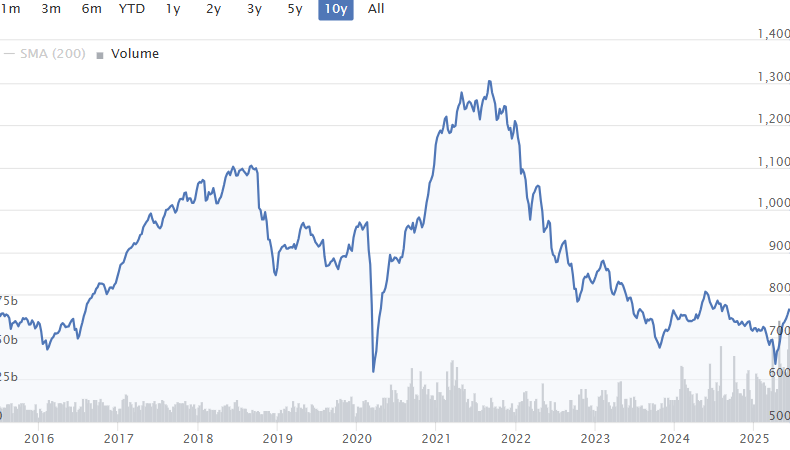
Peel Hunt has great strength in mid-caps too but even if we focus on small-caps (represented below by the AIM All-Share Index), there has been a noticeable bounce off the tariff-related lows. Even a very modest IPO flow could do a lot for performance here. Of course the index is still far below the post-Covid high, which fuelled an enormous IPO boom:
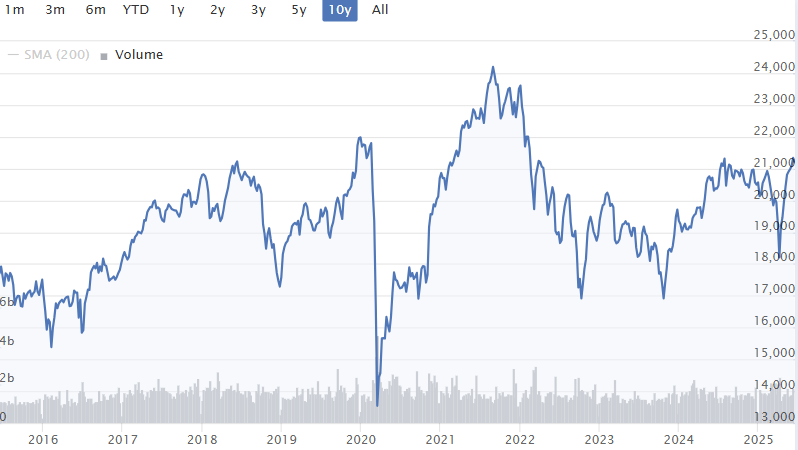
Mid-caps (represented by the FTSE-250 Index) have been doing fine in share price terms, but IPO activity here is much rarer:
One aspect of Peel Hunt’s performance that does frustrate me is that it doesn’t adjust its costs quickly enough to prevent annual losses. It would be a sign of great financial discipline if it could do that, and it has been close, but it just hasn’t been able to manage that in recent years.
In FY25 it reduced headcount by 5%, as it tried to reduce costs and get to breakeven.
But staff costs are still up by 3%, even on an “adjusted” basis which excludes share-based payments and staff restructuring costs.
On an unadjusted basis, total staff costs rose nearly 10%.
Perhaps it’s too much to expect a bank like this to achieve breakeven in an IPO drought, but I remember that Cenkos (now Cavendish (LON:CAV)) used to be able to do it.
In any case, I am still GREEN on this for now.
Roland's Section
Costain (LON:COST)
Up 8.5% to140p (£381m) - £10m Share Buyback & H1 Trading Update - Roland - GREEN
Construction and infrastructure group Costain has issued a half-year update confirming that trading remains in line with FY25 expectations. This follows an in-line update at May’s AGM.
Margin guidance is also unchanged from May, suggesting that Costain will hit its 4.5% adjusted operating margin run rate target “during FY25”. As Mark commented in May, this seems to suggest that the full-year margin will be lower than this, but that FY26 results could benefit from a full-year of improved profitability.
Commentary on the group’s order book certainly seems confident:
Forward work position “more than four times annual revenue”
FY25 wins to date include new contracts in nuclear energy (Sizewell C)
Further work with Anglian Water to deliver an extra 260km of strategic pipeline
“Busy bidding further new work across all sectors”
£10m share buyback / pension: Costain has also announced a new £10m share buyback alongside today’s update. It looks like this is largely going to be funded by cash saved by not having to fund contributions to its defined benefit pension scheme this year.
The group’s scheme is said to have been fully funded (>101%) at the end of March, which allows the annual £3.3m pension contribution to be suspended.
This also frees up additional cash due to the suspension of the dividend parity requirement attached to the pension contribution plan. This requires Costain to make matching pension contributions for all dividends paid in excess of the £3.3m standard contribution.
This year’s dividend is forecast to cost £7.2m, so this means an extra £3.9m is available.
My sums suggest a total of £7.2m is being saved by avoiding pension contributions this year. This has been rounded up to £10m to fund a buyback that’s scheduled to complete by 23 December 2025.
Costain’s balance sheet looks in decent health and the shares have an earnings yield in excess of 10% at current levels. Taking this into consideration, I think a buyback could provide attractive returns at current levels, assuming profitability remains stable.
Updated estimates: house broker Panmure Liberum has updated its earnings forecasts slightly today to reflect the expected impact of the buyback:
FY25E EPS +1% to 14.4p
FY26E EPS +2% to 15.9p
These figures put Costain on a FY25E P/E of 9.8, falling to 8.9 in FY26.
Year-end net cash is now expected to be £172.6m. Although this may be a peak figure, the company is likely to be generating a useful interest income from its cash, adding to profitability at a PBT level.
Roland’s view
Costain appears to have decent momentum and to be on track to achieve a decent level of profitability for a business in this sector.
While it’s worth remembering that such businesses need to maintain healthy cash positions (as I discussed recently here), I think that Costain’s buyback and dividend look both affordable and justified.
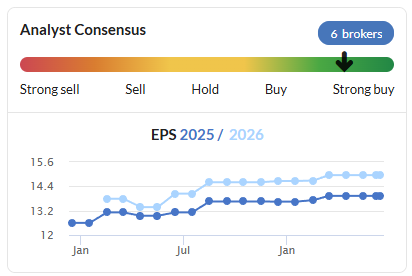
In addition, as Mark commented in May, applying a 4.5% operating margin to FY26 forecast revenue of £1,270m suggests an operating profit of £57m. My sums suggest this could be slightly ahead of current forecasts, which have already been upgraded several times over the last 18 months:
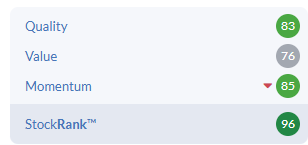
A positive outlook and reasonable valuation are reflected in a high StockRank:
I’m happy to stay GREEN on Costain today.
NextEnergy Solar Fund (LON:NESF)
Up 0.9% to 70.8p (£407m) - Full Year Results - Roland - AMBER
This solar energy and battery storage investment trust has now declared dividends of 76.3p since IPO in 2014 – equivalent to £395m or (almost) today’s entire market cap.
However, higher interest rates have left shares in this sector trading at hefty discounts to book value, leaving trusts unable to issue new equity to fund new projects. Instead, NESF (and others in this sector) have been forced to resort to selling assets and using the cash to repay short-term debt, shore up NAV and fund share buybacks.
This is not necessarily as desperate and/or cynical as it might seem at first glance. There is some sound financial logic behind this strategy, as highlighted in today’s results.
Capital recycling programme: NESF is currently midway through a Capital Recycling Programme targeting 245MW of sales.
According to today’s results, 145MW of disposals have been achieved so far, raising £72.5m and achieving a 2.76p increase in NAV per share.
The sale of the final 100MW of assets being targeted is currently said to be “in a competitive sales process”.
The key factor here is that selling these assets has created accounting value because they have generally been sold at a premium to book value. This has allowed NESF to repay some of its debt and also buy back shares at a discount to book value.
Selling assets at a premium to book value and then buying back shares at a discount should be accretive to NAVps, assuming book values for the remaining assets remain stable. The StockReport shows us that NESF’s book value has fluctuated within a range in recent years:
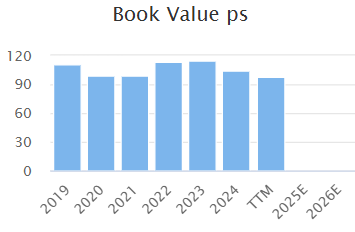
Unfortunately, NESF’s book value fell by 9% last year, despite the company’s efforts to support it. This fall highlights the cocktail of other variables the fund needs to manage successfully:
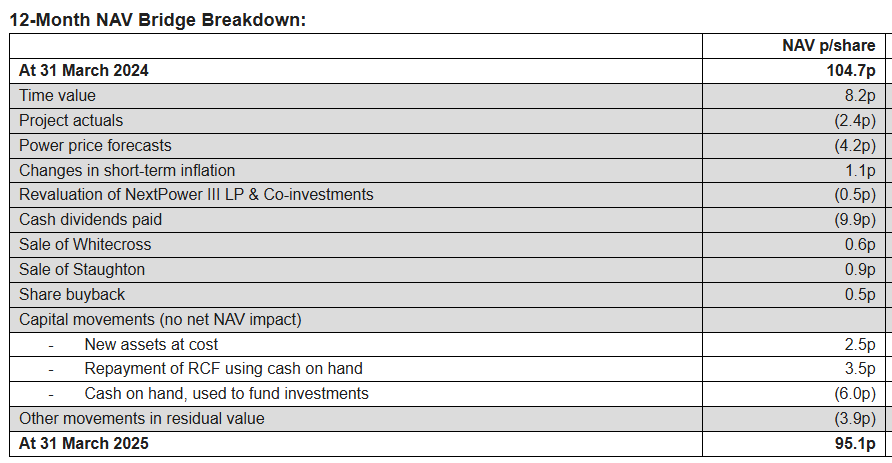
The biggest movement – time value – reflects the unwind of the discount on future cash flows due to the change in valuation date. In other words, future cash flows are one year nearer and so worth more than they were one year ago.
Project actuals reflect the impact of weather conditions and maintenance issues. Electricity generation was 5% below budget last year, due to some adverse conditions.
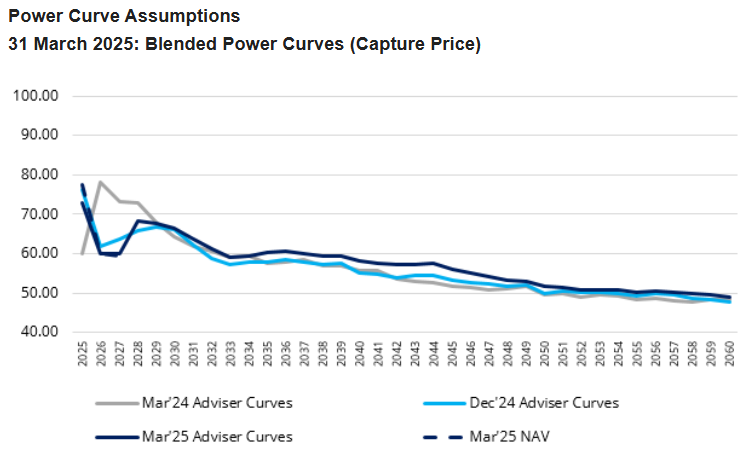
Power price forecasts are self explanatory and were a further negative factor, extended the trend seen in recent years:
Dividend: Renewable energy companies like NESF need to juggle interest rates, power price forecasts and fluctuating weather in order to sustain a reliable dividend.
Today’s results confirm a full-year payout of 8.43p per share, covered 1.1x by net cash available for distribution of £56.4m.
Management expects cash cover for the dividend to improve to 1.1x-1.3x this year, although the target payout has been left unchanged at 8.43p. This gives a prospective yield of 12% at current levels, one of the highest in the sector.
Gearing: renewable energy projects often have relatively low expected returns on capital, but returns can be improved by use of gearing.
NESF’s gearing appears to be at the higher end of what’s typical in this sector. Today’s results report total gearing of 48.4%, up from 46.4% one year ago. It seems that disposals have not been sufficient to reduce overall gearing against other negative impacts.
For contrast, peer Bluefield Solar Income Fund (LON:BSIF) reported a figure of 43% in its last accounts and larger wind-focused trusts Greencoat UK Wind (LON:UKW) and Renewables Infrastructure (LON:TRIG) (disc: I hold TRIG) were both under 40% at the end of 2024.
NESF debt falls into three categories, with an average cost of 4.9% (FY24: 4.5%):
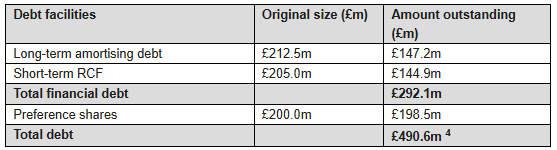
The company says its long-term debt is at fixed rates and is on track to be fully repaid by subsidy-linked project cash flows over time.
However, the floating-rate RCF will need to be managed using surplus cash or disposals, as far as I can see.
The preference shares are a little unusual – checking the annual report, the company has 200m of these with a fixed coupon of 4.75% (£9.5m annually). These cannot be redeemed before 2030.
Overall, I don’t think NESF’s debt situation looks unsustainable. However, my initial impression is that the higher level of gearing (and potential inflexibility of the preference shares) could carry some extra risk.
Roland’s view
Last year’s results show how difficult it is to predict exact cash flows from renewable energy assets. Over time, the broad trend may be correct, but it’s subject to regular disruptions. This is likely to increase as the proportion of unsubsidised assets in the market grows over time.
One way that NESF and others are mitigating this risk is by entering into more long-term power purchase agreements (PPAs) with large private sector customers such as industrial groups and data centre operators.
At the end of March 2025, 16% of NESF’s were subject to a long-term PPA. Deals such as these could support attractive and predictable cash flows from what are long-life assets – the average remaining lifetime of NESF’s assets is almost 25 years.
As an income investment, NESF has a decent track record over the last decade. The payout has never been cut and and it expects dividend cover to improve slightly this year, implying a 12% yield.
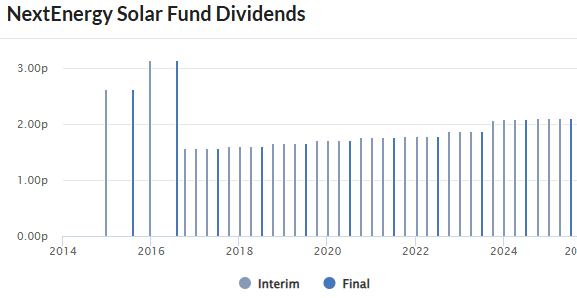
My concern would be that buybacks and disposals – while mathematically correct – equate to a slow-motion liquidation. NESF is already one of the smaller companies in this market and would ideally get larger, in my view. Consolidation might be one option, as we’ve been seeing among some smaller REITs.
The combination of small size and above-average gearing means I think the risks here are slightly higher than elsewhere. But with NESF trading 25% below book value and offering a covered 12% dividend yield, I think it could still be worth closer consideration for interested investors.
Disclaimer
This is not financial advice. Our content is intended to be used and must be used for information and education purposes only. Please read our disclaimer and terms and conditions to understand our obligations.

42 comments
I see 2 directors at Brickability (LON:BRCK) have sold 4m shares, hence the share price drop. Time to sell?
Why ? REVS8 just topped up https://www.stockopedia.com/co... and I'm holding on.
Maybe they know something? I have followed large director sales, in the past, which has saved me from falls. Profit warning at Ibstock (LON:IBST).
They still have big holdings - don't know their financial situation but could well be the case they have most of their wealth tied up in this company and want to diversify a bit. Would you want to have 90% of your portfolio in one share?
If I had inside information and I was happy with what I saw YES!
You can have all the inside info about the company, but ultimately a lot will depend on the macro and industry situation, especially for this sort of business.
I doubt he has 90% in Brickability (LON:BRCK) he sold over 10m in 2021 at 95p. This is the largest sale since then.
Brickability (LON:BRCK)
i wouldnt necessarily be selling - but lets be honest these are chunky share sales. this is the exact kind of company where management have much more information at their fingertips than we do. My slight worry here was how sustainable the profits would be at the units they acquired for lots of wonga - they were making boerdline ludicrous profit margins that one would expect would bring in more competition long term and wouldnt be sustainable.
PH still holds 16 mill despite 3 million sell - so i think perhaps in isolation this sale might be perhaps viewed as sensible diversification - but could this be the start of more selling to come ?
If PH has done very well from prior share sales and doesnt need the money as seems to have been suggested then timing isnt exactly great ref sale. Particularly if he made real wonga at higher price - if he doesnt need the money and has faith why is he selling at price others here think is dirt cheap.
I guess only time will tell here and even then reason for sale could be genuine.
Hot off the heels of our excellent Mello2025 event in Chiswick last week, tonight we will be hosting our first online MelloMonday of June.
We will have a keynote kick off the show, followed by three company presentations and all rounded off with our popular BASH panel.
The full line up is as follows (subject to minor change):
5:00pm Keynote interview with Gervais Williams
5:30pm Company Presentation from Artisanal Spirits (LON:ART)
6:00pm Company Presentation from IP (LON:IPO)
6.30pm Mello 2025 review and company news
6:40pm Company Presentation from Seraphim Space Investment Trust (LON:SSIT)
7:10pm BASH (Buy, Avoid, Sell, Hold) with Richard Crow the Cockney Rebel
You can register for our webinar here: https://www.melloevents.com/mm...
Use code: MMSTOCKO50 for 50% off tickets
Please note, if you are a shareholder for any of the companies above, you are entitled to a free ticket with code: SHFREE
David
Thanks Roland for the great analysis on NextEnergy Solar Fund (LON:NESF) which I hold , along with several others in the sector, but only because the double digit dividend yields are irresistible, and also the chance of sector consolidation.
These Renewable Energy Trusts are so difficult to understand (unlike the many mainstream Trusts and REITS) that I count them as punts and go with part stakes. Your explanations about NextEnergy Solar Fund (LON:NESF) today will help considerably in understanding the others a bit better too.
A good write-up Roland.
Renewable energy trusts have certainly had a terrible couple of years. I added more to NextEnergy Solar Fund (LON:NESF) when Helen Mahy became chair, but unfortunately she didn't last long and my average buy price is 80p. I suspect she left as a large merger transaction was not forthcoming - she merged MedicX Fund with PHP a few years back and was the chair at TRIG before times got more tricky. This solar fund is a solid but very average performer (6.3% per annum post IPO, is at least 1% lower than the best solar farms). I would like to see the valuation reductions turnaround. What with discount rate increases, various other net negative adjustments, a downward trending curve and an awful year for solar farms in 2024 the NAV has hopefully bottomed or close to bottoming. Disposals have been slow as well reflecting lack of demand. 2025 is turning out to be a record solar year to date and so will definitely be a tailwind in 2025 versus a headwind in 2024. This would have caused some of the revenue reduction along with asset disposals. Although gearing is high, the preference shares are long dated and only yield 4.75% with options to convert to equity in 2026. Excluding this, gearing is 30% which is not too bad. I suppose the investment case is is the 12% covered dividend and keeping the NAV at close to £1. It's the latter that the market has reservations on. You also need to watch the remaining asset life with ROC subsidies which is now only about 10 years, so these are ageing assets.
Best renewable trust is Greencoat UK Wind (LON:UKW) in my view. Best solar trust is Bluefield Solar Income Fund (LON:BSIF).
Not much comment on this board about AI.
A possible timeline:
2025: Gradual realisation of the impact of AI. Working groups set up to investigate.
2026: Large scale implementation of AI. Benefits not much greater than the costs of training and reorganisation, so the impact on profits is not substantial. Freeze on recruitment.
2027: Widespread redundancies and a sharp rise in profits.
2028: Very high unemployment, demands for Universal Basic Income. Most profits are earned virtually in the cloud. It is unclear where companies are located, making it difficult to tax these profits. Deflation in CPI, companies in competitive industries cut prices significantly.
I think that admin heavy companies like banks and insurance companies are going to be big benficiaries, also research companies like technology and pharmaceuticals. The losers would be property REITs and recruitment agencies. Likely that Canary Wharf will be a ghost town in a few years time.
According to Sam Altman of Open AI, the timeline above is far too slow. Most of the gurus suggest that the impact of AI will be substantial by the end of this year.
Worrying, but what can be done to ease the potential impact to all of us? Is it too late?
Worrying, but what can be done to ease the potential impact to all of us? Is it too late?
Well we will find a way wont we.
I was roundly riduculed on here a while back (by some) for suggesting that we could levy a tax or robots / ai etc - where there is a will there is a way - albeit our powers that be having the ability to be procative here should be a worry.
Remember i think at present something like 50% of people pay little in taxes - so if those people lose their job thats possibly not going to affect things to greatly ref taxes we generate
there is scope for doing something similar to china and using technology to make lives better - so we could invest spare peoples times in doing soemthing useful for society if they cant get job elsewhere - eg we will probably still have a huge shortgage ref carers ata reasonable price. Iyt would be nice if streets were clean and there was police presence in local communities with al areas being maintained to standard people paying council tax would hope.
Obviously fast changes quickly has potential to put many companies out of business quickly - so it should be a worry for us - who knows where that ends. Eg can soemone muscle in on what google do an put them out of business.
Its pretty easy to track payments made by people in the uk - at present we already let vast sum depart the country with much lower taxes being paid by said big boys - so taxing them new overseas vat and rate (based on sales) that bites is one very very simple way to go if one wants to look after uk entities paying proper taxes.
Does having spare office space and shortgage of living accomodation present huge structural problems - i have on simple solution here that probably doesnt even need to be mentioned its that obvious.
Many people say times are nothing like as good as they used to be - as someone who grew up in the 70's and 80's i think everyone i know has much better standard of living than back then - albeit some areas are not as nice as they were. strangely my local seaside town is in better nick than it was in the 90's - its annoying that successive governments havent done more to ensure reasonable enviorment for most - an obvious easy starter would be to tax empty buildings/land so that leaving it to go to rack and ruin and brining entire states down is not an option - if an reit cant fill a mall or sell it to somrone who can - hand it back to the council for them to make decent use of.
Interesting comments here.
Teaching in a university, we have an enormous problem with AI generated work. Students type in a target mark because they have learnt that otherwise the work is 'too good'. This shows the power it has, it does appear to create original work. We can argue what original means but didnt Newton say he stood on the shoulders of giants, so even a genius does incremental work.
Sam Altman obviously talks his own book, but he has been fairly accurate over the last 5 years. He knows what is in the lab now, which will be public at the end of this year.
Students are probably the cutting edge of AI - if nothing else its proving their ability to be adaptable if they use AI as much as possible without "cheating" (or getting caught if they chose to cheat) - how much work they put into that i know not. I remember at college with one particularly tricky programming task - 80% of students got deduction for plagarism including the poor bod who was clever enough to know what to do and told one or more people who must of told everyone else - at it was a very complex task. I seem to remember i needed help but wasnt silly enough just to copy what someone else did - most did though.
I guess the lazy one are more likely to stand out ref AI - although like everything else its an intelligence test to a certain degree - those that are talented will get away with it and those that struggle may look like they have ben lazy. Hopefully the clues are there for the dilligent marker
Personally i am amazed how far we have come in many respects since the 70's tehc wise and AI in particualr has come out of nowhere - albeit its reasonably obviuous toa certain degree its just brute force logic at work rather than true thinking. Then again with soem things we havent progressed as all - so probbaly enough for all sides here to be able to backup their viewpoint.
Personally i view automation AI as a good thing - i remember my mate used to load up and empty floppy disks by hand for a living on 12 hour shift not something you would want your worst enemy to do - not helped by his mate a qualified engineeer sleeping through most of the same shift when the machines were working.
If ever there was a tool to make communism work AI and automation is the dream really - perhaps one day one country will get rid of money and get that licked - output enough for country and simply give everyone decent basics and reward those that contributing to society by giving them the bonus perks. Hmmmm that always goes wrong in the films though doesnt it - no pleasing folk i guess.
Wouldn't that be a scary thought.... "Dynamic Benefits and Tax" from AI, as part of a communist society.
AI will analyse the data they have on a person - incomes, expenditures, living habits, social charity, usefulness to society... and decide what tax is right for you to pay, what benefits is right for you to get. Company tax will be assessed in the same way. "In AI we trust".
I mean, we have so much political wrangling right now on "who should pay what tax" and "who should get what benefits" and "its so unfair in this situation or that situation".
But wouldn't it be utopia if we can get the right level of taxation and benefits for everyone?
Or too much Big Brother? :)
Logical conclusion of this rather bleak forecast is that, collectively, many companies adopting AI substantially reduce their customer base, as they no longer have earned income to spend on the companies' goods and services. Suspect the future may not be as predicted in this forecast.
Every major technological advancement has been accompanied by predictions of permanent rises in unemployment. So far every one of those predictions has been wrong.
New technology does create dislocation, as old jobs disappear and new ones are created and those who can't bridge the gap end up losing out at the expense of those who are able to engage with it. How serious a dislocation that is will be interesting to see as, conceptually, you'd think the gap between a current job using IT technology and and working with AI ought to be less extreme than the introduction of IT in the first place.
No doubt there will be changes, although at the moment I spend half my time telling the AI that it's wrong ...timarr
You get a nice little essay if you type in "please outline a likely future timeline given the impact of ai from now to 2030, concentrating on the economy" and the story it tells aligns with yours.
I do not agree (did AI in the early 90s when neural networks were just starting to get interesting- but not that interesting). My dad gave me his copy of popular mechanix from the early 60s recently - indicating a future in the 80s where we have flying cars, home robots that do all the housework and fusion power. People make all sorts of predictions...
[Three quotes:
It's difficult to get a man to understand something when his salary depends on not understanding it. -Upton Sinclair (1934)
A map is not the territory - Alfred Korzybski (1931)
The future is already here – it's just not evenly distributed - William Gibson (1992?)]
...and asking an AI researcher about how important his (for it usually is) job is and how it will change the world for the better. In this place we tend to be cautious with people who talk their own book, I would suggest you apply the same view to what AI researchers proclaim, and write in articles / papers that are then stored & discussed on the internet and used as training data for LLMs, They want the next funding round to be an up round.
LLMs / RLMs basically predict the next response from the input and their neural network. As the models get larger and more 'recursive' (my term, probably wrong) they do get 'better' (as defined by various tests - usually mathematical and coding) and may well be at human level or above in some domains.
AI commentators tend to forget that a *lot* of people do not work in an office. AI may be able to optimise a delivery network. I do not think they will replace the DPD delivery man (builder / electrician / plumber / almost any job that is physical) any time soon (it will happen one day, just not for a long time)
They don't do that well outside in the real world. Tesla may claim autopilot is safer than a human driver but autopilot is mostly used on US highways 'motorways' - a controlled environment and this is a country where crossing the road at a place that is not marked as a crossing is illegal. A map is not the territory and I do not expect to see a driverless vehicle in a UK urban street any time soon.
I would add that ocado has been developing a robotic warehouse for the last 25 years and isnt quite there yet. Amazon uses people where they are cheaper that robots.
AI will do well in controlled environments. And in uncontrolled environments that AI can control.
I saw a youtube about 2021 (I think the video was earlier) on an american who had problems with squirrels. He connected a raspberry pi to a camera, added in some open source image recognition and taught it to recognise squirrels. He then bought a robot arm and a supersoaker. Connected it all up and the squirrels want away.
The future has been here for some time. Loitering AI guided munitions that target anything that looks like a human are cheap and are probably already out there and will control that uncontrolled environment. The only thing stopping this is human moral revulsion. That will not last.
AI should also do well on motorways (controlled environments - no humans, everything doing in the same direction in marked lanes) but probably not so much in roadworks / contraflows.
It should also do well as a support for some white collar jobs - but (at the moment) you still need a human in the loop to know if the answer is right and there is evidence that some supporting citations in support of AI generated legal documents do not exist. I think it is called 'hallucinations'.
Unsurprisingly, guy that runs large AI business says that AI is gonna be super powerful and take over the world
Panic if you want to, but I'm not stressing about it in the short to medium term. It is a useful productivity and learning tool currently and very misunderstood by the public in terms of how it works and how far the technology can go. It is just as likely to be peaking currently and there are lots of reasons it will be very hard to improve it much further.
Another breakthrough can happen of course but that's like worrying about quantum computing suddenly breaking the world order as we know it. Sure, it can happen and maybe some new world order would emerge if it did, but its not super likely any time soon and if it comes the world will adapt as it always has.
Thought this little comment from the CEO of NVDIA was of interest. I am no expert on AI, so found this surprising.
"U.K. has one of the richest AI communities anywhere on the planet. The deepest thinkers, the best universities—Oxford, Cambridge, Imperial College. Amazing startups. I ..The U.K. is the largest AI investment area anywhere else in the world. Between these two ideas that you are rich with great computer scientists, it is a fantastic place for VCs to invest. The ecosystem is really perfect for takeoff. It is just missing one thing. It is surprising. This is the largest AI ecosystem in the world without its own infrastructure, which is the reason why we are talking about it so much." – Nvidia ($NVDA ) CEO Jensen Huang
Wasn't this Jensen on stage with Keir trying to persuade him to pump money into AI? We are a great country for doing AI research but a terrible country to run the actual servers... Host them in the cheapest place you can find (we are perhaps the most expensive in the world)
Ask Ed Millibund why. Global leader in net zero and useless aircraft carriers.
Once we ruled the waves, now Dover is open season.
Guy who sells AI hardware tells UK that all we need to succeed is lots of AI hardware.
Perhaps someone should tell him about remote access.
Sounds like asking a barber if you need a haircut.
KKR has also held talks with Spectris (LON:SXS) and has now been given access to the same due diligence information as Advent. Anyone for a takeover battle? Possible happy days for Spectris holders.
Think this Q has been asked of others before - but why is NextEnergy Solar Fund (LON:NESF) on a buyback programme and not reducing debt?
Maybe plenty of debt puts the stopper on take-over bids?
I don't know the numbers, but one possibility is that it is seen as better value to buy back shares at a ~25% discount to NAV vs paying down debt at 3-5% interest (or whatever rate the debt facility is at. Also ignoring for now the reliability of that NAV, validity of buybacks as a general approach, etc etc)
NextEnergy Solar Fund (LON:NESF)
one possibility is that it is seen as better value to buy back shares at a ~25% discount to NAV vs paying down debt at 3-5% interest
Agreed, Tim. Not only do buybacks improve NAV per share (you are buying £1 of NAV for 75p) but also the shares yield just under 12% so you are saving those dividends on the shares you buy back. I have held NESF for a while, simply for income, and bought more recently as that yield seems to be sustainable (it is more than covered by cashflows) and is attractive if it can be maintained long-term.
I keep getting drawn to this type of share due to the big discounts to NAV and high dividend but then talk myself out of it. I "optimistically" think energy prices have to start coming down in the UK at some point. The historic accounts are also very choppy, simple things like Revenue (massively up and down every year for NESF), the only stable metric is free cash flow which tends to be good and is attractive to me. Does anyone have any insights in how to best evaluate this category of investment?
NextEnergy Solar Fund (LON:NESF)
Does anyone have any insights in how to best evaluate this category of investment?
Free cash flow is surely the correct metric? You have 20+ years of future production from solar panels that don't require much maintenance capex so it's all about (a) your entry price, (b) the future path of electricity prices and (c) what discount rate you use - linked to future expectations of inflation. That's how I look at it. It's a stable business: the sun will reliably rise every morning and society will need electricity for the foreseeable future.
NextEnergy Solar Fund (LON:NESF) Thanks for all these comments but another Q. - How/why has the income generated decreased from £80m to £73m - there's no explanation given as far as I can see.
Grime and lichen on the panels surfaces?
And Unicorn droppings.
With Rockhopper Exploration (LON:RKH) we could wipe out the national debt, make industry competitive and all in a land “far, far away -so politically and environmentally out of sight and mind.
Perhaps Shell (LON:SHEL) will buy them and move operations to the US.
In meantime I’m watching silver as goes into all these Chinese solar panels.
'24 was a grey overcast year with less sunshine than usual - unlike '25. This years figures should reflect that increase in the hours of sunshine
Once the sun zealots move on from net zero they will figure out its water that sustains life. Plants eat CO2 so water and sun good - zealots bad.
Possibly because they are disposing of revenue generating assets to reduce the debt and pay divs?
Good read across for Cavendish (LON:CAV) from Peel Hunt (LON:PEEL) today. Outlook:
"Following the challenging market conditions of February and March, FY26 has started more positively, with the Trump administration agreeing a number of trade deals, including with the UK, and with interest rates having been cut by the Bank of England. We are seeing a rotation out of US assets into Europe and greater institutional positivity towards the UK. ECM activity in the UK remains generally subdued but could gain traction should macroeconomic conditions continue to stabilise. Meanwhile our M&A franchise remains highly active with a strong pipeline of transactions."
Peel CEO was on Today programme (c. 7.20am) pointing out that 30 companies had exited the UK stock market over the past year but we haven't had 30 IPOs. Not great for us private investors.
There is the still the existential question for both Cavendish (LON:CAV) and Peel Hunt (LON:PEEL) about IPOs, and stable/growing number of listed companies.
Peel Hunt is expanding to Abu Dhabi. Cavendish expanded to Manchester...
There is, at least, a very buoyant secondary fundraising market, as well as debt restructuring and private market still, that Cavendish reported on in its last update.
Furthermore, I see Cavendish have increased their headcount by about 4-8% over the past 6 months, and they were the ones with a bit more cost discipline in their latest results, so this maybe signals there is demand in some areas of business, just not in IPOs yet.
Cavendish's share price has already recovered 20-30% from its lows earlier this year. So the market is pricing in some earnings recovery already...
But my price target here is well north of 20p from the 11p currently, so I continue to hold.