Daily Stock Market Report (Thur 13 Mar 2025) - Pension news, VANL, IGG, ESYS, FAN, GMS, OSB, GEMD, STB, CABP, DFS, RST

Good morning! Thanks for all the positive feedback on yesterday's report. Today's Agenda is now complete.
1pm: wrapping up for now, thank you.
Companies Reporting
| Name (Mkt Cap) | RNS | Summary | Our view (Author) |
|---|---|---|---|
Halma (LON:HLMA) (£10.0bn) | TU | Adj. EBIT margin for FY March 2025 now expected above 21% (prev: “around 21%”). | |
IG group (LON:IGG) (£3.2bn) | Q3 TU | Trading rev +15% year-on-year, driven by higher rev/client. Confident of meeting exps. | GREEN (Graham holds) A pleasing update with revenue growth flowing from positive market conditions - there are plenty of reasons for customers to want to trade in this environment. Against that, customer numbers aren't growing much. A new buyback could be announced after the balance sheet is adjusted, leading to further share count reduction. |
Deliveroo (LON:ROO) (£1.82bn) | Preliminary Results | Robust top line, adj. EBITDA at top end of guidance. Outlook: high single digit growth. | |
Osb (LON:OSB) (£1.55bn) | Preliminary Results | Adj. PBT +4%, actual PBT +12% (£418m). £100m buyback. 2025: low single digit loan book growth. | GREEN (Graham) I tend to be positive on cheap lenders in this environment, and can find few reasons not to be positive on OSB at this valuation. It's going to buy back some shares very cheaply using only a fraction of post-tax profits, while also paying a well-covered dividend. |
Savills (LON:SVS) (£1.43bn) | Final Results | Rev +7%, adj.PBT +38% (£130m). 2025: most markets in recovery. Expects refinancing-driven activity. | |
Allianz Technology Trust (LON:ATT) (£1.40bn) | Final Results | NAV +35.6%, behind benchmark. Avoided excessive concentration risk. Discount narrowed to 8.6%. | |
Trainline (LON:TRN) (£1.39bn) | TU | FY Feb 2025: rev +12%. EBITDA margin: marginally ahead of guidance. New £75m buyback. | |
Volution (LON:FAN) (£1.03bn) | HY Results | Rev +4% organic. PBT -11.3% due to non-underlying costs. Outlook: ahead of consensus. | AMBER/GREEN (Graham) [no section below] The SP is up 30% since we looked at it last year. The company has "good momentum" going into H2 with structural growth drivers that include tightening building regs, demand for quality indoor air, and the need to reduce energy costs. With earnings for FY July 2025 trending ahead of consensus (30.4p), I think the current-year PER is likely to be c. 18x. Organic revenue growth is modest at 4%, and I note a large gap between statutory and adjusted earnings, due to acquisition activity. Acquisitions have resulted in net debt of nearly £190m and a higher leverage multiple of 1.5x, and the balance sheet now has deeply negative tangible equity. I think a more cautious stance may be justified, as risk levels have increased. |
Bridgepoint (LON:BPT) (£2.86b) | Final Results | Pro forma underlying income +52% (£404m). PBT £93m. Upgraded fundraising guidance. | |
Glenveagh Properties (LON:GLV) (£676m) | Final Results | Completions +77%, rev +43% (€869m). ROE 14.2%. Outlook: “exceptionally strong”. | |
Alfa Financial Software Holdings (LON:ALFA) (£660m) | Full Year Results | Rev +8%, PBT +15%. Outlook: record level of TCV (total contract value), expects mid-teens growth. | |
C&C (LON:CCR) (£599m) | TU | PW. FY26: expect continued consumer uncertainty. Earnings to be marginally ahead of FY25. | |
Empiric Student Property (LON:ESP) (£556m) | Preliminary Results | EPS +5%. NTA per share 120.7p (share price: 83p). Outlook: like-for-like rental growth 5%. | |
Care REIT (LON:CRT) (£448m) | Annual Results | Contracted annual rent roll +5.3% (£51.4m). Cannot raise more capital to achieve potential. | PINK (108p offer) |
DFS Furniture (LON:DFS) (£303m) | Interim Results | Underlying PBT doubles to £17m. Margin improvements. Expects to outperform consensus exps. | RED (Mark)[No section below] |
Restore (LON:RST) (£290m) | FY Results & Acquisition | Rev -1%, adj. PBT +14%. Trading since the start of the year has been good. £22m acquisition. | AMBER/GREEN (Mark) [No section below] |
Gulf Marine Services (LON:GMS) (£176m) | Contract | 2 vessels, 3-yr contract extensions in the Middle East at enhanced rates. | GREEN (Mark) |
Cab Payments Holdings (LON:CABP) (£136m) | FY 24 Results | Volumes +7%. £16m adj. PAT, in line. Executing well against 2025 plan, expecting income growth. | AMBER (Mark) [No section below] |
Secure Trust Bank (LON:STB) (£79m) | Final Results | SP up 19% to 500p They have generated an adj. PBT of £39m in 2024. After both taxes and exceptional items, profit for the year is nearly £20m. Profits grew before impairments. Confident in medium-term targets. | AMBER/GREEN (Graham) [no section below] |
Van Elle Holdings (LON:VANL) (£42m) | TU | PW - u/l PBT for 25H2 to be similar H1 due to delays in Canada & UK Building Safety Act | BLACK (AMBER/GREEN) (Mark - I hold) |
essensys (LON:ESYS) (£24m) | Half year Results | Rev -11%, +ve EBITDA, ARR -16%, EPS -3p, Net cash £2.2m (£3.5m) | AMBER/RED (Mark) |
Gem Diamonds (LON:GEMD) (£13m) | FY Results | Rev +9.9% to $154.2m, Att. Profit £2.9m (FY23 $2.1m loss). Net debt $7.3m (FY23 $21.3m). | AMBER/RED (Mark) |
Graham's Section
IG group (LON:IGG)
Up 4% to 966p (£3.4bn) - Third Quarter Revenue Update - Graham - GREEN
At the time of publication, Graham has a long position in IGG.
The punchline from today’s update is that IGG “remains confident of meeting FY25 consensus” when it comes to revenue and adjusted PBT.
The company hopefully includes in the RNS that revenue consensus is £1,027 million and adjusted PBT consensus is £494m.
As for progress in Q3, we learn the following:
Revenue +12% on prior year to £268m, driven by a 15% increase in trading revenue and offset by a 7% reduction in net interest income.
The trading revenue benefited from “stronger trading conditions which increased revenue per client”. Active clients grew by just 2% year-on-year to 328,0900.
Net interest income fell due to lower interest rates and stable client money balances (£3.8 billion as of Feb 2025).
There was some nice growth at US subsidiary tastytrade which saw Q3 trading revenue up 30% year-on-year to $50.9m (reported in GBP as £40.8m).
Freetrade acquisition: we discussed this in January. IG informs us that Freetrade has continued to trade well, and in line with expectations. The takeover is expected to close in April 2025.
Share buyback: there is an ongoing £200m buyback to be completed in FY May 2025. IG are now seeking to adjust their balance sheet - to reduce their “premium account” and “merger reserve” - so that more of their equity will be classified as retained earnings. This would give them more flexibility, and could lead to more capital being returned to shareholders.
Checking the interim balance sheet I see that there was £125m in “share capital and share premium” and £590m in “merger reserve”. So that’s a lot of capital that could potentially be unlocked.
I also note from the interim report that they had “£658m of headroom over the Group minimum regulatory capital requirement”.
So I don’t think it’s a stretch to envisage hundreds of millions of pounds being unlocked for more dividends and buybacks - or it could equally be used for M&A/investment opportunities.
Graham’s view
I’m a broken record here and when it comes to this sector as a whole. I am now consistently GREEN on IGG, PLUS and CMCX. IGG has been in my personal portfolio for years, and was in other portfolios I managed for years prior to that.
Stockopedia’s calculations agree with my assessment, viewing it as a Super Stock. It’s not every day that you see a QualityRank of 100:
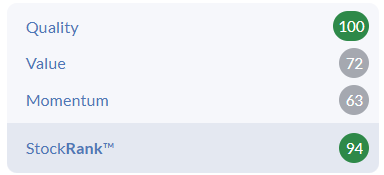
Usually with a high QualityRank, there is a catch such as low growth. IG’s growth doesn’t happen in a straight line - it ebbs and flows with trading activity in the financial markets. But the overall trajectory is clear enough.

It’s a market leader with a trusted and broadly recognised brand, and yet it trades at a modest earnings multiple:
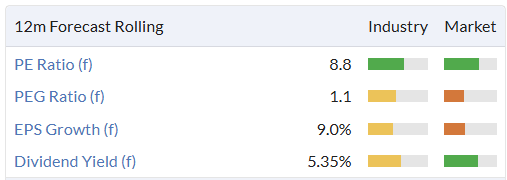
The cherry on top is that the share count has been reducing as excess cash flow has been directed to buybacks.
I’m still quite sceptical of the $1 billion tastytrade acquisition in 2021, which resulted in the creation of 61 million new shares.
However, buybacks in the last three years have taken the share count back below where it was prior to the acquisition, and the share count looks set to fall further still. Meanwhile, tastytrade has been growing well.
IG is currently 13% of my personal portfolio.
In the interest of balance, some risks faced by the company include:
Competition from aggressive rivals (when it comes to their marketing) such as CFD broker Plus500 (LON:PLUS).
A fresh round of regulatory intervention is always a possibility.
Quieter market conditions will produce a revenue decline, especially if there has been no substantial growth in customer numbers.
The expansion into a variety of new product categories brings potential risks.
Osb (LON:OSB)
Up 2% to 429p (£1.59bn) - Preliminary Results - Graham - GREEN
OSB GROUP PLC (OSBG or the Group), the specialist lending and retail savings group, announces today its results for the year ended 31 December 2024.
OSB is “focused on carefully selected sub-segments of the mortgage market such as Buy to Let, Residential, complex commercial and semi-commercial, development finance, bridging and asset finance”.
They are “predominantly funded by retail deposits sourced through our Kent Reliance and Charter Savings Bank franchises”.
Some highlights from today’s results:
Underlying PBT +4% to £442m
Statutory PBT +12% to £418m
Most KPIs and key numbers have moved negatively, for example:
The loan book fell slightly due to a securitisation in December.
The net interest margin also reduced slightly due to lower mortgage spreads over the Sterling interest rate benchmark.
And the company's cost to income ratio rose due to “continued investment in the transformation programme, redundancy costs and the new Bank of England levy”.
More positively, the loan loss ratios (a measure of the impairment charge as a percentage of total loans) fell dramatically, due to higher house price expectations.
CET1 ratio: this key measure of safety has increased slightly to 16.1%, which I think is slightly higher than the banking sector as a whole.
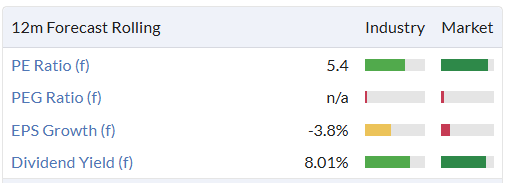
Share buyback: there will be a new £100m buyback over the next twelve months. I can’t argue against this given the CET1 ratio. It’s only a fraction of statutory PBT and it will lead to share purchases at a very cheap earnings multiple:
CEO comment notes that 2024 was the second year of a five-year transformation programme.
Outlook
I appreciate the clear guidance. There is little growth baked into forecasts but I guess at a PER of less than 6x this is to be expected!
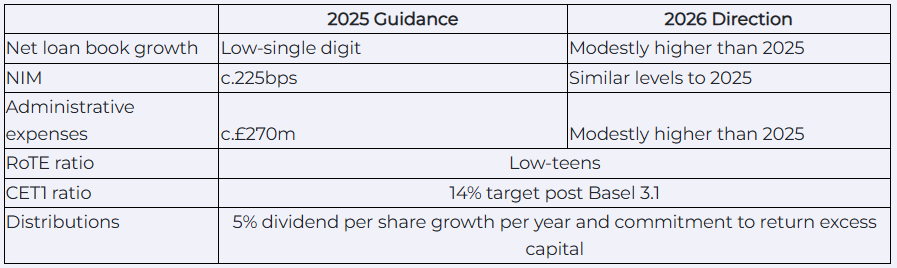
The company also provides a list of medium-term aspirations for 2027-2029 which I recommend checking out. The main point for me is that the company is targeting RoTE (return on tangible equity) of mid-teens, rather than the low-teens expected in 2025-2026.
Graham’s view
I don’t study this one frequently but based on a review this morning I see little to dislike.
The results for this year are pretty clean, without excessive adjustments.
The balance sheet has shareholders’ funds (i.e. net assets) of £2.2 billion, almost fully tangible. It’s no surprise in this environment that the market cap would offer a substantial discount to that figure.
At this sort of valuation, I would personally be happy with a RoTE of over 10%, let alone in the low-teens or mid-teens. So I don’t think the company even needs to hit its targets to justify the current share price.
I’ll stick my neck out and give this a GREEN.
Out of £28 billion in liabilities, nearly £24bn in is the form of retail depositors. Perhaps that is one niggle worth mentioning - a very large reliance on deposit funding.
And from a macro point of view, any major problems in the buy-to-let sector will be felt at OSB.
Mark's Section
There seems to be an increasing focus on pensions recently, with Norcros (LON:NXR) announcing the outcome to their 2024 triennial review this morning:
The 1 April 2024 valuation has now been agreed, subject to completion of the formal documentation, with the prior actuarial deficit from April 2021 of £36.0m being updated to an actuarial deficit of £11.7m on a technical provision basis, representing a funding level of 96%.
This is good news, but it is worth noting that this doesn’t have any impact on the short-term contributions:
The schedule of cash contributions to June 2027 of £3.8m per annum (indexed by CPI) that was agreed in the 2021 valuation, will continue.
The reduction is after June 2027 and will be paid into escrow. This is because once cash contributions are made into a scheme, it is almost impossible to get a surplus, should it arise, back out. Whether these more positive conditions continue really depends on interest rates. If these fall, then deficits may rise again, which is why many companies are keen to get a buyout, where possible. A buyout also removes the need for the company to pay the scheme administration fees, which can be significant and last as long as the scheme does. Here, Norcros say:
Cash contributions post June 2027 are expected to be less than c.£1m per annum and will only be paid to the extent that asset performance or any escrow funds do not cover ongoing scheme administration fees.
Investors need to be careful when analysing companies with deficits. These often don’t appear on the balance sheet due to more favourable assumptions under IFRS accounting standards. It is the more cautious triennial valuation that determines the cash contributions, and investors need to look at the cash flow statement to understand the real situation for shareholders (for whom that cash goes permanently out of their pockets and into the pension scheme).
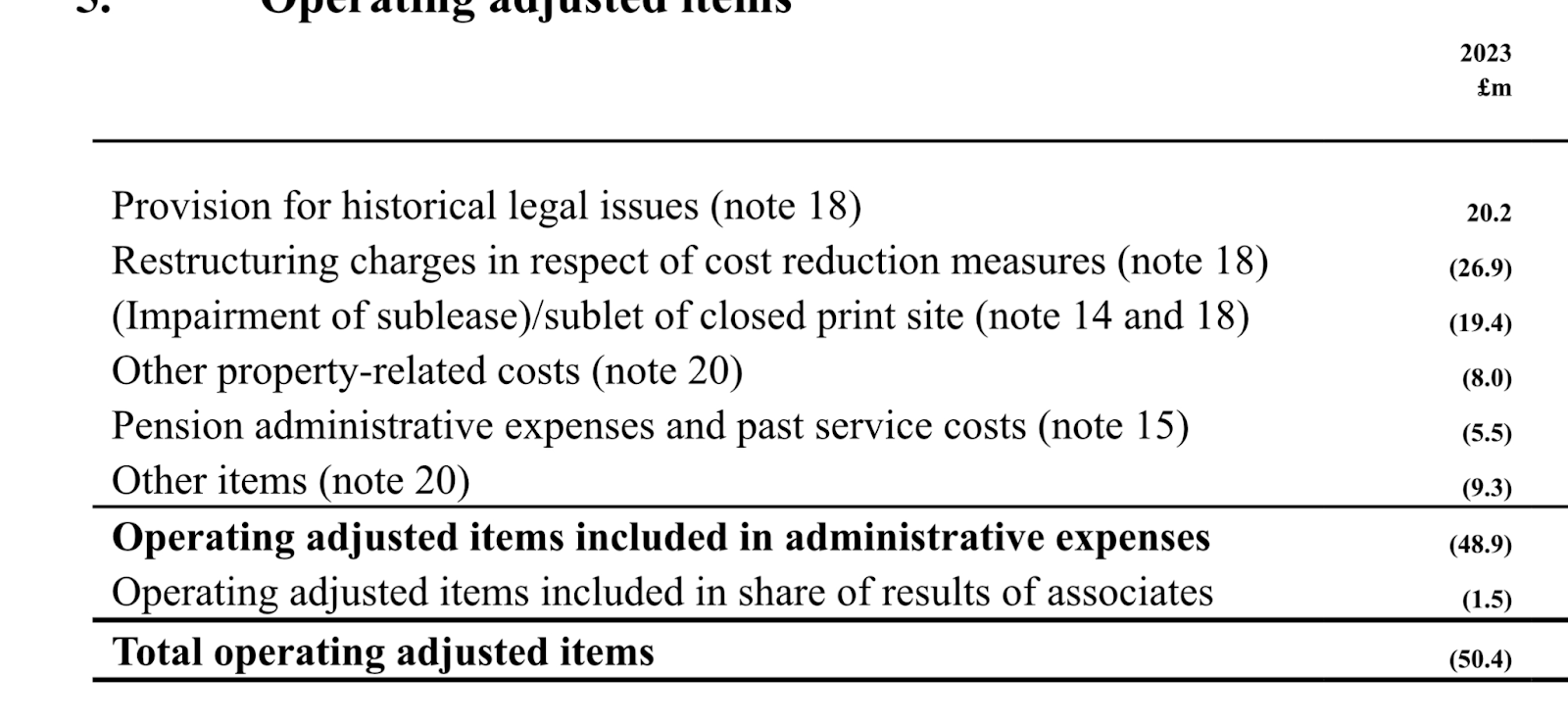
Many companies like to exclude pension administration charges from the adjusted results, despite these being cash costs borne by the company and ongoing in nature. For example, Reach (LON:RCH) in the last annual results adjusted out £5.5m of admin and past-service costs:
Reach have also had what appears to be an ongoing dispute with their pension trustee. With the last set of FY results, they announced that:
After a number of years, the 2019 and 2022 Pension Triennial valuations are concluded. There is an agreed pathway to fully funding the schemes and from 2028 pension commitments are expected to reduce by c.£40m(1)
However, cash contributions to the scheme before 2028 actually went up, and there will be a further assessment before 2028. This week, The Times, reports that
The Pensions Regulator (TPR) revealed that it had to resort to threats of enforcement action, which includes fines and criminal prosecution powers, to force Reach plc, which now owns the Mirror, to lift its payments to the scheme to help fill the shortfall in its funding position.
This is what the Pension Regulator said:
Through negotiation, we were able to help facilitate the trustee and company to reach a mutually acceptable solution without the formal use of our powers. The final agreement included making significant improvements in the deficit recovery schedule with the financial support of the wider group, and improving an existing dividend sharing agreement whereby amounts above a certain percentage increase in dividend distributions will result in a sum matching the excess dividend increase being made to the scheme.
Our intervention, through working with Reach Plc and the trustee, resulted in the scheme receiving an additional £5.1 million per annum from the company, backdated to the start of 2023, which will be paid every year until the end of January 2028. The scheme is expected to be fully funded on its prudent technical provisions basis by January 2028.
Although they didn’t have to use their legal powers, the regulator has real teeth and has forced Reach to pay an extra £25.5m into the pension fund that the company appeared reluctant to do. Investors should be very wary of any delays in agreeing on triennial recovery payments. Such delays are likely to prove bad news for shareholder returns.
Graham adds: there was an interesting announcement from the government in January which expressed an intention to unlock the surplus funds in defined benefit pension schemes. In particular, pension trustees could agree to share a portion of their surplus with sponsoring employers, to enable the employer to reinvest in their core business. The employer will have no access to the surplus without the consent of the trustees, but it seems increasingly likely that an element of the surplus funds at some schemes could make their way back to them. The ownership of pension surpluses is a complex legal topic! Perhaps it will be adjusted back slightly in favour of the employer.
Van Elle Holdings (LON:VANL)
Down 18% to 31.5p - Trading Update - Mark (I hold) - BLACK AMBER/GREEN
It is a profits warning from this ground engineering contractor:
…the Board now expects underlying profit before tax for the second half of FY25 to be similar to the first half.
Their broker Zeus reveals what this means:
Zeus forecast revenue for FY25 is reduced by 6.1% to £137.3m and underlying PBT is reduced by 32.6% to £4.0m, implying an even 50:50 split between H1 and H2 2025 PBT.
The blame is put on two areas. Firstly, delays caused by Building Safety Act approvals in their Rock & alluvium subsiduary. Although they say that overall UK operations are only slightly below expectations. So it seems the bulk of the issues appear to be with delays in Canada:
Van Elle Canada Inc. has experienced further delays as a strategic supply partner to the major infrastructure upgrade programme for the Toronto rail network. As a consequence of these delays, the division's trading performance will now be weaker than initially anticipated. Van Elle has developed a solid track record locally in Canada and has secured several key frameworks throughout FY24 and FY25 which have created several attractive medium-term opportunities. With the near-term uncertainty around the timing of key investment programmes, the Board is reviewing its strategic options with respect to its operations in Canada.
The move into Canada is sounding increasingly like a mistake. It has incurred significant start-up costs and appears to have not yet delivered meaningful profitability. They now appear to be considering selling or exiting the business, which would be embarrassing.
The downgrades Zeus makes for future years are far less severe:
Due to the current challenging market conditions, we reduce FY26 revenue by 5% to £153.3m and underlying PBT by 7.5% to £7.0m. FY27 PBT is also reduced by 4.0% to £9.2m. FY27 estimates still show Van Elle hitting its medium-term financial objectives of 5-10% revenue growth, 6-7% underlying EBIT margin and 15-20% ROCE.
This puts them on an FY27 P/E of around 5 following today’s fall, which makes them cheap if you believe the forecasts. However, after this warning, it will take some time to build confidence that management have a handle on things. Perhaps the biggest embarrassment is that the much larger geotechnical groundworker, Keller, have been continuously upgrading forecasts during this period:
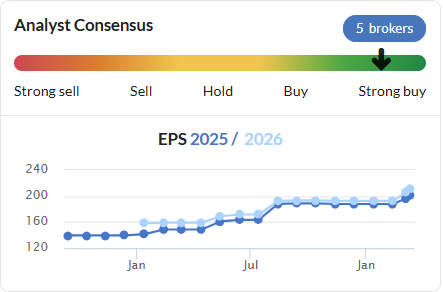
This difference in performance is why Keller trade on a P/TBV of 2 compared to around 0.6 for Van Elle. The company is taking steps to improve the productivity of its assets, but this appears to be taking the form of selling off under-utilised equipment rather than improving utilisation:
In light of the trading pressures the Group is facing, there is an acute focus on careful working capital management and aligning its cost base to drive operating efficiencies. Additionally, the Group has disposed of certain non-core assets in support of a robust balance sheet and its objective of improving ROCE.
Given the recent performance, shareholders (of which I am one) may prefer that they sell the whole business to someone who can better use the assets. The shouts for this from the more activist shareholders on the register may be getting louder today.
Mark’s View
Paul, Graham, Roland and I have all rated this GREEN over the last year. However, Roland rightly expressed concerns over the H2-weighting implied by the H1 results. Despite the low forward rating and discount to TBV, it feels like this profits warning should downgrade this to AMBER/GREEN. It may well prove to be a blip caused by understandable delays, but the gap between trading here and the likes of Keller opens the possibility that the issues are more serious.
essensys (LON:ESYS)
Down 2% to 36p - HY Results - Mark - AMBER/RED
The main headline at this flexible workplace technology provider is that they have returned to positive EBITDA. However, the other metrics are going the wrong way:
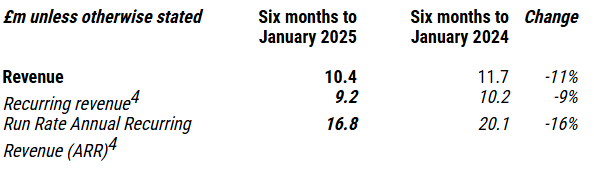
The reason given is the previously flagged downsizing of a large strategic customer. The company would prefer we ignore this in comparisons, but I don’t see why this should be treated any differently. Like many companies, their revenue appears to be recurring, until it isn’t.
The EBITDA improvement comes from cost-cutting:
Operating expenses decreased to £5.3m, a reduction of £2.2m (29%) compared to the prior year. This reduction was driven by the Group reorganisation, which began at the end of H1 23 and completed in H1 24 and reflects the strong emphasis on cost management and operational simplification in the business.
However, it is worth noting that EBITDA is not a useful measure of performance for a company that capitalises intangibles:
The Group continues to invest in product development in the UK. Where such work is expected to result in future revenue, costs incurred that meet the definition of software development in accordance with IAS38, Intangible Assets, are capitalised in the statement of financial position. During the half year, the Group capitalised £1.1m in respect of software development (H1 24: £1.1m), as it continued to invest in its products.
Capitalisation is running behind amortisation, which helps cash flow, but at a time when a company is cutting costs, it may represent them putting a brake on development to conserve cash. The balance sheet doesn’t look too bad for this sort of company, although there is no real tangible asset backing. Cash burn during the half was around £1m. They claim their cash is enough to see them through to cash flow breakeven:
Cash at the half year end was £2.2m (H1 24: £3.5m). Cash outflows in H1 25 amounted to £0.9m, compared to £4.4m in H1 24. This was supported by tax credits in respect of R&D activities received in H1 25 of £0.9m. Management expect cash burn to reduce further in H2 25, as we optimise our Cloud costs. The Group continues to maintain sufficient cash reserves to fund its working capital requirements and its return to cash generating operations. Excluding leases, the Group has no debt and has an existing undrawn £2m loan facility committed until 31 July 2025.
But this would seem to assume further cost-cutting. It may be that the management changes also announced today could lead to a change of strategic direction and improved trading:
Chief Executive Officer succession
· As announced separately today and as part of a planned succession, Mark Furness has decided to retire as Chief Executive Officer, after founding essensys in 2006 and leading the business since launch
· Mark will remain on the Board of the Company and will move to a new role as a non-executive director of essensys with effect from 1 May 2025
· James Lowery, Chief Operating Officer, will take over as Chief Executive Officer on 1 May 2025
However, given this is an internal appointment, it seems that muddling along will most likely be the future course.
Mark’s view
It seems as though the company finds itself between a rock and a hard place. They have been unable to grow revenue, which is forecast to be at similar levels to 2019 in the future:
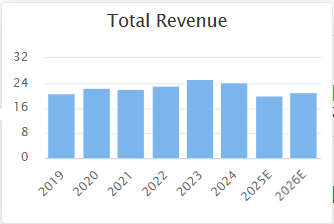
Cost cutting has stemmed the cash burn but perhaps at the expense of being able to invest in sales or product development. This means that flat revenue and continued small accounting losses appears to be the most likely future for the business. As such a £24m market cap seems very hard to justify. AMBER/RED.
Gulf Marine Services (LON:GMS)
Up 6% to 17.5p - Contract - Mark - GREEN
A short update from this marine vessel operator to say that two of its vessels have had 3-yr contract extensions. The most important part is that these were “secured at enhanced rates”. However, it would have been nice to get more details on how enhanced these were.
The issue is that the company is highly cash-generative at the moment because they have a high depreciation charge but are not investing capital into growing their fleet. With a Return on Assets of only around 6%, we are still at the point of the cycle where investing in new ships looks uneconomic based on current rates. So, the strategy of running the existing fleet and using the cash to pay down debt looks the right one. However, at some point, management will need to make a decision - are they going to invest again into growing the fleet, or are they just going to run the existing fleet until the ships eventually become uneconomic to operate? These are relatively long-life assets, so you feel that shareholders would probably prefer the latter, especially if the cash generation ends up as dividends instead of debt reduction. However, management teams don’t tend to like running declining businesses, and the temptation must be to re-invest that capital into growing the fleet at some point in the future. Shipping is a highly cyclical industry, and management teams have a tendency to invest at exactly the wrong point in the cycle, which is how Gulf Marine Services originally ended up with a large new fleet of ships funded by debt just as rates collapsed.
Mark’s view
Roland rated this GREEN following their recent re-financing, and with enhanced (although unquantified) rates agreed today, I see little reason to change that rating. The low P/E and discount to TBV mean that there is potential value here as rates continue to strengthen. However, what stops me from owning the shares is the uncertainty over whether rates will ever get back to levels that make the assets productive enough to justify a premium to TBV and, if they do, whether management will suddenly discover a desire to add to the fleet rather than pay down debt and make returns to shareholders.
Gem Diamonds (LON:GEMD)
Flat at 9.6p - FY Results - Mark - AMBER/RED
It seems a modest recovery here with weaker production offset by higher value per carat received:
· Carats recovered of 105 012 (109 656 carats in 2023)
· Waste tonnes mined of 5.4 million tonnes (8.8 million tonnes in 2023)
· Ore treated of 5.0 million tonnes (5.0 million tonnes in 2023)
· Average value of US$1 390 per carat achieved (US$1 334 in 2023)
· The highest dollar per carat achieved for a white rough diamond during the year was US$41 007 per carat
This has always been a business highly dependent on a few large, high-value diamonds, which makes results quite variable. However, this year, this has produced profits and a reduction in debt:
· Revenue of US$154.2 million (US$140.3 million in 2023)
· Underlying EBITDA of US$29.7 million (US$15.2 million in 2023)
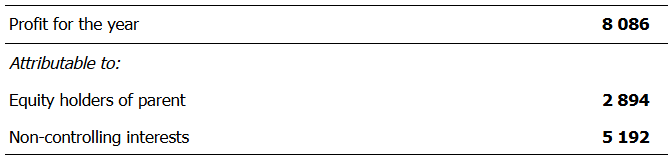
· Profit for the year of US$8.1 million (US$1.6 million in 2023)
· Attributable profit of US$2.9 million (loss of US$2.1 million in 2023)
· Earnings per share of 2.1 US cents (loss per share of 1.5 US cents in 2023)
· Net debt of US$7.3 million as at 31 December 2024 (2023: net debt of US$21.3 million)
The difference between profit and attributable profit is because, as well as a royalty expense, the government of Lesotho holds a minority interest:
The other complexity is that they capitilise and amortise their waste-stripping:
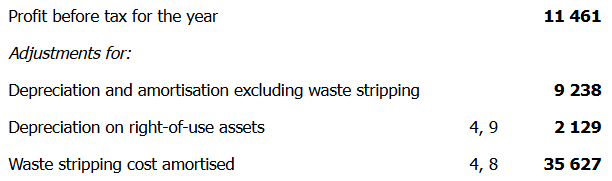
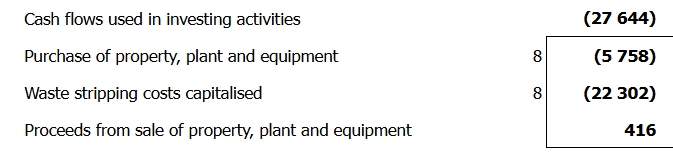
In this case, the debt reduction is almost entirely due to reduced waste stripping. This may be due to the decision to use steeper slopes, and may be a permanent shift. However, it may also indicate the company is taking short-term actions at the expense of long-term ones.
The fundamental problem with this business, is that it has been unable to make consistent returns to shareholders:
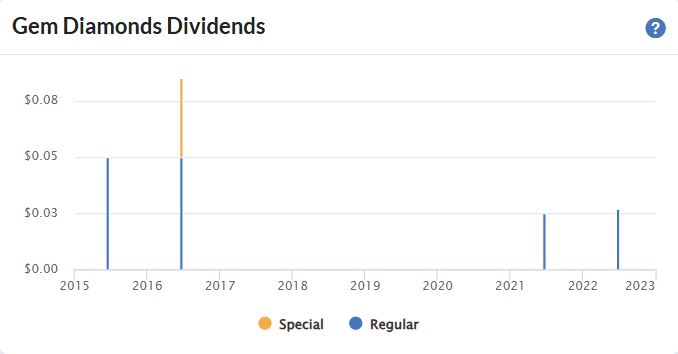
This doesn’t appear to be about to change in the short term either:
The Board is not proposing a dividend based on the 2024 financial results due to the volatility in the current macro-economic outlook, the expected impact thereof on the diamond market, the Group's available cash resources, and the medium-term business outlook with the implementation of Letšeng's updated mine plan, which will result in higher-value Satellite Pipe ore only being accessible from the end of 2029.
Mark’s view
The few dividends it has been able to pay in the good years don’t make up for the bad. In the meantime, it is running a large mining operation almost entirely for the benefit of other stakeholders. That may well be the right thing to do, but it doesn’t make it a business I want to be an equity holder in, especially as mining assets tend to have limited operational lives. AMBER/RED.
Disclaimer
This is not financial advice. Our content is intended to be used and must be used for information and education purposes only. Please read our disclaimer and terms and conditions to understand our obligations.

58 comments
FWIW I completely agree with Graham on Volution (LON:FAN)
If I was in charge I'd be considering a raise at these prices of about a 10% increase in shares. This would knock a big hole in debt and leave it with an easily manageable amount. I might feel differently if they were at 3 or 4 pound but if they could get it away at £5.60 I think it would put them on a really solid footing.
Or they could cut the divi but I think that would hit the price harder than a raise. They probably don't need to do either if nothing goes wrong but risk is up.
The best roll ups happen when cash flows fund them.
I hold.
Kitwave (LON:KITW) down 5% today, another 52xweek low. Crazy. Forward PE of 7
Ex-div today
Ex div yes but down more than 7.5p
There has been some director buying recently at Kitwave (LON:KITW)
Van Elle Holdings (LON:VANL) my main concern is Canada, if the tariffs continue on steel/Aluminium, then this could affect their economy enough, to cause delays in major Govt contracts. Think about 80% of their steel goes to the US.
Another day, more small caps dropping.
Been considering last few months the wisdom of stock picking anymore. Only been investing a few years and I have a long time horizon ahead, but an index fund is the easier place to go. My US index fund has trounced my ISA, might not always be the case I know.
Apologies for negative post, just thinking aloud!
This year, my US folio is much worse than my UK folio, l'm talking about 10% worse. Yes up to end of last year, the US folio was way ahead, over 2 years.
Problem is the US have elected Trump.
Things could get a lot worse, we are not in a recession yet or it could all blow over. Trade wars won't help anyone.
Rusty2
Portfolios (usually) hits the troughs before recession and bounces back once trade war and the recession have arrived.
The experience of lockdowns during Covid is the evidence.
Markets fell before each lockdowns and rose during the lockdowns!
Yes markets slump before the recession starts but "On average, the U.S. stock market peaks five months before the start of a recession", the peak was only about 3 weeks.
So we could have a way to go. Markets have not fallen that much yet.
I share your frustrations, but I am heartened by the sound analysis and views of the stockopedia team backed up by the experienced members whose insights help an amateur like me avoid the rocks , except where I have rush of blood and press the buy button before taking a much needed breathe
I suspect the Trump factor is helping those like IG group (LON:IGG) who trade on volatility
IGG This is quite an overlooked company, I think. Its EPS has more than doubled over 9 years, pays a healthy dividend, has good returns on capital, is not indebted and is trading on a P/FCF of 5.7.
I hold. Let's see if Graham gives it a Green. I'm feeling lucky.
Van Elle Holdings (LON:VANL) I have just had to try to buy on the barclays platform around 15 times to put through a small order for £1000 and £2000 at around 08.20 today, it wouldnt sell me £3K as a single trade hardly big bucks. It seems to me that something is up like the professionals are getting first dibs on open when they were heavily marked down. You have to feel hard done by dont you.
Yet another company coming up
Now l can only buy Van Elle Holdings (LON:VANL) and not sell, even small amounts around £500.
Last time I checked Van Elle Holdings (LON:VANL) they were selling at a tad over 33p. Progressive have earnings for FY25 and FY26 of 2.9p and 4.9p respectively.
The market is pretty discombobulated at present so who knows where share prices are going.
I picked up 9k at circa 31.5p on the bell and 6k at 32ish
Nothing else to buy
Could sell up to 50k very easy
In a nutshell the mr market and the market Makers were trying to tree shake the price down
The sell price offered was 30 then 31 then 32
You could then see these shares appearing on the market .
Its just market trading spivs shaking a tree buying at 9 oclock selling at 9.30 and making a few quid
Nothing wrong with that I guess so long as you check what qty is available on the market you can sort of figure it out
Read the RNS theres a mention of Looking at options on the canadian division .
For 100% sure Rockwood have lost patience at the new activist investor Peter G are now going to get this broken up or sold .
First move is certainly get shot of Canadian division .
Becoming a “special situation” / break up valuation for me .
32p was too cheap .
I bought 50k shares on AJ Bell just now at 33.9 with no difficulty.
Yes you can buy now the price has gone up.
Trainline (LON:TRN) upbeat update from this homegrown tech company, if only our government would get behind it, it’s doing a great job already- why the government want to reinvent it’s wheel is ridiculous, will cost us to start from scratch, bound to be a money pit…. Anyway I sold out on the recent announcement by government, but am keeping an eye on getting back in.
They have brought back 8% of their shares and putting a further 75million into the share buyback program. They’re confident in what they are doing.
I think there is a massive demand to travel by train and to go abroad by train, they make it an easy one stop shop, growing market share in Spain, France and Italy too. More trains opening up by other providers through the Eurotunnel soon. Cost of travel holds back the trains but flights are getting more expensive, talk of fuel tax on airlines will hike the price and hopefully level the playing field in the cost of domestic travel. Wouldn’t it be nice if the government could reduce the cost of train travel. Direct Google search’s seems to be throwing some challenges - they have flagged this in the report, there is too much power in American tech, we have to balance this out. Other vulnerabilities are those well paid train drivers who love a strike… costing 3-4 million a day.
Add ons building, they already sell coach tickets sounds like they are adding more. And white label is established, reminds us this is a tech company not a shop…
Down 14% only for the brave
Re :Trainline/ Google
The exact wording in the release is.
" However, additional industry-wide changes to the presentation of Google's search engine results further suppressed organic search results and so continued to weigh on Web sales"
I did a quick search on Google to satisfy my curiosity, using the simple phrase buy train tickets online. I am aware that these results can change and might only be a snapshot.....
The results showed that Trainline was in second place behind Avanti on the paid links and first in front of National Rail on the organic search. This looks quite reasonable and as good as I would expect. I suspect that the meaning behind the comment is more nuanced and it might be very useful for holders to clarify what the issue is.
I would also have thought that Trainline would have been trying to counter any search threat by encouraging users to download the app - but this isn't mentioned.
Don't hold - but intrigued by what actually is the biggest threat to Trainline. More inclined to think its Google rather than some future Government project.
Loads of good competition in this space now, quick glance at the numbers suggest it is still very overvalued even after a -15% drop today... I find it very uninteresting personally. Down 15% today and wouldn't surprise me if it continues to fall to below 200p, in the market we are in now.
I agree TStubbs, I too am keenly watching. I think Trainline is a great 'monopoly'..
Change in ticketing is sorely needed but a national app is not required. My understanding is that all (14?) train franchises HAVE to have their own ticketing app. And they're all a bit rubbish - even though train data and pricing data and payment rails are effectively a commodity...Also who wants to collect 4 or 5 different apps..to move around? Less than one person.
Interestingly I also believe it's just one coder that built trainline and then all the other apps as freelance!! So it's not about the code it's the UI/UX.
When franchises change or get nationalised NOTHING changes. Just the brand and uniform. Same trains, same drivers, same routes, same ticket pricing. Same problems. (While I'm ranting - National electrification ? Forget it. Unless you can rebuild 4000 rail bridges in 4 years...these are all electoral pipedreams)
If the government simplified ticketing to £1 per mile. Return double the price of oneway - that might work. But at present there are 52 types of ticket from Birmingham to London, and delay repay is just awful as the franchises blame railtrack etc etc Ticketing is a gordian knot that needs a knife.
Trainline has a great headstart, great brand moat and mindshare. Setting up a national version to compete is a triumph of hope over experience. I predict -its doomed. What next ? A nationalised skyscanner? A nationalised ticketmaster, rightmove, autotrader?
My research shows UK train ticket sales c£10Bn; of which e tickets £4.7Bn ; of which TRN £3.5Bn. They have c75% of e ticket sales for a reason...
I sold TRN in Nov because of the uncertainty caused by a government shot in the foot. More cost, less growth, punishing successful companies and more customer confusion.
Sadly the uk ticketing narrative has changed. TRN is a great company but being nibbled to death by ducks. I wish them all the best in Europe.
If the government simplified ticketing to £1 per mile. Return double the price of oneway - that might work.
that wouldnt work for those living up North !!! - there would be blood on the streets.
what is needed is an incentive to get more people on trains at quiet times and perhaps less people on overcrowded trains. train companies should be forced to keep reducing prices till they sell 90% capacity - whetherspoons makes more money by being full compared 1/3 full pub charging double the price - so it could be done with extra revenue if they worked more like low cost airlines.
Some train fares are so far out of kilter with reality - they are putting an unecessary block on good cashflow they could have. More so as well those that can least afford to travel are hardest hit by current method of mostly keeping prices very high - the reality if train is 50% empty that ticket price from newcastle to london for late buyers should probably come down to reasonable price that someone on lower means can afford !! rather than them saying no you cant travel !
current rules are also plain stupid - if one turns up early and train is half full one cant get on that train and free up space for someone else later - so some flexbility ref changing trains should be built in.
It should really be a customer centric model rather than as it is at present a model where they as close to actively price gouge as they can get away with - with it beinga happy cartel of francisors not competing on price.
The £1 a mile would work fine.
The trains are rarely on time so you would get 100% delay repay back most days :)
BTW The £1 per mile was illustrative; it could be 10p. Just a simple system where you could calculate the cost of the ticket without even buying one...
£1 a mile, you must be joking, that would be about £100, for me to London, l usually pay £8 with a railcard. Trains have been on time, not needed to claim for late running. But once a train was cancelled. Longer distances should be cheaper than shorter ones.
Where's the monopoly? I can't really speak for outside of the UK, but as a commuter in UK I can't understand why anyone is still using Trainline. I switched to Trip.com app ages ago. Just like Trainline, they've integrated with the centralised booking systems for tickets, sort out split tickets for you if it cheaper, give you an eticket with a QR code etc. In fact when I just looked, for the same journey (my standard commute to London) Trip.com is £2 cheaper.
Surely the trend for trainline in the UK is now exclusively downwards - seems to be so many good ways to buy tickets now without punitive fees. Even just buying direct from the train websites is pretty good these days.
Perhaps I am missing the point? To me, it looks like a company living purely off of its brand at this point, can't see that they could feasibly maintain the sort of fees they're charging... Maybe its simply a circumstance of where I live and the commuting I do, but neither I nor anybody I know still bothers to use Trainline.
I don't get it either. I just book with my train company, it is just as easy as Trainline and does not charge any fees, so it is always cheaper. Just save the e-ticket. I would not use Trip, as they are Chinese, people have had problems with them, if things go wrong.
'Does not charge any fees'? . Sign me up for the free lunch. Also worth remembering most train tickets are still subsidised by gov tax payers by 25%...
Trainline charge booking fees, the train company does not, you just pay for the ticket.
One thing l really hate on Trainline, is the misleading prices, it says from £12 on various dates in April, when l select that date, there are no £12 tickets, the cheapest is £28. Plus their booking.
Why pay a booking fee, why not just book direct, with the train company?
All good points. But why is split ticketing even a thing? My 5yr old kids don't understand why a journey to the same place is cheaper if you buy two tickets instead of one. It's a mess. ELI5 for me?
I buy train tickets via my Uber phone app. Currently they are giving a discount and I get extra American Express points. The trainline is no monopoly for me.
It's a great idea but I believe the Uber train app is london only as a test. And American express is 1%. of the UK card market. And TRN i think is 75% of UK - e tickets. I guess it depends how you define monopoly. But a discount is a discount, I'd do the same.!
Couldn't agree with you more, Labour government need to wake up to the importance of outsourcing expertise. I think extending trains journeys to Europe is a real opportunity for trainline
And while we are talking about dividends...
Empiric Student Property (LON:ESP) is paying their final dividend as an ordinary divi, not as a PID - something to bear in mind (you need to watch out for this with REITs) when it comes to next year's tax return!
Dividends
A final interim dividend of 1.075 pence per share has been declared for the final quarter of 2024, bringing total dividends paid and payable in respect of 2024 to 3.7 pence. This represents a six per cent increase on the total dividend paid in respect of 2023 and a 88 per cent pay-out on EPRA EPS.
With all recent dividends having been paid entirely as Property Income Distributions, there is sufficient headroom to pay this final dividend of the year as an ordinary company dividend. Payment will be made on 11 April 2025 to shareholders on the register at 28 March 2025.
Sorry MC, can you explain the tax issue with Reits in more detail? I know nothing about this.
Snowdrop. It’s only an issue for those not holding REITS in ISAs where all income received and capital gains are tax free.
Trying to be brief, UK REITs are exempt from corporation tax on profits derived from UK property but must pay at least 90% out to shareholders as a Property Income Distribution within 12 months. If they have other profits (eg from foreign property) they will be taxed on them but can pay them out as ordinary dividends like any other company. In the hands of the shareholder, REIT ordinary dividends are taxed at dividend tax rates with the dividend allowance available. However, PIDs are treated as property income (non-savings but not earned income), taxed at standard rates (20/40/45%) with no allowances available (other than general personal allowance). As an additional complication, PIDs are normally paid net of 20% basic rate tax, the shareholder being taxed on the gross amount (net payment plus tax deducted at source) with a tax credit for the tax deducted. As Ken says, these complications disappear if held in an ISA (or SIPP) where no tax is payable except that you may need to check that the ISA provider has reclaimed the tax deducted at source from PIDs - or, better, has notified the REIT that the shareholding is held in a tax exempt wrapper in which case the REIT can pay the PID gross (no tax deducted at source).
The mix of PIDs and ordinary dividends can make it more complicated to work out the yield on a REIT - in particular, the after tax yield to a taxpaying shareholder.
Hope that helps (and that I've got it correct - not a tax expert!).
Does that explain the SP drop despite an increased dividend?
Van Elle Holdings (LON:VANL)
Profit warning, but not desperate, it appears. I assume that Board expectations equate to market expectations? The shares are cheap and the company has cash on the balance sheet. The outlook statement even has a mildly positive tinge. Will be interesting to see the market reaction.
I hold having bought at around 38p and will continue to do so. Rockwood Strategic (LON:RKW) hold 9% and Peter Gyllenhammer has recently acquire a 4% holding, so I am in good company, although even the best don't get it right all the time. On that note I will wait to hear from Mark's as I am sure that he will have a view.
From the trading update
"There are over 40 projects currently in the approvals process, the majority of which are now expected to commence in FY26 and will result in a FY25 performance for Van Elle's UK operations slightly below the Board's expectations.
Outlook
In light of the trading pressures the Group is facing, there is an acute focus on careful working capital management and aligning its cost base to drive operating efficiencies. Additionally, the Group has disposed of certain non-core assets in support of a robust balance sheet and its objective of improving ROCE.
Building on the increase in the Group's order book announced in the interim results, several large projects have recently been secured in the General Piling division, which will be delivered in early FY26. In addition, scheduled workloads across March and April represent an increase in volumes, providing encouraging momentum into the new financial year.
With an expectation that the housing market will progressively improve throughout calendar year 2025, further progress in the energy and water markets, combined with the Government's commitment to accelerate infrastructure spend and address the backlog of Building Safety Act approvals, the Board remains optimistic for the Group's prospects for FY26 whilst recognising that the pace of market recovery may be slower than previously expected."
Van Elle Holdings (LON:VANL) Shares are down 18%. This was only reviewed by Roland on 29/1/25. Was rated Green. I hold also.
Van Elle Holdings (LON:VANL)
Rockwood have 10.3% now so, presumably, a seat on the board. In the last video presentation, Richard Staveley said something has to happen at VANL. It just did, though probably not what he envisaged. One of my larger holdings alas.
Van Elle Holdings (LON:VANL)
None of the top 3 shareholders (Rutter, Otus, Harwood) have a seat on the board.
Richard Staveley's comments were fascinating - from the initial "Hmmmm...." to the end where the full quote is "...something has to happen here soon - for shareholders". The latter came after pointing out active shareholders and then indicating not happy with the margin. You can see his full comments by clicking here.
After this morning's RNS I suspect the "soon" becomes "very soon".
Hi sharw,
Apologies if I am teaching my grandmother to suck eggs, but for Harwood read Rockwood Strategic (LON:RKW) , which is part of the Harwood stable along with Odyssean Investment Trust (LON:OIT) . Christopher Mills owns 29% of the equity in Rockwood Strategic (LON:RKW) . As you stated Rockwood Strategic (LON:RKW) do not at present have board representation insofar as I am aware.
I have no doubt that Richard Staveley along with Peter Gyllenhammer, who is now holding 5.11% of the company will be having some frank conversations with the management team, led by CEO, Mark Cuttler who in fairness comes across well in company presentations. However as young Richard points out that while revenue has grown operating margins have gone nowhere in a number of years.
Canada appears at present to have been a poor allocation of capital. We shall see what the prelims bring, which unfortunately we have to wait until July for. I continue to hold and have a full size position.
Hi jonno -
Van Elle Holdings (LON:VANL)
Yes, I am aware of the complex Rockwood/Odyssean/Harwood/C Mills setup. I wrote Harwood because that is the named holder on both Stocko https://www.stockopedia.com/sh... and the company itself https://www.van-elle.co.uk/sha... - I think they have used that because Harwood are named as the "person subject to the notification obligation" on form TR-1.
I did a lot of work looking at VANL a couple of weeks ago when it popped up on Ed's screen "Multibaggers: Extreme Criteria at Breakout" (and still there). I concluded that I would not buy but sit on the fence for a while, partly because of the Richard Staveley clip I linked to in my last comment.
Good call to sit on the fence. The share price recovered a fair bit from the low today. Would I buy if I didn't hold? I know the company well, like you having done a fair amount of research, so with that knowledge, yes but probably only half a position size. Time to sit back and see what transpires. There is plenty of potential and value in the company.
Progressive on Van Elle Holdings (LON:VANL) this morning : We reduce our FY25E adjusted PBT by 27% and, possibly over-conservatively, FY26E by 14%
Alfa Financial Software Holdings (LON:ALFA)
A strong finish to the year.
If you have an interest in this one then better to go to the company directly as Stocko's templates don't appear to handle the special dividends very well.
Not sure what that does to the algorithms & stock ranks.
Company divi record vs Stocko front page...(the special divis do show in the cashflow page, but appear to come through to the stockreport inconsistently)
An update on IG group (LON:IGG) . Worth a quick look? Revenues up, interest margin down, acquisitions, read across to CMC Markets (LON:CMCX) . Client numbers barely up.
Hope it does read across Cmcx seems to be death spiral
Morning chaps, I would like to see your views on Alfa Financial SW (LON:AFS). Lots to like and a raised special div. Also like the rise in subscription revs. Like the new format BTW - the target commentary on large caps is very useful.
I was pleased to see an unexpected and generally positive "business update" from Fuller Smith & Turner (LON:FSTA) today. I've held this for 4 years or so and remain surprised that the market hasn't picked up on the value on offer here. The company owns a well invested estate of mainly freehold pubs. While there are undoubtedly headwinds from increased employment costs and the risk of cost inflation, the fact that this is a "premium" operator means they have the margins to absorb some of this far better than some competitors. The stock pays a handy dividend and today's announcement shows that they have reduced the cost of their unsecured debt and can afford to invest in new freeholds. The price is now well below where it was in March 2020, at the height of Covid pessimism for the sector, which seems nonsensical to me, so I have decided to top up my holding today.
I should add that there is a shareholder discount card on offer for holders of more than 1,000 shares which is a great benefit!
And following discussions here yesterday - they mention that they have arranged a buy-out of their pension fund with guess who - Legal & General (LON:LGEN)
Osb (LON:OSB) finals out this morning look like a solid beat compared to expected results here on Stockopedia. Would you concur Graham?
Norcros (LON:NXR) - good news update this morning re their pension fund deficit- but if interested, do read the full announcement . Pensions are invariably a complex puzzle of numbers
https://newsfile.refinitiv.com...
Osb (LON:OSB) results seem positive with good outlook. Ditto the above!
Looks like a solid trading update today from £IGG. No doubt they will drop 5%