
Next PM: there is the faint prospect of a leadership contest within Labour, but this seems to be primarily for the sake of having a leadership contest. There are no contenders with momentum and widespread support, other than Andy Burnham.
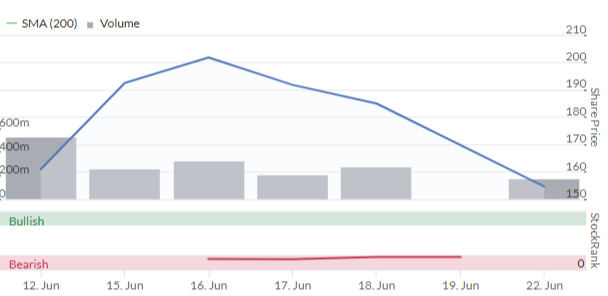
Tech sell-off: after its initial pop to $201 per share, Space Exploration Technologies (NSQ:SPCX) has been on the decline in recent trading sessions and fell 16% yesterday to $154.60 (still above its IPO price of $135). Elon Musk's net worth is bouncing around by hundreds of billions of dollars daily:
Alphabet (NSQ:GOOGL) also had a tough day yesterday, falling 5%.
Overall, the Nasdaq Composite Index fell 1.3%, and general weakness in the equity markets has continued overnight in emerging markets. The Korean Kospi index is down 8%.
Overnight market movements:
The FTSE is set to open down 1% at 10,335
S&P 500 is down 1% at 7,400
Brent crude is down 1.3% at $76.90/bbl
Gold is down 1.7% at $4,120/oz
Bitcoin is down 1.7% at $63,340
Companies Reporting
| Name (Mkt Cap) | RNS | Summary | Our view (Author) |
|---|---|---|---|
Bunzl (LON:BNZL) (£8.0bn | SR95) | H1 revenue expected to be +4% at constant rates, with growth supported by inflation. Volume growth driven by N.Am with good growth in Distribution. FY26 outlook upgraded: now expects revenue growth to be slightly stronger than previously. Operating margin guidance unchanged; “slightly down year-on-year”. | ||
Plus500 (LON:PLUS) (£3.3bn | SR85) | Has launched 24/5 CFD trading on “selected stocks and ETFs”, including SpaceX. | ||
Filtronic (LON:FTC) (£836m | SR58) | FY26 revenue to be in line with EBITDA slightly ahead of expectations at £55.5m and £11.1m respectively. Announces additional $0.5m contract with an existing customer. FY27 outlook (y/e 31 May): strong order book covers 90% of FY27 consensus revenue. Broker Cavendish FY26E EPS upgraded to 3.3p (prev. 3.2p). FY27E EPS unchanged at 3.4p per share. | AMBER = (Roland) [no section below] For a company with a £800m+ market cap to announce a $0.5m (£370k) contract win seems a little promotional to me. In this case the issue is obvious. While Filtronic appears to be performing well, the reality is that profits have nearly halved from peak FY25 levels as the product mix has changed and costs have risen. While today’s guidance is marginally ahead of consensus, the 3% increase to EPS from broker Cavendish isn’t enough to justify a positive market reaction for a stock that’s trading on c.100x forward earnings. We were neutral on this business when its shares were trading at half this level earlier in the year. While I recognise the high level of excitement (and opportunity) in the space market, objectively I think Filtronic looks too expensive. I’m going to maintain our neutral view ahead of August’s results but I think it could pay to be cautious. I note that almost all of the company’s largest shareholders have been taking money off the table this year. | |
Telecom Plus (LON:TEP) (£766m | SR53) | Final Results for the year ended 31 Mar 26 & Strategy update and new five year plan | Revenue +5.6%, adj pre-tax profit +4.7% to £132.2m. Adj EPS +3% to 122.8p with total dividend of 50p (FY25: 94p) and £40m share buyback (equivalent to 50p per share). Total customers +23.3% to 1.43m with organic customers +10.3% to 1.26m. FY27/Strategy update: aiming to double multiservice customers from c.500k to 1m by FY31. Will require c.£55m of investment annually. FY27 adj pre-tax profit to be £80-90m. | BLACK / AMBER/RED ↓ (Roland) I’m downgrading our view on TEP this by two notches today to reflect the scale of today’s FY27 profit warning and my feeling that the company has been guilty of complacency – enjoying record profits following the start of the Ukraine war without giving sufficient thought to evolving for the future. I estimate FY27 adjusted EPS could be c.80p, in which case the stock is trading on less than 10x forecast earnings – potentially good value. But with an extra £55m a year earmarked for price cuts, marketing and IT spending, I’m wary about calling the bottom just yet. This is TEP’s second profit warning this year – I am inclined to stay cautious until there’s some evidence of improving momentum. |
Pantheon Infrastructure (LON:PINT) (£553m | SR67) | Q1 NAV total return of -2.6%, with trailing 12-month NAV total return of 12.1%. Q1 NAV per share -5.6p to 124.8p, post-dividend. Main contributor to decline was a -3.9p movement in the valuation of PINT’s investment in Constellation Energy Corporation. | ||
Big Technologies (LON:BIG) (£305m | SR54) | Various contract wins and renewals. Confident that 2026 trading will be in line with market expectations (adj EBITDA of £24.7m to £25.9m). | ||
B.P. Marsh & Partners (LON:BPM) (£252m | SR70) | Received the second tranche of deferred consideration of £5.1m relating to the sale of Aspira Corporate Solutions Limited. Total proceeds from Aspira are now £11m, with a further £5.1m payment expected in 2027 giving a total of £16.1m, in addition to a £3.3m loan repayment. | GREEN = (Graham - I hold) [no section below] This defcon payment provides a helpful boost to BPM’s cash balance. At the full-year results, we were told that BPM’s cash balance was £29.6m as of 26th May, with a “strong pipeline” that meant BPM was “well positioned to deploy capital selectively”. This £5.1m payment might only be around 2% of BPM’s market cap, but they seem able and willing to use the majority of the firepower available to them for new deals - so I expect that it will be used productively. | |
Dialight (LON:DIA) (£149m | SR63) | Revenue -9% with adj operating profit up $6.1m to $10.3m. Net debt reduced to $1.9m. FY27 outlook: expect to achieve sales growth, profit growth and eliminate bank debt this year. | ||
Ramsdens Holdings (LON:RFX) (£146m | SR96) | Cash offer from US pawn operator FirstCash Holdings for up to 609p per share, comprising a payment of 600p per share plus dividends of up to 9p. | TAKEOVER (Roland) | |
Strategic Minerals (LON:SML) (£125m | SR44) | Additional samples from 2025 drilling have identified “tin-rich mineralised structures” and “tungesten enriched structures” to the north of the Redmoor deposit, outside the current modelled resource. | ||
EnSilica (LON:ENSI) (£118m | SR53) | FY26 revenue +51%, with adj EBITDA of £4.7m (FY25: £0m). FY27 expectations: revenue £32-34m & adj EBITDA £5.5-6.5m. PanLib FY27 forecasts unchanged. | ||
Taylor Maritime (LON:TMI) (£85m | SR94) | Sold a vessel generating net proceeds of $11.4m. Also agreed sale of a 50% JV vessel, generating net proceeds of $16.6m. Both are expected to complete in June, following which the company expects to make a minimum $45m return of capital in July by redemption of ordinary shares. | ||
Severfield (LON:SFR) (£82m | SR69) | FY26 revenue +1%, adj pre-tax profit -42% to £10.5m. Adj EPS -37% to 2.7p, in line with expectations. UK/Eur order book of £507m. Headwind from lower-margin projects expected to roll off in FY27. FY27 pre-tax profit expected to be in line with previous guidance of £12-15m. | ||
Journeo (LON:JNEO) (£77m | SR56) | Purchase orders totalling £1.3m for the provision of its on-board bus safety systems and high-security cloud-based SaaS services for Metroline Manchester. No reference to any impact on forecasts. | ||
Intercede (LON:IGP) (£73m | SR34) | Revenue down 2.8% (or down 0.5% at constant currencies). PBT £3.7m (FY25: £4.6m). Given the strength of delivered contracts year to date, the Company has started FY27 in line with the Board's expectations. | ||
Hardide (LON:HDD) (£58m | SR57) | Proposed cancellation of both the share premium account and a separate capitalised non-statutory reserve, generating c. £3.2m of distributable reserves. The goal is to enable share buybacks to fund executive share option awards, and to make distributions to shareholders possible. | ||
Gear4music (HOLDINGS) (LON:G4M) (£54m | SR85) | Revenue +30%. PBT £10.3m (FY25: £1.6m). FY27 trading to date in line with board expectations and on track to deliver FY27 consensus market expectations. | ||
Character (LON:CCT) (£51m | SR78) | “Enterprise Management Incentive” share option scheme. Substantially similar in structure and in operation to the 2017 Plan. | ||
Symphony Environmental Technologies (LON:SYM) (£21m | SR13) | Revenue down 13%. Operating loss £2.1m due to Middle East operations and one-off strategic costs. Net profit achieved in the first five months of 2026. | ||
iomart (LON:IOM) (£20m | SR65) | Results in line with revised market expectations. Adjusted pre-tax loss £4m. Outlook: “While a modest decline in full year revenue is expected, the Board expects the benefits of cost base actions and an increased focus on higher-value, strategically aligned services to support an improved profit profile during the second half of FY27.” | ||
Hercules (LON:HERC) (£20m | SR36) | “The acquired businesses are performing as hoped and while there have been some delays in the commencement of some key projects across the business, we are confident that we are well positioned for the future…” | BLACK (RED ↓) (Graham) [no section below] Roland downgraded our stance on this in May as accounting irregularities were brought to light. This problem was combined with the absence of forecasts for FY September 2026, although forecasts from SP Angel have subsequently been reinstated. Today’s AGM statement reads like a profit warning to me, with delays to key projects, although the company doesn’t quantify the financial effects that these delays might have. And I can’t see any broker update yet: the most recent forecast I can find is for a small operating loss this year (<£200k). I can only conclude that this loss might turn out to be wider than previously expected. I also note that the company’s gross cash balance (c. £7m) is funded by loans and an invoice discounting facility. Given all of the above, I think that a further downgrade is needed and that this must be a RED for us today. | |
Kelso group (LON:KLSO) (£14m | SR36) | As set out in the most recent portfolio update, NAV increased by 35% in the first five months of the year to 3p. | ||
Angus Energy (LON:ANGS) (£12m | SR n/a) | Revenue £9.5m, operating profit £1.5m (H1 2025: £3.4m). “...immediate priority remains the completion of the restructuring process and the restoration of trading in the Company's shares.” Material uncertainty arising from “dependence on continued gas production, compliance with the terms of its financing arrangements and the successful completion of the restructuring”. | (Shares suspended since 19 May 2025) | |
Arkle Resources (LON:ARK) (£12m | SR18) | €225k operating loss, no revenues. Arkle continued its strategy as a gold, zinc and lithium explorer, working in Ireland and Botswana. Shortly after the year-end, in January 2026, we announced a transformational acquisition that repositions the Company as an energy metals explorer with uranium at its centre. |
Roland's Section
Ramsdens Holdings (LON:RFX)
Up 30% at 590p (£192m) - Recommended Cash Acquisition - Roland - TAKEOVER
We’ve been consistently positive on pawnbroking, gold and jewellery retailer Ramsdens, most recently here. The company has proved an excellent way to play the gold price and – in our view – is a great example of a well-run, good quality AIM business.
Ramsdens’ reputation has clearly spread across the pond as the company has now become the latest British firm to succumb to an offer from a deep-pocketed US buyer.
In this case, it’s a trade sale rather than a private equity bid – Ramsdens board has recommended a cash offer from NASDAQ-listed US pawnbroking group Firstcash Holdings (NSQ:FCFS), which is coming back for seconds after buying the UK’s largest pawnbroker, H&T, last year.
FirstCash operates over 3,300 shops in the US, Latin America and the UK and has a market cap of c.$10bn. So today’s £203m offer for Ramsdens is probably small enough to qualify as a bolt-on acquisition.
Here are the details of FirstCash’s offer:
Total consideration: up to 609p per share in cash or up to £206m, including dividends.
600p for each Ramsdens share from FirstCash
Up to 9p in dividends reflecting the interim payout of 6p and special dividend of 3p that were declared with the company’s recent half-year results.
The offer represents a fairly healthy premium across all recent timeframes:
33% premium to yesterday’s closing price of 453p
46% premium to the volume-weighted average price of 412p over the last three months
22% premium to Ramsdens’ all-time closing high of 493p on 3 June 2026
The offer is comfortably above Ramsdens’ all-time high, so this guarantees that any current shareholder will receive a profit from the takeover.
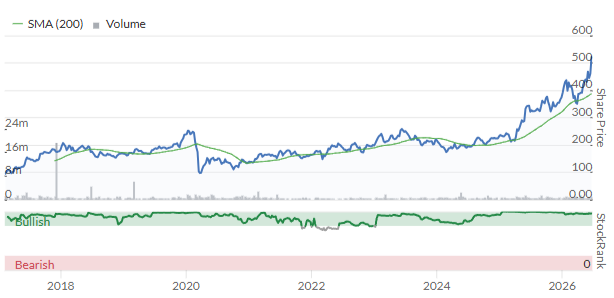
Longer-term shareholders have done much better, of course. Investors who bought Ramsdens’ following its 2017 IPO could be in for a 500% profit, plus dividends:
Valuation: the latest forecasts from house broker Cavendish show Ramsdens generating earnings of 67p per share this year and 45.5p in FY27.
This means the FirstCash offer is equivalent to a FY26E P/E of 9x and a FY27E P/E of 13.
However, as Graham has pointed out previously, the FY27 forecasts are based on an average 9-carat gold price of £32/g, below the current level of c.£35/g. So there may be in-built scope for upgrades if gold remains stable at current levels.
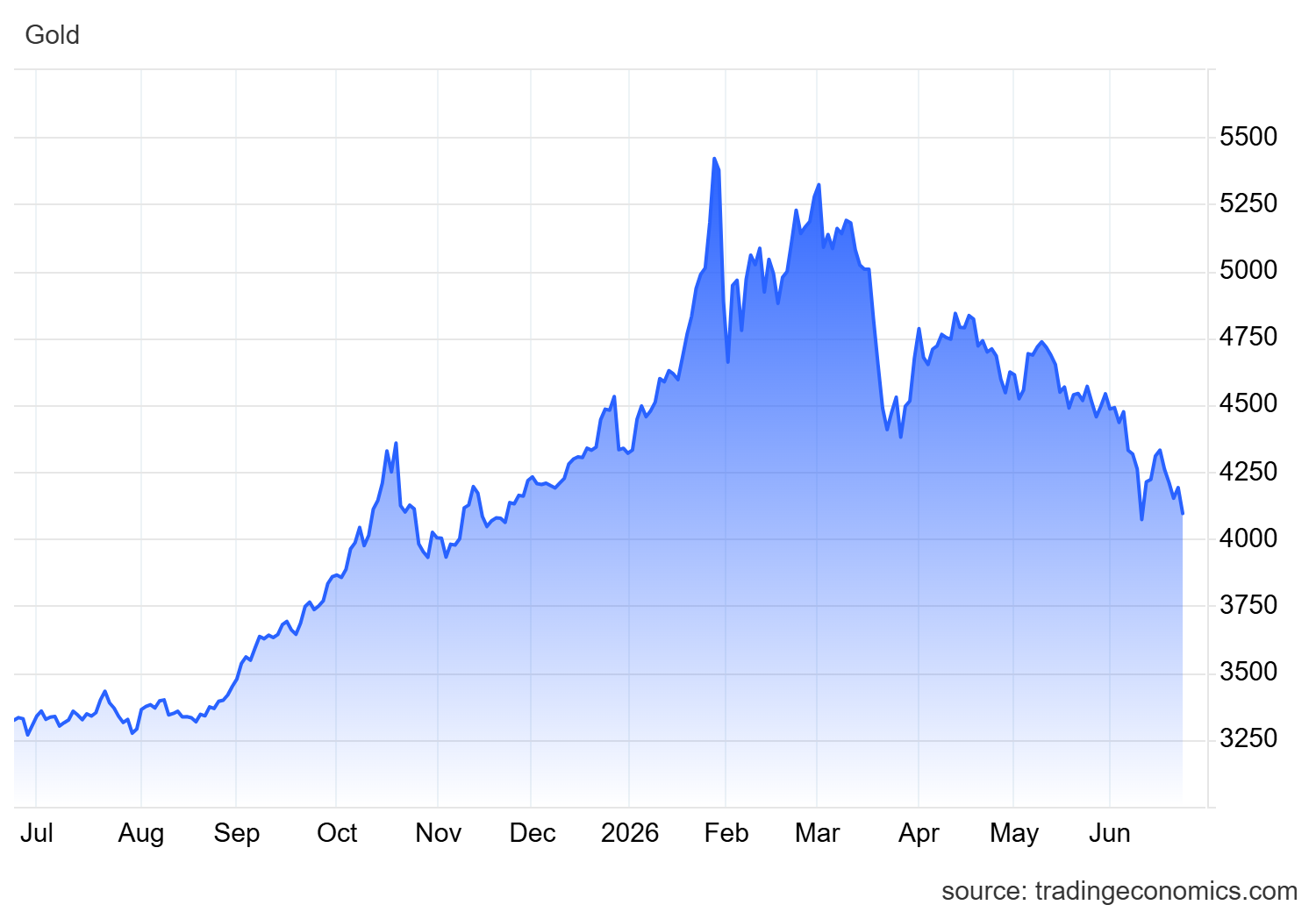
Of course, there could also be significant downside if the gold price continues to decline, but I imagine some commodity price risk has been factored into the offer.
Valuation
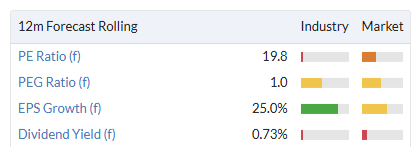
Overall, I think it’s fair to suggest FirstCash is not paying more than c.10x near-term earnings for Ramsdens, which has minimal debt and enviable quality metrics:
The attraction for FirstCash is not hard to see.
FirstCash shares trade on P/E of 20 – double my 10x P/E estimate for its acquisition of Ramsdens:
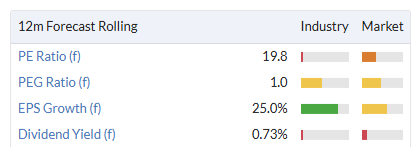
In theory, this means that Ramsdens’ earnings will be valued at 20x when added to FirstCash’s results. That should effectively give a c.£400m boost to the US group’s valuation, double the cost of the acquired UK earnings.
Ramsdens is also a higher-margin business than FirstCash, so this acquisition should be margin-accretive for the buyer:
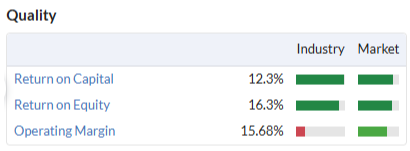
Competition approval?
H&T and Ramsdens are the UK’s largest pawnbrokers by some margin. According to some brief research, I believe they control around 65-75% of the pawnbroking market in the UK, based on pledge book data.
The completion of this acquisition is dependent on the approval of the Competition and Markets Authority. Presumably FirstCash is reasonably confident this will be possible despite the market consolidation that will result.
I would guess that one factor in favour of the deal being approved is that H&T has historically been stronger in the south of England, while Ramsdens has more of a skew to the North/Wales, limiting direct overlap. Even so, I think there’s some possibility that regulatory risk could hold up this deal.
Roland’s view
Ramsdens’ chairman Simon Herrick appears to blame UK investors for not being bullish enough to protect Ramsdens from a takeover offer:
Unfortunately, the share price has not fully kept pace with the Group's positive profit and earnings per share growth and FirstCash has made a cash offer for the Group which represents a 35% premium to the current share price. The Board, following independent advice from Cavendish as to the financial terms of the Acquisition, considers the Acquisition to be recommendable to our shareholders.
A counterpoint to this argument might be that UK investors were recognising the commodity price risk in this situation.
Ramsdens’ recent half-year results showed that gold trading generated the same gross profit as jewellery and pawnbroking combined, but the price of gold has fallen by c.20% since the end of that reporting period.
This offer means that Ramsdens’ shareholders are getting a fixed premium in exchange for losing their exposure to the gold price and the potential risks and benefits of Ramsden’s continued expansion.
Based on what we know today, I think it’s probably a reasonably fair offer for both parties, but only time will tell whether FirstCash has secured a bargain.
Telecom Plus (LON:TEP)
Down 25% at 714p (£568m) - Final Results & Strategy update and new five year plan - Roland - BLACK/AMBER/RED ↓
It looks like I was not sceptical enough in April when utility reseller Telecom Plus announced a slight downgrade to expectations together with a change in dividend policy and a strategy review.
The market voted with its feet, but it looks like investors were still not prepared for today’s profit warning; FY27 profit guidance has been cut almost 40% from previous consensus of c.£140m.
The shares are down by a further 25% this morning, leaving them down by around 65% on a 12-month view:
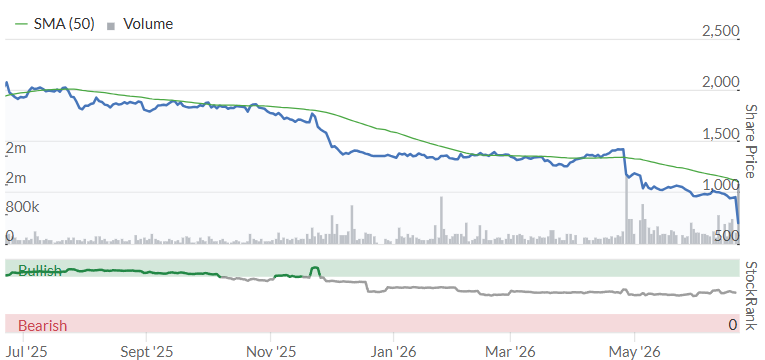
As a former fan of this previously reliable dividend payer, I am keen to understand what has gone wrong here.
FY26 results summary
Telecom Plus operates under the Utility Warehouse brand, offering multiple utility services to customers on a single bill. Its USP is that sales are made in-person through a network of self-employed agents (“Partners”). The company argues that this approach provides a unique competitive advantage when it comes to persuading people to overcome fear/inertia and switch multiple services at the same time.
Results for the year ended 31 March are in line with April’s revised guidance. The headline figures do not seem to suggest any serious concerns:
Revenue up 5.6% to £1,941.1m
Gross profit up 8.7% to £389.2m
Adjusted pre-tax profit up 4.7% to £132.2m
Adjusted earnings per share up 3% to 122.8p
Net debt of £143m (FY25: £116m), representing 0.9x EBITDA (FY25: 0.8x)
Shareholder distributions are in line with April’s revised guidance, with the total distribution unchanged but the dividend reduced to free up cash for share buybacks:
FY26 total dividend: 50p (FY25: 94p)
FY26 share buyback: £40m (50p per share)
This is the first dividend cut from this business for 20 years, but it’s true that the total amount of cash being distributed is consistent with the prior year. Personally I don’t like the shift from dividends to buybacks – this has long been a popular income stock. The company’s shift to buybacks in this context suggests to me that management is trying to support the share price through an expected period of weaker earnings.
To the company’s credit, the buybacks will be subject to explicit valuation benchmarks. Today’s results explain that buybacks will only be undertaken when the stock is trading below 20x forecast adjusted post-tax earnings. This means the company is requiring an adjusted after-tax return on investment of at least 5% on buybacks.
This is slightly more generous than Next’s benchmark approach of an 8% pre-tax yield, which is equivalent to c.6% post tax. But a 5% net yield isn’t unreasonable and the very fact Telecom Plus has devised and published buyback criteria is to its credit, in my view. Very few companies appear to do this and even fewer share their criteria publicly.
Rising costs leave payout uncovered: worse still, this combined payout isn’t supported by cash. Looking at today’s accounts, my sums suggest the business generated just £48m of free cash flow last year. That’s enough to cover the dividend or the buyback, but not both. This is due to a sharp rise in capex last year:
Capital expenditure of £63.6m (2025: £17.2m) related primarily to the acquisition of customer contracts from TalkTalk and our ongoing technology investment programme.
It would be interesting to know the split between TalkTalk customers and IT spending.
Operational metrics seem reasonable at first, but problems soon emerge – and this lies at the root of today’s strategic update and FY27 profit warning:
Total customers up 23.3% to 1.43m (boosted by the addition of 193k broadband customers from TalkTalk)
Organic customers up 10.3% to 1.26m
Total services supplied to organic customers up 7.6% to 3.62m
Partners up 7.7% to 77.2k
So far, so good. Here’s the bad news. Multiservice customers have long been the core driver of profits for Telecom Plus – typically the longest-lived and most profitable. But the average number of services per organic customer has fallen steadily over the last two years:
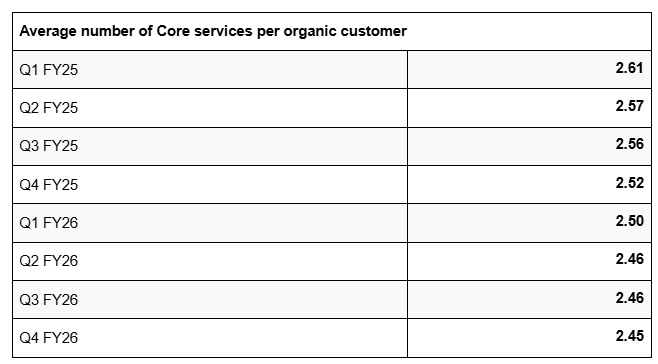
In today’s results, the company says that c.500,000 of its customers are currently multiservice – out of a total of 1.43m.
Strategy Update
After the party comes the hangover.
While April’s statement did include a number of warning flags (with hindsight, at least), today’s update makes it clear that the period of rapid, profitable growth enjoyed since the Ukraine war triggered an energy price crisis has now ended.
For some background on this, Telecom Plus has a long-term wholesale supply agreement with E.ON for gas and electricity that means it enjoys a measure of protection against short-term volatility.
When the Ukraine war triggered an energy price crisis, a number of small UK energy suppliers offering unsustainable rates failed. The market consolidated into a smaller number of large suppliers, including Telecom Plus.
At the same time, the group’s wholesale supply arrangement meant it was able to undercut the UK price cap and offer the cheapest energy tariffs in the UK for a period of time. Customer growth was very strong and it seems the company started to take a more relaxed view on lifetime customer value and acquisition costs:
Our view, based on the market dynamics at the time, was that (i) single service customers would be more profitable than had been the case historically, with longer lifetimes due to a reduction in future incentives to switch, and (ii) we would need to invest less in both acquiring and retaining customers in a more rational market paradigm. We accordingly set our business growth targets based on these assumptions.
Of course, it should have been obvious that competitive forces would return to the newly-consolidated market at some point. Perhaps it should also have been obvious that customers would start to demand more sophisticated tariffs and digital services. But apparently it wasn’t (my emphasis):
Since then, market dynamics have shifted. Octopus has emerged as a new type of challenger: it is now the UK's largest energy supplier with over 25% market share, up from just 6% five years ago. It has achieved this through building up hundreds of millions in cumulative losses, while building a very strong brand and an advanced digital platform and customer experience, which has coincided with customer expectations shifting rapidly. These trends are set to continue as the energy market as a whole undergoes a similar transition and customers start to engage with and demand self-serve capabilities as well as new developments, such as time of use and other innovative tariff types.
At the same time, we are the only other large supplier alongside Octopus that is gaining organic market share. All of the other large suppliers are losing market share and as a result they are all competing hard on price to stem the losses. We have seen increasingly competitive introductory pricing over the last year, making it more challenging to acquire multiservice customers (as our multiservice energy discounts are not always attractive enough to outcompete single service acquisition tariffs from competitors), whilst single service customers have greater incentives to switch (often with headline savings of £150-250).
Competition and consolidation in the broadband market is also said to be having an adverse impact on both gross new customers and churn levels for this service.
Insurance has not proved the saviour that was hoped for, either. After having to pause sales of new policies in FY25 while discussions with the FCA took place, sales of new policies “have been slower than expected to recover”.
Five-year plan: the impression I get is that Telecom Plus has been caught by surprise with ageing IT, a bloated cost base and renewed competition from the big utility companies.
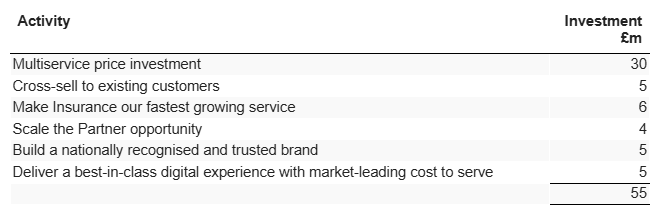
The FY26 results have highlighted a large increase in technology spending. Today we have the five-year plan:
To deliver on our five-year plan of doubling the number of multiservice customers from c.500,000 to 1 million, resulting in an increase in adjusted profit before tax to c.£175m by FY31, as well as improving the quality of our earnings, we are implementing a strategic P&L investment programme of approximately £55 million per annum across four pillars
The four pillars mentioned above are:
“Optimising our multiservice proposition …”
“Scaling the Partner sales channel to increase multiservice customer acquisition”
“Building a nationally recognised and trusted consumer brand”
“Developing a best-in-class digital experience, underpinned by rapid AI adoption, with market-leading cost to serve”
The bottom line is that Telecom Plus plans to spend £30m cutting prices and developing more competitive tariffs for multiservice customers. The balance will be used for marketing and technology spending:
FY27 outlook & FY31 ambition
Subtracting £55m from FY26 adjusted operating profit of £132m gives £77m.
Telecom Plus appears to be budgeting for some underlying growth this year as the group’s revised FY27 guidance is for an adjusted pre-tax profit of £80 to £90m.
The company helpfully provides a bridge showing the transition from FY27 guidance to its FY31 target:
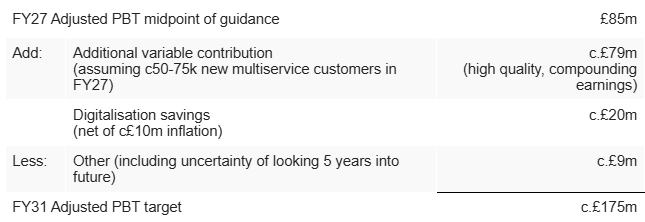
Using FY26 pre-tax profit of £132m as a starting point, this represents a compound growth rate of just under 6%.
I don’t have access to revised broker forecasts today, but using the FY26 accounts as a guide, I estimate FY27E adjusted EPS of perhaps 80p, putting TEP on a forward P/E of 9.
Using guidance for shareholder distributions of 80%, with half of this as dividends, I estimate a possible FY27 dividend of 32p, giving a possible 4.5% yield.
Roland’s view
Telecom Plus says that early efforts from its revised strategy are paying off so far in FY27, with multiservice growth up to 9.7% annualised and increases in Partner activity and consumer brand awareness.
That seems promising. It’s possible that the business will return to growth following this year’s profit reset.
On the other hand, I can’t help feeling cautious given the extent to which management appears to have been caught unawares by changing market conditions. The impression I get is that the business rode the wave of easy wins that followed the start of the Ukraine war, without investing for the future or considering the broader changes taking place in the UK energy market.
I’m also a little alarmed by the scale of today’s profit warning. The company’s decision to make such big cuts to pricing suggests to me that management sees a serious risk of rising attrition among energy customers. I suspect that profitability could be under pressure for a while.
There’s also the question of whether AI and AI-adjacent services such as price comparison will reduce the appeal of Utility Warehouse’s core multiservice offer.
Companies such as MoneySupermarket.com are working hard to take ownership of customer relationships and semi-automate underlying switching. Services like this could end up providing competing offerings without the intrusion of having a salesperson in your living room.
On balance, I think it’s fair to take a cautious view here until we see evidence the situation has stabilised. I’m downgrading our view to AMBER/RED today.
See what our investor community has to say
Enjoying the free article? Unlock access to all subscriber comments and dive deeper into discussions from our experienced community of private investors. Don't miss out on valuable insights. Start your free trial today!
Start your free trialWe require a payment card to verify your account, but you can cancel anytime with a single click and won’t be charged.