Finding Neglected Bargains

This week, I am continuing our summer theme of looking at some of the more interesting Guru Screens in more detail. So far, Roland has looked at Jim Slater's Zulu Principle and the GARP screen here. A couple of weeks ago, I wrote about Ben Graham's Enterprising Investor Screen.
For those who have never looked at the guru screens before, they can be found in the Browse section of the sidebar here:

Given my preference for cheap stocks that may benefit from the power of mean reversion, I tend to gravitate towards the Value Investing and Bargain Stock screens. However, all types of investors should be able to find a screen that suits their investing style.
As I look through these screens, one of the most appealing ones to me is the Neglected Firms Screen. The screen description explains that it uses value and quality measures to find neglected shares that are under-researched by analysts and potentially misunderstood by investors. It looks for companies with low analyst coverage, above-average earnings growth, and cheap according to their price-to-earnings and price-to-book ratios. In their book Quantitative Equity Portfolio Management, Chincarini and Kim say that:
It is likely that neglected firm's stock prices do not reflect all the relevant information available and that their prices will react sluggishly to relevant news. This opens a window of time and opportunity for an astute investor to purchase undervalued, neglected stocks and reap the rewards when the market recognizes the stocks' true values.
This sounds like an interesting angle - if investors can find companies with limited broker coverage that are growing and cheap, then investors may be able to gain an informational or analytical edge over other market participants.
The Screen
One of the keys to this screen is that investors can benefit by looking at stocks where others aren't. Having just a couple of brokers give a (semi) independent view of prospects means that the story may not be well-known amongst individual investors or institutions:

Chincarini and Kim's rationale for the outperformance of neglected firms is that the market may miss the growth potential of such businesses. Hence, the screen looks for companies growing faster than average in their industry:

The idea is that the market may be slow to price this growth, hence the requirement for these companies to also be cheaper than average:

The screen also looks for companies that appear to be better quality businesses than the average for their industry:

Finally, the screen excludes tiny companies and those industries where these valuation metrics are not particularly useful:

Adapting a Guru Screen
One of the features of Guru screens is that investors don't have to agree with every criterion, and subscribers are free to adapt the screens to their preferences. First, they will need to create a copy of the screen by clicking here:

One of the easiest ways to adapt a screen is to turn off one or more criteria via the check mark here:

In this case, I am leaning on my research that showed that investors shouldn't ignore low-margin stocks as long as they are good quality companies that are reasonably priced.
Investors can also add in their own criteria. In this case, I think for a firm to be neglected, it needs to be below a certain size, so I have included an upper market cap limit:

The Results
My version of the Neglected Firms Screen currently generates 15 stocks in the UK market:
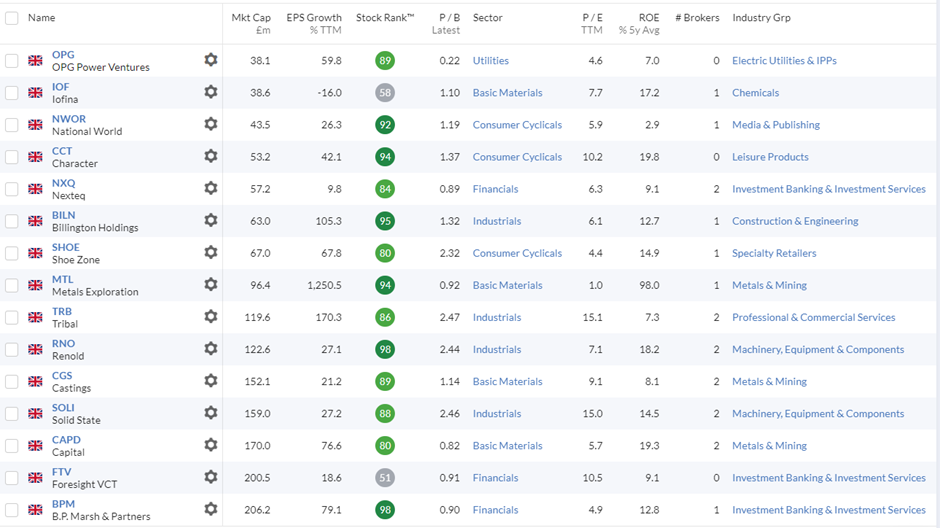
Of these, Castings (LON:CGS) Capital (LON:CAPD) and B.P. Marsh & Partners (LON:BPM) featured in my article on Ben Graham's Enterprising Investor Screen, so I won't repeat the summaries I did there. Both B.P. Marsh & Partners (LON:BPM) and Capital (LON:CAPD) looked worthy of further research. I will immediately exclude Foresight VCT (LON:FTV) as a VCT fund is not the type of investment stock screeners are usually after. This leaves 11 stocks to look in more detail to see if they are hidden gems. I will look at the first five in this article and examine the remaining six stocks next week.
OPG Power Ventures (LON:OPG)
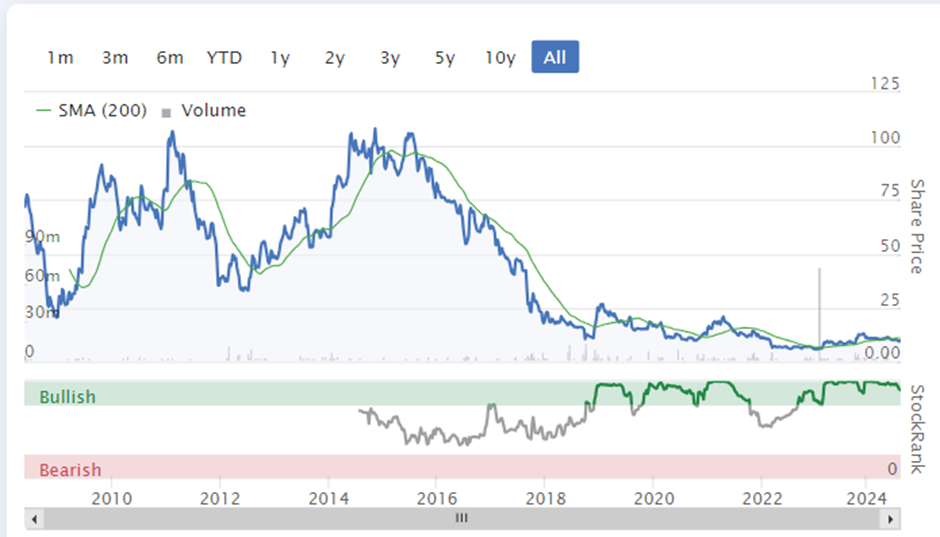
OPG Power Ventures owns and operates coal power stations in India. It does beg the question of why this is listed on AIM. It has been listed for a while, which should give some comfort, but with a not particularly stellar record:
There are broker forecasts here, but they are for EPS to decline further:
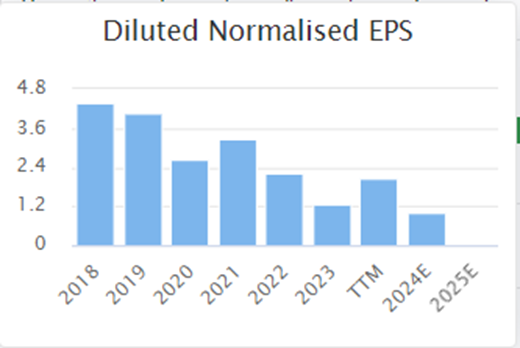
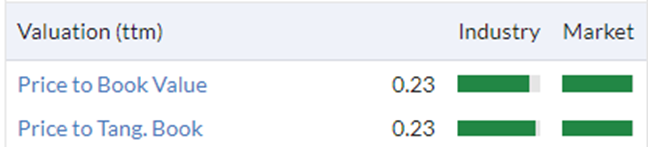
This puts them on a forward P/E of 10, which doesn't stand out for a business with these trends. However, there is a huge discount to Tangible Book Value that may appeal to some value investors:
Given the location of the assets and their lack of productivity, I am not sure that alone should be enough for investors to consider taking a position. Their cash flow has enabled them to pay down debt but not pay a dividend. There have been a couple of dividends declared in the past:
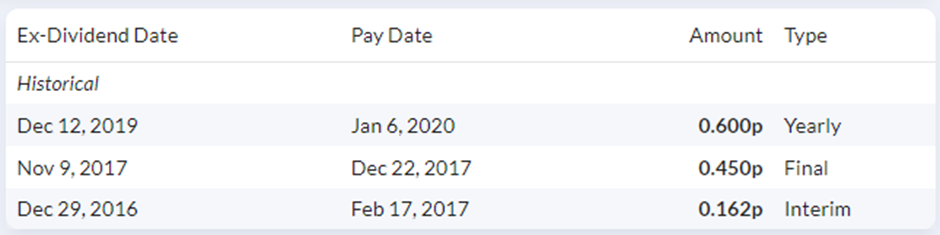
However, these are far from consistent, and the 2020 payment was a scrip-only dividend. This means that no cash was paid out, and the company simply issued more shares to every shareholder. The effect is really just a small stock split, and it is a waste of shareholders' time and money. It may even leave shareholders with a tax liability despite the economic reality of their holding being unchanged!
Adding to the risk, there is a controlling shareholder who owns a high enough percentage to able to do whatever they like with the business or listing:
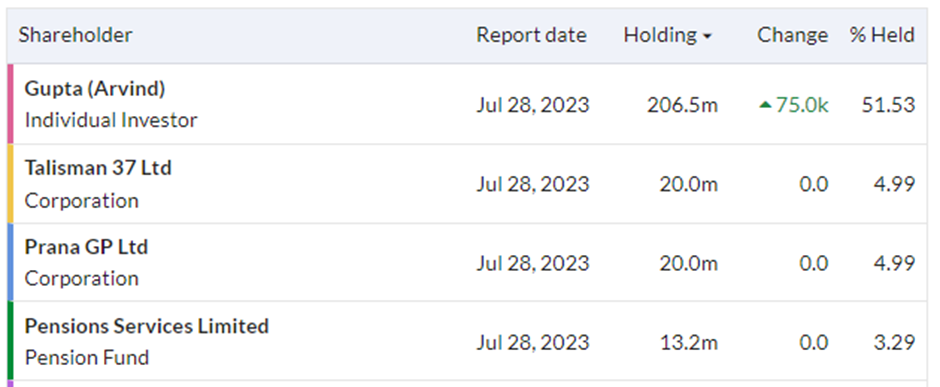
This firm may be neglected by investors but for good reasons.
Iofina (LON:IOF)
Iofina extracts iodine and similar industrial chemicals from brine in the US. It was loss-making for many years, but 2021 saw a step change in fortunes, and now the company has been a strong earner for the last few years:
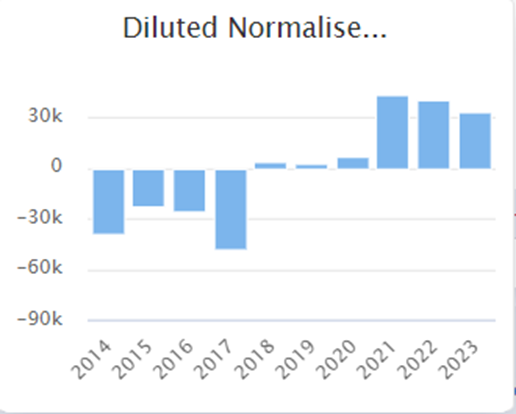
The company had an equity raise in 2019 and a debt refinancing in 2020, which means that although the company now has net cash:
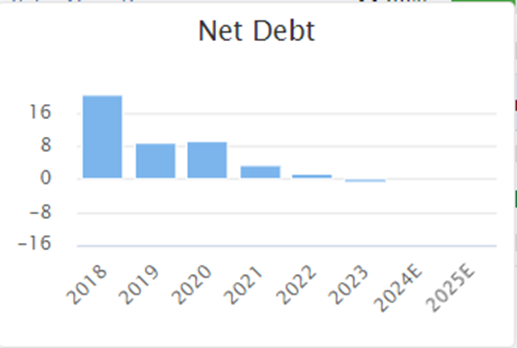
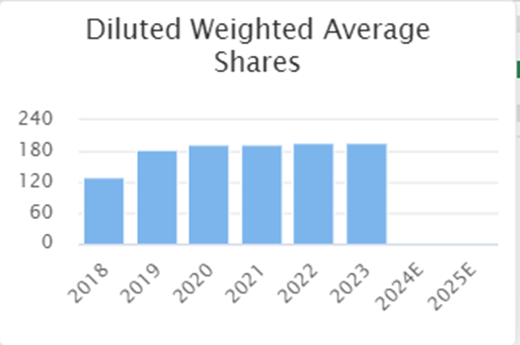
This has come at the cost of an increased share count:
Earnings are forecast to fall going forward despite increasing production:
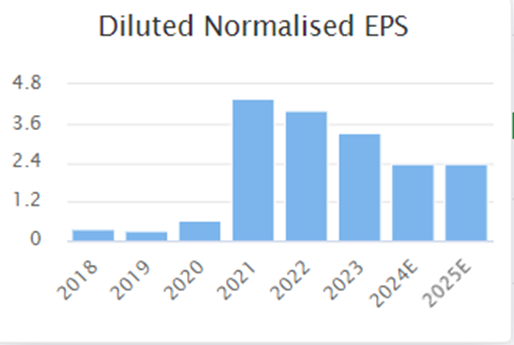
It seems this is due to increasing costs and renegotiating two long-term brine supply agreements at worse terms in order to secure long-term supply. In their May 2024 Results Presentation, the company said that spot prices were around the mid to high sixties ($) per kg and that prices have remained steady:
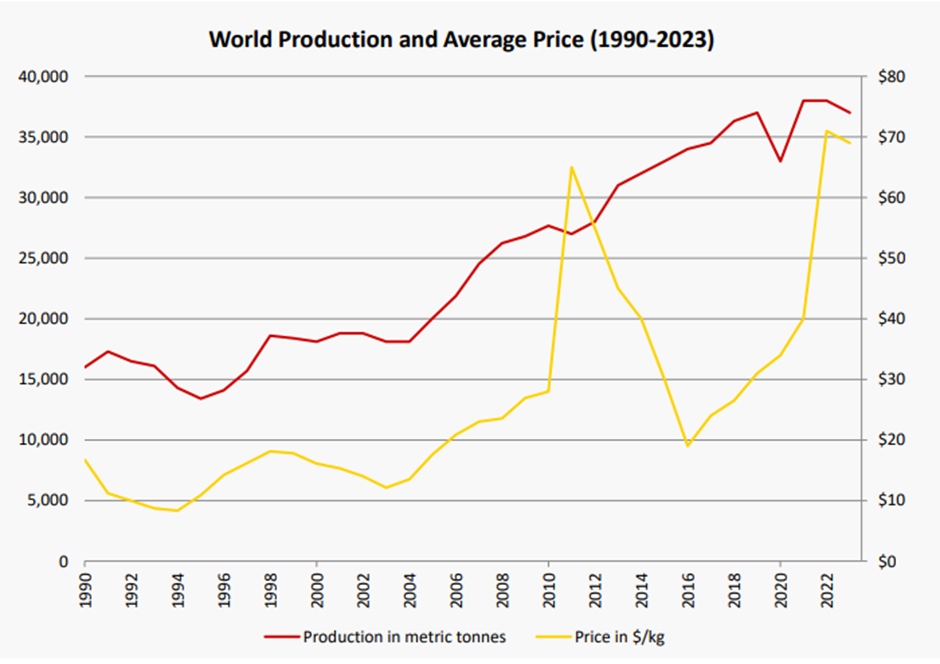
However, this price chart shows that the historical price of iodine has been both cyclical and volatile, so investors are definitely taking a commodity risk here. This makes the current forward P/E of 10.7 not particularly cheap. The company can certainly grow earnings with new plants, but these require capital investment, and because of this capital intensity, the company has not yet paid a dividend.
The investment case here appears to boil down to predicting the future iodine price. Iofina claims that demand for iodine continues to outstrip supply. However, they don't provide any evidence for this. Investors will need to do their own research on this commodity market before considering an investment here.
National World (LON:NWOR)
I wrote up National World last year as a Stock Pitch and not much has changed. The valuation metrics remain compelling:
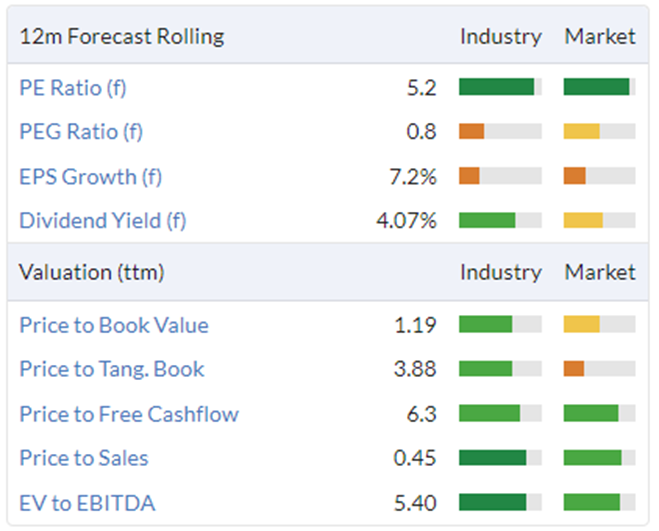
The fact that the company isn't growing organic revenue may put off some investors. However, it is managing to grow EPS via acquisitions and cost-cutting. When stronger advertising markets return, then they should be able to grow organically again, although not at particularly brisk rates given their industry. The common theme of such media companies is digital transformation. National World appears to be doing this at least as well as competitors.
Perhaps the strongest argument for National World (LON:NWOR) being undervalued is that competitor Reach (LON:RCH) is on double the rating when investors treat the cash payments Reach has agreed to make to its pension trustees and phone hacking victims as debt. Both companies like their adjustments, particularly excluding restructuring costs, which are surely part of how these businesses operate rather than an exceptional cost. However, National World reported lower restructuring costs in the H1 results that were released at the start of this month, and these no longer significantly impact the valuation. Reach is a larger, more liquid company that may suit some institutional investors. However, for an individual investor there seems to be little reason to own Reach (LON:RCH) when the better-run National World (LON:NWOR) is available on a much cheaper rating.
Character (LON:CCT)
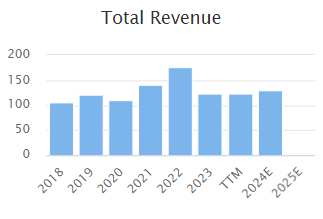
Character is a toy manufacturer and distributor. They have struggled to grow over the years:
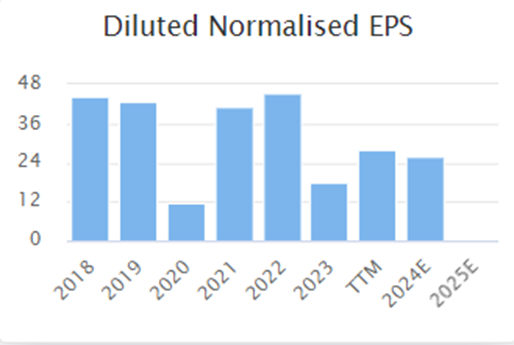
However, in the good years, they are highly profitable:
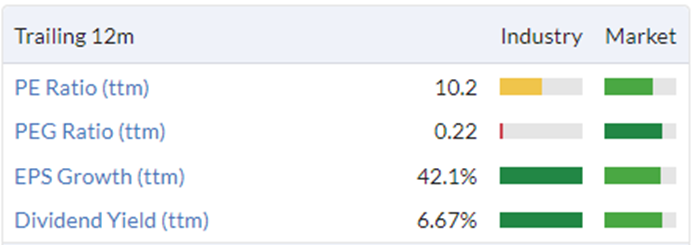
This has never been a particularly high-rated company:
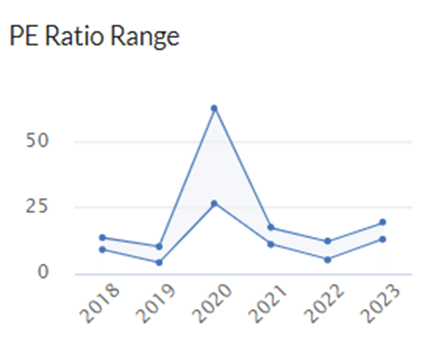
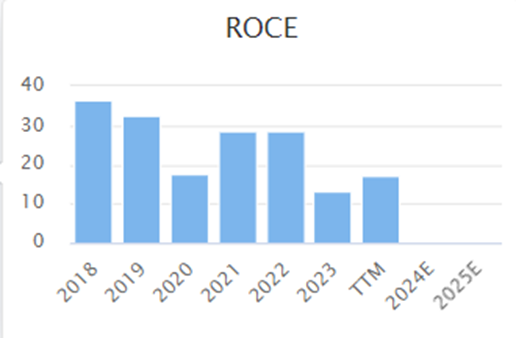
This is partly due to the lack of growth, and partly because they don't own the IP of many of the toys they sell and instead license these. Despite this, they have managed to generate a reasonable return on capital:
In addition, they have always been very cash-generative, as demonstrated by the 6.7% dividend yield:
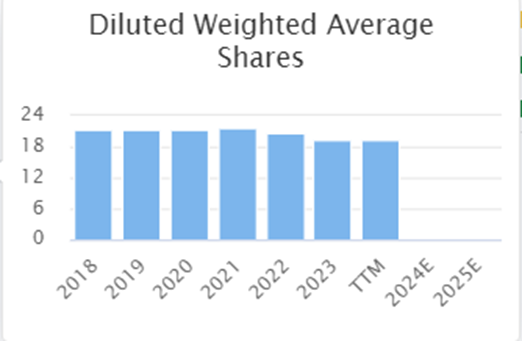
They have also been buying back shares, and this is starting to have a noticeable impact on the share count:
The recent buyback ended in June, but with around 20% of the market cap in cash, there is scope for them to extend this in the future:
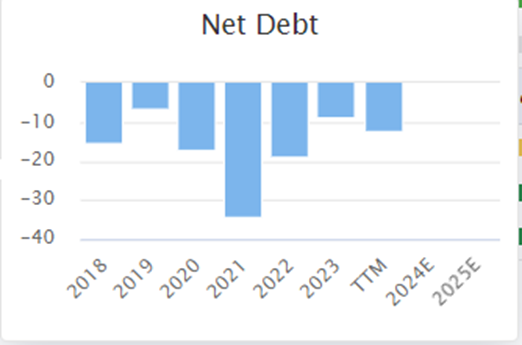
Some of the cash inflow is from inventory sales and hence not repeatable. History suggests it may reverse at some point if they manage to generate sales growth. Still, the size of the cash buffer means this can easily be absorbed, as well as dividends paid and buybacks made.
This is a seasonal business, and the majority of the profit is generated in H2. However, the H1 results released in May showed an improving picture:
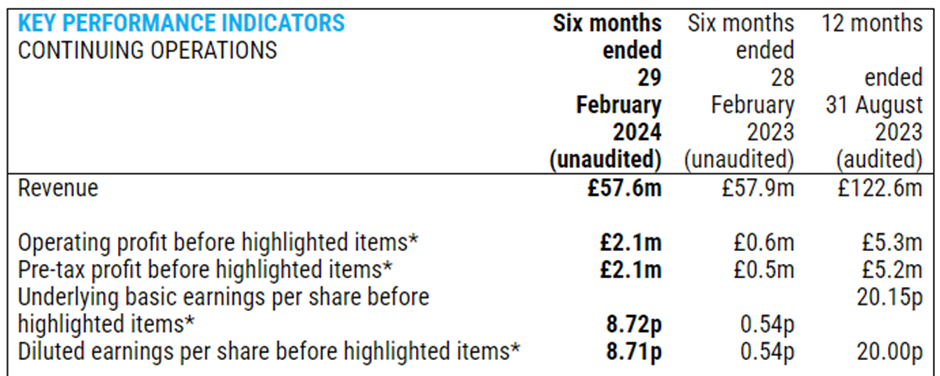
This was due to lower selling and distribution costs where they said:
The Group reported profit before tax and highlighted items of £2.1m (HY 2023: £0.5m; FY 2023: £5.2m), the increase in profit being mainly due to reduced selling and distribution costs. This primarily related to the logistics costs associated with the Group's Scandinavian business being lower, as inventory was significantly reduced from last year, and increased influencer sales in our UK domestic market producing a lower advertising to sales ratio.
In terms of outlook, the company said:
The Board is comfortable that the Group is on course to meet its targets
However, more recently, freight prices have increased again on Red Sea tensions, meaning that this optimism may need to be tempered in the short term. In the long term, a return to their more normal 40p+ EPS is possible, which will make the current share price look cheap. Especially given the significant cash balance.
Nexteq (LON:NXQ)
Nexteq has appeared cheaply rated for some time. However, it recently had a pretty big profit warning, with FY24 revenues expected to be 15%-20% below market expectations and adjusted profit before tax to be 30%-40% below market expectations. They blamed destocking in their gaming hardware subsidiary Quixant. However, it is their industrial electronics division, Densitron, that faces the largest fall in sales this year. In the latest trading update, they said:
Within the Group's brands, we expect to report that Quixant revenue is down 10% to $30.9m (H1 2023: $34.3m) and Densitron revenue down 22% to $17.3m (H1 2023: $22.0m).
The company hit its profit forecasts for 2023 by increasing prices at Densitron in the second half. This meant a step change in operating margins, but it seems it may have come at the cost of sales this year. This isn't the only bad news recently - the Chair, CEO, and CFO are all leaving when successors have been found. I can't remember the last time that all three such board members at a company resigned simultaneously.
On the current forecasts, the company is reasonably cheap, particularly if investors take into account the large cash balance:
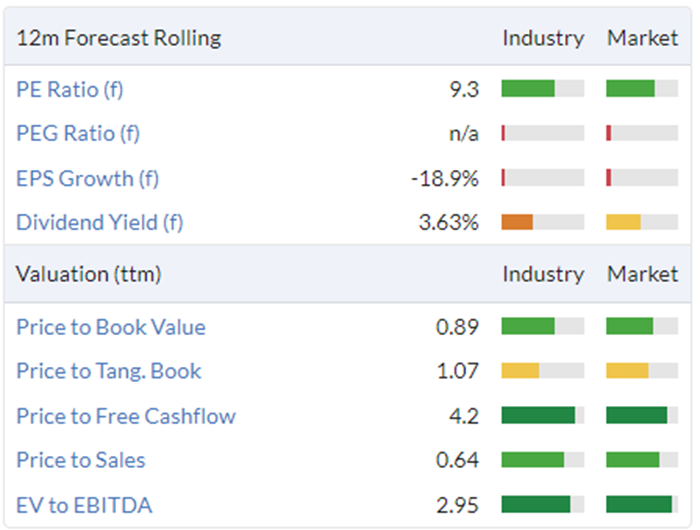
However, I'm not sure much faith can be put in these. It can take some time for things to turn around, and when a new management team is appointed, the temptation will undoubtedly be for them to kitchen sink it and blame it on the previous board. In addition, there are unlikely to be any major uses for the cash pile, such as earnings-enhancing acquisitions, until the new management is in place and gets a handle on the core business.
In the meantime, there is a buyback in place. Even after the profits warning, the company has committed to extending this. The idea that this will support the price seems to have stopped the share price from falling. However, there appeared to be an institutional overhang before the warning, which is unlikely to end soon. On the balance of probabilities, a new management team may be able to extract value here, given a history of mostly profitable trading. It may be a long wait until there are signs of this, and it is reflected in the share price.
While not every company on the Neglected Firms screen looks to be a hidden gem, it has definitely highlighted some stocks worthy of further research. Next week, I will finish the set by looking at Billington Holdings (LON:BILN) Shoe Zone (LON:SHOE) Metals Exploration (LON:MTL) Tribal (LON:TRB) Renold (LON:RNO) and Solid State (LON:SOLI) .
[Disclosure: Mark owns shares in Billington Holdings (LON:BILN) Capital (LON:CAPD) National World (LON:NWOR) ]
Disclaimer
This is not financial advice. Our content is intended to be used and must be used for information and education purposes only. Please read our disclaimer and terms and conditions to understand our obligations.

9 comments
great article mark!
IMO the price to book measure sort of holds this guru screen back a bit. i found simplifying it and tweaking it to just:
ROE 5yr average > 15%, no. of brokers covering <2, net profit margin 5yr average > 0%, EPS 5yr growth > 0%, market cap less <£1B
was a bit more useful. you can ofc tweak the inputs, but from playing around with it, the combination of EPS growth + high ROE (or high ROCE, or high greenblatt ROCE, or high ROIC etc) + the limited broker coverage (especially) + small cap is unusually strong
i will add: limited brokerage coverage, small cap (<$2B), strong quantitative figures and consistent sales/revenue growth will throw up some very strong US companies as potential research candidates
I couldn't say whether it increases the chances of finding a winner as I don't have enough history and examples to know, but when I see a stock popping up on different screens I pay particular attention to it.
I feel this must be telling me something, I just need to work out what it is!
Thank you for the article. I noticed when you referenced Charter (LON:CCT) you quoted: In addition, they have always been very cash-generative, as demonstrated by the 6.7% dividend yield:
You explain this with the image of the ttm dividend yield from the Growth and Value data.
Further down the page you show growth and value data again this time using forecast data.
As a subscriber how do I change between the two readings?
Great spot and question, I’d not personally noticed the screen varies between companies. Can’t see a setting where you can configure the page.
I assume it depends on whether the database has sufficient broker forecast data. Character (LON:CCT) doesn’t seem to so has to rely on trailing data. That would be my answer anyhow.
I would note that Reach (LON:RCH) carries almost double the dividend than National World (LON:NWOR) so should have a higher premium?
Sorry for the late reply. I've only just spotted this comment.
I think a lot depends on whether that dividend is sustainable, and whether it is funded out of debt or free cash flow. For Reach (LON:RCH) in the last couple of years, the dividend has been funded by taking on debt and stretching working capital. Analysts think the dividend is sustainable and may even be increased slightly, so they must expect cash flow generation to improve going forward.
In this situation, I'm not sure any significant premium is warranted.
Excellent post
Nice work Mark