Hargreaves Lansdown: contrarian buy or a fallen star?

Leading retail investor platform Hargreaves Lansdown (LON:HL.) has seen its growth slow in recent years, as a raft of newer and cheaper competitors have entered the market.
Relatively high prices and a lingering association with the Neil Woodford scandal may also be hindering sentiment towards the business.
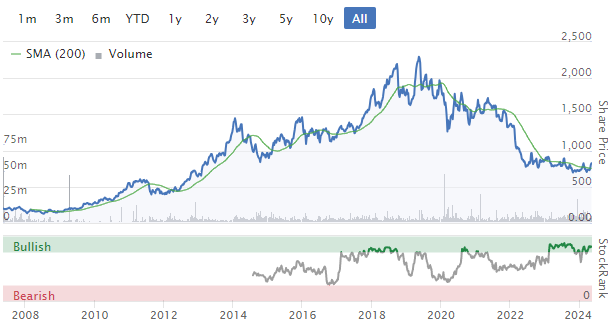
However, while Hargreaves undoubtedly faces some near-term challenges, trading appears to be stabilising. April’s third-quarter trading update was good enough to trigger a round of broker upgrades.
Hargreaves’ historic DNA is as a low-cost innovator. Today the company is a hugely profitable market leader. If CEO Dan Olley can combine these strengths to rejuvenate the business, I believe the shares could be cheap on a medium-term view.
In the meantime, I think Hargreaves £500m net cash balance and well-supported 5.7% dividend yield should help to underpin the stock’s valuation.
Summary
Pros:
Market leader with near-40% share
Very strong profitability and good cash generation
Modest valuation if business can return to earnings growth
Cons:
May need to cut prices to become more competitive
Ongoing legal action relating to Woodford affair
Highly competitive marketplace, can HL attract new generations of investor?
Profile
About the stock
Hargreaves Lansdown is an investment platform serving the direct-to-consumer market. It’s classified in the Financials sector, within the Investment Banking & Investment Services industry group.
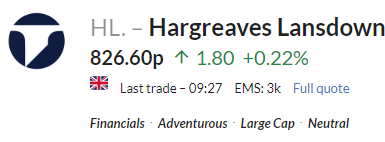
Hargreaves’ floated on the London market in 2007 and is currently a member of the FTSE 250, with a market cap of £3.9bn and a recent share price of 825p.
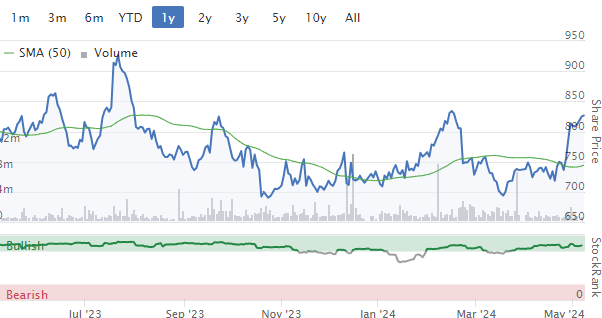
The StockRanks show a high quality score for Hargreaves Lansdown, but fairly average scores for value and momentum.
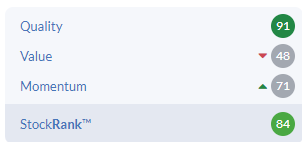
The stock’s overall style rating is Neutral. This suggests that while the business has some good qualities, it may be less likely to outperform in the near term than some higher-ranked companies.
About the opportunity
Hargreaves Lansdown is the market-leading DIY investment platform in the UK, with a market share of around 40%.
The company delivered an almost unbroken run of profit growth from its flotation in 2007 through to 2020. Profits then fell sharply through 2021 and 2022 before recovering in 2023.

Against this backdrop, former CEO Chris Hill launched an ambitious spending programme. This was intended to upgrade the company’s technology and develop its ability to offer advice-lite services. This expensive plan received a mixed reception from investors and led to a period of public criticism from co-founder and major shareholder Peter Hargreaves.
Mr Hill has since left the business and been replaced by former non-exec Dan Olley. He has promised a renewed focus on the company’s core products, better cost control, and improved customer service.
Hargreaves is widely seen as a more expensive option for clients than many rival firms and faces much more aggressive competition than it did 10 years ago.
Critics believe that to protect its market share, Hargreaves will have to cut its fees and sacrifice profitability.
More bullish investors, including me, believe the company’s scale, strong brand and mature offering should provide enough headroom for price cuts and innovation.
In my view, Hargreaves should be able to protect its market share without sacrificing too much profitability. I don’t think it needs to be the cheapest DIY platform, as long as its service and product offering remain among the best on the market.
On balance, I believe Hargreaves Lansdown shares offer both value and growth potential at current levels.
Business & Model
What is the company’s history and what does it do?
Hargreaves Lansdown was founded by Peter Hargreaves and Stephen Lansdown in 1981 as an investment newsletter, providing information on unit trusts and tax planning.
By the late 1980s, the company’s service had evolved to include investment management and to offer PEPs (a predecessor to ISAs). During the 1990s, the company started offering a full stockbroking service, gaining market share by simplifying the process for investing in funds and new stock offerings – popular during this era of privatisations.
Hargreaves launched its online share dealing service in 1999, with a minimum dealing charge of £9.95. This was the cheapest rate in the UK at the time and Hargreaves was seen as a low-cost innovator.
Today, the headline share dealing price advertised on Hargreaves’ website is £11.95 per deal. It’s no longer the cheapest, even among the large, full-service investment platforms. Key rival AJ Bell (LON:AJB) recently cut its standard dealing charge to £5, for example and also has lower platform fees.
Despite Hargreaves’ more complacent pricing, it has continued to grow. The group’s most recent trading update revealed an increase in customer numbers and record assets under administration at the end of March 2024.
How does the business model work?
Hargreaves charges a range of different fees on client assets and activities. These can broadly be divided into custody charges and service fees.
Platform fees – a charge based on the value of customer assets – have historically contributed as much as 50% of group revenue.
Stockbroking fees and fund management fees (on HL’s own fund products) are generally the next largest contributors.
This picture changed in 2023 as Hargreaves enjoyed a bonanza from rising interest income on cash held in client accounts.

Source: HL FY23 results
Like most of its rivals, Hargreaves is now sharing interest income more generously with its clients (who own the cash!). The half-year results indicated c.60% of interest is now passed through to clients.
Despite this, management expects to maintain a 2% revenue margin on cash as long as interest rates stay above 3% – which I think is likely. But the proportion of cash held by clients is said to be falling as they “invest, save or withdraw”.
I think net interest income will remain much higher than in the past, but I suspect it has peaked for now and will fall somewhat over the next 18 months. Hopefully, this will be offset by an increase in transaction fees and further gains in AUA.
Markets & Competition
What is the size and state of the company’s market?
Hargreaves Lansdown competes in the direct-to-consumer (DIY) subset of the UK investment platform market.
According to a recent report from Boring Money, assets under administration in the UK DIY investment market rose by 14% to £392bn last year.
Hargreaves’ own AUA rose by 12% to £142.2bn in calendar 2023, suggesting a slight loss of market share. Boring Money believes HL had a market share of 36% at the end of last year, below its historic peak of more than 40%.
The addressable market for UK investment platforms is expected to continue growing over the coming years, as investors take increased responsibility for their retirement savings. This seems logical, reflecting the structural decline in the proportion of workers who have final salary pensions.
Who are the company’s key competitors?
Hargreaves Lansdown is the largest UK DIY investment platform. Its closest competitors in the full-service category are companies such as AJ Bell and Interactive Investor (owned by Abrdn (LON:ABDN)).
Other mass market competitors include bank-affiliated offerings such as Halifax and those from trading services such as IG group (LON:IGG) and eToro.
Hargreaves also faces growing competition from newer platforms including so-called robo-advisors and low-cost services like Freetrade and Trading212.
Boring Money estimates that robo platforms now have a 22% share of customer accounts. However, these services typically appeal to younger investors with smaller investment pots, so their share of AUA is likely much lower than 22%.
It remains to be seen whether investors will graduate from cheaper, no-frills services to more comprehensive offerings such as Hargreaves, as they become older and have larger sums to invest.
How does it derive its competitive advantage?
Hargreaves’ competitive advantage is likely derived in several ways:
Brand: Hargreaves Lansdown’s leading market share and first-mover history means that it has strong brand recognition.
The value of this should not be underestimated, in my view. As with current accounts held with high street banks, many investors do not look beyond familiar well-marketed big brands when opening investment accounts.
Customer inertia is also a significant factor. Hargreaves reported client retention of 91.4% in Q3.
Switching costs: press commentary and anecdotal evidence suggest this is a controversial topic.
Some investors report unacceptable delays and unreasonable fee structures when transferring investment accounts between providers (I am not specifically referring to HL).
Other investors (including me) have previously moved their share dealing accounts between providers with minimal delay, zero cost and no problems at all.
The reality seems to vary quite widely. But I think the general perception is that switching is complicated and expensive, with the risk of problems. When this view is paired with customers’ natural inertia, I think that switching costs are perceived to be a barrier for many investors, even if they don’t need to be.
Network effects: there is no particular reason to use HL just because many others do. Unlike – say Rightmove (LON:RMV) or Auto Trader (LON:AUTO) – customers do not gain any benefit from using the market leader rather than a mid-sized competitor such as II or AJ Bell.
Having said that, Hargreaves’ size, longevity and FTSE 250 listing are likely to reassure investors that it’s a safe place to keep their savings.
Economies of scale? We might hope that Hargreaves’ size would generate economies of scale that could be passed onto investors in the form of lower fees. But this does not seem to be true. Indeed, I would argue that this is one of the main challenges facing the business.
I have to admit it’s not clear to me whether Hargreaves can enjoy any further economies of scale as it continues to expand. I wonder if costs such as technology, customer service and regulatory overheads may continue to rise in line with growth in the group’s customer base.
Is the competitive advantage durable?
Companies with market leadership are very often able to retain this for long periods, unless their position is disrupted by mismanagement, regulatory factors or technological change.
I think Hargreaves should be able to retain its market leadership, as long as it is well managed, sufficiently lean, and continues to innovate.
Of course, there’s no guarantee that this will be the case. Beyond its brand, I do not think Hargreaves has any clear intrinsic advantages over its larger rivals. Simultaneously, the group does face competition from newer generations of service that provide a quite different (and cheaper) user experience.
Financials & Ownership
What is the record of growth & profitability?
Hargreaves Lansdown’s revenue has risen at a compound average rate of 7.7% per year since 2014. Over the same period, operating profit has risen by 5.7% per year.

I think this is a solid growth rate for a fairly mature business, but when profits rise slower than revenue, this tells us that profit margins have weakened:

Hargreaves’ profitability is still exceptionally strong, but the group’s operating margin has fallen from just under 60% in 2014 to 48% over the last 12 months.
Cost inflation: one reason for this seems to be that operating costs have risen faster than revenue.
Stockopedia’s data show Hargreaves’ operating expenses rising from £150m in 2014 to £390m in calendar 2023. That’s a compound growth rate of 10% annualised, compared to less than 8% annualised revenue growth over the same period.
I can see several possible explanations for this increase in costs:
Bloat: as the group has expanded, it may have become less efficient
Overheads: technology costs and IT wages are examples of areas where the company has likely seen significant cost inflation.
Regulatory costs: hard to avoid, but larger companies usually find them easier to absorb as they can be spread over a greater number of customers
Competitive pressure and loss of pricing power: this sector is more competitive than it used to be. Customer acquisition costs may have risen, at the same time as the pricing power of Hargreaves’ core services has probably weakened. After all, the company’s original online dealing charge of £9.95 (in 1999) would be about £18 today, adjusted for inflation. Fees on actively-managed funds have also been cut as cheaper passive options have become popular.
I’d suggest that investors considering Hargreaves Lansdown need to form a view on how the group’s profitability is likely to evolve.
I would imagine that there’s scope for some cost savings after 15 years of strong growth.
But I also think that Hargreaves is going to need to cut the price of some of its standard services, too, in order to compete more aggressively with other larger rivals.
I suspect the profitability of the group’s core service offering will remain flat or decline slightly, but there may be scope to offer additional value-added services in the area of advice.
Is the balance sheet in good health?
I do not think shareholders need to worry about Hargreaves’ balance sheet. The group has consistently maintained a net cash position in recent years:

The FY24 half-year accounts showed net cash of £536m at the end of December 2023. That’s equivalent to 14% of the group’s market cap, or 18 months’ operating profit.
Is there evidence of historic share dilution?
As far as I can see, Hargreaves has never issued a significant number of new shares. The share count appears to have been flat for at least the last decade:

A lack of dilution is a common hallmark of owner-led companies.
What is the ownership of the company? Does management have stakes?
Founders Hargreaves and Lansdown have both retired from the board, but still control more than 25% of the company’s shares. Peter Hargreaves remains the company’s largest shareholder, with nearly 20%.
Management shareholdings appear to be fairly minimal. CEO Dan Olley was not in the role during the last financial year, but Stockopedia data only reveals one £55k purchase since his appointment.
CFO Amy Stirling owned just under 14k shares directly at the end of the last financial year and Stockopedia data shows her buying a further 6,764 since then. I estimate she has a holding that could be worth c.£165k at current levels.
Executive directors are required to build a holding equivalent to three times salary, but are typically allowed six years to achieve this.
Among institutions, noted long-term UK equity fund manager Lindsell Train is the group’s second-largest shareholder, with 12%. A number of other mainstream institutions also hold the stock in smaller size.

Valuation
How does the relative valuation compare versus industry and sector?
Hargreaves Lansdown’s valuation appears to be somewhat average versus the wider financials sector:

However, a more targeted comparison against FTSE 250 peer AJ Bell shows that Hargreaves looks significantly cheaper – albeit with much lower growth expectations:

What is the stock’s intrinsic valuation?
Analysts covering Hargreaves Lansdown have an average target price of 932p at the time of writing, implying 15% upside from the last-seen share price of 812p.

Alternatively, I’ve used the Gordon Growth model to estimate a fair value for the stock.
Price = Forecast dividend/(rate of return - dividend growth rate)
My calculations were based on the assumption that I’d require a 10% rate of return and that Hargreaves’ dividend will continue to increase at its recent average of 5% per year:

Plugging these values into the formula above gives me a fair value estimate of 928p per share – remarkably close to the analysts’ target price!
Trends & Catalysts
Are there any significant macro trends the business is benefiting from?
The overall size of the retail investment market is expected to expand steadily for the foreseeable future as the UK population ages, and more people take responsibility for managing their own retirement savings.
This seems likely to happen regardless of UK economic growth, due to changes such as the phasing out of final salary schemes and the increase in statutory retirement age.
This chart from AJ Bell’s FY23 presentation highlights recent growth and the scale of the remaining opportunity seen by AJ Bell – although note this includes advised assets as well as the DIY investor market where Hargreaves plays:

Source: AJ Bell FY23 presentation
Are there any catalysts that could drive a rerating in the medium term?
I can see two main catalysts for a re-rating:
Cost/price structure: if Hargreaves can deliver a sustainable reduction in its cost base and more competitive pricing while largely preserving its margins, then this might support a modest re-rating.
Advice market: AJ Bell is able to address both the DIY and advised markets by providing a different version of its platform for advisers to use to manage their clients’ assets. This is a big part of the retail investor market and one that Hargreaves may logically try and tap into.
Rather than building its own adviser platform and trying to enter an increasingly crowded market, one possibility is that Hargreaves will find a way to successfully expand its existing advice offering.
This has already been mooted by the company and was part of ex-CEO Chris Hill’s investment plan. I’m not sure if this goal has survived the transition to CEO Dan Olley, though.
Hargreaves’ current advice service only generated 1.5% of group revenue during the first half of this year. But if the company can find a semi-automated advice formula that scales, then I think the Hargreaves brand could be a strong launching pad for a service of this kind.
Risks, Threats & Hurdles
I think the main risk for investors is that Hargreaves Lansdown won’t change anything. I don’t think that would lead to a collapse, but I do think that it could lead to a period of below-average returns, where the high dividend yield was offset by a stagnant or declining share price.
At the very least, I think the company needs to sharpen its pricing.
Regulatory changes are also a possibility in financial services. One particular concern for me might be the risk that Hargreaves could fall foul of the regulator in any area relating to advice or the new Consumer Duty rules.
The Neil Woodford affair was perhaps a warning of how even a big operator might potentially leave itself exposed to liability in this way. A number of HL customers are going through the legal system to seek compensation for losses on their Woodford fund holdings, according to this article, and the issue has not yet been resolved.
Personally, I don’t think Woodford will do lasting damage to Hargreaves, financially or reputationally.
I could be wrong. But in my view, the growing quality and quantity of Hargreaves’ competitors is a more serious medium-term threat to the company’s market leadership.
Recent trading & news
Q3 update to 31 March 2024: Hargreaves most recent trading update struck a positive note, reporting net new business of £1.6bn and closing assets under administration at a record £149.7bn.
Good momentum into tax year end with increased gross inflows, net new clients and share dealing volumes.
Customer numbers rose by 34,000 to 1,858,000 during the period – the number of net new clients was 48% higher than during the same period last year, suggesting improved investor sentiment and risk appetite.
Revenue for the quarter rose by 6% to £199.7m and Hargreaves said that increased dealing volumes and platform fees helped to offset lower levels of interest income from client cash.
Half-year results for 6mo ending 31 December 2023: Hargreaves’ half-year results showed a slowdown in net new business, which fell by 38% to £1.0bn during the period.
Despite this, total assets under administration rose by 6% to a record £142.2bn and the group reported a 5% in adjusted pre-tax profit for the period, which rose to £221.5m.
Statutory earnings were held back by £17m of exceptional costs relating to technology write-offs and management restructuring, but overall guidance for the year remained broadly unchanged.
The interim dividend was increased by 4% to 13.2p per share, in line with guidance for the full-year payout.
Sentiment & Outlook
What do the brokers currently think and are they upgrading estimates?
City analysts left their forecasts more or less unchanged after February’s half-year results. But April’s third-quarter statement triggered an upgrade to forecasts to reflect improving net inflows and higher share dealing volumes.
Consensus earnings forecasts on Stockopedia rose by around 5% to 67.8p per share following the April release.

What would the person selling to us be thinking and who are they?
Although the company’s high margins and strong cash generation remain appealing, consensus forecasts for FY25 suggest earnings may remain flat next year.
Uncertainty remains around the company’s future plans for pricing and advisory services, both of which could influence market share and profitability.
Hargreaves faces tougher competition than in the past and arguably has not yet shown that it can win younger customers from newer low-cost services.
Investors taking a cautious medium-term view on the business might see the recent 15% share price gain and decide to reduce their exposure.
Conclusions
Hargreaves Lansdown is a market-leading business with a strong brand and market leadership in the DIY investment platform sector.
The company is currently facing some headwinds from higher technology spending, competitive pressures and new-generation robo-advisor and low-cost services.
The near-term profit outlook is relatively flat, but I believe the business has a medium-term opportunity to develop value-added services and find ways to attract newer generations of investor.
Although the share price is within 20% of my current fair value estimate, I think there’s scope for a re-rating if the company can deliver a leaner cost structure and a return to growth.
In my opinion, Hargreaves Lansdown is a credible choice as a contrarian buy at current levels.
Disclosure: Roland owned shares in IG Group at the time of publication.
Disclaimer
This is not financial advice. Our content is intended to be used and must be used for information and education purposes only. Please read our disclaimer and terms and conditions to understand our obligations.
10 comments
Good work on this one Roland! +35% for anyone who purchased on 8th May to today
Hargreaves Lansdown (LON:HL.) are giving back up to £100 trading fees until 21st June. However they did not tell me until l had done a trade. It started 1st May. If l have not done any trades before 21st June, l probably would not have known about it. Spoke to someone else who uses HL and he did not know about it either. Seems HL are under some pressure to keep their clients sweet. I'm still moving most of my ISAs to other platforms.
I will do a separate topic about it also.
Excellent analysis and fair coverage of both HL’s strengths and weaknesses. Roddy10 comments remind us why there continues to be significant short interest in the stock. Nonetheless, its strong financials and dominant market position afford it time and space to reinvent itself. If its management team is not up to this task then a takeover by one of the big US players might be on the cards. I too remain concerned about the CEO’s inexperience and ability although not his authenticity and the new non-exec Chair’s poor business track record.
The business was starved of net interest margin during the period of ultra low interest rates stemming from the 2008 financial crises. Whilst it may not be able to maintain the eye catching £268.7m contribution from net interest margin (up from just £50m in FY22) for the reasons discussed in the article and comments section it is very likely to see the contribution from net interest margin significantly higher than in the previous 14 years, and if the cash finds its way back into the market then higher broking and platform fees will likely compensate.
It’s undeniable that AJ Bell is growing more rapidly and has a more experienced and entrepreneurial management team than HL but this is in part reflected in its much higher rating. Although Hargreaves Lansdown has been a profitable investment for me since getting involved last autumn there might now be a case for now running with two horses rather than just one.
Incidentally anyone looking at the FCA attitude to cash in accounts ought to read page 28 of the 2023.12.07 FY23 results presentation from AJ Bell - https://www.ajbell.co.uk/group...
(1) I think it would be reasonable to make an estimate of potential litigation costs / regulatory and legal fees / compensation related to the Woodford affair. I suspect the circa £536M cash pile has not gone unnoticed by regulators and lawyers.
(2) I think the behaviour during the first phase of rising rates ie holding onto the windfall and not passing it through was reprehensible - and I am not convinced it fulfils their obligations of acting fairly w.r.t customers......I wonder if any lawyers have considered this and whether it matches the wider FCA obligations of acting fairly to customers (did I mention they have a cashpile of £536M?) [See slide 11 of this re Dear CEO letter - note that HL compares themselves to 'platforms' but that will include a lot of IFA platforms that have a different model to a low-cost stockbroker -https://www.hl.co.uk/__data/as... - in case link does not work I was referring to slide 11 of 2024 interim results presentation dated 22 Feb 2024]
(3) The interface and user experience is a tad clunky, unwieldy and underinvested. There were quirks which were a tad weird over Covid - eg they temporarily stopped their bed and isa service - surely that should have been fully automated this number of years after ISAs started?
(4) You mention your dividend expectations and I think this gets to the nub of the matter. This is a company where investors and management have focussed more on the reliability, regularity and growth of dividends rather than investing for future business. Notwithstanding that I am shocked by the overhaul costs (think there was a proposal to spend £175M on IT by previous mgmt) - especially those proposed by previous management and I suspect the cash pile might have had something to do with their largesse (did I mention the cashpile of £536M).
(5) I think the risk for Hargreaves is that market share loss will be slowly at first and then a lot all at once.
(6) The previous chair (Deanna Oppenheimer) left as well as the CEO. I think this is worthy of note.
(7) Three of the current board - John Troiano, Michael Morley and Adrian Collins have wealth management / fund management experience. I think that is an upgrade - as I have felt the company had been losing its way. Nonetheless, I think that a lot of HL's weakness is due to a lack of understanding of the plumbing of financial markets and what customers want, right from the top - I am still to be convinced that the present CEO ('seasoned technology leader and has a track record of driving digital transformation in established businesses'.....'brings problem solving and analytical skillset' - all from https://www.hl.co.uk/about-us/... ) is the right leader. The chair also does not appear to have relevant vertical domain experience.
(8) Abrdn bought Interactive Investor at frankly an overinflated price. In order to 'justify' the acquisition, I think it is reasonable to anticipate that Abrdn will be pumping in advertising spend and so the marketing / advertising intensity in this market will increase - that would, I anticipate, increase the cost of acquisition and cost of retention of new customers for HL.
(9) The 'belief' is that new management has reined in the spend. Slide 12 of the interim results presentation 2024 however mentions 'strategic investment spend' of '£175m + £50m'...hmmmm... and if you look at a lot of the boxes on the page one could easily forget this is an investment platform / stockbroker. (Also slide 30).
(10) Slide 18 in the above is interesting as asset retention is 90.4% (vs 92.2% client retention) - this goes back to my point earlier that market share is lost slowly at first....
(11) Some of the management slides are from the school of Vernon Hill (eg slide 21 'Delight clients, drive growth').
(12) Overall I think the key to valuing HL is:
(a) has it been overearning due to covid / interest rate spread? What is the true underlying profitability in a normalised environment going forward?
(b) has the competitive intensity increased with the involvement of Abrdn in the sector?
(c) is the leadership focussed on the right things - or developing a zoo of technology acronyms which are not going to solve the underlying issues for customers? (eg no mention of a tool to match stockopedia?)
(d) what do I need to deduct as a contingency for litigation / fines etc?
(e) in a recessionary environment how much of the cash stashed away in HL (eg in the cash ISAs / multi-bank cash isa) going to be withdrawn?
---
Notwithstanding that a lot of my family's investments are held at HL - but I was recently looking at the costs / expenses and have a note for myself to consider moving over the summer to someone else - probably AJ Bell.
Hi Roddy,
Thanks for your in-depth comments. I agree that risks remain at Hargreaves Lansdown (LON:HL.) and spending plans are still substantial under the newish CEO.
I have to admit that although I've used several of the big platforms, I haven't used HL, so I can't comment on the interface. But my view broadly is that it makes sense for Hargreaves to invest in updating its technology, not least because this could help recruit new generations of customer.
The market is still shaking out and adjusting to higher interest rates and tougher competition, in my view.
I'd argue that history suggests many newer upstarts will come to nothing, while a few will thrive. Meanwhile, incumbents with strong market share start off with a strong hand. If HL loses all of its advantages, it will probably be due to mismanagement, in my view.
With Hargreaves and Lansdown still controlling a substantial shareholding, I would hope that isn't going to happen. But it could do...
Regards,
Roland
I enjoyed the analysis and agree the thrust of it. If they are x growth and not attracting next generation investors it will take time to register in the valuation and at this stage not immediately apparent. Existing customer base is sticky and supports the valuation. Cost base control should be better from the market leader but the foray into advisory services ill judged. Sticking to the knitting and being more adept at winning new long term younger customers the answer.
Thank you for such a comprehensive piece of analysis.
Thank you, Roland, for your insights on Hargreaves Lansdown. You've rightly pointed out a key issue, that despite being a market leader, they no longer offer the lowest prices or the most innovative features, which I believe could be critical in attracting a price-sensitive, tech-savvy audience. This suggests that their historical competitive advantages, such as strong brand recognition and customer loyalty, may not suffice in the long term. To maintain their market position, Hargreaves Lansdown could very much benefit from reassessing their pricing structure and enhancing platform functionalities to meet changing investor expectations. For instance, I haven't made significant investments in my portfolio with them for years, and their accounts team has yet to take notice, which speaks volumes about their client engagement (other platforms have benefitted as a result). I think that ultimately, Hargreaves Lansdown's ability to adapt to market changes, especially in pricing and technology, will be crucial for sustaining their competitive edge in a crowded and evolving marketplace.
---