Iofina: does October’s pullback leave an opportunity for this Super Stock?

Iofina's first-half output rose 29%, operating profit nearly trebled and the balance sheet moved into net cash compared with a year earlier. Those are the types of numbers that deserve a closer look.
Then came the 16 October update. Lower water supplies and delays at two plants prompted a cut to second-half production guidance. The shares were down 12% at 48.50p late that morning.
At around 50p, I think there could be an opportunity here. Iodine prices remain firm, the largest plant has been commissioned and two more are due next year.
The company also carries a StockRank of 96 and Super Stock status – like Churchill China, which I covered two weeks ago, it fits the bill for Ed’s list of Speculative Super Stocks.
Of course, there are caveats and questions. Iofina has disappointed on production before. The question is how much confidence to put in the next stage of growth and whether medium-term targets are reachable – neither of which I have the answer to.
The Pitch
Iofina extracts iodine from the brine water produced alongside oil and gas, with its operations primarily in Oklahoma. Its plants sit beside its partners’ disposal wells, recovering iodine before the water is disposed of. The company’s chemical business, based in Kentucky, sells crystalline and prilled iodine and makes iodine derivatives for a range of industrial and healthcare uses.
As the market cap (£98 million) suggests, this is a small producer, and it operates in a market dominated by Chile and Japan. Iofina has little influence over the iodine price, but it can increase the amount it produces – and this is a large part of the investment thesis.
In the first half of the year, production hit 393.3 tonnes – the aforementioned 29% rise -- while the company’s operating profit rose 178% to $4.9 million. H2 guidance has been cut, to around 440–455 tonnes, but that’s still above last year’s 437.6 tonnes – still moving in the right direction.
And as alluded to, it’s expanding. IO#12, its largest plant so far, had been commissioned by 16 October. At that point, production was expected to begin over the following weeks. IO#13 and IO#14 are targeted for the end of H1 2027.
And then there’s the valuation. The stock trades on 11x rolling forecast earnings. Demand for iodine used in X-ray contrast media is growing at around 6% a year, according to SQM.
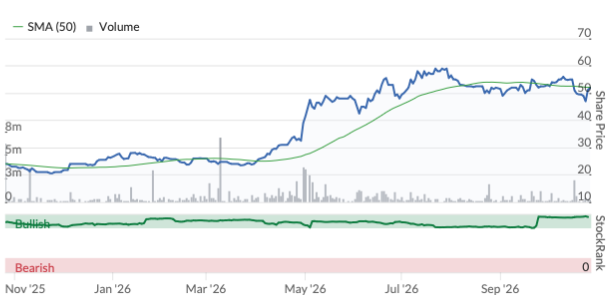
[Chart: Iofina share price, 12 months. Source: Stockopedia]
The Big Picture
Healthcare is the largest source of iodine demand. SQM estimates that X-ray contrast media accounted for 38% of the market in 2025, with pharmaceuticals and LCD/LED applications at 13% each. Meanwhile GE HealthCare expects demand for CT and X-ray contrast media to double over ten years – it’s investing $138 million in its Cork (Ireland) plant.
More diagnostic scans mean more demand for contrast media. This is a useful tailwind, but it doesn’t make the whole iodine market immune to the economy. SQM estimates total demand grew just 0.6% in 2025 and expects around 3-4% growth in 2026, to approximately 40,000 tonnes.
What’s more, the vast majority of iodine is produced in just two countries. The USGS estimates Chile produced 23,000 tonnes in 2025 and Japan 9,000 tonnes; US production is withheld. SQM puts its own market share at about 37%.
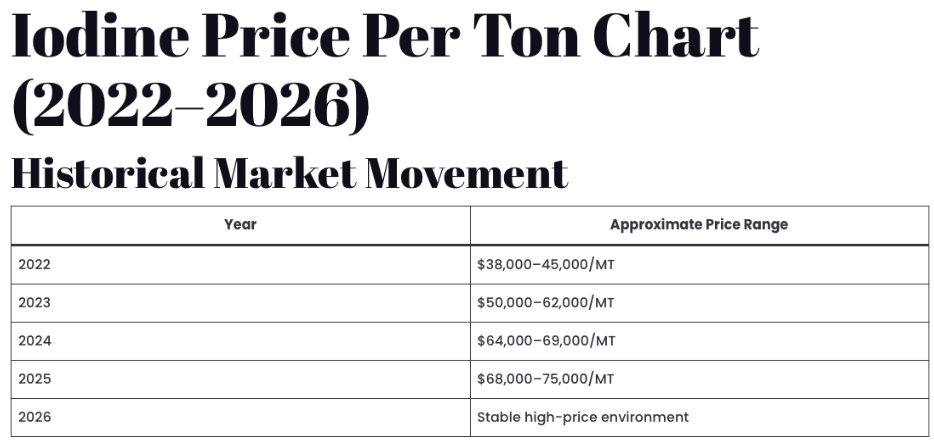
[Chart: Iodine price per tonne. Source: Cavin Resources]
Going Deeper
The first-half results suggest there’s some real momentum here.
A much better first half. Revenue rose 7% to $31.3 million, gross profit increased 62% to $10.2 million and adjusted EBITDA doubled to $6.6 million. Profit after tax was $3.5 million against $2.5 million, despite the prior period benefiting from government subsidies.
Higher output brought unit costs down. Iodine production rose 29%, while average production costs per kilogram fell 15%. Iofina’s plant operating costs are largely fixed, so higher output spreads them across more tonnes. Better water volumes, a milder winter and cost control also helped. With selling prices barely changed, this helps explain why adjusted EBITDA rose 103% despite revenue increasing only 7%.
The 2025 comparison needs care. Forecast net profit of $7.90 million for 2026 looks flat against $7.87 million last year. But 2025 included $2.1 million of US Employee Retention Tax Credits. No further payments are due.
Meaningful output increases incoming. IO#12’s annual production target is 170–220 tonnes. The additional IO#11 pipeline is expected to add 45–65 tonnes a year. Those are meaningful additions against last year’s group output of roughly 743 tonnes.
Targeting 2,000 tonnes a year. IO#13 and IO#14 will contribute towards management’s medium-term target of 2,000 tonnes a year. At the October update, groundwork was expected to begin shortly.
Water is an issue. Q3 production fell to 205.2 tonnes from 215.8 tonnes. Iofina cited lower brine volumes, maintenance, delays to the IO#11 pipeline and delays commissioning IO#12. The business also said that supplier upgrades temporarily shut some disposal wells.
Big shareholder tops up. Richard Sneller held 24.38% at 30 June 2026, up from 21% before the holdings notifications issued in March and April.
Valuation
The forecasts make Iofina look attractively priced for long-term growth. However, with just one broker covering the stock, it’s worth treating these figures with a degree of caution.
11x rolling forecast earnings. The 2027 PE is 10.2x, with EPS forecast to grow 63.4% that year.
$7.2 million of net cash at 30 June. That compares with $0.8 million of net debt a year earlier. The $6 million revolver was undrawn, and a further $10 million capex facility has been arranged.
Strong cash generation. The company has generated positive free cash flow per share in every year from 2020 onwards, reaching 4.33 cents over the latest 12 months. In H1 2026, operating cash inflow of $7.85 million covered $5.76 million of capex.
A healthy balance sheet. Current assets cover current liabilities 2.57 times, while the F-Score is 9/9 and the Z-Score is 5.62. Together with its net cash and borrowing facilities, this gives Iofina room to fund expansion. There is no dividend, and management has not committed to a start date for payouts.
And here’s some Mike Bassett-style maths (if you get the reference). IO#12 and the additional brine supply to IO#11 have a combined budget of $10.2 million, targeting an extra 250 tonnes a year at the midpoint. At $74.69/kg, that would equate to about $18.7 million of annual revenue, assuming the production volumes are measured on the same iodine-equivalent basis as the selling price. That’s revenue rather than profit, of course, but it helps explain the attraction of building more plants.
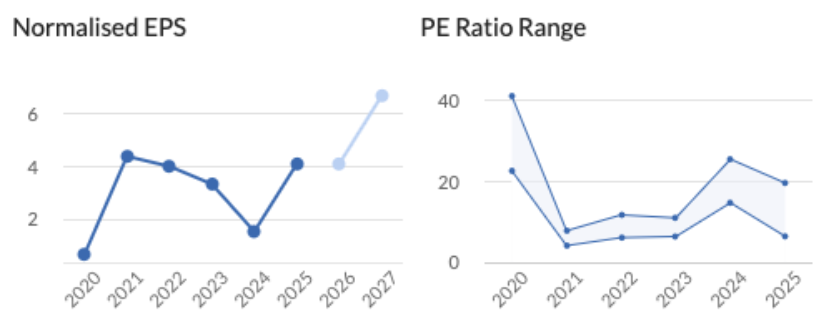
[Chart: Iofina EPS and PE ratio, five years. Source: Stockopedia]
What the Brokers Say
Canaccord Genuity is Iofina’s nominated adviser and broker. With just one broker, the limited coverage is worth bearing in mind.
The forecasts show EPS of 4.10 cents for 2026 and 6.70 cents for 2027. Revenue is expected to rise from $69.9 million to $94.6 million, with net profit increasing from $7.90 million to $12.9 million. There has been no change in consensus EPS over the past month.
The stated price target is $0.94 and implies a 37% upside.
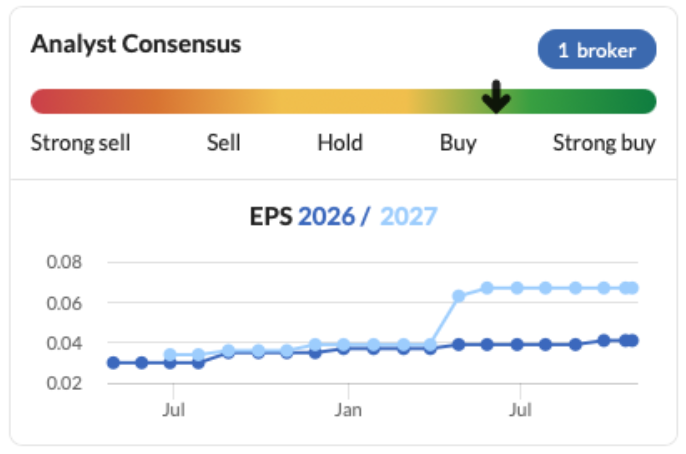
[Chart: Stockopedia analyst consensus. Source: Stockopedia]
The Bear Case
The biggest risks are water supply, iodine prices and getting the new plants running.
Water supply keeps causing problems. Iofina relies on its partners for brine, and disruptions have repeatedly hit production. October brought another guidance cut. Q4 now needs 234.8–249.8 tonnes, against 205.2 tonnes in Q3, to meet the revised range.
The iodine price could fall. Strong prices underpin the expansion case. SQM has said its sales volumes could moderate toward year-end as competitors introduce supply. More supply could pressure prices just as Iofina increases output.
The new plants must deliver. IO#12 needs to ramp up, with IO#13 and IO#14 due by the end of H1 2027. Delays, higher construction costs or lower output would put the earnings forecasts at risk.
Losing a large customer would hurt. The biggest accounted for 17% of 2025 revenue.
Trading costs are substantial. The quoted spread was 426 basis points, or 4.26%, at the last check. That’s a sizeable hurdle before an investment makes money.
The Bottom Line
There’s plenty that interests me when I look at Iofina. The first half showed how higher output can lift margins, and operating cash flow covered the plant investment. There’s net cash on the balance sheet and more capacity on the way.
At 11x forward earnings, the valuation looks reasonable, but it needs the growth to come through. Another production miss would make those forecasts harder to trust.
For now, I think the growth case survives October’s setback. Even the bottom of the revised range beats last year’s second-half output. The next test is whether water supplies recover and IO#12 delivers.
The longer-term prospects could be significant. Management’s target of 2,000 tonnes a year compares with 743.2 tonnes produced in 2025. There’s considerable scope for growth if the company can deliver it.
I’d expect the Q4 update in January, based on previous years, although no date has been confirmed.
Disclosure: James Fox has no position in Iofina.
Disclaimer
This is not financial advice. Our content is intended to be used and must be used for information and education purposes only. Please read our disclaimer and terms and conditions to understand our obligations.

1 comment
Thanks James, good writeup what is SQM though?