Is Shell really still a Super Stock?

Correction: This article previously missed a disclosure statement. Roland Head owns shares in Shell.
Anyone who bought big oil stocks in the depths of the 2020 crash has done very well. Shell (LON:SHEL) shares have more than doubled since October 2020. The dividend is also now 50% above the reduced payout announced in 2020.
Shell’s share price recently topped its pre-pandemic level, before slumping as the market started to price in weaker demand for oil.
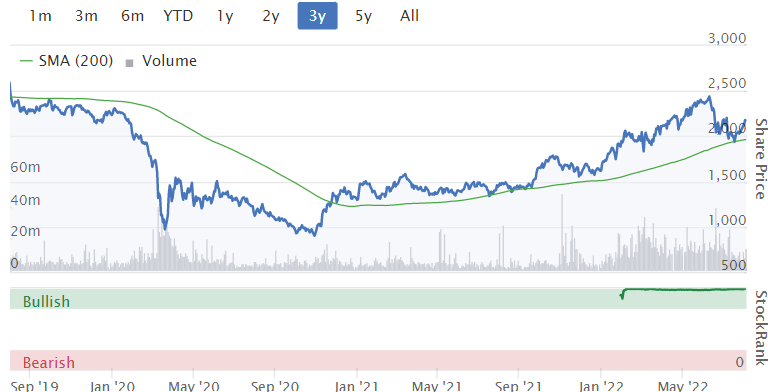
However, Stockopedia’s algorithms are taking a more bullish view. They’ve digested the group’s half-year results and still rate Shell as a Super Stock, with a StockRank of 99.

Shell’s dividend looks rock solid to me and I do not expect another cut. But with profits expected to peak this year, I’m unsure of the case for growth or a further re-rating of the shares.
To find out more, I’ve decided to dig into the story (and the numbers) a little further this week.
Known knowns, unknown unknowns
Early on in my investing career, a much more experienced investor told me to remember that the oil market always overshoots.
We saw this in the early months of the pandemic, when the price of some oil contracts briefly went negative. There was a new groundswell of pressure on fossil fuel producers to clean up their acts. Very little attention was given to the inevitable rebound in energy demand when the pandemic eased.
I wonder if we’re now seeing energy markets overshoot to the upside. Brent Crude recently came close to $140 per barrel, before settling back around the $100 mark.
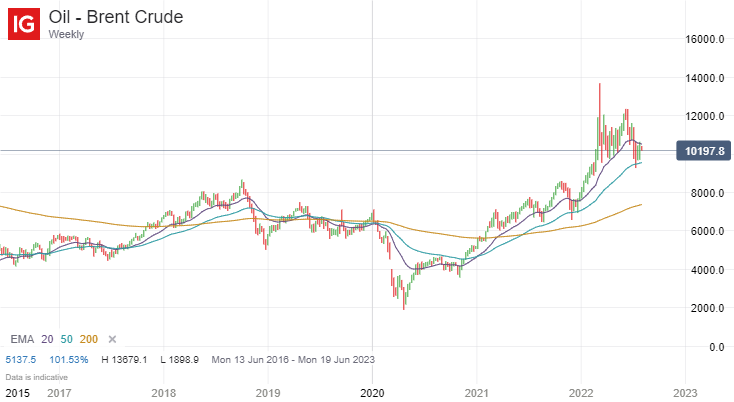
Source: IG Group
For Shell and its rivals, high oil prices have been a boon. But oil prices are still well above pre-pandemic levels. This seems to assume that demand will be higher than in 2019, or that supply will be more restricted. I’m not sure how strong either argument is.
For example, this recent FT article (paywall) suggests to me that the UK, EU and US may be inclined to continue allowing Russian oil shipments, as long as they are going elsewhere.
Shell’s own Brent crude price assumptions are for $80 for 2023, and $70 for 2024. These numbers would leave oil trading broadly in line with pre-pandemic levels.
In addition to high oil and gas prices, Shell’s refineries have also driven profits higher this year. The company’s average refining margin per barrel quadrupled from $5.70 in Q3 2021, to $28 per barrel in Q2 2022.
This increase was driven by fears that sanctions could trigger fuel shortages. But I think that any sign of slowing demand would relieve this pressure.
In short, I think this is a difficult situation for investors. Shell is trading well and looks very cheap. But profits seem likely to drift lower, perhaps for several years. What’s a fair valuation? Let’s take a look at the numbers.
Valuation: one metric that isn’t cheap
Shell has a ValueRank of 88 and looks cheap on many of my favourite valuation metrics.
- Earnings yield (EBIT/EV): 20%
- TTM P/E: 6.4
- TTM P/FCF: 5.4
- Price/book: 1.0
If the current levels of profit and free cash flow are at all sustainable, then the shares appear to be very cheap.
However, there’s one valuation metric that suggests to me that Shell’s share price is already well up with events. The dividend yield.
Shell’s trailing dividend yield is only 3.7%. Although the payout has risen quite quickly since being cut in 2020, I think it’s worth remembering that Shell’s medium-term guidance for 4% annual dividend growth remains in place.
Recent dividend growth has exceeded this rate, but only due to the exceptional circumstances. I’m not convinced these will continue. Broker forecasts support this view. Consensus estimates show dividend growth slowing to more normal levels from next year:

Expected rate of return: One valuation technique I like to use is to estimate the expected rate of return by adding a stock’s dividend yield and its forecast dividend growth rate.
This approach is based on the assumption that the share price will change to keep the dividend yield constant.
Here, we can see that Shell’s expected rate of return is likely to be around 9% over the next year, based on a 4% yield and dividend growth of 5%.
9% is slightly above the long-term average annual total return from the UK market of 7%-8%. On this basis, I’d say that Shell shares might be slightly cheap.
For a mature business that’s expected to report declining earnings and has a mediocre record of through-cycle profitability, I don’t find this level of value very tempting.

This leads me to the conclusion that the real opportunity here is that market conditions will remain stronger for longer than expected.
I think that Shell’s momentum metrics do provide some support for this view.
A third momentum factor?
Shell’s MomentumRank of 99 suggests a very strong technical picture. The numbers certainly stack up well.
The stock’s price momentum metrics are mostly green, although the recent sell-off is reflected in negative 1m relative strength and a fall in trading volumes versus the three-month average:

The consensus trend chart also show repeated earnings upgrades over the last 12 months:

A third momentum factor: Shell’s current profitability and strong cash generation is supporting massive share buybacks and ongoing debt reduction. These activities are taking place on a fairly epic scale.
Net debt has fallen by $22bn since the end of 2020, and Shell has committed to share buybacks of $15.5bn in 2022 alone. That’s around 8% of the group’s current market cap.

While share buybacks don’t directly put cash in shareholders’ hands, they do help to support earnings per share growth and cut the cost of future dividends. Deleveraging has a similar effect, ultimately.
If I’m wrong, and commodity market conditions stay stronger for longer, Shell will also be able to cut debt and reduce its equity base to a greater extent than expected. That could provide a strong tailwind for future shareholder returns.
Conclusions
It’s not hard to see why Shell might be classed as a Super Stock. The shares look cheap and the business has strong fundamentals, improving profitability, and stunning momentum.
However, while I am a big fan of systematic investing, I can’t completely ignore what the company’s own management appears to be telling us.
Shell’s dividend is expected to be covered five times by earnings this year. But rather than consider a special dividend for shareholders still smarting from the 2020 cut, Ben Van Beurden and his board are focusing resolutely on buybacks and debt reduction.
This approach tells me that Shell’s board believes that the future will be smaller. Smaller profits, and perhaps lower returns on investment as the focus tilts to renewables.
Higher levels of capital expenditure may also be needed at some point, to fund future returns and more ambitious acquisitions.
Ultimately, I can see two plausible but quite different pictures for Shell shares. Personally I’m cautious, but this is a situation where we all need to DYOR and decide for ourselves.
Disclosure: Shell is a constituent of the SIF Folio Roland Head owns shares.
Disclaimer
This is not financial advice. Our content is intended to be used and must be used for information and education purposes only. Please read our disclaimer and terms and conditions to understand our obligations.
16 comments
The biggest risk to Oil and Gas companies is the governments hitting them with windfall taxes. All these will do is reduce further the supply and add to the crisis.
Peak oil supply is here. The Saudis have said “they maybe, possibly, if we can, we will look into increasing their oil production from 12mbopd to 13 m - maybe in the next few years”. They are maxed out.
US shale has also peaked in 2 of the 3 main shale discoveries.
Meanwhile The US is currently releasing 1 million barrels per day from their reserves which is reducing the global price. They are only doing this To try boost support for sleepy joe at the midterm elections. The reserve will be empty long before the end of the year.
Financial engineering is being used to try and reduce the oil price, but The saudis know this and basically said they will reduce supply to support oil price.
There is almost zero chance of the oil companies having bad results for the next 5 years. It will take at least that time frame to meaningfully increase oil supply by exploration and drilling.
Global reserves are running out, There is no $50 oil left in the ground, but there is plenty $100, $200 oil......
I don’t hold Shell at the moment due to the polical risk of crazy envy politics mentioned above. Also any oil company saying it’s going to come carbon free is insane.
That’s like Greggs saying they will be pastry free.
"Also any oil company saying it’s going to come carbon free is insane."
I had exactly this conversation with my father this morning. Petrol is a hydrocarbon, along with many other products that comes out. Carbon. The clue is in the word. That's their actual business model. So to say that they're carbon-free is absolute nonsense.
Google also said recently that they were carbon-neutral. That's slightly more credible, but still unlikely. Google uses massive amounts of electricity. You have to perform significant contortions to come up with the idea that they're carbon-neutral.
So please, can everyone please stop jumping on the "we're carbon neutral" bandwagon because the truth is that everything down to the cellular level consumes energy in some form and produces waste that needs to be disposed of.
Spleen vented.
"That’s like Greggs saying they will be pastry free."
I'm writing that one down!
The only “Carbon” the WEF and their followers want to get rid of is You, Us, ie the “useless eaters” as the WEF described us.
As you say reduction of “ Carbon” is nothing but a political policy. Pollution, yes we can reduce that, but CO2 is literally plant food.
your comment about google is right, the full nonsense of companies claiming they are carbon neutral was demolished in the film by Michael Moore a couple years ago
Planet of Humans
Personally I think “they” realize Peak oil has finally arrived and the only way supply is balanced is by population is by a massive reduction of the population. It’s a managed decline to stop the sales of pitchforks rocketing! ;-)
Hi Roland,
Another well written thesis.
Shell (LON:SHEL) still has a 25% upside from today's price based on @Tocqueville 's DCF valuation.
I own this stock and brought it at a higher valuation than today's price. I believe it has sufficient runway for capital appreciation and capital returns to shareholder via BBs and Dividends, even at their own estimate of oil prices. Nobody can say which way Oil prices will go, assuming it doesnt drop below $60 a barrel, Shell (LON:SHEL) should give a good return. Furthermore, I expect it to accelerate its renewable energy business and I forecast it to be the leading if not the biggest renewable energy player in the market. You can see the signs of these in their greenfield, brownfield and acquistions. Climate change nazism not withstanding, I dont believe the epitaph for Big Oil is written yet. I reckon there's a couple of decades return extraction due.
Summary - A Super Stock(ish) investment now, if you can stomach its volatility induced by oil prices.
Hi Roland,
What are you doing with your holdings in Shell ?
Buying, Holding or Selling.
Regards
Melvyngd
Made 61% since Feb 2021 + divs, so it seems super stockish to me :-), that said, its probably time to take some profit ,
Then again, if they can refocus into EV charging and/or Hydrogen fuel cells, who knows? I'm happy to take profit now and see what develops...
Hopefully, his maybe the last of the fossil fuel gains :-)
There are some good comments here most of which I agree with. I have a large holding in Shell (plus a smaller holding in BP) and around 18% of my portfolio in oil. Research I have read (Gorozen being the best) suggests an imbalance between supply and demand leading to significantly higher oil price.
I think Roland places too much emphasis on the dividend yield. The true return to investors is dividend plus share buy backs. BBs are not universally popular with smaller investors but where used cleverly (Apple is a good example) can lead to significant increase in shareholder value.
Kuronagi,
I think the debate between buybacks and dividends is an interesting one, but I think that many companies fail to pay sufficient regard to the price being paid when they buy back their shares.
In the case of Shell (LON:SHEL) at present, the buybacks are being carried out close to book value, so the price being paid seems reasonable. However, I can't help seeing the buybacks as a hedge against an uncertain future by BVB and the board.
I may be too sceptical - things could well turn out better than I expect. Time will tell; that's what makes a market.
Regards,
Roland
gorozen have published some incredible work.
I recommend everyone read this then go buy some O&G companies.
Gorozen - Gas crisis coming to USA
thanks very much for the link posted above
Well worth reading for anyone interested in the commodity sector
I bought Shell (LON:SHEL) two months ago. My own preference is for further share buybacks over increases in the dividend. It suggests to me a longer term approach to profitability and at 3.77% the dividend is hardly negligible as it stands. Also share buybacks appear good value and shrewd capital allocation given that the Price to Tangible Book Value is a mere 1.16 and the F/PE is only 5.1.
Shell is also one of the early movers in terms of grasping new energy including Biofuels, Wind Power and Electrification, but I also think it is well placed to play a large part in the emerging issues of energy security and independence which require increased production of oil and natural gas.
I note also that Warren Buffett has been loading up on Occidental and Chevron in the past few months which suggests to me that he thinks the economics of energy firms are very strong at the moment.
Interestingly using the company v company comparison Shell easily beats both Occidental and Chevron.
Shell is also one of the early movers in terms of grasping new energy
Yes, this point is worth emphasis.
ITM Power's (ITM) experimental filling station is at Shell Beaconsfield. The contribution to profits is close to zero but I should rather hold SHEL than ITM with a value of 3.
BP also has a 41% stake in an Australian project so both majors are on to Hydrogen but neither is ignoring the future of energy. Growth stocks?
https://www.theworldofhydrogen...
I have to agree with Bouden 54 about the size of the dividend probably being a PR decision. I do not normally invest commodity companies but in the present exceptionally unpredictable circumstances I think it is good hedge against the negative impact of high energy prices on the market and on my own personal energy bills. Like aflash, the reason I chose Shell was its large and expanding exposure to LNG which distinguishes Shell from many other major oil companies. I have also invested in Chesapeake Energy and Comstock Resources in the US for the same reason and so far so good.
I think you're paying too much attention to the dividend, which I don't think is a useful valuation metric in this case. The company could comfortably increase the dividend many times over but is mindful that this does not look good from a PR perspective (given the energy/cost of living crisis) - so buybacks are their chosen method for returning cash. I do not think the low dividend is because the company believes it is not sustainable as you suggest.
While current high oil prices may not last, Shell is still very profitable and would offer good value 60-70 dollar oil. At the very least I feel Shell offers a good hedge in the event that oil prices remain high. For me, the main risk is some sort of government intervention or windfall tax - I am more concerned about this than the risk of falling oil prices or recession.
Many moving parts.
Of particular interest to me is LNG.
The impairment from divestment in Russia's Sakhalin island LNG project will affect results.
The LNG shipping business and Shell's expertise will prosper.
Then Green Governments threaten new developments so oil companies are less inclined to make multi-year investments in exploration.
That may keep the oil price high.
So many fund managers and pension funds park cash in the share that price movements are central to U.K. market perceptions.
Big employer & tax payer too.
Discounted Cash Flow analysis of Shell (worst case scenario)
Discount rate: 8%
EPS TTM: 416
Estimated EPS yearly growth: 0% (very conservative)
Terminal value at the end of a 10 years period: 0 (ridiculously conservative, assuming the company will be worthless in 10 years just to entertain the most outlandish 'green energy' narrative)
Intrinsic value: 2,791.39