Kitwave (LON:KITW): quality management and growth potential

Summary
Wholesaler Kitwave (LON:KITW) specialises in supplying frozen, chilled and ambient goods to convenience stores and foodservice businesses across the UK.
The group floated on the AIM market in 2021 and continues to be run by founder Paul Young. The shares score well for quality and momentum factors but remain reasonably priced, in my view. I think this business has considerable growth potential and recently added the shares to my SIF Folio.
Bull points:
Strong record of buy-and-build growth
High ROCE and good cash generation
Experienced owner-management
Reasonable valuation
Bear points:
Significant exposure to a few large customers
Exposed to macroeconomic headwinds in foodservice
Acquisitive model could go badly wrong
Profile
About the stock
Kitwave operates in the Consumer Defensives sector and is part of the Food & Drug Retailing industry group.
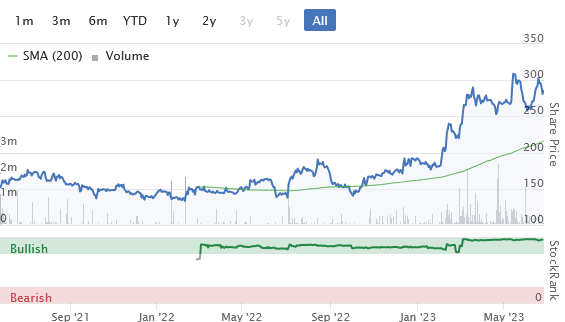
The group floated on the AIM market in 2021 and the stock has recently traded at 290p, giving a market cap of £202m. Liquidity is reasonable for a small cap, with a 73% free float and recent average volumes of c.300k shares per day – about £900k.
The StockRanks show high quality and momentum ratings, suggesting Kitwave could possibly fit the adventurous growth profile Megan discussed last week.

Kitwave shares have doubled since their IPO, but a forecast P/E of 11 and 3.8% dividend yield suggest to me that the business may still be reasonably valued.
About the opportunity
Stockopedia’s algorithms currently view Kitwave as a Super Stock.

The business delivered organic revenue growth of more than 25% last year, together with improved profitability and strong cash generation.
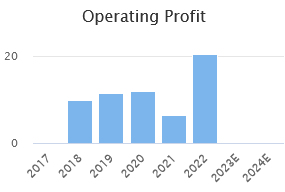
Consensus forecasts suggest another strong performance during the year to 31 October 2023, with growth expected to flatten out during the following year.
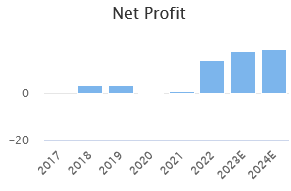
At some point, I expect growth to slow as the business reaches a more mature scale. But the markets in which Kitwave operate are relatively fragmented and it may be possible for the company to continue expanding for some time yet.
Rival Booker (owned by Tesco (LON:TSCO)) is significantly larger and is continuing to expand at an attractive rate.
In the past, careful use of acquisitions has allowed Kitwave to enter new markets and expand its geographic coverage. I expect this strategy to remain a significant source of growth.
Business & Model
What is the company’s history and what does it do?
Wholesaler Kitwave was founded by chief executive Paul Young in 1987 as a single cash and carry. It’s since expanded to operate a fleet of 550 delivery vehicles from 29 depots around the UK.

Customers include convenience stores, pubs, restaurants, leisure centres and other wholesalers. One of the company’s key strengths is its relationship with branded goods producers, who trust Kitwave to provide a route to market into independent retailers.
Key business segments and revenue breakdown
Kitwave supplies a wide range of frozen, chilled and ambient branded goods, in addition to fresh produce for foodservice customers.

Ambient (2022 op. profit: £6.8m): distributes ambient branded products such as snacks, confectionery and soft drinks to retailers and vending services. Last year saw a 14% increase in cases supplied compared to the prior year. Operates under brands including Squirrels and Westone Wholesale.
Frozen & chilled (2022 op. profit: £6.4m): described by management as “preeminent route to market partner for the brand owners” for supplying frozen and chilled foods into independent convenience stores. Reported a 9% increase in cases supplied last year. Operates under brands including Eden Farm Hulleys.
Foodservice (2022 op. Profit £8.9m): higher-margin business supplying the catering trade. Delivered a strong post-pandemic recovery last year. Operating brands include HB Clark, Millers Alpine and M.J. Baker.
What is the business model? How does it make money?
As a wholesaler and distributor, Kitwave makes money by buying in bulk and then distributing many small orders to closely-grouped customers.
Kitwave stocks more than 30,000 SKUs (individual items) sourced from over 300 suppliers. These are consolidated in the company’s warehouses and then supplied to customers in small mixed orders.
Providing this consolidation and distribution service allows Kitwave to add a mark-up to its stock costs and generate a profit.
Markets & Competition
What is the state and size of the company’s market?
In its admission document, Kitwave said that the UK grocery and foodservice wholesaling market was estimated to be worth £28bn in 2020. This figure was expected to reach £32.6bn by 2025.
Although there are a number of national competitors that Kitwave is unlikely to compete with, the company believes the remainder of these markets are highly fragmented and offer opportunities for growth.
The admission document includes the following graphic. The green segments (34% of retail and 46% of foodservice) represent “smaller local and regional competitors” that may provide opportunities to expand through consolidation (i.e. acquisition):

Kitwave’s group revenue was just over £500m last year. This suggests to me that the group could still have plenty of room for organic and acquisitive growth.
Who are the company’s key competitors?
For UK share investors, one of the best-known rivals to Kitwave is probably Booker. This former FTSE 250 firm was acquired by Tesco in 2018 and has continued to expand steadily. Tesco’s FY23 results show that Booker generated sales of £8.7bn last year.
Rival wholesaler and retail operator Bestway is presumably a competitor, but it’s also one of Kitwave’s largest customers. Bestway buys frozen and chilled products from Kitwave through its re-wholesaler channel and generated 5.4% of Kitwave’s revenue in the year before the IPO.
In the foodservice market, national rivals include brands such as Brakes and Bidfood, both of which are owned by larger international groups. Booker also competes in this market.
In addition to a handful of big national operators, there are still a great many smaller local regional wholesalers. These also compete directly with Kitwave.
How does it derive its competitive advantage?
Kitwave’s 35-year growth record, profitability and multi-brand strategy suggest to me that the group may have some competitive advantages. I believe these are rooted in strong management and growing scale.
Intangible assets: Kitwave owns a number of well-established brands that are likely to be familiar to retailers and foodservice operators in regional markets.
The company has also been investing in technology to digitise customer ordering and improve warehouse efficiency. This could provide further modest advantages over smaller rivals.
Finally, Kitwave has long-established relationships with major brand owners such as Unilever (LON:ULVR), Molson Coors Beverage Co (NYQ:TAP) , and Walkers Snacks (owned by PepsiCo (NSQ:PEP)). These allow the group to enjoy competitive terms that might be hard for new entrants or smaller wholesalers to secure.
Switching costs: while switching costs are not especially high, changing wholesale suppliers does result in a certain level of friction and additional overhead during the change.
I would suggest that customers who are happy with the service and price they receive are unlikely to switch wholesalers voluntarily.
Network effects: for restaurants and shops, there’s generally no direct benefit from using the same wholesale supplier as your competitors. The exception might be if they offer superior payment terms, customer service, or product choice.
This may be true for Kitwave, at least to some extent. The company claims that its focus on the independent market means it can provide order fulfilment and next-day delivery on orders from as low as £100.
This is a service that larger UK delivered wholesalers don’t always offer, so using Kitwave may allow some customers to benefit from improved stock availability and lower working capital requirements.
Cost advantages & greater scale: well-managed distribution businesses generally become better and more profitable as they get larger.
Greater scale provides greater buying power and supports denser and more efficient delivery routes, allowing for more competitive pricing.
Kitwave’s strategy of organic and acquisitive growth appears to provide at least some of these benefits, in my view. However, the company remains significantly smaller than some key competitors, by revenue.
Is the competitive advantage durable?
Kitwave’s brand portfolio and specialist focus on independent operators may provide some modest competitive advantages.
However, I would suggest that the majority of Kitwave’s advantages are derived from three decades of skilled management by founder Paul Young and his team, together with regular acquisitions.
Off-market acquisitions of smaller, privately-held companies are generally completed at lower valuations than the parent company commands.
For example, acquisitions made in the decade before Kitwave’s IPO were typically valued at an EV/EBITDA multiple of 4x-5x, according to its admissions document. Today the company’s shares trade at 7x EBITDA. This valuation difference makes it relatively easy for well-managed acquirers to create value from acquisitions.

This consolidation model can sometimes work successfully for a surprisingly long time. One notable example on the UK market is FTSE 100 member Bunzl (LON:BNZL).
However, opportunities to scale globally are relatively rare and rely on strong management over long periods. Many opportunities exist for errors or strategic mis-steps that could set back the progress of the business.
For these reasons, I’m not yet convinced that Kitwave’s competitive advantages are especially durable when compared – for example – to leading consumer goods brands.
Financials & Ownership
What is the record of growth & profitability?
Kitwave’s growth record was interrupted during the pandemic when many of its foodservice customers were forced to close. Excluding this period, sales and profits have risen steadily over the last five years:

Profitability has also been fairly strong, in my view. Distributors generally have low margins due to the pass-through nature of much of their revenue.
But Kitwave has generated returns on capital employed in excess of 20%, except during the pandemic. This is a high figure for any business and suggests that management’s capital allocation choices have probably created significant shareholder value:

Kitwave’s market share remains relatively small, but the company does also appear to be gaining share as it grows. In 2021/22, both the retail and foodservice businesses delivered organic revenue growth significantly ahead of forecast market growth:

Is there evidence of historic share dilution?
Kitwave hasn’t issued any new shares since its IPO in 2021. But the company did raise new equity when it floated.
The admissions document shows that the group issued 42.7m new shares to raise gross proceeds of £64m. This money was used to repay debt.
What is the ownership structure of the company? Does management have stakes?
Kitwave is quite widely held by institutions specialising in small caps. Its largest shareholder is Liontrust Asset Management (LON:LIO) with a 16% stake.
Founder Paul Young remains the second-largest shareholder, despite selling some stock in the IPO:

However, Mr Young and a number of his fellow directors have continued to sell meaningful amounts of stock since Kitwave’s flotation:

Valuation
How does the relative valuation compare versus industry and sector?
Kitwave looks reasonably valued against other companies in the Food & Drug Retailing industry group, based on forecast earnings and yield:

The company’s historic valuation looks more stretched…

… but I don’t see this as a concern, given Kitwave’s superior profitability:

There aren’t really any direct peers listed on the UK market. Perhaps the closest match – Booker – is part of Tesco, so can’t easily be valued or compared.
Based on the information available today, I think it’s fair to say that Kitwave is reasonably valued against sector peers and the wider market.
Trends & Catalysts
Are there any significant macro trends the business is benefiting from?
According to research published last year by the Institute of Grocery Distribution (IGD), annual sales from convenience stores are expected to rise from £45bn to £51bn by 2027. This represents annual growth of 13%, significantly ahead of the big supermarkets (although behind discounters).
The smaller, more regular shopping patterns seen in recent years should be favourable for Kitwave. The trend towards more heavily-invested convenience stores offering broader ranges could also provide a boost for the company.
Are there any catalysts that could drive a rerating in the medium term?
If Kitwave can maintain its recent combination of strong growth and high profitability, then I think the shares could gradually re-rate to a higher valuation.
The stock’s current valuation is on a level with much less profitable supermarkets and other retailers, suggesting investors are still cautious about this recent flotation.
Risks, Threats & Hurdles
There are a number of risks that could cause significant disruption to Kitwave’s business.
Acquisition risk: this was the first risk factor mentioned in Kitwave’s admissions document:
“Any future acquisition poses integration and other risks which may significantly affect the Group’s results or operations.”
It may be worth remembering how quickly the acquisitive booze wholesaler Conviviality failed in 2018. These businesses operate on slim margins and can easily suffer cash flow problems if things go wrong.
Customer concentration: in the year before Kitwave’s IPO, its two largest customers were B&M European Value Retail SA (LON:BME) and Bestway. These generated 6.5% and 5.4% of group revenue, respectively, both through the Frozen & Chilled channel.
Last year’s results said that the group’s largest customer generated less than 9% of revenue – the customer isn’t named, but I think it’s probably still B&M.
Losing one or two large customers or renewing contracts on inferior terms could have a material impact on profitability.
Macroeconomic risks: while convenience retail is probably fairly defensive, the foodservice sector could yet see a further slowdown if the UK suffers a recession.
Foodservice is higher margin than retail for Kitwave, so a slowdown could have an outsized impact on profits.

Credit risks: a substantial increase in bad debt could have a rapid impact on profit.
Last year’s results showed an impairment provision of £2.1m, equivalent to 4% of year-end receivables.
However, the actual bad debt expense during the year was just £0.82m, equivalent to 1.7% of year-end receivables. I estimate this would have reduced operating profit by about 4% last year.
Competition: as Kitwave continues to expand, it may find itself competing more heavily against larger rivals with greater financial resources.
The admissions document warns that these might employ “more aggressive pricing policies” and might benefit from “superior brand recognition” to Kitwave:
“Competitive pressures may reduce the margins available to the Group, thus impacting future profitability”
Recent Trading & News
Trading over the last 12 months has generally been strong. Updates have been well-received by the market and prompted a number of earnings upgrades.
5 July 2022 - Interim results: “we expect to be significantly ahead of expectations for the current year.”
Management says that “trading returned to pre-pandemic levels” with H1 revenue up 51% to £223m and improved margins. The acquisition of leading south-west foodservice supplier M.J. Baker was completed.
3 Nov 2022 - FY trading update: full-year update confirms results should be in line with upgraded expectations. Investment in a new web platform is yielding positive results.
28 Feb 2023 - final results: full-year revenue up 32% to £503m, with gross margins reaching 20%. Operating profit reaches £20.4m, compared to a pre-pandemic high of £12.0m. “FY23 has started well … we expect a positive outcome for the year”.
2 May 2023 - H1 trading update: “The Board anticipates that the Group’s results for the full financial year will be slightly ahead of market expectations”.
Sentiment & Outlook
What do the brokers currently think and are they upgrading estimates?
Analysts covering Kitwave have upgraded their earnings estimates several times over the last year. Sentiment remains positive, although the aggregate rating has eased slightly over the last three months and growth is expected to slow in FY24:

What would the person selling to us be thinking and who are they?
Early private investors may be tempted to take profits, having seen the stock double from last year’s lows.

Institutional shareholders might consider starting to scale back their positions if they believe the growth is likely to moderate or decline. For fund managers, the only way to sell a small cap is when it’s still rising, due to the limited liquidity in these stocks.
Founder Paul Young might also potentially decide to take some money off the table too. If Mr Young made a particularly large sale I might question whether he remained fully committed to the business or saw problems ahead.
Conclusion
I think Kitwave is a good business that benefits from strong management and continued growth opportunities.
Although this business model carries some risk and probably lacks the true defensive moat of strong consumer brands, I believe Kitwave’s long-term success has created some limited competitive advantages.
Kitwave shares appear to be reasonably valued, on the assumption this year’s results will be stable or better than those achieved last year.
In my view, further market share gains should be possible over the medium term. I think this stock could still offer opportunities for new investors.
Disclosure: Roland owns shares of Kitwave and Unilever.
Disclaimer
This is not financial advice. Our content is intended to be used and must be used for information and education purposes only. Please read our disclaimer and terms and conditions to understand our obligations.

17 comments
Some large director sales, seems to have knocked the price down.
Cashing in post IPO perhaps.
The signal on director sales is less clear than open market buys. I don't believe it's a strong indicator for a number of reasons, as people often have life reasons to sell.
Strong interim results from Kitwave today (ahead of expectations). Revenues up 23% to £275m - powered partly by the acquisition of Westcountry Food Holdings in December 2022. Debt has risen by £20m in the period owing to the additional loan taken out to fund that acquisition and operating cash flows down on the first half of last year.
Still there is a lot to like in the numbers with profits up almost 50% and a strong outlook for further revenue-boosting acquisitions.
A couple of points which make me think the shares are pretty much fully valued for possibly some time:
I didn't see net debt mentioned (it could have been as I'm a speed reader and easily miss stuff so sorry if this was covered)
Net debt rose from £35m to £44m (21-22) and lease liabilities from £13m to £18m. (Total net debt then is about £62m).
This isn't THAT bad - but I think this is why the rating looks too low but if you consider the debt then maybe the rating is enough for now?
It took ages to find the debt - it was right at the bottom of a very long statement. But maybe it will be easy to pay down some of the debt?
My other worry: It's done well but forecast is for £23.9m pre tax then next year only a rise to £25.1m - this is quite pedestrian. I think it would need a "well ahead of expectations".
Finally, the chart shows any effort to get above 310p immediately meets with sellers.
Overall then, while this looks like a decent company all right, valuation wise, up with events?
What do others think of these points? An interesting debate!
Hello Robbie,
Always good to look at the bear points!
Growth looks pedestrian, I would be hoping for a "well ahead", like you say. Maybe the "slightly ahead" will turn in to that?!
So forecast profits of 25M against a market cap of 200M, still room for upside at less than ten times profits to market cap?
I hold.
Also, would you not exclude lease liabilities from the net debt figure?
Regards.
Fair point by classical metrics this looks below value, but your point on the market ceiling of 310p makes sense. The debt situation if kept under check would provide an entry point once it's reduced. It ticks most of the check points of a well run company, but it's also prone to be forgotten if growth is lacking and doesn't manage to expand at the desired rate, then the only return one can hope is through divs.
The share price is already 327p, today, so does not make sense to me. Do the forecasts include the recent acquisition? Forecasts look very conservative to me. Increased debt has come from acquisitions which should add profits straight away.
From todays update: "KITW posts 23% increase in H1 revenues to 275 mln pounds ($349.22 mln)
** Says profit before tax rose 48% to 8.3 mln pounds in H1"
I have not studied it in detail yet.
Re debt, Paul Scott's comment today: "Gross bank debt is £37m, slightly offset with £3m of cash, so net borrowings of £34m. The £64m quoted in the commentary includes £30m of lease liabilities, which I ignore for the purposes of net bank debt."
Higher than I like but if profits keep growing then should not be an issue.
I think the net debt of c.£60m includes lease liabilities. Today's interims show net bank debt of £34m plus leases.
I wouldn't want this to go too much higher, but I'm comfortable with it as things stand, given the history of decent cash generation.
(I hold)
What do you make of the large director sales Roland? Find it a bit off putting...
Thank you Roland. I'm soon to select another 6 shares for my NAPS portfolio and I noticed Kitwave (LON:KITW) came out in the QM screen, so this article is very timely.
Good write up Roland. Thanks for sharing. Kitwave (LON:KITW) is also one that cockney rebel owns and like. He also did a write up https://cockneyrebel.substack....
Good coverage Roland, i hold am very optimistic this can do well over the long term.
Thanks Roland. A very well researched and interesting article
Hi Roland : great to see another great, balanced article. Am always amazed how a company with a low operating margin can generate such good ROCE & ROE figures. For how long ? - well the timescales you mention are convincing. However, having survived a few years as a shareholder in Conviviality as you mentioned (walking away with a small profit), I am still very wary of companies with low operating margins. They can work though. ATB Geoff
Roland. Thank you for another good piece of work. I agree with your conclusions and am a holder.
Another thoughtful and comprehensive article, Roland. I wish I was like that!