Marks & Spencer (LON:MKS) may finally be on the right path

High street stalwart Marks and Spencer (LON:MKS) has been in turnaround mode for nearly a decade. But the group’s Food franchise remains valuable. Meanwhile, M&S’s recent performance suggests the company’s aggressive restructuring under chairman Sir Archie Norman may be delivering results.
Improved financial performance means that this defensive business has earned a high StockRank. With the shares trading close to their book value, is it finally time to buy into this recovery story?
Bull points:
Very high StockRank reflects improved financials, modest valuation
Strong trading in 2022 suggests turnaround is working
M&S Food joint venture with Ocado provides modern, scalable online presence
Investment in digital and better-performing modern stores
Supply chain restructuring should improve efficiency
Bear points:
A tired brand that’s lacking innovation?
Pre-Christmas rebound in high street trading may have been due to one-off factors, e.g. postal strikes
Profits are expected to fall in FY23/24 due to difficult economic outlook
Profile
About the stock
Marks and Spencer operates in the Consumer Defensives sector and is part of the Food & Drug Retailing industry group. However, the company’s Clothing & Home business could also be said to fit into the more cyclical Specialty Retailers industry group.
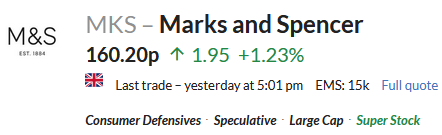
The group’s shares currently trade at 160p on the LSE Main Market. Marks and Spencer is a member of the FTSE 250 and has 2.0bn shares in issue, giving a market cap of £3.2bn. Free float is 99%, so liquidity should be excellent.
The StockRanks are very favourable for Marks & Spencer, with a particularly strong MomentumRank score.

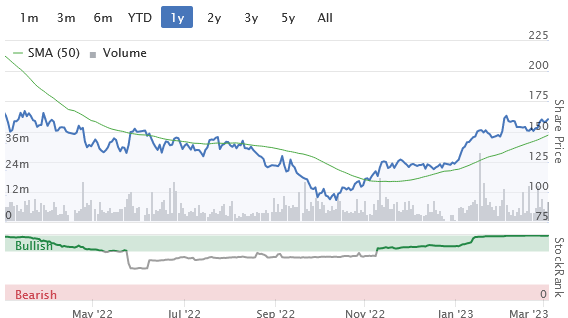
Recent share price action has been positive, probably helped by a strong Christmas trading statement in January and the broader market rally seen so far this year.
About the opportunity
Marks and Spencer is classified as a Super Stock, highlighting broad strength across its Quality, Value and Momentum factor scores. Although the company’s Speculative rating implies some additional risk of volatility, the outlook appears to be positive at present:
If the firm can navigate the difficult year ahead successfully, it could be well positioned for a return to growth.
Business & Model
What is the company’s history and what does it do?
Marks and Spencer is a high street retailer selling clothing, homewares and food. The group’s history stretches back to 1884, when Michael Marks opened a market stall in Leeds, pricing everything at 1p.
A partnership with Tom Spencer followed and the pair’s Penny Bazaar stores became successful. Unlike most contemporary stores at the time, customers were free to browse without any pressure to buy.
After the firm’s founders died in 1905 and 1907, Marks’ son Simon Marks gained control and chaired the company from 1916 until his death in 1964 – a period of great growth and success.
Under Simon Marks’ leadership, the chain became a household name and a byword for value, quality, fashion and innovation.
I think it’s fair to say that many of these attractive characteristics have been weakened over the last 10-15 years. In addition, the decline of UK high streets and the growth of online retail – and new affordable brands – has put additional pressure on this business.
However, M&S remains one of the UK’s biggest retailers and is not out of the game yet.
Key business segments and revenue breakdown
The group generates annual revenue of c.£11bn and operates in three main business segments:
UK Food: this division generates 60% of group revenue, but less than half the group’s operating profit due to supermarket-style low margins.
UK Clothing & Home: this division only generates around one-third of sales, but generates an attractive 10% operating margin. This has historically supported strong cash generation.
International: M&S operates over 400 stores and 100 websites globally. These sell a mix of food and clothing/home products. During the first half of the current year, international sales contributed 9% of group revenue at a respectable c.8% operating margin.
Ocado: the group reports its Ocado JV as a separate segment. However, this division slumped to a small loss during the first half of the current year, as customers stepped back from online grocery shopping.
What is the business model? How does it make money?
M&S is a mixed retailer. The group’s clothing, home and food operations design and source own-branded products that are sold through its store network and online.
In addition, M&S now sells a growing range of third-party branded products.
Markets & Competition
What is the state and size of the company’s market?
Marks and Spencer operates in three core markets in the UK - clothing, homewares and food.
Clothing: according to data from Statista, UK consumers spent £68bn on clothing and footwear in 2021.
Homewares: the latest results from homewares market leader Dunelm include data suggesting that the total value of the UK homewares and furniture market is £23bn.
Market share: Marks & Spencer reports clothing and home sales as a single segment. These totalled £3.3bn last year, so we can conclude that the firm’s share of these combined markets is around 3.6%.
However, there are sizeable elements of both markets that the company doesn’t aim to serve. I think it’s reasonable to suggest that M&S’s share of its addressable clothing and home markets is substantially higher than 3.6%.
Food: According to data from Statista, the UK grocery market was worth around £212bn in 2021. M&S is a minnow in this market, with annual sales in FY21 of £6.6bn. That’s equivalent to a market share of about 3%.
M&S also contributes about 28% of Ocado’s sales, by revenue – I estimate this as about £600m, annualised.
Oddly, M&S the company doesn’t seem to be included in Kantar’s benchmark quarterly report on UK grocery market share, despite selling more groceries than Ocado and Iceland:

Source: Kantar
Despite its reputation as a popular choice for treat food, M&S Food didn’t score all that well in a recent YouGov survey on popularity. Perhaps those questioned were more focused on value:

Source: Statista
Who are the company’s key competitors?
Clothing & Home: Marks & Spencer competes against many companies in these sectors. Key competitors with comparable size and customer demographics include:
Company | Ranges | Approx. annual sales |
Marks & Spencer | Clothing & Home | £6.6bn |
John Lewis | Full-range department store | £5bn |
Next | Clothing & Home | £4.9bn |
Dunelm | Homewares only | £1.6bn |
Food: the Kantar graphic above shows us that M&S Food’s share of the UK grocery market remains very small. To some extent, it competes against all other UK supermarkets. However, given M&S Food’s market positioning and reputation for quality and convenience foods, I’d suggest the following key competitors:
Company | Approx. annual sales |
J Sainsbury | £30bn |
Waitrose | £7.5bn |
Co-Operative Food | £3.9bn |
Marks & Spencer | £3.3bn |
What is the company’s strategy?
In its store network, Marks & Spencer is aiming to operate a smaller number of modernised full-line stores, together with an increased number of dedicated M&S Food shops. The group is also expanding its online sales
Clothing & Home: M&S aims to deliver a mix of value and contemporary style across casual and formal wear. The company’s historic focus on its own brands is being scaled back and M&S now offers more than 40 third-party brands.
M&S claims to have 22m Clothing & Home customers, highlighting its mass-market focus.
Food: aims to attract customers based on a reputation for freshness, quality, convenience and innovation. In the UK, M&S operates around 320 Food stores and has nearly 500 franchised locations.
The current strategy appears to be to try and expand this business by persuading more shoppers to do their whole shop at M&S Food. The group is also expanding online through its JV with Ocado.
How does it derive its competitive advantage?
Historically, Marks & Spencer’s trusted brand and ubiquitous presence on UK high streets has provided the company with a competitive advantage over most rivals. However, I’d argue this advantage has been significantly reduced over the last 20 years by a combination of factors.
Intangible assets: M&S still has a very high level of brand recognition, but it’s no longer trusted as a default choice for value, style, and quality in the way it once was.
Clothing & Home is a particular weak point, whereas the M&S Food brand appears to have retained more of its historic strength.
Switching costs: the growth of online retail means that consumers have a much broader range of choices across the company’s operating segments. As a result, switching costs are far lower than in the past.
Familiar sizing and product choices in clothing may still provide some degree of switching friction, but I’d suggest this is much less of an advantage than it once was.
Network effects: it’s hard to see much of a moat here. Customers do not derive much obvious benefit from shopping at M&S just because their peer group does. The brand does not have enough cachet to be sought after, except perhaps in some Food segments.
Cost advantages: I think it’s hard to see any areas where M&S has sustainable cost advantages over rivals.
However, the company’s programme of new store openings may provide a modest short-term cost advantage, as leases are currently being agreed on more favourable terms than in the past. The company says new stores are generating “substantially improved sales productivity … and quick paybacks” compared to legacy stores.
Greater scale: M&S is probably large enough to benefit from some manufacturing economies of scale in its Clothing & Home business.
The group’s store network is also reasonably dense and its UK operations are large enough to support a dedicated warehouse and distribution network.
However, I think it’s hard to see M&S Food benefiting from any meaningful cost advantages versus rivals. This business lacks scale against major supermarkets and must also be able to demonstrate superior quality versus discounters.
Is the competitive advantage durable?
M&S still has significant brand equity. However, this needs to be backed by successful product ranges and good execution if the company is to retain any competitive advantage over its rivals.
I do not think this business has the same level of competitive advantage it once enjoyed.
Financials & Ownership
What is the record of growth & profitability?
Marks & Spencer has a fairly sorry record of growth and profitability in recent years, but there are now clear signs of an improving trend.


Is there evidence of historic share dilution?
M&S performed a small equity raise in 2019 to help fund the Ocado joint venture. Other than that, there has been no significant share dilution over the last 10 years.

What is the ownership structure of the company? Do management have stakes?
There’s no significant management share ownership. All the major shareholders are institutions:

Valuation
How does the relative valuation compare versus industry and sector?
On an absolute basis, Marks and Spencer shares look quite reasonably valued to me. The stock trades on a rolling forecast P/E of 11, with a 3.3% dividend yield.
The stock’s earnings yield (EBIT/EV) of 9.6% is well above the 8% threshold I use as a value benchmark, while strong cash generation last year has left the shares trading on less than five times trailing free cash flow.
However, while the stock does seem affordable, this is a relatively cheap sector of the market. The company’s shares don’t look especially cheap compared to its main rivals:

The John Lewis Partnership is possibly the most apt comparison for Marks and Spencer, but it’s not a listed business.
Instead, here’s a snapshot from the Compare tool showing how M&S shapes up against three other competing retailers. While M&S has the lowest rolling P/E, it’s also expected to suffer the biggest decline in earnings over the next 12 months:

On balance, my view is that the shares are probably priced fairly on a short-term view, but could benefit from a higher rating in the medium term if performance continues to improve.
Trends & Catalysts
Are there any significant macro trends that the business is benefiting from?
High levels of inflation are likely to be a short-term headwind for the business. But M&S Food’s typical mix of fresh, premium, and convenience foods could benefit from consumer demand for meal-by-meal shopping and more accountable product sourcing.
In Clothing & Home, consumer focus on price may provide M&S with a chance to re-establish its value credentials and regain ground that’s been lost to rivals.
Are there any catalysts that could drive a rerating in the medium term?
If Marks & Spencer can maintain its recent record of gaining market share across its business, I think the group’s superior profitability and cash generation (vs supermarkets) could justify a medium-term re-rating for the stock.
The steps being taken by current management to turnaround the business seem credible and effective to me, although I think it’s too soon to be sure if they will deliver durable success.
Risks, Threats & Hurdles
High inflation and a weak economic outlook are likely to provide headwinds, at least in the short term. Broker forecasts suggest earnings will fall in FY24, before returning to growth.
Over the medium term, many larger M&S stores remain on costly long leases that allow little flexibility. While the group is doing what it can to manage this risk, it could prove a persistent drag on profitability if the company is not able to drive sufficient levels of sales growth.
Finally, it’s possible that this long-running turnaround just won’t ever quite succeed. Many younger people have never shopped at M&S and haven’t grown knowing the brand in the way that pre-internet generations did. I don’t know how easy this might be to reverse.
Recent Trading & News
Recent trading summary
Christmas 2022/23 Trading (12 Jan ‘23)
“M&S sustained trading momentum through the peak quarter and both Food and Clothing & Home have delivered strong growth.”
Chief executive Stuart Machin was on bullish form in M&S’s post-Christmas/third-quarter trading update. With some justification, I think:
Group sales in Q3 rose by 9.9% to £3,601m.
M&S Food +6.3% like-for-like (LFL)
Clothing & Home +8.6% LFL
International +12.5%
According to the firm, M&S Food outperformed the market on both value and volume, reaching its highest ever recorded market share in the run-up to Christmas.
Clothing & Home also gained share, reaching a 10% market share during the pre-Christmas period – the highest level since 2015.
New and remodelled stores were said to have outperformed expectations, while 20% growth in Click & Collect reinforced the benefits of the group’s omnichannel model – although this may also have related to postal strikes during this period.
Outlook: Full-year profit guidance was confirmed, but the company warned that “there are clear macroeconomic headwinds ahead and underlying cost pressures”. This suggests a cautious outlook for 2023/24.
What do the brokers currently think and are they upgrading estimates?
Broker consensus forecasts edged higher after January’s trading statement. However profit forecasts for FY23 and FY24 remain lower than they were 12 months ago, providing a reminder of the impact of higher inflation.
The consensus stance on the stock is broadly unchanged at Hold.

These forecasts put Marks and Spencer shares on a 2022/23 forecast P/E of 10, rising to a P/E of 11 for 2023/24.
What would the person selling to us be thinking and who are they?
On a long-term view, Marks and Spencer shares are still trading close to record lows. But on a shorter view, the stock is up by more than 50% from the trough valuation seen in October 2022.

Anyone selling today might feel that the good news is in the price and that further progress – if any – will be much slower and more hard-won.
Conclusion
Marks & Spencer remains a powerful name in retail and still has a substantial share of the UK clothing, homewares and food retail markets.
The group’s clothing and home ranges appear to be regaining some of the ground lost in the past. If this persists, then the higher margins and strong cash generation of this business might once again support generous shareholder returns. However, I think it’s too soon to be sure if this element of the turnaround has succeeded.
While M&S Food’s growth seems more assured, as a standalone grocer this business would be low margin and might struggle to gain sufficient scale. I think it’s attractive as part of the combined group, but less so otherwise.
Whatever happens over the medium term, it seems very likely that macroeconomic headwinds will slow the group’s progress in 2023.
However, on an absolute level, Marks and Spencer’s valuation looks attractive to me. I’m also impressed by the company’s progress over the last year. On balance, I think the shares could deliver attractive returns from current levels.
Disclosure: Roland owns shares in Dunelm Group.
Disclaimer
This is not financial advice. Our content is intended to be used and must be used for information and education purposes only. Please read our disclaimer and terms and conditions to understand our obligations.

8 comments
I am only looking today as there has been an upbeat article in the Sunday Times (21 May https://www.thetimes.co.uk/art...), citing principally management changes and improving clothing sales. It focuses principally on the newish boss of foods but reminds us of the overweening influence of clothing and concludes with a paeon from a big young (female) fan of their clothes on The Times staff. i am tempted.
I'm a former holder (I set a stop loss and forgot about it, until my broker sold them). I'm not in any hurry to buy back in, other than for sentimental reasons; the shares had been my Dad's and Tom Spencer was born round the corner from me in Skipton. We have a blue plaque but oddly no M&S of our own until about ten years ago.
A recent visit to M&S and Next in Bradford was very revealing. Next had it's clothes and homewares as a series of rooms that gave quite a well set up impression(Prob. better for shoplifting too). In contrast Marks's had a traditional clothes on rails schtick with worse lighting, I think Next uses daylight mimicking bulbs. A few odd points: in Next the clothes on the racks complemented each other, nothing stood out as distinct. Are their clothes styled to look good in the shop? If so how do they look on you? Does Next have less stock/ variety, it certainly felt like it.
Suits in both terrible, little or no canvassing and all the lapels fused. The last time I needed a new suit I ended up having it made up for me by a tailors in Leeds. Money well spent, as things obviously haven't got better since. A couple of years ago the Guardian did a report on what happens to town centres when M and S closes, where they opined that often Marks's was the last shop in a medium sized town that would sell well made clothes; I can only conclude they were talking about Women's clothes not menswear.
Odd note, Next had a home display with a ball of fluff (Like when your hoover spits back) on a bobbly lilac rug, Even that looked complementary, in Marks's it would have stook out like a sore thumb.
Maybe Marks and Spencer is best considered as a kind of ethical supermarket (Seen as accountability/ traceability feels like the direction of travel here), perhaps a proxy for unlisted Booths and Waitrose, that just happens to have a bank and a clothes shop attached. One being a plus as most people hate their bank but seem to trust M and S, the other perhaps being a minus; do you know anyone who buys clothes there? NB for as long as I can remember Marks and Spencer has been treated as a bellwether for the health of "The High Street", the outlook usually gloomy but they are still there!
I prefer Costco on all metric in the retail sector. It is still a growing company inside and outside the North America. It's not dissimilar to John lewis. Treat the worker, customers well and the shareholders benefit too. It has a high PE as it is considered a growing company.
The idea that everyone will just buy from Amazon now (a pandemic blip) is over. People (some people) like shopping. They like going out, seeing what they are buying, feeling it, trying it out, chatting. . They won’t be sent the wrong item in the wrong colour, or something that’s ten times smaller than they realised. Solid M&S should benefit!
I see the inexorable rise of Aldi as only a part of the reason that M&S will struggle in the longer term. I was talking to an old friend about M&S while I was reading the above and I said to her the other problem they have is that there is a perception that their clothes are targeted at older people. I am 67 and she is 70. Neither of us would even consider buying clothes from M&S. If we won't who will. I'm a great believer in buying into trends that affect me every day. I bought into the rise of Fevertree at £8 as a gin drinker and their appearance on supermarket shelves. I sold at £20ish when I thought they were overvalued. I don't see M&S as cheap. I just thing they are in long term terminal decline. But then what do I know. I bought Independent Insurance!
Maybe all the other 50, 60, 70 year olds.
Why won't you buy them?
an excellent analysis. I cannot see myself buying their shares anytime soon
Good post. While I do not hold m&s I do have a great deal of respect for Archie Norman. Having met him a few times in the 90’s I have been impressed. He did do a great job turning around ASDA when he was their CEO.