My biggest investing mistakes of the last year

The problems with portfolio reviews
In early January, many investors like to publish end-of-year reviews. However, a form of selection bias undoubtedly affects who chooses to report. Those who have done well are more likely to put the effort in to write up their investing year. Professional investors have to report their performance, and their partners expect detailed commentary, which can give a more balanced view. However, even amongst these investors, having a strong year can introduce an element of hubris. Merriam-Webster summarises hubris as:
In classical Greek tragedy, hubris was often a fatal shortcoming that brought about the fall of the tragic hero. Typically, overconfidence led the hero to attempt to overstep the boundaries of human limitations and assume a godlike status, and the gods inevitably humbled the offender with a sharp reminder of his or her mortality.
Anyone who has invested for any period of time will recognise the feeling of being humbled by the market gods!
A second bias affects those reading portfolio reviews. Investors view someone with a particularly strong yearly performance as someone to be emulated. This may be true over the very long term. However, the time period that investors evaluate performance is typically three to five years. In the same way that corporate performance tends to mean-revert over these timescales, so do many investment styles. For example, Quality Investors performed phenomenally well from 2015 to 2019, and this gave many fund managers in this space godlike status. Sadly, neither the performance of the funds nor the status of these managers survived different market conditions. Investors who read the glowing annual reviews and converted to investing in “quality compounders” and holding forever are still waiting for their time in the sun.
With selection bias, hubris, and switching strategies being major problems that can be caused by portfolio reviews, it is tempting to neither review one’s portfolio nor read others’ reviews. However, this may cause investors to miss out on significant learning opportunities. The best investors tend not to be those with the greatest knowledge but those who are most willing to keep adding to their understanding. My own solution is to review the mistakes I made over the past year, with, hopefully, a focus on avoiding these in the future.
What is a mistake?
It may be tempting to think that every losing investment was a mistake. However, I don’t think this is true since it misses the role that luck plays in short-term investment outcomes. Investors can do great research and spot an underpriced opportunity, yet an unpredictable disaster can blow a hole in the investment case. In contrast, investors can buy into a high-risk potential fraud that receives a takeover offer. The conclusion investors take from these examples almost certainly shouldn’t be to invest in as many frauds as possible!
When deciding what is and isn’t an investing mistake, I like to turn to the following table from Michael Mauboussin:
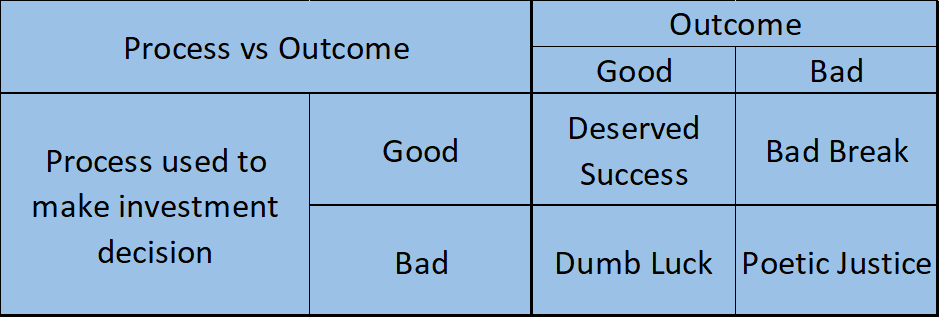
Occasionally, I may be able to spot where I’ve had a poor process but got lucky. However, the key learning opportunities are most likely to be where I had a poor process and received a poor outcome.
Finding Mistakes
One of the easiest ways to find mistakes is to look through the biggest losers in my portfolio and what I can learn from these:
Mistake 1 – Ignoring my own rules
I often comment that the biggest mistake investors make is being overweight in very risky positions. Yet I fell for the same mistake by having around 5% of my portfolio in Hummingbird Resources (LON:HUM) . I believe the rationale for owning shares was sound; this was by far the most geared play on the gold price, which had been incredibly strong during the year. The financial metrics were undoubtedly poor, but the presence of a very supportive lender assuaged my concerns. However, management failed to deliver operationally, and what should have been a highly profitable mining operation never consistently delivered enough production to achieve positive cash flow even at current gold prices. Eventually, the lender lost patience, forced a debt-for-equity swap at 2.667p and is in the process of buying out other shareholders at the same price:
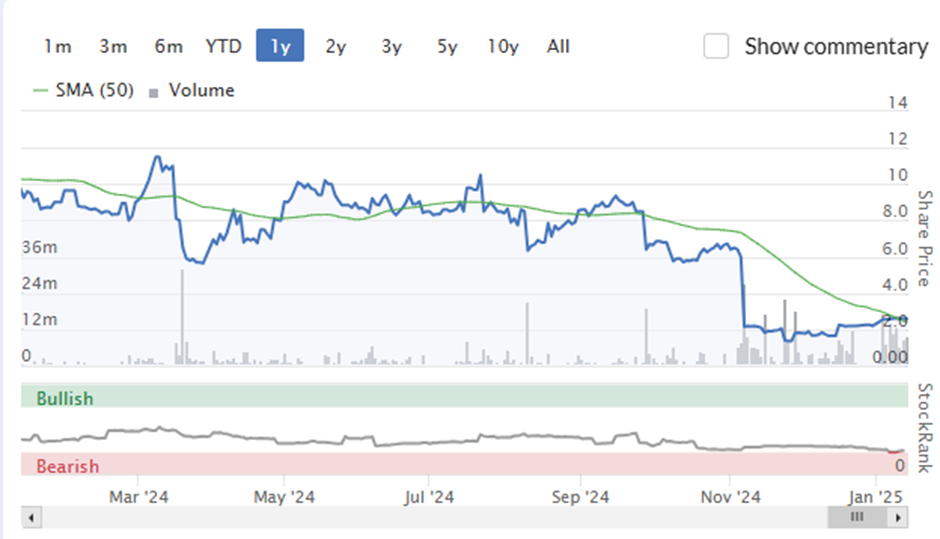
This could have been much worse, and I think the lender was being very fair in offering external shareholders anything, given the financial position that the company ended up in. This could easily have been a 5% loss instead of the 3% it ended up being. My focus had become the potential upside. Compared to other companies with similar production, the shares would have been 40-50p if they had managed to deliver in line with their mine plan. While the risk-reward ratio was indeed favourable, the level of risk meant this should have been nowhere near 5% of my portfolio. This was a painful lesson…again!
Mistake 2 – Under-estimating how poor sentiment can get
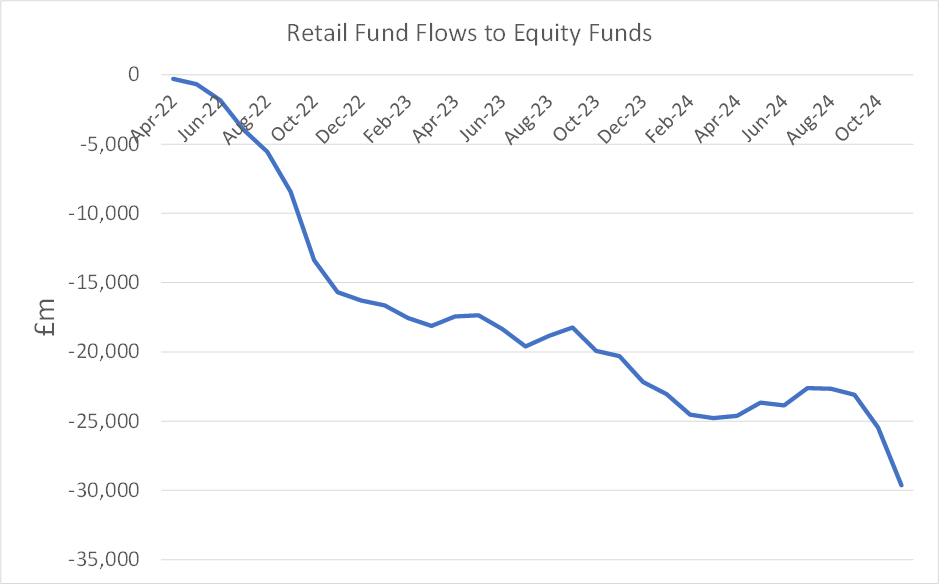
This has been another terrible year to be a UK small cap investor. At the start of the year, I was relatively positive about the UK markets. It felt like the outflows over the last few years had to reverse at some point, and lower interest rates could be the trigger. This was proved correct over the first few months of the year. However, I completely missed the impact that an election could have on UK investor and economic sentiment and how this would be reflected in further equity outflows:
In my case, this mistake is epitomised by Ingenta (LON:ING) . When I wrote about this stock in July, the share price was around £1.25, and I commented that:
The conservative accounting and balance sheet strength makes this a low-risk bet. Over the long term, it would seem difficult to lose money in a company trading on a cash-adjusted P/E of around 7, which has 80% recurring revenue streams.
While that may yet prove to be true over the long term, it has made no difference to the short-term share price performance:
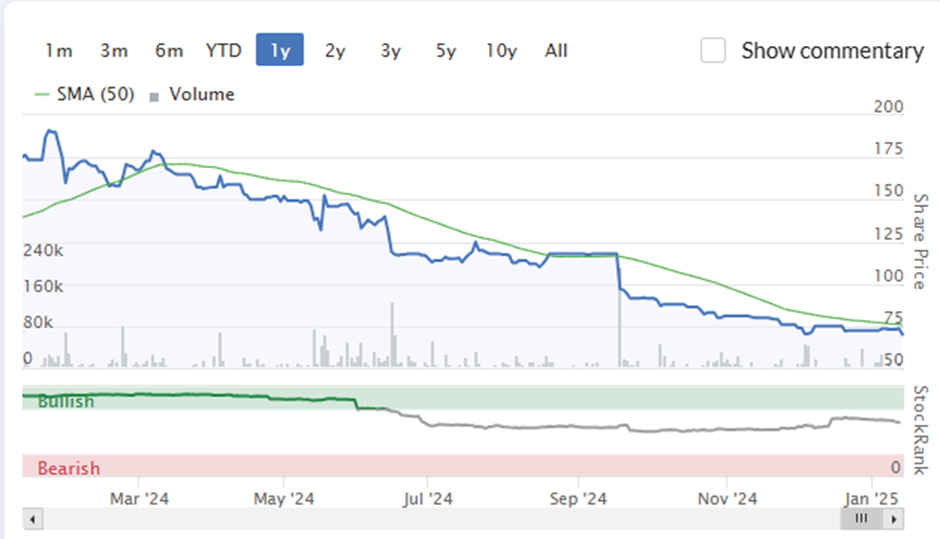
The fall here was partly due to a downgrade in EPS. However, with EPS forecasts dropping 21% over the year and the share price dropping over 60%, this drop appears to be more about the poor sentiment towards UK microcap shares, particularly those on AIM. I certainly didn’t see how badly UK stocks would be viewed by investors. While I would probably still have averaged down in companies such as Ingenta (LON:ING) , I would have been a lot more cautious if I’d understood how negative the sentiment could get over the past year.
Mistake 3 – Poor selling
Another way to identify mistakes is to look at shares I sold or top-sliced during the year that subsequently went on to perform strongly. On average, it seems my selling discipline has added somewhere in the region of 6% to my annual performance. When reviewing my mistakes of 2023, I said:
Overall, my biggest mistake was being too aggressive in my buying and too timid in my selling. This may be a function of the range-bound market for small caps in 2023. However, unless there are clear signs that 2024 is a significant bull market where buy and hold works best, I will aim to be more cautious in my buying and aggressive in my selling.
With 2024 being similarly challenging for UK-focused investors, I appear to have learnt from my past mistakes in this area. However, the stock that has done best since selling was Made Tech (LON:MTEC) , up around 90%. My buying discipline was good, and I got in close to the year’s lows. However, I viewed a 30% rise in share price in response to a single contract win as excessive and sold. It turned out to be just the start of the re-rating:
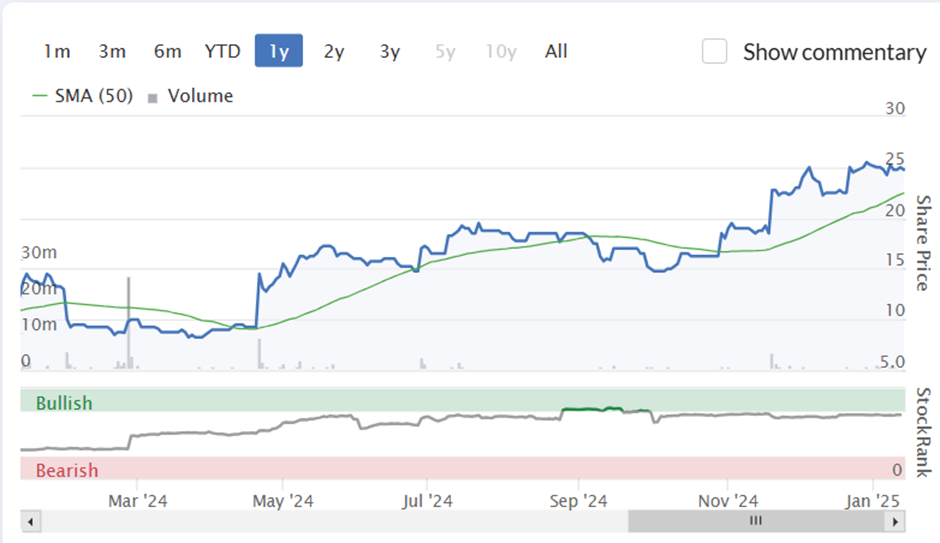
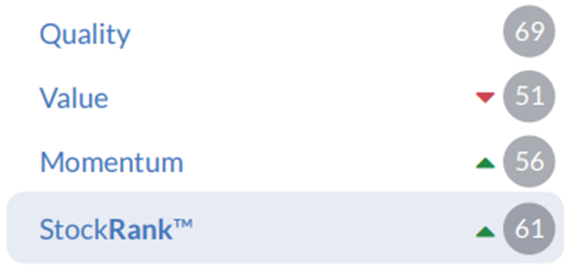
Often, when a stock starts to deliver good news, it continues to do so for much longer than we expect. However, I don’t think I can judge myself too harshly on this one. At 38x forward earnings, this is in no way a cheap stock, and while the momentum Rank is now strong at 97, it wasn’t when I sold:
Mistake 4 – Missed opportunities
The mistakes above are all mistakes of commission – I took actions that proved to be wrong. However, there is a second category of mistakes – those of omission, where I failed to take action where I should have. One of the easiest ways to identify these is to look at the shares that performed best over the last year that I didn’t own.
A quick screen reveals 40 stocks that doubled in the last year with a market cap greater than £10m. Many of these were highly speculative stocks that I never would have owned. For example, around a third of these have a value rank below 10! However, there are a couple of themes which I probably should have profited from and didn’t. The first is for gold producers to do well. Because I owned Hummingbird Resources (LON:HUM) as the most highly geared stock to the gold price, it meant that I didn’t own stocks such as Pan African Resources (LON:PAF) or Serabi Gold (LON:SRB) . Here is the Pan African chart:
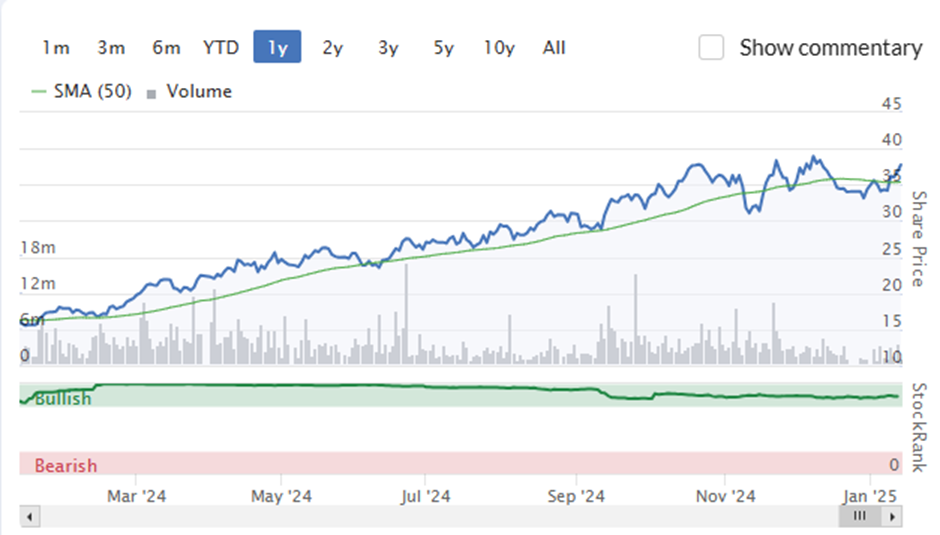
So, being overweight Hummingbird Resources (LON:HUM) has actually been a double error.
The second theme I notice is for stocks trading at very low price-to-book values to be taken over for high premiums. For example, N Brown (LON:BWNG) or Brand Architekts (LON:BAR) . I didn’t own these stocks because I didn’t see any obvious outer for them. In the current market, it seems that a huge discount to assets is enough of a catalyst.
In the past, I’ve commented on the investing landscape being sniper or shotgun markets. During sniper markets, there are only a few pockets of value, and investors need to be quite selective. However, during shotgun markets, there is value everywhere, and investors need to blast away. The nature of takeovers is that they are unpredictable. However, if I had simply bought many stocks at a big discount to TBV or low price-to-free-cash-flow, I may have been exposed to more events that “outed” value, such as these.
Focusing on investing mistakes is hard to do, especially in difficult years. I feel like I’ve gone 12 rounds with the market in 2024, simply to come out with a result not much better than the FTSE Total Return Index. However, the process is also cathartic. It is only by recognising the mistakes I make and avoiding those in the future that I become a better investor. I’d thoroughly recommend that all investors give this process a go.
[Disclosure: Mark owns shares in Hummingbird Resources (LON:HUM) Ingenta (LON:ING) ]
Disclaimer
This is not financial advice. Our content is intended to be used and must be used for information and education purposes only. Please read our disclaimer and terms and conditions to understand our obligations.
41 comments
thanks mark for the review. my mistake was being overweight on uk stocks and enough on us.
Thank you Mark for your interesting and honest review of the last year.
Also ( I forgot) I like the Greek stuff. Not millenium but 2000 years old trading advice. Hamartia, hubris, nemesis, peripeteia, anagnorisis and... catharsis. The Germans added Shadenfreude ( A word that doesn't exist in English so we don't need to go there) . And of course there is occasional flourishing ; Eudaemonia. Life is often a tragedy, sometimes a comedy - but always a quest. Good luck to all fellow travellers!
Candid. Or Candide. In this Voltaire - 'best of all possible worlds' we often showcase our gains but not our losses. The endowment effect is so strong it's hard to admit errors / that + compounded effects with Kahnemans prospect theory (we feel losses x2 as much as we enjoy gains) means that your candid take is even rarer. Thank you. Honesty and self awareness are rare these days. ps I enjoy my losses as it allows me to reallocate capital to missed opportunity costs... and keeps my feet on the ground. I'm a bore already. Imagine if everything share I invested in made 100% gains...(we can only dream)
Dear all, I have never read a book about Warren Buffet. I would imagine there has been an astonishing amount written about Mr Buffet however can anyone recommend a good book?
Dear all, I have never read a book about Warren Buffet. I would imagine there has been an astonishing amount written about Mr Buffet however can anyone recommend a good book?
The Snowball, his biography by Alice Shroeder which he supported (and probably wished he hadn't). It'll tell you more about why Buffett invests the way he does than any amount of "Invest Like Warren Buffett" books which don't tell you how to invest like Warren Buffett on account of they're not written by Warren Buffett.
Or the Berkshire Hathaway annual shareholder letters, which probably give as good an explanation of why he does what he does as you'll ever get:
https://www.berkshirehathaway....
timarrThanks timarr.
Buffet is ok in a folksy way. But it was a partnership and personally I think Charlie Munger was the wiser. His Almanack is now available again https://www.amazon.co.uk/Poor-...
Thank you Mark loved very well written article that makes one re think certain strategies. The common mistake is falling in love with a share.
My example is Ashtead first bought in 2010 at around £6.20. those that know the share knows that it has touched highs of £64. I held for over 20 years sold some during Covid when it fell to £17. Bought in again at £24 kept it ever since it went back up to £64. A small profit warning sent it back to £49. only a few weeks ago.
I keep breaking my own promise to myself to top slice when it gets to the £60s. Now waiting for the long climb up again. will it happen who knows.
Would be great to hear if others have the hold for ever thoughts.
Great article Mark. I read this yesterday with a sense of achievement that I had avoided any major mistakes last year. Today however I have taken a real kicking. A 55% loss on IG Design (LON:IGR) after todays profit warning. Following Ed’s rule I sold today on this profit warning. I read the RNS at 7am and placed a stop loss trade at 15% below last nights closing price. The price gapped down over 30% on opening and by the time I was able to get AJB to place a trade the price had fallen to 55%. All Stocko metrics are good and the chart did not seem to me to indicate any real momentum shift. My question is could I have avoided this mistake.
IG Design (LON:IGR)
My question is could I have avoided this mistake.
There was a previous profit warning last September. That was the time to get out.
Stockranks and other metrics aren't reliable indicators at the level of individual stocks, only at the portfolio level.
timarr
Thanks Timarr.
Thanks SCI20, and commiserations on IG Design (LON:IGR) , which I also held, and was one of my 12 Stocks of Christmas.
I guess we have yet to see whether this ends up being one of my Investing Mistakes for 2025, but the initial signs are that it could well be. My mistake appears to be believing the well-regarded CEO and CFO when they gave very specific reasons why they thought H2 would be ok this year on a recent PI World presentation. Given the exact opposite of what they said appears to have happened, they have pretty much gone from hero to zero in one step.
Could you or I have avoided this mistake? Perhaps by never listening to management teams and going by the pure numbers, which did suggest H2 could be a stretch to hit the figures for £IGR . But then, I know many investors get their edge from management calls, attending AGMs, etc., and prior to this week's update, the team at IG Design (LON:IGR) were highly credible.
One thing I think could be a mistake is expecting that a stop-loss order would save the losses. In my experience, such market orders almost always get executed at the worst prices of the day. They guarantee losses rather than stop them.
I think the idea of automatically selling on a profits warning is also potentially problematic. While the quant approach doesn't avoid getting profits warnings, it can guide you as to how to react after you've had the initial blow. While the average stock continues to decline, there is quite a big variation between styles. High Flyers, those with high momentum and low value, tend to do really badly following profit warnings. Whereas Quality Value stocks actually tend to bounce back somewhat. This is what the Ranks were for IG Design (LON:IGR) prior to the warning:
So there may be some nuance or specific reasons this won't follow the typical trend, but with the QV ranks higher than the M, this may be a candidate to hold rather than react and sell.
My own view is that we've gone from a stock on a P/TBV of around 0.5 to maybe around 0.3-0.4 after the write-downs are included. The market is pricing this as if these assets, which are largely receivables and stock, will never be productive again. I think it is perhaps still too early to conclude that. However, it may be a long wait for any re-rating even if management are successful in making these productive again. Given what has happened, the market will not believe the forecasts and will wait for several years of decent numbers before allowing this to trade at a premium to book value again. This will almost certainly be too late to save my pick as one of the 12 Stocks of Christmas, even if it arrives eventually!
Thanks Mark for your detailed reply. I made the decision to sell and crystallise a 55% loss. Time will tell whether or not this was the correct decision. The thought that profit warnings come in threes coupled with the opportunity cost of awaiting a recovery influenced my decision. The biggest frustration was not being able to place a sell trade at market open when the sp had fallen by 30%. The Small Company Share Watch have IG Design (LON:IGR) on their 2025 NAPS so it would appear that a number of investors will have been blindsided by this.
Brilliant article Mark and really interesting posts. I tend to find selling losing positions which I have had a long time despite profit warnings YouGov (LON:YOU) Solid State (LON:SOLI) is my mistake. Both these companies I have done extremely well but I fool myself into thinking after a profit warning “it will come back and I will make up the loss” and it NEVER happens. I watch them tank 40% and also don’t even put a short bet on even though the opportunity is staring me in the face!
Thanks Mark for such an open and candid post. One of my golden rules to assist me in not breaching Buffet's first and second rule is my "never ignore the Falling Star rule": if anything I hold becomes a Falling Star, I sell immediately and I never buy into a Falling Star no matter how tempting the recovery play looks.
Of course it's not foolproof , as indeed none of the Stock rankings are (one only has to look at the unfortunate Super Stock that was IG Design (LON:IGR) prior to this morning's bombshell trading update).
A good example of how my rule has saved me from the opportunity cost of holding onto something for too long would be Bioventix (LON:BVXP) , a company I've done well from and hugely admire. It's also one I've "fallen in love with" in the past but having peaked around £50 last February, it became a Falling Star a few months later at around £43. Because of my love for the share, it would have been tempting to sit tight but that would have been a mistake. My capital was better deployed into something with momentum and the opportunity cost would have been great as the share steadily continued its decline towards today's £31. It remains a Falling Star and I remain out of it despite my continuing admiration of the company.
I guess my point is that we all pay our subscriptions and sometimes forget that the most powerful tools we have are right in front of us. The apparent simplicity of the rankings and styles belie their power.
But Mark, you haven't mentioned Doubling-Down, this was my downfall in Hummingbird. Decisions like this and Top-Slicing must be made but can go either way and not only that but can go hand in hand. I would eleborate on Michael Maubousin's table by inserting Poor and Fair between Bad and Good since nothing is black or white when investing in shares. Take my holding in CMC Markets, first doubling down - good, then top-slicing - good. Then buying Wise - good - then top-slicing - poor, buying Serabi Gold - good - and holding on - good - and buying Pan African and holding on -good - and top-slicng it - good. Adding To is yet another decision, not quite the same as doubling-down, which can lead to mistakes in the Poor/Fair area. Typically this is where re-investment of my divividends go. At this moment in time I see myself standing at a crossroads and not seeing any lettering on the signpost so wish readers of this comment 'Dumb Luck'.
Stingingly honest post. Few would advertise their errors only boast of successes. But the post is so important as it shows the importance of rehearsing the reasons for actions and teaches lessons which are universal. Thanks Mark.
Good candid article Mark. Just read The Little Book of Behavioural Investing by James Montier. Explains why we all keep making these mistakes and dispels the idea that any of us can hide from our natural human failings!
My big mistake was averaging down on HVivo which didn’t fit my investing rules in the first place. Broke at least 2 of my investing rules in one big lesson!
I’d do the NAPS !
Still working at 67 (thanks to not being financially savvy) and looking for what can keep the brain going and fun when eventually push the scary retired button.
The kids get the house so everything else is risk capital to grow wealth (yes I will). The 5% rule seems a good one and noted.
I have a small pension £25k with the black cloaked lady and last year increased by 3k. Impressed with that actually after looking at my performance in and out and many daily hours slaving away, so reticent transferring into the SIPP just yet.
I could water plants, change nappies, watch the Spanish gardener, polish the boat metalwork (neither of the last two but you get the drift) or fight the market - the brain is a muscle and with hard work and lady luck (hand in hand) then it's all all 'interesting' and upwards.
Buffets rule is always in my mind "Rule No. 1 don't lose money and Rule No. 2 don't forget rule No. 1 - live to fight another day and learn in the process.
Great article. Thanks
Really good article Mark.
It’s a stupid phrase “It’s never wrong to take a profit”
Buffett on selling: 1) something better, 2) Change in economy or management, 3) Too big 40%.
.
Terrific again Mark, you write great articles. So true about the biases we suffer from. My biggest error of 2024 was getting out of Apple (NSQ:AAPL) Alphabet (NSQ:GOOG) and NVIDIA (NSQ:NVDA) because I felt too thinly spread and decided instead to reduce my number of holdings and focus on a market where I might have an edge - UK small caps! On Maboussin's chart I'm going to be kind to myself and put that down as "Bad Break".
All you have to do is buy and sell above and below the 50dayMA price which overrides the worst of our humanness.
Not many technical traders on here historically but the fundamentalists need the chart as well to see what the market or sentiment believes.
The 50ma is fairly blunt but yes a safety tool. Stocko has an alert button for it plus RSI so can sit back and forget about until get the email.
Hi Mark
Many thanks for a great article and quote.
It is always easy to talk ourselves either into buying a particular investment or on the other hand not selling one we should.
Two ways we justify this and I have been guilty of both are:
Firstly, ‘its in for free’.
Last year Zotefoams (ZTF) was such a case for me. The business was well run and profitable and there was the potential of the game changing manufacture of a recyclable mono-material for beverage cartons.
Of course this wasn’t ‘in for free’ and when the development stalled the share price fell. I remain 20% below water.
Secondly ‘bad news is already in the price’. There is of course a big difference between potential bad news and a RNS to such an effect. An example escapes me. Probably due to protective denial.
It is said that you learn best through mistakes you make personally and less so by observing the mistakes of others. This I am sure is true. However as the years roll on and I invariably repeat the mistakes that I have made in the past the pessimist in me worries that I am destined to just keep on making the same ones.
More worrying still is the thought that:
“A mistake repeated more than once is a decision.” -Paulo Coelhol
The Resource thing was always speculative and in my opinion focused upon under the SCVR. A world leading new form of milk carton - really.
I put 1k into HEIQ some Swiss performance fabrics outfit (it had anti-microbial properties - just after the pandemic - no s**t Sherlock, got mugged by the IPO market. And hence its demise. Golden Goose and all that.
I like Sketchers shoes. Very comfortable, no laces (slip-ons) (since childhood carried over to old age) but have a rubber/plastic etc sole. Why was this company special. Nike, airplane seats (not comfortable). Sorry nice company etc etc.
Secure Trust Bank (LON:STB)
Close Brothers (LON:CBG)
It was said up until October the band news of DCAs was priced into these assets. It wasn’t.
I’m now 45% underwater on the former (although did top slice more than I’ve lost in total).
I think I’ll be waiting a long time to get back to neutral, if they don’t become insolvent.
You don’t want to ‘lose money’ as Buffett said, but there’s an opportunity cost to holding in these circumstances
You don’t want to ‘lose money’ as Buffett said, but there’s an opportunity cost to holding in these circumstances
Buffett wasn't suggesting you should hold onto a losing investment simply in the hope of it "coming good". That's loss aversion - the inability to take a loss and move on, it's one of the major reasons private investors underperform the market. What Buffett was talking about was value investing, which is a very different thing:
Of course, as Mark suggests, there are times where we can make the right decisions and get the wrong result. However, the question is "over what timeframe?"
I habitually invest too soon - based on fundamentals but into a falling trend - and then have to wait for the market to appreciate the genius of my decision (ahem) - or rather, for the fundamentals to overwhelm momentum. Generally, if the decision hasn't played out in three years I will move on. I never, ever, simply hold onto a stock because I'm hoping I'll make my money back.
However, circumstances change, as we saw with Secure Trust Bank (LON:STB) and Close Brothers (LON:CBG). Bitter experience shows that as soon as regulators get involved the impact is unquantifiable and the timescale over which it will play out is unforeseeable. Company managements are habitually optimistic, but frankly can't have a clue in these circumstances because no one does.
I sold both on the original announcement and wouldn't go near anything connected to this mess until there's a clear resolution - which could take years and be incredibly expensive.
As the old phrase goes - you don't have to make it back the way you lost it.
timarr
Personally my errors are usually on the sell rather than buy side.
Mainly selling too late after the story has changed and occasionally selling too early when there is more juice in the tank.
Brilliant article, respect for sharing your mistakes which I am sure many of us are guilty of doing too, including me! I love the Process vs Outcome table, I veered off my process post budget. I thought investing in Volex (LON:VLX) , Gamma Communications (LON:GAMA) and Premier Miton (LON:PMI) would be great calls after they all sold off before 31st October, I lost money on all 3! I’ll stick to looking at buying stocks in uptrends and not trying to get macro events right!
Yes good thoughts.
I think I'll have a look at my dealings in 2024 and make a similar list of failings, but of course my biggest failing will probably not to do what I set out to do.
Prepare to fail or fail to prepare??
Great article Mark, I am massively guilty of selling too soon Yu (LON:YU.) Cohort (LON:CHRT) ,and Cerillion (LON:CER) come to mind, but there are also others.
Spot on about hubris Mark. Never confuse intelligence with a bull market.
I think a lot of private investors are too hard on themselves, its not a game of perfection, youll get lots wrong. Just accept that as part of the process and move on like an opening batsman playing and missing. Im a simple guy so work on getting 50% right, then its a case of limiting the losers as quickly as possible and letting winners run where possible. Adding to the best ideas too, but only if theyre rising.
Id also add dont give the benefit of the doubt to a company, it wont be repaid. If theyre hinting at a slowdown its better to pull the trigger before the crowd piles out at the next update.
I have definitely been guilty of holding on to shares for too long because I refused to believe that a favourite share was no longer performing. A good example of this would be Somero Enterprises (LON:SOM)
Really great article. Thank you
The quote is brilliant as is the article. A key reason why we can't be arrogant about our knowledge is that ultimately share selection is based on management efficiency. Something not even Stockopedia can measure. One of the reasons why I like the odd fund as fund managers do visit companies and finds are well spread. Ultimately, diversification is our best friend as it is an acceptance that we will get it wrong.
Excellent Mark. I think we can all identify with these mistakes, which in context have the virtue of being reversible, particularly when we learn not to repeat them. The key lessons I draw from this:
- Watch sizing. Have a full position weighting (mine is 3%) beyond which you become very risk averse. Always consider what will be consequence of a sudden 50% drop.
- On thematic stories - like PMs- maybe consider a collective vehicle?
- Find a way to patience with long term winners, if you are lucky enough to have them. This can be difficult on pull backs when you see profits seemingly diminish; but holding these is probably the secret to real outperformance?
- Of course this omits the reinvestment of dividends, which is possibly the most powerful tool c/o compounding and suits the income approach. Therein perhaps another story, but one which I know many investors of a certain age have become quite attached to supplement their meagre pensions!
Really superb article, Mark.
Love the quote from Merriam-Webster. Should be printed out in big letters and stuck on the fridge door of one or two on here !