New Year NAPS - Top Stocks for 2022 with lessons from the Tao

One of the joys between Christmas and New Year is the time it brings us all. After all the mess of gift giving and receiving is over and relatives have left… there’s a moment where you realise you’ve finally some time for yourself. It’s in these gaps that we have moments for reflection, to make new resolutions, to read, to ponder… or just lie around and eat a pot of honey. I found myself nostalgically reading “The Tao of Pooh” and reflecting on some of the things I’ve got wrong in 2021 - namely trying to do when not doing would have done just fine. On reflection, the NAPS embodies a number of taoist principles, and it’s in this vein that I’ll review what’s been another good year.
NAPS Portfolio Performance 2021
The NAPS Portfolio appreciated by 28.3% through 2021 (excluding dividends & transaction costs) versus the FTSE All Share at 14.5% (18.6% including dividends). In spite of a reversal from the 39% high on September 1st, it has been a remarkably strong showing in a year when so many portfolios have suffered.
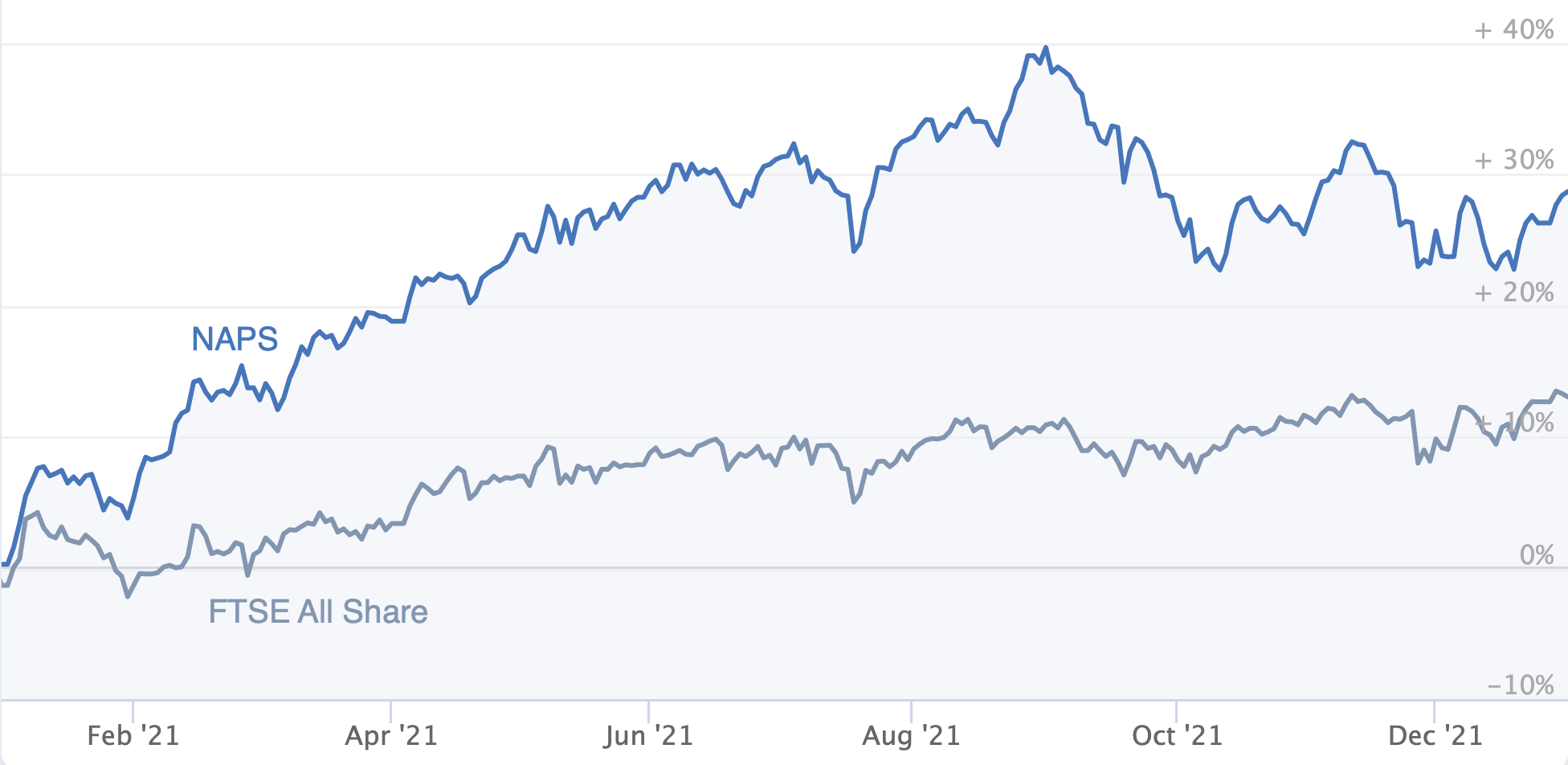
The Long Run Performance
For those that need reminded, the NAPS is my “no-admin-portfolio-system”. A 20 stock portfolio from the highest StockRank stocks, diversified fairly equally across all 10 sectors, rebalanced annually. It’s a “select once, leave for a year portfolio” that requires no more than an hour to put together, but has performed remarkably well over the last 7 years. With more than an 18% annualised return over this period, £1 would have grown into ~£3.23 following this process in a tax efficient wrapper.
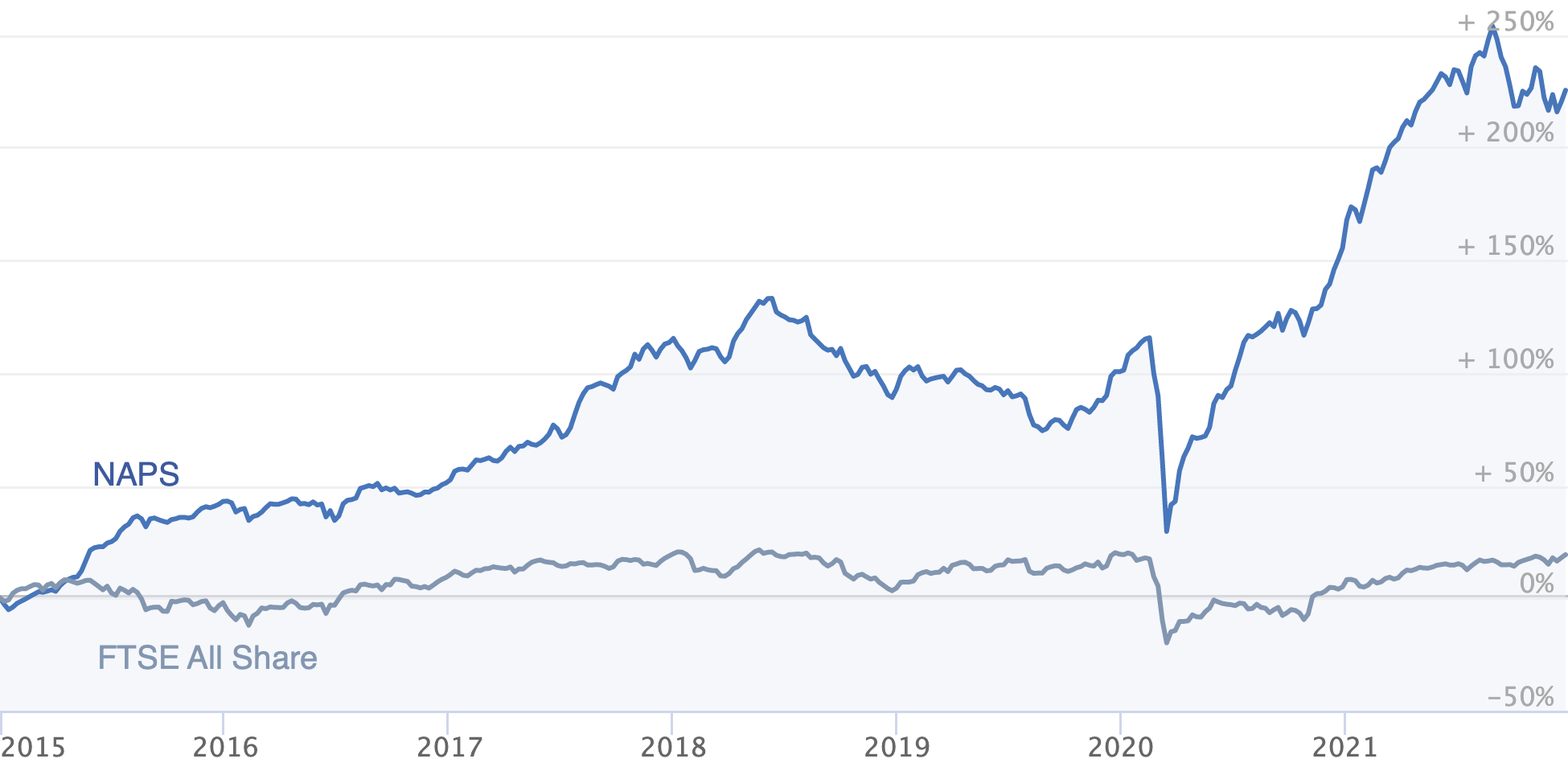
Please note that the above performance excludes dividends for both NAPS and FTSE All Share. The FTAS has a 49% total return (including dividends) over the same timeframe. I prefer to exclude the impact of dividends from NAPS performance tracking as it is a conservative way of factoring in transaction costs.
If you’d like to learn more about the NAPS - you can catch up on all the articles in the blog archive here. There are also some videos on Youtube which I keep promising to update and will do soon.
Winners and Losers 2021
While Reach (LON:RCH) couldn’t hang onto all of its gains this year, it still managed an 88% return before dividends, closely followed by a strong showing by Somero Enterprises Inc (LON:SOM) , Wynnstay (LON:WYN) , Drax (LON:DRX) , Up Global Sourcing Holdings (LON:UPGS) and Sdi (LON:SDI) . Those “Bold Bets on Big Mo” have indeed paid off.
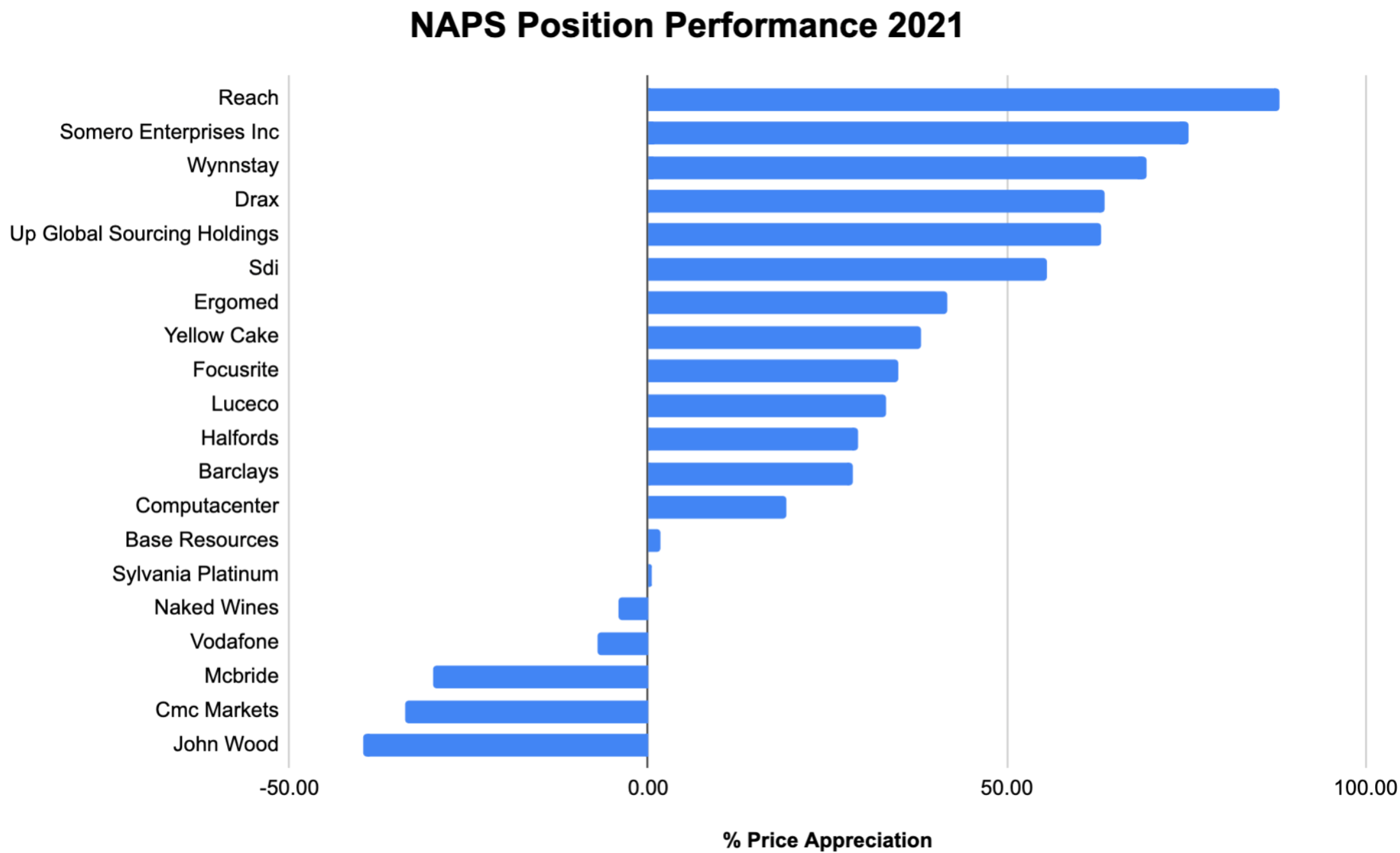
15 out of 20 of the holdings generated a positive price return, with some unfortunate losers in Cmc Markets (LON:CMCX) , Mcbride (LON:MCB) and John Wood (LON:WG.) But it’s the average that counts - and a 75% “hit rate” of winners is above average for the portfolio.
The perils of being a Bisy Backson
The Bisy Backson is always going somewhere, somewhere he hasn’t been. Anywhere but where he is. “That’s just it,” said Rabbit, “Where?” “Perhaps he’s looking for something.” “What?” asked Rabbit. “That’s just what I was going to say,” said Pooh. And then he added, “Perhaps he’s looking for a—for a—” For a Reward, perhaps. Our Bisy Backson religions, sciences, and business ethics have tried their hardest to convince us that there is a Great Reward waiting for us somewhere, and that what we have to do is spend our lives working like lunatics to catch up with it.
The underperformance of the UK’s junior market ( FTSE AIM All Share Total Return +5.6% ) illustrates what has been a sobering year for stock pickers in general. One way of monitoring the conviction interests of private investors (subscribers and non subscribers) has been the Stockopedia Challenge. It’s a competition that we’ve run over the last couple of years which has gathered two or three thousand entrants each year.
Tracking the performance of the top 20 most picked stocks has revealed that the strong penchant for risk taking, encouraged during 2020’s Covid Rebound, has not paid off. The list contained only 8/20 winners - a 40% “hit rate”. Yes, this is a competition and people do select punts, but if the sentiment on Twitter is anything to go by then the –14.5% return may have been suffered by many. I’ve heard of some investors who have lost up to 90% in 2021 by following the crowd into highly discussed names at the top of the cycle. While the top 20 selected by the Stockopedia Subscriber community did do better (+6% YTD) there are many on the overall list that will be familiar to the community - BOO, SAGA, DDDD, AVCT, NCYT, SLP, ORPH, ECR, ODX, SYME, GGP, IAG, HZM, TILS, HZM, PHE, BMN, ODX, SNG, ARB.

We have taken the decision not to run the Stockopedia Challenge for 2022 for a variety of reasons linked to the above (we are likely to revisit it in a different format in future) - but if you do wish to monitor the general interests of private investors there are some alternatives. Paul Hill on Twitter has been running a poll which can be found here, and David Stredder will be launching another competition called the Mello BLISS with rules designed to avoid speculation. If you haven’t yet been to a Mello Monday webinar - I highly recommend it as you’ll discover amazing insights from the very best private investors and fund managers - you can learn more and sign up here.
Wu-Wei - The “Pooh Way”
I have mused on many occasions as to the benefits of rules based investing. But with all the distractions of markets, it can be very hard to stick to. My own personal performance has failed to keep up with the NAPS as I broke my own rules. At the start of 2020, I began Chairing the Stockopedia Staff Investment Club and started to enjoy stock picking (as opposed to systematic investing) again. After all, there’s nothing like a great story to give you confidence in your share picks.
James Montier once mused in a paper titled "An Ode To Quant:
The evidence is clear: quant models usually provide a ceiling from which we detract performance rather than a floor on which we can build performance.
Which certainly sums up my own experience in 2021. I’ve managed to take my own winning NAPS system and reduce its returns through meddling - taking a smaller number of higher conviction positions, attempting to time entries and exits, and ending up with a 17.6% return when 26%+ was on the table at lower volatility (and less emotional distraction). So I begin (again) the process of shifting back to a more systematic, and more boring, NAPS Portfolio.
But there are great benefits to being boring - or should I say - reducing effort. The Taoists call this “Wu-Wei” which is translated as “non-doing” and so often misinterpreted by slackers as a justification for laziness. But Wu-Wei is more accurately interpreted as “effortless action” - taking action to ensure you swim with the currents rather than against them.
As described in the Tao of Pooh…
Mistakes are made by man, the creature with the overloaded Brain who separates himself from the supporting network of natural laws by interfering and trying too hard.
My own belief, well supported by hundreds of years of financial history, is that there is a natural law of the stock market. Rewards accrue to those that patiently own better quality, reasonably valued, stronger momentum shares. These are the three factors around which the StockRanks are designed and which have continued to explain (and predict) stock market returns. It seems that the only thing that has ever really mattered in an equity portfolio is to maintain a well diversified exposure to quality, value and momentum shares and wait for the market to do its natural work.
Of course, the Eeyores out there will keep acquiring knowledge to Complain about the world, and expect it to end with the ultimate collapse of stock markets everywhere. Too much cheap money, too much inflation, too many zombie companies, the end of the interest rate cycle, too much government intervention. They will create doomsday portfolios with the conviction of being right eventually, which I’m sure they will be… eventually.
Meanwhile the Rabbits out there will keep acquiring knowledge in order to be Clever and stay “one step ahead” of everyone else. Darting from one investment to the next, getting over-excited about all of AIM’s more speculative investments, predicting the future of technology, energy and healthcare while exhausting themselves from the effort and wondering why they’re so often at the wrong end of a long shotgun.
“Rabbit’s clever,” said Pooh thoughtfully. “Yes”, said Piglet “Rabbit’s clever, and he has a Brain.” There was a long silence. “I suppose,” said Pooh “that’s why he never understands anything.”
As the book illustrates, it’s Pooh that seems to most embody the principles of Tao.
“But, Pooh,” cried Piglet, all excited, “do you know the way?” “No,” said Pooh. “But there are twelve pots of honey in my cupboard, and they’ve been calling to me for hours. I couldn’t hear them properly before, because Rabbit would talk, but if nobody says anything except those twelve pots, I think, Piglet, I shall know where they’re calling from. Come on.”
To me, those twelve pots of honey are the three simple factors that I forgot to hear due to the cacophony of opinions that people share about stocks.
So my New Year’s Resolution is to be less Rabbit, less Eeyore, and more Pooh.
The 2022 Portfolio
For the third year in succession we will be using very similar rules - outlined in some depth at the start of 2021. The portfolio is constructed by selecting 20 stocks from two pools. The first being the highest ranked turnarounds (according to their Value & Momentum using the VM Rank), the second being the highest ranked high flyers (according to their QM Rank). Forced diversification across 10 sectors helps manage risk, with only 1 selection in each of Utilities and Telecoms with a top up in two other sectors with the next highest ranked shares.
As usual, I don’t love the picks - but not loving the picks has always worked well as so often it’s the shares you loathe that turn out best. Who would have wanted to own Drax (LON:DRX) this time last year ? A utility which has broken many a heart over the years. But it’s appreciated by 63% over 2021 and brought great spine to the portfolio. This is why it’s imperative to maintain broad sector agnostic exposure in a portfolio - to ensure you are Less Wrong from year to year. Being Right is what many Wish to Be… but being Less Wrong is the Winning Strategy.
Here’s the list:
| Name - Ticker | Market Cap £m | StockRank | Sector | RiskRating |
|---|---|---|---|---|
| ATYM - Atalaya Mining | 574 | 98 | Basic Materials | Adventurous |
| HILS - Hill & Smith Holdings | 1436 | 85 | Basic Materials | Balanced |
| VTU - Vertu Motors | 247 | 99 | Consumer Cyclicals | Speculative |
| SYS1 - System1 | 52 | 97 | Consumer Cyclicals | Speculative |
| WOSG - Watches Of Switzerland | 3573 | 86 | Consumer Cyclicals | Speculative |
| IMB - Imperial Brands | 15360 | 94 | Consumer Defensives | Balanced |
| RE. - R E A Holdings | 55 | 83 | Consumer Defensives | Speculative |
| YCA - Yellow Cake | 621 | 91 | Energy | Balanced |
| BP. - Bp | 65599 | 88 | Energy | Adventurous |
| TLW - Tullow Oil | 650 | 88 | Energy | Highly Speculative |
| LIO - Liontrust Asset Management | 1311 | 90 | Financials | Adventurous |
| NWG - Natwest | 25857 | 89 | Financials | Adventurous |
| DPH - Dechra Pharmaceuticals | 5726 | 73 | Healthcare | Balanced |
| INDV - Indivior | 1798 | 94 | Healthcare | Highly Speculative |
| RWA - Robert Walters | 605 | 97 | Industrials | Speculative |
| SOM - Somero Enterprises Inc | 305 | 99 | Industrials | Speculative |
| TUNE - Focusrite | 859 | 84 | Technology | Adventurous |
| FDM - Fdm (holdings) | 1398 | 82 | Technology | Adventurous |
| AAF - Airtel Africa | 5017 | 95 | Telecoms | Speculative |
| CNA - Centrica | 4199 | 96 | Utilities | Adventurous |
It’s notable that this list contains a few companies that may shy ESG minded readers away - two oil producers, a cigarette manufacturer and a palm oil producer. While I am a great believer in the power of ESG investing to change the world for the better, I’m also conscious that the weight of capital being driven into ESG funds is creating great distortions in financial markets and thus consumer’s lives. The forces of ESG have shot the price of gas to the moon which is a harbinger of more distortions to come - there is a growing worry that the oil price could do the same as underinvestment continues in these sectors. I do recommend reading Doomberg to understand more about the growing energy crisis. The NAPS process favours rational capital allocation and currently has no ESG bias - it may benefit from sector undervaluation that ESG is creating.
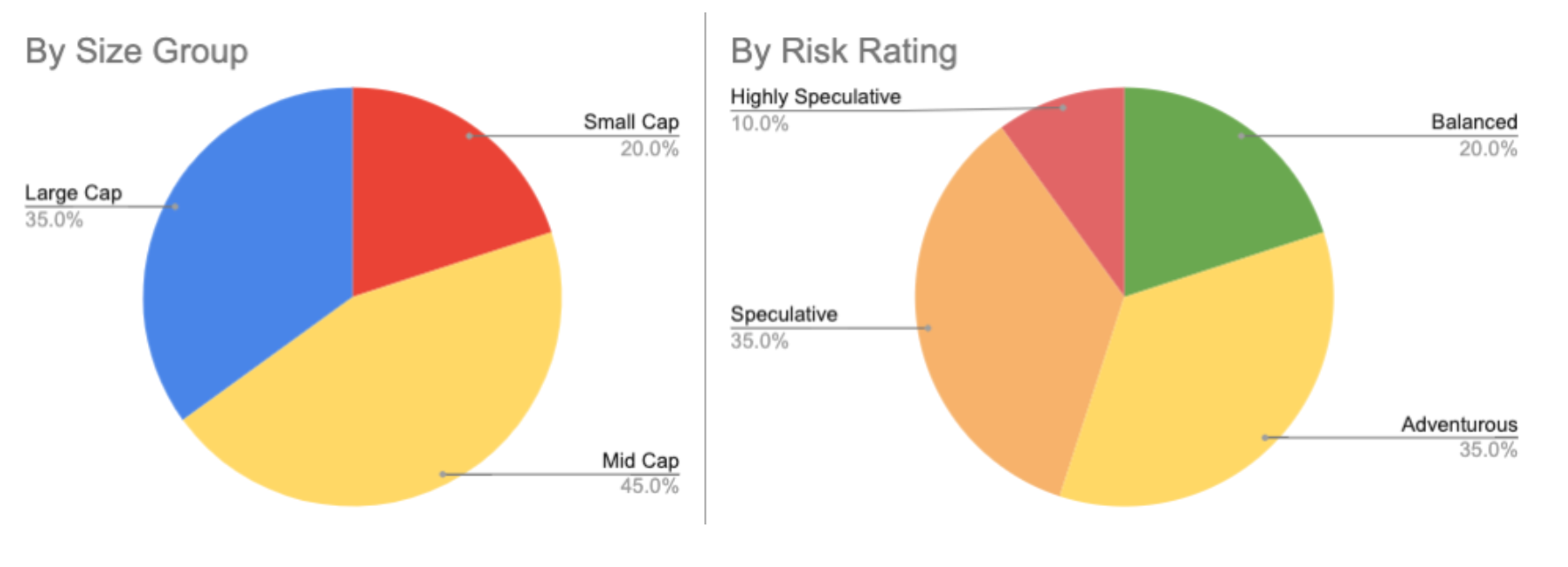
In previous years I’ve added constraints to favour small caps, but more recently I’ve been letting the ranks guide the distribution. This year’s portfolio is more weighted to mid and large caps, with only 4 small caps in the mix. I’m quite comfortable with this - the FTSE 100 has been outperforming over the last 12 months after all and that momentum may well continue. Similarly, I’ve relaxed the rules around excluding “Highly Speculative” shares. There are only 2 in the mix this year (Tullow Oil and Indivior) but they are mid caps and not at the extreme end of the risk spectrum. There are three shares with spreads around the 5% mark (REA, System1 and Somero), but the median spread is only 0.49% (average 1.44%). I generally find that good brokers can offer better execution than the quoted ask price so the spreads may be tighter than in our database.
The Stocks
Thanks again to Jack and Ben who have written up some briefs about the 2021 stocks for those who wish to know a little bit more.
Basic Materials
Hill & Smith Holdings (LON:HILS)
Hill & Smith is a FTSE 250 listed supplier of infrastructure and galvanising services around the world. Its products are found in flood defences, agricultural settings and highway crash barriers, among many others.
Its core markets are growing but like many others, Hill & Smith is having to manage the effects of supply chain pressures and higher input prices. In its favour, it has some solid quality characteristics, resilient profitability and momentum in both its earnings and share price.
In a trading update in November 2021, the company said: “The board remains confident in the medium to longer term outlook for the group, supported by strong growth drivers for both sustainable infrastructure and safe transport.”
Atalaya Mining (LON:ATYM)
Atalaya Mining, previously known as EMED Mining, acquired the ownership of the old Rio Tinto copper mining assets in the Pyrite Belt of Andalusia, North West of Seville. They have been ramping up production to hit new records of production and revenues and turning into an impressive outfit. Their main cash cow is the Proyecto Riotinto open pit mine but have also acquired the Masa Valverde nearby. They have been working through some community issues with their Proyecto Touro prospect in the NorthWest of Spain but a strong focus on ESG may help them replicate what they’ve done in Andalusia. This is a cheap copper miner, with a strong yield and no debt, exposed to the growing demand for copper in the electrical age. Dr Paul Jourdan at Amati has been building a position and explained his bullishness on a recent Moneyweek podcast.
CEO Alberto Lavandeira commented in November “I am pleased to report another strong quarter and year-to-date for Atalaya Mining. Robust operational performance, combined with strong copper prices, has seen our EBITDA for the first nine months of 2021 more than triple from the amount generated during the same period of 2020.”"
Consumer Cyclicals
System1 (LON:SYS1)
Formerly known as BrainJuicer, System1 is turning heads now for its shift away from bespoke advertising consultancy work to more scalable digital solutions (backed up by an ever-growing bank of proprietary advertising data). This move towards smaller and more automated solutions should lead to higher quality earnings and cash flow, as well as a more fundamentally profitable enterprise in future.
The shift to automated products is accelerating and represented 46% of revenue in Q2 (up from nothing in the prior year), which could signal a real incoming inflection point for the group. In the meantime, it is profitable, cash generative, has a strong balance sheet with a net cash position of £7.5m, and is buying back shares.
In its interim results released in November, founder and executive president John Kearon said: “*We believe that the growth in data revenues signals tangible progress towards our strategic goals, and that these revenues will in due course more than offset the expected reduction in bespoke consultancy projects as more companies adopt our automated data products.”
Watches Of Switzerland (LON:WOSG)
Watches of Switzerland is the UK market retailer of luxury watches and boasts long standing relationships with the likes of Rolex and Patek Phillipe. It traces its lineage back to the 18th century and hasn’t lost a partner in over 10 years. While brand owners typically retain a lot of economic value, WOSG plays an important role in providing routes to market, linking high end consumers to luxury watch owners.
The future looks bright for the group, which is leveraging its heritage and partnerships to kickstart its expansion into the lucrative US market. The impressive progress here has led to a rerating of the share price, but is the stock now too expensive?
In the group’s interim results released in December, management said: *“Through a consistent investment programme, we have further strengthened the business, paving the way for continued success as we advance our Long Range Plan objectives to strengthen our luxury watch leadership in the UK, become the clear market leader in the US and capitalise on the growth potential in the EU market.”
Vertu Motors (LON:VTU)
For so long, out of favour and offering asset-backed value, the auto dealer sector is now “in play” as a result of semiconductor shortages causing havoc with global car production. While there is less new car supply, used cars are selling at higher margins than previously. The net effect has been to catapult car dealer margins to historically high levels.
But for how long will these conditions persist, and what will normal levels of profitability look like on the other side? These are important questions, but for now bumper profits are filling up the coffers and transforming balance sheets.
In Vertu’s most recent trading update in December, it said: “The Board remains cautious on the future outlook with the potential of further disruption from Covid–19 to our resource levels, consumer confidence and global supply chains… the Board now anticipates that the Group’s adjusted profit before tax for the year ending 28 February 2022 will be no less than £70m (previously not less than £65.0m).”**
Consumer Defensives
R E A Holdings (LON:RE.)
R.E.A. is a UK-based palm oil producer with plantation operations in the province of East Kalimantan in Indonesia. Its origins date back to the early 1900s, when it was involved in overseas rubber plantations.
Improvements in the price of palm oil have fed through to R.E.A’s finances in 2021. As a result, there has been strong momentum in its share price. At current levels, the stock still looks cheap across a range of measures. While environmental groups aren’t keen on palm oil development in Indonesia, R.E.A. does provide extensive documentation, including external assessments, of its environmental and social commitments.
In its interim results in September, the company noted: “[A]… favourable combination of circumstances provides an opportunity to place the group’s finances on a firmer footing and, if, as the group expects, CPO and CPKO prices remain at remunerative levels, the group can look forward to a period of prosperity.”
Imperial Brands (LON:IMB)
Imperial Brands (previously Imperial Tobacco) was one of the great contrarian winners for Woodford in his early years as the addiction to tobacco products proved ever profitable in spite of advertising and regulatory restrictions. But since 2016 the stock has suffered, especially due to ESG concerns, market share losses and a lack of growth. But the company has a revamped strategy & leadership and is focusing on a smaller group of priority markets, while developing its heated tobacco and vape products as the shift away from combustibles continues. As a large cap giant with £8bn in revenue from 120 markets and a huge 9% dividend forecast it is likely to remain a mainstay of pension portfolios for some time to come.
CEO Stefan Bomhard commented in November at Final Results "This has been a year of important progress and significant change, as we begin to deliver on the new, focused strategy we announced in January 2021…. The year ahead will complete the two-year strengthening phase.. this period builds the foundations for the subsequent three-year phase, which focuses on the acceleration of returns and sustainable growth in shareholder value.
Energy
Bp (LON:BP.)
Shares in the oil and gas giant BP have drifted in a narrow range since the Covid crash in early 2020. That year, an oil price war between producing nations quickly gave way to one of the biggest declines in global consumption since the second world war.
Since then, demand has risen on the back of an improving economic outlook. Meanwhile, BP is endeavouring to transform its business and become a renewable energy generator, but the market seems unsure. BP’s shares trade on a single figure forward PE despite it being on course to record bumper profits in 2021.
In a third quarter update in November, Bernard Looney, the CEO of BP, said: *“This has been another good quarter for BP - our businesses are generating strong underlying earnings and cash flow while maintaining their focus on safe and reliable operations.”
Tullow Oil (LON:TLW)
Tullow Oil is an oil & gas exploration and production group primarily focused in Africa and South America. Its production guidance for the current year is in the range of 58,000–61,000 barrels of oil equivalent per day.
Like a number of profitable stocks in this sector, Tullow continues to look cheap across multiple metrics despite solid appreciation in the share price over the past year. It refinanced its debt facilities in the first half of 2021, but at ~US$3.8bn (TTM), that debt is considerable, meaning that Tullow’s outlook is very dependent on oil and gas prices.
In a trading statement in November 2021, Rahul Dhir, the CEO of Tullow Oil, said: “We have delivered strong operational performance across both Jubilee and TEN [production fields] this year and the Ghana drilling programme continues to be successful.”
Yellow Cake (LON:YCA)
Yellow Cake is maintained in the NAPS from 2021. Yellow Cake was incorporated in 2018 on the view that uranium is structurally undervalued and aims to hold physical U3O8. It offers direct exposure to the uranium price which may prove profitable, given the nuclear sector appears set for a revival given its emissions free clean energy capability. In the USA, the Sprott Physical Uranium Trust has been grabbing some headlines as it appears to try to corner the market in Uranium. There are some players who believe the price of Uranium could spike dramatically as underinvestment in new supply meets growing demand and Yellow Cake is a way to play this. Shareholders should understand that the company is likely to continue issuing shares to acquire uranium. An extensive write up of YCA can be found here by Jack.
Andre Liebenberg, CEO of Yellow Cake, said in December at interims“The demand side of uranium is strong and growing, yet considerable supply constraints remain. We continue to have real confidence in our business model, our strategy and our investment case.”"
Financials
Liontrust Asset Management (LON:LIO)
Liontrust Asset Management has been a stellar performer for shareholders over the last decade - with a share price growing from 90p in 2010 to 2200p today. This kind of share price growth can give shareholders vertigo but the company appears reasonably valued at a PE of 17 for its prospective earnings growth of 26%. At interims in September, the company reported Assets under Management (AUM) of £36bn - an increase of 15% since the start of the year and inflows of £2.1bn +19%. The group continues to win awards and positions itself strongly to retail investors with a strong focus on video production and website traffic.
Alastair Barbour - non exec Chairman - stated at the interims in September “ The last six months has demonstrated the strength of Liontrust across the business. This includes the quality of our investment capability, breadth of our client base, strong sales and client service, great communications, distinct brand and robust infrastructure. As a result, the Board are confident about the continued growth of your Company over the coming months.”
Natwest (LON:NWG)
As well as personal banking, NatWest is the largest business and commercial bank in the UK. Its share price has largely recovered from the Covid market crash and, operationally, the group is reporting positive momentum in the current 2021 year.
While banks can be notoriously complicated and hard to value, the forecast yield of 4.6% is below average for the sector. Meanwhile, momentum in its share price and earnings forecasts is positive.
In a third quarter update, Alison Rose, the CEO of NatWest said: “Throughout Q3 2021, NatWest continued to deliver a strong operating performance; growing in key areas and accelerating our digital transformation to improve customer experience and make our business more efficient.”
Healthcare
Indivior (LON:INDV)
Indivior has been on a journey since listing back in 2014. Shares reached a high of nearly 500p before cratering to a low of around 34p. Today, they trade for 247p after a strong run that has seen the stock comfortably outperform the rest of the market with a 1 year relative strength measure of some +126%.
Much of this outperformance comes down to the group’s legacy business holding market share well against generic competition, while its new treatment comes to the fore. Litigation has been an issue for the group but progress has been made here. It continues to weigh on sentiment, however, which could prove to be an opportunity. The company continues to divide opinion, but the stock itself has rarely looked better value when balancing the price against future prospects, and presents itself as a prime takeover candidate.
The group said in its Q3 results, released in October: “We are pleased to report another quarter of good growth and further strengthening of our leadership in addiction treatment.”
Dechra Pharmaceuticals (LON:DPH)
Dechra Pharmaceuticals is a specialist in veterinary medicines. It claims that the majority of its products treat conditions where there is either no viable alternative or its products have clear advantages. Dechra was a Covid winner, with many of its main markets growing strongly through the crisis.
Shares in the company performed exceptionally well through 2021 as its financial performance accelerated - and that was reflected in regular earnings forecast upgrades. The stock looks expensive but Dechra’s growth is expected to continue.
In its full year results published last September, Ian Page, the CEO of Dechra, said: “Dechra has continued to outperform a robust market throughout the Covid–19 pandemic affected financial year. As we start the new financial year trading remains strong with the momentum and market penetration seen in the second half of the prior financial year continuing.”
Industrials
Robert Walters (LON:RWA)
Labour shortages and wage inflation abound heading into 2022, and Robert Walters has been benefitting with a series of profit upgrades. The stock has rerated and is close to all-time highs but, given the favourable recruiting backdrop across a number of countries, the near-term outlook continues to look positive. Broker estimates have been behind the curve for much of the past year.
This is a fundamentally well run recruiter, but these stocks are often the first to rebound in a cycle. Is this a peak valuation? Reports suggest wage inflation might be here for a while longer and it could well be that there is further to run here. Certainly, from a factor perspective, the stock has merit at these levels.
In its recent trading update in December, the group commented: “…as a result of strong trading across all regions in the first two months of the fourth quarter and improved visibility in respect of December trading, profit before tax for the full year ending 31 December 2021 is expected to be comfortably ahead of current market expectations.”
Somero Enterprises Inc (LON:SOM)
Somero is a perennial Super Stock whose market-leading position in the niche supply of vehicles and equipment in the construction of flat floors for automated warehouses has enabled it to generate enviable returns on capital over time (regularly in excess of 40%). While its overseas adventures have been slightly more hit and miss, its core business goes from strength to strength and expansion into India signals a promising opportunity to bring its clever products to a new, large market. What’s more, trading on just 11.1x forecast earnings, the valuation is hardly demanding for a proven quality operator.
In its most recent update, the group commented: “The Board is pleased to report that it has seen strong trading momentum continue throughout H2 2021. This, combined with the Company’s ability to consistently deliver on customer orders, means that the Company now expects to exceed previous guidance for FY 2021.”
Technology
Focusrite (LON:TUNE)
Focusrite is an owner-managed audio and music products specialist that has developed rapidly as a result of strong organic growth and some strategic acquisitions. It has a solid, conservatively managed balance sheet and a strong track record of sales and earnings growth.
It has some eye-catching operating margins of around 20% and nearly 40% return on capital employed. This is a popular stock and the valuation looks high, but its strong quality metrics are reassuring. There may be concerns that Focusrite has seen a temporary sales surge due to the pandemic.
In a trading update in December, Phil Dudderidge, the executive chairman of Focusrite said: “During the first quarter of the current financial year, demand has remained strong overall and revenues have been in-line with management expectations.”
Fdm (holdings) (LON:FDM)
FDM is a group that essentially provides “outsourced IT help”. It recruits, trains and deploys its own permanent IT and business consultants to clients, either on site or remotely.
The group boasts some solid, double-digit margins and consistent profitability despite the turmoil of the past couple of years. Value investors won’t like the expensive rating but FDM is expected to bounce back to its pre-Covid growth trend this year.
In its half year results last July, Rod Flavell, the CEO of FDM said: "I am pleased to report that FDM made strong progress in the first half of the year and, while our markets remain impacted by the pandemic, we have seen operational performance return to levels that we experienced prior to the pandemic.”
Telecoms
Airtel Africa (LON:AAF)
Airtel Africa has two very different businesses: more traditional telecoms infrastructure operations across 17 African nations, and a lower capex, higher margin Mobile Money proposition that seeks to bring accessible finances to the continent’s “unbanked”. The latter has attracted notable global partners including MasterCard, suggesting Airtel Money could have a big future as part of the African financial system.
Compared to more UK-focused stocks, there are powerful demographic tailwinds in countries such as Nigeria that should make long-term growth more achievable. But there are, of course, geopolitical risks too. A price to forecast earnings ratio of 10.7x appears reasonable once you balance the risks against the rewards.
In Airtel’s recent H1 results, incoming CEO Segun Ogunsanya said: “ The first half of last year, and especially Q1, was impacted by the start of Covid, but even after adjusting for these effects, our revenue growth rates for the half year for the Group and all our service segments are ahead of our FY’21 revenue growth trends, and in reported terms these are all in strong double digits.”
Utilities
Centrica (LON:CNA)
2021 was a tumultuous year for the UK energy supply industry. Soaring gas prices forced several small suppliers out of business, which was a bonus for groups like Centrica, which owns British Gas. In a highly regulated industry, rising wholesale prices can’t always be passed on to customers. But this year there’s an expectation that regulators will raise industry price caps, which should boost profitability for Centrica.
Shares in the group have already risen in anticipation of higher profits, and brokers have hiked their earnings forecasts. Price caps are undoubtedly a drag on margins, but those strict controls are partly why utilities companies are often maligned by the market - and valued cheaply as a result.
In its interim results last July, Chris O’Shea, the CEO of Centrica, said: “Our first half financial performance was broadly as we expected overall, and we continue to make good progress towards the simplification of our company.”
Disclaimer
This is not financial advice. Our content is intended to be used and must be used for information and education purposes only. Please read our disclaimer and terms and conditions to understand our obligations.
151 comments
Well, who could have predicted that year and its effect on NAPS. -17.42% down (-15.57 with dividend and stock splits) overall across the list of stocks. Some highlights (LON:INDV, LON:IMP, LON:CNA, LON:BP,), lowlights pretty much everything else.
Roll on next year and hopefully back to profit with a strategy that has been rather successful since I joined in 2015
I do a NAPs folio every month. Since July things have improved. October is up over 11% already, mainly due to Yu (LON:YU.), up 97%. November is up 6.5%.
Ultilities have done well this year, Centrica (LON:CNA), Yu (LON:YU.) and Telecom Plus (LON:TEP)
Very true, if I break it down and look at it from a monthly point of view compared to the full year, then I get a more positive result. Everyone to there own.
You may have misunderstood me, I meant I do a new NAPs selection every month. The original NAPs done in January, had a low point around end of September and has recovered somewhat, my NAPs is different from Ed one, though.
My recent ones picked Yu (LON:YU.) which has done exceptionally well. Even taking YU out of October's, it still has done well. Really not sure what next year will bring.
which I guess makes it SAPS - Significant Admin Portfolio System.
What I'm also seeing is the top QM are outperforming the top VM stocks in the last 3 months.
How do you link an Excel cell to a live share price please? Cheers
Liontrust Asset Management (LON:LIO) has fallen off the cliff in the last 6 months. Time to buy?
NAPS is nearly tracking the S&P500. As of yesterday 05/05 the index was down 13.5% compared to 04/01/22. An equally weighted £20k NAPS portfolio (i.e., £1k in each of the 20 stocks) invested on 04/01/22 is down 13.8%. ROIs range from -47% (Lions Trust) to 25% (R E A Holdings). +ve ROIs - 8 stocks, -ve ROIs - 12 stocks. The businesses are all sound and I guess if this was a rising market, it may have outperformed the S&P. Given the current situation, it may be prudent to use trailing stops. @Ed Croft - you might have to then rename it to MAPS - Minor Administration Portfolio Service
I've always said the NAPS approach is a jazz sheet to riff on, not a fixed musical score. Some people create more active rules, others stay more passive. It's really up to the user depending on personal preference, time horizon, risk tolerance and more. If someone has a 10 year horizon and the capital is not required in the interim - market volatility shouldn't matter - it should be embraced humorously. If someone has a shorter time horizon - then having more active risk management may be beneficial - both in terms of capital protection but also for mental health.
People need to keep the faith! No strategy is immune from the overall market conditions. As Ed points out the NAPS is down less than the S&P 500 so far which pretty good.
If as investors we run at the first sign of a setback (which many do) then we only end up missing out on the rebound and the transaction costs will also eat into your portfolio.
Investing in stocks is a long game and as Warren Buffet said the market is there serve you and not to instruct you.
Having a real dilemma about NAPS 2022 - I have been very disciplined so far and done no tinkering whatsoever. However I'm wondering if 2022 is "Black Swan" enough to bail out into miners and commodities? Vertu Motors (LON:VTU) Robert Walters (LON:RWA) Hill & Smith Holdings (LON:HILS) Focusrite (LON:TUNE) and Liontrust Asset Management (LON:LIO) all down well over 20% - portfolio down 11% ytd (maybe this isn't too bad relatively - but it feels bad).
I want to keep the faith - but it is hard!
People have generally got the wrong idea about NAPS. This is a “no-administration” portfolio for people who have some money but do not want to manage a share portfolio actively. It has done better than most active portfolios over the last few years. But it is still a passive portfolio. So it can only be assessed as a basket of shares over twelve months. If it is rubbish this year then we can all feel better about ourselves (unless we have done worse). You are either “all-in” or you are not.
Another 2022 NAPs selection bites the dust. We can add System1 (LON:SYS1) to the list of heavily underwater stocks. Fortunately I don’t hold but the current return on the portfolio is heading south in a hurry. Though including Bp (LON:BP.) will have helped returns but the small cap plays are being hit badly.
ACounsell - NAPS will correct harder than the FTSE All Share, but probably not as hard as the AIM All Share. That's by design. It's a higher beta than the safer indices, but not as high beta as others.
TBH - judging performance over weeks is not the point of the NAPS. It's just a long-only equity portfolio after all... not an absolute return long/short portfolio. Therefore it corrects and is volatile just like normal long only equity portfolios.
Hi Ed,
Understand and accept your comments about relative risk and judging performance over a longer time period. My comment was not intended as a criticism - more an observation that the NAPs had got off to a difficult start with 7 of the selected holdings falling by more than 15% and a number of others in negative territory. Overall as you highlight the NAPs portfolio is doing less badly than a lot of other ‘benchmark’ indices in what is beginning to look like a difficult year for markets in general.
It's certainly going to be interesting seeing what happens this year. If it recovers and ends up making a decent return for 2022 I will never doubt again.
I will just hold on now and wait and see what happens made a lot of changes to the portfolio and I dont think its made much difference. Next Year I wont be buying stock with more than 300 bps spread the spread on Somero Enterprises Inc (LON:SOM) and R E A Holdings (LON:RE.) is ridiculous now.
I have 3 NAPS running at the moment one started end of December, one mid Jan and one end of Jan. I’ll be starting a new one up every two weeks. I now only use VM stocks as the market seems to be pulling in that direction. Performance on the VM only NAPS are as follows..
End Dec +8.45%
Mid Jan +4%
End Jan +4.5%
I will of course keep an eye on QM stocks and if they come back into favour will include them in future NAPS.
So you have 60 stocks? I guess some appear in all 3? Are you running 3 seperate portfolios?
I have 10 stocks per portfolio and yes there is certainly overlap between the 3. Currently running as separate portfolios but with stockopedias restriction I only have space for another 1 or 2 to monitor here.
I had thought of doing this. Great idea. Hope you report back after a year to see the results.
Airtel gapped down 10% due to a large holder dumping stock, I sold, but may buy back in if it starts to consolidate or steadily rise
the NAPS really depends on momentum, as mentioned numerous times below, if a stock loses momentum, I'll break the rules and sell, after all those are the NAPS rules not mine.
This is the performance so far. You have to set it up yourself with e.g £1000 per share bought on Jan 1st. Only takes twenty mins….
Yes that looks about right :(
I've created a NAPS portfilio but not bought any shares in it yet - is there a 2022 version of https://assets.stockopedia.com/topstocks2021.pdf ?
I'm pretty sure that the Stocko team decided not to do this for 2022.
Arguably it is early days yet but performance continues to look pretty dire for the NAPs portfolio this year - some of which I hold along with my own picks. At c. 3:45pm today the NAPS portfolio was down around 16.5%. There are 8 winners & 12 losers. The winners don't make happy reading for any ESG and 'green' investors out there! Mining (Atalaya Mining (LON:ATYM)), Tobacco (Imperial Brands (LON:IMB)), Palm Oil (R E A Holdings (LON:RE.), Oil & Gas (Bp (LON:BP.), Tullow Oil (LON:TLW), Centrica (LON:CNA)), Banking (Natwest (LON:NWG)) and Airtel Africa (LON:AAF)
There are some pretty bad losers which keep on heading south. Liontrust Asset Management (LON:LIO) down c. 28%, Dechra Pharmaceuticals (LON:DPH) down c. 28%, Focusrite (LON:TUNE) down 26.3% and Fdm (holdings) (LON:FDM) down 21.4%. I have already sold Hill & Smith Holdings (LON:HILS) (down c. 15.5%) and despite decent metrics and positive recent trading updates from Liontrust Asset Management (LON:LIO) and Focusrite (LON:TUNE) (I hold both) they keep on falling. I am seriously considering heading for the exit because I can't see why they should be performing so badly and the macro/geopolitical environment looking ahead doesn't look great. I fear the the momentum play that has served the NAPs so well in last couple of years has run its course
Are you sure it's down 16%? My one is down 4% YTD but I don't have some of the winners, such as Imperial Brands (LON:IMB) Tullow Oil (LON:TLW) and £RE. and I have all the big losers, so I thought NAPS here would be outperforming my NAPS.
Most the NAPS I have set up since April 2021 have underperformed the market, some by considerable margins such as 10%. But it goes like that, Stockopedia and NAPs wont always outperform. Indexes are being held up by some large caps that are outperforming, such as Oil and banking.
Stockopedia works much better in a bull market.
I set up a virtual portfolio with £2500 invested in each of the 20 NAPs selection. I based it on the start price on 1st trading day of 2022 and included trading costs and and any stamp duty. I’m a little surprised yours is only down 4% when you have all the losers and not all of the winners. That is a pretty good result in the current market. Fortunately I didn’t follow the NAPs porfolio in its entirety but I’m probably down c. 10% on this portion of my portfolio.
I set mine up on 1st January as well. I checked the figures and 4% is correct, the losers are down around 13% on average. See the other post by djrhs which shows it is down by 3%. I don’t understand how you get -16%. I don’t include trading costs or stamp duty, but my trading costs are very low £3 and I don’t inc. dividends.
NAPS 2021 which I still have set up is down 7% this year.
Hi,
Oh dear, looks like one of those dreaded formula errors has crept into my spreadsheet that I use to calculate the performance of the NAPS. Excel has a feature that links to current stock prices so data input is minimal but having corrected my formulae error you are right YTD performance is actually down 4.1%. Many thanks for putting doubt in my mind and forcing me to recheck my spreadsheet. At least it is not mission critical! However, I think my individual stock performance comments are valid and I may need to sell some of the losers before things get any worse. Fortunately I have a decent holding in Shell (LON:SHEL) & Bp (LON:BP.) !
I thought something had gone wrong. NAPS often performs better than I think. I did buy a few of the big losers but fortunately I also have larger holdings in Bp (LON:BP.) and £SHELL
Where can I view how the NAPS 2022 portfolio is doing ?
You can't without setting it all up. I have a NAPS set up but it's not exactly the same as this one. It's been pretty mixed so far.
ive tampered this to oblivian. I won't tamper next year and I will now keep my hands off my portfolio until new year's Day. The substitutes are also falling now. Lesson learned. Need to be more like pooh. Marks and Spencer has proved to be a terrible substitute for wosg.
ive tampered this to oblivian. I won't tamper next year and I will now keep my hands off my portfolio until new year's Day. The substitutes are also falling now. Lesson learned. Need to be more like pooh. Marks and Spencer has proved to be a terrible substitute for wosg.
My First year trying this. Next year I will definitely add a rule to the QM and VM ranks that control the spread probably less thn 200bps. REA Holdings is 500bps! I dont like losing 5 % just on the trade.
In the early NAPs there was a rule about spread < 500bps, I think, this seems to have disappeared recently, but I agree 500bps is too much but 200 May cut out quite a few winners. Somero Enterprises Inc (LON:SOM) is about 370bps, Ergomed (LON:ERGO) is also.
?bps
Yes, Spread is measured in basis points, have a look at the Stockreport.
ok thanks
Oh dear what a bad start. Maybe we should have started this in February?
I've not amended my portfolio at all but I am panicking somewhat. I also bought second week in January at the peak so I'm down 15% at the moment. I want to sell a couple but I've probably left it late so I'm sticking to the philosophy.
You mean March!?!
Actually my February NAPS is showing a small profit.
So I broke today. I couldnt tolerate Hill and Smiths decline any longer and James Lathams bollinger bands look ready to burst. I triggered the stop loss I shouldnt have had and bought James Latham. Happier now.
Liontrust could be next
Liontrust Asset Management (LON:LIO) is down 21% now.
But early fallers can recover in NAPs and early leaders often fall.
I bought LIO under 19 and added under 18.
It is now under 17 and I am thinking to add more now or wait for under 16?
Its gone now. I will be buying Harbourvest Global Private Equity (LON:HVPE) instead when it hits 2400. I'm not convinced that LIO is going to recover from this drop.
This is my first shot at NAPS and I picked 10 of the 20 (1 per sector). Not looking good at the minute but then the market in general hasn't been great for the last month or so.
I've read about using stop losses but do investors consider a target growth, ie 25% and then selling the stock. Whilst this stops the chances of big winners it does lock in profit.
I don’t like automatic stop losses. Your reaction should depend on why the price has gone down. Price fluctuates much more than inherent value. When a stock I hold goes down a lot I aim to either a) buy more if the fall is unjustified or b) sell if the fall is justified.
Target growth is a terrible idea except in cyclical sectors where upside is limited. I wouldn’t expect Tesco to increase by 100% but if you sell early on most sectors you will miss some big winners. Cut your weeds not your flowers.
I hate holding onto losses much more than 20% nowadays. If they're down this much I seriously consider getting out.
I've been burnt before by holding onto a handful of huge losses and eventually sold, crystallising a big loss. So what do you then? You sell some big winners to try and claw back some of the losses only to leave yourself with some shares not doing much, only to see the winners you've just sold, continue to go up even more.
As you say, cut the weeds, not the flowers
Only issue with running big winners is they can reverse quite quickly, as you can see from charts, for stocks such as Boohoo (LON:BOO), Best Of The Best (LON:BOTB), Reach (LON:RCH), Volex (LON:VLX) are just a few that come to mind, I had held on to some winners far too long.
Thanks to all for the responses re taking profits in NAPS. I know there is no perfect rule otherwise we would all be rich. Interesting reading.
Best wishes.
B
From my experience the winners tend to run for 9-12 months then can run out of momentum. Most big winners, if picked for 2 years running, rarely do as well the second year, conversely ones that did not do so well the first year do better the second time around.
Over the past 2 years there have been some big winners, I think in 2020 there were 4 stocks that had +150% gains, selling those at 25% would have been a massive mistake.
Hill & Smith Holdings (LON:HILS) went for me too despite some pretty tough selling rules: - 15 % ( it was supposed to be a ‘balanced’ I.E. lower risk!) trailing stop loss, less than 80 stock rank, relative performance vs. relevant index > minus 10% and below 200 day MA - sadly it hit them all so had to go this week. As you say Liontrust Asset Management (LON:LIO) is looking precarious too & maybe next. Have a few too many stocks, not necessarily NAPS, in hugely negative territory so really don’t want too many more! No doubt any sales I make will stage a fantastic recovery by year end!
I'm really trying to be more like pooh. I really am. I really want to swap out Watches of Switzerland for Marks and Spencers and Dechra Pharma for SDI group and Hill and Smith for James Latham. Its a struggle not to tamper.
maybe GSK not SDI group. Oh god I'm definitely not pooh.
I sold on Dechra today. I follow NAPS to the letter except for selling a stock when it’s 20% down and then spending the returns on current highest QM in the sector
Interesting. Is that a rolling stop loss? I'd like to know how your returns compare to Ed's if you've been following that strategy for a while. I'm tempted to use Ed's method but I'd find it hard to hold on to a stock that's going down massively.
Yes it’s a rolling stop loss. From the back testing I did on last years portfolio it only added 1 or 2 percentage points by the end of the year however I too hate holding anything that is falling massively.
so far the highly speculative tullow oil proves to be spot on!
for the rest of the year i think the energy is the right sector to be in.
Hi Ed, another great write up, thanks. After doing many dummy runs, I decided to take the plunge with NAPS as running my investments on top of all else life throws at you was causing me to age in dog years. I am really pleased that I did, though it was a difficult start having set it up in mid September!
One interesting point to note. I hadn’t particularly planned it like this, but I ended up with all my VM in one trading account and all my QM in another. The VM is doing very well, while the QM is doing badly (though I should stress I am happy with the combined results).
Also, I may have missed it, but do you do an update at this time of year on how SNAPS is performing.
Thanks again
Some factors (and combinations of factors) can do well while others do poorly. So VM doing well while QM doesn't is perfectly natural. With hindsight one can always explain why one set of factors has done better than another, but not always before! What I like about investing across multiple factors (and multiple sectors) is that you don't have to outsmart the market... you can yield to the market and let it do the work for you.
Patience is a great virtue... but it's almost maddeningly difficult to be patient and have the emotional resolve to wait. The NAPS strategy works... but it doesn't always work. There are often market periods where it can feel invested in all the wrong parts of the market, but as we've seen in the last 12 months there are also times where it invests in all the right parts of the market when everyone else is in the wrong ones !
I've found that the NAPS underperforms occasionally by a small margin, but can outperform by a large margin. Again it goes back to the idea of being Less Wrong. If you are Less Wrong consistently over time, your capital ends up compounding at a higher rate as you suffer lower drawdowns than strategies that try to be More Right.
BTW - "Less Wrong" is the name of a terrific website here for rationalists.
Ed
would you review the NAPS on a monthly basis?
@jayrannejad - no I won't review the NAPS monthly. Volatility is volatility, and for me, the NAPS is not about the names on the list. It's about the basket.
I set up a NAPS 30/9/21. I get a slightly different result from you. VM is probably ahead of QM but not by a lot. Overall it is up 3.8%, the FTSE Allshare is up 5% over the same period, but NAPS has spreads to account for, so it's about the same. The best gainers are Vertu Motors (LON:VTU) and Watches Of Switzerland (LON:WOSG) both up 42.5%, the worst ones are Capita (LON:CPI) (-27%) and Sthree (LON:STEM) (-25%).
None of the NAPS I set up last from April onwards 2021, has done very well, in fact April and June are around 10% down on the index. So NAPS works some times, January it has worked well. I don't have enough historical information to tell which are the best times to start a NAPS.
Not enough folios on Stockopedia to study this.
For me this was the best article and most thought provoking I have read, many thanks AR
NAPS got off to a flier but had it's wings trimmed in the last few days.
Does anyone know why Dechra Pharmaceuticals (LON:DPH) is down 16%, can't see any news apart from a broker price upgrade.
Focusrite (LON:TUNE) and Liontrust Asset Management (LON:LIO) also are down quite a bit.
I noticed that someone sold off 5 million pounds worth of Dechra on the 6th but other than no news other than upratings
Perhaps more surprising is the poor performance of one of the Basic Materials sector NAPS selections. Hill & Smith Holdings (LON:HILS) is down c. 15% - no negative news following positive trading update in November and business is focused on infrastructure so not a high growth tech stock, and arguably in favoured sector. It is hitting all my sell rules (stop loss 15% from high since purchase as ‘balanced’ stock, relative performance vs, FTSE 250 >-10%, negative vs. 200 day MA and stock rank<80). I know the NAPS strategy is to buy & hold for a year (Ed’s patient approach) but I hold a few shares where I have waived these rules and seen falls in excess of 50%! No doubt if I hit the sell button £HILS will rocket for the rest of the year as has frequently happened in the market over the last 6 years. However I digress into my own investment foibles - do any subscribers have an insight into Hill & Smith Holdings (LON:HILS)?
Sorry, I don't know about Hill & Smith Holdings (LON:HILS), could it be because of concerns about the Chinese construction industry? Looking the QM for Hill & Smith Holdings (LON:HILS) it is only 89 now, quite a fall in 2 weeks, some in that sector are doing well such as Anglo American (LON:AAL) but they are different business from £HILS.
Yes if I sell they will rocket and if I buy they will fall more.
But it is not the worst performer in NAPS, £DHP is down 20% and Liontrust Asset Management (LON:LIO) -145, both of which I bought this year but not at NAPS prices.
VALUATION!
They are on High P/E with low dividend. When interest rate and treasury rates are rising, jam tomorrow is not the good place to wait for!
LIO, DPH are growth stocks. value is the name of the game in the town now!
excellent piece of work Ed.
I really enjoyed reading the article and the comments.
I have been investing for more than 3 years now.
The older I have become the more I try less to pick individual stocks. I do it for challenges, fun and brain exercise.
I am more inclined to leave it to professional to do my main investment meaning I buy investment trusts and funds.
Over the last five years they have beaten me :
I hold Fundsmith, SSON, SMT,BRWM and BRGE.
Thanks Ed, I really love the idea of this - and I did it last year - but OMG did I fail! Tinkered it to death - a disastrous year down 19.5% - the only survivor from my original NAPS selection from last year was solid state - up 50%! You live and learn - I have sold the dross I ended up with (mainly aim junk) and have re-entered the NAPS arena. Just hoping I have learned a valuable but costly lesson.
Hi Ed,
Great article and it's fantastic to follow how the NAPs are performing.
Question - Based on the data, is there a way to improve the NAPs performance further by implementing the strategy on a specific date during the year?
For example, a majority of companies have a 31 December year-end. This suggests that most Q1, H1, Q3 trading updates should happen around the same time. It then takes a couple of days for analysts to input data and the StockRanks to update. At this point, the data is probably most valid and it could offer the best prices to buy the highest ranked stocks.
Any thoughts on this would be great.
Cheers,
I would say first day in January is probably the best time to start based on my NAPS. They often get off to a good start. Around mid December may also be a good time to catch the Santa rally if there is one. But there have been a couple of market corrections around March, 2020 was one. Last year the first quarter was the best performing, NAPS I set in April onwards did gain very much at all and some even lost money. April NAPS I selected is up 1.42% currently, actually April NAPS was up 15% in 1Q but then has fallen back.
But every year is different, I don't think the results have that much impact, it is more to do with the market movements.
Thanks Ed.
Here is the audio book for those who wish to be.
Hi Ed - many thanks for the report and list. I too have taken the plunge today by buying 19 out of the 20 NAPS stocks in my ISA. I couldn’t buy Somero Enterprises Inc (LON:SOM) on interactive investor without filling in some US tax form so went with Royal Mail instead which ranked similarly in the QM list.
a flying start for your list today - pity I couldn’t share in it but hey ho, it is supposed to be about performance over 6 and 12 months, so I’ll just chill…..
Ed - excellent article as always. Like a few others on here, I have decided to take the ‘NAPS plunge’ in 2022 after reading with interest the results over the last few years. Like others, my selected 20 is subtly different (17/20 the same) but, as you say, timing and some personal biases are the reasons for this. Good luck all…!!
I bought £DCH, this morning it's now down 9%, typical.
I do hold some of the NAPS selection already.
Have tried to recreate today's naps (3 Jan) using the rules described in last year's article and get almost no overlap with above choices. Was wondering if anyone else was having a similar problem? Eg for me Atalaya ranks 7th in basic materials....bemused
If this is when looking at the list after copying into an Excel spreadsheet does Atalaya have the same VM/QM rank as those above it? If so this may be the issue. It can be avoided or 'tie broken' by using another metric of your choosing after VM/QM i.e. lowest BPS or highest stock rank etc. Ed did do a youtube video explaining the process, and also written instructions in the year it moved from SR to QM/VM.
Hi Ed,
You focus on QM and VM with the NAPS selection, but ignore QV - I can understand the rationale for that in a long-running bull market, (one that we've come to see as the norm), but in more difficult times does it make sense to ignore companies that might be deemed to be 'cheap' but 'quality' ? Has anyone runs the figures over the years based on the same selection process but simply using the Stockrank, and thus by implication taking a more balanced view of all three attributes? How might that fare in a choppier market/prolonged downturn?
article already out of date as gas prices have fallen nearly 300p from their peak
What a daft thing to say! Any article is out of date the day after it is written. You could have said the same thing if gas prices had risen 300p - or fallen 10p. What will they do tomorrow?
As a matter of fact, BO and Centrica are both up since your comments!
I'm reading the NAPS thread and Paul's review in parallel and I wondered whether the NAPS may be an ideal platform for a one year leveraged position. Has this been tried?
I'm reading the NAPS thread and Paul's review in parallel and I wondered whether the NAPS may be an ideal platform for a one year leveraged position. Has this been tried?
I'd be interested to see what would have happened with 6 month rebalancing, i.e. swap the NAPS selections for SNAP selections in July
Hi dodge 1664,
I monitor this on a regular basis and had the 2021 NAPS selection been replaced with the SNAPS selection in July (which Ed has said in the past is not the approach he takes) it would not have worked well. The SNAPS selection retained Halfords (LON:HFD) and Focusrite (LON:TUNE) but only achieved a c. 2.0% return in the 2H. Might this mean that the momentum play has run its course and following a similar strategy for 2022 might be a mistake?
Hi ACounsell,
thanks for the info. I note that NAPS was up 31% by the end of June, but ended the year up only 28.3%. So the switch to SNAPS would have helped a little bit, even after stamp duty.
Have you tracked performance from earlier years?
Dodge
Hi Dodge
Apologies - yes I had my initial calculation the wrong way round (too much Xmas food and drink perhaps)! Below are my best estimates of NAPS & SNAPS performance for the last 5 years. They may not agree exactly with Ed's numbers due to minor timing differences in terms of determining the portfolio's start/end values, but they are pretty close. To get the FY result for the SNAPS portfolio I have taken the NAPS 1H cash increase/(decrease) and added it to the SNAPS 2H cash increase/(decrease) to get a FY number which is then used to calculate a % return over and above the NAPS starting portfolio cost for that year. On balance results suggest best not to rebalance at HY with only a significant improvement seen in 2H 2021 which I guess isn't surprising.
Hi Ed,
Another excellent year for NAPS and the systemic approach really works and saves time. I have incorporated some elements in my own process and have often thought of dropping my own process and just buying the NAPS, but enjoy my own process too much, and really select stocks for multi-year ownership to limit costs.
I'm really interested in why you don't drink your own 'kool-aid' and take the plunge with the NAPS. Is this always going to be a thought experiment only?
BSV
I do drink my own kool aid BSV. My own portfolios are always NAPS-esque, high ranked and sector diversified. But I’ve experimented with varying levels of personal discretion and position sizing over the last 2 years and proved (again) that I don’t add much value over the pure systematic approaches
Aside from my discretionary long only equities - I have been running a strongly levered long/short spread bet portfolio with 50-60 pan-European NAPS positions (mostly UK). Earning the premium between high and low ranked stocks has been very profitable recently.
There are many ways to skin the cat.
I have been running a strongly levered long/short spread bet portfolio with 50-60 pan-European NAPS positions (mostly UK). Earning the premium between high and low ranked stocks has been very profitable recently.
Ed, I have often thought that this would make a good strategy as on average the high ranking shares outperform the low ranking by a considerable margin. Unfortunately, the averages conceal the fact that both the best and worst performing shares tend to come from the lower ranks. With a short position you are potentially exposed to unlimited loss from those low rankers that go on to make spectacular gains. How do you manage that risk?
@Dwit199
It's harder in practice to run a good long/short (market neutral) strategy than it appears in theory. I use IG as my spread bet firm, and they have a lot of restrictions on shorting. Most names can't be sold to open a position which radically reduces the universe of shortable instruments. They provide information on which markets can be shorted via a spreadsheet and via their API. I code a fair bit so do use their API, but the spreadsheet can be found here. There's another one for CFDs.
I've found that to ensure sector neutrality, I need to use a broader universe - hence European names. There is quite astonishing leverage provided by spread betters. Which is a highly double edged sword. In a broadly diversified portfolio you can get a lot of exposure with lower amounts of capital. But there's significant risk on any "factor reversal" where the low ranked shares outperform the high ranked.
Some have called market neutral strategies "picking up pennies in front of steamrollers". When it's going well it feels far too easy - especially as you avoid the ups and downs of equity market risk - but 2020 was awful for long/short strategies as low ranked shares dominated high ranked - these kinds of reversals do happen every now and then. Calmer waters are better for earning the 'spread'.
This is an interesting exercise! Isn't it about time to try and expand it to markets outside the UK? I think specifically a US or EU version would be interesting on the side. That would also add an overview of sector performances across regions.
Agree NAPS would benefit from a NAPS USA and NAPS AUST approach.
Why don’t you do your own and then post it on here? Many subscribers don’t have the US or Europe regions.
That's true, but as it's the founder doing the exercise right now I imagine he has the necessary access.
I don't think you necessarily need access to the region to read through a systemic approach to investing based on Stockopedia's ressources.
But how do you know which stocks qualify if you don't have the region?
I do NAPS every month on UK stocks but I don't have any other regions now for various reasons. The problem with Europe many of the stocks were not available to trade on my platforms and costs were high. US not convinced that Stockopedia really works in that market, but if someone does a NAPS we can see.
Do you have the US region?
Hi,
I'm from Denmark, so I have the EU, UK and US region as I hold stocks within every area in my personal portfolio. So far I haven't encountered any errors in data in either region. In fact one of the reasons I'm subscribed here at all is that the validity of data is excellent across so many countries.
What's the cost of trading EU and US stocks from a UK broker? I'm using SAXO in Denmark and the costs there are quite low. Not as low as DK stocks, but low enough for it to be viable.
it's a restriction from a reader perspective of course, but running a portfolio from Stockopedia's side on a EU and US filter shouldn't be a problem.
I'm not saying there are errors but if you look at the Stockopedia performance figures for the highest ranked stocks, you will see the US does not perform as well the UK and Europe: https://www.stockopedia.com/le...
Also I found some of my best performing US stocks were not highly ranked on Stockopedia.
Trading depends which platform you use, most charge a forex fee, often 1% plus their dealing fees, so it can be quite a bit more expensive, same on European stocks. On Ig Group (LON:IGG) I pay 0.5% forex and no dealing fees, so it's not too bad. There are also tax issues on dividends. Spreads on US stocks tend to be much narrower than UK stocks.
Why don't you do a NAPS on US and European (ex UK) stocks and post them so we can see how well it performs. If the US performs well I may tempted to add that region.
I might! I didn't know you could track history like that here, so thanks for the link.
I think your conclusion isn't quite right though. If I look over the last 5Y balanced annually, the results are as follows:
UK 90-100: 76.44%
EU 90-100: 108.07%
US 90-100: 81.87%
S&P 500 for comparison is 111.23%.
So in that regards, on the contrary, the UK is underperforming over the same time period.
But you need to compared against the index and other ranks. The US 90-100 rarely beats the index. I make it up 60.49% over 5 years.
The UK and Europe the top 2 ranks consistently are the 80-90 and 90-100.
If you did a S&P tracker it would outperform the US 90-100 with much less costs.
I’d love to see your results for the 12 portfolios Rustbucket as I’m doing the same thing this year on a fortnightly basis. For me it’s an attempt to stop me “playing”.
Thanks but I did not do all 12 as not enough folios on Stockopedia. I did from April 2021 onwards, actually it was not very exciting at all, many had a small loss or gain, most of the gains were in the first quarter, since then none of the NAPS did really show any large gains which is a bit surprising. April NAPS was up about 2.5%, the FTSE Allshare was up over 10% YTD. June was down 4.4%, FTSE AS +5% YTD. OCT is up 4%, same as ALL Share. These figures are up to 1/1/2022. Other months I don't have the results to hand but they were similar when I last looked. Certainly January 2021 NAPS was the best by far even if it did fall back from 1st September.
NAPS 2022 certainly off to a flyer today, is the market picking up on NAPS?
Thanks Rustbucket.
Re: NAPS 2022 certainly off to a flyer today, is the market picking up on NAPS?
I did my January NAPS purchases just after Christmas expecting a bounce in early Jan when the new NAPS were announced - certainly seems to be the case. For once I got timings right!
I only did one extra NAPS last year on the 17th July and that’s up 10% although 2% of that is from todays jump.
Last years NAPS also got off to a flyer also, up 6% by 11th January. I have noticed that on some other NAPS as well.
I did NAPS last year for UK / EU / US. All 3 portfolios outperformed their respective benchmarks. Also worth highlighting I did do some tinkering (around 30% across the year) based on either VM/QM scores dropping substantially, or the stock price dropping 20%. This tinkering methodology worked in each market - i.e. the replacement stocks (still chosen on the same basis and same sector, just updated for time) generally outperformed the original stocks.
I too sell off when closing price on trailing stop loss is 20% - a manual process. Interesting to see that you also monitor VM/QM. What do you class as a substantial drop? Do you think this made a big difference to overall returns?
Hi Graham. I generally sell if the relevant VM/QM drops much below 75 (given most start above 95 this is a reasonable fall). After costs I do not think it made a huge difference to returns but the logic still holds true. My basic summary is from 60 stocks bought (across UK/US/EU) early Jan, I sold 20 at some point in the first 9 months because of the reasons described. Of these 20, only 4 went on to outperform the market. Of course not all 20 replacements outperformed, but there were more than 4 winners from these replacements.
Thanks Hiley I’ll certainly keep an eye on vm/qm from now on
Last year I watched the NAPS with interest, surprise and disappointment as it beat my own portfolio quite comfortably and I resolved to put my faith in it this year with a portion of my money.
Now that the NAPS 2022 have been chosen, I’m nervous! These shares as a group were up 60% for 2021!! Can we really expect them to outperform again??? As Ed said “I don’t love some of the selections” - like WOSG already surely at the top…..?
But that’s the whole point of course, take all the cognitive bias out of the equation. I’m still deciding if I have the stomach to commit £50,000 to a selection of shares I don’t “believe in”. I wonder how many people do actually have the courage to buy the whole NAPS…..
”These shares as a group were up 60% for 2021”
Yes indeed there is a momentum loading (QM+VM) and momentum triggers a deep cognitive bias against it. But we should remember that 6m/1y relative strength is the most predictive factor of all.
I agree that pandemic winners (like WOSG, VTU, TUNE amongst others) may have top of the cycle earnings profiles… but… is it the top of the cycle? It’s hard to know. Could it be that in 12 months time with hindsight we think it obvious that those stocks were top of cycle - or will we look back and think… blimey those trend lasted longer than we expected?
Who knows…the nature of momentum is that trends often persist far longer than we expect and currently scary charts can look rather cheap with hindsight. I’ve learned from Dart Group(Jet2), Games Workshop and others that big winners from one year often compound to the next…
As a Taoist might say… it’s the nature of things…. let it flow.
(DYOR, not advice etc)
Hi Ed, a good read and interesting stock selection. As you infer many of the shares in this year's NAPS are likely to be unattractive to many for a variety of reasons. I own two, Atalaya Mining (LON:ATYM) and Vertu Motors (LON:VTU) and there are some that I would like to own such Liontrust Asset Management (LON:LIO), but are currently too expensive. I also like Wynnstay (LON:WYN) and would look to purchase if the share price falls back.
I don't deny the efficiency of a 'mechanical system' such as Naps and its success, but for me apart from financial independence, the other important aspect of investing is enjoyment. Like many I have fun researching stocks and trying find those companies that are underappreciated before they are discovered by the market and bid up to overly optimistic valuations. So mechanical systems with fixed rules are not for me, but each to their own and I appreciate that they may well be attractive to those where family and work commitments preclude the luxury of time to devote to researching individual companies.
I have been fortunate to beat the NAPS in 2021, but that of course could easily change this year.
Best wishes to all at Stockopedia for 2022
I looked at last years success and compared it to my own - and was roundly beaten.
So, to keep the enjoyment and the idea / fantasy that Im better than the system - Im planning to split my funds this year and have 50% on NAPS and 50% my own choices.
It will make it interesting, because Ill split into 2 portfolios - and can "race" to beat NAPS!
A great read Ed and clearly excellent long-term results. Think I might have to consider adopting this type of thing for a small % of my PF for a couple of years to see how things go.
Best wishes. K
Great read, thanks. An attractive option as I will be busy with work and adopting such an approach this year will likely lead to less distractions, more work done thus more money to invest. A question… If I wanted to fill my ISA with the NAPS portfolio and only had £16k left of my allowance would you recommend splitting this across all 20 stocks? Or removing the 2 lower stock ranks from turnarounds and high flyers leaving myself with 16 stocks (with ~£1k of each) and accepting a greater risk?
Good question. I think it depends on trading costs, mine are very low now at £3 per transaction, so buying small amounts is not an issue for me. But there are several stocks that I would not want to hold anyway, such as tobacco and palm oil, also I would not hold 3 energy stocks either out of 20. You could start with 16, then in April if you have more funds add to it then.
Thanks Ed. A great read for Sunday morning. I definitely need to be less like Rabbit and more like Pooh.
Another great read Ed. From the selection for the semi annual NAPS (SNAPS) I make the return to be circa 36% at end of 2021. I don't suppose you have the annualised interest for the SNAPS from inception?
Cheers and a happy new year!
Hi, thanks for this write up, interesting as always.
Can you remind me if you use any stop losses at all? I am sure you have discussed it in previously but I can’t remember the answer.
Stop losses are not used at all on NAPS.
@Ed Has there been any consideration of using a stop loss or stock rank loss/decline as part of the NAPS? For example using a stock rank"loss" of 75 would have sold Reach Reach (LON:RCH) at 373.5 (according to the data on the stock page) This would have stopped the holding of hitting the high point of 420 but avoided the subsequent decline to 282.5.
Obviously there is the risk of a decline in the stock rank or getting stopped out by price, causing a sale, followed by improvement in the price
But if you do it for Reach (LON:RCH) you would have to do it for all, Drax (LON:DRX) would have been sold at around 370p, it is now 605p. Several others would also have been sold. Then what, would you replace them or just soldier on with existing stocks?
Yes, apologies I wasn't clear, you would do it for all. I mentioned Reach as that is a holding of mine. I wondered if anyone had applied a similar idea or stop loss
Personally if I were running the portfolio I would replace the stock with another but it may then make it hard to track returns if you're putting different amounts in at different times, dealing costs etc and would also lessen the no admin aspect
Well I think last year, you would have been worse off, if you had sold when SR dropped below 75, Yellow Cake (LON:YCA) would been been sold at around 220p in early March, but it’s difficult to work out because you don’t what would have replaced them. Also as you say transactions costs and spread need to be taken into account. Stops losses have been mentioned before, but some years would have taken out the big gainers, probably 2020 that would have happened, there were some winners that year, 4 around 150%.
The beauty of NAPS is you just leave it for a year.
If you replaced Yellow Cake (LON:YCA) with £EQZ in early March, price was about 24p, you would have had to sell within a month at around 18p, so you would have lost 25%, the gains on YCA were over 50%, so it does not seem to work.
Every year I look at this portfolio, and every year I think "nope not for me", and nearly every year I've been impressed with the results given the lack of attention it needs.
My first Land Rover, and every one subsequently has a button, "hill descent", it's used for situations when you want the car to take driving control from you when in tricky landscapes. I call it the "leap of faith button" because you take your foot off the brake and accelerator and trust this to the vehicle, it's got me out of a few awkward situations.
I recognise the portfolio isn't a recommendation, but this year, just for the sake of it, I think I'll press that button. Whether I'll keep my foot off the brake though, I can't promise.
Mike probably why you should have traded for an Toyota FJ40 :) - removes the leap of faith
reminding me of the scene in fight club there
This is a great advert for the benefits of Stockopedia that with minimal effort and meddling you can achieve such outperformance!
Ed - based on last years lesson of meddling with the NAPS will you simply back your selections above with real money and sit back and relax? I imagine that will be hard to do!
I have posted my yearly review here https://www.stockopedia.com/co... and almost matched your NAPS performance (within 1%)
Great article, Ed.
This year, as you're following the Tao of Pooh, you should back your selections with real honey.
A brilliant read, thank you Ed. (I’m off to re-read AA Milne!)
Thanks Ed, I did my list this morning, I got a few different stocks from you. 3 Energy, that’s unusual, is that a first? I had Serica Energy (LON:SQZ) and Bp (LON:BP.)
But the surprise is no Diageo (LON:DGE) that is the top CD in my list, any reason why it’s not included?
Yes - 3 for the energy sector is indeed a first. My narrative bias brain tells me this is a good thing due to my comments on energy, but a 10% weighting to oil producers is obviously significant exposure to an unpopular sector that could go either way.
My list was finalised yesterday in time for writing, so there may be differences in rank ordering.
Diageo suffered the cut in the Consumer Defensives sector to ensure an equal 10 QM and 10 VM split across the portfolio. The process tends to spit out more QMs than VMs... and VMs take precedent. Diageo is a higher QM ranked share than those in other sectors... TBH I'd rather own it than IMB as a consumer defensive selection, but IMB's VM won out.
OK thanks Ed, I understand about £DGE. There is one other stock has been at the top of the VMs for a while which is Riverstone Energy (LON:RSE) which not included. There are so many financials in the top VM and have been for a while.
I agree about some of stocks selected this year, I would not invest in Imperial Brands (LON:IMB) or R E A Holdings (LON:RE.)
I will do my own NAPS this year and see how it compares.
Yes I should have mentioned - I skipped Riverstone Energy as a "financial" as it is really an investment vehicle for the energy sector.
Good to avoid £RSE Riverstone due to serious corporate governance issues. The managers play heads we win tails you lose.
I think all of us have our own NAPS and maybe we should share it here!
How do you share it here? I did set one up but it's a bit different from Ed's but I don't owned all of them.
It has been a really mixed bag so far, I don't think I can remember a NAPs being like this years.
Thanks Ed I also think oil and gas will do well for 2022. I have Enquest (LON:ENQ) as my preferred pick.
@Edward could you consider posting an EU-based NAPS.
It would be interesting over time to see the performance outside the UK as well, I know you have the performance trackers you can look at. The NAPS is a very good strategy for most people and more localized content makes it easier to get convinced, in addition many EU-based account holders need to invest within the EU to be able to reinvest profits without having to tax. Hope you can consider it.