Oil & gas stocks offer opportunity and risk

In this piece:
Why recent performance and near-term forecasts aren’t driving share prices higher
Why the hydrocarbon decline could now be quicker than expected
Do valuation metrics support a tobacco-style investment in oil and gas producers?
I have to admit that I’ve always had a somewhat guilty fascination with oil and gas stocks. They’ve sometimes proved to be poor investments for me, and I don’t invest much in this sector these days. But I’ve found it hard to ignore the current combination of record profits and ultra-low valuations.
Take Shell (LON:SHEL), for example. The FTSE 100’s largest company reported a record $40bn profit last week for 2022, more than twice the 2021 figure of $19bn.
No one seriously expects this level of profit to be repeated for the foreseeable future (at least, I don’t think so…), but forecasts for the current year still show a yield of 4.4%, covered nearly four times by earnings.
There’s plenty of headroom here, too. At the current rate of growth, Shell’s dividend might even return to its pre-2020 level in coming years.

More broadly, the big UK-listed fossil fuel producers all score highly for value and boast healthy StockRanks:
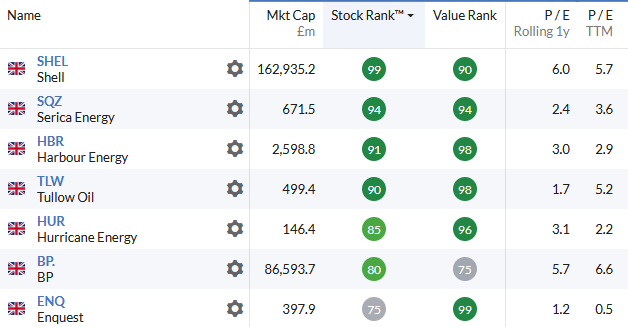
Is the market missing an opportunity, or is this a classic cyclical trap? I think the answer may lie somewhere between these two extremes, as I’ll explain.
Where are we now?
Let’s start with a look at oil and gas prices. This will give us a view of where prices stand today, compared to before the Ukraine-Russia war.
Brent crude is now trading back at roughly the same level it was before Russia invaded Ukraine.

Source: tradingeconomics.com
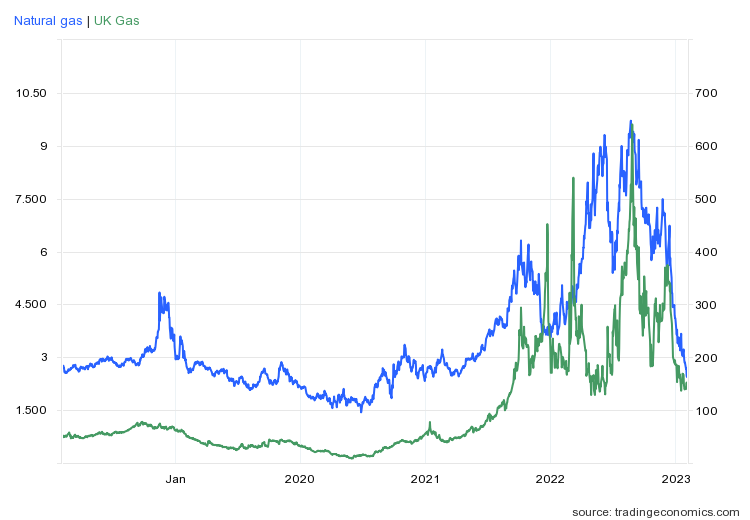
Gas prices have fallen back to pre-war levels too, after last summer’s buying frenzy. A relatively mild winter has meant that inventory levels have remained comfortable across Europe.
Although UK natural gas prices are still elevated by historic standards, the US natural gas benchmark has now returned to entirely normal levels:
Source: tradingeconomics.com
Market prices don’t seem to be suggesting any kind of imminent shortage. This may help to explain why the stocks I listed above have fallen by around 20% in aggregate since oil prices peaked in May 2022:
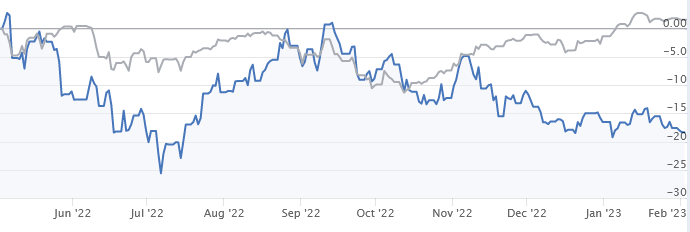
Note: to get this chart, I put the companies listed above in a Folio without any transaction data. Stockopedia will then generate a simulated performance chart and plot this against the folio’s benchmark – in this case, the FTSE All-Share index.
What’s next for oil & gas?
In the short term, market conditions may be influenced by the strength (or not) of western economies and a possible increase in demand from China’s reopening. Trying to predict the interplay of these factors is beyond my pay grade and – I’d suggest – probably futile.
All I will say is that Shell’s share price has previously been a reliable predictor of looming oil price slumps. The FTSE 100’s largest stock has previously peaked in 2001, 2008, 2014 and 2018/19. Make of this what you will…

Looking further ahead: I’m more interested in the longer view, in terms of potential investments. I think that one key element to consider is how future fossil fuel production will balance against the expected long-term decline in consumption.
As we saw in 2020 and again in 2022, when the market fears a significant mismatch between supply and demand, energy prices can become very volatile indeed.
One bullish argument is that since the 2014 oil price slump, the supermajors have cut back on capital investment. As a result, there’s a risk we could see a shortfall in future supply, as new production fails to replace declines in output from mature fields. This could lead to sustained higher prices and periodic spikes higher, as we saw last year.
This school of thought seemed to be gaining currency in 2021 – here and here, for example. However, I’ve seen less of it since the Russians invaded Ukraine. BP’s recently-published 2023 Energy Outlook provided one possible explanation.
Although BP (LON:BP.) believes that investment in oil and gas production will still be needed through to 2050, the company now believes that global carbon emissions could peak sooner than previously thought.
The US Inflation Reduction Act is given as one reason, but the main reason for this change in viewpoint is the war itself. According to BP, this situation has prompted many countries to focus on decarbonising their energy systems and reducing dependency on imported energy, which is dominated by fossil fuels.
Spencer Dale, BP chief economist, says that we’ve seen this pattern of behaviour before (my bold):
“... the experience from the major energy supply shocks of the 1970s suggests that events that heightened energy security concerns can have significant and persistent impacts on energy markets”.
BP now believes the war will lead to a lasting reduction in global GDP and accelerated changes to countries’ primary energy sources. This could mean that carbon emissions peak sooner than the company previously thought.

Source: BP 2023 Energy Outlook
This chart shows how BP’s 2035 energy source assumptions have changed since last year:

Source: BP 2023 Energy Outlook
There’s much more detail in the report for anyone who is interested. But I’d like to share two more charts that caught my eye.
BP expects OPEC producers to take a growing share of production over the coming decades.

Source: BP 2023 Energy Outlook
The firm’s modelling suggests that in almost every scenario, the biggest production declines will come from non-OPEC producers (dark green), such as UK firms:

Source: BP 2023 Energy Outlook
Where does all this leave us? As Megan explained recently, we can make a structural growth case for energy transition minerals such as copper, nickel, and zinc.
That doesn’t seem possible with oil and gas. Even some of the world’s largest producers are planning for a long-term decline.
The rate and extent of this decline is still very uncertain, in my view, but in the North Sea at least, clear plans are emerging for decommissioning over the coming decade (note this data only covers three major operators).
I think we could be entering a stage where fossil fuel producers become similar in some ways to tobacco firms.
People have been predicting the demise of tobacco companies for decades, but they remain large-scale businesses with attractive economies of scale and strong cash generation. They aren’t necessarily bad investments, at the right price.
Valuation: is the price right?
The UK oil producers included in my earlier graphic are all trading on super-low P/E ratios. However on other measures I think they look more fully priced:
Company | Mkt cap | Forecast P/E | Forecast dividend yield | CAPE 10y |
Shell | £163bn | 6.0 | 4.4% | 12.5 |
BP | £87bn | 5.7 | 4.3% | 10.6 |
Harbour Energy (LON:HBR) | £2.6bn | 3.0 | 7.6% | n/a |
Serica Energy (LON:SQZ) | £670m | 2.4 | 6.9% | n/a |
Tullow Oil (LON:TLW) | £499m | 1.7 | 0% | 3.1 |
Enquest (LON:ENQ) | £398m | 1.2 | 0% | 0.7 |
Hurricane Energy (LON:HUR) | £146m | 2.2 | 0% | n/a |
Dividend yield: earnings in a cyclical business can fluctuate from year to year, but dividends tend to be sized so that they’re more sustainable. Most businesses don’t want to chop and change their payout policy every year.
For mature businesses like these, with limited growth prospects, I see dividend yields as a more likely indicator of their valuation. Broadly, I would say these dividend yields are fair value, not cheap.
In fairness, BP and Shell at least are far more efficient businesses than they were 10 years ago. Costs are under control and they are producing more oil and gas from reduced spending.
However, the forward picture is still a concern. The cost of debt and equity capital in this sector is widely-reported to have increased significantly in recent years. Other costs must surely be rising again, too. Future projects could cost more to finance, capping profitability. The energy transition remains a longer-term challenge.
In contrast, I think upstream-only firms Harbour, Serica, and Tullow are likely to have a more limited appetite to take on new debt. Borrowing costs will be higher than in the past. And with a growing number of producing fields in decline, I suspect borrowing money could become progressively more difficult.
Right now, I agree with Stockopedia’s algorithms. Valuations look cheap and momentum and quality scores are reasonable.
However, there’s no guarantee commodity prices will stay high – although they might.
Looking beyond that, no one knows exactly how the balance of supply and demand will change due to decarbonisation. Nor is it clear how much capacity or inclination OPEC will have to ramp up production.
Conclusions
As with tobacco stocks, I think oil and gas producers can no longer expect investors to price in future growth. Shareholders and lenders will want upfront returns – that means high yields and low valuations, in my view.
I think this sector will continue to offer opportunities to investors, but I don’t think it’s as safe as the current rosy consensus might suggest.
Disclaimer
This is not financial advice. Our content is intended to be used and must be used for information and education purposes only. Please read our disclaimer and terms and conditions to understand our obligations.

34 comments
Good article! Pity about the idiotic rants from climate change deniers in the comments.
I see no 'idiotic rants' here, nor any claims that the weather doesn't change. Calling people deniers is abuse, and an attempt to equate them with something more sinister. I think what you meant to say is that you don't agree with them.
Absolutely correct.
XTR: If like me you attribute little value to ESG and woke investments then I would recommend listening to this:
I see no 'idiotic rants’
If that was true before (questionable), it is hard to uphold now
History will show that Net Zero fanatics are either myopic or utopian.Do you ever ask yourself why most hot climate countries are not doing Net Zero in practice?
Either the world will find a technological solution to Global Warming like Nuclear Fission or the human race will adapt to Warmer Conditions but if neither happens then the world will find a Hiroshima type solution
When the USA wanted to end the Pacific War in 1945 they decided to nuke 2 Japanese Cities knowing it would kill hundreds of thousands of Japanese civilians but force Japan to surrender.If Global Warming is man made and the only solution becomes reducing the Global Population then it is obvious the likes of Trump,Putin, Xi etc will implement a Hiroshima solution if they are able to and space travel has not progressed enough to create human colonies on other planets.
THE CASE FOR DRILL PIPE
In light of the Seymour Hersh article last week (that the western media dare not report), I'd like to point out that 75% of the world’s supply of drill-pipe comes from just 5 manufacturers. No drill pipe means no more new oil and gas supply. Disclosure: I own all of these including TMK listed on MOEX via IBKR. Vallourec recently did a large deal with Petrobras in Brazil and personally I think Vallourec has the potential to go back to its all time high (i.e. 70X) when this oil and gas supply fiasco gets serious.
1. TMK (Russia)
2. Tenaris (Italy)
3. Vallourec (France)
4. NOV (US)
5. Hilong Holdings [1623] (Hong Kong)
Note: TMK accounts for 15% of global drill-pipe supply. Due to sanctions this supply is unavailable to the west.
Looking at BP (LON:BP.) the estimated net profit figures for 2024, don't look correct to me, how can they make $105bn?
These figures have been corrected now.
AIM dog Active Energy (LON:AEG) is looking interesting, could it be about to have its day?
Their patented CoalSwitch wood pellet product looks to have potential. Commercial scale production coming online this year, opportunities are across North America which is still a heavy coal user, and should be accelerating due to the IRA legislation.
I have taken a starter position, could be just a punt but looks a decent one.
https://www.aegplc.com/coalswi...
To add some smaller oil producers into the mix here…. I hold Petrotal (LON:PTAL) , Arrow Exploration (LON:AXL, I3 Energy (LON:I3E) and Jadestone Energy (LON:JSE) . All are extremely cheap (using traditional metrics) and have much better growth profiles than the large caps mentioned here.
I am a long-term investor in both RDS and BP, during covid when the oil price went negative I added more shares BP @181p and RDS @ 1250, both are in profit plus good dividends since I hold them (nearly 4 yrs now)
Oil Jumps After Russia Says It Will Cut 500,000 Barrels Of Oil Output
"Giovanni Staunovo, an analyst at UBS Group AG, pointed out that no oil producer can fill the Russian supply gap. And it's only a matter of time before the Biden Administration panics, although any further releases from the SPR are now unlikely. OPEC nations and partners don't appreciate the G7's price cap on Russian oil. These sanctions will likely backfire with higher crude prices."
Source
Yet oil prices are only up just over 1% today. BP (LON:BP.) was up strongly but has now fallen back.
I don't understand Russia's logic, thought it would want to sell more oil to fund it's war? Unless it just to raise oil prices but will that bother the US? Oil price now is less than before Ukraine.
Hi Rusty2.
The diesel oil cap rolled out last Sunday by the EU is set at $100/barrel I believe. My guess is that diesel prices start to rise passed this threshold level at some point this year...
The Pulitzer Prize winning Seymour Hersh article (link here) hasn't gained much traction in the west either considering the gravity of it so perhaps the oil cut was about that as well.
So it looks like Russia is simply turning up the volume (much like they are doing with the war). The simple truth is that the G7 countries still consume Russian oil but they pay a premium for it via India as a middle man etc.
Since the first COP in Germany in 1995, World coal, oil and gas demand have all increased. When looking at energy type by graph the sections for solar and wind are so small that they are hard to see. This is after massive subsidy and investment around the World in solar and wind during 28 COP conferences over nearly 3 decades.
Reliable high density energy will still be in demand for many decades to come. Additionally the many vital non energy uses of oil and gas that form the basis of modern life and are also not going away in a hurry.
BP make a pertinent point about the World responding to the Russia/Ukraine energy shock. However this time around:
* there is an anti energy company philosophy predominant in many markets around the World (neatly illustrated by the Royal Opera House ditching BP as a sponsor!) which must impact negatively on investment
* interest rates have increased, again negatively impacting on investment
* whilst energy use per person in Europe and North America is falling, our populations are still rising and so overall energy use is still growing
* US energy use per person is 76K KWH, but China’s is only 30K…do you expect them to want to stay at such a low level? And then there is India at 7K per person and Africa at 4K per person. Try telling them to stay at anything near their current energy levels! Plus World population growth for another 25-45 years.
* 1970s oil shock - most countries around the World scarcely used oil back then…and those that did were starting with extremely inefficient energy usage. That clearly no longer applies a large car in 1970s would do between 8-15 MPG, now a similar sized car will have so many more functions (ventilation, heating, entertainment, powered steering, windows, SatNav, etc) and yet still do 35-55 MPG.
So I’m happy with my holdings in Harbour Energy (LON:HBR), Serica Energy (LON:SQZ) and Gulf Keystone Petroleum (LON:GKP) with their low debt/ net cash, great dividends and very low valuations.
Yes by their nature they will fluctuate, but for the foreseeable future there will be plenty of demand for oil, gas and coal, and their price will be supported by the demand and supply factors I mention above.
Finally whilst the BP report is rammed with good data (some of which is quoted above) I suspect that both they and Shell are heavily influenced by the current vogue for believing that CO2 controls the weather. It may be that they are happy to promote the notion of falling high density, reliable oil and gas use (despite the opposite trend) and transitioning to unreliable, low density wind and solar energy to placate their SJW opponents and critics despite the many real World obstacles to such a transition.
Martin VT: I agree wholeheartedly and your comments remind me of this article which I recently read:
Wind-Power Makers Suffer Huge Losses, Want To Abandon Major Project
I see Vestas Wind Systems A/S (CPH:VWS) 4Q earnings are out tomorrow, might be worth a look.
Good point Rusty2:
Vestas announces preliminary full-year 2022 figures and financial outlook for 2023
The wind power industry’s challenging period continued in 2022 due to unexpected geo-political uncertainty, an accelerating energy crisis, and high inflation. In this environment, Vestas’ fourth quarter results were negatively impacted by additional challenges. The negative impact in the fourth quarter causes the full-year results to be lower than the outlook, primarily driven by a confined number of project delays, an impairment on our V174-9.5 MW turbine and increased warranty provisions.
In 2022, Vestas made strategic and commercial progress in terms of strengthening operations and substantially raising prices that indicates Vestas will deliver improved financial results in 2023. Activity levels in 2023 are expected to be lower than in 2022 followed by a step up in 2024 where installations in key markets are projected to increase.
Preliminary results for full year 2022
Vestas’ preliminary and unaudited 2022 results show a total revenue of EUR 14,486m, (outlook: EUR 14.5-15.5bn). The Service business accounted for EUR 3,155m of the total revenue, corresponding to a year-on-year growth of 27 percent (outlook: min. 20 percent). The higher-than-expected revenue growth in Service thereby partially offsets the lower-than-expected Power Solutions revenue, which has been impacted by delays in execution.
Based on the preliminary numbers, the EBIT margin before special items was (8.0) percent (outlook: approx. (5) percent), primarily driven by isolated events in the fourth quarter of 2022 as well as delays in a confined number of projects by the end of the fourth quarter. In the fourth quarter, additional warranty provisions of EUR 210m have been made. The higher warranties primarily relate to increased repair and upgrade costs and a few select cases. As a result of an expected challenged profitability and lower order intake for offshore projects utilising the V174 turbine, an impairment of EUR 95m has been made on that platform in the quarter. The EBIT margin for the Service business is expected to amount to 21.4 percent compared to an outlook of approx. 22 percent.
Total investments*) are expected to amount to EUR 758m (2021: EUR 773m) which is lower than the outlook of approx. EUR 850m.
Looks like the fact these things need so much maintenance is what is making them any money at all. And their windmills get massive subsidy sic their business in US growing because of Biden’s fantastic ‘Inflation Reduction Bill’ which in reality is just $2 Tn of ‘green’ handouts!
Thanks Martin, for that, for some reason it is not on Stockopedia. Think they do need a lot of maintenance, the ones near me, often some are not going round.
The problem is with them, is in some parts of the world, they don't have enough wind to make them viable, it is not like the UK in many areas. But I'm surprised by the lack of solar in some hot, sunny countries.
Thank you Alphaflight. Yes interesting tweet. Too many people got caught up in the notion of wind and solar as being ‘free’ energy, whereas they are hugely capital and resource hungry…and indeed subsidy needy to boot.
Their development is completely dependent upon fossil fuels in great quantity, as indeed is their ongoing maintenance. For example huge amounts of specialist oil is needed every year for lubrication of these giant turbines!
Martin: You're not wrong. Also as you will know, modern farming is a function of fossil fuels, we essentially convert oil in to food via pesticides and diesel powered machinery*
* I own farms in different parts of the world and modern farming is all about oil irrespective of location. No oil means no food, no tree plantations etc. No trees means less solar panels because we burn trees in order to make solar panels (source below for the non believers).
Burning trees to make solar panels
Wise words Martin VT. I thought I was the only Stocko subscriber that has not fallen for the climate change hubris which has led western governments to adopt their unbelievably crass net zero policies. As you say, energy density is all important. And you can bet people still believe in having energy readily available 24/7, in spite of HMG's apparent aspirations to turn us into a third world country. So until we have the magic wand that creates cheap grid level storage to back up highly inefficient weather dependent Rube Goldberg creations, we will continue to need ever greater supplies of hydrocarbons. I hold Serica and Harbour and dozens of other oil and gas companies. The next few years will be very interesting......
Excellent article. Oil consumption will decrease over the next ten years matched by lower production in big oil companies. The sovereign oil companies , The Gulf, Russia and others, continue to produce enough to satisfy demand. The price ( oil and big oil company shares) is right now and it is a good income investment for many more years to come.
CO2 is not the enemy of the planet, fossils fuel provide far more than just energy it took around 200 hundred years to get its technical excellence and worldwide coverage. Renewables even by 2030 provide only around 10% of the world energy needs. Time to wake up to climate fanatics. Oil is still a good home for investors.
Saudi Oil Minister's recent comments:
"...As Bloomberg also notes, Saudi energy minister Prince Abdulaziz bin Salman also used remarks at the Riyadh conference on Saturday to decry the lack of investment in refining capacity that has left the world undersupplied. He reiterated that OPEC+ would remain cautious in deciding when to ramp up output."
Source: Oil To Face "Serious" Supply Problem In 2024 As Production Capacity Runs Out, Goldman Warns
Stockopedia rankings are based mainly on past data. Oil and gas prices have fallen considerably in the last 10 months, so profits are likely to fall from 2022. I agree the future is not so rosy looking and I have sold some Shell (LON:SHEL) and BP (LON:BP.) at 2500p and 500p respectively, seems to be a bit of ceiling around that level, will b e interesting to see if they can break out but I think other sectors have more potential at the moment. I have held them as an income stock anyway.
As soon as I said that, BP (LON:BP.) are up 6% today.
Shell (LON:SHEL) and BP (LON:BP.) yields used to much higher in the past, look back to around 2017-8, div. was around 5.5% to 6.5% on a similar share price. There is a lot nonsense in the media, about shareholders getting huge dividends. In 2020 Shell lost about 20bn, now they make some profit, they have to pay windfall tax.
If Labour do get in power, I see windfall taxes or taxes on oil companies increasing.
North Sea oil is already taxed at 75%. And it is difficult to see how to Labour would tax non-UK oil profits.
Well it is proposed "To raise an extra £8bn from the windfall tax, Labour would close a loophole allowing tax relief on fossil fuel investment and backdate the tax to January."
Not sure how legal that is.
They can also, I think, offset tax by investing in renewables.
Even the Tories have imposed windfall taxes on oil companies and even on renewables.
Rusty: Very true!!
South American (NYSE listed) companies with crazy socialist governments don't look any more risky than the likes of Shell or BP in terms of government expropriation (sorry, "windfall taxes"). I'm talking about: EC (14% dividend), PBR (56% dividend), YPF (no dividend, massive upside potential though) et al.
Any views on oil service companies being safer than oil E&P companies?
Oil and gas services are down circa 95% relative to the S&P 500 over the last 10 years.
Source: Reuters World Oil and Gas Drilling vs Oil and Gas Equipment & Service Index
Again, same thing being demonstrated here:
There is a linear relationship between GDP and oil demand...
Over then next few decades we will need a lot more oil. We can't dig up, smelt and then transport the likes of say copper (required for windmills, solar panels, EVs and so on) without lots of diesel.
The oil service and equipment sector was (and still is) the most undervalued sector of the market I've been researching. The ETF "XES" captures a lot of this if you don't went to stock pick.
The E&P companies are well worth owning too. The drillers, pipeline, geophysics et al are all massively under appreciated, if you compare these sectors all together there is a clear pattern, they were all completely bombed out and are now recovering.
Copied Rolands Fundsmith screen and restrict to "Oil & Gas Related Equipment and Services" = zero.
Also playing with Value/Momentum screen focusing on a Industry Grouping.
Might start looking at Contrarians next who haven't already had their mini bull run.
In the services space don't forget the shippers Ardmore Shipping (NYQ:ASC) Scorpio Tankers (NYQ:STNG) but again a bit of a scary sector.
On Oil & Gas I think LNG need a place Cheniere Energy (ASQ:LNG.
We could also look at King Coal Teck Resources (NYQ:TECK) but that might upset a few, still coughing after the correlation with tobacco.