Polar Capital: £1.2bn of Q2 net inflows as the tech boom lifts assets

Analyst’s view:
I'm staying GREEN on this stock, as I was before. The big picture is that its forecasts have just been upgraded and it's still trading on a single-digit PE multiple. The music may stop playing at some point. But it hasn't stopped playing yet.
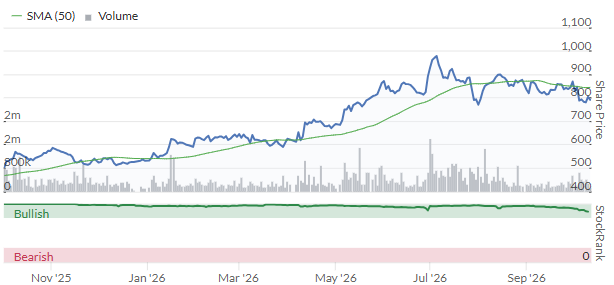
Down 2% at 791p (£787m) - AUM Update
There's been a slowdown in quarterly net inflows at this fund manager, but they do remain positive.
Q2 (July-Sep) net inflows £1.2bn
Financial year-to-date net inflows now £3.6bn
As for overall assets under management:
Q2: AUM falls from £45bn (end of June) to £43.7bn (end of September), due to moderately negative market movements/performance.
Financial year-to-date: AUM is still up massively from £30.6bn (end of March), with an extraordinary £9.5bn of positive market movements over the past six months.
The figures seem to be distorted by the fact that the end of March was around the low point for equity markets this year. The S&P 500 reached its low for 2026 that day, before Trump made what in hindsight sounds like an April Fool's Day joke: that the war against Iran was "nearing completion" and that he was planning to wind it down within "two to three weeks".
Stocks have soared since then, and especially the sectors in which Polar invests. So while Trump may have been wrong about the war neatly concluding, it is true that equity markets have become much more relaxed when it comes to assessing the long-term consequences of the war.
Performance fees: at first glance these might seem disappointing, with £8.8m of performance fees accrued by Polar in H1, compared to £15m in H1 last year. But last year was exceptionally strong and also very H1-weighted. Predicting full-year performance fees based on the position at H1 comes with a great deal of uncertainty.
Estimates: thanks to Equity Development for maintaining coverage here. They confirm that Polar's performance fee result in H1 was not bad at all; ED had only pencilled in £4.8m of performance fees for the year as a whole. With £8.8m of performance fees having already accrued in H1, they increase their full-year forecast to match that figure.
That strikes me as a nice, conservative way of predicting this unpredictable number.
Excluding performance fees, ED's adjusted EPS forecast for the current financial year is unchanged at 88.7p (and for next year, it's unchanged at 107.5p).
Including performance fees, the adjusted EPS forecast for the current year increases by 3% from 94.3p to 97.2p. But they emphasise that it's still to soon to say whether the performance fees that have been accrued thus far will ultimately crystallise. That mostly depends on fund values at the end of the calendar year.
CEO comment excerpt:
Demand was strongest for our differentiated specialist strategies, led by Global Technology and Artificial Intelligence. Healthcare, including Biotechnology, Smart Energy and several other strategies also contributed to net inflows. Client engagement remained high, particularly in Europe and Asia, while the geographic mix of new business continued to broaden.
Graham's view
The PE ratio for the current year is about 8x or 9x, depending on whether or not you include performance fees.
Based on expected AUM growth towards £50 billion next year, the PE ratio is expected to fall closer to 7x.
But I'll be the first to admit that this is highly uncertain: it depends to a large extent on sentiment towards the global technology boom.
As a reminder, here's the split of Polar's AUM in March:
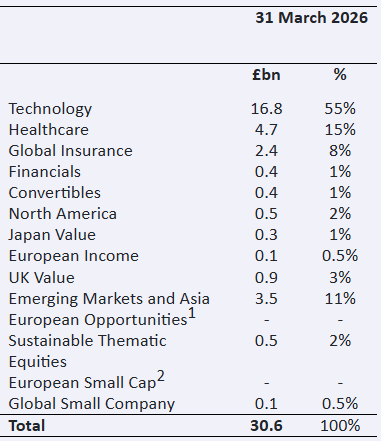
As you can see above, Technology soared to represent more than half of AUM. And that was before the boom that occurred from April. Healthcare, Insurance and EM/Asia provide a limited degree of diversification.
Polar's success has flowed in part from its reputation as a sector specialist. So ending up with a highly concentrated AUM is perhaps inevitable. But it's the key risk here, from my point of view.
I'm still going to be GREEN on this stock, as I was before. The big picture is that its forecasts have just been upgraded and it's still trading on a single-digit PE multiple.
The music may stop playing at some point. But it hasn't stopped playing yet.
Disclaimer
This is not financial advice. Our content is intended to be used and must be used for information and education purposes only. Please read our disclaimer and terms and conditions to understand our obligations.
Discussion on Polar Capital Holdings (1)
Comments here are also visible in the Daily Stock Market Report
Polar Capital Holdings (LON:POLR) and Fidelity Emerging Markets (LON:FEML) are not similar enterprises at all.
FEML is an investment trust - it invests in stocks and shares in emerging markets with the fund's managers coming from Fidelity, a large US investment manager.
Fidelity have other UK listed investment trusts such as Fidelity China Special Situations (LON:FCSS) or Fidelity Special Values (LON:FSV).
POLR is a UK investment manager who have several UK listed investment trusts of their own such as Polar Capital Technology Trust (LON:PCT) and Polar Capital Global Healthcare Trust (LON:PCGH).
Polar and Fidelity are in the same business, albeit at different scale.
n.b. the investment managers, Nick Price and Chris Tennant, of Fidelity Emerging Markets (LON:FEML) are interviewed in the latest edition of the Money Makers podcast.
(I do not hold any of the stocks mentioned)