PWR: A cool compounder motoring ahead

Stockopedia contributor Roland Head, recently wrote an article where he built a screen to find quality stocks that are strong compounders. (Building a screen to find Compounding Quality stocks) The idea with this type of stock is to buy and hold. You are not looking for a quick gain, but rather to watch your wealth compound over a long period of time. Warren Buffett has said that when he finds a great business, his favourite holding period is "forever". I took this screen and applied it in the Australasian context. 14 stocks met all of the criteria. One of those stocks was PWR Holdings (ASX:PWH).
PWR is a manufacturer of advanced cooling systems. They have traditionally been focussed on motorsport and are the dominant provider of cooling systems for Formula 1 with all teams using their cooling products. They also work with Supercars, touring cars, rally cars, Nascar and Indycar teams all over the world.
They have gradually been diversifying their revenue sources. More than half their revenue now comes from outside motorsport.
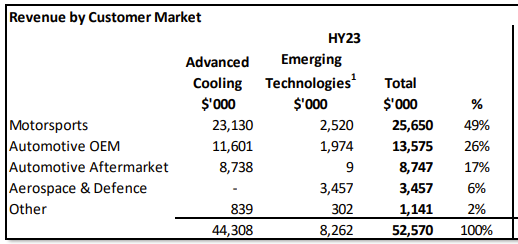
Original Equipment Manufacturers (OEM) are now the second largest revenue generator for the business. This involves the supply of cooling systems for high performance vehicles such as the new AMG X1 and Ford Mustang GT500. They are also pushing into the electric vehicle market. EV’s have sophisticated cooling requirements. PWR is now involved in seven different EV manufacturing programs. To improve their access to the big EV manufacturers in the UK and Europe they have been making acquisitions and building a significant manufacturing facility in the UK.
Perhaps surprisingly for a family business started on the Gold Coast in 1987, the majority of revenue is now generated overseas. Their biggest markets are the USA, followed by the UK, Italy and then Australia.
So why do they make the quality compounders screen?
The first criteria the screen focuses on is, unsurprisingly, quality, specifically a QualityRank of over 80. PWR easily qualifies here with a quality score of 92.
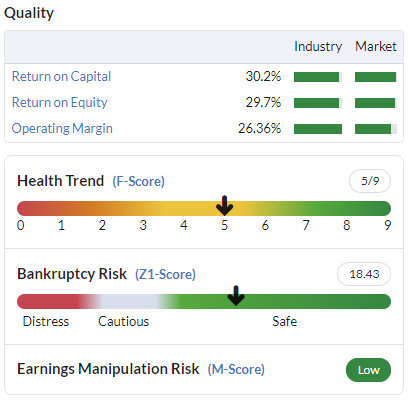
Next the screen focuses on profitability. A number of measures are used here. The first is return on capital employed (ROCE). In the long term, a company’s growth rate will be limited by the returns it can generate on its capital. Roland uses a threshold of 18% for Long-term ROCE. PWR is well clear at 31.5%. He also wants the most recent trailing twelve month (TTM) ROCE to be above 15%. PWR is 30.2%.
Margins are also a very important indicator of profitability. Roland has created four rules to ensure a company is generating attractive profit margins. These include both the five year average operating margin and the TTM operating margin must be above 10%. PWR comes in at 28.7% and 26.4% respectively. The net profit margins for both the five year average and TTM must be above 8%. In the case of PWR they are 20.9% and 19.5% respectively.
Of course, high quality businesses need to generate plenty of cash. Cash flow can be variable, so some margin is appropriate. To that end, Roland has used two rules to test for cash conversion. Operating cash flow per share can be compared with EPS to ensure that accounting profits are backed up with cash. A cut-off of 0.8 gives some margin. PWR’s ratio is 0.9.
We also want to review the surplus cash being generated by the company’s assets. Roland has opted for a threshold of an 8% cash yield. This compares with the risk free cash rate in Australia of 4.1%. Ideally you want an even higher cash yield from a quality compounding business, but free cash flow can vary from year to year for legitimate reasons. PWR’s long term cash yield is 14.6%.
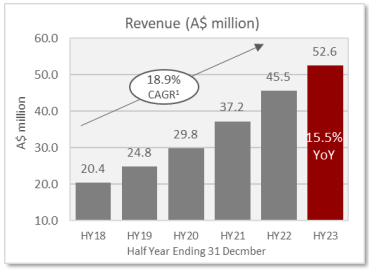
To provide a compounding return a business has to be growing. Given that we have already established that the business has high profit margins, we can focus here on revenue growth. We will look at both the five year average growth as well as growth in the most recent period. We are less worried about high growth rates and more concerned with consistency. We want stocks with a positive average growth rate over 5 years and growth of more than 5% over the last 12 months. PWR’s 5 year sales CAGR is 16% and the most recent growth rate was 23.5%.
Finally when looking for quality companies, we need to be sure that they are not fuelling their growth by loading up on debt and therefore putting future returns at risk. Roland has included two measures to give a general guide as to how a business is managing its leverage. He looks for debt to total assets of less than 50% and interest cover of 10 times. PWR comes in at 16.7% and 100 times respectively, showing that debt is used very conservatively.
The table below summarises all of the factors for the compounding quality screen, comparing PWR with the thresholds. As can be seen, PWR compares very favourably on all measures. It has clearly been a quality compounder over the last five years and there are strong indicators that it may continue to be so.
Criteria | Threshold | PWR |
QualityRank | 80 | 92 |
Long-term ROCE | 18% | 31.5% |
TTM ROCE | 15% | 30.2% |
Operating margin 5 yr avg | 10% | 28.7% |
Operating margin TTM | 10% | 26.4% |
Net margin 5 yr avg | 8% | 20.9% |
Net margin TTM | 8% | 19.5% |
OCF / EPS | 0.8 | 0.9 |
Avg FCF (long term) / Assets | 8% | 14.6% |
Sales CAGR 5 yr | 0% | 16.0% |
Sales TTM / Sales Prior TTM | 5% | 23.5% |
Debt to assets | <50% | 16.7% |
Interest cover | 10x | 100x |
This screen has focused on quality and not given any attention to value. Advocates of this approach generally have the view that over the long-term it will be the growth in the underlying value of the business that is the biggest determinant of return rather than the price paid. Of course paying a lower price will also boost the returns, but investors need to be careful not to fall into the trap of always waiting for the value metrics to hit a certain level and therefore failing to ever get on board.
PWR’s share price has fallen 30% since its high point early this year, however the value metrics are still very high and the Value Rank is only 10.
Full disclosure, I have personally applied this approach to PWR. I first purchased it in 2018 at $2.75. I have added more at $4.69 in 2019 and $4.15 in 2020. I have also trimmed my position at various points when the weighting in my portfolio became too high, most recently in late 2021 at $10.14. It is now my fourth most profitable investment in over 25 years of investing with an annualised return of 31%.
Important Information: Stockopedia Ltd ABN 39 757 874 670 UK business registration number 0637267 (“Stockopedia”) is an Authorised Representative of Daylight Financial Group Pty Ltd ABN 77 633 984 773 (“DFGPL”) which is the holder of an Australian Financial Services Licence (AFS Licence No. 521404).
Information in this commentary is current as at date prepared unless otherwise stated. However, please bear in mind that investments can go up or down in value, and that past performance is not a reliable indicator of future performance. For more Important Information please refer to the Disclaimer section of this website.
This communication may contain general financial product advice. It has been prepared without taking into account your personal circumstances, and you should therefore consider its appropriateness in light of your objectives, financial circumstances and needs before acting on it.
If our advice relates to the acquisition or possible acquisition of a particular financial product, you should obtain a copy of and consider the Product Disclosure Statement (PDS) before making any decision.
The author holds interests in the following stocks mentioned in this article: PWH. This position can and will change at any time without notice.
Disclaimer
This is not financial advice. Our content is intended to be used and must be used for information and education purposes only. Please read our disclaimer and terms and conditions to understand our obligations.
2 comments
Hi Chris
I am a fan of this investment style and also of PWR. I have held since 2019 and also top sliced some along the way, but believe they have still hopefully a runway of growth ahead and I am planning to hold for the long term.
As well as the quantifiable quality metrics, I also like the fact that it is owner operated and the founder still has a large stake (circa 20%) in the company. They treat their employees and customers well, which is another Buffet style indicator of a quality company. The CEO Kees Weel is a real straight shooter and has great vision and plans for the company and so far seems to be executing to the plan. I think the transition across to 'emerging technologies' where they are using the expertise they have built up through F1 and motorsports in general to branch out to aerospace, defence and EV's should help them sustain growth going forward.
For anyone interested in this style of investing, the recently posted Stockopedia presentation by Megan Boxall, "Investing in Quality Stocks Masterclass" is worth watching.
Cheers
Tom
Thanks Tom, there is a lot to like about PWR.