Reacting to current market conditions

There is no doubt that recent global events have thrown a spanner into the works for many investors. For a while now, I have been pointing out the value disparity between the larger companies and the smaller ones in the UK:
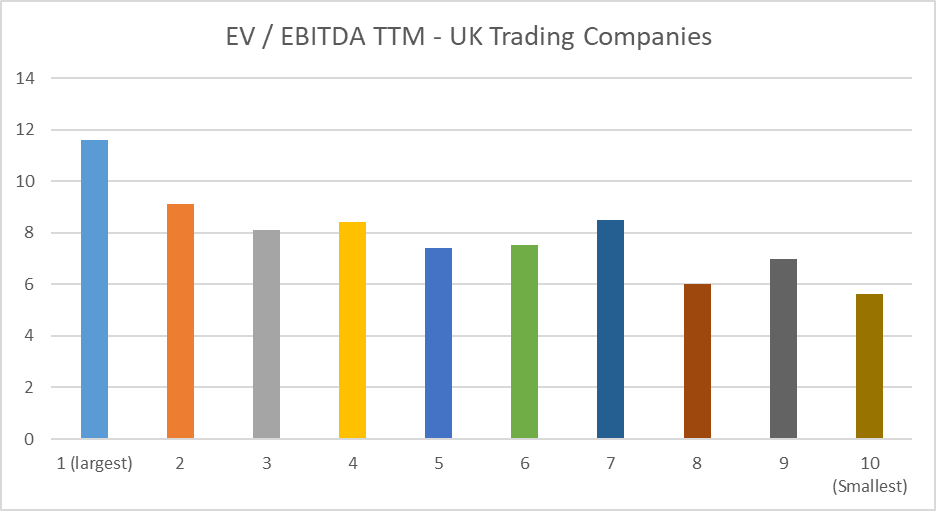
Almost all international funds from asset allocators have flowed into FTSE 100 companies (roughly the first decile). The UK has looked cheap compared to other developed markets, particularly the US, which has led to positive fund flows into the largest UK stocks. In contrast, smaller companies are much more at the mercy of UK-based individual investors, either through their direct equity exposure or through small and microcap funds. Here, confidence has been weak for several years, leading to the smallest stocks trading at less than half the EV/EBITDA multiple of the largest (on average).
It is worth noting that, as long as investors focus on profitable stocks (the smaller-company tail has a higher proportion of more speculative stocks), I can find no difference in quality or outlook between the largest and smallest companies. In fact, small companies appear to retain the stronger growth prospects that typically accompany their nimbler approach, which is usually rewarded with a higher rating than larger companies.
Larger global asset allocators tend to be slow to react, which means that the FTSE100 weakness has largely tracked global equity markets. These have no doubt been painful moves for investors. However, at the smaller end, we have seen some precipitous sell-offs, especially in more popular stocks. The valuation disparity in the graph above has made little difference to investors, as there has been a dash to cash at any price, whether through conscious decision-making or stop-losses.
What was shaping up to be a good year of recovery for those who held cheap small caps is now looking like another year to forget. With small caps once again taking a battering, strategies that tend to be market-cap neutral, such as StockRank-based ones, may face some short-term challenges.
Is this logical?
The ability to act quickly to changing market conditions is one of the benefits of managing one’s own portfolio. When the outlook sours considerably, and higher energy prices and interest rates put a dampener on economic activity, individual investors don’t have to wait for an investment committee decision to get out. The big question is, should they?
On the one hand, Ed has recently pointed out the value of trend-following for equity returns. If investors held the AIM index when it was above its 120-day moving average, versus buy and hold, the return difference is stark:
Regime |
Days |
% of Time |
Annualised Return |
Volatility |
Above MA |
3,748 |
49.9% |
+22.7% |
11.6% |
Below MA |
3,762 |
50.1% |
-20.4% |
14.7% |
Buy & Hold |
7,510 |
100% |
-1.2% |
13.3% |
However, the AIM index is rather strange. The largest 40 stocks have the same combined market cap as the remaining 506 companies. The FTSE Small Cap index may have far fewer companies, but it has a more balanced weighting across its constituents, which will more accurately reflect how investors would build a portfolio of smaller companies. This has also gone below its 120-day moving average. However, It is worth noting that in the last year alone, the 120-day MA would have generated at least seven buy or sell signals:
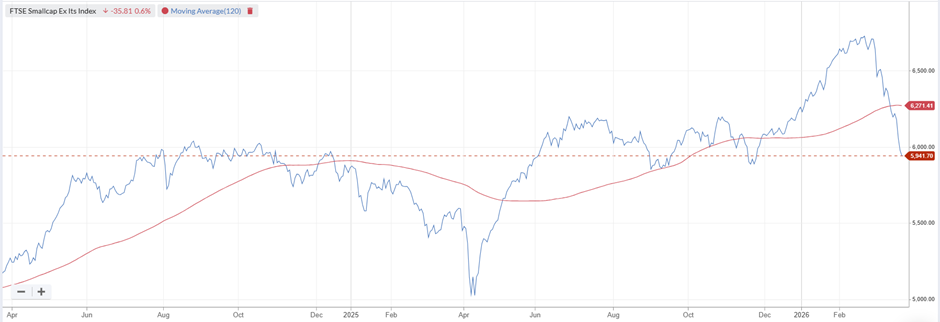
Moving Average trend following is a strategy that generates quite a lot of noise as well as signal.
The other factor that should give pause for thought is that the typical investor has terrible market-timing instincts. It is well known that fund investors' attempts at timing the market typically cost them about 1% a year in lost returns. For more volatile assets, the drag is even worse.
According to Morningstar, Ken Heebner was the best-performing fund manager for the decade ending 2009. This was a time period that included a housing and stock market boom, and the related bust we now call the Great Financial Crisis. This was an incredibly volatile period with significant market and economic upheaval.
Heebner’s fund delivered an 18% compound annual return for investors who held for those 10 years. However, the average investor in the fund generated an 11% compound annual loss during the same period. Investors created this massive 29% annual underperformance for themselves by buying into the fund after it had posted strong returns and bailing after it suffered losses.
What to do?
The reality is that there is no right or wrong way of reacting. Each of us has our own unique circumstances to consider. Those who can duck out of equities at the first sign of a crisis and get back in at the opportune moment will generate higher risk-adjusted returns.
However, history suggests that the markets will bottom before the news flow reaches its worst and that many investors will capitulate close to the nadir, only to miss out on strong subsequent gains. Given the value disparity, smaller companies are likely to be the ones that rip higher once sentiment finally returns.
I believe this is an area where Stockopedia tools can help investors stay grounded and avoid emotionally driven knee-jerk reactions.
Cheap Growing Companies
One simple way to take advantage of current market conditions is to buy cheap, well-run companies, such as those trading at low multiples of earnings. EV/EBITDA isn’t the perfect measure, but as my first chart showed, it highlights valuation mismatches; using Enterprise Value instead of Market Cap accounts for cash or debt levels, which can make a big difference during periods of economic upheaval. However, it is a historical measure, and the problem is that historical cheapness alone may have little correlation with the future. To combat this potential mismatch, I like to look for companies that are cheap on historical measures and forecast to grow EPS. (This isn’t a perfect fit, but EBITDA growth isn’t available in the screener.)
Together with a modest quality check, this gives a useful screen:
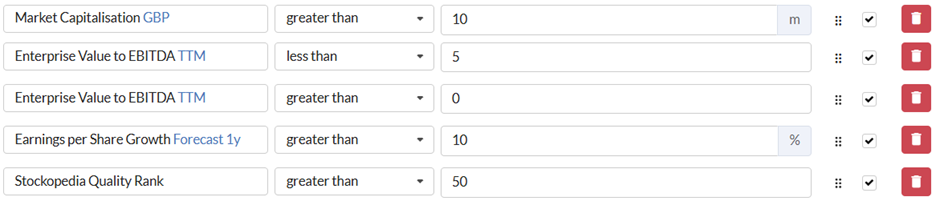
Currently, this screen generates 35 results:
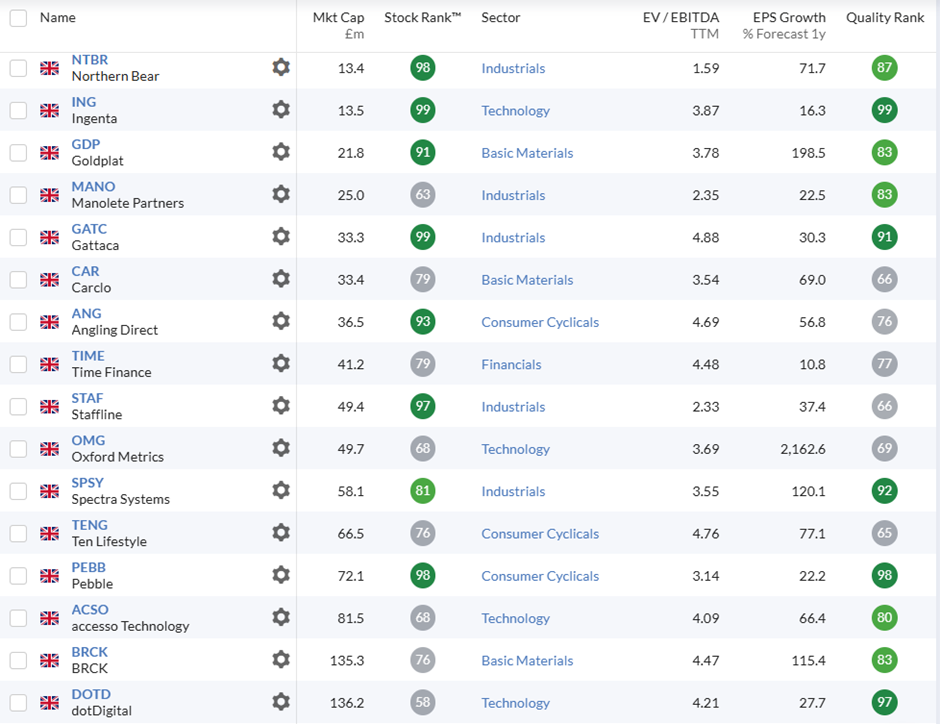
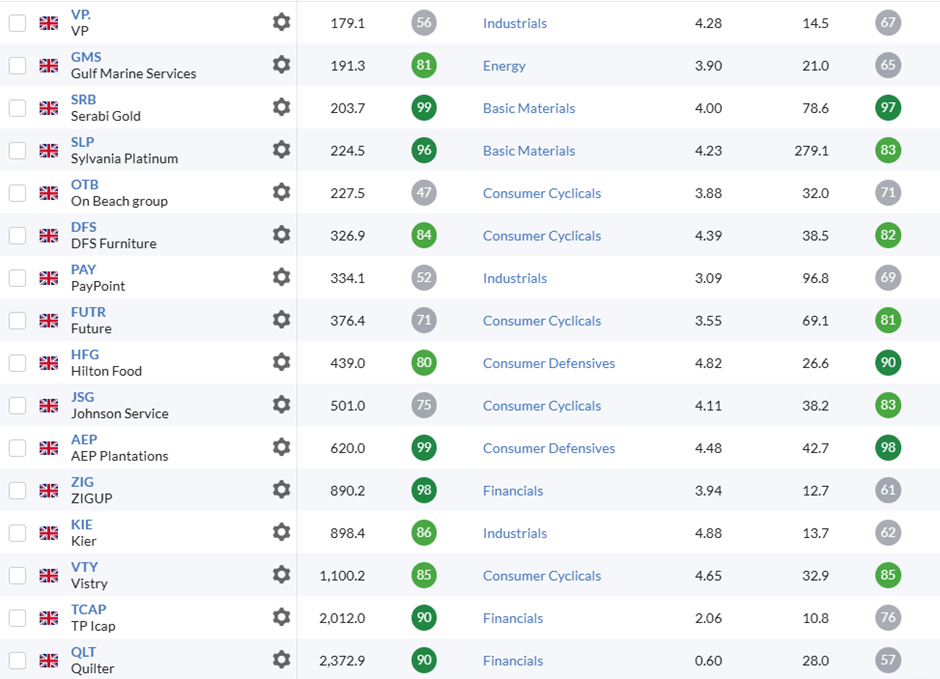

Anyone who has followed my writing will be unsurprised to learn that I own several of these companies, and many of the others are on my watchlist.
All change
There is a problem with this simple screening: it relies on brokers' forecasts. One reason current market conditions are difficult to navigate and why so many investors simply dash for cash is that the impacts on businesses are so uncertain. However, I believe investors can come up with a broad-brush idea of the most affected stocks. Here is my quick attempt to categorise these:
Positive or largely neutral:
Northern Bear (LON:NTBR) Ingenta (LON:ING) Goldplat (LON:GDP) Manolete Partners (LON:MANO) Angling Direct (LON:ANG) Oxford Metrics (LON:OMG) Spectra Systems (LON:SPSY) Ten Lifestyle (LON:TENG) Pebble (LON:PEBB) accesso Technology (LON:ACSO) dotDigital (LON:DOTD) Serabi Gold (LON:SRB) DFS Furniture (LON:DFS) PayPoint (LON:PAY) Future (LON:FUTR) Hilton Food (LON:HFG) Johnson Service (LON:JSG) AEP Plantations (LON:AEP) ZIGUP (LON:ZIG) TP Icap (LON:TCAP) Quilter (LON:QLT) Ithaca Energy (LON:ITH) Harbour Energy (LON:HBR)
Slightly negative:
Gattaca (LON:GATC) Carclo (LON:CAR) Time Finance (LON:TIME) Staffline (LON:STAF) BRCK (LON:BRCK) VP (LON:VP.) Sylvania Platinum (LON:SLP) Kier (LON:KIE) Vistry (LON:VTY) 3i (LON:III)
Definitely negative:
Gulf Marine Services (LON:GMS) On Beach group (LON:OTB) International Consolidated Airlines SA (LON:IAG)
Each of us will have our own idea of which category these companies belong to. My aim here isn’t to be definitive, but to show that it is possible to judge which companies may now have brokers' forecasts that are behind the curve. Some of these may look cheap on a historical basis, but not on a forward-looking one. However, many remain cheap and growing businesses even with the current macro backdrop.
Caveats
Secondary Effects
A business being largely unaffected by the Iranian war doesn’t mean that it doesn’t face significant volatility. For example, changes in the gold price clearly impact Serabi Gold (LON:SRB) . This hasn’t moved as many would expect during a period of high global uncertainty. One theory is that large moves in oil prices have led to margin calls for commodity traders, and the quickest way to increase liquidity is to sell gold positions. The second commonly stated reason is that Gulf states that have lost oil revenue are selling gold reserves to meet their obligations. On top of this will be the speculative actions of traders trying to get ahead of these moves. Research by Monetary Metals suggests that recent moves may be more speculative than they first appear. They produce a proprietary metric called Gold Fundamental Price, which they say:
…seeks to back out speculative forces in the gold market to reveal the underlying physical supply and demand picture. The degree of divergence between the market price of gold and the fundamental price is, in our opinion, an indication of market exuberance or pessimism.
Over the very long term, this has seen a good correlation with the spot price. Recent divergence may, therefore, be bullish for gold (and companies such as Serabi Gold (LON:SRB) and Goldplat (LON:GDP)):
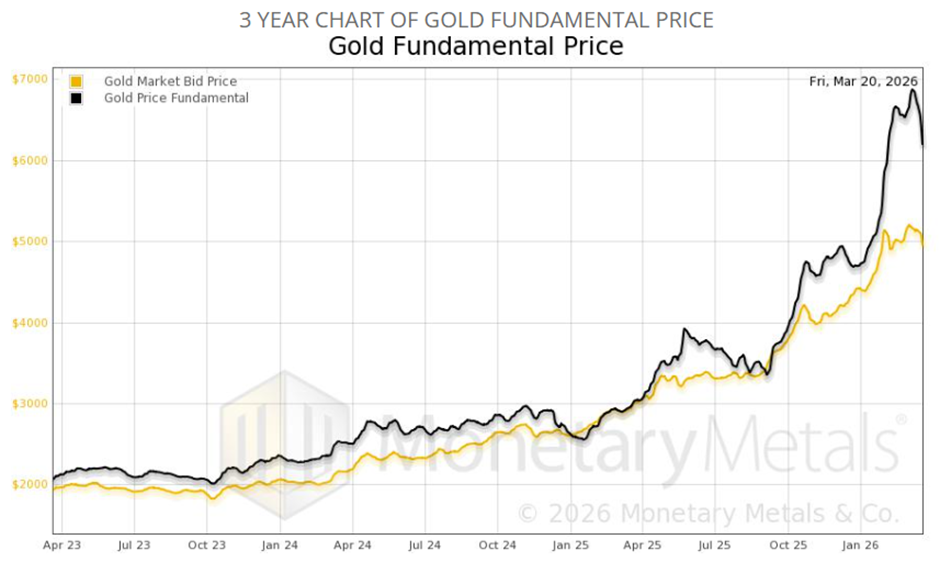
Although Monetary Metals also cautions that:
The fundamental price is computed according to a model based on our economic theory. We believe that this model reflects the forces of supply and demand in the physical market however there is no guarantee that the market price will move to the fundamental price quickly or ever.
And we need to be wary of gold-related companies talking their own book.
The main point stands that investors need to be aware of secondary effects when assessing the impact on these companies.
It’s in the price
The second factor to consider is that even if a company is impacted by higher oil prices or disruptions to activities in the Gulf, this may already be reflected in the price. When I reviewed the recent announcement from On Beach group (LON:OTB) , I was surprised that the market had not already anticipated the impact on this and similar companies. As it happened, the company itself was unable to quantify the impact, so it withdrew its guidance entirely. However, the company has a history of adapting to external challenges and has grown its business despite a weak consumer backdrop in the UK for several years. Some investors may want to look through all the uncertainty and decide that it's all in the price by now.
Summary
While a dash to cash may be a logical response to recent geopolitical turmoil, it is not without risks. Investors need to know when to invest back into equities, and that point is likely to be when the news flow is most pessimistic, not when it all seems ok again. These events have occurred at a time when smaller companies are at historically very cheap multiples compared to their larger brethren. Yet this valuation anomaly hasn’t prevented significant further sell-offs at the lower end of the market. Simple screening shows that there are now many cheap, growing companies unlikely to be significantly affected by higher oil prices or travel disruptions in the Gulf.
Given that the average investor’s market-timing instincts are poor, many investors may be better off simply buying good companies at low prices and not worrying too much about the day-to-day gyrations in response to world events.
[Disclosure: At the time of writing, Mark has long positions in Ingenta (LON:ING) Goldplat (LON:GDP) Spectra Systems (LON:SPSY) Serabi Gold (LON:SRB) Future (LON:FUTR) ]
Disclaimer
This is not financial advice. Our content is intended to be used and must be used for information and education purposes only. Please read our disclaimer and terms and conditions to understand our obligations.

14 comments
I try to distance myself from the daily news and nibble away at the good stocks that have taken an undue beating. The more I "close the doors" and buy good stocks when they are cheap the better I do, irrespective of all the macro. That's plan A. Occasionally my brain interferes and I make a fear-sale. But mostly if the prices are down I'm a buyer. It's strategy that will continue to work until capitalism fails!!
Thank you mark do you have a copy of the screen? Northern bear will suffer due to poor weather so far this year
Yes, sorry. I meant to include the link to this in the article but forgot: https://www.stockopedia.com/sc...
Thank you Mark, I think subscribers want to hear some balance and reason when markets move fast like they are at the moment. I also hold Serabi Gold (LON:SRB) and it's fallen from nearly +500% to just over +300%, and it still feels like I'm losing money !
@Mark Simpson. Thanks for the report. I thought i would add my personal experience of trading through good and bad markets. When I started trading I took a liberal approach and held stocks through thick and thin. I did terribly. When I started to analyse my results one thing stood out. The losses were cancelling out the gains. In other words letting my losses get worse in the hope of reversal was not working well. I changed my strategy after a couple of terrible years and decided to stick to a set of rules with the most important one being to minimise losses. Why? Simply because all the research I made on sucessful traders like Oneil, Minnervini etc had all one thing in common, they did well not because they consistently picked winners but because they cut their losses! It transformed my returns the following years. I now enter every trade with the question of how much could I lose if it goes wrong? My two most important rules are 1: minimise losses by keeping them down to at least half your average gain pro rata, Ie if your average gain is 10% on a stock cut losers at no more than 5% loss. If it reverses so be it. The second one is only trade in strong markets ( when the odds are in your favour). One of the arguments you often hear is that of not missing out if the markets reverse. So what if by that stage your loss is 15, 20, 25% or more, you will be trying to make up the loss before you even see the profit, not to mention the fact that the maths starts to work against you the bigger the loss. I prefer to miss the initial surge and have money to invest. It takes more than one day to reverse losses obtained during correction or a bear market. A good example was yesterday when the markets suddenly turned( for a brief moment) and I dipped my toe in, with minimum initial exposure. As soon as they weakened with the news changing I exited and more or less broke even to fight another day. Everyone will have their own way of approaching the markets and mine personally is you make money by concentrating on not losing it in the first place!
Couldn’t agree more MT. I am currently nursing 16% loss and worrying about when to re enter is small beer imo. As for the shares listed , I currently hold or recently held more than half of them with many being apparent lost causes considering even their medium term performance. I just banked Ithaca Energy (LON:ITH) but have retained International Consolidated Airlines SA (LON:IAG) due to stellar gains for me since Covid. You can be selective in going to cash and there is nothing preventing re entering positions etc. if appropriate. The GOLD ‘fundamental price’ was new to me but carries a whiff of snake oil imo. Interesting nonetheless, especially given the current disparity with the price that matters and its future direction.
Thanks for the post Mark. One to ponder over.
.
Good to have you here Momentum your posts are well worth reading can I ask at some point could you post up a brief summary of your strategy e.g trading markets in an uptrend, minimise losses etc.
Regards
Andy
Thank you Phoenix, I will try to do that when I get a chance. In essence its not that much different to a Minervini, O neill approach with the addition of trading upside reversals as they bounce off certain moving averages, with the caveat of always being prepared to exit the trade if it does not do what you expect to do. Most of the time you are looking to enter a trade as precisely as you can ( if the setup is right) and to be in profit more or less straight away ( if you have got it right)
Hi momentum trader,
I certainly think there is a lot of value in your approach, and it chimes with Ed's recent articles that suggets that if you ony invested when indices are above their long moving averages you would do better. However, as I wrote in the article, the average investor is truly terrible at this - by chasing that which has done well and ignoring that which has done badly, they tend to lose far more than if they had just bought and held. Clearly you have a system that works effectively. Most investors don't, and even those who do, rarely manage to stick to it.
I also think stop losses are brilliant ways of avoiding loss aversion. However, there are also a couple of issues with them. One of the reasons high-quality businesses are trading at a fraction of their likely fundamental value is that investors have put stop losses on illquid stocks and these are being hit at any price. The second issue is that they don't tell you when to get back in. I've seen many investors get stopped out and buy back into the same stocks only to be stopped out again.
If you only trade large liquid stocks and never hold into news I think stop losses will work really well. If you apply them to illiquid stocks or hold into newsflow into the type of smaller companies many Stockopedia investors favour, then theres a high chance these become "guarantee-losses" rather than "stop losses".
At the end of the day, none of us get it right all the time and the best we can do is consistently tip the odds in our favour. Only investing in companies with strong momentum or buying cheap growing businesses both achieve this.
It is also interesting to note that at least a third of the Cheap Growing Companies screen have a Momentum Rank above 85% and should be high up the list for Momentum investors to buy, even in current markets:
Of course, investors would still be bonkers to put stop losses on many of these in current markets, in my opinion, but that doesn't mean the Momentum isn't therei n many of these initially Value-based picks.
Cheers,
Mark
Hi Mark, thank you for taking the time to reply. I do agree that keeping to a strategy may not always be easy for most. I did a post recently titled "Understanding Bias" which I believe helps to explain why this may happen. Crystallizing a loss can be psychologically for many a really hard thing to do but doing it when the loss is not to big is much easier. I take the approach of a loss is a loss even whilst it is only a paper loss as I dont want to let bias dictate. My approach as a trader will probably be at odds with some other investors who take a long term investment approach. There is absolutely nothing wrong with that. Ultimately what matters is what works for you. I think your points regarding stop losses are valid and I try not to use them regularly or if I do, I give enough room, (especially with Aim stocks), as I believe market makers can bring the stock down to take out stops or to maybe fill a back order. I tend to use Level 2 trading on those as on larger companies using SETS level 2 is not that useful. With AIM often by looking at the amount of stock available on the buy and sell side you can in a lot of cases ( if you are by your computer at the time) tell if a price is about to rise or fall and doing dummy quotes on stocks before buying can give more precise indicators of the real spread or lack of stock. I also find entering an auction before a trade opens can get you in or out of a trade quickly, which can ( not always) be of help if you get caught out holding a stock when a surprise RNS is released. I try to normally exit a stock before results or partially sell some of it off (if I have good profits) to hedge it, but only if I have some confidence that the results will be good. In these current volatile depressed markets holding into results I believe would be a bigger gamble because even if the results are good the slightest mention of geopolital challenges can send that stock south. You are also right that none of us get it right most of the time, I would go as far as saying that most of us dont get right a lot of the time. Even extremely succesful traders like Minervini will if i remember correctly state that he gets it right mostly 50% of the time and sometimes 30% but some of his annual returns are in the 100 plus percent He manages it as minimising risk is his no1 priority. I have found myself that in a good bull market cutting losses means you only need a few big winners to have really good returns over the year that are way in excess of the general market returns. I have to add that this site is a great platform for evaluating a companies fundamentals. The only thing that I think would be useful ( at least for me ) would be an average volume line and RS line on the charts.
Totally agree on the loss-aversion. It is why I personally hide my P&L on individual positions so my decision-making isn't biased by this. Finding hacks to avoid these biases is half the battle in investing.
I have a hilariaous story about Minervini being completely unable to take a loss which I'm going to tell in my Mello Birmingham talk. Do come and say hello if you will be there.
Sounds like you have learned the Robbie Burns system Momentum in my opinion his biggest skill is killing losers quickly but I think only about 1 in a 100 investors can do that consistently.
I am a super humble fella but when it comes to investing I fall into the "i am right and the market is wrong " group which is why I've never made stellar returns.
I'm doing way better the last 2-3 years since I switched to indicie etf's , gold and oil etf's plus some investment trusts these are way safer to average down into and I also keep 10-20% in money market to take advantage of times like now/last April.
I'm also a lot more relaxed at the moment being in etf's than single stocks although I have recently bought some Natwest (LON:NWG) more as an income play and I wouldn't have an issue adding to this on the way down.
I studied single stocks for nigh on 25 years, have access to countless fund managers and am qualified in portfolio management but my mindset isn't right for the single stocks game if you split your money over 20-25 etf's/trusts with reasonable diversification you should still be able to average 10-12% per annum with fairly low weekly input on your time/life.
I still love this site though for listening to the views of people who are way better at this than me and there are plenty of them on here for sure.
There is no reason why Stockopedia can't be used to inform ones choice of funds.
Thanks Mark for this considered post and the shares fulfilling the terms of reference. I only hold Serabi Gold (LON:SRB) and have to keep rinsing my brown corduroys.