Sector spotlight: a pick-and-shovel investment opportunity

One of the things I like most about Stockopedia is the way it allows us to slice and dice market data in so many different ways, making it easier to spot potential opportunities.
My normal strategy is to follow a bottom-up approach, screening for individual stocks which satisfy my criteria. But to shake things up a little, I recently decided to try looking at the market from a top-down perspective, focusing on sector-level data instead.
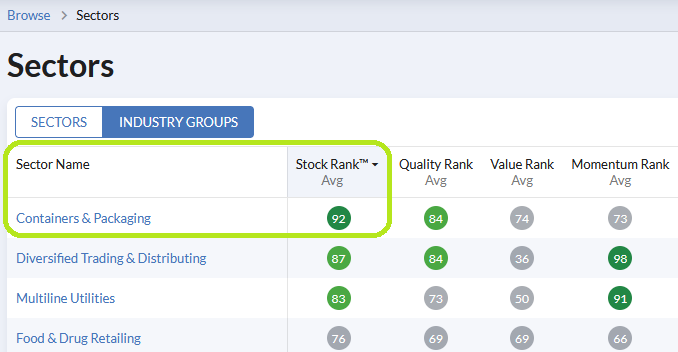
To get started, I sorted all of the UK stock market industry groups by StockRank, starting with the highest. As a result, I’ve found what I believe could be an attractive medium-term investment opportunity.
The sub-sector in question is Containers & Packaging, which has the highest average StockRank of any industry grouping in the UK market. Quality, value and momentum all score well.
With Black Friday just gone and Christmas shopping in full swing, there’s also a pleasing seasonality to this selection:
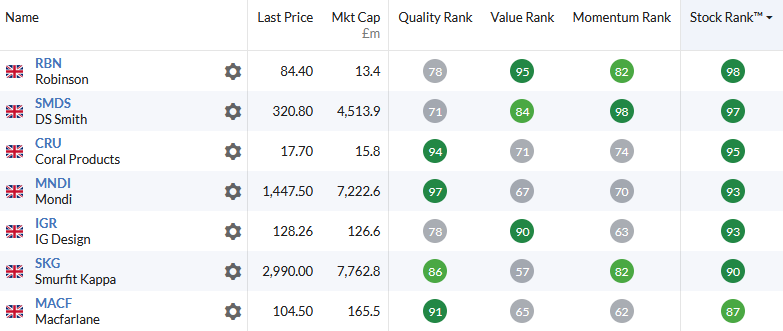
The seven companies in this group range from FTSE 100 members to micro-caps. However, I think that the majority of them are similar enough to be reasonably compared. This should hopefully make it easier for me to assess their relative attraction as potential investments:
Why I’m interested
The Containers & Packaging industry group is home to companies that make cardboard boxes, plastic packaging, and all the other miscellany needed to safely transport industrial and consumer goods from source to destination.
I see this sector as a pick-and-shovel play that’s somewhat in the tradition of the companies who supplied tools to gold prospectors in the Gold Rush.
Ecommerce, consumer and industrial firms all need to pay for packaging, regardless of whether they succeed or fail. Recent results suggest that supplying this packaging can be more profitable than selling the products within it:
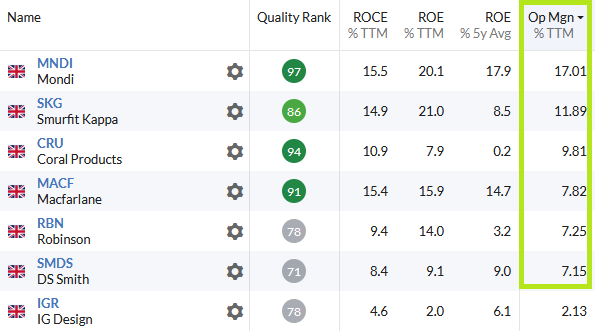
For example, the recent operating margins of the packaging companies I’ve highlighted above are all higher than those of ASOS, AO World, and Halfords – or indeed Ocado, Tesco, Sainsbury and Marks & Spencer.
(The only exception to this pattern is gifting and stationery group IG Design. In my view, this business is something of a misfit here, as all the other firms in this industry group supply types of product packaging to trade customers.
In any case, IG Design is in a turnaround phase at the moment and falls outside the scope of this article. However, if you’d like more information, Paul covered IG’s half-year figures in the SCVR on 30 November.)
Strengths & opportunities
Why are these companies scoring so highly for quality, value and momentum? In other words, why are these apparently good businesses looking unloved?
I think the answer is that they face short-term risks, but offer significant medium-term opportunities.
Structural growth: trends in urbanisation, ecommerce growth and sustainability suggest to me that packaging demand will continue to grow steadily over the coming years.
This view is supported by a recent Smithers report forecasting that the global packaging market will expand by almost 3% per annum between 2018-2028, reaching over $1.2tn.
This prediction maps well onto guidance from DS Smith for medium-term volume growth of GDP +1%, which the company recently estimated as being equivalent to 4% across its markets.
Smithers identifies four underlying growth trends:
Demographic: broad-based economic growth and urbanisation in emerging markets
Packaging technology: packaging has a widely-accepted sustainability issue, presenting opportunities for innovation.
In the UK, 80% of consumers believe online shipments contain excess packaging, while 81% would prefer to receive eco-friendly packaging materials:

Source: Statista
While recycling rates have improved over the last couple of decades, data for 2021 show that less than half the plastic packaging created in the UK last year was recycled:

Source: Statista
Clearly there is scope for further improvement. In terms of consumer sectors, I’d guess that food and healthcare offer particular opportunities.
Consumer trends: Globally, consumers are expected to continue to purchase more online, creating demand for packaging.
Brand owners: Packaging may also play a greater role in protecting against fake and counterfeit goods, according to Smithers. Packaging is also increasingly being used to emphasise brands’ sustainability credentials.
Risks
The ubiquitous presence of packaging in our lives makes it easy to forget that this is a cyclical, commodity business.
Returning to DS Smith, this business reported a 22% (£1,207m) increase in operating costs for the year ended 30 April 2022. That comprised £720m on raw materials, £297m on energy and £190m on “other costs”.
Fortunately for shareholders, the company was able to pass these costs onto customers and secure improved profit margins.

There were similar stories of cost inflation and price recovery at big caps Mondi and Smurfit Kappa. But commodity costs are only one element of the packaging business. The other element is economic activity. Demand growth can slow or even reverse during a recession.
My guess is that inflation will peak and start to ease in 2023. But if this coincides with softer demand in western economies, then packaging firms could face tougher comparatives in 2023/24. Indeed, broker forecasts already reflect this possibility. This chart for Smurfit Kappa shows quite clearly how City analysts see the risk:

This cyclical risk is probably the underlying reason for the broad-based share price weakness we’ve seen in this sector over the last year:

Conclusions
The larger firms in this industry group are trading on 10 times forecast earnings, with an average dividend yield of 4.4%. All of them boast an earnings yield (EBIT/EV) of more than 10%.
For investors willing to look beyond the short-term headwinds, I think there’s good value on offer. In my article next week, I’ll take an in-depth look at one of these businesses to explain why I’m interested.
In the meantime, I’d welcome your thoughts in the comments on the outlook for these companies and the broader packaging sector.
Disclosure: Roland owns shares of Macfarlane.
Disclaimer
This is not financial advice. Our content is intended to be used and must be used for information and education purposes only. Please read our disclaimer and terms and conditions to understand our obligations.

7 comments
Thanks Roland. I have used the sell off of 3 Russian packaging companies and a fall in the share price of Mondi as an opportunity to buy . I think that the fundamentals are strong and the dividend yield and potential growth makes this a good addition to my portfolio. It has also helped to diversify my portfolio which was a tad under strength in basic materials
Thank you for an interesting piece as always Roland.
One question that comes to mind and that you aappear not to have touched on is "are there any new technologies that could cut through/disrupt the current status quo in these businesses, and who is adopting them?"
Looking forward to your write up next week. I’ve been buying more DS Smith over the last few weeks
Hi Roland, if I may ask, what happened to the SIF portfolio, my second favourite read.
Hi Rob,
The SIF folio is still ticking over. I'm now publishing quarterly updates so that I can cover a broader range of other topics.
You can find the latest SIF update here:
https://www.stockopedia.com/co...
Regards,
Roland
I agree with the thesis, but I'm instinctively wary on Coral Products owing to their plastic-centred product range - my wife would kill me if I owned shares in it, which in any case I won't because of low liquidity. I am bullish on Macfarlane and Smurfit Kappa as the most nimble on the one hand and the market leader on the other. I own Smurfit Kappa (LON:SKG)
Thanks for the interesting article Roland. I also recently had a look at this sector from what you might call a top-down approach as I was seeking successful serial aquirers. The packaging sector is highly fragmented, with the top 25-30 companies accounting for only 25% of the sector according to McKinsey, and plenty of small private companies. This could therefore be a happy hunting ground for serial aquirers. There are also a couple of VC companies looking for serial aquisitions via their vehicle, Berlin Packaging, which tends to confirm the above. I found that the company you hold, Macfarlane, seems to have a decent, steady record of aquisitions as well as some organic growth so the company seems to know what it is doing and the information you provide seems to confirm the attractions of the sector in which it operates. The ROCE is also OK for Macfarlane but I would prefer a little lower debt although I don't see this as a significant problem as it is operating in a steady sector with steady demand. I look forward to your article next week in case you can shed more light on this company. I'm not sure how innovative it is compared to larger competitors.