SIF April review: Harvey Nash, Redrow and IAG are in the spotlight

After last week’s round-up of a successful year for the SIF portfolio, this week it’s back to business as usual. As it’s the end of the month, I’m looking at stocks which could be up for eviction after at least nine months in the portfolio.
This month’s stocks
No stocks were added to the portfolio in July last year, so none are nine months old. But I do have three stocks which were bought previously and remained in the portfolio after the March review. I need to check if these firms still qualify for the SIF screen:
Recruitment group Harvey Nash. Last week’s results contained some hefty restructuring charges. How have these affected the small cap’s screening performance?
Housebuilder Redrow - the SIF portfolio’s oldest stock looks set to hang on for another month
British Airways owner International Consolidated Airlines Group - a disappointing performer so far, but things could be changing.
Here’s how these three stocks have performed during their time in the portfolio so far (excluding dividends):

Harvey Nash
One reason why I now hold stocks in the portfolio for a minimum of nine months is to ensure that at least one set of accounts is released during the holding period. Doing this means that a fresh set of figures is pushed through my screen while the stock is in the portfolio. This usually also results in updated broker earnings forecasts.
I believe this is useful as it tends to highlight the direction of travel for the business, at least over the short term. Are margins improving? Is earnings momentum slowing. Are sales stagnating?
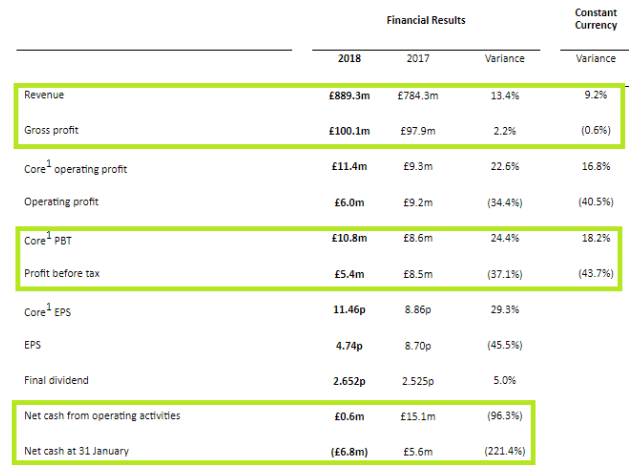
Harvey Nash’s results for the year ending 31 January were published last Friday, so are very recent. A 9.2% increase in constant currency revenue was marred by a fall in gross profit margins from 12.5% to 11.3% There were also some hefty non-recurring costs relating to the transformation programme and to acquisitions.
I’ve highlighted the relevant figures in the table below, which was taken from the results:
As Graham Neary pointed out in March, non-recurring items have been fairly small in recent years. So the company’s claim that last year’s costs are exceptional and should be disregarded carries some credibility.
Similarly, while the cash flow figure in the table above seems dire, operating cash flow excluding working capital movements and non-recurring items actually rose last year, from £10.8m to £12.4m.
In total, the group logged non-recurring, non-core costs of £1.8m. On top of this there were non-recurring, core costs of £3.0m. Together these cause the stock to fail my screen post-results, due to the impact they had on profits last year:
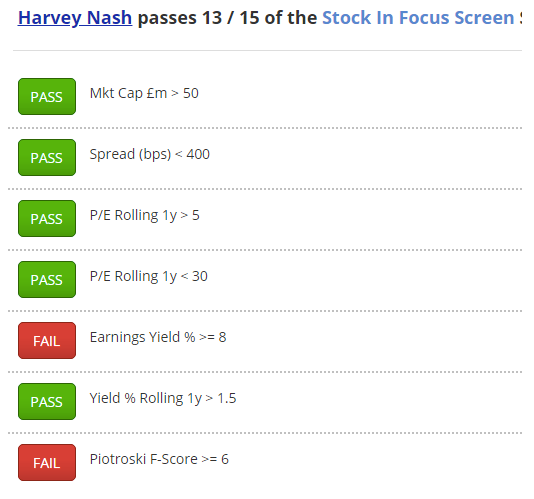
It’s tempting to say that I should disregard some of these non-recurring costs and leave the stock in the portfolio. I suspect this might be the correct decision from a fundamental point of view.
However, this kind of rule-breaking will make managing the portfolio difficult for me. And it’s also inconsistent. I haven’t excluded adjustments for other stocks, so why do so here?
My decision: I’m going to sell the stock from the portfolio. I’ll log a decent profit and I’m prepared to accept the risk that I might miss out on a longer-term gain. Ultimately, SIF isn’t a long-term buy and hold portfolio.
Total return: 29.6pc
Verdict: Sell
Redrow
I’m not going to spend much time discussing housebuilder Redrow. The group hasn’t issued any significant news over the last month and continues to pass my screening tests with ease.
My decision: This stock stays in the portfolio for another month. I can see no reason to sell at the moment.
Total return to date: 30.1pc
Verdict: Hold
International Consolidated Airlines (IAG)
An article in the FT (paywall) caught my eye last week, noting that the share prices of several US airlines had been hit by guidance for higher fuel prices.
American Airlines’ share price has fallen by nearly 15% over the last month. The latest plunge came after the group said fuel costs are expected to rise by $2.3bn this year, and warned ticket prices might rise.
Fortunately, London-listed airline stocks have remained fairly stable. I’m not sure whether this is because US airlines face tougher competition on domestic routes, or whether there’s some other reason.
Perhaps UK-based airlines hedge their fuel costs differently to US groups? I don’t know. If anyone has industry knowledge on this it would be great to know more.
In any case, I’d expect rising fuel prices to affect UK airlines sooner or later. Analysts seem to think so. They’ve cut earnings forecasts for IAG over the last month:
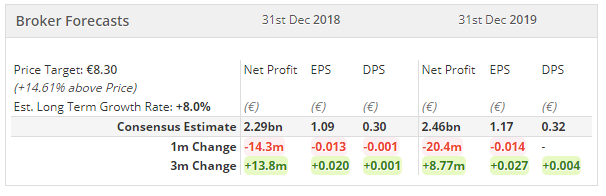
Although this is only a modest change, the reduced rate of earnings growth it implies has caused the stock to fail two of my screening tests:
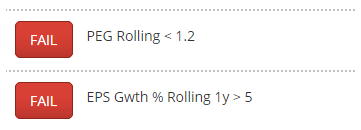
My decision: I’m not sure whether this is a false alarm or a useful early warning. But I’ll be selling IAG from the SIF portfolio this month in accordance with the rules.
It’s been a slightly disappointing investment, but when dividends of around 3.5% are included, the position should cover its costs and make a small profit.
Total return: +5.1pc
Verdict: Sell
That’s all for this week. I’ll sell Harvey Nash and IAG from the SIF portfolio this week. I’ll also sell the shares from my own holdings after this article has been published.
I’ll be back next week, hopefully with details of a new stock for the portfolio and of the new stocks I added to the International SIF in April.
Disclosure: Roland owns shares of Redrow, Harvey Nash and International Consolidated Airlines Group.
Disclaimer
This is not financial advice. Our content is intended to be used and must be used for information and education purposes only. Please read our disclaimer and terms and conditions to understand our obligations.

5 comments
International Consolidated Airlines SA (LON:IAG) was my best performer on Friday with some good numbers. It also seems to have broken up with a gap up. I think they have a way to go yet as International Consolidated Airlines SA (LON:IAG) seems to have become a consolidator in a famously fragmented and problematic industry. For sure £RYR and £EZY continue to forge on but there seems to be a place there for a company to swallow up all the rest who are not performing and I think IAG is that company. They seem to have deep pockets too!
Anyone tempted to hold IAG will need to share Willie Walsh's view that Brexit will not be an issue for them.
The EC has issued a reminder that all UK issued licenses will cease to be valid in the EU once the UK becomes a third country.
"Certificates issued before the withdrawal date by the competent authorities of the
United Kingdom on the basis of the provisions of the Basic Regulation and its
implementing rules will no longer be valid as of the withdrawal date in the EU. This
concerns in particular:
Certificates of airworthiness, restricted certificates of airworthiness, permits to
fly, approvals of organisations responsible for the maintenance of products, parts
and appliances, approvals for organisations responsible for the manufacture of
products, parts and appliances, approvals for maintenance training organisations,
and certificates for personnel responsible for the release of a product, part or
appliance after maintenance, issued pursuant to Article 5 of the Basic
Regulation;
Pilot licences, pilot medical certificates, certificates for pilot training
organisations, certificates for aero-medical centres, certificates for flight
simulation training devices, certificates for persons responsible for providing
flight training, flight simulation training or assessing pilots' skill, and certificates
for aero medical examiners, issued pursuant to Article 7 of the Basic Regulation; "
etc, etc.
https://ec.europa.eu/transport/sites/transport/files/legislation/brexit-notice-to-stakeholders-aviation-safety.pdf
Yes, indeed. But is there any reason to suppose that the EU will think it is better to paralyse air travel between the UK and the rest of Europe thereby devastating the economies of areas that are highly popular with British tourists rather than accepting that British licences are equivalent? It would seem to be perverse to do so and highly unpopular with countries such as Spain, Portugal, Greece, Italy.
Furthermore, were British airlines able to fly to European destinations prior to the formation of the EU? Yes. Are other non-EU countries airlines able to establish their credentials to fly into the EU? Yes.
So, the possibility of a problem exists, but the probability of it occurring would seem to be quite low. So while Brexit may cause many difficulties which are hard to solve, I don’t think this particular one is a significant threat.
Not a pro or against Brexit point, just putting this single issue in perspective (as I see it). No position in IAG
Thanks Roland - very interesting as per usual.
Hi Roland
Thanks for your article , I too hold HVN (not with much conviction ) is it me but I find their accounts difficult to understand ? Also the last 3 years Operating margins and ROCE has been falling and debt increasing thinking of selling myself .