Small Cap Value Report (Fri 2 Mar 2018) - Snow, RBG, G4M, PCF, IHP, HVN

Good morning! Thanks for the suggestions so far.
Stocks on my radar are as follows:
- Revolution Bars (LON:RBG) - interim results
- Gear4Music (LON:G4M) - trading update
- PCF (LON:PCF) - AGM trading statement
- IntegraFin Holdings (LON:IHP) - admission to Official List
- Harvey Nash (LON:HVN) - trading update
This list is subject to change!
Cheers,
Graham
Snow - a quick word on the brutal weather conditions, which have caused travel chaos and business disruption across the UK & Ireland.
It has personally affected me, as I was supposed to be flying to London today instead of writing this report! But I got a text message from Ryanair Holdings (LON:RYA) late on Wednesday evening, informing me that my flight would not be going ahead.
It would be risky business to trade shares based on short-term weather patterns, but I would guess this is going to have an effect on many companies - insurers and retailers spring to mind.
Anyway - take care, wherever you are!
Revolution Bars (LON:RBG)
- Share price: 163p (-4%)
- No. of shares: 50 million
- Market cap: £81.5 million
Many of you have already left insightful comments in the thread below, discussing this premium bar chain.
My views on it are as follows:
Like-for-like sales: I am ok with the company adjusting LFLs to include New Year's Eve, to get LFLs of +1.9% instead of +0.4%. I discussed this at the trading update last month.
New sites: site opening is on track. Four new sites opened, including three just before Christmas. Six planned for the full year, taking the estate to a total of 74.
Adjusted Operating Profit: this is where it gets interesting, as the company claims to have achieved an adjusted operating profit of £6 million, versus a reported operating loss of £3.7 million.
This is what the "exceptional" items look like. You'll notice that there were £2.3 million of exceptional items during the entire previous year.
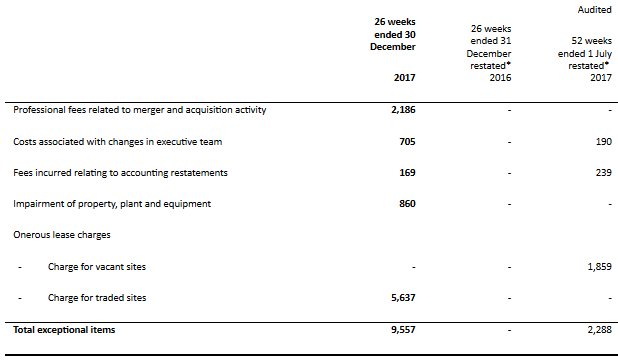
- Professional fees: "legal and corporate advisory fees, and registrar and virtual data room services provided in respect of the Board recommended offer from Stonegate and the merger proposals from Deltic".
While I accept that these fees are one-off in nature, don't they seem a little on the high side? Shouldn't Stonegate/Deltic have paid for the data room? What corporate advice did the company need in order to put the offers to shareholders? It seems like rather a lot of money to spend on fees, when you are the company being bid for.
- Changes in executive team: compensation and legal fees to do with the resignation of CEO & COO, and recruitment of a new CEO. While changing CEOs doesn't happen every single year, I would argue that it happens often enough that it is just a normal cost of doing business.
- Impairment: Not sure I would leave this out either, as these are real cash costs and were probably incurred recently. The company says that the changes "do not affect the Group's cash flows", but the expenses they relate to were certainly paid out in cash in the past. They have to be recognised as an expense somewhere along the line.
- Onerous lease charge: this is the big one, with £5.6 million in provisions. The company says:
Following a more robust analysis of the trading performance of the Group's bars, a small number have been identified as requiring an onerous lease provision, based on projected bar contribution and rental commitments. The adjustment will reduce rental charges in future periods; it does not affect the Group's cash flows.
Again, note that the company says it does not affect the group's cash flows.
However, the rental commitments will be paid in cash. And real losses will be incurred, based on the company's projections. What the company is doing is recognising the losses up-front. It will thus be able to recognise reduced losses in the future.
So I don't view this £5.6 million figure as being exceptional in any way. It is nothing more than trading losses being recognised up front.
Balance sheet: Revolution has made further restatements to its previous-period balance sheets. The result is that net assets for July 1st 2017 are shown as £35 million, while net assets for December 30th 2017 are shown as £29 million.
- Starting net assets: £35.2 million
- Total comprehensive loss: minus £3.4 million
- Share-based payment: minus £765k
- Dividend: minus £1.65 million
- Ending net assets: £29.4 million
Dividend: as you can see above, the company paid out another hefty dividend during the period, and today it announces that it will maintain its interim dividend at 1.65p.
Current outlook is mixed from the CFO. He is positive about the outlook for significant profits from the development of new venues, and also mentions the following:
Whilst recent sales trends have been below the norm, there is reason for optimism on costs given that labour scheduling software and processes should help to mitigate the impact of wage increases over the next two years and the step change cost increases arising from the 2017 rating revaluation of business properties and the introduction of the apprenticeship levy will slow appreciably from April 2019.
My opinion: Regular readers will know that I have been lukewarm towards this stock and the entire sector. As you can see from the outlook comment above, there are significant cost pressures facing the industry which are largely (though not entirely) beyond the control of companies.
With respect to this company in particular, my view is that the LFLs are ok - neither extraordinarily good nor bad.
2pm Edit: Having thought about it some more, and taking your comments into account, I agree that the company is currently making a small profit - the best thing to do is probably to ignore the onerous lease provision completely, both now and in future periods.
So we can say that the company made a profit of £1.9 million (reported loss £3.7 million with the onerous lease provision £5.6 million added back in) or £4.1 million if you also add back the M&A-related fees.
It remains the case the dividend is being paid through borrowing, as the company drew down a further £3 million during the period, taking the total to £10.5 million.
I thought the shares were approximately fairly valued when I covered the trading update recently (with the share price at 172p), but I would be a lot more cautious on the back of these results. I think the case for the "self-funding roll-out" is harder to make, given the onerous lease provisions made today.
Of course, the company might be worth more in the hands of Stonegate or somebody else, so we can't rule out another bidding war at some point.
£G4M
- Share price: 631p (-3%)
- No. of shares: 21 million
- Market cap: £132 million
Further progress by this distributor of musical instruments:
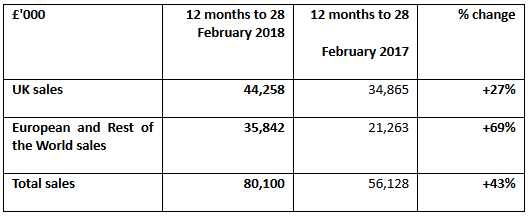
I am in the habit of checking the second derivative of sales, i.e. checking whether growth is growing or not. Let's see the same table from a year ago:
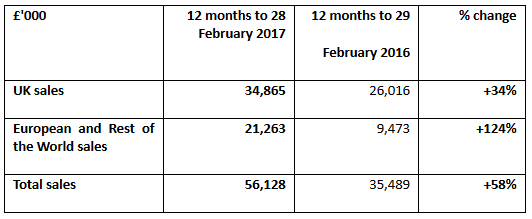
Ok, so growth was a bit higher a year ago. That's understandable, given the low base it has been rising from.
It's a similar story to when I covered it in January (with the share price at 740p).
At that time, G4M reported sales growth of 42%, compared with 55% in the corresponding update a year prior. Shareholders apparently expected more.
Coming back to today's update, we learn that customer numbers are up by 39% to 374,600.
Sales growth at 43% implies that sales per active customer increased a little bit - sounds good.
I am really interested in own-brand sales, as it's where G4M might achieve additional pricing power. The update says that own-brand sales "kept pace" with other-brand growth. So they are probably still around 25% of total sales, then.
CEO comment amounts to a small profit warning, I think:
EBITDA for the second half of FY18 will be ahead of the six-month period ended 28 February 2017, although as a result of the investments we have made during the year into our customer proposition, infrastructure, staff, systems and marketing, we expect EBITDA for the full financial year ended 28 February 2018 to be in line with our FY17 result.
Analysts had been forecasting EBITDA around £4.0 - £4.1 million for FY 2018, up from £3.7 million in FY 2017. So we have a cost over-run of about £400k.
My opinion: I don't see much reason to change my previously-stated view on this. However, given the share price weakness, it's considerably more interesting now than it was at 800p.
The question is: how many years of growth are you willing to pay for in advance? Remember that official forecasts have been for net income of £3.7 million in the year ending February 2020 (versus the £130 million market cap today).
If you have a lot of confidence in the company growing through 2020-2022 and taking market share to eventually become a much bigger business, then it would make sense to get involved.
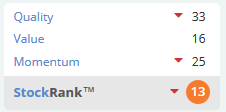
The Stockopedia algorithms don't like it, calling it a "Sucker Stock". Clearly, there is an element of speculation when you are paying up in advance for future growth:
PCF (LON:PCF)
- Share price: 30p (+2%)
- No. of shares: 212 million
- Market cap: £64 million
(Please note that I currently hold shares in PCF)
After all I've just said about paying up for future growth, I am now going to talk about a stock which I have purchased for its future growth!
PCF Bank, previously known as Private & Commercial Finance, is a lender to both individuals and businesses, financing vehicles and plant/equipment.
What's interesting about PCF, and what makes it different from many of its rivals, is that it has succeeded in getting itself a banking license. That means it can take retail deposits, one of the cheapest forms of financing, and be less reliant on wholesale funding from other banks. It started taking deposits last July.
Today's AGM statement says that trading for the first five months of the year is in line with expectations.
Expectations have been high. New business originations have almost doubled to £54.5 million, while the entire lending portfolio is up 35% to £172 million, compared to a year ago (it still could not take retail deposits a year ago).
Retail deposits are up to £81 million, versus £53 million at the end of September. That means that growth slowed down after the initial three-month burst. I think management are comfortable with that, as extremely rapid growth in deposits might be difficult to match with new lending opportunities, particularly while the company still has a lot of wholesale debt outstanding.
Guidance is unchanged:
Our medium-term targets for the Group remain unchanged at 12.5% return on equity and a lending portfolio of £350m by September 2020, while asset diversification remains a goal and will follow in due course.
I wouldn't be concerned if there was only a small miss against that £350 million portfolio target, but I think that PCF has a great chance of achieving it.
Consider that it just recorded a 35% annual growth rate in the portfolio, despite not having bank functionality a year ago. If it maintained a 35% growth rate (compounded) for the next two years, it would be around £310 million in March 2020, and have six months left to get the last £40 million.
Its ambitions after 2020 are even grander, but I am happy for it to take things one step at a time and continue to grind out growth at the current rate.
While I do own this stock for its growth prospects, I don't think that I have overpaid for it.
You could argue that the market cap is too high against book value of just £39 million, but I think investors have to give credit for PCF's extremely efficient bank operating model and its growth opportunity as a small player with a banking license.
Relative to earnings, the company is not expensive:

As you can see, it pays a small dividend. I would be happy if the company paid no dividend at all and ploughed all resources into growing as quickly as possible. I know some shareholders do want a dividend, so I guess the small one is a fair compromise.
Talking about shareholders, the parent company owns nearly 55% of the shares, so there is a very limited free float.
Turning back to earnings, analysts are forecasting net income of £8.1 million in the year ending September 2020.
There is risk involved, not least in the potential for a general business downturn and in car sales.
So it's possible that the forecasts will turn out to be optimistic. But from the current share price, I am hopeful that we will see both earnings expansion and multiple expansion over the next few years.
IntegraFin Holdings (LON:IHP)
- Share price: 263p (unch.)
- No. of shares: 331 million
- Market cap: £871 million
Initial Admission - Official List
I thought I would mention this in passing as it's a new listing in the financial sector. It listed at 196p earlier this week and is now trading 34% higher, for a market cap of almost £900 million. The IPO raised £178 million for selling shareholders only, not for the company itself.
The company's homepage is here (external link). It's an investment platform used by over 5,000 financial advisers, helping them to manage client assets and put them into the right tax wrappers, funds, etc. The service has been around since 2000.
According to the prospectus, the company had revenues of £80 million in FY 2017, converting to net income of £30 million, i.e. a huge net profit margin.
It has paid a dividend and/or bought back shares every year since 2007, returning £85 million in total. The cash flow summary looks excellent, and it sounds like it has been profitable every year since 2003. The only negative is that it paid out a special dividend worth £11 million just prior to admission, which won't be available to new investors.
I haven't got the time to look into it in any more detail today, and it's a bit too big for this small-cap report, but I'm motivated to keep an eye on it going forwards.
Harvey Nash (LON:HVN)
- Share price: 86.5p (-0.5%)
- No. of shares: 73.5 million
- Market cap: £64 million
Back to the recruitment theme with this. We recently covered smaller player RTC (LON:RTC).
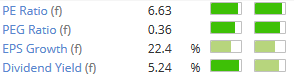
This stock is also offering plenty of small-cap value, as recruiters tend to do:
Today's update says that results for the full year ending January 2018 are expected to be in line with expectations.
Adjusted profit before taxation and non-recurring items is set to be up c. 22% compared to the prior year. That number was £8.6 million last year, so we can look for it to be £10.5 million this year (ending January 2018).
Thankfully, Harvey Nash has been reporting very few non-recurring items in recent years, so the discrepancy between the adjusted PBT and actual PBT has been tiny.
In FY 2018, it made two acquisitions and has undergone a "transformation programme", introducing the risk that we will have larger adjustments this year. But in my view, the numbers would still carry a great deal of credibility, since the adjustments have been small for a while.
It's important to think about the performance at constant currencies, given Harvey Nash's geographic spread. Only 38% of net fee income was generated in the UK & Ireland, according to the interim results.
As this table illustrates, gross profit for the year just ended was a lot weaker at constant currencies, compared to actual exchange rates. So the adjusted PBT would probably be weaker, too.
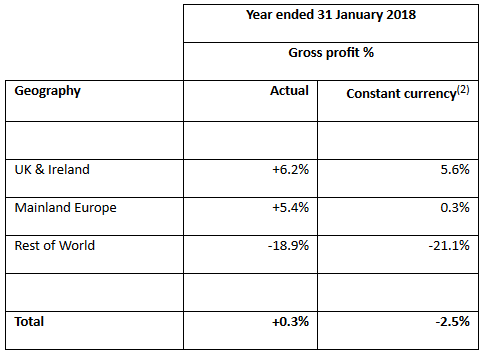
UK & Ireland and Mainland Europe are both performing fine in terms of gross profit growth, while the rest of the world is shrinking back to core markets. The transformation programme has reduced headcount and shut down loss-making offices.
My opinion: It remains very cheap, even with £6.7 million net borrowings at year-end. Let's add that on to the market cap for an enterprise value (EV) of £70 million. It is forecast to earn adjusted net income of £10 million in the current year (FY 2018), putting it on an adjusted EV/Earnings multiple of just 7x (or a PE multiple of 6.4x).
While recruiters probably should have low earnings multiples, I think there is a point at which the economics of buying them for the dividend and earnings yield becomes compelling.
These charts show that in its recent history, the lowest PE multiple Harvey Nash has traded at is around 5.2x, while the highest dividend yield it has traded at is 7.9%.
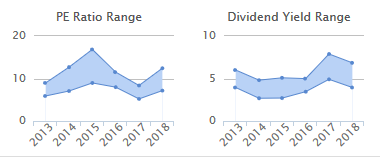
Looking at the other extreme, the highest PE multiple it has traded at is 16.8x. So we are currently much closer to the low in historical PE than to the high.
If you can combine this knowledge regarding historical valuation ranges with the assumption that we are not at some sort of cyclical high in earnings, then I think we potentially have a really good argument in favour of investing in this!
That's all I've got time for today. Have a great weekend and stay warm!
Best wishes
Graham
Disclaimer
This is not financial advice. Our content is intended to be used and must be used for information and education purposes only. Please read our disclaimer and terms and conditions to understand our obligations.

75 comments
Revolution Bars (LON:RBG) - Sharepad shows negative FCF
That puts you back into believing the ever shifting numbers. Or not.
A couple of points on Revolution Bars (LON:RBG):
Looking at these interims, they generated £7.1m of operating cash flow and spent £6.6m on capex, but the capex consists of 4.3m for the fit out of new sites (so is expansionary capex) and £2.3m of maintenance capex.
That means free cash flow was £4.8m for the half year (£7.1m OCF less maintenance capex of £2.3m), which compares to £3.8m in the prior half year. Granted, part of that was due to favourable working capital movements, but it’s also net of the one-off cash costs of the M&A activity.
So I think pointing to the increase in debt to suggest the roll out is failing or is not self-funding is stretching the point a bit.
On the point about whether they are funding the dividend payment from debt, I can see how this argument can be made, but it could equally be argued that the £4.8m of free cash flow is sufficient to cover the £1.65m paid out in dividends nearly three times over, and that it’s really the £4.3m of expansionary capex that is causing the increase in debt.
They could scale back the number of openings if they really wanted to stay debt-free, but why would they, if they believe they have multiple opportunities to expand new sites at high rates of invested capital, and if they have the financial firepower to do so?
Onerous leases – yes it could be argued the existence of loss making sites is evidence of poor capital allocation, but to an extent this is just a ‘to be expected’ part of doing business in this area. Both Stonegate and Deltic carry a provision for onerous leases for example, while a quick Google reveals that Marston's (LON:MARS), J D Wetherspoon (LON:JDW), Punch Taverns, Greene King (LON:GNK), EI (LON:EIG) and Mitchells & Butlers (LON:MAB) also all carry provisions for onerous leases (or property provisions, as they are called in a couple of instances). So it’s not really credible to point to the provisions at RBG and claim poor management on their part, unless you are going to claim the same for everyone else who carries onerous lease provisions, which is pretty much all of their listed comparators.
Unless RBG are planning on closing those sites which are subject to an onerous lease provision (and I’ve not seen anything to suggest that is the case), it can probably be assumed that the sites are trading well enough to cover their variable costs but not all of their fixed costs, which I would imagine is primarily rent and business rates. If the provisions did relate to sites which were being closed, it could be inferred those sites were not even covering their variable costs, which would be a much worse situation.
Hi Bestace good points but...I think the issue is Revolution Bars (LON:RBG) is a relatively new format rollout (listed from March 2015) & has previously stated that they had no tail of underperforming bars. The comparisons you’re making with established pubco’s are interesting/relevant only if they relate to provisions made to bar openings within the last few years?
Yes, clearly they do now have a tail of non-performing sites, so things have deteriorated in that regard. Given the size of the provision I thought it was rather poor to provide so few disclosures that could have provided some context. How many sites are we talking about? what's the length of the remaining lease for these sites? in what way has their new methodology changed from their previous methodology for calculating these provisions? what assumptions are they using on discount rates, inflation, turn-around plans etc. We don't know the answers to any of those questions because they did not see fit to tell us.
I had put together a comparison of each of those other companies' onerous provisions compared to their overall lease commitments, but I'm not posting it here because I think the ratios are pretty meaningless as comparisons - each company has differing methodologies and assumptions and the disclosures are wholly inadequate (not just from RBG) to provide any meaningful read-across. However I did think the mere existence of onerous provisions at all those companies was worth noting.
Revolution Bars (LON:RBG)
Morning Bestas et al,
I couldn't agree more with the points you've made and my biased view as a holder is that there still remains significant hidden value here. Some additional thoughts:
Cash Balance after Dividend, Expansion and Fees
Net increase in cash was reported to be +£1.6m. Adding back +£1,2m for monies from NY that would have ordinarily been included*, and removing the -£3m increase in borrowings, implies that cash balances would have been relatively flat. Not bad given that this was after:
(* "...it should be noted that had New Year's trade fallen in to the current reporting period and consistent with the comparative period, net debt at the period end would have been 1.2m lower than reported and therefore is broadly unchanged over the period.")
Onerous Leases
It's quite hard to work out the impact of the onerous leases going forward, given the seemingly unlimited number of restatements, but I've made an attempt.
LFL
LFL sales up to and including New Years = +1.9%
LFL sales after New Years to Feb 24th = -2.0%
So overall LFL relatively flat? Doesn't seem disastrous, especially as it excludes sales from new venues.
Conclusion
Still a growing, cash generative business, paying out a dividend.
My only hesitancy is with the high recruitment/resignation/professional fees, which continue to make little sense.
A
Hi Abtan
‘I couldn't agree more with the points you've made and my biased view as a holder is that there still remains significant hidden value here’
If that is so why have mgt so effectively hidden this value?
Multiple restatements & anemic LfL figures ...after a lot of faffing to get them to look + do not suggest successful rollout to me .
One final thought ...refurbs are undertaken when trading at a given outlet weakens unacceptably..all sites currently subject to refurb are excluded from LfL.
My working theory is Revolution is a so so to poor format, Revolution da Cuba much better but only in high traffic locations, unfortunately they have a number of sub scale secondary locations with Revolution which cannot move to the more successful format..I suspect on zero evidence that that is where the onerous lease provisions come in.
FWLIW I have noticed that one Revolution outlet closed with little clarity as to what was occurring https://www.macclesfield-express.co.uk/news/revolution-bar-temporarily-closed-13185900 ..that site was not in any LfL figures for a long time...but has now reopened.
..best of luck but it’s value is too hidden for me!
Thanks for the reply and on-going discussion.
Some thoughts in italics below:
‘I couldn't agree more with the points you've made and my biased view as a holder is that there still remains significant hidden value here’
If that is so why have mgt so effectively hidden this value?
I didn't get the impression that they had hidden its value. When I read the last interim report, I found their main points relatively well explained. The only real negative I saw was the 2% LFL sales drop and would have appreciated an 8-month LFL update. Even with regards to the onerous leases, a bit more detail would have been useful, but they stated that there was no cash impact that hadn't already been accounted for, which makes sense. I do not expect every venue to be profitable, whatever the business.
"Multiple restatements & anemic LfL figures ...after a lot of faffing to get them to look + do not suggest successful rollout to me ."
I don't fully agree with this comment, but I can understand why many would. One thing I would add is that it is quite difficult to manipulate Cash, and Cash does not seem to be an issue for reasons previously mentioned.
One final thought ...refurbs are undertaken when trading at a given outlet weakens unacceptably..all sites currently subject to refurb are excluded from LfL.
I'm not surprised refurbs take place at weakening venues. This applies to every player on the high street. I'm honestly not sure whether to include refurb stored in LFL comparisons.
My working theory is Revolution is a so so to poor format, Revolution da Cuba much better but only in high traffic locations, unfortunately they have a number of sub scale secondary locations with Revolution which cannot move to the more successful format..I suspect on zero evidence that that is where the onerous lease provisions come in.
Not sure why they would they keep opening both formats if this were true.
FWLIW I have noticed that one Revolution outlet closed with little clarity as to what was occurring https://www.macclesfield-express.co.uk/news/revolution-bar-temporarily-closed-13185900 ..that site was not in any LfL figures for a long time...but has now reopened.
..best of luck but it’s value is too hidden for me!
Hi abtan
Re obfuscation compare the clarity of J D Wetherspoon (LON:JDW) recent trading update
‘For the first 12 weeks of the second quarter (to 21 January 2018), like-for-like sales increased by 6.0% and total sales by 4.3%. In the year to date (25 weeks to 21 January 2018), like-for-like sales increased by 6.0% and total sales by 4.3%.
As a result of better-than-expected sales, year-to-date underlying profit before tax is slightly ahead of our expectations. Similar outperformance in the second half will be more difficult to achieve.’
..by comparison Revolution Bars (LON:RBG) are a) underperforming b)far less clear c)far smaller so should be clearer
As to the point about the onerous lease provisions not impacting cash...well they wouldn’t because they never do.
My point on refurbs was if say your 10 worst performing sites are subject to refurbs they drop out of the LfL ..and they’re most likely to be sites where the model is called into question (hence the onerous lease provisions) ..and that is doubly true as some of them were unplanned refurbs as per an earlier RNS explanation for a profit shortfall iirc
My view is the formats age more quickly than was planned and that vicious circle of Capex is why bar/nightclubs quoted businesses have always imploded in the past..this looks v high risk for that reason ..the warning signs are clear imho ..good luck anyhow!
Edited to add I’ve just spotted this excellent post that covers the ground from an analyst point of view
https://www.stockopedia.com/co...
I am puzzled by the Revolution Bars (LON:RBG) onerous lease provision treatment. It could be quite correct that it's a more zealous move to use an IFRS requirement for impairment to be recognised, but it isn't clear (to me) how far forward in future periods they have gone (they have obviously gone back). It would seem this is where the rigorous view of the auditor about the principle, and a management seeing an opportunity to trade-off a non-cash impairment against reporting better future profits may have met in the middle.
it seems to violate an older principle of the old accounting of 'matching' revenue to accounting periods. A bit like using an accounting time machine by accelerating the depreciation calculation. Supposed to make for prudence, but actually ends up confusing where the reference baseline is or was.
Be interested in Paul's take, as well a having Graham's helpful analysis
It's come to something if the accounting rules allow such confusion over cost recognition in a business as simple as running a chain of bars.
Can I thank Graham and readers for the excellent dissection of Revolution Bars (LON:RBG) ? As someone with a busy full-time job it's just hard for me to make the same level of analysis about accounts, which aren't my strong point anyway. When reading the RNS I missed, for instance, mammyoko's point that the write-downs on leases are against currently trading sites which doesn't seem like a good sign.
The new CEO can't start soon enough to tidy the business up and make some changes to the product offering to simplify it and increase margins.
Never sure how to identify maximum pessimism or optimism.
But I can decide whether I think something is investable for me. Usually goes along the lines of, 'if I can't sell, would I be happy to be in for the very long-term?' That involves a judgement about the people as well as the business model.
And, with hindsight, even enormous pessimism can sometimes prove insufficient.
Is not the best time to invest at the maximum pessimism? Are we there yet with Revolution Bars (LON:RBG) ?
I'm surprised that so many people are still keen on Revolution Bars (LON:RBG)
Over the period I read Paul's coverage the story kept changing. At one time it was very low short-term rentals with initial inducements. Then various issues about management capability, and who could be believed, and accounting practices. And then there are all the question marks about the sector. Does it really seem to be the time to invest heavily in food, which is what Paul thought they should be doing.
I can't say it's not cheap - just that I have no idea what it is really worth or how to access reliable information that will allow me to value it. And my experience has taught me to avoid companies where the management seem dodgy, unreliable or untrustworthy. Better to pay more when you can trust management to do a good job, headwinds or not.
Good evening Graham,
thanks for your comments today. I have had PCF (LON:PCF) on a watchlist for some time, occasionally looking into it when there has been a RNS and/or share price movement that has caught my eye. Possibly a reason I have baulked at investing is that it only has a stock ranking of 35; do you see that being a concern?. I do not invest solely on the ranking within stockopedia but it does seem to have a bearing on how a company is likely to perform and am inclined to invest more with a ranking of 80+. All subject to far more indepth research of course.
Regards
CM
re Beaufort Securities - looks to have been at the bargepole end of small cap brokers
http://citywire.co.uk/wealth-manager/news/beaufort-securities-charged-with-fraud-by-us-prosecutors/a1097638
Surprised that Revolution Bars are still paying a dividend. Better to invest that money in the business, and perhaps via modest price increases? Someone posted earlier that a pint of beer can cost less than at Wetherspoons. If their bars are up market can they get away with charging a bit more without hitting sales too hard? .Agree competition makes this hard to achieve but upmarket customers can afford to pay a bit more, and anyway these days, with ever fewer using cash, some seem to have little idea what they are paying for anything. Some I know haven't even noticed how the fall in the £ against the Euro has meant higher costs on their European holidays!
I'm dithering about selling. Have never had a chance to go to see for myself as there aren't any of their bars near us, but have seen regular reports of plenty of customers.Perhaps if better financial management (including cancelling tie dividend) along with other efficiencies, things could soon look up; And if they can't do it a bidder might well be able to. So holding for a possible bid for now.
Thanks for flagging IntegraFin Holdings (LON:IHP). Going on my watchlist. Let's see if it builds a base from the IPO.
Thanks for the comments on G4M. Gear4Music saw a sharp drop in interim (to Aug 17) profits and EBITDA despite a strong rise in revenues. This was partly blamed on the costs of expanding the company's footprint in Europe, specifically Sweden and Germany, and the development of a USD website. EBITDA fell from £1.3mn to £0.7mn, net profit was effectively nil. Incidentally, they had raised c£4mn in a share placement in May to help fund these items and other developments including a head office relocation. One month ago, in early January, the company released a trading update demonstrating further strong revenue growth in the four months to December 2017. In today's release G4M suggests flat EBITDA for the year to February 2018. This implies second half EBITDA of £2.9mn against £2.3mn for H2 of the year to February 2017. Admittedly that is a lower margin but it is nonethless a 26% increase if we trust the figures. and the EBITDA calculation.
It was quite clear last October that the company was way behind parity with the previous year's profits, it was quite clear from the January update that H2 revenues were still growing sweetly, and it seems some of the costs of expansion are now being absorbed by this excellent revenue growth.
You will have guessed I own the stock. The reason that I bought it was that following a comparison I did against some other internet retailers, specifically PURP, JustEat and BooHoo, I concluded that on a number of measures G4M stacked up well or better than these better-known names (from memory sales to market cap and gross margins were among them). I must say that I can see nothing in today's release to cause alarm, quite the opposite. The full numbers will be out on May 15th, I hope my continues optimism will prove justified.
WdWombat - that's a really good way of looking at internet disruptors vis a vis sector they are disrupting.
Not looking as rosy for RBG as a takeover target, I fancy FLYBE better as I expect the premium to be higher. Good punt too while we wait for the lock-in period for Deltic and Stonegate to lift, where we might see a bid from Stobart during that period.
Hi Graham,
Thanks for review on PCF (LON:PCF).
If OK may I challenge on multiple expansion here and I hope I get the rest of this right!
If ROE is 12.5% and P/B stays at 1.5 (keep math simple), that would imply PE multiple of 12, which is same as current multiple.
Accept that book value will (should) grow and assuming no change in multiple P will move in line with E, which will move in line with B
Since P/e and p/b are effectively function of ROE, would multiple expansion not require higher than expected ROE?
Which may well be the case certainly over the long term
Hi, thanks for the question. You say "assuming no change in multiple" - are you referring to the P/B multiple there? If the P/B multiple stays the same, and if the ratio between E and B stays the same, then yes, I agree that the P/E multiple will stay the same. My hypothesis is that P/B might not stay the same, and so the P/E multiple might not stay the same :)
Thanks Graham,
Indeed - I was assuming flat P/B.
Reason : currently high(er) p/b implies higher growth in book value which if book value expectations reverse, would come down. My view, if all banks collectivebook value growing much more than economy is problematic (eventually)
Personally, I think higher ROE is more likely on grounds of:
1. Lower funding cost
2. Less risky and so higher leverage due to what is hopefully a stickier deposit base.
P/B high relative to mature banks, low/avg relative to Challenger banks and low relative to specialist lenders, so P/B multiple expansion is certainly within reason I'd suggest.
In which case, there is a double whammy!
If I may ask, when / what price did you buy at?
Have been following since they got license - (not easy) and they have a moat versus other non-bank lenders.
Separate rant: regulations should not be the reason for a competitive advantage.
To borrow from Paul, may you not find band-aids after a paper cut on each of your fingers!
Hi again - re: PCF (LON:PCF).
Yes, I am also hopeful that ROE will improve. A big customer base and operational leverage, if the business model can remain very efficient, could see to that. And if we get that, then the multiples (P/B and P/E) should improve too. I roughly agree with your cause-and-effect reasoning. It's difficult to predict exactly how investors will value it, if the execution of plans over the next two-and-a-half years is successful.
I bought in December, January and February at prices ranging from 26.5p - 28p.
Thanks for your input. Talk again.
This lunchtime announcement from Falanx (LON:FLX) may affect other small cap shares.
Statement re Joint broker
The Company notes the announcement today regarding Beaufort Securities Limited ("BSL") and Beaufort Asset Clearing Services Limited ("BACSL") being placed into insolvency and that the Financial Conduct Authority (the "FCA") has imposed requirements on BSL and BACSL to cease all regulatory activity.
BSL is a joint broker to the Company pursuant to the AIM Rules for Companies (the "AIM Rules"). As a result of the requirements imposed by the FCA, BSL will no longer be able to provide broking services to the Company in accordance with the AIM Rules.
Turner Pope will become sole broker with immediate effect.
The LSE shows a list of companies here:
http://www.londonstockexchange.com/exchange/companies-and-advisors/aim/for-companies/nomad-broker-profile.html?nomadBrokerId=334
Most have put out a statement saying they are seeking a new NOMAD following Beaufort's insolvency.
Thanks sharw. I didn't know where to look to find a map from advisors to companies. That's useful.
With reference to RGB, it hard for me to see value in revolution bars now as it seems to me it has loss momentum in it expansion plans and eps grow , after 2018 what are it growth plans ?
On the otherhand , we have Marstons seems to be completly ignore by the markets
it throwing off a dividend of 7% and pe of 7 and it yearly revenue still growing .
Am i missing something ?
dustyie,
Marston's (LON:MARS) has over £1.3bn, or twice its market cap, in net debt, making it an entirely different proposition.
Point taken on Marston's (LON:MARS) but it trading at around tangible book value, as many of its properties are freehold and new build. It is a very different entity from Revolution Bars (LON:RBG) with activities spanning pubs/restaurants, brewery/beer production and distribution and hotels (lodges).
Anyway each to their own, you pay your money and make your choice.
Jonno
GavSmith01
Yes I see your point on it debt . but it asset are 2.3 billion approx and book value per share is 147p and RBG book value per share is 80p
Going on the market prices today the market have factor in a 20% drop Marstons business for the coming few years . Only time will tell .
I wonder whether brexite uncertainly is affecting consumers spending .
p.s. i have a small holding in Marston and recently sold my RBG holding
"I wonder whether brexite uncertainly is affecting consumers spending . "
Brexit Certainly isnt affecting spending at Wetherspons.
"Shares jump after Wetherspoons serves up rise in profits"
https://www.ft.com/content/6070d688-99de-11e7-a652-cde3f882dd7b
I hold RBG having bought in at a lower price, selling half at 210p in 2017 post bid. I topped up after the price drop following the bid not turning into a done deal.
Having looked at the interims and having read all of the comments on here, it would seem that RBG really does divide opinion at the moment.
I am holding and still remain confident of achieving 240p within the next three years.
RBG has an average food proposition at present and revamping that alone could generate the growth needed for me to be a happy investor.
Revolution Bars (LON:RBG) - excellent summary Graham. Like you, I find the £2.2m of legal fees astonishing. They were almost begging to be taken over so it's not as if a costly defence against an aggressive bid was being mounted!
I think that although there might be an argument that Mr Foster is kitchen-sinking to make the business more attractive to Stonegate, it could just as easily be that their accounting function isn't or wasn't fit for purpose and that these are necessary adjustments to previously over-optimistic results. They have a track record of financial incompetence rather than financial sophistication. But perhaps the new CFO is more cute and this is the final clear-out?
Ultimately, whether this is kitchen-sinking or whether it is a necessary adjustment the outcome is still a significant and unexpected operating loss and you have to believe in the exceptional nature of all their adjustments to turn that into a good result for the future.
Graham
don't disagree with your thoughts on RBG but the £5.6m onerous lease provision would be based on the life of the lease not just this year so not quite right to expense all of this in this financial year and state the business is loss making. 70% of the lease commitment are over 5 years per last years accounts
To me this is looking like a provision against future losses. It's been a while but I thought one of the specific things you can't provide against are future losses and restructuring costs.
Assuming my memory of reporting standards is correct, this will be written back at year end accounts and future earnings will be lower by the amount of the loss.
From what I am seeing they were not looking at things on a per venue basis and are likely realising that certain locations are subsidising others
Hi there, re: Revolution Bars (LON:RBG)
This is also directed to Gromley,
I have thought about it some more. I've realised that I agree with you guys, and have edited the article accordingly. I no longer refer to an underlying loss. See the "2pm edit" section.
Thanks for the feedback
Graham
Nice one Graham (and apologies to HornBlower - for missing the fact you'd already made my point!)
Going forwards they will arguably now be 'overstating' profits but not counting all of their rents - which will make their accounts all the more difficult to really understand. I'd say that cash generation possibly becomes are more important (or at least understandable) metric going forwards and as Graham rightly points out they are in fact borrowing to pay the dividend.
So not really very compelling imho at this stage. My position here is only small, but I'll be thinking over the next few days whether it's worth holding onto for the potential bid premium.
Revolution Bars (LON:RBG) it might be the fairly new CFO tidying up what were sloppy accounting policies. will certainly help future EPS. a lot to play for if new CEO can steady the ship and run the operations cleanly for a year or two.
They might be able to get some Mothercare sites pretty cheaply soon reading today's RNS
In Revolution Bars (LON:RBG) report, they mention 'onerous lease' and that "The adjustment will reduce rental charges in future periods; it does not affect the Group's cash flows."
Can someone tell me what exactly does this mean? My perception is that some bars are loss making, and therefore they are taking a hit now, but will mean that future reports will benefit from these costs being recognised now?
exceptional charges is £9.6m and I'm trying to figure out how much are 'exceptional'
Hi James, re: Revolution Bars (LON:RBG). Hopefully my report helps to answer your question! G
Graham, yes, Revolution Bars (LON:RBG) might get a bid, although after this RNS any potential bidder would, imo, be having second thoughts. For me, it just doesn't pass the smell test.
Revolution Bars (LON:RBG)
It will be interesting to examine future accounts to see whether the releases from the 'onerous lease' provision are disclosed as exceptional credits.
Phil
Hi Graham,
Re Revolution Bars (LON:RBG) whilst I agree up to a point about not excluding some of the exceptionals (I particularly dislike the practice of taking future losses into exceptionals - effectively inviting investors to ignore them twice) I think it is wrong to conclude that this translates to an 'underlying' loss for the period. You would need to amortise the director changes over say 3-5 years (although they may actually be exceptional given they were not planned changes) and also amortise the onerous leases over the remaining lease periods (no idea off the top of my head how long).
Someone suggested that amongst the reasons for these adjustments would be protection from takeovers. I would have to disagree this point, the two most likely predators Deltic & Stonegate know pretty clearly what the books look like . It seems to me that one of those two is still the best avenue to unlock shareholder value.
I have a small position here, primarily because of that last point.
Re Revolution Bars (LON:RBG) - the provision they have taken for onerous leases on what Mr Foster describes as a 'small number' of sites is required under FRS 102 Provisions and Contingencies.
Basically, where a site is losing money and they cannot convince PwC that it is forecast to become profitable in future, they are being required to take a provision now for the future rental costs. If the site becomes profitable, the provision will be released. The provision will mean that the cash costs of the lease are, in future, taken against the provision rather than put through the P&L. Consequently, future results will be improved as the rental costs have already been provided for.
I have two concerns. The first is that the provision is being taken against sites that remain trading whereas the existing onerous lease provision was against vacant sites. This implies that the trading sites are making a loss and forecast to continue doing so. If they base a decision to invest in future sites on the current performance of existing sites ignoring rental costs they will compound previous bad investment decisions.
The second concern is that either these sites have become loss-making sites through a deterioration in performance or through an arbitrary change in the assessment of their future performance. We are led to believe that it is the latter - 'Following a more robust analysis of the trading performance of the Group's bars'. Does this mean that they were being too optimistic in the past or that they could be being too pessimistic going forwards? What were the previous auditors doing which meant that they missed the need for a £6m provision? Either the previous auditors were negligent in allowing too optimistic a view to be taken on loss-making sites or the financial performance of those sites has changed.
Others have rightly said that this could be a case of taking a provision now to improve results in the future - this would correspond with the change in both CFO and auditor in the last year. However, as I have said, it means that we have no clear idea of the underlying profitability trend of the business.
I can't see that it is management's interests to reduce profits now so as to flatter profits in the future. Management were all for the Stonegate bid and taking a charge now is not going to improve the chances of that being resurrected soon. For that reason, I am inclined to think that the provision has been required by PwC rather than engineered by management.
I was a holder from lower and decided to exit this morning. I think, like Paul, that Stonegate will be back. I just don't think it will be that quickly given these results. They refused to pay up before and these accounts wouldn't, I think, make them want to do so now. Any take out at the same premium would now need to be 25p higher than last time and Stonegate's risks have increased wheres it isn't obvious that the potential return has increased.
Fully expecting to be proven wrong!
Too often I have held a stock with some grey areas and lived to regret it. For this reason I put in place rules like operating margin minimum 10%. I bought in to RBG because a trade investor was interested at a much higher price, but circumstances arise which change this and I think Mammyoko has summed it up pretty well. Adding to a situation where multiples are toppy I have taken the view to sell and stop hoping for saviours to come along for reasons I don't understand to buy a business which cannot clearly express itself through its accounts. If you can't explain to people clearly and simply what you do and how you do it, then it is not a good idea to invest. Good luck to everyone who takes a different view to me.
In October the Management of Revolution Bars (LON:RBG) supported a takeover offer at 203p. With the wreckage of these interims I think we can see why.
The new management has to virtually start again with a group that has almost no growth and high legacy costs.
As Paul has pointed out on occasion, the way to do this sort of company is to find a successful formula and then repeat with more locations. RBG has done it the other way round, they have expanded by repitition but now have to find a successful formula.
Graham, Do you know if Paul is still planning to look at Indigo Vision from yesterday, or could you take a look at it please.
Re Revolution Bars (LON:RBG) , I agree with Deveinthelakes comment that "This looks like a kitchen sink job, possibly to assist in future LTIP's and/or fend off bidders by projecting a much improved future performance when compared to the current base."
The results are not stellar but also not a disaster given concerns over general consumer spending for a premium cocktail offer and the distractions from the bid/mgt changes last year. Maybe a bit below others in segment as per comments above.
Overall then, we are back where we were 18 months ago but with share price 30% lower and another 6 big sites already funded through opening and on the roster. We have a Premium bar group, rolling out more or less from internally generated cashflow with a proposition that is still currently very profitable (famously 38% ROI on new venues claimed). Now with increasing location opportunities opening up as city centres lose retail stores (Game etc) and go more to entertainment focus plus a provision made for earlier smaller/older locations. But group remains at risk from fashion (fade of Sex in the City cocktails and Cuba) - highly competitive sector.
Ongoing accounting issues are messy but reflects catch up/new auditors but mostly short term noise: share price is about the future.
My glass is half full as I am (still !) looking 2-3 years out. If independent, increasing group size should help it maintain margins and I see the trend to all day / late night premium city centre drinking strengthening in key cities (at expense of small towns/suburbs, hence provisions). More likely, someone buys the group.
Either way I hold and am inclined to buy more.
If you're looking at Harvey Nash (LON:HVN) Graham it would be interesting to hear your thoughts, as a comparison, on the FY results from Robert Walters (LON:RWA) yesterday. To my mind this is a recruitment company which is really firing on all cylinders and effectively insulating itself from UK specific issues by generating over 2/3 of its net fee income from outside the UK.
Damian
Mercia Technologies (LON:MERC) (which I hold) announced the sale of one of its investments today at a profit. I'm struggling to understand why a company that is currently profitable (and that the stockreport says has cash worth half it's market cap) has broker forecasts for a loss in the current and next FYs. This looks like a strong buy to me - what am I overlooking?
I've only looked at the RNS this morning but it says it made a profit of £0.6m on an investment of £9.9m over a period of 3 years. So at circa 2% per annum profit in 'real terms' that's probably an actual loss.
Revolution Bars (LON:RBG) - I think the only part of the P&L that can be relied upon here is the turnover figure. There have simply been too many adjustments to confirm what the true profit trend of the business is. The revenue line isn't showing much LFL growth.
The cash position tells it all. Borrowings have steadily increased to £10m from £7m at year-end (coincidentally, reflecting the £2.2m of professional fees and £0.7m of termination costs).
The (short-term) bull case for this remains dependent on the prospect of another approach from Stonegate. I don't think Deltic are credible. However, Stonegate showed that they were unwilling to pay up before and clearly weren't desperate to acquire Revolution Bars (LON:RBG) by paying even another 10%. The risk from their inflexibility was that Revolution Bars (LON:RBG) thrived as an independent entity and that Revolution Bars (LON:RBG) 's rejection of their offer looked to have been the right decision.
I would not say that these accounts demonstrate a clearly thriving independent business (even allowing for an element of kitchen-sinking) and so I would think Stonegate can afford to bide their time to see if the arbs who bought at £2 (such as BoA) are prepared to stick it out. The case for doing so looks to be less convincing on the basis of these accounts. Deltic may also decide that having £2.4m of cash tied up in Revolution Bars (LON:RBG) that isn't generating any return isn't worth the risk.
I think Stonegate can afford to wait and see if the price drops back to closer to the 125p level at which they made their offer in July. It probably won't but there doesn't seem to be much in the way of trading, market sentiment or credible competing purchasers to push the price higher at the moment.
Another request for Revolution Bars (LON:RBG) please and also would appreciate any thoughts on PCF (LON:PCF) update if time allows.
Got a Rev near work - go regularly as £3.50 / pint, which is cheaper than Wetherspoons if you have member card thing - usually busy - seems to be doing well.
Self funding roll out is always nice, but those accounts are getting ridiculous - and given the nature of the business, it really should not be in the too difficult pile.
PCF - Growing nicely and looks like all well.
I like the increase in deposits from I think £50m to now £80m - should help their margin and asset quality also seems to be holding up.
But - P/B is very high for a bank, unless take view this is a speciality lender (with a deposit base) - cheaper funding at the expense of compliance costs. There are far cheaper Banks around though (hold £VM, £LLOY)
Hold RBG - will continue to do so (but its getting testing)
PCF is WL - hoping sub 25 but not sure it is getting there.
Ref RBG - very messy financials, this may perhaps offer a buying opportunity if some sell up or get put off buying in the sort term.
Is it acceptable to blame a takeover approach for poor trading in a bar group - F no, its admin disgrace top bods not remaining fully focused on ensuring the basics are done right.
If i was a holder i would be very annoyed at the sloppy approach taken with regard to the compilation of the accounts figures, how is anyone meant to fully absorb things like the silly extra moths depreciation. Head office costs not being fully allocated sounds like a typical pimping the books thing. Oh and the upshot of the adjustments now is that future earnings will be higher due to a future lower depreciation charge - hmmmm thats just coincidence that the kitchen sinking will benefit the next clean set of figures !!
Having said all of the above there is a semi reasonable business there (i think) but i am not tempted to buy at the current price now.
Question - has anyone used Research Tree? Thoughts? Can I cancel before the trial period expires if I don't like the platform?
yes - Research Tree is a great platform. In the world of MiFID II it means you get a lot of access to research within your subscription that you wouldn't otherwise be allowed to see on a timely basis. Worth the subscription I would say for any sensible investor that looks after their own portfolios. Pretty certain Paul is a big fan too. Maybe he can comment too?
I look at it every day. It contributes both to giving me up to date analysis on stocks I own as well as idea generation and research before I buy/sell so adds value.
I understand you can cancel before trial period ends but if your portfolio is of reasonable size and you are active I'm not sure why you'd want to.....
How well should Revolution Bars (LON:RBG) group be doing? With the seasonality of the bar trade and companies having different reporting dates it is hard to draw comparisons. However, I think we should try (as long as we can find companies that are reasonably comparable to use) as it’s only this way that we can tell if they are a strong company relative to their peer group or not.
One of the closet competitors looks to be Be At One Ltd.
http://barmagazine.co.uk/be-at-one-bars-report-record-trading-over-festive-period/
They are reporting like for like year to date revenue at +8.1%. (Their year end is end March so this +8.1% is covering 3 quarters).
Against that RGB doesn’t look to be growing its LFL very much, however perhaps Be At One are buying the business.
(I hold no position in these companies).
Revolution Bars (LON:RBG) definitely one of the more complicated accounts. Why can't they choose a HY end date that isn't interfered by key trading periods? Like HY ending Feb?
Also management have been sneaky by trying to hide the onerous lease exceptional charges (of which is it £5m+) within the £9m of exceptional charges, instead trying to hide behind the aborted takeover charges (only £2m).
My calculations of the newly opened sites (in FY2017) is that they're only making £6.3k EBITDA a week in H1, compared to £7.2k EBITDA for (mature) sites existing before Jan 2017. So are their new sites making less than existing? That would call into question their rollout prospects. In the outlook statement, however, they identified that 5 upcoming sites are going to be larger than usual.
I like that their operating cashflow of 7.1m (and this is after exceptional items) is higher than what is spent on capex for new sites, so at their current rollout rate (6 sites) its a self-funding rollout.
Any other thoughts on £RBG?
Also interested in the AGM statement from Impax Asset Management (LON:IPX) .
https://www.impaxam.com/sites/default/files/AGM_2018_web.pdf
You have reviewed Impax Asset Management (LON:IPX) before. Everything in the statement looks good. My only worry would be that profits follow assets under management (AUM). A fall in AUM driven by falls in the market could have a magnified effect on Impax’s profitability
I hold.
Revolution Bars (LON:RBG) - exceptional item onerous lease charges of £5,637k - this is a provision for rent on loss-making sites. So an acceleration of losses that may or may not be incurred. if the sites become profitable the provision will be released. So, to the extent that the rental costs are being recognised upfront, future profits will be enhanced. The worry here is that Revolution Bars (LON:RBG) are incapable of accurately assessing whether their sites make a real profit and, consequently, they may be making poor investment decisions.
Having to restate already restated figures doesn't inspire much confidence in the finance team's ability. However, the question is whether the poor accounting is a consequence of systems or people. It would be more concerning if it was the former as the latter can be more easily replaced. I have the feeling that Mike Foster is more capable (less aggressive?)than his predecessor and that this is the final round of adjustments being cleared out rather than a deterioration ion trading causing previously profitable sites to become loss-making.
Revolution Bars (LON:RBG) - the onerous lease charge looks somewhat dubious to me.
"Following a more robust analysis of the trading performance of the Group's bars, a small number have been identified as requiring an onerous lease provision, based on projected bar contribution and rental commitments. "
Just because they are not making a profit on a unit does not mean per se it is over rented. It could be it needs a big cap ex refit or it is the wrong size or town for their operation. Another operator may make a profit from the same venue.
There will be other sites where they have done a cracking deal at a low rent and are making greater profits than the norm. Are they going to add in an exceptional surplus on the balance sheet for these?
This looks like a kitchen sink job, possibly to assist in future LTIP's and/or fend off bidders by projecting a much improved future performance when compared to the current base.
agree. my read on this was similar. I have more confidence that this FD is taking a conservative view and adjusting accounts accordingly/as I expected. I don't have a problem with New Years eve being included as a like for like. Given its importance to trading I'd argue it would be remiss not to show the comparison as the omission may misdirect the health or otherwise of the business in this and the next period.
Morning Graham,
If you do have time, and the interest, I'd appreciate your views on XP Power (LON:XPP) final results, issued yesterday.
https://www.investegate.co.uk/xp-power-ltd--xpp-/prn/final-results/20180301070000PBAFE/
Thanks,
IG
Hi IG, re:XP Power (LON:XPP), I might circle back to that one later. Cheers.
Another request for £G4M. I find their trading update very difficult to interpret. If EBITDA for y/e 28/02/18 is inline with 2017, what does that mean for real profits? And if EBITDA (or even worse, adjusted EBITDA) accelerates this year will real profits go up too?
The positive view - they have done their major investment, users and revenues are growing very nicely, they have built their economic moat, super profits will follow
The cautious view - growing revenues and EBITDA is the easy bit. But can they turn that into real cashflow and real profits?
I have been watching this one from the sidelines. Looking forward to hearing your thoughts Graham on whether it is safe yet to jump into the water..
Off topic: Uk's Fca - Beaufort Securities Limited (Bsl) And Beaufort Asset Clearing Services Limited (Bacsl) Are Placed Into Insolvency.
Thoughts with all those effected.
RBG - if their accounting system can only cope with complete weeks they should have their period ends at less busy dates such as end of January and July.
Revolution Bars (LON:RBG) Seem to have to adjust their figures more and more to give a positive spin - I'd appreciate your analysis.
Phil
My morning smallcap tweet:
Revolution Bars (LON:RBG), £G4M
Revolution Bars (RBG) H1 - 26 weeks to 30 December (why the change from 6 months to 31 Dec?). Rev up 11%, LFL up 0.4%, EPS -6.8p (FY17 Restated 8.5p). Adj EPS 9.4p (FY17 Restated 10.0p). LFL adjusted to remove the benefit of New Year's Eve trading 1.9%. Outlook positive but vague. [Edit] Last 7 weeks excluding New Year's Eve LFL down 2%. "We believe that like-for-like sales reduction is temporary and that growth will return as footfall naturally improves as customers recover from the Christmas period, with the better weather and in particular the bank holiday weekends when the business traditionally see stronger sales." That's BS. How will the seasonal growth improve LFL?
Gear4music (G4M) FY trading: rev up 43%. EBITDA in H2 will be up but "s a result of the investments we have made during the year into our customer proposition, infrastructure, staff, systems and marketing, we expect EBITDA for the full financial year ended 28 February 2018 to be in line with our FY17 result." Don't state if this is in line. F/C is for an 16% fall in adj EPS.
£G4M (Gear4Music) trading update and Revolution Bars (LON:RBG) interims our this morning likely to attract a fair bit of attention.
https://www.investegate.co.uk/revolution-bars--rbg-/rns/interim-results/201803020700054768G/
https://www.investegate.co.uk/gear4music--g4m-/rns/trading-update/201803020700034632G/
Revolution Bars (LON:RBG) look steady (small LFL growth) but not spectacular. Given the potential for distraction by the two bids arguably a reasonable result. G4M showing strong growth, especially overseas, but profitability lagging due to incurrence of expansion related costs. Glass half full or half empty for both of them depending on your frame of mind.
Also note that the directors of Plus500 (LON:PLUS) have sold about 1/3 of their remaining shares (c.7m/£80m) via a placement at £11 per share. Not a holder .... but if I was I’d be wary they know something that I don’t.
https://www.investegate.co.uk/plus500-ltd--plus-/rns/result-of-placing/201803020700044721G/
Gus.
To be fair the Plus500 (LON:PLUS) directors also sold a bunch of their shares at 650p and the price has pretty much doubled since then if you include dividends, so maybe not such a barometer.............. That said I am not minded to buy at this level until I know what the ESMA consultation comes out with.
I liked Revolution Bars (LON:RBG) this morning and do hold those. Surprised to see the drop first thing. I do wonder, like many on these threads, why they are listed though. Not sure the market will ever rate them so I continue to hope for a buyout at circa 240-250p
Plus500 (LON:PLUS) after the last director sale, the share price actually fell significantly not long after as regulation fears appeared.
Not a holder
Yes, agree, and those fears could well reappear depending on outcome of the ESMA consultation which, is due in the next couple of months I believe.
I am also not a holder at the moment but not because the directors have sold shares but because of the uncertainty around ESMA. I hope their original proposals don't come into play as this would be a serious impediment to private investors, causing cost of hedging to go through the roof. However, it could prove to be a knock to Plus500 (LON:PLUS) and for that reason I will sit on sidelines.