SIF Folio: Could I have spotted a problem at Staffline?

Taking a loss on a business that disappoints is a routine part of investment. But what we really want to avoid is companies that go bad and result in a 100% loss.
Carillion and Patisserie Valerie are two high-profile examples from recent years. Carillion was easy to spot, Patisserie Valerie not so much.
The latest shock stock is recruitment group Staffline (LON:STAF). This AIM firm had its shares suspended on 30 January, after the board became aware of “concerns … relating to invoicing and payroll practices”.
I added Staffline to the SIF Folio in October and bought the shares for my own portfolio at the same time. So I am keen to know what’s gone wrong. The SIF holding (and my own) were suspended showing a loss of nearly 50%, but this is academic. Until the shares come back from suspension, they’re effectively worth zero.
As my SIF stock screens are not offering any new shares for me to consider buying this week, I’m going to devote this week’s article to taking a closer look at Staffline. Was there something I should have seen?
The story so far…
Let’s start with a look at a timeline of events so far.
4 July 2018: H1 trading update receives warm reception.
Staffline issues H1 pre-close trading update. Everything seems fine. Graham Neary reported a positive impression of the firm in the SCVR on that day. The shares start climbing and gain 30% by early September.
25 July 2018: Interim results look fine.
H1 results appear to confirm the positive story. Shares keep rising.
8 January 2019: Full-year trading update flags unexpected costs.
Perhaps the first sign of problems. The shares fall after the group’s full-year trading update said results would be “in line with market expectations”, but revealed £20m of exceptional costs.
These costs had not previously been mentioned. They related to acquisitions made during 2018 and to the ongoing transformation of the PeoplePlus training business following the end of the Welfare To Work scheme. The end result was that 2018 year-end net debt was expected to have risen to £63m.
To put these figures in context, in 2017, Staffline reported a net profit of £18.33m and net debt of £16.5m. So the exceptional costs and rise in borrowing were both very material.
Despite this, there wasn’t necessarily a reason to expect serious problems. I was prepared to give management the benefit of the doubt and look beyond what appeared to be poor communication.
30 January 2019, 7am: Full-year results delayed.
The publication of the group’s full-year results is delayed, without explanation. As Paul Scott commented, the shares should probably have been suspended before the market opened, pending clarification. As they weren’t, Staffline’s share price fell by about 30% before the shares were eventually suspended during the afternoon.
30 January 2019, 6.14pm: “Concerns brought to the attention of the board”
The company releases an update stating that during the morning, concerns had been brought to the attention of the board “relating to invoicing and payroll practices within the Recruitment division”. The 2018 results will not be published until these allegations have been investigated.
Recruitment is the the part of the business that provides about 60,000 blue collar staff per day to more than 1,500 UK businesses.
A known risk? Slightly oddly, the company says that it’s confident “its policies in relation to these matters are appropriate” because “these practices have been the subject of prior audits”. My reading of that is that similar concerns may have been flagged up in the past, before being given the green light by the firm’s auditors.
Perhaps coincidentally, I note that Staffline appointed a new non-executive director, Dawn Ward, to chair the Audit, Remunerations and Nomination Committee in October 2018. The 2018 results would be the first figures produced since Ms Ward’s appointment.
What’s the damage? The company says that if proven, the allegations could have a “material” impact on profitability. Materiality is usually defined as at least 10%, so this could be significant, although not necessarily disastrous.
The company also says that no change is expected to previous guidance on year-end net debt of £63m, suggesting that the impact of these allegations may be non-cash, and not affect cash flow.
Should I have spotted this?
Staffline didn’t have any of the obvious warning flags we tend to associate with frauds or unsustainable businesses. Cash generation has always been good and net debt has previously only risen in connection with acquisitions. It’s a UK business operating in the UK and benefits from a number of public sector contracts through its PeoplePlus division.
One potential risk was that acquisitions came thick and fast. Filtering the RNS feed for acquisitions shows six deals in 2017 and 2018 alone.
However, with the exception of A4e in 2015 (of which more in a moment) these were mostly small bolt-on deals, from what I’ve seen. They added scale to the group’s staffing activities but shouldn’t have been too risky for a specialist firm to handle, assuming thorough due diligence.
Running the numbers
To see if I can spot any unusual patterns in Staffline’s accounts, I’ve taken a look at the figures for the last six years. Based on the firm’s reference to invoicing and payroll, I’ve focused on receivables, payables, revenue and gross profits.
Here’s a spreadsheet I put together with some numbers:
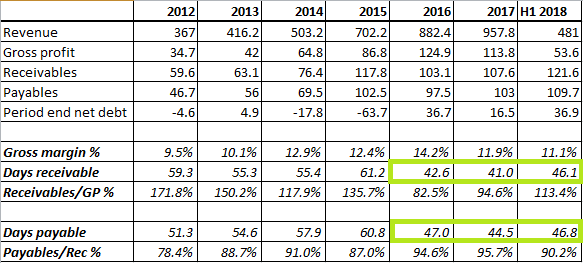
The only thing that strikes me about this is that the company seems to have suddenly started receiving payment for its invoices much more quickly from 2016 onwards. Likewise, it also started paying its bills more quickly from 2016.
One possibility is that this might be linked to the acquisition of A4e in 2015. This business handled welfare to work contracts and similar public sector work all over the UK. Priced at £34.5m, this was a bigger acquisition than usual and became a major part of the PeoplePlus business. I don’t know for sure, but I’d imagine that payment terms might be different to those received from the big corporate clients of the group’s Recruitment division.
From what I can see, these figures don’t highlight any particularly disturbing patterns. What else can we check?
Shall I compare thee to a rival firm?
The only other quick and dirty check I could think of was to compare Staffline with some other listed recruitment firms.
I should say that this is not necessarily a reliable process, because they each tend to have slightly different business models. Once again, I think there’s a particular risk that Staffline’s PeoplePlus training division could distort the picture.
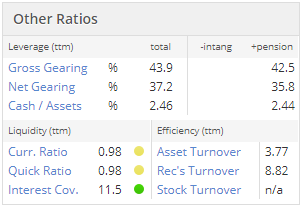
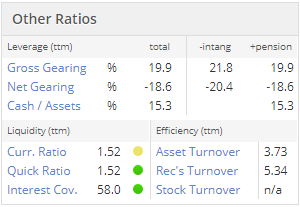
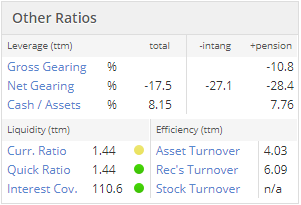
However, a quick comparison of Staffline with some other UK recruiters does throw up some interesting contrasts.
Staffline
Robert Walters
Hays
Pagegroup
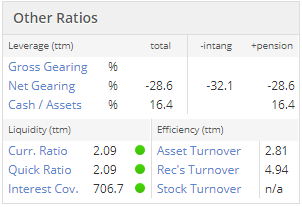
Three things stand out to me:
- Staffline is the only company with net debt, rather than net cash.
- Staffline’s current ratio of 0.98 is barely adequate and is much lower than all the other firms.
- All the other recruiters have a lower level of receivables turnover than Staffline. This is the inverse of days receivable -- i.e. a lower turnover means it takes them longer to get paid. The Stockopedia data suggest that on average, Hays, Robert Walters and Pagegroup have to wait almost 67 days for their bills to be paid, compared to 41 at Staffline.
Should I have spotted something?
Although I stand to be corrected, I don’t think there’s anything obviously wrong here.
Staffline has grown aggressively through acquisitions in recent years, but there’s been no sign of problems. My only reservation is that the firm’s “Burst a Billion” five-year target to hit £1bn of revenue isn’t the kind of thing I like to see. I tend to think that arbitrary revenue growth targets risk incentivizing people to make poor quality decisions.
However, there’s no evidence yet of any wrongdoing. Unfortunately, I think we’ll have to wait until Staffline is able to offer the market an update before we learn anymore.
Next week I hope to find something more positive to write about. But until then, if you have any views or industry knowledge that might shed more light on the situation at Staffline, I’d love to hear from you in the comments below.
Disclaimer
This is not financial advice. Our content is intended to be used and must be used for information and education purposes only. Please read our disclaimer and terms and conditions to understand our obligations.

1 comment
Very grateful to receive this insight as there is precious little elsewhere. Thank you.