SIF Folio: Is momentum failing at Bloomsbury Publishing?

From time to time, I sell a stock because it no longer qualifies for my screen and then -- a few months later -- it’s back in my screen results. This is one of those times. The company is Bloomsbury Publishing, which exited the SIF folio at the start of May.
Bloomsbury is best known as the publisher of the Harry Potter books, but it also publishes a wide range of other fiction and non-fiction.
I don’t have any rule against re-buying stocks and I believe that Bloomsbury could fit within the SIF fund. So today I’ll be taking a fresh look at this stock’s value, quality and momentum credentials.
Bloomsbury Publishing (LON:BMY)
When I sold Bloomsbury in May, the stock failed my screen on two counts:
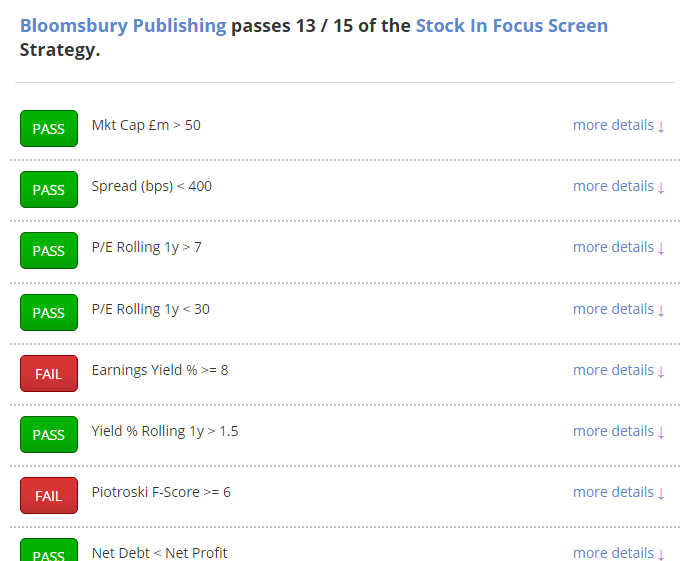
May 2019
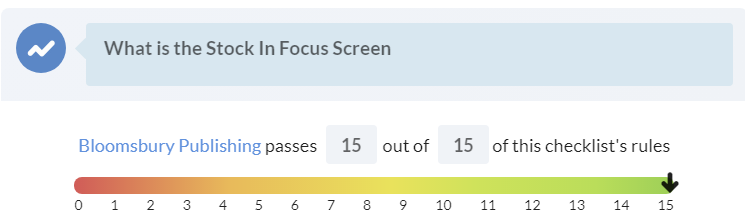
Fast forward to today and the stock delivers a clean sweep:
For investors used to following a more subjective process, my decision to buy and sell stocks on this basis may seem rather arbitrary. I feel that too sometimes, but that’s the point here.
My Stock in Focus (SIF) fantasy fund is run as a rules-based portfolio. I’m only allowed to exert a small amount of subjective judgment on stock picks. My rules are intended to select stocks offering a balanced mix of value, quality and momentum. You can see them here, if you create a copy of my screen for your own use.
I’ve been doing this since April 2016 and so far I’ve stayed ahead of the market:
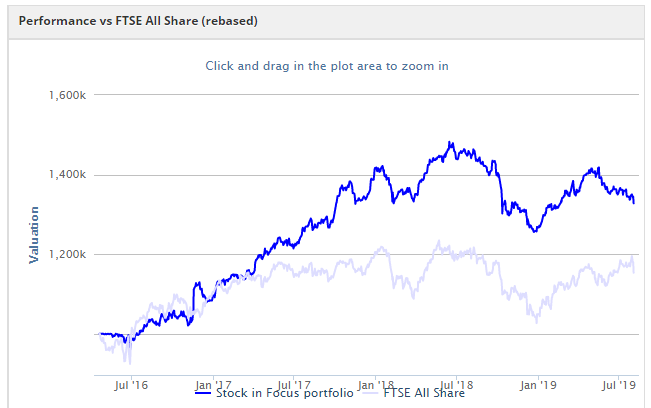
The gap has narrowed recently, but at the time of writing SIF was still ahead of the FTSE All-Share by 18% on a three-year view. I invest a portion of my own real-money portfolio in all of the SIF picks, so I have a strong incentive to make the system work.
Getting back to Bloomsbury, the Harry Potter publisher’s share price has been almost eerily flat in recent months, despite recent results that were ahead of expectations.
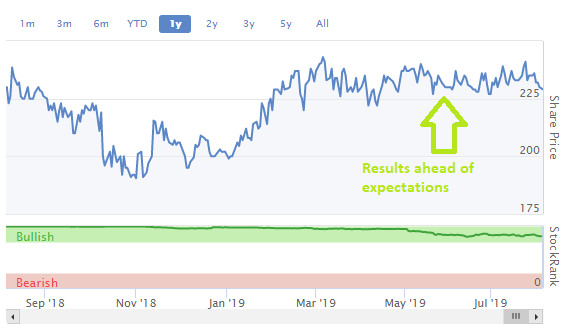
If I had my discretionary investing hat on, I would say this was quite possibly a sign that the shares are fully priced. But I don’t generally allow myself that kind of guesswork, unless I think there are wider problems with a company. That’s not the case here, so let’s drill down to take a more detailed look at Bloomsbury’s QVM factor scores.
Book value
Stockopedia’s algorithms continue to have a favourable impression of Bloomsbury, with a StockRank of 83 and Super Stock status.
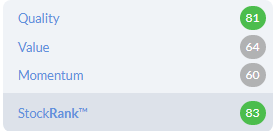
Despite this, the stock’s value score suggests its valuation is fair, rather than cheap:
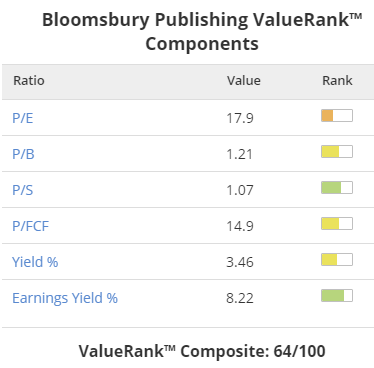
I think it’s worth digging into a few of these numbers to get a more precise view of Bloomsbury’s valuation.
P/E: I would swap the normalised earnings per share figure of 12.9p calculated by Stockopedia’s data provider for the company’s own adjusted figure of 14.97p per share. This reduces the P/E ratio to 15.
Although I’m often wary of adjusted earnings, the only major adjustment here is to exclude the amortisation of acquired intangible assets. I’m comfortable with this as a way of measuring ongoing performance.
P/FCF: Using adjusted earnings to calculate the P/E means that this earnings ratio matches Bloomsbury’s price/free cash flow ratio almost exactly. This tells me that last year’s adjusted earnings were backed 1:1 by free cash flow (excluding acquisitions). This gives me confidence that the adjusted earnings figure gives us a fair view of the cash profitability of the business.
P/B: The price/book ratio of 1.2 looks potentially cheap, but I’m not convinced that it’s very meaningful. Bloomsbury’s balance sheet is packed with nearly £67m of goodwill and intangibles, much of which has come from acquisitions:
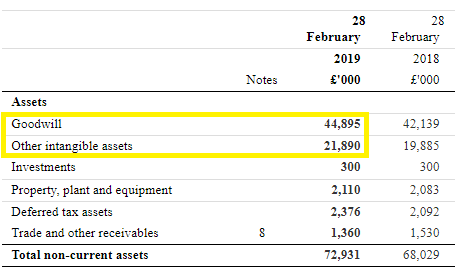
The £22m of intangible assets relate mainly to intellectual property such as publishing rights and subscriber relationships. We can assume that these have real value.
Goodwill of c.£45m relates to past acquisitions. It’s very hard to say how much value a buyer of Bloomsbury’s business would assign to this. As such, I think it’s prudent to exclude it from book value. On that basis, I estimate a book value of 131p per share. So the current share price of c.225p is not strongly supported by net asset value, in my view.
However, I would note the balance sheet is very strong here, with £27.6m of net cash and a current ratio of two.
Earnings yield: The earnings yield compares operating profit (EBIT) with enterprise value (market cap plus net debt). This is effectively the profit margin available to the owner of a business, before tax or finance charges.
Bloomsbury’s earnings yield of 8.2% is above my minimum of 8%, but only just. However, in my view, it's an attractive figure which suggests the business is quite reasonably valued.
Understated quality?
Bloomsbury’s highest factor score by some margin is its QualityRank of 81. Here’s how this is made up:
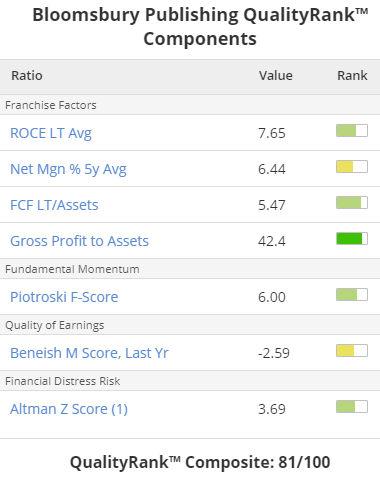
If anything, I think this score could quite easily be higher. The QualityRank is weighted quite heavily towards the Piotroski F-Score.
Bloomsbury’s score of 6/9 is the minimum allowed by my screen. But by drilling down into the F-Score itself, I can see that the failures are only marginal - almost rounding errors. For example:
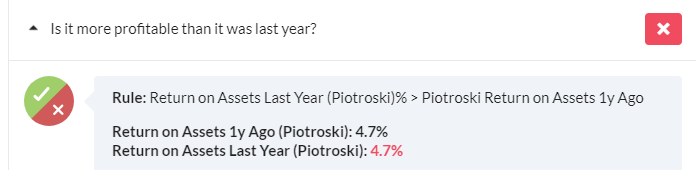
Looking at the remainder of Bloomsbury’s quality factors, I would say they suggest average profitability but good cash generation from the firm’s assets.
Overall, I’m comfortable with the combination of quality and value we’ve seen here. My only concern is over the stock’s momentum, as I will now explain.
Momentum may be failing
Bloomsbury’s latest trading update indicated that results for the year ending 28 February 2020 should be in line with expectations, despite a 3% fall in H1 revenue.
However, the rather excellent broker trend graph on the new Stockopedia site shows us that analysts have turned more cautious on the outlook for FY21:
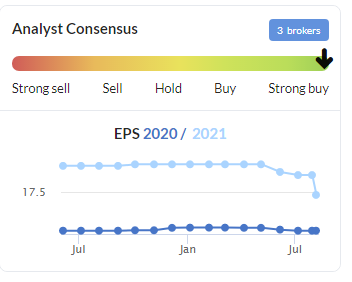
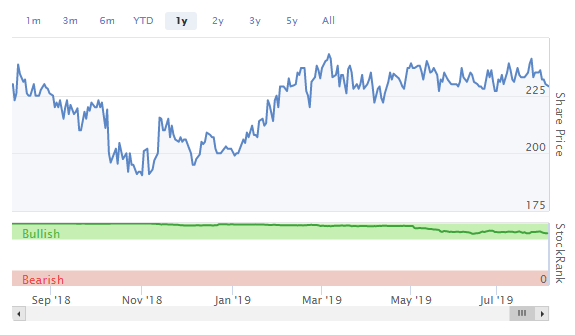
I don’t know what triggered this downgrade, but I note too that Bloomsbury’s StockRank has been in steady decline as well. Over the last year, the StockRank has fallen 99 to 83.
This is easily visible on the new StockReport, where the StockRank trend is shown under the price chart:
Given this backdrop, it’s not surprising to see that the MomentumRank score is okay, but not great:
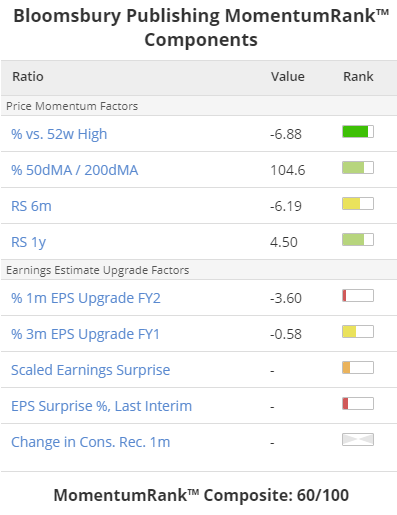
The stock’s technical price momentum appears to remain fairly strong. The shares are trading close to their 52-week high and the 50-day moving average is comfortably ahead of the 200-day average.
However, I’ve put together a different chart view using exponential moving averages, which give more weight to recent data points. I’ve also added a momentum indicator.
As you can see, the chart shows the share price dropping through the 200-day moving average and suffering from declining momentum:
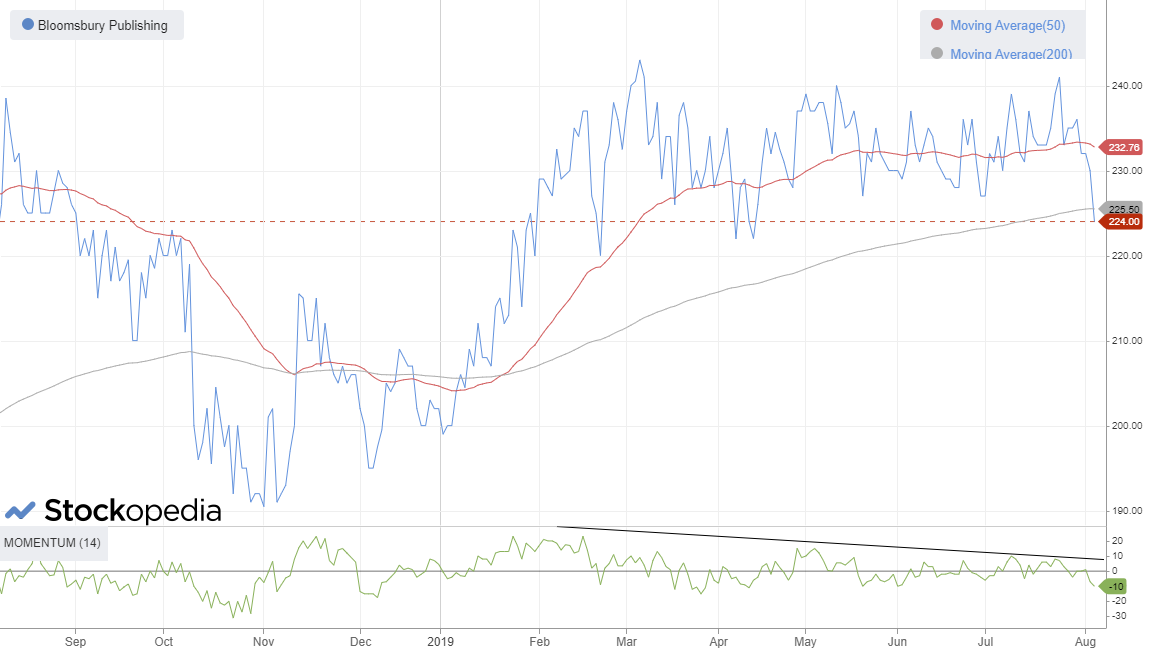
I’m not a technical analyst and I don’t generally trade on charts. But this picture does seem to suggest that the stock could be heading for a period of weakness.
I’m also concerned about the recent cuts to consensus forecasts for FY21.
On the other hand, earnings are still expected to rise this year and next year. The stock’s rolling forecast P/E of 13.7 seems reasonable to me, and the yield of 3.7% provides further appeal.
My decision
In short, my view on Bloomsbury would be that it’s a good business with a high-quality balance sheet. As a long-term hold, I’d have no qualms. But as a shorter-term position I’m struggling to get comfortable with the idea of buying the stock.
However, I think this is one situation where I must bite the bullet and move anyway. Bloomsbury stock passes all of my screening rules. I have no tangible reason to refuse it. So I will add the shares to the SIF folio this week and to my own holdings, after this piece has been published.
I’d love to hear what you think about this company - and my (perhaps) over-rigid approach. Please feel free to share in the comments!
Disclaimer
This is not financial advice. Our content is intended to be used and must be used for information and education purposes only. Please read our disclaimer and terms and conditions to understand our obligations.

2 comments
I think I would wait for a breakout 240 before buying.
Roland said "P/B: The price/book ratio of 1.2 looks potentially cheap, but I’m not convinced that it’s very meaningful."
If they sold more books they could get that P/B ratio right down.