SIF Folio: Lessons from my biggest losers

There are no new stocks I can buy from my SIF screen this week. So as we’re coming up to the SIF portfolio’s third birthday, I thought it would be a good time to take a look at what’s gone wrong over the last three years.
In my experience, the importance of avoiding big losses is often overlooked and misunderstood by many private investors. I suspect this is partly rooted in the psychology of loss aversion and anchoring. Both are traits that make us want to hold on to stocks until they return to the price we paid for them.
Another reason why investors underestimate the damage caused by losses may be that some overlook the maths involved. A 50% loss requires a 100% gain to return to break even. Is such a stunning turnaround likely? Very often, the answer is no.
Steering clear of losers
One of my aims when I designed the rules for the SIF folio was to avoid stocks that would deliver big losses.
I took a two-pronged approach to try and protect my fund from disastrous investments:
Diversification and portfolio sizing: In an evenly-weighted portfolio of 20 stocks, a 50% loss on one stock will only result in a 2.5% fall in the value of the portfolio.
Avoid outliers: My rules specify a maximum P/E ratio of 30 and a minimum of 5. I won’t buy stocks with a market cap of under £50m or a spread of more than 4%. I also look for businesses with rising earnings, a dividend and stable or rising sales.
This approach is designed to help me to avoid value traps, momentum traps, and companies that need detailed research to be understood. Although it also means that I’ll miss out on some stunning successes, I think this is a good compromise for a portfolio where stocks are selected by screening.
The SIF approach won’t work for everyone, but it’s in line with the Stockopedia philosophy of letting proven investment factors work in your favour.
My rules have performed tolerably well for me so far:
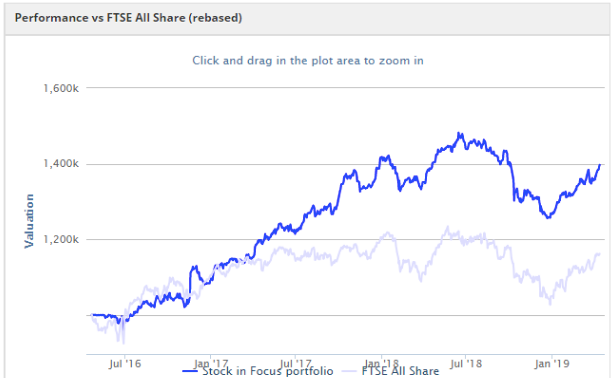
SIF performance vs FTSE All-Share index April 2016 - April 2019
What’s gone wrong?
Over the last three years, the SIF folio has held seven stocks which have been sold for a net loss of 20% or more. In addition to this, there are two stocks currently in the portfolio which have a running loss of more than 20%.
Here are the members of this rogue’s gallery:
Plus500 (LON:PLUS) - Loss: -52%. Dec 2016
Shares in this Israeli CFD/spread betting firm crashed when new regulatory limits on leverage for retail traders were announced in December 2016. I concluded that the business would fundamentally change and sold the shares without waiting for my minimum holding period to complete.
This reactive decision was a mistake. The restrictions didn’t take force until August 2018. In the meantime, the shares bounced back rapidly and went on to triple in value.
Keller Group (LON:KLR) - Loss: 37%, Oct 2018
Geotechnical engineering (groundworks) specialist Keller put out a profit warning just two weeks before the shares were due to be sold.
Profit warnings happen. But was I right to buy the stock? Although the shares passed my screening tests, the firm’s history of low margins, low return on capital, and rising debt suggests that the risks were foreseeable.
I should probably have taken problems at the loss-making Asia-Pacific division more seriously. This division has a history of poor trading. Management assurances that it would return to profit in 2018 turned out to be too optimistic.
Costain Group (LON:COST) - Loss: 27%, Jan 2019
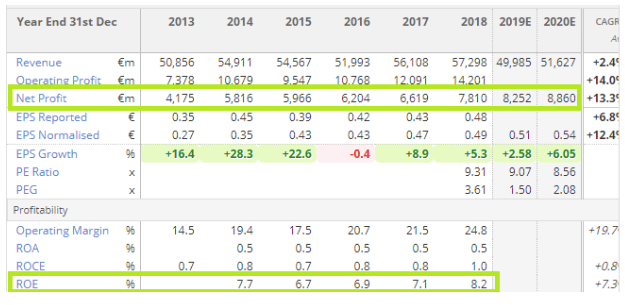
I don’t feel so bad about Costain. This group has a focus on complex programme management and often takes a leading role in major construction projects. Its capital-light business model means that despite slim margins, return on capital employed has averaged 18% since 2013:

The shares started to fall in autumn 2018, despite a solid first-half performance and a stable order book. However, reports that lenders were scaling back their exposure to the sector fuelled fears of a cyclical downturn. Costain stock started to fall (despite maintaining a healthy average month-end net cash balance of £90m).
With hindsight, the shares were probably quite fully priced when I added them to the folio in March 2018.
easyJet (LON:EZJ) - Loss: -25%, Feb 2019
Like Costain, I think easyJet is a good business bought at the wrong time. When I added the shares to the folio in May 2018, they were trading at near-record highs. easyJet seemed to be defying cyclical risks and emerging as a winner amid problems elsewhere.
However, the combined risks of Brexit and growing evidence of slowing growth triggered sustained earnings downgrades from September onwards.
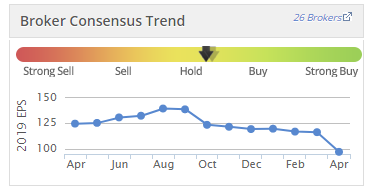
The shares started to fall and haven’t yet recovered.
Go-Ahead Group (LON:GOG) - Loss: -22%, October 2016
Bus and train operator faced sector-wide challenges in 2016, and Go-Ahead faced issues of its own, such as Southern Rail.
This is an example of when my screen picked up a stock just as its profits and share price were peaking. I guess this is one downside of relying too heavily on momentum - you sometimes arrive just as the party is ending.
Lesson learned? Regulatory risk, I suppose. UK rail franchises have caused a lot of grief for not much profit. Most of the UK’s listed transport companies now seem to be focusing on buses, which offer fatter margins and less hassle.
Banco Santander (LON:BNC) - Loss: -21%, Nov 2018
In all honesty, I don’t know how to explain the poor performance of this banking stock. There are lots of moving parts (and risks) in this international banking empire, but the Stocko stats suggest performance has been better than the share price suggests.
Perhaps now would be a better time to buy?
RusHydro (LON:HYDR) - Loss: -20%, October 2017
I bought two London-listed Russian stocks as an experiment. One (TCS Holdings) performed very well. The other, utility group RusHydro, did not.
I no longer buy Russian stocks as I don’t like or fully understand the dynamics of the Russian stock market.
Staffline (LON:STAF) - Running loss of -30%, still holding
Recruitment group Staffline has spooked the market twice in the last four months. I covered the story here in more detail.
So far, the problems appear to have been overstated, but investor confidence has yet to recover.
Bilby (LON:BILB) - Running loss of 75%, still holding
This AIM-listed building services group has been by far my worst pick yet. I reviewed the situation recently - you can read my findings here.
I don’t know how this situation will pan out under the group’s new CEO. But perhaps I should have been deterred by the relatively recent flotation, acquisitive business model and the obvious risk that a big contract might go bad (as seems to have happened).
Conclusions
In my view, two characteristics stand out from this catalogue of losses:
The risk of buying cyclical stocks near their peak. Valuation ratios often look attractive in this situation, but that’s because profits are at near-record highs. Screening for this is difficult.
The risks of investing in construction or ‘lumpy contract’ businesses with thin profit margins and potentially large liabilities.
What should I do? It’s notable that three out of the nine businesses listed above operate in the construction sector.
One option to avoid future problems might be to rule out this sector.
Another possibility would be to rule out companies with profit margins below a certain level.
I don’t want to throw the baby out with the bathwater. But I am planning to make some changes to try and avoid this type of problem in the future.
I’ll explain my plans next week, when the SIF Folio will get its third annual review and I’ll publish details of any changes to my rules for the year ahead.
Disclosure: Roland owns shares of Staffline, Go-Ahead Group and Bilby.
Disclaimer
This is not financial advice. Our content is intended to be used and must be used for information and education purposes only. Please read our disclaimer and terms and conditions to understand our obligations.

19 comments
Hi Roland (and to all the others who add to this great thread)
I think BH1991 (post 15) makes an extremely coherent point with his comparison to the insurance industry.
One excellent rule I learned from reading Mark Minervini was his uncompromising stance to managing risk, first and foremost. Above and beyond picking stocks, using metrics to identify good stocks or picking when to enter a trade.
His rule was so incredibly simple I could not believe I had not thought of it myself.
Quite simply, if a trade/investment is going against you, then slice by 50%. If it continues to slide, exit 100%. A refinement to this, if the trade is clearly going against you on first falling (or the market signals are going red), exit 100%.
Now, I realise this is biased towards a trading mind-set rather than an investing mind-set which favours looking for good metrics within a stock. But, this rule has been a fantastic bonus to my investing behaviours (and peace of mind).
I also realise this goes against your hands-off approach but you could adopt a variant, whereby at buy time you note at what negative percentage you might slice by 50% (say -10 to -15% from purchase price). Then exit 100% at say -20 to 25%. If first drop is below -15% then exit 100% at first hit.
I appreciate this might not align with your approach, but what it does offer in line with your approach is that it allows you to stay in a holding after an initial falling, to then see out that holding to your full nine months. With a benefit that the stock might rise again (as your 6 month holding vs 9 months holding analysis suggested to you happens, when you did that quite a few months ago). If the stock does not rise but does not hit the exit 100% level, then although you have taken a loss initially it is lower (in absolute terms) than if you had run the full holding for your nine months assessment.
Many thanks for your continual write ups I read them avidly and always learn from them and the others who are attracted to contribute to your threads.
Regards
Howard
Interesting article as always Roland!
In my opinion, if you want to avoid big losses, the simplest and most effective way of doing this is to apply a stop loss. In your case, that’s 20%. I don’t disagree with tweaking your risk selection criteria to avoid low probability investments, but losses are an inherent part of investing and need to be actively managed.
I work in the motor insurance industry and can draw similarities between insurance portfolio management and stock portfolio management. Insurance companies design risk selection criteria, which aim to mitigate the frequency and severity of losses (claims). Although insurance companies will tweak their criteria if they see an emerging trend (e.g. theft of keyless entry vehicles using relay amplifiers), they still can’t avoid the inevitable large loss.
You see, insurance companies recognise that a large loss can occur at any time, with any vehicle/driver they insure. Everybody has the capacity to cause serious injury whilst driving. It doesn’t matter if you have the most sophisticated insurance pricing model, you will incur losses. It’s simply the cost of doing business.
The stock market is no different. Every stock has the potential to drop 20% or more, regardless of its industry group, operating margin or P/E ratio. Therefore, the investor needs to recognise this and apply prudent risk management when such events occur.
My worry here is that you will apply more filters to your stock screen, move into different industry groups or stocks, incur the inevitable 20%+ losses and start the whole process again. This is the trap most investors fall into. They believe applying more filters to your screen will solve the problem when in fact, its risk management.
Your current stock screen contains all the factors which increase the probability of finding winning investments (quality, growth, value & momentum). However, even when all the stars align, you will still have losing investments. Unlike insurers, you can cap those losses at whatever level you choose, in order to stay profitable and that's the great thing about the stock market!.
Would you consider applying a stop loss? Interested to hear your thoughts.
Re. stop losses and risk management.
Thanks to BH1991 & others who've suggested a stop loss and commented on risk management.
I completely agree that some losses are inevitable - as with insurance they are a fact of life. BH1991 also makes a good point about 'overscreening' - a screen isn't a perfect filter and relies on volume and diversification to produce a good result in aggregate. In that respect, I guess a stock screen is a good analogy for an insurance pricing model.
Stop losses are a popular form of risk management and they do make good sense for a trading strategy with fixed/limited holding periods. I do have a couple of issues with them, though.
1) Stop losses are arbitrary. The sell-off we saw at the end of last year saw a number of SIF stocks fall by 20%. They've since recovered and are at breakeven or in positive territory (e.g. £BVS). As a rule of thumb, I think 20% is a 'normal' level of volatility for many stocks -- they can fall (or climb) that far based on sentiment alone, without any fundamental cause. As such, selling automatically at -20% doesn't sit comfortably with me.
2) The definitive version of the SIF Folio is my Stockopedia Fantasy Fund (https://www.stockopedia.com/fantasy-funds/stock-in-focus-portfolio-6449/). At the moment, Fantasy Funds don't offer stop loss functionality.
To approximate this function, I'd have to set up a Stock Alert (https://www.stockopedia.com/alert/) to warn me when a price dropped 20%. I could then sell manually. This introduces timing issues and subjective decisions. For example, by the time I logged on and decided to sell, the share price might have recovered to trade above my stop loss threshold. What should I do then? There's no hard-and-fast rule, in my view.
3) Profit warnings. I have a lot more sympathy with the idea of selling automatically after a profit warning. In my experience (supported by the data) shares tend to underperform for some time after a profit warning.
The old adage that "profit warnings come in threes" is rooted in behavioural psychology. Company managers - like most of us - tend to be in denial and only reluctantly accept the full scale of the problems facing them. The painful, drawn out decline of Debenhams (LON:DEB) is a classic example.
To sum up, I am considering introducing a new rule to sell after a profit warning. Although this would involve some manual administration, it wouldn't require me to make decisions based on share price action. The fact of the warning itself would be the trigger to sell.
I'll have more on this next week. In the meantime, thanks to all for your comments and support. For all those on UK time, I hope you're able to enjoy the sunny Easter weekend.
Cheers,
Roland
I also got caught on Bilby (LON:BILB) by not selling out at the first warning (which I usually do), being lulled into a false sense of security by the institutional buying of the founder shares (another red flag). So, like you, here I am trying to asses if this is the bottom on a stock with the potential to grow.
The elephant in the room - which we should not have had to guess at - is just how large and damaging is the MoD litigation? I am decided to hold not least because of the recent installation of David Bullen as the new CEO. We shareholders may not be getting any insight into the litigation, but I assume that Bullen will have dug deep into this before deciding to take on the job, and presumably concluding that the problems are not fatal. But I am also all too aware that a "new CEO kitchen-sinking" may be on the cards here. Our pain may not be over yet and it has to be asked - do I want any more?
I think you have identified the right lessons. With a systematic high level approach like the SIF portfolio I would avoid construction / large contract businesses entirely. While the valuation multiples often look superfically cheap, they actually tend to be wildly overvalued given the execution and competition risks and cyclicality. The base rate return for investing in this sort of business must be terrible I imagine (like small-cap resource stocks). Unless you have a specific insight from more detailed research it makes sense to avoid...
Could you amend your rules so that you would exit a stock if a profit/trading warning occurred? That way, if you held a stock that lost 20% of its value but the rest of the market, or at least sector, fell a similar amount then you would still hold but if there was a company specific trading warning then you would sell? That would certainly have stemmed losses in Bilby (LON:BILB) - I lost about 35% investing in this catastrophe, but at least I sold at around 71p.
I can't make any informed view on international stocks... but do the same rules applied to a UK SIF approach also work for international markets without tweaking?
I agree with other suggestions to avoid companies with a low margin... though I can't decide what that should be.
Re. selling after a profit warning. I've given this a lot of thought and I am tempted by this solution.
There's plenty of evidence that profit warnings tend to lead to a prolonged period of poor performance. Stockopedia's excellent "Anatomy of a Profit Warning" guide gives the data on this and is a good read.
My main problem in the context of this portfolio is that selling after a profit warning would require unscheduled manual intervention. This goes against the principles of the portfolio.
I'm not sure how to square this circle -- but it is something I've thought about a lot.
Roland
Could you perhaps run an automatic trailing stoploss at (say) 18%? That would catch significant profit warnings.
I would not select companies that have an operating margin under 5%, that would cut out some of the losers. Also I would avoid Israeli based companies, too many seem to go wrong. Go-Ahead (LON:GOG) was a timing issue, if you had held on you would be in profit now. I'm not keen on this holding for a certain time, think you could be more flexible on selling if things have changed.
@herbie47
One of the measures I'm thinking about is implementing a minimum operating margin rule.
My only slight reservation is that some good businesses generate attractive returns on capital and free cash flow even though their margins are low. But excluding this small minority might be a price worth paying.
Re. Go-Ahead (LON:GOG) -- agree. I think it's a decent business and I hold the shares in my income portfolio.
Roland
Roland deserves a 5 star recommendation for :
1. publicly declaring his losses
2 facing up to his mistakes honestly and objectively .
Few stock commentators have the internal resilience to do either.
I think he is a bit too harsh on himself. Once a share has collapsed it is all too easy to job backwards and say it fell because of X when many other influences both good and bad muddied the company's situation at the time the
purchase was made.
I think that successful investment means taking a measure of risk and inevitably and occasionally the risk results in a loss. A portfolio that only has gains is arguably not taking enough risk.
As an experienced Bank Manager once told me: a Bank Manager who has no bad debts is probably not lending enough (or is very good at covering up).
Further all companies including the best have occasional dark periods (check Warren Buffett's last annual results) .The question devolves to the long-term fundamentals for the industry and the product/service and in sum the willingness to withstand the showers and wait for the inevitable sun (apologies for the metaphor).
Thanks for your kind words!
Re. losses, I do expect losses and am happy to take them. But as a general rule I'd hope that good selections within my framework for this portfolio would mean that losses greater than about 20% are rare.
So far, big losers have been fairly rare (seven >20% losses out of 61 closed positions). But I'm sure there's still room for improvement. I'd especially like to avoid the next Bilby (LON:BILB)...
Cheers,
Roland
Disclosure: I own shares of Bilby.
Here's food for thought. If we look at the quantiles for P/E we get:
So the choices of 5 and 30 are not balanced. You might consider a slightly higher lower bound of maybe 9 or 10. Although it seems like a small difference it could trim out another 15% or so of "difficult" stocks.
I suspect that most people would prefer to skew their P/E selection towards the low side to avoid overpaying of course. But in terms of performance over the next year, higher P/E tends to perform better.
Hi Nick,
Thanks for your comment. I agree that a P/E of 5 is still unusually low, I can see some argument for increasing this slightly, perhaps to 8.
My value investing instincts make me want to buy cheaper stocks, but as you say sometimes they're cheap for a good reason. Food for thought.
Regards,
Roland
Sorry to appear thick Nick but could you explain what the four columns relate to as I'm currently in the dark.
Many thanks
It's just saying that 5% of stocks have a P/E less than 5.7, 10% have a P/E less than 7.3, 15% have a P/E less than 8.7 and so on up to 95% have a P/E less than 77.4.
Galliford Try (LON:GFRD) another good example of what you preach today Roland
Galliford Try (LON:GFRD)
Within Galliford there is Linden Homes which the company's presentaion for the year ended 30/6/18 stated made an operating profit of £184.4m. Barratt Developments (LON:BDEV) made an operating profit of £862.6m for the same period and currently has a MV of £6.3bn. On this basis Linden Homes should have a MV of £1.3bn - the entire of Galliford Try (LON:GFRD) is valued today at less than £700m . Those numbers can be refined, tweeked, whatever ... but the construction contracting side of £GFRD is being given a negative value by the market and I personally cannot argue with that.
Is construction all bad? No, I don't think you can say that - Morgan Sindall (LON:MGNS) ,for example, seems to be a great company. T Clarke (LON:CTO) (which I hold) is increasing margins by going into specialist areas. Both seem reasonable if not good investments.
Perhaps companies that bid for major government contracts on a risk basis should be avoided?
Phil
Hi Phil,
I agree that there are good companies in the construction sector such as Morgan Sindall (LON:MGNS) and T Clarke (LON:CTO). But I previously thought that Keller (LON:KLR) fell into this category too, thanks to its high-end specialist skills. It probably does, but only on a very long-term view.
I'm coming round to the view that construction firms are possibly not well suited to public markets -- concentrated private ownership by long-term investors who have an insider's understanding of the business may make more sense.
Such investors will be better prepared to collect fat dividends when times are good, and ride out the storm when problems arise.
Re. Galliford Try (LON:GFRD), I agree that the construction business looks like a liability at the moment, but in the interests of balance I suppose there's an argument for suggesting that it may prove to be countercyclical to the housing business. Personally, I'd rather own a really well-run 'pure' housebuilder, even at current levels.
Avoiding low-margin government contractors with risk exposure to major contracts would certainly have saved many investors some heartache (and losses) in recent years - outsourcers come to mind, too. Perhaps the answer is to avoid super-low margin businesses?
Roland