SIF Folio: Money from waste makes Sylvania Platinum a tempting choice

This week I’m looking at one of the top-ranked stocks on Stockopedia. It’s not necessarily a company you’d expect to fit this description. As a small-cap, single-commodity miner operating in South Africa, Sylvania Platinum isn’t without risk.
This very profitable firm currently qualifies for my Stock in Focus screen, which hunts for affordable growth stocks. Sylvania also has a StockRank of 98 and has delivered a very solid financial performance in recent years. In short, it’s the kind of mining stock where I might be prepared to risk my own cash.
Before I get started, let me deal with a couple of potential objections.
What about diversification?
Regular readers will remember that I added mining royalty specialist Anglo Pacific Group to my SIF fantasy fund last week. Adding another mining stock this week might seem unwise in terms of diversification.
Generally, I’d agree. But in this case I think I might actually be improving the balance of the portfolio across sectors. Here’s how SIF looks at the time of writing:
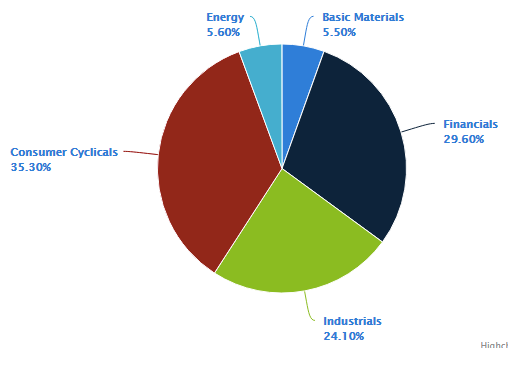
Two things stand out to me.
Firstly, the portfolio’s combined investment in Energy and Basic Materials stocks is less than half the exposure to other sectors.
The second thing you’ll notice is that five of the 10 top-level sectors are missing altogether. The reason for this is that there aren’t currently any qualifying stocks from these (largely defensive) sectors in my screen.
I’ve discussed this situation and my portfolio’s cyclical bias before, here. For now, I’ll just say that I am willing to add more commodity stocks to the portfolio if they pass my tests.
Aren’t small-cap miners usually sucker stocks?
I think it’s fair to say that you have to kiss a few frogs to find your prince in the small-cap mining sector. My approach is to ignore all the companies with no revenue and very few assets (explorers). Instead, I focus on companies with solid production assets and fairly reliable cash flows.
Stockopedia boss Ed Croft commented in his 2018 NAPS article that his rules-led approach “has a good record with mining stocks”. He cited Central Asia Metals, a stock which generated a 30% gain for the NAPS in 2017, plus a more modest profit for SIF during the same period.
I’ve also had some success with small-cap commodity stocks in my personal investing. So I’m comfortable investing in such firms, as long as my exposure isn’t too great.
The story so far
Sylvania Platinum’s main activity is reprocessing tailings from platinum mines. This is the waste ore from which most of the precious metal has already been extracted. Treated correctly, this waste yields profitable quantities of platinum group metals (PGM), such as platinum and palladium.
The company operates in South Africa, which is home to around two-thirds of global platinum production. There doesn’t seem to be any risk of running short of tailings. But the grade of these can vary, meaning that the same tonnage won’t always yield the same amount of PGM.
For example, tonnage processed rose by 6% last year, but the grade of this material was 11% lower. The overall result was that PGM production rose by 0.2%.
Despite this, the firm’s financial performance improved considerably last year. Revenue rose by 24% to $62.8m, while operating profit climbed 23% to $15.5m during the 12 months to 30 June.
This increase in profit was almost entirely due to an increase in the average PGM basket price. The company said that this rose by 21% to $1,135/oz during the 12 months period.
Broadly speaking, this increase masks a fall in the price of platinum and an increase in the price of palladium. It’s not clear to me how these trajectories might change. So let’s focus our attention on Sylvania’s financial qualities instead.
Platinum-grade value?
A ValueRank of 87 suggests that this small-cap could score highly with bargain lovers. Drilling down into the figures seems to confirm this view:
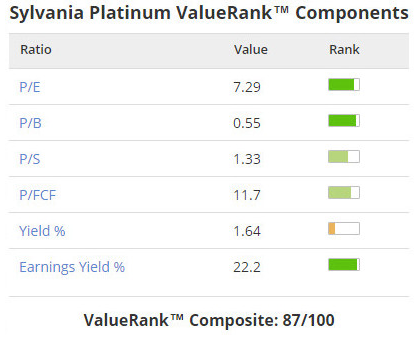
The stock’s trailing P/E of 7.3 and price/free cash flow ratio of 11.7 speak for themselves. Both are cheap without being suspicious, in my view.
An earnings yield of 22.2% is also mighty impressive, reflecting the group’s net cash balance, high margins and cautious valuation. However, I’m a little surprised that this profitable and dividend-paying firm should be trading at a 45% discount to book value.
A closer look provides some reassurance. The balance sheet shows equity of $112m, which gives a book value of about £86m. This puts the stock a more reasonable discount of 27% to book value, rather than the 45% suggested by the Stocko data.
Overall, I’m quite happy with the value picture here.
Downturn masks improving quality
Sylvania’s QualityRank of 69 is the firm’s lowest factor score.
Here’s how the breakdown looks (remember you can view these components by clicking on the rank numbers on a stock’s sector page):
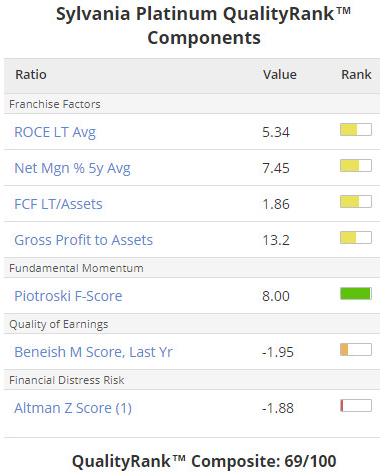
Starting at the top, the stock’s franchise factors are fairly average. This isn’t surprising, as the platinum industry has been through a tough time during the last six years. Sylvania was loss-making in 2014:
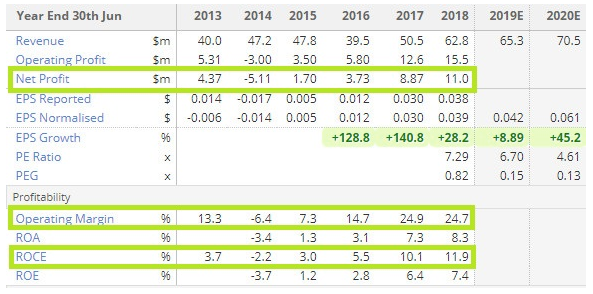
Apart from that one bad year, the group’s operating margin has been pretty respectable. The last two years have been outstanding, with margins of more than 20%.
A look back at the firm’s past results shows that production has risen from 57,587 ounces in 2015 to 71,026 ounces last year. Costs also appear to have been well controlled. I think it’s fair to say that Sylvania Platinum has delivered results that would be the envy of some other small mining firms.
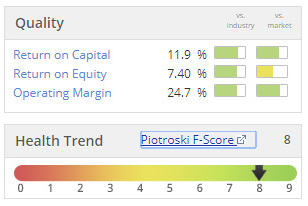
The stock’s Piotroski F-Score of 8/9 emphasises this appeal. Profits, returns and cash generation are all improving.
One final point worth noting is that the group hasn’t issued any new shares since 2009. Overall, this company appears to have a decent track record of protecting and generating shareholder value.
Momentum is bubbling ahead
Mining stocks should generally carry quite low valuation multiples, in my opinion. Shareholders face continual risks from commodity prices, political disruption and operational disasters.
Sylvania Platinum certainly looks cheap. The stock boasts a rolling forecast P/E of 6.2 and a forward yield of 5.8%. We’ve already seen that the stock’s quality metrics are fairly impressive. What I need to check now is whether there’s evidence of improving momentum.
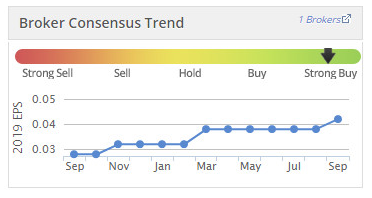
The omens are good. The broker consensus trend has risen steadily over the last year, most recently after the group’s results were published:
Taking a broader view, the stock boasts a MomentumRank of 99:
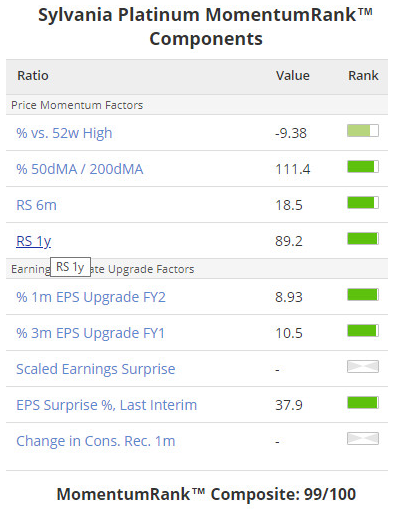
There’s really nothing to dislike here, in my opinion. Sylvania’s share price has outperformed the market by over the last year (relative strength) and the firm’s last results came in ahead of expectations (earnings surprise).
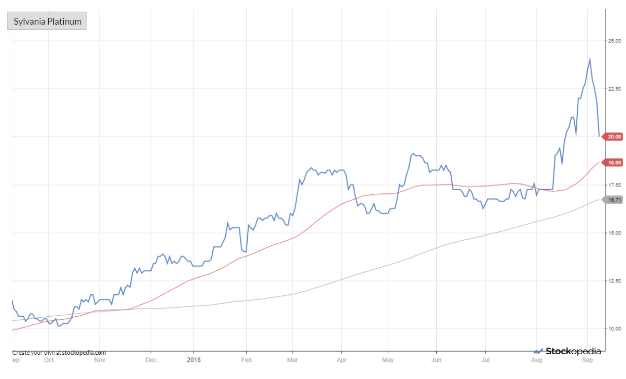
Price momentum also remains strong, with a supportive chart picture:
My decision
The price spike that hit the stock following August’s result statement seems to be unwinding, which is a relief. I’d rather buy at the bottom of that range than the top.
There could be more volatility ahead, as this is a small-cap stock with a speculative rating.
Despite this, the company appears to be to be well-run, attractively valued and positioned to deliver attractive shareholder returns. So Sylvania Platinum will join Anglo Pacific Group in the SIF fantasy fund and in my own portfolio this week.
Disclosure: Roland owns shares of Anglo Pacific Group.
Disclaimer
This is not financial advice. Our content is intended to be used and must be used for information and education purposes only. Please read our disclaimer and terms and conditions to understand our obligations.

9 comments
Hi Roland, I've owned this stock for several years.
I like your article but think that you should mention Sylvania is I) 10x smaller than the larger platinum miners II) because it is a tailings business it has structurally lower costs than its larger competitors III) Its larger competitors like Lonmin can't dig the shiny stuff out of the ground and make a profit.
There's an excellent chart on page 20 of their most recent results which makes this point.
http://www.sylvaniaplatinum.co...
So the reason I bought it is the asymmetric risk reward
I) platinum price stays the same or even falls further, it's profitable and should generate a decent return at the current valuation
II) competitors cut back on capex (or go bust - check out the Lonmin or Impala Platinum share price chart) and platinum price rises THEN we're talking "multi-bagger".
NB It's already been a multi-bagger for me, but actually I think we could just be getting started.
Given the relative performance of PGM metals over the last couple of years - Palladium & Rhodium at all time highs and Platinum pretty much at record lows I assume Sylvania Platinum (LON:SLP) success is down to a focus on the two best performing metals rather than the one it is named after! If these commodities suffers any sort of mean reversion can they switch production back to Platinum to keep their momentum going?
That's incorrect. Sylvania's success is because it's not a miner, it's a tailings business. Which means its has structurally lower costs (cash cost $450 - $550/oz) is its competitive advantage
- see my response
I bought two lots of Sylvania Platinum (LON:SLP) in August, one before the results and one after them. They were flagged up on one of the screens that I created with Momentum > 90 and Quality > 75. Before the results this company passed four screens, and now it is six which cover both Momentum, Quality, and Value, as well as the Neglected Firm screen... although one of the two new screens passed is James Montier's short selling screen. Perhaps the latter is due to the recent correction, which I didn't really understand as the results looked fab to me; maybe short-term investors were escaping with a quick profit...
Thanks for the very detailed SIF analysis, Roland. Although, as you say, Sylvania Platinum (LON:SLP) and Anglo Pacific (LON:APF) are both resource stocks, I don't think there is any commonality in terms of commodities.
There are a lot of things to like about this stock. It was on one of my filters, value with momentum and I bought early Aug just as it started to break out. I think I was up around 12% before it started to correct, so I'm now at par, including dealing costs, so I'm hoping for a price increase, like before. I'm going to stay with it until at least the end of the year and re-evaluate then.
I noticed the strange Altman score, but didn't know why, so thanks JohnEustace for explaining that.
In this sector I'm also interested in one other stock, Kaz. I got stopped out, but will re-enter when I think the share price has stabilised after the recent development/prospect purchase that sent it tumbling (but it is also profitable and cash generative).
Isn't this Roland's portfolio?
Why does Stocko give Sylvania a distress z-score ?
The Altman Z score looks for Market Value of Equity/Book Value of Total Liabilities >1.439
For Sylvania the value is -4.88, hence the distress label.
BUT the Sylvania liabilities are negative due to a large minority holding being included so I think this is an error in the Stocko programming. The formula used needs to be changed to correctly deal with negative liabilities.
One for the programmers if I'm right?
Thanks,John.