SIF Folio: Secure Trust Bank may deserve a higher rating

It’s been a while since I’ve owned a banking stock in SIF. But I feel that there are some attractive valuations in this sector at the moment, so I’m happy to be able to have a look at a lesser-known banking stock this week.
Secure Trust Bank (LON:STB) is a recent addition to the results of my buying screen. This £220m West Midlands-based bank is not a company that I’ve ever owned or researched in detail, but my initial impressions are favourable.
Secure Trust uses a traditional savings and loan banking model. Savings are collected from retail customers and loaned to retail and business clients through a mix of asset-backed, property and vehicle loans. The bank has 1.5m customers, £2bn in customer deposits and £2.4bn in loans.
Until 2016, Secure Trust was controlled by AIM-listed private bank Arbuthnot Banking. However, Arbuthnot sold a 33% stake in STB in 2016, ceding control of the business. Arbuthnot has continued to sell down its stake since that time and now controls just 4.4% of STB stock.
Why I’m interested
I’m looking at Secure Trust Bank for the SIF folio because it passes all my screening tests, and does not duplicate any of the portfolio’s existing stocks. But I’m glad to have the opportunity to do this, because I believe that last year’s crash has left some of the UK’s smaller listed banks trading at attractive levels.
Recent years have seen specialised lending banks such as Paragon Banking, OneSavings Bank, Close Brothers (disclosure: I hold) and Secure Trust generating much higher returns on equity than the big FTSE 100 banks.
In this case, the Stockopedia data indicate that Secure Trust has generated an average return on equity of 9.2% since 2015, including 2020.

In contrast, Lloyds has averaged just 5.2%. Barclays has achieved an average RoE of just 2.4%, despite (because of?) its legion of highly-paid investment bankers.
I suspect the smaller banks’ lack of PPI liabilities account for some of this differential. But I think that another reason for their outperformance is that these more specialised banks can lend money more profitably than their mainstream rivals.
We can get a feel for this by comparing the banks’ net interest margins. This banking metric compares the interest rates on funding (e.g. deposits) with interest income from lending.
Lloyds is one of the most profitable FTSE 100 banks, but its net interest margin was 2.5% in 2020 and 2.9% in 2019. In contrast, Secure Trust’s net interest margin was 6.3% in 2020 and 6.5% in 2019.
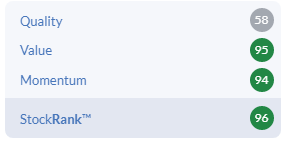
Stockopedia’s algorithms like Secure Trust Bank too, awarding this stock the Super Stock style rating and a StockRank of 96. I reckon this business deserves a closer look.
Value: attractive
Secure Trust Bank’s share price has doubled from the lows seen last summer, but remains well below pre-pandemic levels:
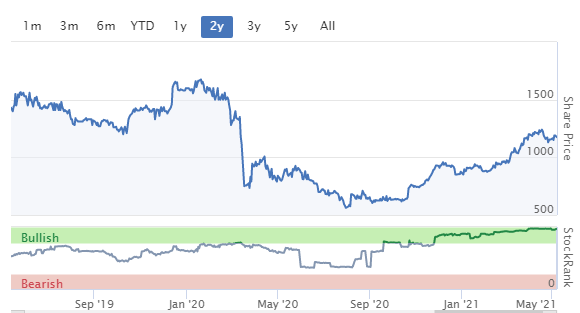
I think this could provide an attractive entry point. A ValueRank of 95 seems to support this view.
According to Stockopedia stats, Secure Trust shares trade at around 0.8 times book value and 13.7 times trailing earnings. The dividend yield with respect to last year is 3.7%.
These metrics seem fairly attractive to me, given the increase in bad debts and disruption to new lending seen last year.
Secure Trust's balance sheet also appears to be healthy, with a Common Equity Tier 1 ratio of 14.2%. This measure is well ahead of regulatory requirements and in line with levels reported by the big FTSE 100 banks.
Quality: robust
Secure Trust's profitability metrics fell sharply last year. This probably contributes to the stock's QualityRank of 58, which is its lowest factor score by some margin.
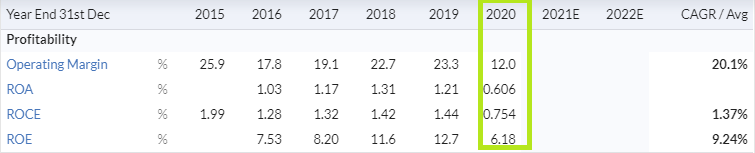
However, I'm not too concerned about this slump. Early indications seem to suggest that performance will move back towards historic levels over the next 12-18 months.
Indeed, medium-term guidance from management is for a return on average equity of 14%-16%. If the bank can achieve this target, then I’d expect the shares to trade on a higher multiple of book value than we’re seeing at the moment.
Secure Trust Bank's profitability suffered last year, but the bank's fundamental health seems good to me. I'm comfortable with the situation, assuming that the outlook remains positive.
Momentum: strong, but masked by illiquidity?
Secure Trust Bank currently qualifies for Stockopedia's Value Momentum screen. This looks for reasonably-valued stocks with an improving outlook.
STB’s MomentumRank of 94 is certainly strong. To understand why,I'll break this score down into its two core components.
Price momentum: The technical momentum indicators for Secure Trust are fairly positive, although there is one red mark that deserves comment.
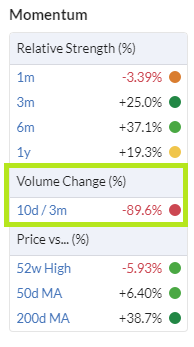
The 10d/3m volume indicator suggests that trading volumes over the last 10 days have been significantly below three-month average volumes. Below-average volumes typically suggest declining interest, but I'm not sure how relevant this is here.
Secure Trust appears to be relatively illiquid, with Stocko data showing a spread of 3.9% and less than £500k of stock trading each day on average over the last three months.
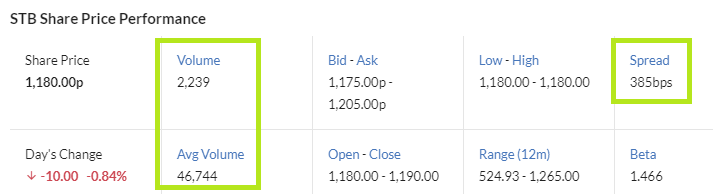
Given the potential illiquidity of this stock, I’m not too concerned by short-term volume fluctuations.
Earnings estimates: I’m more interested in the earnings outlook for the share. The latest consensus estimates suggest that Secure Trust’s earnings are expected to rise by 50% to 130p per share in 2021.
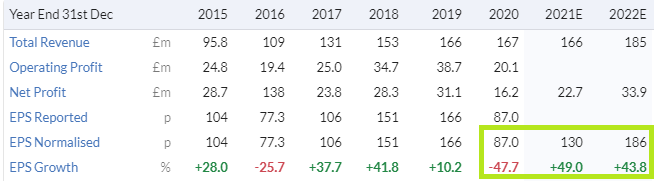
This looks encouraging, although I think it’s worth noting that the broker trend show us that the bank's profits are still expected to be significantly lower this year than they would have been without the pandemic:
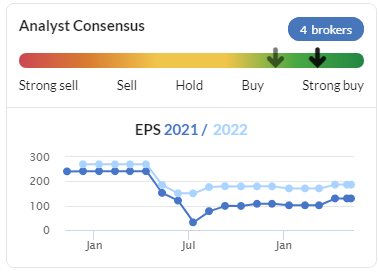
Analysts do not expect the bank's earnings to return to 2019 levels until 2022. However, given the impact of the pandemic during the first four months of 2021, I don't think this is too alarming.
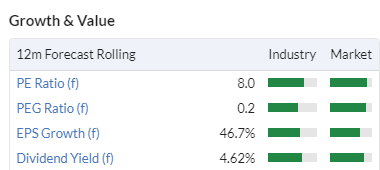
Indeed, I think the shares look attractively valued if the bank can hit current consensus forecasts:
My decision: I’m buying
Until the last year or so, I'd never paid much attention to small- and mid-cap UK banks. I'm starting to think this might have been a mistake. The London market has several smaller banks with long trading histories and (consistent) superior profitability.
The main risk I can see for Secure Trust Bank and others is that consensus earnings estimates are closely-linked to the current rosy outlook for the economy. If this turns out to be too optimistic, which I think is possible, then earnings could fall below expectations for a more extended period of time.
That would be a disappointment, but my impression is that Secure Trust’s balance sheet is sufficiently robust to handle most likely scenarios.
In any case, the stock passes all of my screening tests and does not overlap too heavily with any of SIF’s other holdings. On that basis, I’ve decided to add Secure Trust Bank shares to the SIF folio and my own holdings this week.
As usual, I’ll make the trades after this article has been published.
Disclaimer
This is not financial advice. Our content is intended to be used and must be used for information and education purposes only. Please read our disclaimer and terms and conditions to understand our obligations.

9 comments
Interestingly they just released a trading statement at 4.15pm. All seems to look OK at first glance with steady pick up in new lending.
Looking at their website, I see that the AGM was 10am today.
Hi Roland.
Thanks for this - always a good read. I don’t know Secure Trust Bank (LON:STB) , but as a general comment I’d observe that the lending spread charged by the banks is the price of credit to their customers. It has many components, one of which is an assessment of the risk of delinquency and default by the borrower. In a competitive lending market, the fact that their margin is 2 to 3x that of Lloyds suggests either that they’ve exploited a customer niche that the others can’t access or that they are happy to take on corporate customers at the riskier end of the credit spectrum. Fine when the economy is on a roll and the impact of Covid dislocation is being postponed by government grants and easy monetary policy but potentially more problematic in a downturn.
The likes of HBOS and Bradford & Bingley seemed to be shooting the lights out in the early noughties with the huge growth in their corporate lending book ..... until the music stopped and they went “bang!”.
Gus.
I think it is more the former - niche areas of the lending market can charge higher rate but not necessarily with higher risk. Secure Trust bank have always been pretty conservative lenders and theirs impairment rates actually look a lot better than the big banks.
Hi Gus,
That's a fair point - a wider net interest margin does indicate (in theory at least) a higher degree of lending risk. However, in this case I think that the focus on more profitable niche areas explains much of the extra margin.
Looked at a different way, I suspect that if we stripped out the huge prime mortgage book from Lloyds Banking (LON:LLOY) accounts and looked at its motor finance and corporate loan books, we'd find a higher net interest margin on those riskier/more specialist products.
For example, £MOTOR offers Black Horse (Lloyds) finance to customers from 7.9% APR.
I think competitive mainstream mortgage lending must be the main factor holding back the big banks' interest margins. After all, when fixed mortgage rates for prime borrowers are well under 2%, how much margin can be left? Not a lot, I suspect, even with near-zero funding costs.
In my view, the mid single digit NIM generated from SME lending by smaller banks such as Secure Trust Bank (LON:STB) reflects their specialisation and does not solely imply excessive credit risk. That said, I think that Secure Trust's market includes some near-prime lending. Some of this could become sub-prime in a recession...
Certainly, I agree that in a downside scenario, credit performance could get much worse.
Even so, I think the comparison with HBOS and Bradford & Bingley in 2008 is a little harsh. As far as any of us can tell, banks do have much stronger balance sheets and lower leverage than 12 years ago. They should be able to absorb losses more easily. Time will tell, I guess.
Roland
There are some good points in here, but remember that most bank failures are caused by liquidity issues.
Banks specialise in maturity transformation i.e. they borrow short and lend long. This in itself creates a natural margin as short term rates are lower than long term ones - even in today's weird interest rate world. If a bank runs into trouble, depositors can get their money out far quicker than a bank can call its loans.
A word of caution that I would sound here is that STB seems to have a high level of deposit funding. If there is a downturn post the phasing out of Covid reliefs then its lending book could suffer, potentially undermining its business model.
Hi Roland, v interesting. Any idea why it doesn't have a Bankruptcy Risk Z-score?
Isnt it the case that banks cant be allowed to go bankrupt ?
I think the Stockopedia analytics don't work particularly well for Banks and that is one of the reasons why the Z-Score isn't populated for any of them