SIF Portfolio: 3 new foreign stocks + small-cap specialist Miton revisited

Last November I launched an international version of the SIF portfolio using a slightly modified set of rules. This virtual portfolio now holds 21 stocks out of a target of 24, so it’s nearly up to size.
At the end of May, I added three new foreign stocks. There wasn’t space to include these in last week’s monthly review, so this week I’m going to provide a short summary of each before moving on to consider a new stock for the main UK SIF portfolio.
To start things off, here’s a snapshot of how the International SIF looked on 1 June:
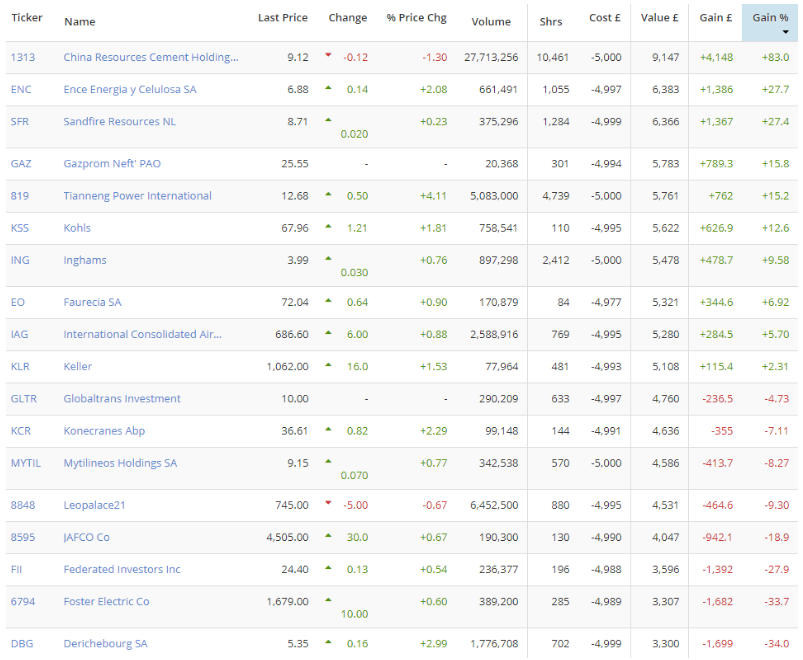
This portfolio is seeing much bigger gains and losses than the UK-only SIF portfolio. I’m not sure why yet, but it will be interesting to see how this affects overall portfolio returns.
Two of my May picks came from the EU which should helping to bolster the European influence in the portfolio. The third is from the USA. All three have Super Stock status and a StockRank of at least 98.
Granges AB (STO:GRNG)
This £750m Swedish firm is the kind of specialist engineer you might find in the FTSE 250. It produces rolled aluminium products such as heat exchangers, transformer windings and food containers.
My main concern with this business was that it might be too dependent on the automotive sector, to which I already have exposure through Faurecia SA. However, the recent acquisition of Noranda has reduced automotive sales from “almost 90%” to “around half”, according to the Granges website.
Financially, all looks good. Net profit has doubled since 2013, but return on capital employed has remained fairly stable, with a five-year average of 13%. Net debt is less than three times net profit, and the stock’s forecast P/E of 11 seems reasonable. There’s also a forecast yield of 2.7% covered 3 times by earnings.
Evonik Industries AG (ETR:EVK)
German group Evonik Industries is a £12bn chemicals group which operates in sectors including consumer goods, healthcare and various industrial markets.
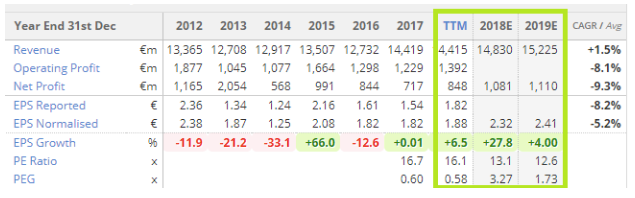
Profit growth has been inconsistent in recent years, but a strong result is expected this year.
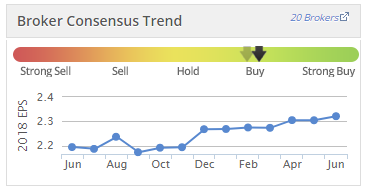
The broker consensus trend also shows encouraging momentum:
A forecast P/E of 13 and 4% yield seem reasonable, and I’m also encouraged by the group’s €775m net cash balance.
Best Buy Co Inc (NYQ:BBY)
The closest UK match to US technology retailer Best Buy is probably Dixons Carphone, in which I own shares. Best Buy’s share price movements over the last year suggests to me that like Dixons, it’s performing reasonably well but operates in challenging markets:
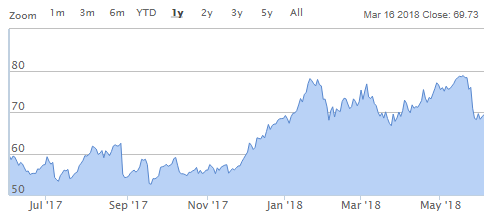
The rules for this portfolio mean that I don’t look too deeply into a business. So I don’t really know what lies behind Best Buy’s recent share price plunge. I’d suggest that anyone considering buying the stock with real money might want to find out more. But my goal here is to find out whether you really can make money from stocks without knowing too much about them!
In this case, Stockopedia tells me that adjusted earnings are expected to rise by about 20% in 2018/19. The stock offers a forecast yield of 2.5% and trades on about 13 times forecast earnings. A rising broker consensus trend suggests that the recent share price fall wasn’t a profit warning, which is reassuring:
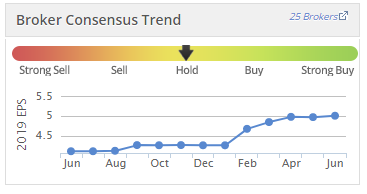
Best Buy’s return on capital employed figure of 36% seems encouraging, as does the group’s $1.3bn net cash balance.
I’ve missed a 20% gain
When I sold the portfolio’s shares in small-cap specialist fund manager Miton Group in July last year, I was pleased with the 46% total return they’d delivered for the SIF portfolio. But I was also conscious that there was no compelling reason to sell, except that the stock no longer passed all of my screening tests.
A sad shortfall in my record-keeping means that I can’t tell you exactly why Miton had stopped qualifying for my screen. But what we’ve seen since then is that the firm’s excellent financial performance has continued. The shares have climbed another 20%.
Miton now qualifies for my screen again. So it would be easy to say that selling last year was a mistake. After all, by holding on I could have reduced my trading costs, received more dividends, and enjoyed another 20% gain.
However, holding on to the shares would have broken my rules. These say that once a stock has been in the portfolio for nine months, I should sell when it no longer passes my rules. As I discussed recently when I added Sirius Real Estate to the portfolio for the second time, SIF is really more of a trading portfolio than a buy-and-hold style fund.
I should also point out that even though I sold Miton in July last year, the SIF portfolio has risen by about 14% since then. So the stocks I purchased in place of Miton have also performed fairly well.
Ultimately, my goal is to avoid big losses while capturing profits from affordable, growing businesses. I’m not trying to capture every last penny from a few big winners.
Miton still has good numbers
Looking at Miton as a fresh purchase, most of the comments I made in 2016 remain relevant today. You can read more about my original analysis of this firm here. I’m not going to repeat it today, but I will make a few observations on the changes seen since then.
Assets under management: In November 2016, Miton had assets under management of £2.7bn and £18.4m of net cash. By the end of 2017, AuM had risen 40% to £3.8bn. Net cash was slightly higher, at £19.9m.
StockRank: Miton’s StockRank was 95 when I first bought the shares in November 2016. Today it’s almost unchanged, at 94.
Valuation: 18 months ago, the shares traded on 14.7 times trailing earnings with a trailing yield of 2.3%. Today, the equivalent figures are a P/E of 16 and a yield of 3%. The stock’s earnings yield (EBIT/EV) has fallen from 12.9% to 8.9%. So the shares are more expensive, relative to historical earnings. This is reflected in the stock’s ValueRank, which has fallen from 74 to 65 over the period.
Momentum: Today the shares trade on a 2018 forecast P/E of 14, with a forward yield of 3%. That’s pretty much the same as 18 months ago. After a run of strong results, the stock’s MomentumRank has increased has risen from 73 in November 2016 to 88 today.
These changes seem acceptable to me. But they do seem to suggest that we’re at a later stage in the cycle. The strong growth in assets under management reflects both customer inflows and a continued bull market in stocks. A market correction would be likely to trigger outflows and a falling asset values. If or when that happens, the shares could fall sharply.
My decision: I will add Miton to the SIF portfolio this week. I’ll also buy the shares for my own portfolio, once this article has been published.
Disclosure: Roland owns shares of Dixons Carphone and Sirius Real Estate.
Disclaimer
This is not financial advice. Our content is intended to be used and must be used for information and education purposes only. Please read our disclaimer and terms and conditions to understand our obligations.

9 comments
Hi Roland
Your articles always interest me as I have a € portfolio based upon the NAPS system.
Your ideas for foreign stocks are great and I add them to my watchlist.
Keep up the good work.
Hi Roland
Very interesting read as usual, thank you.
Very small point.
Would you be able to add the country flag to your International Portfolio say just after the stock name column?
Regards
Howard
Hi Howard,
Thanks for your feedback. The country flag is actually shown in the portfolio already, unfortunately I cropped it out in an effort to make the text more easily readable within the width of the page!
I'll leave the flags in next time and see if I can remove any columns to make the table more legible.
Regards,
Roland
Hi Roland
Ok, now I appreciate your challenge.
No worries if you cannot fit it in.
Just a suggestion, maybe volume column(s) are less important for such a snap shot report.
Regards
Howard
Hi Howard, I agree, I've just removed the volume column!
Regards,
Roland
Many thanks for this, Roland. Always interesting and insightful. The question that puzzles me about Miton is, am I better off owning shares in Miton itself or investing in one of their products. Anyone got any thoughts?
Thanks for your comment, JollyBiologist.
This is a perennial question for asset manager stocks! I guess the answer depends on your investment goals and the other assets in your portfolio.
Investing directly in Miton (LON:MGR) stock would give a very different level of risk and asset exposure to investing in one of the group's funds.
Regards,
Roland
Hello Roland, Is the price paid 1789.5 for EZJ right as this is not apparent on price history of the stock for 22nd May.Thanks
Hello Gaja1,
The prices paid on fantasy fund trades are based on actual reported LSE trades, so I assume that someone paid 1789.5p on 22 May. You can read more about how Fantasy Fund trades are priced here:
https://help.stockopedia.com/community-guide/participating/fantasy-funds
As a reminder, SIF is a virtual fund. Although I do own most of these stocks myself, the trades shown on the SIF fund page (https://www.stockopedia.com/fantasy-funds/stock-in-focus-portfolio-6449/) are simulated trades and don't represent actual transactions.
Regards,
Roland
Disclosure: I own shares of easyJet.