SIF Portfolio: Could Standard Life Aberdeen offer hidden value for investors?

The Stock in Focus (SIF) portfolio fantasy fund isn’t a vehicle for special situation investing or arbitrage opportunities. As regular readers will know, my stock selections are governed by the results of the SIF screen and some simple rules for diversification.
But this doesn’t mean there isn’t room for me to select stocks for the portfolio based on my perception of future opportunity. As long as the company concerned satisfies all of my rules, then the remit for this fund allows me to add some discretionary choices into the mix.
An interesting possibility?
Most of the stocks which qualify for my screen at the moment are either already in the portfolio or are duplicates. For example, housebuilder Crest Nicholson is too close to Redrow to consider buying both.

One of the few stocks that is eligible for purchase is insurance and asset management group Standard Life. Although the portfolio doesn’t contain many big cap stocks, there isn’t a rule against it. Indeed, I believe there’s some value in adding a few stable, income-generating big caps into the mix.
Doesn’t Standard Life duplicate Miton? Leaving aside the difference in size, this is a valid question. Small cap fund manager Miton has been a successful investment for the SIF Portfolio so far. It’s risen by 33% during the five months it’s spent in the portfolio.

Although there is some overlap, I’m prepared to consider Standard Life for two reasons. The first is the group’s life insurance and savings business, which Miton doesn’t have.
The second reason is that Standard Life is expected to merge with emerging markets-focused group Aberdeen Asset Management this summer. The combined group will be known as Standard Life Aberdeen.
Why I’m interested: Aberdeen doesn’t qualify for the SIF Portfolio, thanks to last year’s profit slump and its poor share price performance over the last two years. But Aberdeen’s StockRank of 95 is significantly more impressive than Standard Life’s figure of 61.
The proposed merger seems to have attracted a fairly lukewarm response from investors. However, I think Standard Life could benefit from what appears to be the start of a recovery at Aberdeen Asset Management.
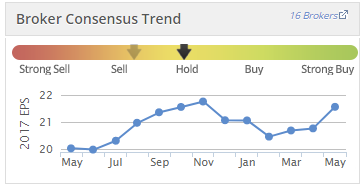
Broker forecasts for Aberdeen have risen steadily this year. These have coincided with more positive comments from other firms (such as Ashmore) about emerging market conditions:
It’s also worth noting that historically, Aberdeen has been the more profitable business. It has a five-year average return on equity of 16.4%, compared to 9.5% for Standard Life.
Cost cutting: The second area where I can see the potential for greater-than-expected gains is in the cost savings that should result from combining these two firms’ asset management businesses.
One of the main reasons for this merger is to allow the two businesses to benefit from efficiencies of scale. These are needed so they can compete more easily with low-cost passive funds. So far, plans have been made public for 800 redundancies and annual cost savings of £200m after three years. But management are often able to deliver greater savings than they can disclose before a deal completes. I’d hope for that to be the case here.
The proposed merger is expected to result in Aberdeen shareholders owning 33.3% of the combined group, with Standard Life shareholders owning the remainder. Assuming the deal goes ahead, which seems likely, anyone investing in either company today is effectively buying a 2:1 mix of Standard Life and Aberdeen stock.
With that in mind, let’s take a look at what’s on offer from each firm. Should I add Standard Life to the SIF portfolio?
Value: merger could improve dividend headroom
Here’s how the two firms rate in terms of value:
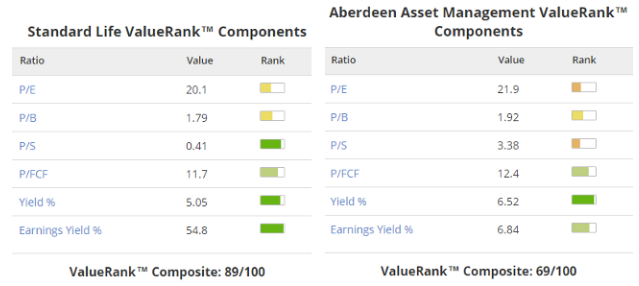
Both companies look pretty similar based on their trailing figures. One risk is that neither stock is cheap in terms of trailing earnings. Both firms have a trailing P/E of more than 20, indicating to me that a certain amount of earnings growth is already priced into the stock.
Similarly, although both firm’s dividend yields are attractive, Aberdeen’s payout ratio looks quite high. Inverting the firm’s P/E and P/FCF ratios gives an earnings per share yield of 4.6%, and a free cash flow yield of 8%. When compared to last year’s dividend yield of 6.5%, we can see that this payout wasn’t covered by earnings and required most of Aberdeen’s free cash flow.
Using the same metrics, Standard Life’s payout seems to have more headroom. Combining the two firms’ free cash flow could help to maintain a progressive dividend, especially if earnings increase as forecast over the next couple of years.
Aberdeen could boost returns
If Aberdeen lags Standard Life in terms of value, it has a clear advantage when it comes to QualityRank:
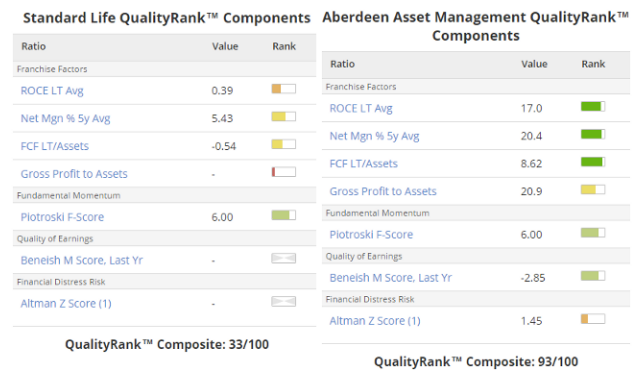
The two earnings quality measures at the bottom aren’t applied to Standard Life, as it’s classified as an insurance stock. So I’ve focused the franchise quality of each firm.
I’ve already mentioned Aberdeen’s track record of generating higher returns on equity than Standard Life. This attraction is also evident here. Aberdeen has been significantly more profitable than Standard Life over the last five years, as the dark green bars show.
If Aberdeen’s management can stem fund outflows and deliver positive investment returns, then I believe these qualities could provide a useful boost to the combined group’s performance.
Momentum is rising in both camps
The SIF portfolio’s short minimum holding period of nine months means that positive momentum is essential. Interestingly, both Standard Life and Aberdeen Asset Management have enjoyed significant increases in their MomentumRank scores over the last month:
Standard Life: MomentumRank +27 in last 30 days
Aberdeen Asset Management: MomentumRank +29 in last 30 days
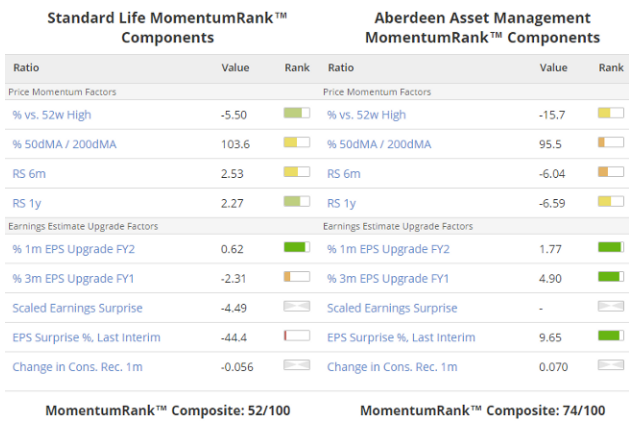
Aberdeen is in the lead at the moment, with a MomentumRank of 74 versus 52 for Standard Life. Here’s how these two figures are made up:
At the start of this piece, I mentioned Aberdeen’s improving earnings momentum. The dark green bars on the right show this in more detail. Earnings forecasts for both the current year and next year have been increased over the last three months. The firm’s last set of figures also came in ahead of expectations, according to Stockopedia’s data.
The figures for Standard Life aren’t as impressive, but in some ways I think that’s part of the attraction. Using Stockopedia’s new rating system, Standard Life has a RiskRating of Balanced and a StockRank Style of Neutral.
In contrast, Aberdeen is Adventurous and a Super Stock. My thesis for investing in Standard Life is that it will provide a mature, stable platform that will allow Aberdeen to deliver stronger growth while benefiting from a lower cost base.
Of course, there’s no certainty that this will happen. The merger could result in boardroom infighting along with bloated costs and continued fund outflows. But both firms have good track records and I’m willing to believe that these can be maintained after they combine.
I’m going to add Standard Life to the SIF portfolio this week. As always, please let me know what you think in the comments below.
Disclosure: Roland own shares of Redrow and Standard Life.
Disclaimer
This is not financial advice. Our content is intended to be used and must be used for information and education purposes only. Please read our disclaimer and terms and conditions to understand our obligations.

6 comments
Investors in the Insurance sector should be aware of IFRS17 introduced this week, a new set of international accounting rules for the sector.
According to this article in the FT yesterday, it is likely to reduce profitability (by 10-20% for some) and increase volatility of profits.
https://www.ft.com/content/7e2bf416-3b18-11e7-821a-6027b8a20f23
edit - link maybe behind paywall. If so Google;
UK insurers hit by biggest accounting shake-up in decades
and you should be able to access
I too hold Aberdeen, and was initially sceptical of the merger but can now see my way through it. In my personal view, once the dust settles post-merger, the Standard Life insurance business will be sold to a consolidator, leaving Standard Life Aberdeen as a "pure" asset management giant, with Martin Gilbert as sole CEO.
Possibly, but Legal & General (which I also hold) seem to like using their insurance business as a funnel for the asset management business.
I'm on the other side of the merger with this one. I hold Aberdeen Asset Management, so it will be interesting to see what happens when these two merge into an asset management monster.
Why does this say written by Ben Hobson then says "Roland own shares of Redrow and Standard Life."
It always been Roland who writes this article.
No concerns over Brexit then?
Sorry Herbie (my fault). Fixed.