SIF Portfolio: Infrastructure group John Laing could profit from an end to austerity

Seven years after the financial crisis, the Bank of England has cut interest rates to a record low of 0.25% and launched a new £70bn round of quantitative easing.
These new purchases will be added to the £375bn worth of assets the Bank of England purchased between 2009 and 2012. While these numbers are staggering, it’s not clear whether QE has been a success. One criticism levelled at QE is while it has pushed up the prices of financial assets and property, it hasn’t done much to stimulate the real economy. GDP growth remains weak, and inflation is low.
June’s Brexit vote raised fears of a recession. One area of particular concern is construction and infrastructure spending. Figures from consultancy group Barbour ABI showed that new construction orders fell by 20% to £5.8bn in July.
The collapse of the controversial Hinkley Point nuclear project is one example of where spending may stall. But it’s also possible that the government will decide to switch its focus from QE to a more Keynesian type of stimulus -- infrastructure spending.
Post-Brexit, Prime Minister Theresa May has committed to make infrastructure investment a priority. There is a growing expectation that this autumn’s budget will mark the end of former Chancellor George Osborne’s long-running austerity policies.
Interestingly, infrastructure spending has also become a focus of the US presidential election. Both Clinton and Trump are expected to ramp up spending on big projects if they win.
 One company that might benefit from increased infrastructure spending in the UK and the USA is John Laing Group, which manages and invests in such projects. In comments made alongside the firm’s interim results last Thursday, chief executive Olivier Brousse highlighted transport, energy and flood protection as areas ripe for public-private investment.
A timely opportunity?
The market was impressed with John Laing’s latest figures. The stock hit a new high and analysts have increased their earnings forecasts for this year. The combined effect of this new data is that John Laing has made its first appearance in my SIF screen this week.
A StockRank of 95 suggests that John Laing could be attractive. In the remainder of this article, I’ll take a closer look at the firm’s figures.
Decent value?
In choosing John Laing, I’m breaking my self-imposed rule of avoiding recent floatations. However, while John Laing only floated in 2015, it is a FTSE 250 firm, rather than a small cap or AIM stock.
The group’s shares trade on a trailing P/E of just 5.5, but the stock only has a ValueRank of 75. This suggests that some of the firm’s other value metrics may be slightly less attractive:
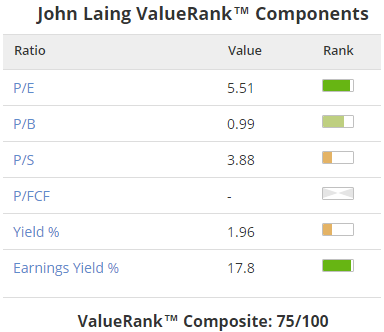
The main areas of potential concern appear to be the price/sales ratio, price/free cash flow and yield.
The 2015 dividend payment was pro-rated to reflect the period from the date of listing. This is why last the 2015 yield of 1.9% is so low. The forecast yield for 2016 is 3%.
The nature of the firm’s business means that turnover and profit are largely the result of investment returns. Costs are low and profit margins are high, so a high price/sales ratio is normal.
Similarly, as John Laing is continually reinvesting cash into new projects, free cash flow is negative. This is normal when property firms are expanding in a strong market, although it can lead to problems in a downturn. More on this in a moment.
Overall, the value picture looks decent, but not outstanding. At about 250p, John Laing stock is trading just below its net asset value of 263p per share. That’s fair value, but not a bargain.
Is quality a concern?
As is normal with newly-listed companies, five years of pro forma figures have been made available to investors in order to provide an idea of historical performance. These show that John Laing has generated an average return on capital employed of 10% over the last five years. The group’s net margin has averaged 34%.
John Laing’s QualityRank of 74 is good, without being outstanding. However, I’m not sure the standard Stockopedia metrics tell the whole story here. I think it’s more instructive to focus on areas such as debt and future liabilities. These aren’t as easy to understand as they might be.
The group’s portfolio of equity and debt holdings in infrastructure projects was valued at £945.2m at the end of June. Against this, net debt of £94.4m appears very low. However, this only reflects the group’s corporate level borrowing. Most borrowing is done by the projects in which John Laing invests.
I think a more prudent way of looking at this situation would also factor in the group’s existing funding commitments. At the end of June, John Laing had future equity and loan commitments of £295.3m. So in total, the group’s financial commitments were 94.4 + 295.3 = £389.7m.
If everything goes to plan, these future commitments should be funded by returns from existing investments, asset management fees, and perhaps a modest amount of corporate debt. There should still be plenty left over for shareholder dividends.
But it’s also clear that if investments underperform or debt market conditions change, this sunny picture could turn cloudy. In a worse-case scenario, John Laing might have to raise fresh cash from its shareholders. That’s why I’ve looked at this in length. Future cash commitments are often overlooked, but can be significant.
The story so far: strong momentum
John Laing’s net asset value rose by 8.3% during the first half. It realised £57.7m from the sale of existing investments and committed £76m to new investments. The group’s investment portfolio provided a cash yield of £18.3m, or 5.0p per share. This comfortably covered the interim dividend of 1.85p per share, and covered some of the increase in funding commitments.
John Laing’s share price rose by about 10% in response to these figures. This rise was probably also helped by a round of broker upgrades in August, which lifted forecast 2016 earnings from 35.3p to 39.0p per share.
The stock’s MomentumRank of 85 reflects this strong outlook. John Laing ticks most of the boxes required for a strong momentum score:
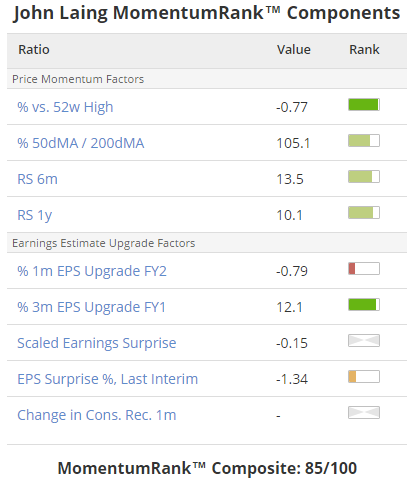
While I’d like to see a bigger discount to book value, John Laing’s forecast P/E of 7 and prospective yield of 3.0% looks a reasonable entry point. If UK and US governments do announce plans for more infrastructure spending this autumn, I’d expect further gains and the potential for significant earnings growth.
Although there are certainly some downside risks, I believe John Laing could deliver decent returns from current levels. That’s why I’m going to add this stock to the SIF portfolio this week.
As always, this is only my opinion -- please DYOR and share your views in the comments below. I’d love to know what you think.
Disclaimer
This is not financial advice. Our content is intended to be used and must be used for information and education purposes only. Please read our disclaimer and terms and conditions to understand our obligations.
2 comments
A company with decent yield which is well covered, with very little debt and very positive momentum. Upsides massively outweigh the potential downsides of being relatively new to the market. Also it has a tiny bid offer spread should things not work out as planned.
Another useful article.
The investment case does not convince me at thistime for price reasons.
It did at the end of last year with Low PE, PEG and Price to Bk & T.Bk and again in the spring.
The ex-dividend date on a large payout provoked a large price drop in April 2016.
This may happen again although unlikely on 29 Sep, the next x-div date. The payout in the spring was three times what they will pay this autumn.
Volume is thin.
A buy at about 220p