Small Cap Report (27 Mar) - MAYG, INS, WHI, POS

Pre 8 a.m. comments
A share which I held until recently, May Gurney Integrated Services (LON:MAYG) have today announced a recommended all-share merger with Costain (LON:COST), which will be renamed Costain May Gurney. They state that the combined group can make cost savings of £10m, so it seems to make sense for them to merge. Although I note that MAYG is on a lower PER, and has a better dividend yield than COST, so shareholders will need to sit down and crunch the numbers to work out whether the receipt of 0.8275 new Costain shares is a fair price or not for each May Gurney share.
EDIT: I flagged the value in May Gurney shares on my Blog 6 months ago when they were 138p. So following this morning's open 32% higher at 245p, that's a gain of 77% for readers who held until today. Naturally, as always, I sold too early a couple of weeks ago! My tag line should be, "good at research, rubbish at trading!"
Results for the year ended 31 Dec 2012 from Instem (LON:INS) look interesting. The numbers themselves are pretty lacklustre, with revenue very slightly down, and adjusted operating profit down by a quarter to £1.5m, although they say this is in line with revised market expectations.
However, it's the outlook which is interesting. Instem had a slow 2012, but then signed some impressive contracts in Q4 and in 2013 with major customers. So it is reasonable to expect improved results going forwards, and as we all know investing is all about valuing future cashflows, not historic ones.
Instem seem to be a software company serving the early development pharmaceutical sector. Historic growth has been fairly pedestrian, but it's all about the new contract wins, including a very impressive US Govt contract win, which put a rocket under the share price a month ago.
Revenues are 70% recurring, and high margin, so there is considerable operational gearing from new contract wins, meaning that profits could rise significantly on these new contracts.
The shares look reasonable value to me on the historic numbers, so could end up looking cheap once the new contracts flow through. Basic EPS is reported as 8.9p although that is flattered in comparison with last year due to a lower tax charge. At 121p that puts them on a PER of 13.6 (not bad for a growth company). There is net cash, but I am disregarding that as it looks as if the cash really belongs to customers in the form of deferred income (i.e. up-front cash paid by customers), judging by the fact that there is a £700k deficit on net current assets.
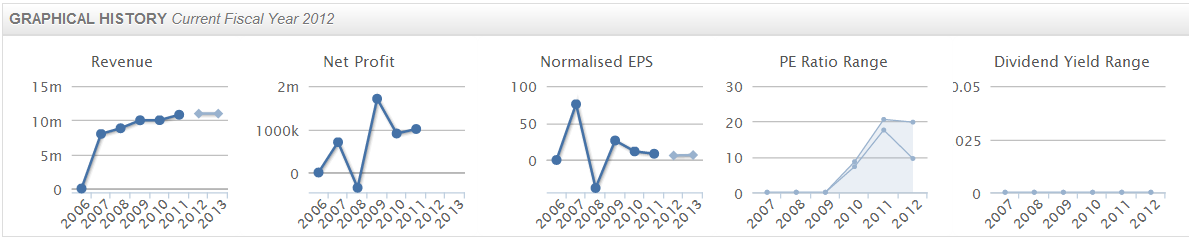
Also there is a £3.2m pension deficit shown on the balance sheet, so this would need to be checked to ensure it's not the tip of the iceberg, as can often be the case under the totally unsatisfactory rules for pension fund accounting that exist at the moment.
I would be interested in finding out more about Instem's prospects, because at the moment it looks good but I cannot quantify what future EPS are likely to be. Broker consensus forecasts seem low, with £1.1m and £1.2m profit shown for 2012 and 2013 respectively. Perhaps some new broker notes will come out following these results, which I would be interested in seeing.
Post 8 a.m. comments
Stockbroker WH Ireland (LON:WHI) have issued their results for the year ended 30 Noc 2012 today. I take a particular interest not as a shareholder, but as a broking client. It's a tough sector, with fierce competition from online brokers, although personally I've always found that online brokers can be a false economy with smaller caps. Whilst they get a small price improvement, they are often locked in to a particular market maker, and may not get you the full range of potential market sources for shares. Also they won't spend the time ringing round the market makers to sniff out a cheaper line of stock.
Whereas having a proper telephone broker, where you can have orders "worked" for you by going onto the order book (i.e. trying to buy at the Bid price, instead of the Offer price!) if there is one, and leaving orders with a market maker good for the day (i.e. giving an order to a MM and then letting them go out and try to find the stock) can lead to dramatic price improvements - sometimes several percentage points off the price of micro caps.
I've done the sums and worked out that for micro to small caps, I save money overall by using a proper telephone broker compared with a "cheap" online broker, as the price improvements, and being able to get filled in one go, rather than having to repeatedly go back for little scraps of shares, more than offset the higher commission charged. You get what you pay for, as with everything in life.
Incidentally, if readers would like an introduction to my broker, just email me or message me through Stockopedia, and I'll see what I can do in terms of getting people onto my friends & family reduced tariff.
Cheap online brokers tend to be more cost efficient for mid to large caps, so I tend to keep several broking accounts, and use the most appropriate one for each situation.
Back to WHI results. They show an improvement, with turnover up 8% to £25.1m, and a loss-making situation having been improved to around breakeven. The balance sheet looks OK, and there is a 0.5p dividend.
Taking a simplistic view of the chart, this looks like it might be a good entry point now, possibly? (especially as market conditions are better now than they have been at any time throughout the last 3 years that this chart covers):

With small cap markets really having come alive since July 2012, I suspect broking might be a good area to look at - since IPOs are happening again, secondary fund-raisings are easier to get away, and new people are coming into the market as investors, it just all feels like a bull market again, and that of course is good for brokers. But they need to get out there and explain how their services benefit clients, as by default people will head for what looks like the cheapest option on the retail side.
Interim results from Plexus Holdings (LON:POS) are interesting. Turnover has risen from £9.3m to £11.3m, and operating profit is up from £1.5m to £1.8m. Those are six month figures of course. Guess what the market cap is? It's £180m!
OK that's it for today. I've looked at lots of other results, but nothing much of interest to me.
See you same time tomorrow.
Regards, Paul.
Disclaimer
This is not financial advice. Our content is intended to be used and must be used for information and education purposes only. Please read our disclaimer and terms and conditions to understand our obligations.

16 comments
Many congratulations to Paul on being nominated for the Small Cap Awards! Details here: http://www.smallcapawards.com/small_cap_awards.pdf
Small Cap Analyst of the Year:
Here's hoping the Panel make the right decision on the night!
Hi again Mark
I should have also said my 'experience and research' made me buy a big chunk of Optare (LON:OPE), because a friend works on the local buses and found the Optare vehicles far and away the best built and most reliable of the fleet. They also seem to have considerable work done on hybrids. I am down 30% and it is still sinking!!!!! No fool is system proof!
B
Shame, buying a stock whose service or product is quality works surprisingly often. However the quality might count for a 100% to 300% increase after 2 - 3 years. The market in a small stock can easily halve along the way. The Stockopedia analytics are a pretty good way of trying to get the market timing right, minimising short term losses. Fingers crossed....
Hi Mark
I actually know nothing whatsoever about commercial property investment, but what ?NRR are doing just strikes me as common sense. Assests like the Forum are clearly undervalued, given their potential. They are simply making cosmetic changes here, and realigning the floor space to give more convenient unit size. They seem to be able to do this as tenants require.The number crunching Paul and others provide here is my only financial background in such matters, but I then try and relate this to my personal experience and research to try and make a decision on what to do with my redundancy money!!
I am unsure about Newriver Retail (LON:NRR) incentives, but I think the occupancy rate will be high due to the municipal involvement, the larger commercial anchor (Iceland), and the fact the newly made smaller units will attract small (perhaps unintentionally transient) local businesses. Due to the debt I would like to get Newriver Retail (LON:NRR) well under £2, but I think that day has well and truly gone!
(I no longer live in Wallsend. I have moved somewhere far more 'deprived', and consequently far cheaper. At a guess your friend lives in Jesmond (Chelsea-on-Tyne) or Tynemouth (the Hove of the North!!!!)
Good luck with the investment, and any others.
B
Not sure this is relevant Jeff, but Treatt (LON:TET) is not an AIM stock, it is fully listed.
Asagi (no position)
Asagi,
You're right. Treatt was in my ISA portfolio too. I should have written small cap, not AIM.
Anyhow, I think considering the fixed fees charged by brokers, it would still be interesting to know how much improvement can be had from dealing via a "full price" broker and figuring out what deal size is needed to make it worth the extra dealing fee.
Jeff
Hi jeff,
The real savings with small caps are made by using a proper broker to "work" orders for you.
So here's a quick example. I looked at a stock recently that was 32p Bid/ 36p Offer. Looking at trades that day, I could see that buys were going through on RSPs (machines that the MMs give to discount online brokers) at 35.4p. So if you were to buy online, you would get a yellow strip saying that they saved you 0.6p per share.
What I did was ring up my proper broker, and just ask him to ring round the MMs to see if there was any stock available (I was looking to buy about £10k worth in a fairly illiquid stock). Anyway, he came back and said there was no price improvement, and only 10,000 shares available at 35.4p.
So I said OK, please give that MM a firm order, good for the day, for 30,000 shares at 34p (the mid price).
2 hours later a seller emerged, and the MM sent the stock straight over to me at 34p. So I bought at the mid-price, and saved 2p a share on the quoted spread, so saving £600 (bear in mind I also bought more than was available at 35.4p, and I got it cheaper).
I paid £25 in commission for this deal, and no Stamp Duty, as I got my broker to put it onto a white label Spread Bet. Sure there is a funding cost of 3% p.a., but there's no CGT, and it doesn't have to be reported on tax returns, as it's a spread bet. You don't have to use any leverage. It's just the most efficient way of doing non-core share trades, in my view.
If you want to talk it through in more detail, message me, and we can have a chat by phone.
NB. No advice intended, this is just me answering a specific question on my personal experience.
Cheers, Paul.
Paul,
Never heard of a white label spread bet. Would like to learn more. Can you tell me how please.
Congratulations on your nomination - well earned
regards
John
Hi John,
White labelling of spread bets is where a traditional broker (in my case WH Ireland) also offer a spread betting ("SB") product, but it is provided via a SB company like IG Index, Spreadex, or others.
The beauty of this is that you can have various accounts (SIPP, ISA, ordinary, and SB a/c's) all under one roof using the same broker. That can be very handy - e.g. if you want to lock in a favourable price movement close to tax year end, but don't want to create a CGT liability, then you can open a short position on your SB a/c in shares that you own. This has the effect of synthetically creating a sell at a favourable price, without creating a tax liability. Then in the next tax year you can reverse the trades - i.e. close the short position on the SB a/c, and sell the physical shares simultaneously in the new tax year.
Of course that can be done through any broker & SB company, but it's so much easier to keep track of if it's all under one roof, since you give the broker the instructions for the complete deal in one go, and there's then less chance of one part of the deal being forgotten about.
The big advantage I've found with WH Ireland is that they get me very good price improvements, especially by working orders in the way I mentioned above. However, once the stock has been bought at the price I want, I then just tell them which account to book it to - ordinary (i.e. where I buy the shares outright), or other, mainly SB.
The SB a/c has the lowest commission charge - only 0.25%, and has no minimum, so I use the white label SB a/c for smaller trades, as it makes them incredibly efficient - I only pay a few quid in commission, but get full telephone service broking. I can only guess that they must do it as a bit of a loss leader, to get an overall package of business, but I'm guessing there?
However, combining 0.25% commission with full service execution, with often excellent price improvements (can be far better than an online broker's price if you work the order), is an unbeatable package in my opinion.
I've introduced quite a lot of my investing friends to WHI, and they've opened accounts there too & all seem very happy. Our brokers at WH Ireland often come along to Mello events too. We've started doing deals together on small caps too, e.g. to take out small overhangs in stocks we like, after meeting management through events such as Mello. So lots going on. It's the next natural progression really for small groups of investors to co-operate through the same broker, to the benefit of all, although obviously we have to be careful about not getting into "concert party" type situations if at all possible.
Feel free to message me if you would like to discuss further.
Cheers, Paul.
Paul
Thanks for the excellent article, as always.
What are your assumptions for calculating the benefit from using a proper telephone broker?
I might typically deal in sums of about £5000. My last AIM trade was selling out of Treatt. currently bid 415, offer 430. Spread 3.6%. So the spread might cost me £90 when buying & £90 when selling.
If my dealing charge increases from £12.50 to £52.50, I need to save over £40, before getting any benefit from a telephone broker. So that requires the spread to be halved.
The bigger the trade, the more likely it is for the additional fees to be justified.
Suppose I need to increase deal size, as this has not expanded anywhere near as fast as the total portfolio size.
Jeff
Dear Marben
With regard to Newriver Retail (LON:NRR) I think you may misunderstand the company strategy. You also seem to misunderstand Wallsend. The company is taking on 'value' property, that is buildings that are past their cosmetic best, and are located in areas away from centres of gentrification. This property can be acquired for knock-down prices in the current climate, at least outside London. The nature of the properties and their locations mean that they attract both the lower end of the retail market as tenants, and the lower end of the income spectrum as customers. Many, many people in Wallsend work, like me, for the national minimum wage. We will not steal your tyres, but we will demand value when we shop, and we will seek out what we regard as bargains to feed and clothe ourselves. We will also not move out of the area as we cannot afford to. I am sorry if you find this offensive or threatening. Newriver Retail (LON:NRR) are concentrating on acquiring value properties while they are still available, and they will prosper. They have even, in this case, had the good sense to obtain the local authority as a key tenant. They really seem to know their market. Most of their portfolio is comparable to the Forum in every way. My one worry is that eventually such properties will no longer be available at a reasonable price, and Newriver Retail (LON:NRR) could end up in a few years servicing too much debt, and with very limited prospects for further expansions. (PS If you reckon Wallsend is bad, try Sunderland!!)
Hi Beginner,
Not at all! :0) Always pleased to hear the other side of the coin. The text is a direct quote from a friend of mine who lives in Tyne & Wear - but not that near Wallsend - so I guess he's going on reputation & local news reports. Hope his remarks weren't too offensive to you.
Must admit, I am impressed that someone on the minimum wage is so knowledgeable about commercial property investment.
As you live in Wallsend, please tell us more about the Forum and how it's been changed by NRR.
However, I do understand NRR's strategy perfectly well - but the questions in my mind are a) what incentives are they having to offer tenants to take those leases?; b) what level of occupancy will they achieve in the medium term?
I agree that the level of debt on the balance sheet is a concern.
For those reasons, my investment in NRR is not too large. I will reconsider my position as results are published.
Cheers,
Mark
Thought I'd just do a little background research on Wallsend, with a friend of mine who lives in Tyne & Wear (as I'm not really familiar with the area, other than from visits). His comments might amuse readers:
Hmmm... I hope NRR know what they're doing. :-/
Cheers,
Mark
Interestingly Numis (LON:NUM) released a positive trading statement today http://www.investegate.co.uk/numis-corporation--num-/rns/trading-update/201303270700089477A/ and their share price has risen 50% over the last 6 months so it could be that they are coming out of the doldrums too.
Worth mentioning a positive announcement from Newriver Retail (LON:NRR) this a.m.
Though TR Property Investment Trust (LON:TRY) 's Marcus Phayre-Mudge advised caution with secondary retail properties at the February ShareSoc members' meeting (in a chat I had with him after the meeting), it looks to me like NRR are doing the right things to add value to their properties. Free car-parking, Amazon lockers and free WiFi seems to be the right way for bricks & mortar retailers to attract footfall in this increasingly internet dominated age.
I hold, loving the yield (and I also hold TRY).
Hi Mark,
Indeed, a good announcement from Newriver Retail (LON:NRR), which is a company I follow.
Their strategy is sensible - adding value to shopping centres they buy, and they focus on value retailers as tenants, thus lowering risk (since the value end of the market is not affected by the internet or the depressed economy).
Fabulous dividend yield too. Could be some capital upside in the long term too, although maybe not for now as retail rents still under great pressure in secondary locations.
Regards, Paul.