Small Cap Value Report (10 Nov 2016) - DVO, PHD, BOTB, WIN

Good morning!
Things seem to be moving at such a rapid pace at the moment. The overnight sell-off in markets yesterday, on news of the shock victory of Mr Trump, has rapidly reversed. So people who were waiting to get back into their favourite shares only had a short time to do so. This is why I prefer to use a bit of hedging against a market plunge, in situations like this, instead of selling up & hoping to buy back in more cheaply.
The problem with small caps, is that you can't just move in & out of them seamlessly, particularly if you want to deal in size that is multiples of the NMS (normal market size). The NMS can often be ridiculously small for many small caps too, so illiquidity becomes a problem even for trades of just a few £k. Then there can be hideous bid/offer spreads to absorb as well.
So overall, I'm really glad that I held all my long positions throughout the turbulence caused by the US elections. My hedging worked, and was actually profitable, because I closed most of the hedges when the S&P500 spiked down to 2,050 overnight. The selling seemed to have run out of steam, and it dawned on me that the market might actually rather like the idea of a pro-business President, even a clown like Trump.
Anyway, on to today's news - also I'll try to catch up with a backlog from yesterday too. I was too tired to write any more yesterday afternoon.
Devro (LON:DVO)
Share price: 182.8p (down 19% today)
No. shares: 166.9m
Market cap: £305.1m
Trading update - this is a new company to me, it's a maker of sausage skins. The share has come into my universe due to a falling share price. The price is down 19% today, so it must be a profit warning.
Devro has a 31 Dec year end, so today's update relates to H2 to date, i.e. 31 Jul to now, early Nov.
The first paragraph sounds OK - some negatives, but offset by favourable input prices & forex;
Sales volume trends were broadly similar to those experienced in the first half, enhanced by improvements in Russia and South East Asia, but impacted by further reductions in Latin America due to the previously highlighted issues, which are being addressed, related to the transformation of our global manufacturing footprint.
Combined, these factors have had an adverse impact on margins, offset by further benefits from lower input costs and foreign exchange.
As a result, the Board's full year expectations for underlying operating profit* remain unchanged.
That all sounds reasonably OK, but here comes the bombshell;
2017 and beyond
Based on current trends, sales volumes in 2017 are now expected to be approximately 10% lower than previously anticipated, which will result in an under-utilisation of available capacity.
Actions are being taken to rebalance the use of capacity across our global manufacturing base. The under-utilisation is expected to have a further adverse impact on margins.
What I can't fathom, is that the RNS contains no explanation as to why sales volumes have suddenly dropped by 10%. That's a serious omission.
Although it does explain what action the company is taking to remedy things;
The Board has decided to accelerate and implement more extensively the next stage of the Group's strategic development, focusing on;
- growing sales through improved commercial capabilities,
- introducing the next generation of differentiated products, and
- further improving manufacturing efficiencies to reduce unit costs.
This will come too late to save the day for 2017 though;
This improvement project will deliver a fundamentally more competitive position. The benefits will offset the effects of the lower volumes, partially in 2017 and fully in 2018.
So here's the profit warning for 2017;
Consequently, the Board now expects underlying operating profit* for 2017 to be lower than previous expectations.
No indication is given of how much lower profits will be - another important omission, because it leaves shareholders in the dark until they can get hold of broker updates. This is very bad form in my view. Companies have the information, and therefore should make it public, in the an RNS.
This RNS should have stated the % decrease in profit versus current market expectations. That's the key information that people need to know, so why withhold it?
My opinion - to my mind, a sudden 10% drop in expected revenues, with no explanation as to what has caused that drop, is a serious concern.
I've quickly reviewed the 2015 accounts, and am impressed with the high operating profit margin generated by Devro. However, as sales are suddenly dropping, maybe it's making too high margins, giving room for competitors to undercut it & steal market share, possibly?
The other aspect of this business I dislike, is that it seems very capital intensive. The 2015 balance sheet shows within fixed assets;
- £56.3m freehold property
- £108.5m plant, machinery & motor vehicles
- £103.4m assets under construction
That seems a lot of capital to generate £33.3m in operating profit.
There's also £147m net debt, plus a £56.4m pension deficit at end 2015, which will probably have grown since then, due to interest rates being so low.
After today's share price fall, the forecast dividend yield will be approaching 5%, providing it's maintained of course, which we cannot necessarily rely on.
Overall then, it doesn't appeal to me at all.
Proactis Holdings (LON:PHD) (at the time of writing, I hold a long position in this share) - news today of a relatively large acquisition costing £15.5m, for a company called Millstream Associates Ltd. I've had a look at this already, as I was made an insider on this deal. The acquisition mainly runs a website called Tenders Direct which allows companies to tender for public sector work. Membership costs £995 p.a.
Most of the funding is coming from a £12.5m placing. I'm very impressed that this has been achieved at 135p per share - representing a premium of 9.3% to yesterday's close of 123.5p. There's nothing fishy about this. What happened is that the placing meetings started when the share price was about 137p, but then there was a sudden spike down in the share price in the last week or so, in common with many small caps shares.
It's clear then that there was strong demand from Instis to get in on this placing, as the price was remained at 135p, 9.3% above the market price. Normally I would expect to see the price reduced, to reflect the current share price.
Overall then, I'm very pleased that the placing was executed so well (well done FinnCap!), and has not disadvantaged existing shareholders at all. If only all placings could be done at a premium to the market price.
Best Of The Best (LON:BOTB) (at the time of writing, I hold a long position in this share) - more good news from this weekly supercar competition company. They're paying another special divi, of 10p this time, which will be paid on 2 Dec.
As you can see, the flow of divis in the last 2 years has been excellent (see extract below), and including this latest 10p special divi means that sharesholders will have received 47.6p in divis in just over 2 years. Plus the shares have 4-bagged in 2 years as well - so a fantastic overall total shareholder return.
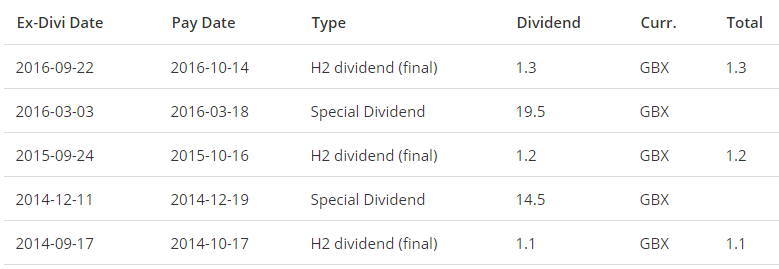
The dividend summary information above is on the Stockopedia StockReport under the "Accounts" tab. The data goes right back for many years, I've only copied an excerpt of it above. This "Accounts" tab also contains details of all Director buying/selling in the shares too, which is useful for reference.
I've just emailed the CEO of BOTB, to thank him for the special divi - especially 3 weeks before Xmas - that'll pay for a few more bottles of fizz!
Right, I have to go offline for a bit now, to prepare for a call with management of Wincanton (LON:WIN) - I've been highly critical of this company's terrible balance sheet in the past, so it will be interesting to hear the perspectives of management. I shall report back here around lunch time.
Also, unless something else crops up, I intend spending most of this afternoon updating this article, so please do check back later.
Wincanton (LON:WIN)
Share price: 203p (up 9.0% today)
No. shares: 123.7m
Market cap: £251.1m
Interim results, 6m to 30 Sep 2016 - I'm warming to this business, which seems to be performing well at a P&L level, as you can see from the highlights reported today. I've highlighted some key figures below - e.g. the introduction of an interim divi, and good reduction in net debt to a reasonably modest level;
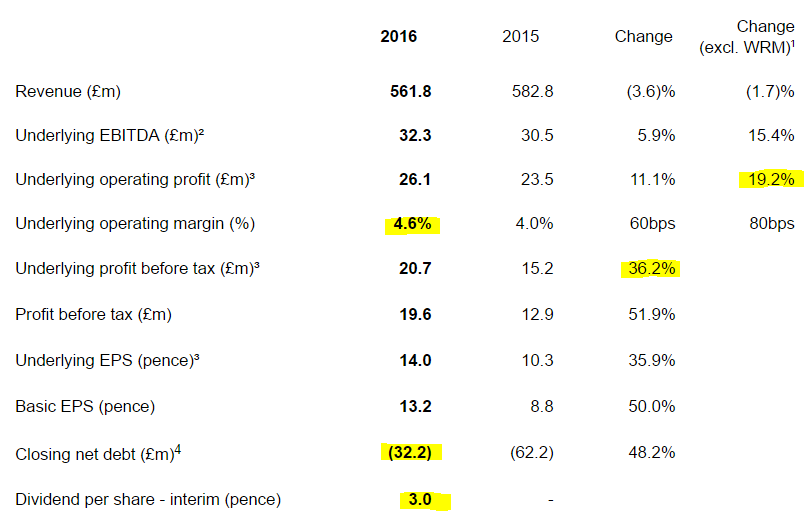
I think a key driver of debt reduction was the disposal of its record storage business to Restore (LON:RST) . The numbers above are for continuing operations only.
Outlook comments sound encouraging, and note that the business is no longer financially distressed, so that should help performance improve, I imagine. It seems to be getting into a virtuous circle, whereby lower debt means more pre-tax profits & cashflows, helping to reduce debt further, as well as introducing divis.
The re-organisation of the Group into Retail & Consumer and Industrial & Transport sectors has been completed and positions the Group well to better service its customers. The exit from certain contracts, notably the onerous Pullman home shopping contracts, has contributed to improved operating profits in the first half.
Together with lower financing costs and taxation, this is expected to lead to full year earnings being marginally above expectations. In the remainder of the year these contract exits will also slightly reduce gross revenues.
The structural drivers for our services remain strong and the Group is well positioned to manage any uncertainty that arises as the United Kingdom works through its exit from the EU. Additionally, the Group now has the financial certainty and capability to support limited scale investments to both protect and grow the business for the longer term. The Board expects Wincanton to make continued progress by delivering excellent service and added value for its customers.
Balance sheet - this is where my concerns have always been. I'm happy with the P&L now - the business seems to be doing quite well. But have the balance sheet concerns gone away? On paper, definitely not, here are some key figures;
NAV is negative at -£233.5m
NTAV is even worse, negative at -£322.4m - clearly an absolutely massive number.
The main reason that the balance sheet is so bad are two factors;
- Negative working capital of -£123.3m (being current assets of £202.5m, less current liabilities of 325.8m). This is a very poor current ratio of 0.62.
- Pension deficit of £169.2m
So there's no denying that this is a really poor balance sheet. However, bizarrely perhaps, the group is not actually in financial distress.
The pension deficit requires cash overpayments of about £15m p.a., rising by RPI each year. That is manageable from cashflows generated each year, but it is of course a large ongoing commitment, and burns up a lot of the cashflow generated by the business. It's vital to factor this into how you value the shares.
I see lots of comments about how low the PER is at this company - well it jolly well should be, since something like a third to a half of the profits/cashflow are needed to service the enormous pension fund. Depending on what bond yields do though, that could change. So this share is perhaps a bit like Trinity Mirror (LON:TNI) or Norcros (LON:NXR) - where there's potential upside from the pension deficit shrinking if bond yields go up.
Chat with Wincanton CEO today
Many thanks to Wincanton's PR person for arranging some time for me to chat by phone to management today. I always like to prepare beforehand, and then just have a Q&A session, rather than them doing a presentation for me.
Here's what I asked, and the answers - it was all on the record, so there's nothing confidential or price sensitive in what follows;
Q1. Contract risks - what length typically, and what impact would it have if they lose 1 or 2 big contracts?
A1. Typical contracts are with household name retailers (e.g. Sainsburys, Co-Op, Argos, B&Q), and are for 3-5 years. Often contracts then renew, or go to a rolling annual basis. Some have been running for 25 years - they tend to be sticky because WIN provides a good service.
Also, each brand may have multiple sub-contracts, so not all eggs in one basket. Fixed costs are well matched to contract terms, and 60% of contracts are open-book (i.e. cost plus contracts) - so many costs are just passed through, with a profit margin added on top.
So there's little operational gearing, and a wide spread of customers & contract expiries. Therefore mgt feel they've minimised contract risks, although mistakes had been made in the past with uncompetitive contracts - .e.g. Pullman contract now ending.
Q2. Are profits concentrated in any key customer(s)?
A2. Commercially sensitive, so wouldn't say. Profits tend to follow volume, so largest contracts are usually most profitable, although some smaller niches have higher margins. No single customer is over 10% of revenues.
Q3. Your 4.6% operating margin - I've heard that the supermarkets don't like suppliers making a higher margin than they do. So are they squeezing you for lower prices?
A3. The margin in WIN's retail & consumer division is lower, at 3.7%. And yes, the supermarkets (and other retailers) are always trying to squeeze the margin lower, as you would expect.
Q4. What cost increases are coming through - e.g. rising drivers wages, Living Wage, Apprenticeship Levy, sterling devaluation.
A4. Drivers are already paid a lot more than Living Wage, as it's quite a skilled job. In other areas, they have to make efficiency savings to offset cost increases. Also that even with pass-through contracts, WIN has to be conscious of the other cost pressures on its customers. So they always try to mitigate cost increases where possible, to avoid damaging the customer relationships.
Turning next to the balance sheet;
Q5. Property & Equipment within fixed assets seems very low, at £34.4m
A5, That's because a lot of property & equipment is held on medium-term operating leases. So the total value of fixed assets the group uses is much higher. We're not a property company, so are happy leasing assets. More niche items are purchased. Open to doing either, depending on economics of each situation.
In a few years' time accounting standards are changing, so all companies will have to bring leased assets onto their balance sheet.
Q6. Deferred income looks high at £140m. Is that things like customer payments up-front, leasehold incentives, etc. What is in there?
A6. A mixture of those, and also it's accruals as well as deferred income.
Q7. Why is the working capital position so weak, at minus £123.3m?
A7. It's the way this sector works. The business is partly funded from working capital. Try to achieve at worst cash neutral positions with customers, sometimes better.
Q8. Sterling devaluation - once retailers' hedges expire, shop prices will have to rise. So consumers will have to reduce the volume of goods bought. Is this going to hurt you in future?
A8. We tend to handle high volume, lower priced products. So will someone who needs an electric drill to put up a shelf really not buy one in 2017 because it costs £3 more? Probably not. Also, we move a lot of food, which is very defensive. Most retailers seem to be hedged to mid-2017. So higher prices are more likely to affect luxury, discretionary items.
Q9. Is it wise to pay dividends again, given the balance sheet weakness?
A9. It was carefully considered, and is felt to be OK, given that net debt is now low relative to EBITDA, less than 1 times. We've focused on cash generation & debt reduction. The divi is well covered, and doesn't place undue stress on the business, it's been set at a sensible level.
Q10. Could the pension scheme trustees scupper future dividends?
A10. We discuss the long-term funding position with the pension fund trustees. In the shorter term, the pension deficit can fluctuate considerably. Recent increase in bond yields in the last few weeks has reduced the deficit by about £50m, so it's volatile. We don't have knee-jerk reactions to short term fluctuations. Trustees want to ensure they act in the best interests of the scheme, obviously.
My opinion - it's always good to chat with management, and get an opportunity to learn more about the business. Given that I cover 500-600 stocks single-handedly, I'm only ever going to have a fairly superficial view of most of them. So I learned a lot talking to Wincanton's CEO today. He's seems very grounded too, which I like.
Overall, I feel that this share is worth a fresh look. It's no longer in financial distress. Although the balance sheet remains very weak, the liabilities are not stretched beyond the ability of the company's cashflow to pay them. It just happens to have a favourable working capital setup, and a huge pension fund. Providing nothing changes adversely, then it does actually look manageable & sustainable.
I would be far more worried if there was excessive bank debt, but that's now quite low, at under 1x EBITDA.
I'll look at the latest broker notes, and crunch the numbers a bit more. It's no longer a bargepole stock anyway, I can safely say now. If the facts change, then I change my mind!
Disclaimer
This is not financial advice. Our content is intended to be used and must be used for information and education purposes only. Please read our disclaimer and terms and conditions to understand our obligations.

40 comments
BOTB
I'd rather they spent this on getting some operational gearing on the go.
They can go overseas or really push their online marketing to see those sales grow exponentially
Instead they are removing cash from their balance sheet
One of the major reasons why the level of voter turnout in the US election was so low is due to the electoral college system. In the majority of US states the outcome is highly predictable, whether that be Repulican or Democrat. In those states anyone voting for the other party might think "why bother?" And many would be voters obviously decided not to bother. And in the end Hilary Clinton received more votes overall than Donald Trump yet she is not going to be the next President of the United States. This is unlike the system we have in the UK where a constituency votes for an MP who represents them in Parliament.
Jardine
I think you need to consider the parallels between the way that US Presidents are elected with the way we choose our Prime Minister. In effect each of our parliamentary constituencies acts like a small US state with a single vote in the electoral college. So if 27% of the votes are cast for party A and 27.1% for party B then party B gets the entire constituency allotment of MP's and gets the entire constituency allotment of votes for the next PM. So we can and do end up with a house of commons where the parties have numbers of MP's which bear no relationship to the number of votes cast. And we get a Prime Minister who is in effect selected by the party machine rather than the electorate. Not significantly more democratic than the US system and in fact less so where the PM is concerned.
Tournesol
I make two points in response as I understand the similarities you highlight but I believe the systems are very different indeed.
1. In the US you vote for a President. In the UK you vote for an MP.
2. In the UK you have a much larger number of constituencies than the number of states in the US. In a swing state such as Florida a simple majority of just one vote could have a hugely distorting effect on the overall result for the county as all the electoral college votes (29) would be cast depending on the result of that simple majority. In the UK each constituency result delivers just one member to parliament.
The big difference is that here in the UK we vote for an MP and in the US they vote for the President.
"Political landscape in both the UK and US would be dramaticly different if voting was compulsory, perhaps thats why its never implemented."
I'm intrigued - how so? What's to say we wouldn't get the same results we do?
Hi
Compulsory voting is an interesting idea. It all hinges on what the carrots & sticks might be:
Ideas for sticks:
Forbidden to use all internet social media
AND / OR
£100 fine
AND / OR
Published list of non voters who do not support democracy
Ideas for Carrots
50 free lottery tickets
AND / OR
£20 voucher for all large retailers
AND / OR
Published list of voters who actively support democracy
What do you think?
My opinion is that we should encourage democracy!
Warranstar.
Your carrots and sticks are too insubstantial I think.
I tend to think we need incentives to vote which derive from the notion that citizens have both rights and responsibilities and you should not get one if you shirk the other.
I'd say that personal tax allowances should have to be earned by fulfilling your civic duty to vote. No vote = no tax allowance. Ditto all state benefits from child benefit to job seeker's alllowance through child care benefits and student loans and pensions. You do not have to vote but if you choose not to then you do not get to enjoy the benefits and advantages of citizenship.
Of course we need to reform the voting system ranging from introducing some form of proportional representation through to electronic voting and getting rid of voting fraud which is a real problem in some areas. Perhaps we should have a "none of the above" option where such votes are subtracted from the vote counts of the candidates. If nobody gets elected we get a rerun with different candidates.
And we need the ability to sack sitting MP's and not let them stay in office after they have been exposed as failing in their duties.
Hi Warran,
All a bit too limp wristed for me.The carrots aren't that attractive,and the proposed penalties hardly likely to persuade someone to go vote.Nor, in fact, should we be offering "carrots" in the first place either imo.
Why reward someone for not engaging in the voting process...
I'm with Tourn, concur with ALL that he scribbles two messages or so dow - especially vis the sacking f MPs found to be putting their fingers ion the till,or worse.
A quick skim of WIN annual reports reveal glaring corporate governance issues. Here's 2 for starters:
ridiculous remuneration, CEO, promoted from finance post last year, eager to follow in his greedy predecessor's footstep, drew £1.65m. Chairman has helped himself to £178k for each of the past two years ... as a non-exec!
BTW, the latterheld equivalent position at Queens Moat Hotels (went spectacularly bust after long running fraud)
Someone said that half the US population went to the polls and supported Trump.
That's absolutely not true.
Voter turnout was only 55%. So the voting breakdown was
27.4% Trump
27.6% Clinton
45% abstain
The real divide is not between those who supported Trump and those who supported Clinton. It is between those who voted and those who didn't. The real scandal is not that Trump won - although in my opinion that brings shame and opprobrium on the US. It is that the political process is so dysfunctional that the two candidates who were offered were equally disliked and rejected. And even more that almost half the population did not think it worth voting.
here is an Excellent article on this subject
I was much taken by a remark made by one of Trump's sons. he said that the key to understanding his father was to realise that he was a blue collar worker but had a bigger bank balance. I think that is very perceptive and is helpful in getting my head round his character and behaviour.
"Voter turnout was only 55%"... "half the population did not think it worth voting".
Not sure I can reconcile those two statements.
As regards the turnout it was actually higher than the election that put Bill Clinton in the White House (53.5%).
Personally I would have liked Bernie Sanders to have been the Democrat candidate and to have won. As for the current rioting it should have been when the news broke of the Democratic party's sabotage of his campaign, or at the murder of staffer Seth Rich who it is believed leaked the story.
Shine66
You quote me as saying "Voter turnout was only 55%" and that "half the population did not think it worth voting" and claim those statements are inconsistent.
You are misrepresenting what I actually said, which was that "almost half the population did not think it worth voting".
Are you seriously objecting to my describing 45% as almost half?
In any event you have entirely missed the point I was making which was that the biggest division is not between the two quarters of the population who voted but between the half* who voted and the half* who didn't. You might disagree but you should not misrepresent.
* yes of course I'm rounding the numbers.
Apologies, Tournesol, it was not my intention to misrepresent your original statement, it was a copy/paste fail on my part. Unfortunately I am unable to edit my original post, sorry.
Pete
Both US and UK indeed most countries that have an optional voting system have very poor turnouts. Australia has one of the highest election turns outs. It is compolosry to vote in Australia. I heard both US and UK politicians argue that it is undemocratic to make voting compulsory? Personally if the system gives you a choice to vote or not then there it is no wonder there is a low turnout. Political landscape in both the UK and US would be dramaticly different if voting was compulsory, perhaps thats why its never implemented.
Hi deucetoace and jonesjeff,
Re Ukraine, it seems to me there are a couple of factors behind the Russian position : firstly, their historic need for buffer states to provide defence in depth/time to regroup where their 'border' areas lack natural hindrances eg mountain ranges and, more recently, the 'quid pro quo' at the time of the de-nuclearisation of parts of the FSU (including the Ukraine), that it would remain within the Russian 'sphere of influence'.
The West, not least in the form of the 'expansionist, empire-building' Eurocrats, (if 6 is good, 27 must be better) sought to bring Ukraine into the Western camp , in violation of this tacit understanding. I think it was naive of the West not to expect the Russians to react the way they have.
As a thought experiment, consider the US Monroe Doctrine and its assertion of US primacy throughout not only the North American continent, but the South American continent as well (and its repeated historical interventions, both overt and covert in support of this claim). Or a map of the world showing overseas US military bases and overseas Russian ones.
The Trump presidency, for better or worse, is likely to force us to revise our world view in many ways ;-<
ATB
Best Of The Best (LON:BOTB) ... does the CEO personally deliver the special divi to the door? Would be a nice touch!
The point I was responding to was that made by JonesJeff who wrote:
"It is about time Europe spent enough on it's defence to be able to fight off Russia without external assistance."
I don't want to hijack Paul's thread but in regard to the Ukraine and Syria I think Putin did what we (or the US) would have done. If Trump delivers on his promise there's an opportunity that could be his greatest achievement in office, and he might actually deserve a Nobel Peace Prize.
Don't be too misled by the Trump rhetoric or his method of descriptive presentation ; he was the one who understood that half of USA population and how to talk to them to get them to the polls , which previous Republicans were unable to do for decades. He will tone down his pre election objectives & take a considered approach which is far more fair to America. The media columnists make hay in such situations ...they have to have something to write about ...and all the better if they can introduce some fear.
That is the essence of the populist agenda. Use hardline rhetorical constructs (often not based in fact) to appeal to a demographic that typically doesn't vote (and is therefore not represented but equally is not representative of the previous status quo)
The challenge then becomes delivering against that hardline rhetorical agenda with real actions (this is where the hard facts start to get in the way)
So is it hard Trump or soft Trump?
Sound familiar?
Re Devro
I was surprised to see "assets under construction £103M " in view of the setback in turnover, It seens a very large and expensive expansion .
I can't understand why they should want to double their already heavy fixed asset base.
Have I missed something?
I did hold the shares for a while after they first came on the Market but felf they were locked into a niche with limited prospects..
It is about time Europe spent enough on it's defence to be able to fight off Russia without external assistance. There is no reason why the US taxpayer should fund all that & last time there was a war in Europe, the Americans turned up 2 years late, so relying on external support is a risky game. If the US did withdraw from NATO, we just couldn't rearm quickly enough to protect ourselves.
As for Devro, it used to be successful growing and on a high PE ratio. As I couldn't figure out why they should be so successful, whilst other food manufacturers were struggling, I decided I didn't know enough to invest in the sector.
The idea that Russia is gagging to invade the West shows just how successful Stoltenberg and Breedlove have been at whipping up fear week in week out with phantom threats. A Russian aircraft carrier navigating from the Baltic to the Med was used to whip up alarm as it sailed through the English Channel - how else was it supposed to get to its destination? Nato has been aggressively expanding into former Soviet states and they have far more to fear from us than we have from them.
Trump presents a clear opportunity to drop the pattern of 'hostile' relations, as he reiterated in his speech on the morning of his win. This is good news for all of us, except investors in the military industrial complex, of course.
Are Ukraine & Crimea phantom?
Is Syria phantom?
You clearly accept the prevailing view in regard to the Ukraine and Syria. I won't ask you to re-consider, but would like to know if you think Russia wants to invade Britain/France/Germany etc? Just curious.
Putin wants to recreate the USSR, that doesn't mean invading Britain etc... but the Baltic states & Poland are a different matter.
What is your view on the Ukraine?
Nato has only moved into former Soviet states because their democratically elected governments want the protection of Nato.
We have seen what has happened in places like The Ukraine which are not part of Nato.
People were also in denial about Hitler in the 1930s. The mistakes of the past are too easily forgotten.
I struggle to think Trump's bold declarations will struggle to survive contact with complicated reality.
I certainly think NATO constituents are going to have to think about financing some of their defence costs, as there seems to be a mood of sharing the pain out more. Withdrawing entirely would be ridiculous, as that's like cancelling your house insurance. You pay a thousand times more for not having a safety policy in place when something happens.
Paul,
You are right about the Warren Buffets comments:
In 1991, The Trump Taj Mahal, an Atlantic City casino that opened the year prior, filed for Chapter 11 bankruptcy protection. A year later, The Trump Plaza Hotel would also file for bankruptcy protection.
Warren Buffet: "Donald Trump failed because of leverage. He simply got infatuated with how much money he could borrow, and he did not give enough thought to how much money he could pay back. You really don’t need leverage in this world much. If you’re smart, you’re going to make a lot of money without borrowing. I’ve never borrowed a significant amount of money in my life. Never. Never will. I’ve got no interest in it. The other reason is I never thought I would be way happier when I had 2X instead of X".
Wise words!
https://uk.finance.yahoo.com/news/warren-buffett-comments-on-trump-at-notre-dame-in-1991-134008040.html
Ian
well there doesn't seem to be any brexit type rally at the moment
"It dawned on me that the market might actually rather like the idea of a pro-business President, even a clown like Trump."
He has made a few billion $'s in his business career and has just got himself elected President of the United States of America despite the combined efforts and money of the Democrats' (and most of the Republican) political machines. All at the tender age of 70.
If that constitutes a "clown" ; what does that make those of us with a lesser claim to fame?
Bonitabeach
Bonitabeach,
Trump inherited his wealth, and still managed to blow it several times along the way.
Although my "clown" remark was more about his constant lying, whipping up hatred, no political experience, and numerous other misdemeanours, sexual harassment, etc.
He doesn't even try to speak accurately or intelligently. He's a bizarre narcissist in my view. The business acumen stuff seems to be largely a myth. I think Warren Buffett said pretty scathing things about his modus operandi.
Regards, Paul.
Paul,
You dismiss Trump as a "bizarre narcissist". Is that an upgrade or a downgrade from "clown"?
Warren Buffett said "pretty scathing things about his modus operandi"
The "modus operandi" of Warren Buffett is one of the causes of Trump's election.
He has spent his career maximising the return to capital of the companies he has invested in at the expense of the employees working there. Behind the warm and cuddly facade is an utterly ruthless man in the pursuit of only one thing, money - and he doesn't care about the little people who get crushed along the way. He has riches beyond dreams but his avarice drives him on.
Read the results of his last big move on Kraft Foods:
thousands-layoffs-coming-after-buffett-merges-heinz-kraft
The little people voted for Trump; I hope he doesn't let them down.
Regards,
Bonitabeach
I am trying to resolve my view on the market narrative post Trump. Those gyrations were extraordinary and I am still not sure if they were healthy this close to the all-time-highs: that said the volume in the recoveries were huge which implies conviction and should be bullish. I'll remain cautious until we close above all-time-highs with a bit of conviction. Clearly there is a low resistance path to the downside: those types of falls are a salient reminder of how markets ascend on stairs and descend on elevators. The limit-down circuit breakers did do their job and may have helped pause for thought
Trump's lowering of the Corporation tax from 35% to 15% will start to make the US competitive with offshore locations who offer favourable tax rates to techs and pharms. Coupled with reduction in repatriation tax to 10% to drive dollars back home, there will clearly be pressure on $Appl and co to move back home . Reckon he is likely to address tax inversions and the like .
The climate change denial is a big boost to US oil and coal .. not a great deal for the planet but a big boost to the US dirty industries
His policies on infrastructure spend and reduction in taxes are likely to be mirrored here in the Autumn statement: reckon we are back to the trickle-down. Lower taxes should give the consumer a boost and may help offset inflationary effects..(until it doesn't and the cycle starts again)
Just my musings, I find it helps to have a set of market beliefs to align investing and trading themes and picks against
There was an interesting analysis regards coal I saw today. It was suggesting that Trumps policy friendliness toward it (coal) may not cause big buisness to rush back into it because if Trump gets unelected they could lose everything they reinvest into it.
Paul how is tenders direct better than due-north. Due north has lots of public tenders and it's free, maybe tenders direct is bigger and better have not checked it out. I screwed up my s and p shorts I bought options on city index and you can't trade them after 1030pm or something like that so bloody useless!
Re. Proactis Holdings (LON:PHD) It is gratifying to see an instance when small shareholders can buy on terms more favourable than the instis.
My analysis of the deal shows that it is on very good terms which should be earnings enhancing. Add that to the fact that the opening price was 132p ( below placing price of 135p), I loaded up first thing.
Hi Paul,
Did you have your meeting with Staffline? If so,do you plan to post on it? I'd be very interested to hear what arose.
Many thanks
Hi Maiken,
Yes indeed, I recorded a long phone call with Andy Hogarth of Staffline yesterday afternoon.
I've not posted it yet, because it needs some editing, which is time-consuming. The problem is that he had a heavy cold, so there are sections where the sound quality wasn't very good which we had to re-record. Also he dissolved into coughing fits several times, poor chap!
So bear with me on that, I'm hoping to edit & publish the audio tonight.
Regards, Paul.
For most people, I think hedging, selling, trying to preempt market moves is silly. Pre-market the S&P went down 5%, before the open it was more like -1%, by the end of trading, it was actually up over 1%. Judging from my Twitter timeline, the only people who were making money yesterday by trying to do all this market timing were the spreadbetting firms!
On another point, look at the performance of financials today, they are absolutely soaring! How many people called that one!?
Hi tabhair,
Yes I agree - for most people hedging isn't really necessary, or even desirable.
Personally I do occasionally hedge, around major external events. This is because I use a fair bit of gearing in some of my trading accounts, so sudden & large market movements are amplified by the gearing. That means hedging becomes more important, to cushion any big market moves.
Also I'm glued to my screen for much of the day (and evening, when something big is going on), so can make money doing some opportunistic trading around big market moves.
Regards, Paul.