Small Cap Value Report (12 Jun 2015) - BON

Good morning! Very quiet for news today, so a shortish report.
Another retailer has reported annual results:
Bonmarche Holdings (LON:BON)
Share price: 284p
No. shares: 50.0m
Market Cap: £142.1m
Final results y/e 28 Mar 2015 - this is a clothing retailer, mainly targeting middle aged & older female customers, at the value end of the market. So a less crowded part of the market than most clothing retailers which aim at younger (but often less affluent!) customers.
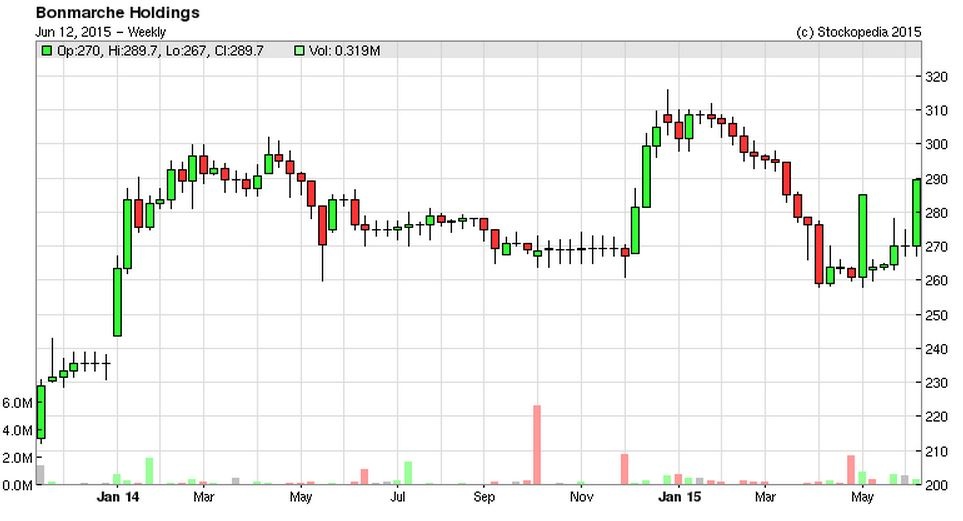
BON floated in late 2013, and has been a relatively successful newcomer to the market, trading at all times above its launch price of 200p. Checking back through my notes here, the shares had a bit of a wobble on 10 Apr 2015 (see my report) when it reported poor Q4 store sales (down 4.7% LFL), partly offset by good online sales. However the company reassured that it would still hit its full year numbers - so clearly management had played it safe, and kept a bit of out-performance in their back pockets, which smoothed over a softer performance in Q4.
Today we see those full year numbers, and my initial reaction is that they seem reasonable.
Revenue - up 8.7% at £178.6m, which benefitted from same store (LFL) growth of 4.0%, boosted to 6.0% once online sales are included. The balance of the increase must be down to new store openings, net of closures. This is a respectable performance in my view.
Profit before tax - it's best to focus on the pre-exceptional figure, which is £12.4m (up 10.4% on prior year). Again, a respectable performance.
The headline numbers show much bigger increases, but that is because last year's figures included a £3.3m exceptional item (which was mostly (£3.0m) cost of the IPO).
EPS - underlying basic adjusted EPS is 20.7p vs 18.6p last year.
If you want to be more prudent, then the diluted (for share options) EPS figure is 19.8p.
Dividends - a final divi of 4.5p has been proposed, taking the full year divis to 6.8p. That is a yield of 2.4% - not madly exciting, but it's almost three times covered, so should be regarded as fairly safe, and likely to continue growing.
Outlook - just general comments, but no nasties in there, so this is at least soothing:

Balance Sheet - all seems fine to me. The company has net tangible assets of £24.3m, which seems perfectly adequate for the size of business.
Working capital is strong, with a current ratio of 1.4, which is more than adequate for a retailer (which can typically manage on leaner working capital than most other sectors, since they sell for cash).
Finally, it has net cash of £10.2m, and an unutilised bank facility, so ample headroom there.
Valuation - based on this year's estimate of 21.3 EPS (which looks achievable, maybe even a bit low), then the PER is 13.3. That seems reasonable to me, especially considering the company has a decent balance sheet with net cash.
My opinion - overall I quite like it. This seems to be a company with good management, who are executing well. The valuation looks about right, and I expect to see this share gently trend upwards over the next few years, as earnings rise.
So I don't think it's going to set the world on fire, but looks a nice steady company to have in say a long term pension portfolio.
Personally I look for bargains, so it's the type of share I might buy on a mild profit warning, when the stock market throws a sale! There's relatively little fashion risk with older customers too, so even if it does warn on profit, it should recover.
I've looked at a few other things, but there are no results/trading updates from any other companies that even remotely qualify as Value, so I'll leave it there for today.
No video today.
Regards, Paul.
(Paul does not hold a long or short position in the company mentioned today. A fund management company with which Paul is associated may hold a position in BON - I don't know whether they do or don't, hence why I say "may"!)
Disclaimer
This is not financial advice. Our content is intended to be used and must be used for information and education purposes only. Please read our disclaimer and terms and conditions to understand our obligations.

5 comments
Thank you Richard and Whitepjs. As always, you have to know your company to know what sits well with it I guess.
Hi Paul,
I know it's a company on your blacklist for very good reasons, but I'd love to hear your views on the investor call transcript for Camkids.
http://www.stockopedia.com/share-prices/camkids-LO...
I was just shocked to see that the company may be real (in that they do seem to have real stores in real shopping centres!)
Hi Paul
As always thank you for your commentary.
You touch on the working capital with Bonmarche. Whenever you read about working capital the commentator always sites the supermarkets as the example of a negative working capital not being a problem. They never mention any other types of companies so, although you do not recommend that Bonmarche, or other retailers receiving cash payments should have a negative working capital I am interested to see that you are relaxed about the possible current ratio they have. Do you have any other good examples where a relaxation in your current ratio rule, or indeed a negative working capital amount is not an issue?
I'm happy if the experts set me right but negative working capital is a good thing Philip. It means that your suppliers/customers are funding your business. ie you have longer credit terms with suppliers than customers do with you.
In manufacturing you may have to hold stock for long periods but retailers try very hard not to - or not on their own balance sheets anyway.
The current ratio of less than 1, or negative working capital as you put it, only really works if you run a cash i.e. not credit business. If you sell things on credit and buy things on credit and the latter exceeds the former (net of stock and cash), then there could come a point when you cannot settle your debts. This may come when you suffer bad debts, your own customers extend the time they take to pay you or your stock becomes unsaleable. You can obviously then take longer to pay your suppliers, but if you have already stretched that time they may not choose to be your suppliers if you do this. I like Paul's margin of safety of 1.2+ for the current ratio. It allows for a degree of uncertainty and a good working relationship with your suppliers.