Small Cap Value Report (12 May 2017) - FTC, IPX, ETO, TTG

Happy Friday!
I usually talk about profitable rather than unprofitable companies, and Filtronic (LON:FTC) is currently the former rather than the latter:
Filtronic (LON:FTC)
Share price: 12.625p (+26%)
No. shares: 206.9m
Market cap: £26m
This company has been on the receiving end of some well-deserved scepticism on these pages in recent times, as it has a track record of losses and ended up significantly increasing its share count in fiscal 2016.
It makes radio frequency, micro-wave and millimetre-wave products for the telecoms and aerospace industries, along with other related products and services (best to take a look at its website!)
Excellent Q4 update today:
Trading during the fourth quarter of the current
financial year ("FY2017") in the Filtronic Wireless business has been
ahead of previous management expectations and despite some marginal,
short-term weakness in trading in Filtronic Broadband, the board now
expects total Group revenue of approximately £35 million in the year
ending 31 May 2017, with a commensurate increase to operating profit,
both of which are ahead of market expectations.
Checking the company's H1 report, I see that it made operating profit of £2.4 million from revenues of £21.6 million (and warned that H2 would be lower).
It's still a high-risk micro-cap, of course, and receives a "Highly Speculative" Risk Rating from Stockopedia.
The customer base is probably still rather concentrated. Last year's annual report said that "until we have expanded our product portfolio and customer base we will remain exposed to short term variations in demand patterns at our main customer". The top four customers in aggregate were responsible for a huge 74% of turnover.
Sales have much more than doubled in fiscal 2017 compared to 2016, so diversification should have improved now at least compared to that level of concentration.
Also, it has significantly strengthened its financial position after last year's placing - my initial glance at the interim balance sheet shows it has a significant excess of current assets over all liabilities (nearly all in the form of customer receivables, so it is relying on getting paid).
Anyway, I'm flagging it here as it might be worth more considered research if you have an interest in the industry and the appetite for this level of risk.
Impax Asset Management (LON:IPX)
Share price: 93p (+2%)
No. shares: 128m
Market cap: £119m
This report came out yesterday but a reader asked me to comment and since I follow the asset management industry, I thought I'd see if I could come up with a few words on it.
Having a listen to the company's webinar on the results, it's a simple proposition: investment focused on resource efficiency and solving environmental problems. 30 investment professionals manage £6 billion in AuM from offices in London, Hong Kong, New York and Oregon.
Food safety, air pollution and clean water are some of the big challenges and themes which the company works on.
Momentum in AuM is fantastic at the moment, reporting six consecutive quarters of inflows and the following H1 movement:
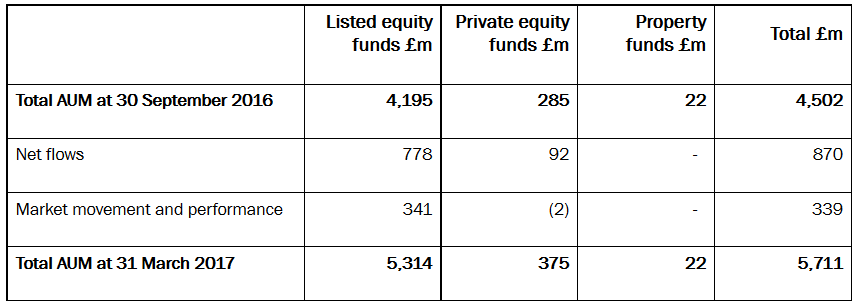
Scrolling down to the income statement, I see that operating costs reduced to 77% of revenue for the period, compared to 83% in the comparable period in 2016.
There is inevitably going to be profit-sharing with employees when you have a people business such as an asset management company, and variable staff compensation will usually rise with revenues, but you should still benefit from operating leverage as an investor and that reduction in % costs is the sort of thing to look for.
Interim dividend increases 40% to 0.7p from 0.5p, and is covered three times.
Balance sheet is fine, no debt and healthy cash reserves of £13 million (of which £6 million is a necessary "risk buffer", i.e. regulatory capital plus buffer).
My opinion
Sounds interesting, with the CEO talking about the capacity for £10 billion in AuM without the need for any new products.
The current market cap is just 2% of AuM, which strikes me as rather low. Depending on their fee margins, many active asset managers trade at higher levels than that - for example, Jupiter Fund Management (LON:JUP) is currently trading at 5% of AuM.
Of course, it's possible that Jupiter Fund Management (LON:JUP) is overvalued too, but I'd be inclined to think it's more likely that Impax shares are still too cheap, despite how much they've already risen.
Entertainment One (LON:ETO)
This is beyond our upper market cap limit but is well-followed by investors so I thought I would briefly mention it.
Entertainment One is a leading independent studio which owns a wide range of intellectual property across film and music, and is the controlling shareholder of the Peppa Pig brand. It also owns the leading kids show PJ Masks. The content library has been independently valued at $1.5 billion (£1,160 million).
Today's announcement is a semi-profit warning as the company warns of £47 million in one-off costs, while maintaining that "underlying EBITDA" will be in line with expectations.
These costs are both in relation to film distribution, making a one-time payment to end a prior agreement and incurring other costs to shift toward digital distribution.
There has been no shortage of drama at E-One. Last year, the company rejected an offer from ITV (LON:ITV) at 236p/share.
It's an appealing company because despite the debt it's carrying (£260 million at the half-year report), there is some great-quality IP on its books and the cash from operating activities has been huge (and has been spent on lots of investment in new IP).
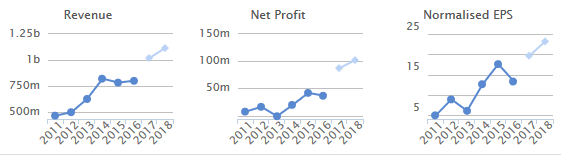
These investments are forecast to pay off and result in significant improvements in results, though it seems investors remain fairly sceptical.
TT electronics (LON:TTG)
This is an AGM statement for the four months ending April.
TT Electronics provides a range of products and services including connectors, resistors, semiconductors and sensors, for the transport, industrial, aerospace and medical industries. It has multiple offices in Europe, Asia and North America. So it's a truly international and multi-faceted business.
The statement is fairly upbeat:
Trading has been in line with our expectations overall. The Group's revenues are 10% higher than the prior year and 1% higher on an organic1 basis.
The Group's order book is strongly ahead of the prior year, giving us better visibility of the outturn for 2017 and reflecting a continuation of the momentum from the end of 2016. The development of our order book demonstrates that our strategy to position ourselves in structural growth markets where there is increasing electronic content is delivering results.
I've just checked the full-year results from March, and they were encouraging. Underlying PBT rose 20% at constant FX, or 40% at actual FX, to £26.9 million. The adjustments weren't too drastic, as reported PBT was close behind at £23.2 million.
It's one of those rare companies which reports its ROIC to investors and explicitly uses it as a KPI.
It achieved ROIC (underlying) at 10.3% in 2016, which is admittedly quite modest. Operating margin is also nothing to write home about at less than 5% at a group level.
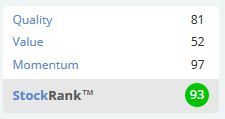
But this is one of those instances where I'd be particularly interested in the momentum of trading, as the order book grows and the company stages a turnaround from weakness in the 2013-2015 period. The Momentum Rank reflects improved fortunes and at a PE of 14x it perhaps merits a closer look.
Net debt should be manageable at £55 million, it is cash-generative and pays a dividend, and the StockRanks like it:
That's all for today, thanks for your comments and have a great weekend.
Best wishes
Graham
Disclaimer
This is not financial advice. Our content is intended to be used and must be used for information and education purposes only. Please read our disclaimer and terms and conditions to understand our obligations.

62 comments
TT Electronics entered a conditional agreement for the sale of its Transportation Sensing and Control division to AVX, for £118.8 million on a cash free, debt free basis. As a result of the disposal, TT Electronics will be in a much stronger position to focus on its strategy of investing in structural growth markets where there is increasing electronic content, with the benefit of significantly enhanced financial capacity.
Share price is up 8% on this news. Could be a lot further upside to come from this now they are better positioned.
Regarding the UK market, Stockopedia's home page currently has the median PE ratio at 14.5x, dividend yield at 3.13% and earnings growth at 13.8% - those seem like entirely normal metrics to me (taking into account that earnings forecasts usually do tend to be overly-optimistic at the market level).
Furthermore the headline FTSE100 index has heavy weightings of commodities and financials - sectors which have been out of favour for the past few years and which would benefit hugely from higher inflation if it does come through. Considering stock markets are priced nominally, if you gave me a choice I'd put my money on the index being 10,000 rather than 5,000 in a few years' time.
However I have thought that the US market has been verging on overvalued for the past couple of years, and if it corrects others will follow. My main concern is we're clearly coming to the end of a multi-decade bull market in bonds (since the early '80s!). While you theoretically can't lose money on bonds when held to maturity, this is a huge beast of a market where investors have gotten used to capital gains, and these will soon turn into paper/mark-to-market losses when yields do rise.
Thought provoking discussion on where we are in the market cycle at the moment. An often used analogy is that as investors we are "climbing the wall of fear" - as the market goes up the views improve but there is a growing fear that as and when we eventually fall off we come down with a harder bump. The less risk averse climb down into cash earlier, the braver/more foolhardy keep climbing (often fueled by leverage) and either get down in time (having made more on the ascent) or end up in the back of an ambulance (or hearse!).
I'm by no means a TA (and apologies to those who are if the following stream of consciousness jars), but in the spirit of “a picture painting a thousand words” I thought the attached chart might be worth considering:-
The main chart gives a long term monthly view of the FTSE All Share index since 1981 (the maximum data set on Stockopedia) re-based on an exponential basis (otherwise the current data trends would swamp the old). I’ve superimposed the Bollinger Bands as well as two simple long term moving averages for 12 and 60 months. At the top there is a chart of the RSI for the same period. A few observations:-
The chart is deliberately long term with slow moving averages to try and give more of a historical perspective. One thing I have learned in 30 years or so of investing is that when bombarded with the daily market cacophony of “white noise” it is really difficult to take a step back and see the bigger picture (terrible mixed metaphor!). In my layman’s view, while the markets might seem “expensive” at the moment, I think we are in the upper quartile of valuations rather than being at or beyond boiling point.
Absent a “new paradigm” giving a step change in market valuations (which I agree with an earlier comment is usually a good indicator of when to head for the exits), the odds seem to be moving towards downside rather than upside but in the meantime could well run up further (nothing like sitting on the fence is there?). Whether the downside is one of the occasional tsunamis a la 2008 or 1999 or just a short term corrective blip like 1987 or 2015 is moot. Perhaps perversely, the longer the markets bulls continue to climb up the wall the harder the bump when we eventually fall off. Given the often mixed messages of where we are in the cycle I’ve found it beneficial to avoid going “all in” on a particular strategy holding a pretty widely diversified portfolio of different asset classes and asset types within the classes. Probably more cash and defensive assets at the moment than this time last year but still happy to keep a decent exposure to good quality stocks and funds (and a few Sucker Stock dogs as well).
Gus.
How did you get the chart to go back to 1981? When I try, it refuses to start earlier than 1997.
Hi Nick.
Not sure if it makes a difference but I used the old style chart function for the ASX index found under the "Home" section as opposed to the new version and selected the option for "maximum" data.
Gus.
Thanks Gus. That is actually very useful. I wanted to look at it using a log scale because I have a feeling that the current growth is really historically not that exceptional, but I've never been able to find anywhere that goes back this far with ASX.
So anyway, fwiw, here it is with a log scale. It puts a slightly different feel on things to my mind.
Hi Nick.
Your reply made me realise that although my commentary referred to a log scale chart, I'd mistakenly pasted in an absolute levels link. Chart should have been as below:-
Same basic story, but makes some of the earlier sell offs (especially 1987) a little bit more apparent and dilutes slightly the visual impact of the 2000 and 2008 sell offs. Also suggests that since 2000 there has been a fair bit of "treading water" compared with the sharp rise in the preceding 20 or so years.
Gus.
Hi Gus - I may be wrong but both your graphs are on a log scale. The scalar difference on the y-axis is multiplicative in both cases and not linear.
Happy to be corrected.
Hi Ram.
I think you may be commenting on the scales in the charts in posts 53 and 54 (which are, as you say, both on a log scale). My post 54 was referring to and correcting my original chart in post 50 (which was on a linear scale). Hope that makes sense.
Gus.
Yes. makes absolute sense. Cheers.
Regarding the MACD, this does seem to give quite clear buy and sell signals as it crosses over the signal line, eg. sell in late 2007 and buy back in mid 2009. Likewise the crossing of the 12 month moving average gives the same signals at the same time. So on that basis we are ok at the moment. But then who knows what is around the corner.
Anybody else worried that some companies may have been affected by the global ransomware attack?
The nightmare scenario is having all their data encrypted and no backups.
Interesting discussion here from the bulls and bears.
I noticed a few comments about the "safety" of large cap, defensive stocks. I agree these stocks tend to have lower volatility and can be good investment choices for risk off situations. However, in my opinion, all stocks are inherently risky. Just because you hold a portfolio of large cap, defensives such as Tesco, Unilever or British American Tobacco doesn't mean you are immune from irrational behaviour of investors/traders panic selling in a market correction. Just look at Sainsbury's share price in 2007/2008...
For me, the transition must be between equities & cash/bonds, not speculative and defensive stocks. Although the relative strength of defensive stocks are higher than speculative shares in bear markets, that does not necessarily equate to positive absolute gains.
I use technicals to identify whether we are risk-on or risk-off (Minervini inspired) and scale back into cash when appropriate. The technicals on my stocks are still bullish so I don't need to panic just yet. When the technicals begin to weaken i.e Burford Capital then I sell and lock in my gains.
I don't know if anybody out there has friends who can talk through an issue like this with - I know I haven't, which is why these bulletin boards/forums exist. Certainly most of my friends wouldn'know a PEG from a clothes line. But I do have one pal who is more of a trader than a long investor who i meet once a month.
For the last 6 months our conversation begins with "when is this bull going to stop". We still don't know and more to the point we still don't know what the trigger will be - Italian election, car buying on PCP, Brexit problem, mountainous debt, Corbyn winning the election, Trump emigrating to Russia, rampant inflation, ill judged interest rate rises- take your pick.
However we like to look at it, being hugely weighted in cash is sleep worthy but but not wealth enhancing. What I have not heard of yet is a mention of bonds. When I seriously started to make use of money from early retirement (after the 2007 crash) my thoughts about structuring a portfolio turned first to income (we all know about the reinvestment adage) to supplement pensions. With that in mind I looked at the ORB and the plethora of retail corporate bonds yielding a minimum of 5%. With this you get guaranteed payback (I trust) and a good yield. I know the new issues market has dried up but even now at heightened prices there is some security in this. I personally have about 30% of the portfolio in this area.
With this yield bias, first mega caps (little gains) were added and as more security was achieved small caps have turbo charged my portfolio so much so that like everyone else I do not wish to lose out.
My point is that it's not just a binary issue , cash or equity, there are other options.
My other point is that share prices are not just about Macro economics (yes baby and bathwater), good quality small caps with international exposure and no gearing are still good investments - maybe it's a question of the quantity of quality you are prepared to hold. A time for weeding or re evaluation maybe.
As always the decision is yours - just don't wait until circumstances decide for you.
Look forward to the ever interesting daily discussions
Steve
I agree with everything you say Steve I have always been a Bear so my view is extreem, the only reason I discuss it here is to help those who are new to this game to realise that the gravy train does stop and when it does it is often a train wreck. In my book investing or trading is about making money and being satisfied when you have. As for bonds do you not think that the next/ only phase in the interest rate market will be up? So bonds are down. I remember many years ago I was giving a seminar when one of the audience told me that building society preference shares could never fall by much because of the security of the building society movement. This argument was followed by journalists who are never responsible for the advice they give. Well we now know differently don't we I often wonder what happened to the man in the audience, he certainly didn't become a client so I will never know for sure but I can guess. I believe you can make a very good profit out of the market without taking unacceptable risks. Obviously you might make more money taking bigger risks but you can also lose it all.
As a buy-and-hold investor all that really matters to me is that I'm comfortable owning the companies I'm currently invested in and I have confidence that those companies will provide a long-term stream of income that will on average grow over time. This is very much Buffett's view I believe, and he has stated that he takes no interest in the day-to-day movements in the prices of the shares he owns and is only concerned with the fundamentals of the businesses themselves.
He laid out his philosophy on pages 18 and 19 of Berkshire Hathaway's 2014 letter to shareholders, and I was comforted to find it matched my own approach (classic confirmation bias?). A couple of selected paragraphs:
"For the great majority of investors, however, who can – and should – invest with a multi-decade horizon, quotational declines are unimportant. Their focus should remain fixed on attaining significant gains in purchasing power over their investing lifetime. For them, a diversified equity portfolio, bought over time, will prove far less risky than dollar-based securities."
...
"Investors, of course, can, by their own behavior, make stock ownership highly risky. And many do. Active trading, attempts to “time” market movements, inadequate diversification, the payment of high and unnecessary fees to managers and advisors, and the use of borrowed money can destroy the decent returns that a life-long owner of equities would otherwise enjoy. Indeed, borrowed money has no place in the investor’s tool kit: Anything can happen anytime in markets. And no advisor, economist, or TV commentator – and definitely not Charlie nor I – can tell you when chaos will occur. Market forecasters will fill your ear but will never fill your wallet."
Despite getting a kick out of seeing a sea of green when I open up my portfolio screens in the morning, I don't particularly like it when markets become highly valued, and unless I think the world is about to come to an end (in which case it doesn't really matter what happens to the portfolios I manage) then I welcome major panics and corrections as it simply means that I'll be able to buy more stock at lower prices, both with fresh cash that I've been accumulating and from dividend reinvestment.
I was somewhat surprised at the reaction to my comments a couple of days ago on the SCVR regarding the potential threat of driverless cars to long-established businesses in the motor distribution chain, but it made me realise that many Stockopedia investors likely have equity holding periods much shorter than mine. I have no problems with that and I'm sure for many it's a very profitable strategy - it's just a modus operandi that I'm uncomfortable with because I've never been successful at short- or medium-term trading and I'm a poor market timer.
In short, I like to sleep well at night whatever equities are doing, but if we do have a 30% market decline then I'll be the proverbial kid in the sweet shop.
This should be a discussion for Moday when the markets are open, not Friday when we have a weekend to worry about it all!
Yikes... this thread is giving me the jitters.
I'm heading over to ADVFN (might take the ostrich with me).
I think at this point of the cycle it's relatively easy to construct plausible sounding arguments on both the bull and the bear side.
Sure the markets look expensive but they can continue to look expensive for extended periods of time, so that by itself should not be considered a sell signal in my opinion.
I'm staying mostly invested but continue to watch the index trends closely as well as the wider macro picture.
There seems to be lots of advice that basically says you can't time market purchases etc. Which I obviously would agree with, but perhaps the time is ripe for another series of Stockopedia notes on the broad issue of exposure in a bull market.
Its like all sage advice it has to be keep given, because the old monkey mind is always jumping about. I suspect most on here fear that all the considerable time and effort invested in investing in this market, and associated gains could simply be wasted in effect, if a meaningful retrenchment comes along.
Now where's that banana!?
Here is a thought You started with a £100k at the beginning of January and you are sitting on a gain of 20%, most on this site will probably have more than that. You would have to have £4million or more in the bank to give you the same return. Investment is about beating cash, is that not a fair reward. If you cashed in and waited until you felt more comfortable about what is going on and the market continues to go up it will be a long time before you are worse off for being in cash. Wealth isn't always created in a hurry, that famous Rothchild quote when asked how come he was rich, still stands today, sometimes it is wise to leave the last ten percent for the next man.
Ken, if you sell and the market keeps going up then you are worse off straight away. I would look at Warren Buffett he is most fairly fully invested, he did write an article about why he does not like being in cash. But I think switching from small caps into large defensive caps with decent yield could be a wise move. I have virtually sold out of some sectors also, I would have sold more but for capital gains tax. I have also bought some gold. Have not got any index shorts on at the moment but I think after the election I may do some.
No argument from me herbie, but I treat investing differently to trading-- having said that I closed all of those positions too, so I am really defensive. The first post I ever put up on this site was about a very good friend of mine who bought Sage for £20k and he wouldn't sell because of the CGT Sage went to £9 and back down to £2 50 I did plead with him to sell when he was making millions, but he wouldn't. . Last year when Brexit happened I was still invested, about 25%, sold at the bottom ( coincidence not skill )took the loss and bought back immediately in my ISA so got the bounce but set off the loss against other profits. With CGT at such low rates I would advise anyone to consolidate current profits and sell and buy back I appreciate that normally that would require a month out of the market but not if you want to restructure into other markets. sectors or even current buys.
I was not really talking about trading, just the difference between being invested or not. I think most people worry too much about losses, it's human nature and I do it myself, that's why I take some profits too early. Re CGT I certainly don't have millions, I have sold about half, I got caught out last year as I used up most of my CGT allowance when moving some high dividend shares into my ISA, one company got taken over, so I'm going to have to pay some CGT on that profit. How do you mean sell, you mean everything or just upto your CGT allowance?
Hi Herbie , CGT let's say you sell everything in your portfolio, you consolidate all profits at a tax rate of 10 % or at worst 20% less the annual allowance of £11300. I would suggest that the current rate will be increased in the not too distant future. Obviously you can take the amount of payment required out of the profit. I am sure you remember when CGT was 40%. Some might argue that the future growth will be reduced if you only reinvest 90% but that only applies if the portfolio is small enough to always qualify for the personal allowance each year. You could always die which means no CGT but it is an extreme form of tax planning.
Got to go now Herbie and continue rereading the magic of Minervini who I believe is also almost all in cash at the moment.
I've read pessimistic commentary from lots of people for years now saying how the market is expensive and a crash is coming imminently and so on. Most of those have missed out on big gains due to their pessimism. Yeah we'll have a correction at some point but I'm not worried.
Hi Ricky There are two high risk strategies --being in cash when the market goes up and being in stock when the market goes down one you lose and one you don't gain,the years have taught me "the don't gain" is better. That being said the market is not about what we know it is always what we don't know that turns into the biggest losses and you rarely find someone who gets it absolutely right either way, but you always find lots who will tell you what has happened--- after the event.
Regards
Ken
Hi Ken,
I guess we're all wise after the event! I agree that not gaining is preferable to losing. Here's where I'm coming from, I know a few people who've been mostly gold since 2011 and shunned stocks fearing a crash/bear market. They're not happy bunnies to say the least. Perhaps we'll soon enter a bear market and gold will break it's 2011 high. Who knows. Bottom line, they missed out on big gains in a great bull market. For me, some investors overrate gold and look at it with rose tinted glasses.
Kind regards
Ricky
I share your concerns simoan. My portfolio definitely has a smallcap bias - the majority are high QM "high flyers" and a mix between balanced, adventurous and speculative. I don't use leverage and mainly insist on an income stream from my holdings. The stand out observation in my PF is the low value rankings. So yes, I would expect those valuations to correct at some point.
But therein lies the dilemma, "at some point". All of the smallcap growth shares in my pf are reporting strong results, a fair few are ahead of expectations with broker forecasts being upgraded. The tech sector is going through a bit of a purple patch business wise; next gen smart phones, augmented reality, the data revolution, SaaS solutions with recurring revenues, robotics, machine learning, fintech, adtech - the US is key to many of these sectors of course and if Trump gets his corporate tax cuts through, these companies are going to be making more money and throwing off even more cash. I can sort of understand why we are in such a strong bull market.
This feels to me like the whole initial internet boom and Y2K thing. Many, many people were calling the top a year or two before it all came tumbling down. But before that happened, fortunes were made (and some were subsequently lost) but only if you were in the market, owning the high flying shares.
I think the UK itself is in a different and precarious situation. Just around the corner we have rising inflation, rising interest rates and the challenge of extricating ourselves from the EU. My own take on this is that a lot of internally focused UK companies could begin to unravel this year with profit warnings and reduced outlook statements. Personally, I am mainly avoiding these companies and focusing more on exporters and those with a decent portion of trade in the US, in particular.
The other factor to consider with UK shares though is the prospect of increased M&A activity which I believe has already started - Waterman (LON:WTM) being a good example just this week. This could fuel the markets still further.
The other action I'm taking to try and benefit from this bull market while also being mindful of the downside risk of a crash/correction is to regularly top slice (and I mean "slice" not "chop") my winners into more defensive holdings which will also serve to increase the diversification. The problem with going into cash is that it hurts both the growth and income of your portfolio as I found to my cost last year when I held c40% cash between June and October.
Regarding leverage being used on smallcaps, I suspect the launch of Stocko's risk ratings will serve us well. My own hunch is that those shares that have more leveraged positions are more likely to be highly speculative and speculative (although the wide spread on some smallcaps also increases the volatility). Personally, I have a lack of conservative ratings, so when I do my next rebalancing, I will be adding more ballast to my pf - larger caps, conservative risk rating, high yields.And I will continue to feed these holdings so long as my growth holdings are growing. I'm sure I'll still take a hit when the music eventually stops but hopefully, I will have recycled sufficient cash into defensive holdings to a) absorb the shock and b) provide funds for value hunting in the aftermath.
You asked!!!
Cheers
Simon
"The other factor to consider with UK shares though is the prospect of increased M&A activity which I believe has already started"
Is this not often a precursor to a crash?
Think your strategy looks good.
Dave
"The other factor to consider with UK shares though is the prospect of increased M&A activity which I believe has already started"
"Is this not often a precursor to a crash?"
I don't know, I haven't studied any data around this. Anecdotally, it seems to me that the value plays are more susceptible. Perhaps the time to become concerned is when the more expensive stuff starts being acquired?
"Think your strategy looks good."
Thank you, we'll see. I top sliced a few of my high flying stars at the beginning of this quarter (Bioventix (LON:BVXP), SYS1, Amino Technologies (LON:AMO), £PEG) and three of those have already risen sufficiently to be back around the holding amounts when I top sliced. I can see quite a big rebalancing coming in June/July if things carry on at this rate - enoyable while it lasts but always in the knowledge that it will end at some point.
You asked!!!
Yep, so I did! Interesting thoughts and you make some great points. However my chief concern is not really with macro factors but rather more with what is fuelling the run up in the share prices of even the flimsiest quality smallcap? Sure, there are some really good quality companies out there but you wouldn't normally pay a PER >20x or a FCF yield < 4% (if you're Terry Smith). The use of leverage really concerns me as it will affect us all, not just those who deploy it, and although I hear what you say I don't believe for one minute the Risk Ratings will change that.
All the best, Si
simoan, I agree with you about being in shares where a lot of PIs have leveraged positions. That was really my point about the Risk Ratings. Those ratings highlight the high volatility shares and it is more likely that high volatility shares are owned with leveraged positions - because leverage tends to create volatility.
Graham,
Do you not think the market undervalues the potential monetised value of the Peppa Pig brand to ETO? Putting a value on this do you think the stock looks cheap?
Thanks
Hi wheelo, I'm afraid I haven't done enough research to answer that Q.
Graham
Filtronic, know them well both as a supplier and a customer. Wouldn't touch them with a punt pole. Mngmt seem to run from crisis to crisis, the thing needs taking private.
IPX, the spread is far too big and the Value Rank is way out of my league.
The current market cap is just 2% of AuM, which strikes me as rather low. Depending on their fee margins, many active asset managers trade at higher levels than that - for example, Jupiter Fund Management (LON:JUP) is currently trading at 5% of AuM.
Of course, it's possible that Jupiter Fund Management (LON:JUP) is overvalued too, but I'd be inclined to think it's more likely that Impax shares are still too cheap, despite how much they've already risen.
It could also be that the assets held by Impax Asset Management (LON:IPX) are far riskier and so a suitable discount is being applied by the market? It certainly seems that way to me when I look at where they are invested. Sometimes new approaches to things are unique for a reason! :)
BTW before I get flamed, I hold some £IPX!
All the best, Si
Hi Si, well that is probably true about the riskiness of the assets but what counts is the fees... you can charge more for managing riskier assets :)
Graham
A lot of buy orders for Waterman this morning at 140p, the price offered by bidder ITC. Pure speculation, or do some people know more than I do?
I am a happy holder.
Richard
Sold mine yesterday at 140p. Don't expect a counter offer given what the bidder holds now, just happy to take the money early. If there is a counter offer good luck to the current holders
Ditto re Waterman (LON:WTM) just sold mine too @140.05
Hi Simoan. I am also slightly concerned but at the same time I fear that I would seriously regret it if I sold up now and watched all my holdings go up another 20%. My portfolio is currently 25% leveraged but as a complete amateur I'm fairly sure that isn't sensible and probably a pretty clear cut case of irrational exuberance. My personal view is that I am so far into profit in the last 12 months that even if my portfolio took a 10% haircut, I would still be in a good place. With that in mind I keep a mental 10% stop loss on growth shares and leave a little more room for manoeuvre on value shares. The big question is how easy will I find it to sell a share I like on a 10% drop. I guess only time will tell.
Hi Ben,
I suspect you are not alone in this position and that is why I asked the question. I think you need to consider what happens if you wake up one morning to find the market has tanked overnight, liquidity has dried up in the smallcaps you hold, and you have a margin call on your SB account? A 10% stop loss won't mean much in that scenario. I think it's been too long since we've had to consider this scenario as investors, and I feel there is now considerable complacency in the small cap retail market.
Thanks for your candour, even though it's only reinforced my concern :)
All the best, Si
Your concern is understandable, after all I had just finished my bachelors dissertation the last time we entered a bear market and probably didn't even know what a 'small cap' was. I think I'll probably end up learning the hard way one day but I'll consider it the price you pay for an education and will hopefully come out of it the other end as a better, if slightly poorer investor. It is worth noting that I do hold about 20% of my portfolio in defensive large caps so I am hoping that will give me some breathing room in the event of a black swan.
Hi Graham,
I know that Eagle Eye (EYE) is low on the Stock Rank register, but it might prove a future growth stock, so I have opened a small "starter" holding on this mornings announcement of a three year contract with John Lewis.
I would be very interested in your thoughts.
Nick
Thanks for the report on Impax Asset Management (LON:IPX) Graham, I am seriously tempted to have a dabble here, I am struggling to see what's not to like. What a great service you and Paul provide. Expert reports on request, well worth the Stockopedia subscription alone and that's not accounting for all the fantastic work Edward and his team do. Thanks also to Dave for flagging. I do think the sharing of information between readers is a big part of what makes the SVR such a great tool for people like myself who are at the very early stages of their investing career, and experienced hands alike.
Thanks for the kind words Ben, and as you say also cheers to Dave for flagging up IPX in the comments section yesterday.
Bruce, that's a good point you raise on competition. I think a specialist has an inherent advantage in the sector so hopefully IPX would at least maintain their share of business as the market grows.
Regards
Graham
Thanks for the report Graham. The growth of Impax in the USA is also significant. They now have £1bn from US investors if I recollect from the presentation?
The growth of the sustainability theme worldwide (yes even in the States in spite of Trump!) should not be underestimated.
Dave
Hi all,
Being as it's a Friday I hope others will indulge me in attempting to start a general discussion about valuations in the Small Cap space. It seems every time I bring up a StockReport the growth, value and quality bars on the right are a sea of yellow, orange and red and the chart looks like the north face of the Eiger. At first I really liked the colour scheme used by the StockReport but now I'm starting to think that maybe they are having a psychological effect on my normal thought processes.
I feel uneasy about valuations at the moment and that I've seen this story before and know exactly how it ends but at the same time seem completely powerless to act. It's psychologically very difficult to sell shares when you have cash to invest as I currently do, especially when everything is heading north at a rate of knots.
What particularly concerns me is how much of this is due to leveraged long positions. I never use leverage but would be interested to know others thoughts and how much leverage they currently have in small caps.
All the best, Si
Hi Simoan. I am also slightly concerned but at the same time I fear that I would seriously regret it if I sold up now and watched all my holdings go up another 20%. My portfolio is currently 25% leveraged but as a complete amateur I'm fairly sure that isn't sensible and probably a pretty clear cut case of irrational exuberance. My personal view is that I am so far into profit in the last 12 months that even if my portfolio took a 10% haircut, I would still be in a good place. With that in mind I keep a mental 10% stop loss on growth shares and leave a little more room for manoeuvre on value shares. The big question is how easy will I find it to sell a share I like on a 10% drop. I guess only time will tell.
I understand how you feel and I have now liquidated all of my portfolio apart from gold related, but even that I have reduced as a result of recent market activity. As you say we have seen it all before and it is difficult not to get into the game when the cash is sitting in the bank achieving almost nothing. I have put it down to recent red flags that have just peaked over the barricade. Last week in Eds webinar he mentioned in all innocence that the aim market has shown great gains compared to the other Indecies. That tells me a lot about mature bull markets as does high prices for small cap stock. Finally I have feeling that if an analysis was carried out we would find the purchasers of stock today are the same group as those who bought the last bull market ending. Where else would you put your money when riches are there for all to see?
Quite topical:
https://www.ft.com/content/406ba2c0-369a-11e7-bce4-9023f8c0fd2e
Hi foolishben did you really mean to send me a link for a subscription to the financial times???
Apologies, I forgot the FT is subscription only. It was actually an article about the lack of volatility in the market and backs ups your cautious view on the current state of play. The punch line was:
"It's a train wreck waiting to happen. The longer we go without a healthy pullback, the worse the eventual crash will be. All we know is it is not normal, not healthy and will not last"
I think you and Simoan have made me realise it may be time to ease of the leverage a bit. I probably owe you both a thanks in advance.
Re foolishben's reply to this- I think if you register with the FT you are allowed about 3 articles a week foc?
You definitely get about 5 articles a week free if you register with The Economist. Well worth it imo.
Dave
I understand how you feel and I have now liquidated all of my portfolio apart from gold related, but even that I have reduced as a result of recent market activity. As you say we have seen it all before and it is difficult not to get into the game when the cash is sitting in the bank achieving almost nothing. I have put it down to recent red flags that have just peaked over the barricade. Last week in Eds webinar he mentioned in all innocence that the aim market has shown great gains compared to the other Indecies. That tells me a lot about mature bull markets as does high prices for small cap stock. Finally I have feeling that if an analysis was carried out we would find the purchasers of stock today are the same group as those who bought the last bull market ending. Where else would you put your money when riches are there for all to see?
Hi Ken,
Thanks for your thoughts. I think it's fair to say you are a little more bearish than me :) It's always interesting to hear what others are doing, which is why I value the SCVR so highly but the best approach will depend on your personal circumstances. I'm a long way from going 100% cash and gold but at the same time I'm becoming more attuned to the downside because I'm starting to feel giddy and drunk on my recent investing results, which is never good.
The main problem I am finding is that I've started feeling like I might be good at this investing lark and could even do it full time, when in fact I'm just riding a wave with all boats rising fuelled by others using leverage, and that's what worries me because when the music stops I know I won't be alert enough to have a chair to sit on! At the very least, I should pay more attention to the liquidity of the shares in my portfolio...
All the best, Si
I don't use leverage either. Not saying people shouldn't, it depends upon an individuals risk tolerance but surely 6-7 years into a bull market is not the best time?
I think from several comments during the year Paul lost loads in the last crash due to leverage in small caps? Sorry if I got this wrong Paul. I lost loads in the 87 crash. I used leverage without realising it- my company paid me a big bonus gross and the tax wasn't due for 12 months. I invested the lot, market crashed and I had to sell to pay the tax.
I am in defensive mode but will benefit from any upside in the interim. I have 10% in safe high yield in my SIPP (Next, Phoenix etc); 30% in UK small caps, 30% USA large caps and 30% cash to jump in if the market crashes. With inflation so low holding cash does not cost much in real terms. I may miss out on a bit of further upside but at least I can sleep at night.
Dave
Hi Simoan,
I also have concerns about current valuations and how sustainable the continued rise in the markets is. I am not leveraged but have been taking some profits here and there over the last few months.
This last week, however, I have sold 25% of my portfolio and am content to sit on this in cash whilst things pan out. I guess it is down to one's own macro view and risk tolerance.
My own view is that indices and other assets such as UK housing have been artificially inflated for so long that something has to give somewhere and I expect a pullback (at least) before too long. That said I also have a nagging thought that keeps saying to me where else at the moment is anyone realistically going to put their money than equities to get what they hope might be a better return than in cash.
I am just waiting for one of those highly ominous portents of either a taxi driver or my mother giving me a share tip and I will sell down a whole raft more!
Richard
I am just waiting for one of those highly ominous portents of either a taxi driver or my mother giving me a share tip and I will sell down a whole raft more!
I agree. My own personal trigger will be the first mention by a market observer of the term "new paradigm" :)
All the best, Si
I drive a taxi!! just joking--but your right about "new paradigm" mentioned by some commentator right at the top of the Japanese Market 1990, I think it was, never been that high since and again Tech Market 2000. All experts!!
My only leveraged position is the VIX index. 'When the VIX is low, it is time to go.'
That said I am substantially underwater so was grateful for Foolish Ben's paraphrase of the FT opinion.
It was difficult to know who to reply to because there were professional opinions expressed by crazycops, daveinthelakes, Ken lowes, simoan and others. I shall not compete, just acknowledge.
It is the 'how long?' question which is so difficult. There could easily be a 'flash crash' over a political event before the economic scenario deteriorates.
Hi Graham, definitely interested in your thoughts on Impax.
A few years ago there was some question about the scaleablity...when they got above £5bn AUM were there enough assets for them to invest in? And also as "sustainable" investing becomes more mainstream, competition increases.
Disclosure...I own it. But interested in your thoughts.