Small Cap Value Report (12 Nov) - SAVG, ACSO, AND, TRI, IND

Good morning! Shareholders in Savile (LON:SAVG) are being put out of their misery with a takeover bid from larger competitor Penna Consulting (LON:PNA). This makes complete sense in my view, as it had become fairly obvious from recent performance that Savile was not a viable standalone business. So the generous 115% takeover premium should be warmly welcomed by holders in my view, as the alternative would have been a de-Listing and the likely 50%+ fall in share price beforehand.
Lo-Q has changed its name to £ACSO, and there is an announcement today confirming that the change is effective as from today. They also issue a trading update covering the 52 weeks to 3 Nov 2013, which reads very positively. The market cap is currently £135m at 685p per share, a valuation which is about 4-5 times what the historic figures would support, so clearly the company has to deliver significant growth just to stand still in terms of share price.
Group revenue has grown 29% year-on-year, through organic growth and the acquisition of accesso LLC in Dec 2012. So by my calculations that puts turnover at £37.5m, so the PSR (price to sales ratio) is a pretty racy 3.6 (anything above 1 tends to indicate expectations of growth, but it depends on the operating profit margin achieved, so a higher PSR is usually given to companies with high operating profit margins).
As the saying goes, turnover is vanity, and profit is sanity. So in this case shareholders will be pleased to note that adjusted profit;
"is expected to be comfortably ahead of current market expectations and at least 48% ahead of the performance achieved in 2012"
So looking back to their 2012 results, I cannot see adjusted profit disclosed, but ordinary profit before tax was £3.15m. So assuming that is the correct comparative to use, then this implies a rise to about £4.7m for 2013. Last year the tax rate was exactly 20%, so assuming the same rate this year, then that takes earnings down to £3.76m. So at a market cap of £135m the PER is now just under 36. So that's an aggressive valuation, that factors in continued strong growth. Paying up-front for several years' future growth just is not an attractive proposition to me.
Although like all growth companies, it's looked expensive all the way up, for several years. So I can see the logic for getting under the bonnet properly, and once you're sure that it's the real deal, just paying up for growth - which is what existing shareholders have done, and been very successful at. That strategy is risky though, as any disappointment will see a gut-wrenching pullback. So to my mind a PER of about 20 would be as far as I'd be prepared to go, which equates to a share price of 382p (cue hoots of derision from shareholders!).
The UK market is about to open in 5 minutes, and the Futures are indicating a fairly flat open, with the FTSE down just 3 points to 6,727.
I flagged Andor Technology (LON:AND) here on 18 Jun 2013 as "potentially interesting" at 294p per share, after a profit warning, but unfortunately didn't follow up on the idea. Pity, as there's a 500p indicative offer from Oxford Instruments announced today. Broker WH Ireland thinks this could possibly flush out a higher bid, pointing out that companies like Andor don't come into play very often.
A lot of people avoid "catching falling knives", i.e. buying shares after a profit warning. However, in a bull market I think one has to be more flexible, and a short term disappointment from a fundamentally good company can provide an excellent opportunity to pick up some cheap shares, providing you can cope with a bit of a short term drawdown (i.e. a short term loss) - something that doesn't bother me at all, because you can't time the bottom exactly every time, so if it's good value then further falls are just an opportunity to pick up more cheap stock.
If it is a fundamentally good company, then the shares should start to recover reasonably quickly (after a few weeks usually, in a bull market, or sometimes almost immediately). Remember that investors are seeing the glass half full at the moment, and that provides opportunities, so it doesn't pay to have a continued bearish mentality in a bull market. For the time being anyway, although none of us know how long this exuberant market mood is going to last.
I remain convinced that we're overdue a sharp correction, so am positioned accordingly - with spare cash on the sidelines, ready to pounce on any bargains. Although I'm still finding bargains, and am happy with all the stocks I currently hold - so a (say) 10% market correction wouldn't shake me out of any of my current holdings, as they are all held because they're good value, so a fall in price would make them better value.
Let's look at the interim results from Trifast (LON:TRI) next. Trifast is an industrial fastenings group (manufacturer & distributor). They presented at a Mello Central investor evening some time ago, and I was left underwhelmed - mainly because it seemed such a boring, low margin industry, that it was difficult to see anything much happening.
I was wrong on that though, as actually Trifast has performed pretty well, with interim EPS rising to 3.06p today (2.9p diluted). So assuming no particular seasonality, then that means a run rate of about 6p EPS. Broker consensus is for 5.22p this year, so they appear to be out-performing against forecasts.
The shares have risen nicely this year, and are now 84p, so I make that a PER of 14, which looks about right if that level of performance is set to continue or improve further. An interim dividend has been re-introduced, but it's only 0.4p. The outlook statement sounds upbeat. They also have a good strong Balance Sheet.
Overall, the company has done well, but it's difficult to see much upside from a PER of 14 for a business in such a highly competitive sector.
I have to nip out for a Pilates class now (it was the only time they do them unfortunately), but will update a bit more when I get back, as there are a couple more results statements I want to review - so please refresh this page about 1pm today for the final update.
Right, I'm back from the gym now - blummin' typical isn't it, the one day I decide to nip out, and my largest shareholding, Indigovision (LON:IND) issue a trading statement! Somehow that evaded my diary system, which will need to be investigated & the culprit severely punished.
Now I fully accept that because it's been my largest position for over nine years, and I've been permanently bullish over that time (in fairness, to varying degrees), that people don't take the slightest notice of what I say about this company any more! Let's be realistic. However, please just humour me on this one.
The reality is that IndigoVision had a remarkable market opportunity when I bought in around 2004, and the shares did extraordinarily well until May 2007, when they peaked at £10 a share (I did my main buying in 2004 at sub-50p, from memory, and held all the way up [and down!]). However, with hindsight, they let the grass grow under their feet, and competitive pressures had eroded their advantage from class leader to a top-end niche player, with a narrow product range.
They compounded their problems by trying to broaden their product range into cameras, but fluffed it through inadequate product development processes, which caused a traumatic period for the company a few years ago when they had a lot of warranty claims to deal with, and their reputation certainly took a knock.
However, those problems are now behind them, and I have been highly impressed with the new CEO, Marcus Kneen, who took over about 2 years ago. I meet him every six months, and he has been carrying out a very clear, logical 3-year turnaround plan. Year 1 was to put in place the correct people & processes (where things had been somewhat chaotic previously). Year 2 was to introduce new product - on a new model of out-sourcing the development to sector specialists, with IndigoVision giving them the required specifications, and the software. Year 3 (which is where we are now) is when they go for sales growth.
So the sales & marketing budget was increased significantly earlier in 2013, and this was expected to lead to a fairly soft period of trading until the second half of 2014, due to increased overheads, and time lags in getting the new salespeople up to speed in selling what are fairly complex products (networked high end CCTV over IP systems).
Rather a long preamble, but I wanted to explain the background properly. Here is the 12-month chart:
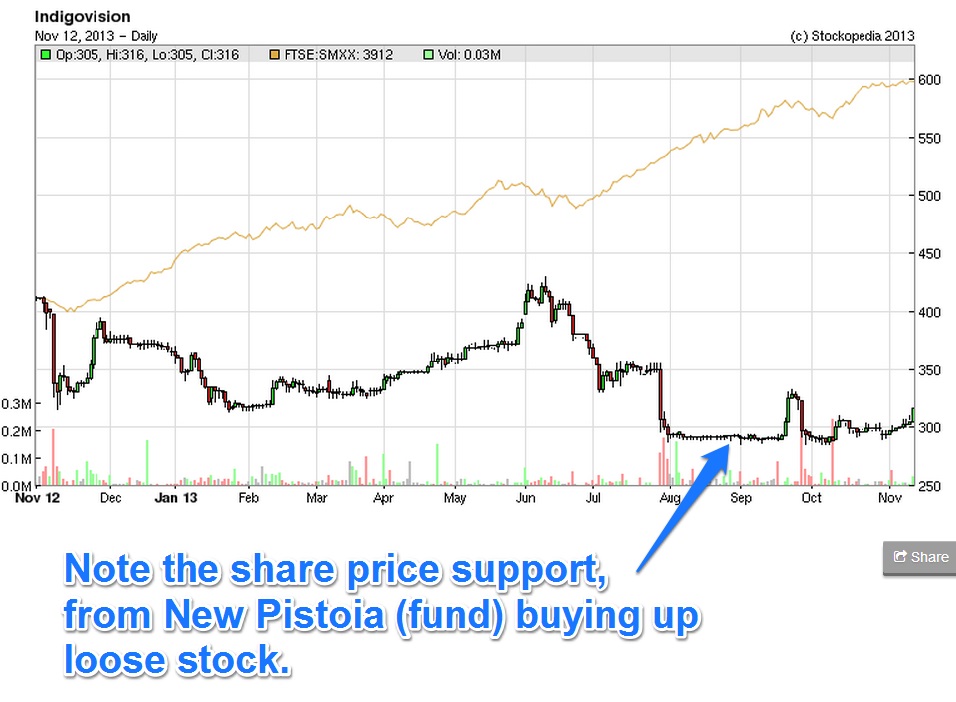
However, I am very pleased to see that the AGM trading statement issued today is a good bit more upbeat than I was expecting. Sales growth is already happening, up 14% on the comparative Q1 period, margins have held up, and the most interesting new product release is a much lower priced range of encoders. I don't think the market has understood yet that the new encoder range will open up the whole of the much larger mid-market to IndigoVision, whereas previously they have been a top end company.
So up until now, their encoder sales have been falling, and that has masked excellent growth in their newer camera ranges. As from now, we should see encoder sales begin to rise, from the new much lower cost range, which combined with strongly rising camera sales (up over a third in Q1) should generate a much more exciting trading result in a few months time. Therefore due to these factors, I am quietly hopeful that 2014 should be the year when I am finally vindicated on this share!
Here are the key parts of today's statement (my bolding);
Gross margins were similar to last year's average and, as planned, overheads rose following the increased sales and sales support headcount put in place in the second half of last year. Notwithstanding these cost increases, the combination of better sales and solid margins resulted in net operating performance for the first quarter being comfortably ahead of the corresponding period last year.
The board indicated at the time of the annual results that the benefit from last year's increase in sales resource was expected to be weighted towards the latter part of 2014 and that remains the case. However, the increased rate of sales growth in the first quarter is an encouraging start to the new financial year and gives the board confidence in delivering the progress we expect for the full reporting period."
So how does it stack up on valuation? The shares are up a surprisingly modest 4% today to 315p, which gives a valuation of just under £24m. The company has a solid Balance Sheet, with net cash - note that they gave away most of the cash pile (probably to deter predators) a while back, but should have built it back up again to c.£3m+ by now I estimate.
I'm getting conflicting information from different sources on current year forecasts, but the common figure seems to be 40.4p EPS. So if that is correct, then at 315p the share price looks to be far too low, especially considering that management have today confirmed that they are making good progress this year.
(Edit: Thank you to Martin for pointing out that the 40.4p broker forecast is actually for a 17-month period, due to the change in year-end. I didn't realise that when writing the original report here. So adjusting it for 12 months, we're probably looking at around 28p EPS if you pro-rate it for 12/17ths. That brings the PER up to 11.3, which is still pretty cheap in my opinion.
Obviously, the PER is only relevant if you have a clear idea of how earnings are likely to proceed. If you buy into the turnaround, as I do, then we could see an operationally geared uplift in EPS of potentially significant size - see what happens when you start increasing sales on a spreadsheet with 50-60% gross margins - the impact on profit from increasing sales can be spectacular once growth gets above about 20% p.a.)
On the downside, we have to be mindful that IndigoVision have repeatedly missed forecasts in the last few years, often at the last minute. E.g. for the year-ended 31 Jul 2013, management on track to hit forecasts right up until days before the year-end, when a large contract they thought was in the bag unexpectedly fell through. The highly operationally geared nature of the business (i.e. high gross margins, on large contracts) means that business is unavoidably lumpy. This has caught them out several times before, hence I think the market will treat upbeat trading statements with a considerable degree of scepticism until the figures are actually in the bag.
However, from my point of view, I've got under the bonnet of what's actually going on at the company, and have been very impressed with their turnaround strategy. It's starting to bear fruit now, so for me this is quite an exciting time, at long last. However, I fully understand other investors scepticism, given the company's disappointments in the past. I think they know that, and are just getting on with the job, and will let the figures do the talking when they come good. Hence why they don't do any financial PR for example.
OK, that's it for today. See you as usual tomorrow morning from 8 a.m.
Regards, Paul.
(of the companies mentioned today, Paul has a long position in IND)
Disclaimer
This is not financial advice. Our content is intended to be used and must be used for information and education purposes only. Please read our disclaimer and terms and conditions to understand our obligations.

15 comments
No list of corporate rebranding failures would be complete without mentioning Corus. Formed after the merger of British Steel and Hoogovens the logic was that since the new company was neither British, nor the product solely steel, it should be called something else.
For some reason it was decided to make up the completely meaningless name - Corus.
Nobody new what it stood for and when the logo replaced the iconic British Steel logo people didnt recognise it as the same business. I seem to recall there was even some problem with the preferred Corus web domian as it was already owned by a flower shop - or something or other. What a mess.
The worry with IND isn't just if they can grow turnovers but can they maintain margins ? if not how much turnover growth is needed to just stand still profit wise. Good news that they have a new range of lower cost encoders which will open up new markets. However what differentiates these low cost encoders and will they canabilise sales of the more expensive encoders ? (and what is the margin on them compared to other encoders ?)
I'm assuming like all technology this stuff is becoming more standardised, is the market able to support high margins or are there other companies offering good enough alternatives at lower prices ?
Always interesting to read your blog Paul, thanks,
K
Hi Kenobi,
Gross margins at Indigovision (LON:IND) are expected to vary between 50-60% on an ongoing basis. Mgt say they can pick & choose what margin they want, by deciding how to price deals, often in competitive tenders - so if they push too hard on margin, then sales suffer (as they will win fewer deals). So they just use their best judgement on that, but also margins vary greatly from one country to another, and from product to product. The good news though is that a lot of the new & growing products (e.g. cameras) are high margin. It's the older products, mainly the encoders, which has suffered price erosion, which they've now tackled with the new, much cheaper models.
So I think that as long as IND keep moving with product innovation, then margins should remain strong. The key thing to understand, which I meant to put in the article, but it slipped my mind, is that IND's competitive advantage is its software. So they see the hardware as being a platform for getting their advanced software into customers. I've also had third party reassurance that IND's software is still class-leading - very high picture quality, at low bandwidth, and a very easy to use, intuitive user interface. But in the past, IND have lost out because they didn't have the full range of hardware, hence their kit would be specified for only part of a system, and a camera manufacturer would grab a large slice of the deal. That should change now that IND has no more obvious gaps in its range.
My perception from meeting the company every 6 months, is that they have moved from slipping back, to coming right to the front again, viz-a-viz competitors. The lower cost encoders could transform things if they are taken up by customers in decent numbers. But we'll see. It's all about execution now, but I feel they're getting back on top of their game, after a root & branch turnaround in the last couple of years - but that message really hasn't been communicated to the Stock Market at all - which could provide a lot of excitement if the figures improve as much as I hope they might in 2014.
No guarantees of course, we'll just have to wait & see what happens.
Cheers, Paul.
Quick update: I've amended today's article to reflect that the 40.4p EPS is for 17 months. Apologies for that oversight, and thanks for flagging it up.
Regards, Paul.
The broker note available on IND's website indicates the 40.4p I'd for the 17 month period to the new year end.
Hi Paul
Oops, above post relates to IND.
On a completely separate tack, I would be interested in any thoughts you have on the HAYT H1 results today. Having thought they were up with events and sold at 61p, these results were much better than I expected so I have bought back in at 68.51p.
Regards, Martin
Paul
As somebody has just pointed out to me on ADVFN, the current revenue and profit forecasts are, in all probability, for an 18 month period taking account of the change in year end. This would certain fit in with the forecasts of a 69% increase in revenue which, given the 14% increase in Q1 sales, seems most unlikely for a 12 month period.
Given your contacts at IND perhaps you can discover whether this is indeed the case.
Best wishes, Martin
Hi Martin,
Ah, I didn't think of that! (re IND and the change of year end).
You could be right, as the current year forecast for 40p did strike me as somewhat high, when they had been forecast at around 30-33p in recent years.
I will do some digging & come back to you.
Regards, Paul.
Completely agree with comments here about re-branding here except in the case of Andersen Consulting their brand had been, if my memory serves me right. completely tarnished by Andersen Accounting and the Enron scandal and I suspect the re-brand was worth it and necessary.
Paul - thanks for your thoughts on Trifast. I quite like this company - sometimes "boring" is good! Especially like the fact that they made a video presentation to accompany these figures - http://www.brrmedia.co.uk/event/118442/partner/lse - something more companies should get used to doing.
I'm sure you would have seen the AGM Statement from Indiogovision today. It looks like that the investment in a larger sales force is starting to have a positive impact on the sales figures. Some interesting contracts also mentioned in the statement including the FIFA World Cup!
It's usually a pretty bad idea for a company to change its name anyway — particularly to an invented word. I still have no idea what the difference is between Aviva and Aveva — and I hold shares in one of them! In most circumstances it is a complete waste of company money. I work in the marketing/comms industry, and I know how many times over the years I have rubbed my hands in glee at the thought of how much I was going to earn just because a client had become bored with their name and wanted a complete rebrand. I'm not sure that shareholders have the first idea how much these exercises cost.
I was particularly annoyed recently when my SIPP manager, with the perfectly fine and logical name of Sippdeal, announced that henceforth they were to be called by the snappy SIX SYLLABLE name of "AJ Bell Youinvest". Bleeding insanity.
When the old Andersen Consulting changed its name to Accenture, the total rebranding cost is reputed to have been over US $100m, the most expensive of all times.
They still borrow your watch to tell you the time...
Re: Lo-Q/Accesso
What a terrible idea it is for a company to change its name and ticker on the same day as issuing an important trading update.
That's a very good point! Although they did pre-announce the date. But you're right, they should have waited a couple of days for the market & investors to get used to the new ticker, and then issued a trading update. Shareholders should email their broker & PR people with this point, so that word gets round & the same issue does not happen again at other companies.